|
시장보고서
상품코드
1911318
북미의 골판지 포장 시장 : 시장 점유율 분석, 업계 동향과 통계, 성장 예측(2026-2031년)North America Corrugated Packaging - Market Share Analysis, Industry Trends & Statistics, Growth Forecasts (2026 - 2031) |
||||||
 Mordor Intelligence
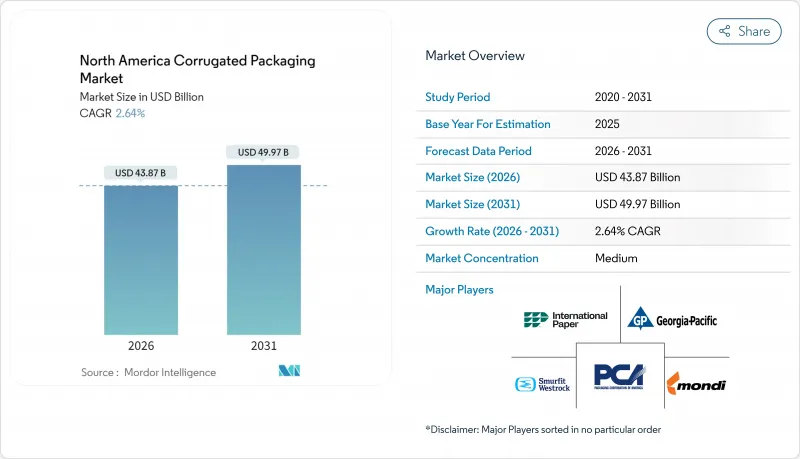
북미의 골판지 포장 시장은 2025년 427억 4,000만 달러에서 2026년에는 438억 7,000만 달러로 이를 것으로 보입니다. 2026-2031년에 걸쳐 CAGR 2.64%로 성장하여, 2031년까지 499억 7,000만 달러에 달할 전망입니다.
2024년 골판지 상자 시장 점유율에서 재활용 골판지 원판지가 49.54%를 차지하며, 기업의 지속가능성 요구사항이 신규 원료보다 재활용 원료를 선호하는 경향을 보여줍니다. 전자상거래 주문 처리량이 가장 강력한 구조적 성장 동력으로 남아있는데, 적정 규모화 추진으로 다양한 플루트 프로파일 수요가 증가하는 한편, 제조업의 근거리 생산 전환으로 상자 유통 경로가 미국 및 멕시코 생산 거점으로 가까워지고 있습니다. 반화학적 및 특수 등급이 연평균 3.65% 성장률로 가장 빠르게 성장하며, 고마진 식품 및 제약 응용 부문를 개척하는 차단 코팅 기술 투자를 반영합니다. 폐골판지 및 원목 펄프 가격 변동성으로 인한 비용 압박은 지속되나, 공장 자동화 확대와 AI 기반 수요 예측 기술이 주요 생산사의 마진 및 서비스 수준 방어에 기여합니다.
북미의 골판지 포장 시장 동향 및 인사이트
전자상거래 택배 물량 급증
전자상거래 배송은 팔레트 단위 재고 보충에서 더 강하면서도 가벼운 포장 솔루션이 필요한 소비자 직배송 소포로 수요를 전환시켰다. 아마존의 패키지 결정 엔진은 현재 연간 10억 건 이상의 치수 결정을 실행하며, 디자인이 복잡해짐에 따라 박스당 가치를 높이는 동시에 재료 사용량을 15-20% 절감합니다. 정기 구독형 상거래는 반복 주문이 골판지 제조업체의 생산량 최적화와 접착제 설정을 가능하게 하여 안정성을 더합니다. 소량이지만 빈번한 배송은 낮은 그램당 중량에서 높은 모서리 압축 강도에 대한 수요를 증대시켜, 고급 플루트 기하학적 구조를 선호하게 합니다. 자동 케이스 조립기와 포장 스테이션은 박스 공장의 ERP 시스템과 직접 연동되어 완충 재고를 축소하고 리드 타임을 단축합니다. 이러한 운영 모델 변화는 소포 증가를 고마진 SKU 확대로 전환함으로써 골판지 박스 시장을 뒷받침합니다.
재활용 가능 포장재 및 플라스틱 금지 규제로의 전환
캘리포니아 SB 54 법안은 2032년까지 일회용 플라스틱 사용을 65% 감축하도록 의무화하여, 골판지 사용을 확대하는'페이퍼화' 전략에 대한 브랜드들의 약속을 촉진하고 있습니다. 플라스틱 오염을 억제하기 위한 미국 환경보호청(EPA)의 프레임워크는 주 차원의 생산자 책임 확대 프로그램(EPR)을 조정하고 운송 재료에 재활용 소재 사용을 장려합니다. 다국적 기업들은 세계의 규격을 통일함에 따라 EU 정책 압박이 북미 포장 지침으로 확산되고 있습니다. 자체 재활용 설비를 보유한 골판지 공장은 새로운 수거 인프라를 구축해야 하는 플라스틱 가공업체 대비 비용 및 규정 준수 측면에서 우위를 점합니다. 재활용 비율을 명시한 조달 정책은 재활용 컨테이너보드 수요를 직접적으로 증가시켜, 전체 톤수 증가세가 완화되는 상황에서도 안정적인 섬유 수요를 뒷받침합니다.
OCC 및 원목 펄프 가격 변동성
2024년 골판지 폐기물 가격은 전년 대비 28% 하락했으나, 해운 차질과 제지 공장 가동 중단으로 원목 펄프 가격은 견조하게 유지되어 통합 생산 업체의 마진 압박을 가중시켰다. 패키징 코퍼레이션 오브 아메리카(PCA)는 원가 변동 상쇄를 위해 2025년 초 라이너보드 가격을 톤당 70달러 인상했으나, 가격 민감도가 높은 부문에서 수요 탄력성 위험을 초래할 수 있습니다. 재활용 섬유 공급량은 소비자 행동에 따라 변동하는 지자체 수거 효율성과 연동됩니다. 통화가치 변동은 펄프 수입이 달러로 정산되는 캐나다 조달을 복잡하게 만든다. 변동성 헤지를 위해 가공업체들은 재고 수준을 높여 운영자본을 묶어두고 투자자본수익률을 희석시켜 골판지 상자 시장 모멘텀을 약화시키고 있습니다.
부문 분석
재활용 골판지 용지는 2025년 최대 매출을 기록하며 골판지 상자 시장 점유율의 49.02%를 차지했습니다. 반화학 및 특수 등급 골판지 상자 시장 규모는 즉석 식품용 내습 라이너 수요 증가로 인해 연평균 3.50% 성장할 것으로 전망됩니다. 브랜드들은 재활용 함량 목표를 조달 평가표에 반영하여 제지 공장이 원료 공급을 확보하기 위해 재활용 시설로 역통합하도록 장려하고 있습니다. 캐스케이즈 그린팩의 2억 5,000만 달러 재융자는 재활용 경량 제품 생산을 확대하며 순환 경제 자산에 대한 대출 기관의 관심을 부각시켰습니다.
수출용 크레이트 및 중공업 엔진에 가장자리 압축 강도와 습윤 강도가 중요한 경우 버진 크라프트 라이너보드는 여전히 필수적입니다. 기름 저항성을 부여하는 특수 코팅을 통해 재활용 기판이 기존 크라프트지 주류 부문로 진출하고 있으나, 고위험 운송에서는 공급망 안정성으로 인해 여전히 신규 원료 사용이 필수적입니다. 향후 재활용 비율 규제 기준이 시장 점유율을 좌우하겠지만, 부가가치 특수 보드가 일반 등급보다 마진 기여도에서 우위를 점할 전망입니다.
단일벽 형식은 2025년 매출의 39.10%를 차지했으며, 간소화된 가공 공정과 낮은 재료비로 선호됩니다. 그러나 삼중벽 디자인은 콜드체인 네트워크 확대와 공작기계 수출 증가로 2031년까지 연평균 4.08% 성장률을 기록할 전망입니다. 삼중벽 골판지 상자 시장 규모는 다일 냉장 운송 중 찢김을 방지하는 두꺼운 보드 덕분에 부양됩니다. 단일벽 라인의 자동화는 신속한 전환을 가능케 하여 전자상거래의 변동성에 대응합니다.
인건비 상승으로 변환업체들은 수동 보조 없이도 더 무거운 삼중벽 등급을 처리할 수 있는 장비에 투자하고 있으며, 접착제 공급업체들은 라인 속도를 유지하기 위해 빠른 경화 제형을 선보이고 있습니다. 투입 비용이 높음에도 불구하고 고가 생물학적 제제 및 산업 기계와 같이 가격 민감도보다 위험 관리가 우선시되는 부문에서는 삼중벽 수요가 증가하고 있습니다. 반대로 단일벽 장비의 경량화 설계는 부피 중량과 연계된 운송 추가 요금을 완화함으로써 시장 점유율을 유지하고 있습니다.
기타 혜택 :
- 엑셀 형식 시장 예측(ME) 시트
- 애널리스트의 3개월간 지원
자주 묻는 질문
목차
제1장 서론
- 조사의 전제조건과 시장 정의
- 조사 범위
제2장 조사 방법
제3장 주요 요약
제4장 시장 상황
- 시장 개요
- 시장 성장 촉진요인
- 전자상거래 소포 취급량의 급증
- 재생 가능 포장재로의 규제 전환과 플라스틱 금지의 움직임
- 경량 고강도 마이크로 플루트 및 소재 절감
- AI 기반 적정 크기 조정 및 주문형 박스 생산
- 밀 키트 및 의약품 물류에서 콜드체인 확대
- 제조의 니어 쇼어링이 국내의 상자 수요를 밀어 올린다
- 시장 성장 억제요인
- 폐지(OCC) 및 원목 펄프 가격 변동성
- 연질 플라스틱 및 경질 플라스틱에 의한 대체품 위협
- 노동력 부족으로 인한 자동화 설비 투자 부담 증가
- 에너지 및 운송 비용 상승
- Porter's Five Forces 분석
- 구매자 협상력
- 공급기업 협상력
- 대체품 위협
- 신규 참가업체 위협
- 경쟁 기업간 경쟁 관계
- 거시경제 요인이 시장에 미치는 영향
- 업계 밸류체인 분석
제5장 시장 규모와 성장 예측
제6장 ;'판지 등급별
- 재활용 골판지
- 버진 크라프트 라이너보드
- 반화학제품 및 특수 등급
- 벽 유형별
- 단일벽
- 이중벽
- 삼중벽
- 플루트 유형별
- A-플루트
- B-플루트
- C-플루트
- E-플루트
- F/N 마이크로 플루트
- 제품 유형별
- 슬롯 박스
- 리지드 박스
- 텔레스코프 박스
- 폴더 박스
- 벌크빈 및 옥타빈
- 최종 사용자 업계별
- 가공식품
- 신선식품 및 농산물
- 음료
- 종이 제품
- 전기 및 전자 기기
- 퍼스널케어 및 화장품
- 기타 최종 사용자 산업
- 인쇄 기술별
- 플렉소 인쇄
- 디지털 인쇄
- 리소라미네이션
- 기타 인쇄 기술
- 국가별
- 미국
- 캐나다
- 멕시코
제7장 경쟁 구도
- 시장 집중도
- 전략적 동향
- 시장 점유율 분석
- 기업 프로파일
- International Paper Company
- Smurfit WestRock
- Packaging Corporation of America
- Georgia-Pacific LLC
- Mondi plc
- Pratt Industries, Inc.
- Cascades Inc.
- Sonoco Products Company
- Nine Dragons Paper(Holdings) Limited
- Oji Holdings Corporation
- Graphic Packaging Holding Company
- Stora Enso Oyj
- Nippon Paper Industries Co., Ltd.
- Orora Limited
- Rengo Co., Ltd.
- Viking Packaging, LLC
- Sealed Air Corporation
- Menasha Corporation
제8장 시장 기회와 장래의 전망
- 화이트 스페이스와 미충족 요구의 평가
The North America Corrugated Packaging Market is expected to grow from USD 42.74 billion in 2025 to USD 43.87 billion in 2026 and is forecast to reach USD 49.97 billion by 2031 at 2.64% CAGR over 2026-2031.
Recycled containerboard captures 49.54% of the corrugated boxes market share in 2024, demonstrating how corporate sustainability mandates favor recycled inputs over virgin fiber. E-commerce fulfillment remains the strongest structural driver as right-sizing initiatives heighten demand for varied flute profiles, while nearshoring of manufacturing shifts box flows closer to the United States and Mexican production hubs. Semi-chemical and specialty grades grow fastest at 3.65% CAGR, reflecting investments in barrier coatings that unlock higher margin food and pharmaceutical applications. Cost pressures persist due to volatile prices of old corrugated cardboard and virgin pulp; however, greater plant automation and AI-enabled demand forecasting help leading producers defend margins and service levels.
North America Corrugated Packaging Market Trends and Insights
Surge in E-commerce Parcel Volumes
E-commerce shipping has shifted demand from palletized replenishment to direct-to-consumer parcels that require stronger, yet lighter, packaging solutions. Amazon's Package Decision Engine now executes over 1 billion dimensional decisions a year, cutting material usage by 15-20 % while still lifting value per box as designs become more complex. Subscription commerce adds stability because recurring orders allow corrugators to optimize run lengths and glue setups. Smaller but more frequent shipments intensify demand for high edge crush strength at low grammage, favoring advanced flute geometries. Automated case erectors and pack stations tie directly into box plants' ERP systems, shrinking buffer inventories and shortening lead times. Collectively, these operating model shifts underpin the corrugated boxes market by translating parcel growth into higher-margin SKU proliferation.
Regulatory Shift toward Recyclable Packaging and Plastic Bans
California's SB 54 mandates a 65% cut in single-use plastic by 2032, catalyzing brand commitments to "paperization" strategies that amplify corrugated uptake. The United States EPA framework to curb plastic pollution aligns state-level extended producer responsibility programs and incentivizes post-consumer content in shipping materials. Multinational firms harmonize global specifications, so EU policy pressure spills into North American packaging briefs. Corrugated plants with in-house recycling assets gain cost and compliance advantages over plastic converters that must retrofit new collection infrastructures. Procurement policies specifying recycled percentages directly elevate demand for recycled containerboard, supporting stable fiber demand even as overall tonnage growth moderates.
Volatility in OCC and Virgin Pulp Prices
Old corrugated cardboard values fell 28% year-over-year in 2024, yet virgin pulp held firm due to shipping disruptions and mill downtime, squeezing integrated producers' spreads. Packaging Corporation of America lifted linerboard prices by USD 70 per ton in early 2025 to offset cost swings, but the increases risk demand elasticity in the price-sensitive segment. Recycled fiber availability correlates with municipal collection efficiency, which fluctuates with consumer behavior. Currency shifts complicate Canadian sourcing as pulp imports settle in U.S. dollars. To hedge volatility, converters carry higher stock levels, tying up working capital and diluting return on invested capital, thereby tempering the corrugated boxes market momentum.
Other drivers and restraints analyzed in the detailed report include:
- Lightweight High-Strength Micro-Flutes and Material Savings
- AI-Enabled Right-Sizing and On-Demand Box Production
- Substitution Threat from Flexible and Rigid Plastics
For complete list of drivers and restraints, kindly check the Table Of Contents.
Segment Analysis
Recycled containerboard generated the largest 2025 revenue, commanding 49.02% of the corrugated boxes market share. The corrugated boxes market size for semi-chemical and specialty grades is projected to climb at a 3.50% CAGR owing to rising demand for moisture-resistant liners in ready-to-eat meals. Brands embed recycled-content targets into procurement scorecards, encouraging mills to back-integrate into material recovery facilities to secure fiber streams. The Cascades Greenpac refinance of USD 250 million widens recycled lightweight output and highlights lender appetite for circular-economy assets.
Virgin Kraft linerboard remains indispensable where edge crush strength and wet strength matter for export crates and heavy industrial engines. Specialty coatings that add grease resistance let recycled substrates encroach on formerly kraft-dominated applications, but supply chain reliability still dictates virgin usage in high-risk shipments. In the future, regulatory thresholds around recycled percentages will anchor market share, though value-added specialty boards will outpace commodity grades in margin contribution.
Single-wall formats accounted for 39.10% of sales in 2025, favored for streamlined converting and lower material costs. Triple-wall designs, however, are set for a 4.08% CAGR through 2031 as cold-chain networks scale and machine tool exports rise. The corrugated boxes market size for triple-wall is buoyed by thicker boards that resist puncture during multi-day reefer hauls. Automation on single-wall lines allows rapid changeovers, meeting e-commerce variability.
Raised labor costs push converters to invest in equipment that can handle heavier triple-wall grades without manual assists, and adhesive vendors respond with fast-set formulations to maintain line speeds. Despite higher input costs, triple-wall demand grows where risk management outweighs price sensitivity, such as high-value biologics and industrial machinery. Conversely, lightweight programming on single-wall units sustains share by mitigating freight surcharges linked to dimensional weight.
The North America Corrugated Packaging Market Report is Segmented by Board Grade (Recycled Containerboard, and More), Wall Type (Single Wall, Double Wall, and Triple Wall), Flute Type (A-Flute, B-Flute, and More), Product Type (Slotted Boxes, and More), End-User Industry (Processed Foods, and More), Printing Technology (Flexographic Printing, and More), and Country. The Market Forecasts are Provided in Terms of Value (USD).
List of Companies Covered in this Report:
- International Paper Company
- Smurfit WestRock
- Packaging Corporation of America
- Georgia-Pacific LLC
- Mondi plc
- Pratt Industries, Inc.
- Cascades Inc.
- Sonoco Products Company
- Nine Dragons Paper (Holdings) Limited
- Oji Holdings Corporation
- Graphic Packaging Holding Company
- Stora Enso Oyj
- Nippon Paper Industries Co., Ltd.
- Orora Limited
- Rengo Co., Ltd.
- Viking Packaging, LLC
- Sealed Air Corporation
- Menasha Corporation
Additional Benefits:
- The market estimate (ME) sheet in Excel format
- 3 months of analyst support
TABLE OF CONTENTS
1 INTRODUCTION
- 1.1 Study Assumptions and Market Definition
- 1.2 Scope of the Study
2 RESEARCH METHODOLOGY
3 EXECUTIVE SUMMARY
4 MARKET LANDSCAPE
- 4.1 Market Overview
- 4.2 Market Drivers
- 4.2.1 Surge in E-commerce Parcel Volumes
- 4.2.2 Regulatory Shift toward Recyclable Packaging and Plastic Bans
- 4.2.3 Lightweight High-Strength Micro-Flutes and Material Savings
- 4.2.4 AI-Enabled Right-Sizing and On-Demand Box Production
- 4.2.5 Cold-Chain Expansion for Meal-Kit and Pharma Logistics
- 4.2.6 Nearshoring of Manufacturing Boosting Domestic Box Demand
- 4.3 Market Restraints
- 4.3.1 Volatility in OCC and Virgin Pulp Prices
- 4.3.2 Substitution Threat from Flexible and Rigid Plastics
- 4.3.3 Labor Shortages Driving Automation Capex Burden
- 4.3.4 Rising Energy and Transportation Costs
- 4.4 Porter's Five Forces Analysis
- 4.4.1 Bargaining Power of Buyers
- 4.4.2 Bargaining Power of Suppliers
- 4.4.3 Threat of Substitutes
- 4.4.4 Threat of New Entrants
- 4.4.5 Intensity of Competitive Rivalry
- 4.5 The Impact Of Macroeconomic Factors On The Market
- 4.6 Industry Value Chain Analysis
5 MARKET SIZE AND GROWTH FORECASTS (VALUE)
6 ;'By Board Grade
- 6.1 Recycled Containerboard
- 6.1.1 Virgin Kraft Linerboard
- 6.1.2 Semi-Chemical and Specialty Grades
- 6.2 By Wall Type
- 6.2.1 Single Wall
- 6.2.2 Double Wall
- 6.2.3 Triple Wall
- 6.3 By Flute Type
- 6.3.1 A-Flute
- 6.3.2 B-Flute
- 6.3.3 C-Flute
- 6.3.4 E-Flute
- 6.3.5 F/N Microflute
- 6.4 By Product Type
- 6.4.1 Slotted Boxes
- 6.4.2 Rigid Boxes
- 6.4.3 Telescope Boxes
- 6.4.4 Folder Boxes
- 6.4.5 Bulk Bins and Octabins
- 6.5 By End-user Industry
- 6.5.1 Processed Foods
- 6.5.2 Fresh Food and Produce
- 6.5.3 Beverages
- 6.5.4 Paper Products
- 6.5.5 Electrical and Electronics
- 6.5.6 Personal Care and Cosmetics
- 6.5.7 Other End-user Industries
- 6.6 By Printing Technology
- 6.6.1 Flexographic Printing
- 6.6.2 Digital Printing
- 6.6.3 Litho-lamination
- 6.6.4 Other Printing Technologies
- 6.7 By Country
- 6.7.1 United States
- 6.7.2 Canada
- 6.7.3 Mexico
7 COMPETITIVE LANDSCAPE
- 7.1 Market Concentration
- 7.2 Strategic Moves
- 7.3 Market Share Analysis
- 7.4 Company Profiles (includes Global Level Overview, Market Level Overview, Core Segments, Financials as available, Strategic Information, Market Rank/Share for key companies, Products and Services, and Recent Developments)
- 7.4.1 International Paper Company
- 7.4.2 Smurfit WestRock
- 7.4.3 Packaging Corporation of America
- 7.4.4 Georgia-Pacific LLC
- 7.4.5 Mondi plc
- 7.4.6 Pratt Industries, Inc.
- 7.4.7 Cascades Inc.
- 7.4.8 Sonoco Products Company
- 7.4.9 Nine Dragons Paper (Holdings) Limited
- 7.4.10 Oji Holdings Corporation
- 7.4.11 Graphic Packaging Holding Company
- 7.4.12 Stora Enso Oyj
- 7.4.13 Nippon Paper Industries Co., Ltd.
- 7.4.14 Orora Limited
- 7.4.15 Rengo Co., Ltd.
- 7.4.16 Viking Packaging, LLC
- 7.4.17 Sealed Air Corporation
- 7.4.18 Menasha Corporation
8 MARKET OPPORTUNITIES AND FUTURE OUTLOOK
- 8.1 White-space and Unmet-need Assessment