|
시장보고서
상품코드
1911370
프랑스의 시설 관리(FM) 시장 : 점유율 분석, 업계 동향 및 통계, 성장 예측(2026-2031년)France Facility Management - Market Share Analysis, Industry Trends & Statistics, Growth Forecasts (2026 - 2031) |
||||||
 Mordor Intelligence
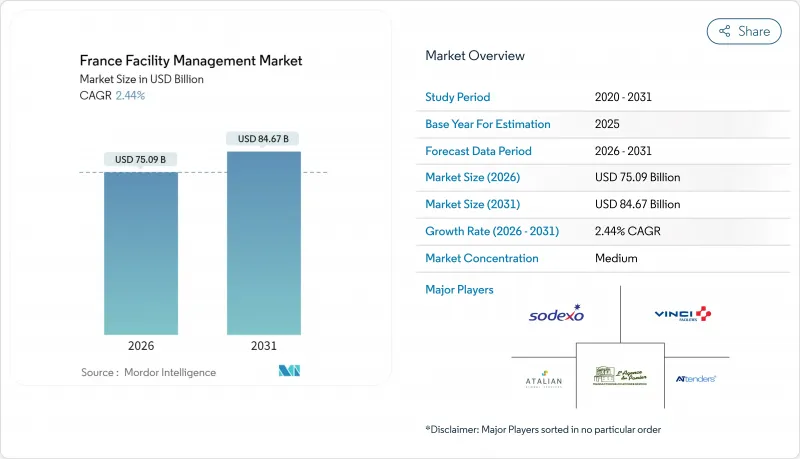
프랑스의 시설 관리(FM) 시장은 2025년 733억 달러로 평가되었으며, 2026년 750억 9,000만 달러에서 2031년까지 846억 7,000만 달러에 이를 것으로 예측됩니다.
예측기간(2026-2031년)의 CAGR은 2.44%로 예상됩니다.
에너지 효율화 규제의 강화, 건축 시스템의 급속한 디지털화, 개보수 공사에 대한 정부의 지원책이 완만하면서도 견조한 확대를 뒷받침하고 있습니다. 수요는 공급자의 보상을 탈탄소화 및 운영 성과 지표와 연동시키는 스마트 성과 기반 계약에 집중하고 있습니다. 기업이 공급업체 기반을 합리화하는 가운데 하드와 소프트를 통합한 서비스 패키징이 주목을 받고 있는 한편, 지속적인 노동력 부족이 공급자를 자동화, 원격 모니터링, 상태 기반 유지보수로 이동시키고 있습니다. 세계 대기업이 비핵심 포트폴리오를 매각하고 국내 유력기업이 규모 확대를 도모하는 가운데 경쟁은 격화되고 있습니다. 동시에 중견 전문 기업은 IoT를 활용한 예측 서비스, 신재생에너지 기술, ESG 컴플라이언스 지원을 통해 차별화를 도모하고 있습니다.
프랑스의 시설 관리 시장의 동향 및 인사이트
건물 관리 시스템의 기술적 진보
IoT 센서, 모바일 CMMS 플랫폼 및 AI 구동 분석의 광범위한 도입으로 건물 모니터링, 유지보수 및 최적화 기법이 변화하고 있습니다. 프랑스 사업자는 이미 42,000개소의 EV 충전 포인트를 관리하고 있으며, 디지털 트윈과 예측 분석의 조합으로 HVAC 에너지 소비량을 15-20% 줄이고 있습니다. Schneider Electric의 EcoStruxure(TM) Resource Advisor는 2030년까지 3차 산업 자산의 에너지 소비를 40% 절감하는 의무를 준수하는 실시간 탄소 추적을 가능하게 합니다. 조기 도입 기업은 다운타임 감소, 장애 해결 가속화, 검증 가능한 지속가능성 지표를 획득하여 기술 투자가 지연된 공급업체의 경쟁 기준을 높였습니다. 이 추세는 또한 알고리즘이 서비스 수준과 에너지 절약 보장을 검증하는 결과 기반 가격 설정을 촉진합니다.
부동산 부문의 성장
상업 부동산에 대한 자금 유입액은 2025년 1분기에 34억 유로에 달하고, 이는 전년 동기 대비 67% 증가했습니다. 사무실 단독으로도 14억 유로를 조달하고 있습니다. 그랑 파리 구상에 의한 메가 프로젝트는 사무실, 상업시설, 데이터센터, 교통 허브 등 신규 공급을 지속적으로 창출하고 있으며, 이들은 가동 개시부터 턴키 방식의 시설 서비스가 요구됩니다. 신축 건물에는 퍼포먼스 대시보드를 포함한 그린 리스 조항이 주로 포함되어 설계, 건설 및 운용 단계를 통한 시설 관리에 대한 관여가 확보되고 있습니다. 동시에 노후화된 기존의 건물은 규제에 의한 개보수 기한에 직면하고 있으며, 통합형 FM 계약을 통해 제공되는 기계설비, 전기설비, 외장 업그레이드에 대한 수요를 더욱 높이고 있습니다.
노동 시장 억제와 기능 부족
프랑스 노동부의 보고에 의하면, 2025년에도 FM 인재 도입 프로젝트의 절반은 어려운 상황이 지속되었으며, IoT 플랫폼, BMS 분석, 에너지 감사 프로토콜에 정통한 기술자의 심각한 부족이 부각되었습니다. 공급자는 스킬업 아카데미, 증강현실(AR) 작업 지시, 로보틱스를 도입하여 인력 부족을 완화하고 있지만 임금 상승은 이익률을 압박하고 있습니다. 고객의 24시간 365일 가동에 대한 기대는 인력 배치 모델을 더욱 복잡하게 하고 자동화된 원격 모니터링의 가치를 높이고 있습니다. 전문적인 시운전과 컴플라이언스 전문 지식이 필요한 프로젝트에서는 인력 부족이 지속됨에 따라 성장이 둔화될 수 있습니다.
부문 분석
하드 서비스는 2025년 프랑스의 시설 관리 시장에서 61.74%의 점유율을 차지했습니다. 이는 강화되는 에너지 강도 기준을 충족시키기 위해 필요한 MEP(기계, 전기 및 배관)과 HVAC(냉난방 공조) 기능이 견인한 것입니다. 본 부문은 2025년 시행되어 67억 유로 규모의 '회복력 강화 기금' 지출과 공조 시스템의 갱신을 의무화하는 노동 안전 제도로부터 직접적인 혜택을 받고 있습니다. 방화 안전 규정 준수는 여전히 필수 요건이며 이는 거시경제의 둔화 시에도 안정적인 수요를 보장합니다. 시설 관리의 하드 서비스는 예측 분석을 통한 상태 기반 유지보수 체제로의 전환에 따라 도입이 증가하고 있으며, 센서 업그레이드 및 자산 수명 연장 조사에 대한 지출이 증가하고 있습니다. 한편, 규모는 작지만 소프트 서비스는 2031년까지 연평균 복합 성장률(CAGR) 2.59%로 성장할 것으로 예상되며 이는 직장 환경이 건강 및 호스피탈리티 브랜드 체험 중시로 이행하고 있는 것을 반영하고 있습니다. 소덱소사의 2024년도 데이터에서는 푸드서비스가 5.7% 성장한 반면, 기존 FM은 2.4%의 성장에 그쳤으며, 범용화된 청소에서 사용자 체험 중심 서비스로의 비중 변화가 부각되고 있습니다. 소프트 서비스의 성장은 방문자 관리와 실내 공기질 대시보드를 통합하는 스마트 빌딩 앱으로 더욱 가속화되어 FM을 보다 광범위한 직원 참여 전략에 통합하고 있습니다.
하드 서비스는 2031년까지 프랑스의 시설 관리 시장에서 가장 큰 공헌 부문이 될 전망이나 기업이 직장 체험을 인재 획득이나 ESG 브랜딩의 수단으로 파악함에 따라 소프트 서비스와의 차이는 서서히 줄어들 전망입니다. 프로바이더는 청소 로봇과 AI 구동형 에너지 절약 기술을 융합시켜 통합 대시보드에 웰니스 분석 기능을 통합함으로써 크로스셀링 시너지 효과를 획득하고 있습니다. 결과적으로 차별화는 자본 집약적인 기술적 유지보수와 디지털 기반의 워크플로를 통해 제공되는 민첩하고 사람 중심인 접점의 균형에 달려 있습니다.
기타 혜택
- 시장 예측(ME) 엑셀 시트
- 3개월 애널리스트 서포트
자주 묻는 질문
목차
제1장 서론
- 조사 전제조건 및 시장 정의
- 조사 범위
제2장 조사 방법
제3장 주요 요약
제4장 시장 상황
- 시장 개요
- 주요 상업 부동산 부문의 현재 가동률
- 주요 FM 공급자의 수익성 벤치마크
- 노동력 지표 - 노동 참여율과 기능 보유 상황
- 서비스 유형별 시설 관리 시장의 점유율(%)
- 하드 FM 서비스별 시설 관리 시장의 점유율(%)
- 소프트 FM 서비스별 시설 관리 시장의 점유율(%)
- 주요 도시권(파리, 리옹, 마르세유, 릴, 툴루즈)에서의 도시화와 인구 증가
- 프랑스 국가 인프라 계획의 부문별 투자 우선순위
- 노동 기준 및 안전 기준에 관한 규제상의 촉진요인
- 촉진요인
- 빌딩 관리 시스템의 기술적 진보
- 부동산 부문의 성장
- 그린 빌딩 실천에 대한 중시 고조
- 소프트 FM 서비스에 대한 수요 증가
- 통합형 시설관리(IFM) 계약의 도입 증가
- 기존 건물의 에너지 절약형 개보수에 대한 정부의 장려책
- 억제요인
- 노동 시장의 억제와 기능 부족
- 경제 변동과 인플레이션 압력
- 시장의 세분화로 인한 규모의 경제 제한
- 공공 부문 계약의 복잡한 입찰 프로세스
- 밸류체인 분석
- PESTEL 분석
- 신규 참가 기업용 규제 및 법적 틀
- 거시경제지표가 FM 수요에 미치는 영향
- Porter's Five Forces
- 공급자의 협상력
- 구매자의 협상력
- 신규 참가업체의 위협
- 대체품의 위협
- 경쟁 기업 간 경쟁 관계
- 투자 및 자금 조달 분석
제5장 시장 규모 및 성장 예측
- 서비스 유형별
- 하드 서비스
- 자산 관리
- MEP 및 HVAC 서비스
- 소방 시스템 및 안전 대책
- 기타 하드 FM 서비스
- 소프트 서비스
- 사무실 지원 및 보안
- 청소 서비스
- 케이터링 서비스
- 기타 소프트 FM 서비스
- 하드 서비스
- 제공 형태별
- 사내 관리
- 외부 위탁
- 단체 FM
- 패키지형 FM 서비스
- 통합형 FM
- 최종 사용자 산업별
- 상업(IT 및 통신, 소매 및 창고)
- 접객(호텔, 음식점, 레스토랑)
- 공공 및 인프라(정부, 교육, 운수)
- 의료(공공 및 민간 시설)
- 산업 공정(제조업, 에너지, 광업)
- 기타 최종 사용자 산업(공동주택, 엔터테인먼트, 스포츠 레저)
제6장 경쟁 구도
- 시장 집중도
- 전략적 동향
- 시장 점유율 분석
- 기업 프로파일
- Sodexo Group
- VINCI Facilities
- Atalian Group
- ONET SA
- Veolia Environnement SA
- ISS World Services A/S
- Equans
- SPIE Facilities
- Samsic Facility
- Elis SA
- DEF Network
- Bouygues Energies and Services
- Derichebourg Multiservices
- CBRE GWS France
- ENGIE Solutions
- Seris Group
- Dalkia
- Axima
제7장 시장 기회 및 미래 전망
CSM 26.02.04The France facility management market was valued at USD 73.30 billion in 2025 and estimated to grow from USD 75.09 billion in 2026 to reach USD 84.67 billion by 2031, at a CAGR of 2.44% during the forecast period (2026-2031).
Heightened energy-efficiency mandates, the rapid digitalization of building systems, and government stimulus for retrofits underpin this moderate yet resilient expansion. Demand is concentrating around smart, outcome-based contracts that link provider remuneration to decarbonization and operational performance metrics. Integrated hard-and-soft service bundles are gaining traction as enterprises streamline supplier bases, while persistent labor shortages push providers toward automation, remote monitoring, and condition-based maintenance. Competitive intensity is rising as global majors divest non-core portfolios and domestic champions acquire scale; simultaneously, midsize specialists differentiate through IoT-enabled predictive services, renewable-energy know-how, and ESG-compliance support.
France Facility Management Market Trends and Insights
Technological Advancements in Building Management Systems
Widespread deployment of IoT sensors, mobile CMMS platforms, and AI-driven analytics is transforming how buildings are monitored, maintained, and optimized. French operators already manage 42,000 EV charging points, and digital twins combined with predictive analytics are cutting HVAC energy consumption by 15-20%. Schneider Electric's EcoStruxure(TM) Resource Advisor enables real-time carbon tracking that aligns with the 40% energy-reduction mandate for tertiary assets by 2030. Early adopters gain lower downtime, faster fault resolution, and verifiable sustainability metrics, raising competitive thresholds for providers lagging on tech investment. The trend also encourages outcome-based pricing, where algorithms verify service levels and energy-savings guarantees.
Growth of the Real Estate Sector
Commercial real-estate inflows reached EUR 3.4 billion in Q1 2025, up 67% year-on-year, with offices alone attracting EUR 1.4 billion. Mega-projects under the Grand Paris banner continue to create fresh inventories of offices, retail precincts, data centers, and transit hubs requiring turnkey facility services from day one. New-build assets frequently include green-lease clauses that embed performance dashboards, thereby ensuring facility-management engagement across design, construction, and operational phases. Simultaneously, aging stock faces regulatory retrofit deadlines, further lifting demand for mechanical, electrical, and envelope upgrades delivered through integrated FM contracts.
Labor Market Constraints and Skills Shortage
Half of all FM recruitment projects remained difficult in 2025 according to France Travail, underscoring acute scarcity of technicians competent in IoT platforms, BMS analytics, and energy-audit protocols. Providers deploy upskilling academies, augmented-reality work instructions, and robotics to ease manpower strain, yet wage inflation compresses margins. Client expectations around 24/7 uptime further complicate staffing models, amplifying the value of automated remote supervision. Continued shortages may cap growth for projects requiring specialized commissioning and compliance expertise.
Other drivers and restraints analyzed in the detailed report include:
- Increasing Emphasis on Green Building Practices
- Rising Adoption of Integrated Facilities Management Contracts
- Economic Fluctuations and Inflationary Pressures
For complete list of drivers and restraints, kindly check the Table Of Contents.
Segment Analysis
Hard Services delivered 61.74% of France facility management market revenue in 2025, led by MEP and HVAC functions required to meet tightening energy-intensity benchmarks. The segment benefits directly from the EUR 6.7 billion Recovery and Resilience outlay and from impending 2025 worker-safety rules that mandate upgraded ventilation and cooling systems. Fire-safety compliance remains non-discretionary, ensuring steady demand even during macro-slowdowns. Asset-management sub-services show rising adoption as predictive analytics push maintenance toward condition-based regimes, increasing spend on sensor retrofits and asset-life-extension studies. In contrast, Soft Services, while smaller, are the growth pacesetter at a 2.59% CAGR to 2031, reflecting a workplace shift toward health, hospitality, and brand-experience outcomes. Sodexo's FY 2024 data show food services progressing 5.7% versus 2.4% for traditional FM, highlighting a re-weighting from commodity cleaning to user-experience-centric offerings. Soft-service growth is further propelled by smart-building apps that integrate visitor management with indoor-air-quality dashboards, weaving FM into broader employee-engagement agendas.
Hard Services will remain the largest contributor to France facility management market size through 2031, yet Soft Services will progressively narrow the gap as enterprises view workplace experience as a lever for talent attraction and ESG branding. Providers capture cross-selling synergies by merging cleaning robotics with AI-driven energy shedding and by embedding wellness analytics in integrated dashboards. As a result, differentiation hinges on balancing capital-intensive technical maintenance with agile, people-focused touchpoints delivered through digitally-rich workflows.
The France Facility Management Market Report is Segmented by Service Type (Hard Services, and Soft Services), Offering Type (In-House, and Outsourced), End-User Industry (Commercial, Hospitality, Institutional and Public Infrastructure, Healthcare, Industrial and Process, and Other End-User Industries), and Geography. The Market Forecasts are Provided in Terms of Value (USD).
List of Companies Covered in this Report:
- Sodexo Group
- VINCI Facilities
- Atalian Group
- ONET S.A.
- Veolia Environnement S.A.
- ISS World Services A/S
- Equans
- SPIE Facilities
- Samsic Facility
- Elis S.A.
- DEF Network
- Bouygues Energies and Services
- Derichebourg Multiservices
- CBRE GWS France
- ENGIE Solutions
- Seris Group
- Dalkia
- Axima
Additional Benefits:
- The market estimate (ME) sheet in Excel format
- 3 months of analyst support
TABLE OF CONTENTS
1 INTRODUCTION
- 1.1 Study Assumptions and Market Definition
- 1.2 Scope of the Study
2 RESEARCH METHODOLOGY
3 EXECUTIVE SUMMARY
4 MARKET LANDSCAPE
- 4.1 Market Overview
- 4.1.1 Current Occupancy Rates in Key Commercial Real Estate Segments
- 4.1.2 Profitability Benchmarks of Major FM Providers
- 4.1.3 Workforce Indicators - Labour Participation and Skill Availability
- 4.1.4 Facility Management Market Share (%) by Service Type
- 4.1.5 Facility Management Market Share (%) by Hard FM Services
- 4.1.6 Facility Management Market Share (%) by Soft FM Services
- 4.1.7 Urbanisation and Population Growth in Top Metros (Paris, Lyon, Marseille, Lille, Toulouse)
- 4.1.8 Sector Investment Priorities in France's National Infrastructure Pipeline
- 4.1.9 Regulatory Drivers Specific to Labour and Safety Standards
- 4.2 Drivers
- 4.2.1 Technological Advancements in Building Management Systems
- 4.2.2 Growth of the Real Estate Sector
- 4.2.3 Increasing Emphasis on Green Building Practices
- 4.2.4 Growing Demand for Soft FM Practices
- 4.2.5 Rising Adoption of Integrated Facilities Management (IFM) Contracts
- 4.2.6 Government Incentives for Energy-Efficiency Retrofits in Existing Buildings
- 4.3 Restraints
- 4.3.1 Labor Market Constraints and Skills Shortage
- 4.3.2 Economic Fluctuations and Inflationary Pressures
- 4.3.3 High Market Fragmentation Limiting Economies of Scale
- 4.3.4 Complex Tendering Processes in Public Sector Contracts
- 4.4 Value Chain Analysis
- 4.5 PESTEL Analysis
- 4.6 Regulatory and Legislative Framework for Market Entrants
- 4.7 Impact of Macroeconomic Indicators on FM Demand
- 4.8 Porter's Five Forces
- 4.8.1 Bargaining Power of Suppliers
- 4.8.2 Bargaining Power of Buyers
- 4.8.3 Threat of New Entrants
- 4.8.4 Threat of Substitute Services
- 4.8.5 Intensity of Competitive Rivalry
- 4.9 Investment and Funding Analysis
5 MARKET SIZE AND GROWTH FORECASTS (VALUE)
- 5.1 By Service Type
- 5.1.1 Hard Services
- 5.1.1.1 Asset Management
- 5.1.1.2 MEP and HVAC Services
- 5.1.1.3 Fire Systems and Safety
- 5.1.1.4 Other Hard FM Services
- 5.1.2 Soft Services
- 5.1.2.1 Office Support and Security
- 5.1.2.2 Cleaning Services
- 5.1.2.3 Catering Services
- 5.1.2.4 Other Soft FM Services
- 5.1.1 Hard Services
- 5.2 By Offering Type
- 5.2.1 In-house
- 5.2.2 Outsourced
- 5.2.2.1 Single FM
- 5.2.2.2 Bundled FM
- 5.2.2.3 Integrated FM
- 5.3 By End-user Industry
- 5.3.1 Commercial (IT and Telecom, Retail and Warehousing)
- 5.3.2 Hospitality (Hotels, Eateries, Restaurants)
- 5.3.3 Institutional and Public Infrastructure (Govt, Education, Transport)
- 5.3.4 Healthcare (Public and Private Facilities)
- 5.3.5 Industrial and Process (Manufacturing, Energy, Mining)
- 5.3.6 Other End-user Industries (Multi-housing, Entertainment, Sports and Leisure)
6 COMPETITIVE LANDSCAPE
- 6.1 Market Concentration
- 6.2 Strategic Moves
- 6.3 Market Share Analysis
- 6.4 Company Profiles (includes Global level Overview, Market level overview, Core Segments, Financials as available, Strategic Information, Market Rank/Share for key companies, Products and Services, and Recent Developments)
- 6.4.1 Sodexo Group
- 6.4.2 VINCI Facilities
- 6.4.3 Atalian Group
- 6.4.4 ONET S.A.
- 6.4.5 Veolia Environnement S.A.
- 6.4.6 ISS World Services A/S
- 6.4.7 Equans
- 6.4.8 SPIE Facilities
- 6.4.9 Samsic Facility
- 6.4.10 Elis S.A.
- 6.4.11 DEF Network
- 6.4.12 Bouygues Energies and Services
- 6.4.13 Derichebourg Multiservices
- 6.4.14 CBRE GWS France
- 6.4.15 ENGIE Solutions
- 6.4.16 Seris Group
- 6.4.17 Dalkia
- 6.4.18 Axima
7 MARKET OPPORTUNITIES AND FUTURE OUTLOOK
- 7.1 White-space and Unmet-Need Assessment
- 7.2 Technology-led Integrated FM (IoT, BMS, AI-based Predictive Maintenance)
- 7.3 ESG-Compliant FM Solutions Demand
- 7.4 Future Service-Model Shifts (Outcome-Based Contracts)
- 7.5 Data-Driven Energy Optimisation and Carbon Reporting Services