|
시장보고서
상품코드
1911823
RISC-V 기술 시장 : 점유율 분석, 업계 동향, 통계, 성장 예측(2026-2031년)RISC-V Tech - Market Share Analysis, Industry Trends & Statistics, Growth Forecasts (2026 - 2031) |
||||||
 Mordor Intelligence
RISC-V 기술 시장은 2025년 13억 5,000만 달러로 평가되었으며, 2026년 19억 1,000만 달러에서 2031년까지 107억 달러에 이를 것으로 예측됩니다. 예측기간(2026-2031년)의 CAGR은 41.21%를 나타낼 전망입니다.

성장의 원동력은 아시아태평양의 2024년에 45.8%의 주도적 지위로 예측되는 65.2%의 연평균 복합 성장률(CAGR), 64비트 코어의 2024년에 42.4%의 지배적 점유율, 그리고 소비자용 전자기기, 자동차, IoT, 데이터센터 분야에서 채택 가속에 있습니다. 커스터마이즈 가능한 오픈 스탠다드 IP, 미국·유럽연합·중국에서의 자국 반도체 프로그램, 확대하는 검증 에코시스템이 설계 채택을 촉진해, 시장 투입까지의 시간을 단축하는 것과 동시에, RISC-V 기술 시장에 신규 참가자를 매료하고 있습니다. 그러나, 단편화된 ISA 확장에 의한 소프트웨어의 복잡성, ARM과 비교한 한정된 후방 호환성, 성숙 노드에서의 고급 EDA 인력의 부족은 채택의 기세를 둔화시킬 가능성이 있는 중대한 역풍으로 남아 있습니다.
IoT 분야의 비용 중심 설계 요건은 각국의 반도체 자급정책과 함께 RISC-V 기술 시장 전체에서 수직 통합 기업과 지역 챔피언 기업에 전략적 기회를 창출하고 있습니다. 128비트 코어의 조기 상용화, ISO 26262 및 ISO/SAE 21434 인증된 IP의 등장, RVA23 프로파일을 통한 툴체인 표준화의 진전은 고성능 컴퓨팅, 자동차, 산업 자동화 분야에 대한 지속적인 확장성을 시사하고 있습니다. 오픈 하드웨어의 스타트업 기업에 대한 투자 의욕이 높아지고, 특허를 공유하는 연합과 IP 벤더와 EDA 공급자를 연계시키는 노력이 진입 장벽을 더욱 저감시켜, 보다 통합된 소프트웨어 하드웨어 스택에의 수렴을 가속화하고 있습니다.
세계 RISC-V 기술 시장 동향과 인사이트
AI/ML 중심 에지 워크로드의 급속한 보급
에지 AI의 도입 확대에 따라 대기 시간과 에너지 소비를 조정할 수 있는 모듈식 프로세서에 대한 수요가 높아지고 있으며, RISC-V 기술 시장은 카메라, 산업용 센서, 자동차 시스템의 신경망 추론을 가속화하는 벡터 확장 기능을 통해 이러한 전환을 활용하는 데 성공하고 있습니다. 중국이 자국 개발의 AI칩을 목표로 하는 반도체 프로그램을 추진하고 있는 것으로, 이 우위성이 한층 더 강해지고, 서양의 수출 규제에 대한 취약성이 최소화되고 있습니다. 이 개방형 표준의 유연성은 IP 벤더, 툴체인 개발자, 인증기관으로 구성된 네트워크를 형성하고, 특정 분야를 위한 컴퓨팅 설계 사이클을 단축하고, 자동차 안전 및 공장 자동화에 있어서 새로운 도입 모델의 실현에 기여하고 있습니다.
소프트웨어 툴체인의 성숙도가 Tier 1 OEM을 유치합니다.
GCC, LLVM, RVA23 프로파일에 대한 무결성 강화는 통합된 툴체인과 강력한 Java/Python 런타임을 제공하여 RISC-V 기술 시장에 대한 신뢰를 높이고 있습니다. 인텔, 구글, 엔비디아 등 주요 지원 기업이 코드를 업스트림에 제공함으로써 전환 비용이 절감되고, Tier 1 OEM 제조업체는 단일 개발 워크플로우로 여러 성능 수준에 대응 가능하게 되었습니다. 소프트웨어 안정성이 향상됨에 따라 광범위한 개발자와 ISV가 클라우드, 에지 및 임베디드 스택을 이식하기 시작했으며, RISC-V 기술 시장은 기업 및 소비자 부문으로의 침투를 더욱 추진하고 있습니다.
단편화된 ISA 확장이 소프트웨어 복잡성을 증가시킵니다.
RISC-V 사양이 사용자 정의 확장을 허용하기 때문에 수십 개공급업체가 자체 조정을 도입하여 바이너리 이식성과 지속적인 통합 파이프라인을 복잡하게 합니다. RVA23 프로파일이 필수 AI/ML 기능을 규정하고 있는 한편, 옵션 요소는 여전히 다수 존재하고 OS 벤더는 복수의 커널과 툴 체인의 바리에이션을 유지할 필요가 없습니다. 기업 CIO는 이러한 이유로 ARM 기반 로드맵을 병렬로 유지하며 RISC-V 기술 시장으로의 완전한 전환을 늦추고 있습니다.
부문 분석
2025년 현재 64비트 설계는 RISC-V 기술 시장 점유율의 41.85%를 차지했으며, 이 시장 규모에서 가장 큰 비율이 되었습니다. 반도체 제조업체가 64비트 코어를 선호하는 이유는 주류 리눅스 배포판, 크롬북 펌웨어, 컨테이너화된 클라우드 소프트웨어가 이미 이들을 지원하기 때문이며, 설계자는 대규모 재설계 없이 대중 시장에서 수익을 얻을 수 있기 때문입니다. 향후 3년간 툴체인의 성숙도 향상과 256코어까지 확장 가능한 SiFive P870-D와 같은 대규모 코어 로드맵을 통해 하이퍼스케일러는 페타스케일 성능 수준에서 RISC-V 랙을 테스트할 수 있습니다.
한편, 128비트 진영은 CAGR 58.2%로 성장을 지속하고, 있으며, 이는 엑서스케일 컴퓨팅이나 1조 파라미터를 넘는 AI 모델이 방대한 어드레스 공간과 고정밀도 벡터 연산을 요구하는 가운데 RISC-V 기술 시장 내에서 가장 높은 성장률을 보이고 있습니다. 유전체학와 기후 시뮬레이션을 위한 메모리 집약적 워크로드는 또한 연구 기관에 128비트 RISC-V 클러스터의 프로토타입 구축을 촉구하고 있습니다. 각 공급업체는 운영 체제, 하이퍼바이저 및 컴파일러 수준에서 소프트웨어 지원 추가를 경쟁하고 있으며, GCC와 LLVM에서는 이미 초기 패치가 등장하고 있습니다. 비용이 많이 드는 IoT 노드의 경우 32비트 코어가 여전히 주류이지만, 르네사스에 이어 더 많은 MCU 벤더가 프리미엄 마이크로컨트롤러를 64비트 주소 공간으로 이행시키면서 그 점유율은 완만하게 축소해 나갈 전망입니다.
지역별 분석
아시아태평양은 2025년 수익의 45.25%를 유지하고 국가 주도 자본이 팹 확장, IP 풀, 검증 실험실을 추진하는 가운데 2031년까지 연평균 복합 성장률(CAGR)62.7%로 성장합니다. 중국 특허 연합은 소송 위험을 줄이고 알리바바, T-Head, 백도 등 기업이 국산 데이터센터용 실리콘 및 AI 실리콘의 규모 확대를 가능하게 하고 있습니다. 인도의 '디자인 인 인도' 캠페인은 새로운 조립 및 시험 능력을 추가하고 있으며, Mindgrove는 2025년 양산 MCU의 출하를 계획하고 있습니다.
유럽은 DARE, eProcessor, 바르셀로나 슈퍼컴퓨팅 센터에서 설계된 SiPearl의 Rhea와 같은 합작 사업에 2억 4,000만 유로를 투자하여 자율성의 길을 확립하고 있습니다. 이러한 프로그램은 지정 학적 위험을 헤지하고 공급망의 탄력성을 촉진하기 위해 RISC-V를 활용하며,이 아키텍처는 EuroHPC의 장기 로드맵의 핵심입니다. 중점 분야에는 엑서스케일 HPC, 에너지 절약형 에지 노드, 안전한 방어 전자 장치가 포함됩니다.
북미는 여전히 혁신의 요람이며 Rivos와 Tenstorrent를 비롯한 실리콘 밸리의 스타트업 기업에 대한 새로운 자금 조달은 딥텍 투자자의 확고한 신뢰를 뒷받침하고 있습니다. CHIPS법의 조성금은 국내의 프로토타이핑 능력을 강화해, 일본의 파트너와의 월경 프로젝트는 2nm 프로세스의 채택을 가속시키고 있습니다. 지역적 중점 분야로는 칩렛, 저전력 AI 추론 가속기, 클라우드에서 에지까지의 오케스트레이션 툴 등을 들 수 있으며, 모두 RISC-V 기술 시장의 고성능 분야로의 진출을 촉진합니다. 사용자 정의 및 라이선스 비용 절감이 마이그레이션 비용을 정당화하는 영역입니다.
기타 혜택 :
- 엑셀 형식 시장 예측(ME) 시트
- 애널리스트에 의한 3개월간의 지원
자주 묻는 질문
목차
제1장 서론
- 조사의 전제조건과 시장의 정의
- 조사 범위
제2장 조사 방법
제3장 주요 요약
제4장 시장 상황
- 시장 개요
- 시장 성장 촉진요인
- AI/ML 중심의 엣지 워크로드 급증
- 소프트웨어 툴 체인의 성숙도가 Tier 1 OEM 참여 확대
- 국가 차원의 반도체 주권 프로그램(EU 칩스법, CHIPS and Science Act)
- 오픈 스탠다드 IP에 의한 실리콘 시장 투입 기간 단축
- 상용 등급 검증 에코시스템(Imperas, Synopsys와의 제휴)
- 도메인 특화 연산을 위한 서드파티 RISC-V 가속기 등장
- 시장 성장 억제요인
- ISA 확장(Extension)의 분산으로 인한 소프트웨어 복잡성 증가
- ARM ISA 대비 제한적인 하위 호환성 보장
- 지적재산권(IP) 보상과 특허소송의 불확실성
- 성숙 공정 노드에서 RISC-V 대응 EDA 전문 인력 부족
- 업계 밸류체인 분석
- 규제 상황
- 기술 전망(칩렛 및 이기종 통합)
- 거시경제 요인이 시장에 미치는 영향
- 투자분석
- Porter's Five Forces 분석
- 신규 참가업체의 위협
- 구매자의 협상력
- 공급기업의 협상력
- 대체품의 위협
- 경쟁 기업간 경쟁 관계
제5장 시장 규모와 성장 예측
- 프로세서 코어 유형별
- 32비트
- 64비트
- 128비트
- 용도별
- 스마트폰
- 5G 기기
- 데이터센터
- 퍼스널 컴퓨터 및 게임기
- 셀룰러 네트워크 인프라
- IoT 디바이스
- 기타 용도
- 최종 사용자 업계별
- 컴퓨팅 및 스토리지
- 통신 인프라
- 소비자용 전자 기기
- 자동차 및 운송
- 의료
- 항공우주 및 방위
- 산업
- 기타 최종 사용자 산업
- 지역별
- 북미
- 미국
- 캐나다
- 멕시코
- 남미
- 브라질
- 아르헨티나
- 기타 남미
- 유럽
- 독일
- 영국
- 프랑스
- 이탈리아
- 기타 유럽
- 아시아태평양
- 중국
- 일본
- 인도
- 동남아시아
- 기타 아시아태평양
- 중동 및 아프리카
- 중동
- 사우디아라비아
- 아랍에미리트(UAE)
- 기타 중동
- 아프리카
- 남아프리카
- 이집트
- 기타 아프리카
- 중동
- 북미
제6장 경쟁 구도
- 시장 집중도
- 전략적 동향
- 시장 점유율 분석
- 기업 프로파일
- Alibaba Group Holding Limited(T-Head Semiconductor)
- Andes Technology Corporation
- Antmicro Sp. z oo
- Apex Semiconductor(Shenzhen) Co., Ltd.
- Bluespec, Inc.
- C-Sky Microsystems Co., Ltd.
- CloudBEAR OU
- EMBEdded Logic Solutions Ltd.
- GreenWaves Technologies SA
- Huawei Technologies Co., Ltd.(HiSilicon)
- Imagination Technologies Limited
- Lattice Semiconductor Corporation
- Microchip Technology Incorporated
- MipSoC Ltd.
- Red Hat, Inc.(SiFive joint IP)
- Rivos Inc.
- SiFive, Inc.
- StarFive Technology Co., Ltd.
- Ventana Micro Systems, Inc.
- Western Digital Corporation
제7장 시장 기회와 장래의 전망
SHW 26.01.28The RISC-V Tech market was valued at USD 1.35 billion in 2025 and estimated to grow from USD 1.91 billion in 2026 to reach USD 10.7 billion by 2031, at a CAGR of 41.21% during the forecast period (2026-2031).
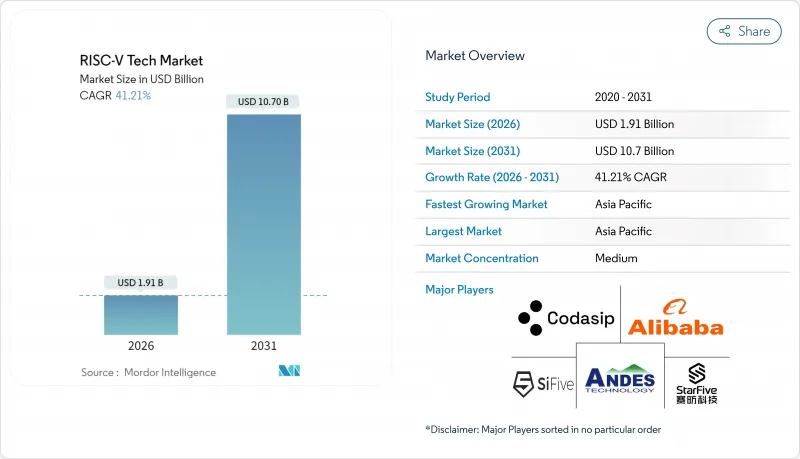
Growth is powered by Asia-Pacific's 45.8% 2024 leadership and its projected 65.2% CAGR, the 64-bit core's 42.4% 2024 domination, and accelerating adoption in consumer electronics, automotive, IoT, and data-center segments. Customizable open-standard IP, sovereign semiconductor programs in the United States, European Union, and China, and an expanding verification ecosystem are amplifying design wins, shortening time-to-market, and attracting new entrants to the RISC-V Tech market.However, software complexity from fragmented ISA extensions, limited backward compatibility compared with ARM, and a shortage of senior EDA talent in mature nodes remain substantial headwinds that could temper adoption momentum.
Cost-sensitive design requirements in IoT are dovetailing with national chip-sovereignty mandates, creating a strategic opening for vertically integrated players and regional champions across the RISC-V Tech market. Early commercialization of 128-bit cores, the arrival of ISO 26262- and ISO/SAE 21434-certified IP, and growing tool-chain standardization through the RVA23 Profile point to sustained scalability into high-performance computing, automotive, and industrial automation. Investors' willingness to deploy capital into open-hardware startups, as well as alliances that pool patents or link IP vendors with EDA suppliers, are further diluting the barriers to entry and accelerating convergence toward a more cohesive software and hardware stack.
Global RISC-V Tech Market Trends and Insights
Rapid proliferation of AI/ML-centric edge workloads
Edge AI adoption is lifting demand for modular processors able to tune latency and energy consumption, and the RISC-V Tech market is capitalizing on that pivot through vector extensions that accelerate neural-network inference in cameras, industrial sensors, and in-vehicle systems. Chinese semiconductor programs targeting indigenous AI chips have pressed home this advantage, minimizing vulnerability to Western export controls. The same open-standard flexibility is spawning a network of IP vendors, tool-chain developers, and certification bodies, compressing design cycles for domain-specific compute and helping to unlock new deployment models in automotive safety and factory automation.
Software tool-chain maturity attracting Tier-1 OEMs
Growing alignment around GCC, LLVM, and the RVA23 Profile has strengthened confidence in the RISC-V Tech market by offering unified toolchains and robust Java and Python runtimes. Flagship backers such as Intel, Google, and Nvidia are contributing code upstream, lowering switching costs and enabling Tier-1 OEMs to target multiple performance tiers under a single development workflow. As software stability improves, broad-based developers and ISVs have begun porting cloud, edge, and embedded stacks, moving the RISC-V Tech market deeper into enterprise and consumer segments.
Fragmented ISA extensions are increasing software complexity
Because the RISC-V specification permits custom extensions, dozens of vendors have introduced proprietary tweaks that complicate binary portability and continuous-integration pipelines. While the RVA23 Profile sets out mandatory AI/ML features, optional elements remain numerous, forcing OS vendors to maintain multiple kernels and tool-chain variants. Enterprise CIOs cite this as a reason to keep ARM-based roadmaps in parallel, delaying full commitment to the RISC-V Tech market.
Other drivers and restraints analyzed in the detailed report include:
- National chip-sovereignty programs (EU Chips Act, CHIPS and Science Act)
- Open-standard IP accelerating silicon time-to-market
- Limited backward-compatibility guarantees versus ARM ISA
For complete list of drivers and restraints, kindly check the Table Of Contents.
Segment Analysis
64-bit designs delivered 41.85% of the RISC-V Tech market share in 2025, translating into the largest slice of the RISC-V Tech market size. Semiconductor houses favor 64-bit cores because mainstream Linux distributions, Chromebook firmware, and containerized cloud software already support them, letting designers capture mass-market revenue without heavy re-engineering. Over the next three years, broader tool-chain maturity and big-core roadmaps such as SiFive's P870-D, which scales to 256 cores, will enable hyperscalers to test RISC-V racks at petascale performance levels.
The 128-bit cohort is registering a 58.2% CAGR, the fastest within the RISC-V Tech market, as exascale computing and AI models larger than 1 trillion parameters demand huge address spaces and high-precision vector math. Memory-intensive workloads in genomics and climate simulation are also nudging research centers to prototype 128-bit RISC-V clusters. Vendors are racing to add software support at the operating-system, hypervisor, and compiler levels, with early patches already appearing in GCC and LLVM. Although 32-bit cores remain the go-to choice for cost-sensitive IoT nodes, their share will compress modestly as more MCU vendors follow Renesas in migrating premium microcontrollers to 64-bit address spaces.
The RISC-V Tech Market Report is Segmented by Processor Core Type (32-Bit, 64-Bit, 128-Bit), Application (Smartphones, 5G Devices, Data Centers, and More), End-User Industry (Computing and Storage, Consumer Electronics, Medical, Industrial, and More), and Geography (North America, South America, Europe, Asia-Pacific, Middle East and Africa). The Market Forecasts are Provided in Terms of Value (USD).
Geography Analysis
Asia-Pacific retained 45.25% of 2025 revenue and will grow at a 62.7% CAGR through 2031 as state-led capital drives fab expansion, IP pooling, and verification labs. China's patent alliance reduces litigation hazards and empowers firms like Alibaba, T-Head, and Baidu to scale indigenous data-center and AI silicon. India's design-in-India campaigns are adding new assembly and test capacity, with Mindgrove planning volume MCU shipments in 2025.
Europe is carving an autonomy pathway through EUR 240 million in joint ventures such as DARE, eProcessor, and SiPearl's Rhea, engineered at the Barcelona Supercomputing Center. These programs leverage RISC-V to hedge geopolitical risk and promote supply-chain resilience, making the architecture a linchpin of EuroHPC's long-term road map. Focus areas include exascale HPC, energy-efficient edge nodes, and secure defense electronics.
North America remains the innovation crucible: new funding for Rivos, Tenstorrent, and other Silicon Valley startups underscores deep-tech investor confidence. CHIPS Act grants reinforce domestic prototyping capacity, while cross-border projects with Japanese partners accelerate 2 nm process adoption. Regional priorities include chiplets, low-power AI inference accelerators, and cloud-to-edge orchestration tools, all of which extend the reach of the RISC-V Tech market into high-performance segments where customization and license savings justify transition costs.
- Alibaba Group Holding Limited (T-Head Semiconductor)
- Andes Technology Corporation
- Antmicro Sp. z o.o.
- Apex Semiconductor (Shenzhen) Co., Ltd.
- Bluespec, Inc.
- C-Sky Microsystems Co., Ltd.
- CloudBEAR OU
- EMBEdded Logic Solutions Ltd.
- GreenWaves Technologies S.A.
- Huawei Technologies Co., Ltd. (HiSilicon)
- Imagination Technologies Limited
- Lattice Semiconductor Corporation
- Microchip Technology Incorporated
- MipSoC Ltd.
- Red Hat, Inc. (SiFive joint IP)
- Rivos Inc.
- SiFive, Inc.
- StarFive Technology Co., Ltd.
- Ventana Micro Systems, Inc.
- Western Digital Corporation
Additional Benefits:
- The market estimate (ME) sheet in Excel format
- 3 months of analyst support
TABLE OF CONTENTS
1 INTRODUCTION
- 1.1 Study Assumptions and Market Definition
- 1.2 Scope of the Study
2 RESEARCH METHODOLOGY
3 EXECUTIVE SUMMARY
4 MARKET LANDSCAPE
- 4.1 Market Overview
- 4.2 Market Drivers
- 4.2.1 Rapid proliferation of AI/ML-centric edge workloads
- 4.2.2 Software toolchain maturity attracting Tier-1 OEMs
- 4.2.3 National chip-sovereignty programs (EU Chips Act, CHIPS and Science Act)
- 4.2.4 Open-standard IP accelerating silicon time-to-market
- 4.2.5 Commercial-grade verification ecosystems (imperas, Synopsys partnerships)
- 4.2.6 Emergence of 3rd-party RISC-V accelerators for domain-specific compute
- 4.3 Market Restraints
- 4.3.1 Fragmented ISA extensions increasing software complexity
- 4.3.2 Limited backward-compatibility guarantees vs. ARM ISA
- 4.3.3 IP indemnification and patent-litigation uncertainties
- 4.3.4 Scarcity of RISC-V ready EDA talent in mature nodes
- 4.4 Industry Value Chain Analysis
- 4.5 Regulatory Landscape
- 4.6 Technological Outlook (Chiplet and Heterogenous Integration)
- 4.7 Impact of Macroeconomic Factors on the Market
- 4.8 Investment Analysis
- 4.9 Porter's Five Forces Analysis
- 4.9.1 Threat of New Entrants
- 4.9.2 Bargaining Power of Buyers
- 4.9.3 Bargaining Power of Suppliers
- 4.9.4 Threat of Substitute Products
- 4.9.5 Intensity of Competitive Rivalry
5 MARKET SIZE AND GROWTH FORECASTS (VALUE)
- 5.1 By Processor Core Type
- 5.1.1 32-bit
- 5.1.2 64-bit
- 5.1.3 128-bit
- 5.2 By Application
- 5.2.1 Smartphones
- 5.2.2 5G Devices
- 5.2.3 Data Centers
- 5.2.4 Personal Computers and Game Consoles
- 5.2.5 Cellular Network Infrastructure
- 5.2.6 IoT Devices
- 5.2.7 Other Applications
- 5.3 By End-User Industry
- 5.3.1 Computing and Storage
- 5.3.2 Communication Infrastructure
- 5.3.3 Consumer Electronics
- 5.3.4 Automotive and Transportation
- 5.3.5 Medical
- 5.3.6 Aerospace and Military
- 5.3.7 Industrial
- 5.3.8 Other End-User Industries
- 5.4 By Geography
- 5.4.1 North America
- 5.4.1.1 United States
- 5.4.1.2 Canada
- 5.4.1.3 Mexico
- 5.4.2 South America
- 5.4.2.1 Brazil
- 5.4.2.2 Argentina
- 5.4.2.3 Rest of South America
- 5.4.3 Europe
- 5.4.3.1 Germany
- 5.4.3.2 United Kingdom
- 5.4.3.3 France
- 5.4.3.4 Italy
- 5.4.3.5 Rest of Europe
- 5.4.4 Asia-Pacific
- 5.4.4.1 China
- 5.4.4.2 Japan
- 5.4.4.3 India
- 5.4.4.4 South-East Asia
- 5.4.4.5 Rest of Asia-Pacific
- 5.4.5 Middle East and Africa
- 5.4.5.1 Middle East
- 5.4.5.1.1 Saudi Arabia
- 5.4.5.1.2 United Arab Emirates
- 5.4.5.1.3 Rest of Middle East
- 5.4.5.2 Africa
- 5.4.5.2.1 South Africa
- 5.4.5.2.2 Egypt
- 5.4.5.2.3 Rest of Africa
- 5.4.5.1 Middle East
- 5.4.1 North America
6 COMPETITIVE LANDSCAPE
- 6.1 Market Concentration
- 6.2 Strategic Moves
- 6.3 Market Share Analysis
- 6.4 Company Profiles {(includes Global-level Overview, Market-level Overview, Core Segments, Financials as available, Strategic Information, Market Rank/Share for key companies, Products and Services, and Recent Developments)}
- 6.4.1 Alibaba Group Holding Limited (T-Head Semiconductor)
- 6.4.2 Andes Technology Corporation
- 6.4.3 Antmicro Sp. z o.o.
- 6.4.4 Apex Semiconductor (Shenzhen) Co., Ltd.
- 6.4.5 Bluespec, Inc.
- 6.4.6 C-Sky Microsystems Co., Ltd.
- 6.4.7 CloudBEAR OU
- 6.4.8 EMBEdded Logic Solutions Ltd.
- 6.4.9 GreenWaves Technologies S.A.
- 6.4.10 Huawei Technologies Co., Ltd. (HiSilicon)
- 6.4.11 Imagination Technologies Limited
- 6.4.12 Lattice Semiconductor Corporation
- 6.4.13 Microchip Technology Incorporated
- 6.4.14 MipSoC Ltd.
- 6.4.15 Red Hat, Inc. (SiFive joint IP)
- 6.4.16 Rivos Inc.
- 6.4.17 SiFive, Inc.
- 6.4.18 StarFive Technology Co., Ltd.
- 6.4.19 Ventana Micro Systems, Inc.
- 6.4.20 Western Digital Corporation
7 MARKET OPPORTUNITIES AND FUTURE OUTLOOK
- 7.1 White-space and Unmet-Need Assessment