|
시장보고서
상품코드
1934591
농업용 타이어 : 시장 점유율 분석, 업계 동향과 통계, 성장 예측(2026-2031년)Agricultural Tires - Market Share Analysis, Industry Trends & Statistics, Growth Forecasts (2026 - 2031) |
||||||
 Mordor Intelligence
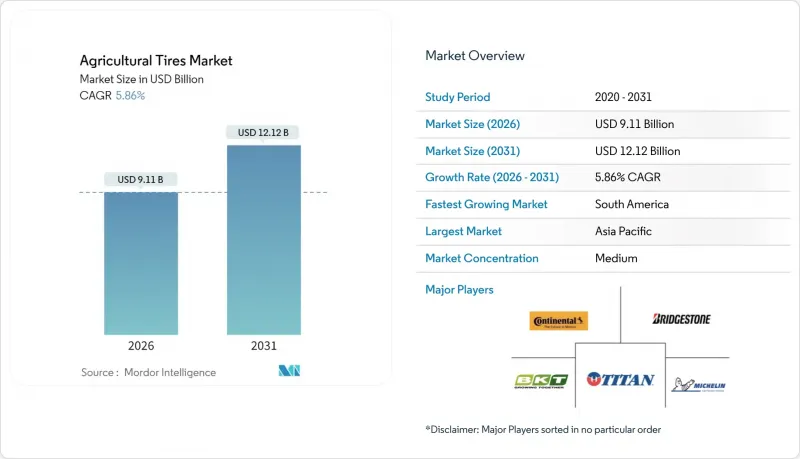
농업용 타이어 시장은 2025년 86억 1,000만 달러에서 2026년에는 91억 1,000만 달러로 성장하고, 2026-2031년 CAGR 5.86%로 성장을 지속하여, 2031년까지 121억 2,000만 달러에 이를 것으로 예측되고 있습니다.
농업용 타이어 시장은 지속적인 기계화 수요, 방사형화 추세의 가속화, 적재 능력을 향상시키면서 토양 압력을 감소시키는 IF/VF 기술의 상용화 등의 요인으로 인해 수혜를 받고 있습니다. 농가의 꾸준한 정밀농업으로의 전환, 노후화된 트랙터의 교체 수요 증가, 운영비용을 절감할 수 있는 중앙 타이어 공기압 관리 시스템(CTIS)에 대한 선호도 증가로 성장세가 더욱 강화되고 있습니다. 기존 기업과 지역 스타트업들이 제품 라인 업그레이드, 스마트 타이어 플랫폼에 대한 투자, 원자재 가격 변동 리스크 완화를 위한 수직적 통합을 추진하면서 경쟁이 심화되고 있습니다. 특히 천연고무 공급원을 중심으로 한 공급망 재구축은 2030년까지 농업용 타이어 시장을 형성하는 중요한 주제입니다.
세계 농업용 타이어 시장 동향 및 인사이트
신흥 시장의 급속한 기계화 및 차량 업데이트
신흥 경제국에서는 눈에 띄는 차량 현대화가 진행되고 있습니다. 아르헨티나에서는 정책 지원을 통한 융자 및 수입 비용 절감을 위한 현지 조달 장려책을 배경으로 2025년까지 트랙터, 수확기, 분무기 판매 증가가 예상됩니다. 30-70마력 기계에 대한 선호도가 높아짐에 따라 중형 전용 타이어의 기회가 강조되고 있으며, 150마력 이상의 장비는 VF 사양으로의 전환을 가속화하고 있습니다. 케이스아이에이치 등 업계 관계자들은 아시아 지역에서의 사업 확장을 추진하고 있으며, 농촌 지역의 제한된 인터넷 환경과 같은 인프라 병목현상에도 불구하고 고성장 시장의 매력적인 견인력을 보여주고 있습니다. 이러한 움직임은 농업용 타이어 시장 전망을 더욱 밝게 하고 있습니다.
바이어스 타이어에서 레이디얼/IF-VF 저압 밀도 타이어로의 전환
방사형화에는 확실한 비용 효율성의 근거가 있습니다. IF 설계는 동등한 공기압에서 5분의 1 더 높은 하중을 가능하게 하고, VF 설계는 그 여유를 5분의 2로 확대합니다. 미쉐린의 뉴홀랜드 CR11 콤바인용 CEREXBIB 2 라인은 19톤의 하중을 넓은 접지 면적에서 지탱할 수 있어 토양 보존에 대한 제조업체의 노력을 보여줍니다. 타이어 및 림 협회(T&RA)가 표준화한 규격으로 공기압 관리 프로토콜이 통일되어 전 세계적으로 보급이 가속화되고 있습니다. BKT, CEAT, 요코하마 고무의 신속한 제품 출시로 OEM 및 교체 시장 모두에서 VF 제품 선택의 폭이 더욱 넓어지고 있습니다. 연료 효율과 토양 건강을 중시하는 농장이 증가함에 따라 농업용 타이어 시장에서는 바이어스 구조에서 첨단 레이디얼 제품으로의 기술 확산이 빠르게 진행되고 있습니다.
변동하는 농산물 가격
농산물 가격의 변동 주기는 농가의 설비투자 능력에 영향을 미칩니다. 브라질에서는 2024년, 세릭 금리 상승에 따른 차입 비용 증가로 인해 농기계 판매량이 소폭 감소하여 약 5만 대를 기록했습니다. 아르헨티나의 농기계 등록대수는 연간 기준으로는 개선된 모습을 보였으나, 2025년 초에는 전월 대비 감소세를 보이며 신중한 태도가 지속되고 있음을 확인시켜 주었습니다. 현금 흐름이 압박을 받으면, OEM 수요는 약해지고, 공장 생산 일정이 불안정해져 타이어 공급업체에 어려움을 겪게 됩니다. 한편, 교환 수요는 더 안정적이어서 수익 하락을 완화할 수 있습니다. 이러한 양극화 현상은 애프터마켓이 전체 농업용 타이어 시장에서 기준 수요를 뒷받침하는 이유를 뒷받침합니다.
부문 분석
2025년 농업용 타이어 시장 규모 중 애프터마켓이 차지하는 비중은 70.74%를 나타낼 것입니다. 특히 고금리 시대에 농기계의 수명 연장을 중시하는 농가의 경향은 이러한 우위를 더욱 강화시키고 있습니다. OEM 채널은 우크라이나의 복구 수요와 라틴아메리카의 정책적 지원으로 인한 차량 갱신에 힘입어 2031년까지 연평균 복합 성장률(CAGR) 5.91%를 나타낼 것으로 예측됩니다.
브리지스톤이 2024년 8월 미국에서 출시한 VX-TRACTOR, VT-TRACTOR, VX-R TRACTOR 제품군은 더 긴 내마모성과 40% 더 높은 적재 용량을 약속하며 프리미엄화를 위한 노력을 보여주고 있습니다. 병행 OEM의 모멘텀은 트레일볼그가 존디어와 체결한 계약에 기인하며, 이를 통해 300개 이상의 브라질 대리점에 접근할 수 있게 되었고, 신형 트랙터 납품에 CTIS 대응 타이어를 배치할 수 있게 되었습니다. 애프터마켓의 견조한 수요와 OEM 주문의 회복과 함께 농업용 타이어 시장 전체에서 균형 잡힌 성장 요인이 강조되고 있습니다.
2025년 기준 농업용 타이어 시장의 56.12%를 차지하는 트랙터는 일상적인 농업 작업에서 핵심적인 위치를 확고히 하고 있습니다. 살포기는 규모는 작지만 2031년까지 연평균 복합 성장률(CAGR) 5.95%가 예상되며, 고간극 기계에 대응하는 좁은 폭의 VF 타이어에 대한 수요가 증가하고 있습니다. 콤바인과 트레일러는 나머지 점유율을 차지하고 있으며, 트레드 설계와 시체의 강성을 형성하는 명확한 성능 기준을 설정하고 있습니다.
아폴로의 Vredestein Traxion CropCare 시리즈는 분무기의 측면 안정성을 30% 향상시켰으며, 작물 보호 장비에 특화된 엔지니어링 노력을 반영하고 있습니다. 미쉐린 VF 900/65R46 CFO 타이어는 직경 2.32m, 적재량 19톤의 뉴홀랜드 CR11 콤바인용 타이어로, 대형 및 고하중 대응 솔루션의 트렌드를 구현했습니다. 이러한 혁신은 성능 범위를 확장하고 농업용 타이어 시장의 가치 제안을 강화합니다.
지역별 분석
아시아태평양은 2025년 기준 농업용 타이어 시장의 37.41%를 차지할 것으로 예상되며, 중국과 인도가 견인차 역할을 할 것으로 보입니다. 두 나라는 전 세계 농기계 성장의 5분의 2 이상을 차지하고 있습니다. 많은 지자체에서는 귀중한 경작지를 보호하는 VF 장착 트랙터 도입을 장려하는 보조금 제도를 통해 노동력 부족에 대한 대책을 추진하고 있습니다. 일본의 레이디얼 타이어 보급은 선진적인 R&D 클러스터와 엄격한 지속가능성 기준에 힘입어 이 지역의 기술적 성숙도를 뒷받침하고 있습니다.
남미는 2026년부터 2031년까지 연평균 복합 성장률(CAGR) 6.09%로 가장 빠르게 성장할 것으로 예상되는 지역입니다. 2024년 브라질에서 농기계 판매가 축소된 후, 모델 플로타 정책 등의 조치와 아르헨티나의 국내 생산 비율과 맞물려 수요가 회복되고 있습니다. 트레레볼그가 존디어의 광범위한 판매망과 연계한 사례로 대표되는 전략적 제휴를 통해 선진화된 저압 타이어가 중소규모 농업 생산자에게 공급되고 있습니다.
유럽과 북미에서는 높은 교환 비율이 특징입니다. 2027년 1월 시행되는 EU 기계규제에 따라 디지털 대응과 안전에 대한 적합성 기준이 높아져 CTIS(Contact Tire Information System)와 센서 장착 타이어가 우위를 점하게 될 것입니다. 우크라이나의 부흥 계획으로 농기계 재고 보충에 따라 OEM 수요가 급증할 것으로 예측됩니다. 중동 및 아프리카은 기계화가 미숙하지만, 관개 의존형 곡물 재배 분야에서 방사형 플로팅 타이어의 농학적 이점이 명확해지면서 수요가 점차 증가하고 있습니다. 전반적으로, 지역별 차이는 여러 수요 창출 요인을 부각시켜 2031년까지 농업용 타이어 시장의 성장 궤도를 확고히 하고 있습니다.
기타 특전:
- 엑셀 형식 시장 예측(ME) 시트
- 애널리스트 지원(3개월)
자주 묻는 질문
목차
제1장 서론
제2장 조사 방법
제3장 주요 요약
제4장 시장 구도
제5장 시장 규모와 성장 예측
제6장 경쟁 구도
제7장 시장 기회와 향후 전망
LSH 26.03.05The Agricultural Tires market is expected to grow from USD 8.61 billion in 2025 to USD 9.11 billion in 2026 and is forecast to reach USD 12.12 billion by 2031 at 5.86% CAGR over 2026-2031.
The Agricultural Tires market is benefiting from sustained mechanization demand, rapid radialization, and the commercialization of IF/VF technologies that improve load capacity while reducing soil compaction. Growth momentum is further reinforced by farmers' steady shift toward precision farming, swelling replacement demand from aging tractor fleets, and a widening preference for Central Tire Inflation Systems that lower operating costs. Competitive intensity is mounting as incumbents and regional challengers upgrade product lines, invest in smart-tire platforms, and pursue vertical integration to mitigate raw-material price volatility. Supply-chain recalibration, particularly around natural rubber sources, remains an important theme shaping the Agricultural Tires market through 2030.
Global Agricultural Tires Market Trends and Insights
Rapid Mechanization & Fleet Renewal In Emerging Markets
Emerging economies are in the midst of pronounced fleet modernization. Argentina anticipates growth in tractor, harvesters, and sprayers sales during 2025, underpinned by policy-backed financing and local-content incentives that reduce import-cost exposure. Rising preference for 30-70 HP machines underscores opportunities for specialized mid-range tires, while >150 HP equipment accelerates the push toward VF specifications. Industry participants including Case IH are expanding Asian footprints, highlighting the magnetic pull of high-growth markets despite infrastructure bottlenecks such as limited rural internet. These dynamics collectively bolster the Agricultural Tires market outlook.
Shift From Bias To Radial / If-Vf Low-Compaction Tires
The cost-benefit rationale for radialization is compelling: IF designs allow one-fifth higher load at identical pressure, and VF designs expand the margin to two-fifth. Michelin's CEREXBIB 2 line for New Holland's CR11 combine, accommodating 19 ton loads with a wider footprint, illustrates manufacturers' commitment to soil preservation. Standards codified by the Tire & Rim Association have harmonized inflation protocols, accelerating global adoption. Expedited product launches from BKT, CEAT, and Yokohama further diversify VF offerings across both OEM and replacement channels. As more farms prioritize fuel efficiency and soil health, the Agricultural Tires market is witnessing rapid technology diffusion from bias to advanced radial products.
Fluctuating Agricultural Commodity Prices
Commodity price cycles shape farmers' capital-spending capacity. Brazil's agricultural machinery sales fell slightly in 2024 to close to half a lakh units amid a uptick Selic rate that inflated borrowing costs. Argentina's equipment registrations showed early-2025 month-on-month declines despite annual improvements, underlining persistent caution. When cash flows tighten, OEM demand softens and factory scheduling becomes erratic, challenging tire suppliers. Conversely, replacement needs remain steadier, cushioning revenue dips. This dichotomy reinforces why the aftermarket anchors baseline demand across the Agricultural Tires market.
Other drivers and restraints analyzed in the detailed report include:
- Growing Global Population & Food-Security Pressure
- Surging Replacement Demand From Aging Tractor Fleet
- Natural-Rubber & Petrochemical Cost Volatility
For complete list of drivers and restraints, kindly check the Table Of Contents.
Segment Analysis
The Agricultural Tires market size attributed to the aftermarket accounts for 70.74% of market share in 2025. Farmers' strong inclination to extend equipment lifespan, particularly during high interest-rate periods, reinforces this dominance. OEM channels are on a 5.91% CAGR path through 2031, buoyed by Ukraine reconstruction and policy-supported fleet renewal in Latin America.
Bridgestone's August 2024 U.S. introduction of VX-TRACTOR, VT-TRACTOR, and VX-R TRACTOR portfolios illustrates the pursuit of premiumization, promising longer wear life and 40% higher load capacity. Parallel OEM momentum stems from Trelleborg's agreement with John Deere, granting access to more than 300 Brazilian dealerships and positioning CTIS-ready tires for new tractor deliveries. The interplay between defensive aftermarket strength and revitalized OEM orders underscores balanced growth drivers across the Agricultural Tires market.
Tractors generated 56.12% of the Agricultural Tires market in 2025, cementing their centrality in daily farm tasks. Sprayers, although representing a smaller base, are forecast for 5.95% CAGR through 2031, sharpening demand for narrow-section VF tires compatible with high-clearance machinery. Combine harvesters and trailers capture residual shares yet set distinct performance benchmarks that shape tread design and carcass rigidity.
Apollo's Vredestein Traxion CropCare series grants 30% higher lateral stability for sprayers, reflecting an engineering push tailored to crop-protection equipment. Michelin's VF 900/65R46 CFO tire, boasting a 2.32 m diameter and 19 ton load rating for New Holland's CR11 harvester, mirrors a trend toward oversized, heavy-duty solutions. These innovations broaden performance envelopes and enlarge the value proposition of the Agricultural Tires market.
The Agricultural Tires Market Report is Segmented by Sales Channel (OEM and Replacement/Aftermarket), Application (Tractors, Combine Harvesters, and More), Tire Construction (Bias, Radial, and IF/VF Radial), Rim-Size (Less Than 20 Inch and More), Equipment Horse-Power Class (Less Than 30 HP and More), Inflation-Technology Compatibility, and Geography. The Market Forecasts are Provided in Terms of Value (USD) and Volume (Units).
Geography Analysis
Asia-Pacific held 37.41% of Agricultural Tires market share in 2025, propelled by China and India, which together delivered more than two-fifth of global equipment growth. Many provincial subsidies address labor scarcity by encouraging VF-equipped tractors that protect increasingly valuable arable land. Japan's radial-tire uptake underscores the region's technological maturity, supported by advanced R-&-D clusters and stringent sustainability standards.
South America is projected as the fastest-growing region with 6.09% CAGR between 2026 and 2031. Following a contraction in Brazil's machinery sales during 2024, policy steps such as Moderfrota coupled with Argentina's domestic manufacturing content are revitalizing demand. Strategic collaborations, exemplified by Trelleborg's tie-up with John Deere's extensive dealership grid, channel advanced low-compaction tires to small and mid-sized growers.
Europe and North America exhibit high replacement ratios. EU machinery regulations effective January 2027 will elevate compliance thresholds for digital readiness and safety, favoring CTIS and sensor-equipped tires. Ukraine reconstruction plans could spark an OEM spike as farming equipment stocks are replenished. Middle East and Africa remain under-mechanized yet display gradual uptake, notably in irrigation-dependent cereals where radial flotation tires provide clear agronomic benefits. Overall, regional heterogeneity accentuates multiple demand pockets, solidifying the growth arc of the Agricultural Tires market through 2031.
- Bridgestone Corporation
- Michelin
- Continental AG
- Balkrishna Industries Ltd (BKT)
- Titan International Inc.
- Trelleborg AB
- Yokohama Rubber Co. Ltd. (ATG)
- Nokian Tyres plc
- Apollo Tyres Ltd.
- Prometeon Tyre Group
- CEAT Ltd.
- Mitas a.s.
- Goodyear Tire & Rubber Co.
- Hankook Tire & Technology
- GRI Tires
- Maxam Tire International
- Specialty Tires of America
- Magna Tyres Group
- Petlas Tire Industry
Additional Benefits:
- The market estimate (ME) sheet in Excel format
- 3 months of analyst support
TABLE OF CONTENTS
1 Introduction
- 1.1 Study Assumptions & Market Definition
- 1.2 Scope of the Study
2 Research Methodology
3 Executive Summary
4 Market Landscape
- 4.1 Market Overview
- 4.2 Market Drivers
- 4.2.1 Rapid Mechanization & Fleet Renewal In Emerging Markets
- 4.2.2 Shift From Bias To Radial / If-Vf Low-Compaction Tires
- 4.2.3 Growing Global Population & Food-Security Pressure
- 4.2.4 Surging Replacement Demand From Aging Tractor Fleet
- 4.2.5 Real-Time Tire-Pressure & Ctis Adoption Accelerating Upgrades
- 4.2.6 EU-Ukraine Reconstruction Triggering Oem Demand Spike
- 4.3 Market Restraints
- 4.3.1 Fluctuating Agricultural Commodity Prices
- 4.3.2 Natural-Rubber & Petrochemical Cost Volatility
- 4.3.3 Supplier Exits Limiting Choice & Raising Prices
- 4.3.4 Rubber-Leaf Disease Constraining Raw-Material Supply
- 4.4 Value / Supply-Chain Analysis
- 4.5 Regulatory Landscape
- 4.6 Technological Outlook
- 4.7 Porter's Five Forces
- 4.7.1 Bargaining Power of Suppliers
- 4.7.2 Bargaining Power of Buyers
- 4.7.3 Threat of New Entrants
- 4.7.4 Threat of Substitutes
- 4.7.5 Competitive Rivalry
5 Market Size & Growth Forecasts (Value (USD) and Volume (Units))
- 5.1 By Sales Channel
- 5.1.1 OEM
- 5.1.2 Replacement / Aftermarket
- 5.2 By Application
- 5.2.1 Tractors
- 5.2.2 Combine Harvesters
- 5.2.3 Sprayers
- 5.2.4 Trailers
- 5.2.5 Loaders & Telehandlers
- 5.2.6 Other Implements
- 5.3 By Tire Construction
- 5.3.1 Bias
- 5.3.2 Radial
- 5.3.3 IF / VF Radial
- 5.4 By Rim-Size
- 5.4.1 Less than 20 inch
- 5.4.2 20 - 30 inch
- 5.4.3 30 - 40 inch
- 5.4.4 More than 40 inch
- 5.5 By Equipment Horse-Power Class
- 5.5.1 Less than 30 HP
- 5.5.2 30 - 70 HP
- 5.5.3 71 - 150 HP
- 5.5.4 More than 150 HP
- 5.6 By Inflation-Technology Compatibility
- 5.6.1 Standard Tires
- 5.6.2 CTIS-Ready / Smart Tires
- 5.7 By Geography
- 5.7.1 North America
- 5.7.1.1 United States
- 5.7.1.2 Canada
- 5.7.1.3 Rest of North America
- 5.7.2 South America
- 5.7.2.1 Brazil
- 5.7.2.2 Argentina
- 5.7.2.3 Rest of South America
- 5.7.3 Europe
- 5.7.3.1 Germany
- 5.7.3.2 United Kingdom
- 5.7.3.3 France
- 5.7.3.4 Italy
- 5.7.3.5 Spain
- 5.7.3.6 Russia
- 5.7.3.7 Rest of Europe
- 5.7.4 Asia-Pacific
- 5.7.4.1 China
- 5.7.4.2 Japan
- 5.7.4.3 India
- 5.7.4.4 South Korea
- 5.7.4.5 Australia
- 5.7.4.6 Rest of Asia-Pacific
- 5.7.5 Middle East and Africa
- 5.7.5.1 United Arab Emirates
- 5.7.5.2 Saudi Arabia
- 5.7.5.3 Turkey
- 5.7.5.4 Egypt
- 5.7.5.5 South Africa
- 5.7.5.6 Rest of Middle East and Africa
- 5.7.1 North America
6 Competitive Landscape
- 6.1 Market Concentration
- 6.2 Strategic Moves
- 6.3 Market Share Analysis
- 6.4 Company Profiles (Includes Global Level Overview, Market Level Overview, Core Segments, Financials as Available, Strategic Information, Market Rank/Share for Key Companies, Products and Services, SWOT Analysis, and Recent Developments)
- 6.4.1 Bridgestone Corporation
- 6.4.2 Michelin
- 6.4.3 Continental AG
- 6.4.4 Balkrishna Industries Ltd (BKT)
- 6.4.5 Titan International Inc.
- 6.4.6 Trelleborg AB
- 6.4.7 Yokohama Rubber Co. Ltd. (ATG)
- 6.4.8 Nokian Tyres plc
- 6.4.9 Apollo Tyres Ltd.
- 6.4.10 Prometeon Tyre Group
- 6.4.11 CEAT Ltd.
- 6.4.12 Mitas a.s.
- 6.4.13 Goodyear Tire & Rubber Co.
- 6.4.14 Hankook Tire & Technology
- 6.4.15 GRI Tires
- 6.4.16 Maxam Tire International
- 6.4.17 Specialty Tires of America
- 6.4.18 Magna Tyres Group
- 6.4.19 Petlas Tire Industry
7 Market Opportunities & Future Outlook
- 7.1 White-space & Unmet-Need Assessment