
|
시장보고서
상품코드
1934676
Wood Plastic Composites(WPC) : 시장 점유율 분석, 업계 동향과 통계, 성장 예측(2026-2031년)Wood Plastic Composites (WPC) - Market Share Analysis, Industry Trends & Statistics, Growth Forecasts (2026 - 2031) |
||||||
 Mordor Intelligence
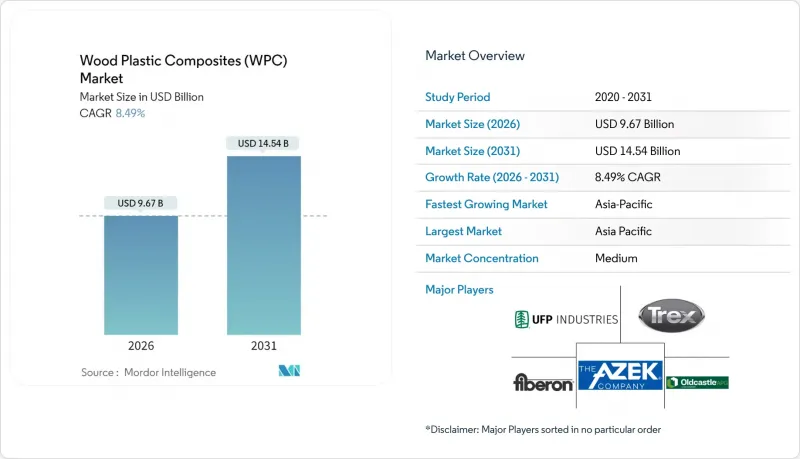
목질 플라스틱 복합재 시장은 2025년 89억 1,000만 달러에서 2026년에는 96억 7,000만 달러로 성장하고, 2026-2031년 CAGR 8.49%로 성장을 지속하여, 2031년까지 145억 4,000만 달러에 이를 것으로 예측됩니다.
수요 증가 요인으로는 아시아 지역의 건설 활동 증가, 북미의 DIY 리폼 수요, 유럽의 재활용 자재 사용 규제 추진 등을 꼽을 수 있습니다. 제품 개발자는 강도를 향상시키는 상용화제와 고함량의 목질 섬유를 배합하고 있으며, 유럽 자동차 제조업체들은 전기자동차의 항속거리 연장을 위해 경량 비구조 부품의 채용을 추진하고 있습니다. 또한, 공급업체들은 색조 보호 및 흡습 억제 효과가 있는 코팅 프로파일의 규모를 확대하고 있으며, 이를 통해 소매 시장에서의 호소력을 넓히고 있습니다. 아시아태평양은 2024년 매출의 55%를 차지할 것으로 예상되며, 현지 제조업체들이 생산 능력을 확장하고 강화되는 지역 보건 규정을 준수하는 무연 PVC 실내 패널을 추구하면서 2030년까지 연평균 9.50%로 가장 빠르게 성장하는 지역이 될 것으로 예측됩니다.
세계 목재 플라스틱 복합재(WPC) 시장 동향 및 인사이트
DIY 주택 개조 트렌드의 부상
주택 소유주들은 빠른 설치가 가능하고, 얼룩에 강하며, 매년 재실링이 필요 없는 데크에 대한 지출을 늘리고 있습니다. 이에 따라 소매업체들은 노동력을 절약하고 소비자의 지속가능성에 대한 폭넓은 선호도를 충족시키기 위해 클릭 핏 보드의 재고를 늘리고 있습니다. 탄소 네거티브 WPC 데크 프로토타입은 현재 제조 과정에서 배출되는 CO2 양보다 더 많은 CO2를 저장하고 있으며, 대규모로 채택될 경우 연간 25만 톤의 CO2를 고정시킬 수 있습니다. 미국의 대형 대량 판매 체인은 캡이 달린 프로파일 제품에 추가 판매 공간을 할당하여 건설 산업의 경기 순환으로부터 생산자를 보호하는 안정적인 현금 판매를 강화하고 있습니다. 디지털 튜토리얼과 인플루언서 컨텐츠는 DIY의 보급 범위를 넓히고, 목재 플라스틱 복합재 시장을 교외 리모델링 예산으로 끌어올리고 있습니다. 이러한 추세는 보드의 색상에 맞춘 애프터마켓 난간과 조명 키트에 대한 수요를 증가시켜 새로운 수익원을 창출하고 있습니다.
EU 순환경제 행동계획의 목재 섬유 재사용 의무화 목표 설정
EU는 2030년까지 재활용 재료 사용률을 23.2%로 두 배로 늘릴 방침이며, 이에 따라 패널 및 데크재 공장은 더 많은 폐목재 분말을 통합해야 합니다. 기업들은 광학 선별기나 화학 세정 라인을 도입하여 기계적 특성을 손상시키지 않고 재생재 함량을 향상시키고 있습니다. 동시에 포장 폐기물 규제에 따라 모든 포장 형태의 재활용이 의무화되면서 바이오 복합재 대체재에 대한 수요가 강화되고 있습니다. 독일과 프랑스의 건설업체들은 그린빌딩 인증제도를 배경으로 더 높은 재활용률을 요구하고 있으며, 이로 인해 고급 선별 플랜트의 투자 회수 기간이 단축됩니다. 그 결과, 재생원료 공급 계약은 다년간의 장기 계약으로 협상되어 원자재 가격의 불확실성이 줄어들고 있습니다. 이러한 정책적 수단이 결합되어 규제 준수 대응의 변화가 구조적 수요 동인으로 작용하여 목재 플라스틱 복합재 시장을 확대시키고 있습니다.
온도 민감도, 내마모성 등의 기술적 과제
일부 배합은 지속적인 열에 의해 크리프(미세 변형)가 발생하여 120℃ 이상의 고온 환경에서는 사용이 제한됩니다. 교통량이 많은 바닥재의 경우, 수백만 번의 보행 후 표면 광택이 사라지는 것으로 밝혀져 시설 관리자의 채용을 주저하게 만들고 있습니다. 나노입자 강화에 의한 표면 강화 연구는 유망하지만, 중견 건설업체가 거부하는 비용 증가를 수반합니다. 온도 피크 시 치수 변화도 설치 공차를 확대하여 계약자의 작업 시간을 연장합니다. 이러한 우려로 인해 금속과 엔지니어링 목재가 입증된 응용 분야에서 금속과 엔지니어링 목재의 대체율이 감소하고 있습니다.
부문 분석
폴리에틸렌계 WPC는 2025년 기준 목질 플라스틱 복합재 시장의 54.30%를 차지하며 시장에서 지배적인 위치를 차지하고 있습니다. 그 장점은 압출 성형의 용이성, 광범위한 필러 허용 오차, 그리고 매력적인 원료 가격에 기인합니다. 제조업체는 최대 60%까지 목분을 혼합해도 점도가 크게 상승하지 않아 판재 원가 경쟁력을 유지하고 있습니다. 폴리프로필렌 등급은 CAGR 9.07%로 가장 빠르게 성장하고 있으며, 자동차 내장 패널에 적합한 높은 열변형 온도와 강성으로 인해 30%의 경량화가 입증되었습니다. 무연 PVC 보드는 특히 아시아의 실내 바닥재에서 건강 지향적 성향이 높아짐에 따라 틈새 시장을 확대하고 있습니다. PLA 등의 바이오폴리머는 시범적으로 데크 타일에 채용되고 있으며, 비용 차이가 줄어들면 향후 보급이 기대되고 있습니다. 상용화제의 혁신, 특히 무수 말레인산 그라프트는 계면 결합을 강화하여 목재 첨가량을 늘리고 수지 사용량을 줄일 수 있습니다. 이를 통해 지속가능성 점수와 수익률을 동시에 향상시킬 수 있습니다.
시장 진출기업들은 2024년 두 자릿수 변동폭에 도달한 폴리머 가격 변동에 대한 헤지 수단으로 수지 라인업을 확장하고 있습니다. 이 전략은 계획적인 크래커 가동 중단으로 인한 PE 공급 부족 시에도 원료 공급의 연속성을 보장합니다. 그 결과, 다양한 제품 포트폴리오가 장기 대리점 계약을 체결하는 데 있어 경쟁 우위를 점할 수 있습니다. 이러한 변화는 재료 과학과 응용 분야 특화 요구를 일치시킴으로써 목재 플라스틱 복합재 시장의 성장 궤도를 강화하고 있습니다.
압출 라인은 2025년 세계 생산량의 69.20%를 차지할 것으로 예상되며, 데크 및 울타리 생산의 핵심 기술입니다. 중량식 피더를 장착한 이축압출기는 수분함량 0.5% 이하를 유지하면서 800kg/h의 가동이 가능하여 공극 형성을 최소화합니다. 라인 자동화를 통해 프로파일 온도를 실시간으로 추적하여 스크랩율을 2% 미만으로 억제하고 있습니다. 사출 성형은 규모는 작지만, 자동차 제조업체들이 3차원 형상과 엄격한 공차를 요구함에 따라 CAGR 8.96%로 확대되고 있습니다. 멀티 머티리얼 오버몰드 기술로 WPC 코어와 소프트 터치 TPE 스킨을 일체화. 차내 공간의 질감 향상과 조립 공정 단축을 실현했습니다. 인발 성형은 교량 보도의 고탄성 빔 용도로 틈새 수요가 있으며, 연속 유리 로빙을 활용하여 높은 굽힘 강성을 발휘합니다.
공정 혁신은 기계 제조업체와 지역 가공업체 간의 라이선스 계약을 통해 확산되어 학습 곡선을 평평하게 만들고 있습니다. 근적외선 분광법을 이용한 인라인 모니터링은 기존에는 실험실에서 건조 테스트가 필요했던 수분 피드백을 신속하게 제공합니다. 이러한 개선은 처리량 증가, Kg당 에너지 소비량 감소, 목재 플라스틱 복합재 시장 규모 확대 및 탄소 발자국 감소를 촉진할 수 있습니다. 디자인 스튜디오에서는 WPC 대응 3D 프린팅용 필라멘트가 등장하여 건축가들이 본격적인 산업 생산을 기다리지 않고도 맞춤형 격자 데크를 자유롭게 시제품을 제작할 수 있는 환경이 조성되어 새로운 보급의 물결을 예고하고 있습니다.
본 "목질 플라스틱 복합재 시장 보고서'는 플라스틱 재료(폴리에틸렌, 폴리프로필렌 등), 가공 기술(압출 성형, 사출 성형 등), 제품 형태(피복(공압출) WPC와 비피복(재래식) WPC), 용도별(건축 및 건설자재, 자동차 부품 등), 지역별(아시아태평양, 북미, 유럽, 남미, 중동, 아시아, 아프리카) 유럽, 남미, 중동 및 아프리카)로 분석되고 있습니다.
지역별 분석
2025년 아시아태평양은 세계 목재 플라스틱 복합재 시장의 54.60%를 차지하며 업계에 중요한 기여를 할 것으로 예측됩니다. 강력한 도시화, 지원적인 녹색 건축 기준, 풍부한 바이오매스 공급이 이 지역의 선도적 지위를 뒷받침하고 있습니다. 중국의 북미 데크재 수출은 공장이 캡스톡 라인을 최적화하고 FHA(주택금융청)의 승인을 확보함에 따라 증가하고 있습니다. 일본에서는 보다 건강한 주택에 대한 정부 보조금 지원을 받아 저VOC 실내용 보드 개발이 선행되고 있습니다. 인도에서는 인프라 정비 추진에 따라 열대 지역에서 흔히 발생하는 흰개미 문제를 피하기 위해 WPC 보도교가 채택되고 있습니다.
북미에서는 DIY 문화 확산과 프리미엄 브랜드 전략이 시장 성장을 견인하고 있습니다. 트렉스와 AZEK는 6,700개 이상의 소매점에 공급하고 지방 도시로 확대했습니다. 홈센터 체인에서는 1피트당 4달러의 캡드보드가 기존 가압처리된 목재보다 더 높은 판매 실적을 보이며 시장 확대를 가속화하고 있습니다. 캐나다에서는 국내 목질 섬유 공급이 공급망을 단축하고 원격지 커뮤니티를 위한 분산형 보드 생산을 촉진합니다.
유럽에서는 정책 프레임워크가 조달 및 재활용 경로를 재구성하고 있으며, 재사용 의무화 목표가 다가오고 있습니다. 독일의 가공업체는 최대 80%의 재생목재 함유량을 시범적으로 도입하여 대규모 개발업체에 영향력을 행사할 수 있는 환경 라벨을 획득하는 것을 목표로 하고 있습니다. 자동차 OEM 수요로 인해 중부 유럽은 사출성형 WPC 부품의 거점으로 자리매김하고 있으며, 인근 조립공장과공급 통합이 진행되고 있습니다. 북유럽 시장에서는 추운 기후에도 불구하고 휴가용 별장용으로 캡이 달린 데크가 채택되고 있으며, 초기 비용보다 낮은 유지보수성을 중시하고 있습니다.
중동, 특히 GCC 국가에서는 사막 환경에 강한 복합 퍼걸러에 대한 수요가 급증하고 있습니다. 자외선 차단제와 내열성 안료가 함유되어 있어 45℃의 환경에서도 색조를 유지합니다. 두바이의 도시 미화 사업이 보드워크 수주를 주도하며, 열대 경재 대비 WPC의 라이프사이클 비용 우위가 부각되었습니다.
아프리카 시장은 아직 초기 단계이지만, 남아공 소매업체들은 염분을 함유한 공기에도 균열 없이 견딜 수 있는 복합재 슬랫을 사용한 고급 아웃도어 가구의 두 자릿수 성장을 보고하고 있습니다.
기타 특전:
- 엑셀 형식 시장 예측(ME) 시트
- 애널리스트 지원(3개월)
자주 묻는 질문
목차
제1장 서론
제2장 조사 방법
제3장 주요 요약
제4장 시장 구도
제5장 시장 규모와 성장 예측
제6장 경쟁 구도
제7장 시장 기회와 향후 전망
LSH 26.03.03The Wood Plastic Composites market is expected to grow from USD 8.91 billion in 2025 to USD 9.67 billion in 2026 and is forecast to reach USD 14.54 billion by 2031 at 8.49% CAGR over 2026-2031.
Demand accelerators include growing construction activity in Asia, DIY renovation in North America, and regulatory pushes for recycled content in Europe. Product developers are blending higher wood-fiber loads with compatibilizers that improve strength, while automakers in Europe specify lighter non-structural parts to extend electric-vehicle range. Suppliers are also scaling capped profiles that protect colour and curb moisture uptake, which widens retail appeal. Asia-Pacific commands 55% of 2024 revenue and will remain the fastest-expanding geography at a 9.50% CAGR through 2030 as local manufacturers upgrade capacity and pursue lead-free PVC indoor panels that meet tightening regional health rules.
Global Wood Plastic Composites (WPC) Market Trends and Insights
Rise in DIY Home Improvement Trends
Home-owners are spending more on decks that install quickly, resist staining, and avoid yearly re-sealing. Retailers respond by stocking click-fit boards that save labor and tap into the wider sustainability preference of consumers. Carbon-negative WPC decking prototypes now store more CO2 than production emits, potentially locking away 250,000 tons annually if adopted at scale. Big-box chains in the United States dedicate additional aisle space to capped profiles, reinforcing steady cash sales that cushion producers from construction cyclicality. Digital tutorials and influencer content widen do-it-yourself reach, pushing the wood plastic composite market into suburban remodel budgets. The trend also lifts aftermarket railing and lighting kits that match board colours, creating incremental revenue streams.
Mandatory Wood-Fiber Reuse Targets in EU Circular Economy Action Plan
The EU seeks to double its circular material-use rate to 23.2% by 2030, which obliges panel and decking factories to integrate more post-consumer wood flour. Companies deploy optical sorters and chemical cleaning lines that raise recycled-content ratios without hurting mechanical properties. Simultaneously, the Packaging and Packaging Waste Regulation compels every packaging format to be recyclable, reinforcing demand for biocomposite alternatives. German and French builders, backed by green-building labels, specify higher recycled fractions that shorten payback for advanced sorting plants. Consequently, recyclate supply contracts are now negotiated over multi-year tenors, reducing feedstock-price uncertainty. These policy levers collectively expand the wood plastic composite market as compliance shifts become structural demand drivers.
Technical Issues Like Temperature Sensitivity and Wearability
Some formulations creep under sustained heat, limiting under-hood use where temperatures breach 120 °C. High-traffic flooring reveals surface gloss loss after millions of footfalls, which deters facility managers. Nanoparticle fortification studies show promise for tougher surfaces yet add cost overheads that mid-tier builders resist. Dimensional drift at temperature peaks also raises installation tolerances, lengthening job times for contractors. These concerns lower substitution rates in applications where metal or engineered wood remain proven.
Other drivers and restraints analyzed in the detailed report include:
- Accelerated Shift Toward Lead-Free PVC-Based WPC for Indoor Applications in Asia
- Light-weighting Push by European OEMs for Non-Structural Automotive Parts
- Fire-Resistance Certification Hurdles in High-Rise Construction
For complete list of drivers and restraints, kindly check the Table Of Contents.
Segment Analysis
Polyethylene WPC held 54.30% of the wood plastic composite market share in 2025, establishing its dominant position in the market. Its dominance stems from easy extrusion, broad filler tolerance, and attractive raw-material pricing. Manufacturers mix up to 60% wood flour without severe viscosity spikes, which keeps board costs competitive. Polypropylene grades expand fastest at a 9.07% CAGR, lifted by higher heat-deflection and stiffness that suit automotive interior panels where 30% weight savings are proven. Lead-free PVC boards, especially in Asian indoor flooring, fill a growing health-conscious niche. Biopolymers such as PLA appear in pilot deck tiles, signalling future openings once cost gaps narrow. Compatibilizer innovation, notably maleic-anhydride grafts, lifts interfacial bonding so producers can raise wood loadings and shrink resin usage. That step enhances sustainability scores and margins simultaneously.
Market participants broaden their resin slate to hedge against polymer price swings that reached double-digit volatility in 2024. The strategy also secures feedstock continuity when planned cracker shutdowns tighten PE supply. Consequently, portfolio breadth becomes a competitive credential in winning long-term distributor contracts. These shifts reinforce the wood plastic composite market trajectory by aligning material science with application-specific needs.
Extrusion lines produced 69.20% of 2025 global volume, making the method the backbone of deck and fence output. Twin-screw extruders with gravimetric feeders can now run 800 kg/hr while keeping moisture below 0.5%, which minimises void formation. Line automation tracks profile temperature in real time, trimming scrap rates below 2%. Injection molding, though smaller, climbs at 8.96% CAGR because automakers require three-dimensional geometries and tight tolerances. Multi-material over-molding joins WPC cores with soft-touch TPE skins, enhancing vehicle interior feel while cutting assembly steps. Pultrusion holds niche appeal for high-modulus beams in bridge walkways, leveraging continuous glass rovings for strong bending stiffness.
Process innovation spreads through licencing deals between machinery OEMs and regional processors, flattening the learning curve. Inline monitoring with near-infrared spectroscopy provides rapid moisture feedback that once required laboratory drying tests. These upgrades raise throughput and shrink energy per kilogram, boosting the wood plastic composite market size and trimming carbon footprints. WPC-ready 3D-printing filaments emerge in design studios, giving architects freedom to test customised lattice decks without full industrial runs, foreshadowing another adoption wave.
The Wood Plastic Composite Market Report is Segmented by Plastic Material (Polyethylene, Polypropylene, and More), Processing Technology (Extrusion, Injection Molding, and More), Product Form (Capped (Co-Extruded) WPC and Un-Capped (Conventional) WPC), Application (Building and Construction Products, Automotive Parts, and More), and Geography (Asia-Pacific, North America, Europe, South America, and Middle East and Africa).
Geography Analysis
In 2025, the Asia-Pacific region accounted for 54.60% of the global wood plastic composite market, demonstrating its significant contribution to the industry. Strong urbanisation, supportive green-building norms, and abundant biomass supply anchor the region's leadership. Chinese decking exports to North America climb as factories optimise capstock lines and secure FHA acceptance. Japan pioneers low-VOC indoor boards, aided by government subsidies for healthier housing. India's infrastructure push sees WPC pedestrian bridges that avoid termite issues common in tropical settings.
North America benefits from a strong DIY culture and premium brand strategies, driving its market growth. Trex and AZEK supply more than 6,700 retail outlets, extending reach into secondary cities. Capped boards priced at USD 4.00 per linear foot outsell traditional pressure-treated lumber at home-centre chains, reinforcing market expansion. Canada benefits from domestic wood-fiber availability that shortens supply chains and boosts decentralised board production to serve remote communities.
Europe's policy framework reshapes sourcing and recycling routes as mandatory reuse targets near. German processors trial up to 80% recycled wood content to gain environment labels that sway large developers. Automotive OEM demand positions Central Europe as a hub for injection-molded WPC parts, integrating supply with nearby assembly plants. Nordic markets, despite cold climates, adopt capped decking for holiday cottages where low maintenance outweighs initial spend.
The Middle East, specifically GCC nations, records brisk uptake of desert-resistant composite pergolas. Formulations embed UV blockers and heat-stable pigments that preserve colour at 45 °C ambient conditions. Municipal beautification in Dubai triggers boardwalk orders that underscore WPC lifecycle cost benefits compared with tropical hardwood.
Africa remains early stage but South African retailers report double-digit growth in premium outdoor furniture made from composite slats that weather salt air without cracking.
- Anhui Sentai WPC Group Share Co., Ltd.
- Axion Structural Innovations LLC
- Beologic
- Fiberon (Fortune Brands Innovations)
- FKuR
- Geolam AG
- Green Bay Decking LLC
- Guangzhou Kindwood Co., Ltd.
- JELU-WERK J. Ehrler GmbH & Co. KG
- Oldcastle APG (CRH)
- PolyPlank Solutions AB
- Resysta International
- Saint-Gobain
- TAMKO Building Products LLC
- The AZEK Company Inc.
- Trex Company Inc.
- UFP Industries, Inc.
Additional Benefits:
- The market estimate (ME) sheet in Excel format
- 3 months of analyst support
TABLE OF CONTENTS
1 Introduction
- 1.1 Study Assumptions and Market Definition
- 1.2 Scope of the Study
2 Research Methodology
3 Executive Summary
4 Market Landscape
- 4.1 Market Overview
- 4.2 Market Drivers
- 4.2.1 Rise in DIY Home Improvement Trends
- 4.2.2 Mandatory Wood-Fiber Reuse Targets in EU Circular Economy Action Plan
- 4.2.3 Accelerated Shift Toward Lead-Free PVC-Based WPC for Indoor Applications in Asia
- 4.2.4 Light-weighting Push by European OEMs for Non-Structural Automotive Parts
- 4.2.5 Surge in Demand for Low-Maintenance Urban Outdoor Landscaping Products in GCC
- 4.3 Market Restraints
- 4.3.1 Technical Issues Like Temperature Sensitivity, Wearability, etc
- 4.3.2 Volatility in Prices
- 4.3.3 Fire-Resistance Certification Hurdles in High-Rise Construction
- 4.4 Value Chain Analysis
- 4.5 Porter's Five Forces
- 4.5.1 Bargaining Power of Suppliers
- 4.5.2 Bargaining Power of Buyers
- 4.5.3 Threat of New Entrants
- 4.5.4 Threat of Substitute Products and Services
- 4.5.5 Degree of Competition
5 Market Size and Growth Forecasts (Value)
- 5.1 By Plastic Material
- 5.1.1 Polyethylene (PE)
- 5.1.2 Polypropylene (PP)
- 5.1.3 Polyvinyl Chloride (PVC)
- 5.1.4 Polystyrene (PS)
- 5.1.5 Others (ABS, PLA, etc.)
- 5.2 By Processing Technology
- 5.2.1 Extrusion
- 5.2.2 Injection Molding
- 5.2.3 Compression and Pultrusion
- 5.3 By Product Form
- 5.3.1 Capped (Co-extruded) WPC
- 5.3.2 Un-capped (Conventional) WPC
- 5.4 By Application
- 5.4.1 Building and Construction Products
- 5.4.1.1 Decking
- 5.4.1.2 Fencing
- 5.4.1.3 Molding and Trimming
- 5.4.1.4 Landscaping and Outdoor
- 5.4.2 Automotive Parts
- 5.4.3 Industrial
- 5.4.4 Consumer Goods
- 5.4.5 Furniture
- 5.4.6 Others
- 5.4.1 Building and Construction Products
- 5.5 By Geography
- 5.5.1 Asia-Pacific
- 5.5.1.1 China
- 5.5.1.2 India
- 5.5.1.3 Japan
- 5.5.1.4 South Korea
- 5.5.1.5 ASEAN
- 5.5.1.6 Rest of Asia-Pacific
- 5.5.2 North America
- 5.5.2.1 United States
- 5.5.2.2 Canada
- 5.5.2.3 Mexico
- 5.5.3 Europe
- 5.5.3.1 Germany
- 5.5.3.2 France
- 5.5.3.3 United Kingdom
- 5.5.3.4 Italy
- 5.5.3.5 Nordics
- 5.5.3.6 Rest of Europe
- 5.5.4 Middle East and Africa
- 5.5.4.1 Saudi Arabia
- 5.5.4.2 Turkey
- 5.5.4.3 South Africa
- 5.5.4.4 Nigeria
- 5.5.4.5 Rest of Middle East and Africa
- 5.5.5 South America
- 5.5.5.1 Brazil
- 5.5.5.2 Argentina
- 5.5.5.3 Rest of South America
- 5.5.1 Asia-Pacific
6 Competitive Landscape
- 6.1 Market Concentration
- 6.2 Strategic Moves
- 6.3 Market Share Analysis
- 6.4 Company Profiles (includes Global level Overview, Market level overview, Core Segments, Financials as available, Strategic Information, Market Rank/Share for key companies, Products and Services, and Recent Developments)
- 6.4.1 Anhui Sentai WPC Group Share Co., Ltd.
- 6.4.2 Axion Structural Innovations LLC
- 6.4.3 Beologic
- 6.4.4 Fiberon (Fortune Brands Innovations)
- 6.4.5 FKuR
- 6.4.6 Geolam AG
- 6.4.7 Green Bay Decking LLC
- 6.4.8 Guangzhou Kindwood Co., Ltd.
- 6.4.9 JELU-WERK J. Ehrler GmbH & Co. KG
- 6.4.10 Oldcastle APG (CRH)
- 6.4.11 PolyPlank Solutions AB
- 6.4.12 Resysta International
- 6.4.13 Saint-Gobain
- 6.4.14 TAMKO Building Products LLC
- 6.4.15 The AZEK Company Inc.
- 6.4.16 Trex Company Inc.
- 6.4.17 UFP Industries, Inc.
7 Market Opportunities and Future Outlook
- 7.1 Emerging Bio-based WPCs
- 7.2 White-space and Unmet-need Assessment