
|
시장보고서
상품코드
1934703
석재 바닥재 : 시장 점유율 분석, 업계 동향과 통계, 성장 예측(2026-2031년)Stone Flooring - Market Share Analysis, Industry Trends & Statistics, Growth Forecasts (2026 - 2031) |
||||||
 Mordor Intelligence
석재 바닥재 시장은 2025년에 135억 1,000만 달러로 평가되었고, 2026년 139억 9,000만 달러에서 2031년까지 166억 2,000만 달러에 이를 것으로 예측됩니다. 예측 기간(2026-2031년) CAGR은 3.52%로 전망됩니다.
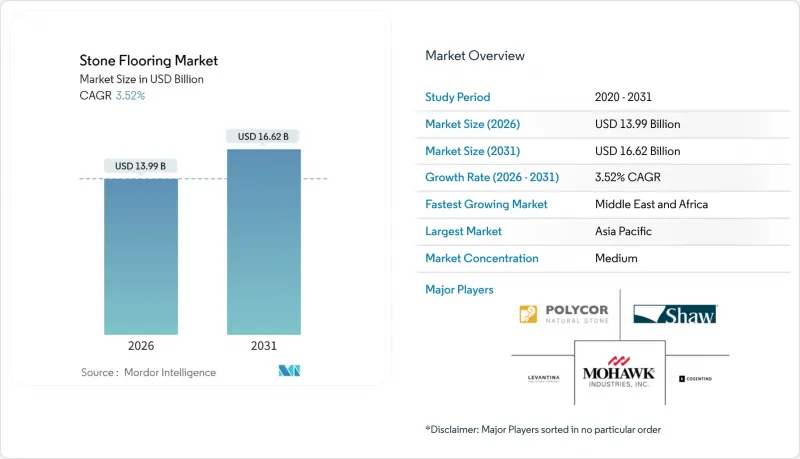
이러한 성장은 프리미엄 포지셔닝, 지속 가능한 조달, 기술 활용 가공이 대량 생산 경쟁보다 우위에 있는 성숙한 시장 환경을 반영합니다. 절단 및 마감 공정에서 자동화를 활용하는 공급업체는 대형 패널의 엄격한 공차 요구 사항을 충족시키면서 비용 우위를 확대할 수 있습니다. 유럽의 역사적 건축물 개보수에 대한 정책적 지원, 세계 호텔 건설 수요의 회복, 공급이 부족한 미국 주택 시장이 결합하여 경기 순환 둔화를 완화하는 수요 기반을 형성하고 있습니다. 그러나 중국산 절석재에 대한 관세 변동, 심각한 시공자 부족, 석재 플라스틱 복합재(SPC) 바닥재의 급속한 보급으로 인해 기존의 수익모델에 도전이 되고 있습니다. 경쟁의 격렬함은 여전히 중간 수준이지만, 주요 기업들은 점유율 방어와 수익률 향상을 위해 지속가능성, 지역 생산, 디지털화를 통한 서비스에 자본을 재분배하고 있습니다.
세계 석재 바닥재 시장 동향 및 인사이트
미국 2급 대도시권 고급 주택 완공 건수 급증
오스틴, 내슈빌, 샬럿 등 미국 2차 도시권은 기존 해안 도시에 집중되어 있던 개발업체들의 주목을 받고 있습니다. 2024년 오스틴의 신규 주택 거래가 40% 감소했음에도 불구하고, 전국적으로 약 450만 가구의 주택 부족은 장기적인 수요의 견고함을 보여줍니다. 이들 시장의 건설업체들은 특히 내구성이 요구되는 오픈 플랜 주방이나 야외 거실 공간에서 차별화를 위한 고급 마감재로 석재 바닥재를 선호하고 있습니다. 유연한 물류 시스템을 갖춘 공급업체는 경기 침체기에 투기성 프로젝트가 재고를 처분할 때 이익을 확보하고, 허가 건수가 회복되면 빠르게 규모를 확대할 수 있습니다. 지역 업체들은 주요 시장에만 집중하는 대형 브랜드와 달리, 지역의 설계 기준과 기후 조건에 맞는 제품 구성으로 선구자적 우위를 점하고 있습니다. 1급 도시의 토지 제약이 심해짐에 따라 투자가 내륙으로 이동하여 더 넓은 고객층에서 석재 바닥재 시장을 지속시키고 있습니다.
EU의 역사적 건축물 개보수 세금 환급 제도
유럽연합 회원국에서는 건축 유산 보존을 위한 재정적 인센티브를 도입하는 사례가 증가하고 있으며, 역사적 정확성 요건을 충족하는 진품 석재에 대한 전문적인 수요 채널이 창출되고 있습니다. 영국에서 보호 건축물의 허가된 개보수 공사에 적용되는 소비세 면제 제도는 규제 프레임워크가 어떻게 고급 석재 수요를 자극할 수 있는지, 특히 특정 채석장 산재와 전통적 마감 기술을 필요로 하는 프로젝트에서 그 가능성을 보여주고 있습니다. 이러한 제도는 종종 원석종 사용과 전통적 시공방법을 의무화하여 인공석재의 진입장벽을 높이는 동시에, 천연석재에 대한 프리미엄 가격을 지탱하고 있습니다. 유산 보호 요건의 복잡성은 확실한 출처 증명과 역사적 복원 기술에 대한 전문 지식을 갖춘 전통 있는 석재 공급업체에 유리하게 작용합니다.
중국산 절석재에 대한 변동관세
미국이 중국산 석재의 일부 등급에 대한 관세를 2025년에 145%까지 인상하고, 인도산 및 EU산 석재에 대한 관세는 20%에서 26%까지 인상하여 세계 무역의 흐름을 왜곡하고 있습니다. 모호크 인더스트리즈(Mohawk Industries)는 국내 사업 규모가 큰데도 불구하고 2025년 1분기 관세 비용으로 5,000만 달러(한화 약 5,000억 원)를 기록했다고 보고했습니다. 대형 유통업체들은 관세 완화 기간 동안 사전 구매를 통해 재고 및 창고 보관 비용을 증가시키고 있습니다. 한편, 소규모 수입업체들은 가격 급등으로 파산 위험에 직면하고 있으며, 업계 구조조정이 가속화되고 있습니다. 공사 예산이 고정된 프로젝트에서 자재비가 급등할 경우 변경지시 관련 분쟁이 발생할 수 있습니다. 튀르키예, 스페인 또는 미국에 채석장을 소유한 기업은 협상력이 높아지지만, 여전히 운송 컨테이너 부족과 국내 운송 비용 상승에 직면해 있습니다. 무역협상이 타결되지 않았기 때문에 석재 바닥재 시장의 모든 관계자들은 납품 가격과 납기를 예측할 수 없는 상황입니다.
부문 분석
대리석은 시대를 초월한 고급스러움으로 인해 2025년에도 석재 바닥재 시장 점유율 32.20%를 유지했습니다. 그러나 엔지니어링 복합재는 5.26%의 연평균 복합 성장률(CAGR)로 빠르게 성장하고 있어 전체 석재 바닥재 시장의 성장 궤도를 분명히 상회하고 있습니다. 화강암은 보행 내구성이 최우선인 분야에서는 견고함을 유지하며, 석회암과 석회화는 지중해풍 주택에 선호됩니다. 슬레이트와 사암은 미끄럼 방지와 소박한 미학으로 평가받으며 틈새 시장을 형성하고 있습니다. 인공 석영과 소결석 제품은 거의 제로에 가까운 다공성으로 천연석 줄무늬를 재현하여 호텔 욕실이나 공동주택 주방에 많이 채택되고 있습니다. 저실리카 배합 기술의 발전으로 미국 여러 기관에서 지적하는 직업적 건강 위험을 줄이고, 규제 측면의 역풍도 완화되고 있습니다. 가공 공장이 자동화와 폐쇄형 물 재활용을 도입함에 따라 생산 효율이 향상되고 폐기물이 감소합니다. 이를 통해 수익률 저하 없이 경쟁력 있는 가격 책정이 가능합니다.
인조석재의 성장 전망은 모조 라미네이트 소재를 능가하는 지속적인 디자인 혁신에 달려 있습니다. 증강현실을 통한 시각화와 신속한 샘플 제공이 결합된 공급업체는 현장 측정 전 설계 단계부터 영향력을 발휘하여 수주를 확정하고 있습니다. 이에 반해 대리석 채석장은 프리미엄 가격을 정당화하기 위해 원산지 추적 가능한 스토리와 탄소발자국 공개를 추진하고 있습니다. 또한, 알루미늄 허니컴으로 보강한 박판대리석 하이브리드 구조물을 공동 개발하여 무게와 시공 속도에서 경쟁력을 높이고 있습니다. 장기적으로 두 카테고리는 공존하지만, 실리카 프리 화학 기술이 색조 깊이와 가장자리 연마 품질에서 동등성을 달성하면 복합재료로의 점유율 이동이 가속화 될 것입니다.
2025년 기준 주택 구매자가 석재 바닥재 시장의 57.40%를 차지했지만, 2031년까지 연평균 복합 성장률(CAGR) 6.03%로 상업용 수요가 앞서고 있습니다. 호텔, 사무실 로비, 고등교육시설에서는 브랜드 가치 향상과 라이프사이클 내구성으로 인해 천연석재가 지정되고 있습니다. 노후화 된 의료시설의 개조는 저 다공성 화강암과 석영이 위생 요구 사항을 충족시키는 데 중점을 둡니다. 한편, 주택담보대출 금리의 고공행진과 소비자들의 신중한 태도로 인해 신규 단독주택 착공 건수는 억제되어 주택 수요는 당분간 둔화될 것으로 보입니다. 바닥재 지출의 80%를 차지하는 리폼 수요는 저조하지만 잠재 수요를 보유하고 있으며, 금리가 하락하면 잠재 수요가 풀릴 것으로 예측됩니다.
상업적 구매자는 더 큰 로트 크기와 엄격한 납기 준수를 요구하며, 사내 설계 능력과 적시 납품이 가능한 공급업체를 우선시합니다. 10년 이상의 제품 보증과 서비스 계약이 결합되어 지속적인 수익원을 창출할 수 있습니다. 주거용 채널, 특히 DIY 중심의 홈센터에서는 전문 인력을 최소화하는 클릭식 엔지니어드 스톤 패널로 전환이 진행되고 있습니다. 디자인 센터 전시장에서 건설사와의 전략적 제휴를 통해 자연석은 주택 구매자의 눈에 띄고, 그렇지 않으면 SPC나 고급 비닐 타일을 선택할 수 있는 계층에 대한 호소력을 유지하고 있습니다.
지역별 분석
아시아태평양은 2025년 기준 41.05%의 압도적인 점유율을 유지했습니다. 이는 중국의 수직 통합 석재 클러스터와 인도의 특수 화강암 수출에 힘입은 것이지만, 양국은 미국의 최대 145%와 26%의 관세((4) 참조)에 직면해 있습니다. 지역적 인건비 우위가 운송비 증가를 상쇄하고, 현지화된 전자상거래 플랫폼이 동남아시아 신흥 시장을 개척하고 있습니다. 한편, 중동 및 아프리카의 석재 바닥재 시장 규모는 사우디아라비아의 기록적인 호텔 건설 계획과 정부 지원 채석장 라이선싱을 배경으로 CAGR 4.47%로 가장 빠르게 확대될 것으로 예측됩니다. 아프리카의 인프라 투자 확대(시멘트 수요가 2024년 350억 달러에서 2030년까지 420억 달러로 증가)는 잠재적 시장 규모를 더욱 확대할 것입니다.
북미는 복잡한 상황에 직면해 있습니다. 주택담보대출 금리 상승으로 주택 착공이 억제된 반면, 450만 가구공급 부족으로 인한 수요는 여전히 누적되어 있습니다. 미국에서는 주택 개보수 시장이 조심스러운 태도를 보이고 있지만, 법원이나 학교 등 공공 부문 개보수 예산은 계속 투입되고 있습니다. 유럽에서는 개보수 세금 환급 제도와 탄소 발자국에 대한 관심이 높아지면서 설계자들이 현지 채석장 석재를 선택하는 경향이 강해져 운송 시 배출량이 감소하고 있습니다. 환경 제품 선언(EPD) 인증을 획득한 기업은 EU 기후법 목표에 묶여 있는 입찰에서 우위를 점하고 있습니다.
기타 특전:
- 엑셀 형식 시장 예측(ME) 시트
- 애널리스트의 3개월간 지원
자주 묻는 질문
목차
제1장 서론
제2장 조사 방법
제3장 주요 요약
제4장 시장 구도
제5장 시장 규모와 성장 예측(금액 : 달러)
제6장 경쟁 구도
제7장 시장 기회와 향후 전망
LSH 26.03.03The stone flooring market was valued at USD 13.51 billion in 2025 and estimated to grow from USD 13.99 billion in 2026 to reach USD 16.62 billion by 2031, at a CAGR of 3.52% during the forecast period (2026-2031).
Growth reflects a maturing landscape in which premium positioning, sustainable sourcing, and technology-enabled fabrication outweigh volume-driven competition. Suppliers that leverage automation in cutting and finishing operations are widening cost advantages while meeting stricter tolerance requirements for large-format panels. Policy incentives for heritage renovation in Europe, a resurgent global hotel pipeline, and an under-supplied United States housing market together form a demand backbone that cushions cyclical slowdowns. However, tariff volatility on Chinese dimensional stone, an acute installer labor shortage, and fast-rising adoption of stone-plastic-composite (SPC) flooring challenge traditional revenue models. Competitive intensity remains moderate; leading firms are reallocating capital toward sustainability, regional production, and digitally enabled services to defend share and lift margins.
Global Stone Flooring Market Trends and Insights
Surging Luxury Housing Completions in Tier-2 United States Metros
Secondary United States metros such as Austin, Nashville, and Charlotte are attracting developers that once focused on coastal cities. Even after a 40% dip in Austin's new-build transactions during 2024, the national housing shortage of about 4.5 million units points to resilient long-run demand. Builders in these markets favor stone flooring for upscale finishes that differentiate their offerings, particularly in open-plan kitchens and outdoor living areas where durability matters. Suppliers with flexible logistics can capture margin when speculative projects liquidate inventory during down cycles, then scale up rapidly when permits rebound. Regional players gain first-mover advantages by tailoring assortments to local design codes and climate demands while larger brands remain fixated on primary markets. As land constraints tighten in Tier-1 cities, investment migrates inland, sustaining the stone flooring market across a broader customer base.
Tax-Rebate Programs for Historic-Building Renovations in EU
European Union member states increasingly deploy fiscal incentives to preserve architectural heritage, creating specialized demand channels for authentic stone materials that comply with historical accuracy requirements. The zero VAT rate applicable to approved alterations of protected buildings in the UK exemplifies how regulatory frameworks can stimulate premium stone demand, particularly for projects requiring specific quarry sources or traditional finishing techniques. These programs often mandate the use of original stone types and traditional installation methods, creating barriers to entry for engineered alternatives while supporting premium pricing for authentic materials. The complexity of heritage compliance requirements favors established stone suppliers with documented provenance and technical expertise in historical restoration techniques.
Volatile Import Tariffs on Chinese Dimensional Stone
United States tariffs on some Chinese stone grades escalated to 145% in 2025, while duties on Indian and EU stone range between 20% and 26%, distorting global trade flows. Mohawk Industries cited USD 50 million in tariff costs for Q1 2025 despite its sizable domestic footprint. Large distributors pre-buy during tariff lulls, lifting inventories and warehousing costs, whereas smaller importers risk bankruptcy amid price spikes, accelerating consolidation. Projects with locked construction budgets face change-order disputes when material costs surge. Companies that own quarries in Turkey, Spain, or inside the United States have more bargaining power, but they still face a shortage of shipping containers and higher domestic transport costs. Because trade negotiations are still unsettled, delivered prices and delivery schedules remain unpredictable for everyone in the stone flooring market.
Other drivers and restraints analyzed in the detailed report include:
- Rapid Hotel Pipeline Expansion Across GCC States
- Rising Adoption of Large-Format Gauged Stone Panels
- Labor Shortages in Qualified Stone Installers
For complete list of drivers and restraints, kindly check the Table Of Contents.
Segment Analysis
Marble retained 32.20% of stone flooring market share in 2025 on the back of its timeless luxury appeal, yet engineered composites are accelerating at a 5.26% CAGR, notably above the stone flooring market growth trajectory. Granite stays resilient where foot-traffic durability is paramount, while limestone and travertine appeal to Mediterranean-inspired residences. Slate and sandstone remain niche, valued for slip resistance and rustic aesthetics. Engineered quartz and sintered-stone products replicate veining with near-zero porosity, winning specification in hospitality bathrooms and multifamily kitchens. Advances in low-silica formulations reduce occupational health risks flagged by several United States agencies, easing regulatory headwinds. As fabrication plants integrate automation and closed-loop water recycling, production yields rise and waste declines, allowing competitive pricing without compromising margins.
Growth prospects for engineered stone hinge on continuous design innovation that stays ahead of counterfeit laminates. Suppliers coupling augmented-reality visualization with speedy sample fulfillment influence early design decisions, locking in orders before site measurement. Marble quarries, in response, promote traceable origin stories and carbon-footprint disclosures to justify premium pricing. They also co-develop hybrid assemblies-thin-cut marble reinforced with aluminum honeycomb-to compete on weight and installation speed. Long term, the two categories will coexist, but share shifts toward composites will intensify if silica-free chemistries achieve parity in color depth and edge polish quality.
Residential buyers represented 57.40% of the stone flooring market size in 2025, yet commercial demand is pacing ahead at a 6.03% CAGR through 2031. Hotels, office lobbies, and higher-education facilities specify natural stone for brand elevation and lifecycle durability. Renovations across aging healthcare campuses underscore hygiene imperatives met by low-porosity granite and quartz. Conversely, high mortgage rates and consumer caution curb new single-family starts, muting near-term residential volume. Remodeling, which accounts for 80% of flooring spend, remains subdued but stores latent demand that should unlock once interest rates soften.
Commercial buyers offer larger lot sizes and tighter schedule adherence, favoring suppliers with in-house drafting and just-in-time delivery. Product warranties exceeding 10 years, coupled with service contracts, open annuity revenue streams. Residential channels, especially DIY-oriented home centers, pivot toward click-together engineered stone panels that minimize professional labor needs. Strategic partnerships with builders for design-center displays keep natural stone visible to homebuyers who might otherwise default to SPC or luxury vinyl tile.
The Stone Flooring Market Report is Segmented by Product Type (Marble, Granite, Slate, Sandstone, and More), End User (Residential, Commercial), Construction Type (New Construction, Remodeling/Retrofit), Distribution Channel (B2C/Retail Consumers, B2B/Contractors/Builders), and Geography (North America, South America, Europe, Asia-Pacific, and More). The Market Forecasts are Provided in Terms of Value (USD).
Geography Analysis
Asia-Pacific preserved a commanding 41.05% share in 2025, buoyed by China's vertically integrated stone cluster and India's specialty granite exports, though both contend with United States tariffs of up to 145% and 26% respectively. [4]. Regional labor-cost advantages offset shipping premiums, and localized e-commerce portals are opening emerging Southeast Asian markets. Meanwhile, the stone flooring market size for the Middle East and Africa is forecast to rise fastest at 4.47% CAGR, underpinned by a record hotel construction pipeline and government-backed quarry licensing in Saudi Arabia. African infrastructure outlays, evidenced by cement demand climbing from USD 35.0 billion in 2024 to USD 42.0 billion by 2030, further expand addressable volumes.
North America faces mixed conditions: elevated mortgage rates dampen housing starts, but pent-up demand remains due to a 4.5 million-unit shortage. The United States remodel sector turns cautious, yet public-sector renovation budgets continue flowing into courthouses and schools. Europe benefits from renovation tax rebates and growing carbon-footprint scrutiny that nudges specifiers toward locally quarried stone, reducing transport emissions. Firms that certify Environmental Product Declarations gain an edge in tenders bound by EU Climate Law targets.
- Antolini Luigi & C. S.p.A.
- Arizona Tile, LLC
- Aro Granite Industries Ltd.
- Bedrosians Tile & Stone
- Caesarstone Ltd.
- Cambria Company LLC
- Cosentino S.A.
- Dal-Tile Corporation
- Dimpomar
- Finstone Group
- Florim S.p.A.
- Fox Marble Holdings plc
- Johnson Tiles
- Laticrete International, Inc.
- Levantina y Asociados de Minerales, S.A.
- Mohawk Industries
- MSI Surfaces
- Polycor Inc.
- Porcelanosa Grupo
- R.E.D. Graniti S.p.A.
- Shaw Industries
- Santucci Group
- Temmer
- Topalidis
- Universal Marble & Granite Group
Additional Benefits:
- The market estimate (ME) sheet in Excel format
- 3 months of analyst support
TABLE OF CONTENTS
1 Introduction
- 1.1 Study Assumptions and Market Definition
- 1.2 Scope of the Study
2 Research Methodology
3 Executive Summary
4 Market Landscape
- 4.1 Market Overview
- 4.2 Market Drivers
- 4.2.1 Surging luxury-housing completions in Tier-2 United States metros
- 4.2.2 Tax-rebate programs for historic-building renovations in EU
- 4.2.3 Rapid hotel pipeline expansion across GCC states
- 4.2.4 Rising adoption of large-format gauged stone panels
- 4.2.5 Consumer Preference for Durable and Premium Aesthetic Materials
- 4.2.6 Technological Advancements in Cutting and Finishing Techniques
- 4.3 Market Restraints
- 4.3.1 Volatile import tariffs on Chinese dimensional stone
- 4.3.2 Labor shortages in qualified stone installers
- 4.3.3 Increasing popularity of SPC/LVT alternatives
- 4.3.4 Embodied-carbon regulations restricting natural stone (under-the-radar)
- 4.4 Industry Value Chain Analysis
- 4.5 Porter's Five Forces Analysis
- 4.5.1 Threat of New Entrants
- 4.5.2 Bargaining Power of Suppliers
- 4.5.3 Bargaining Power of Buyers
- 4.5.4 Threat of Substitutes
- 4.5.5 Competitive Rivalry
- 4.6 Insights into the Latest Trends and Innovations in the Market
- 4.7 Insights on Recent Developments (New Product Launches, Strategic Initiatives, Investments, Partnerships, JVs, Expansion, M&As, etc.) in the Market
5 Market Size & Growth Forecasts (Value in USD)
- 5.1 By Product Type
- 5.1.1 Marble
- 5.1.2 Granite
- 5.1.3 Limestone and Travertine
- 5.1.4 Slate
- 5.1.5 Sandstone
- 5.1.6 Engineered/Composite Stone
- 5.2 By End User
- 5.2.1 Residential
- 5.2.2 Commercial
- 5.2.2.1 Hospitality and Leisure
- 5.2.2.2 Retail and Shopping Centers
- 5.2.2.3 Healthcare Facilities
- 5.2.2.4 Education
- 5.2.2.5 Corporate Offices
- 5.2.2.6 Public and Government Buildings
- 5.2.2.7 Other Commercial Users
- 5.3 By Construction Type
- 5.3.1 New Construction
- 5.3.2 Remodeling/Retrofit
- 5.4 By Distribution Channel
- 5.4.1 B2C/Retail Consumers
- 5.4.1.1 Home Centers
- 5.4.1.2 Specialty Flooring Stores
- 5.4.1.3 Online
- 5.4.1.4 Other Distribution Channels
- 5.4.2 B2B/Contractors/Builders
- 5.4.1 B2C/Retail Consumers
- 5.5 By Geography
- 5.5.1 North America
- 5.5.1.1 United States
- 5.5.1.2 Canada
- 5.5.1.3 Mexico
- 5.5.2 South America
- 5.5.2.1 Brazil
- 5.5.2.2 Peru
- 5.5.2.3 Chile
- 5.5.2.4 Argentina
- 5.5.2.5 Rest of South America
- 5.5.3 Europe
- 5.5.3.1 United Kingdom
- 5.5.3.2 Germany
- 5.5.3.3 France
- 5.5.3.4 Spain
- 5.5.3.5 Italy
- 5.5.3.6 BENELUX
- 5.5.3.7 NORDICS
- 5.5.3.8 Rest of Europe
- 5.5.4 Asia-Pacific
- 5.5.4.1 India
- 5.5.4.2 China
- 5.5.4.3 Japan
- 5.5.4.4 Australia
- 5.5.4.5 South Korea
- 5.5.4.6 South East Asia
- 5.5.4.7 Rest of Asia-Pacific
- 5.5.5 Middle East and Africa
- 5.5.5.1 United Arab Emirates
- 5.5.5.2 Saudi Arabia
- 5.5.5.3 South Africa
- 5.5.5.4 Nigeria
- 5.5.5.5 Rest of Middle East and Africa
- 5.5.1 North America
6 Competitive Landscape
- 6.1 Market Concentration
- 6.2 Strategic Moves
- 6.3 Market Share Analysis
- 6.4 Company Profiles (includes Global level Overview, Market level overview, Core Segments, Financials as available, Strategic Information, Market Rank/Share for key companies, Products & Services, and Recent Developments)
- 6.4.1 Antolini Luigi & C. S.p.A.
- 6.4.2 Arizona Tile, LLC
- 6.4.3 Aro Granite Industries Ltd.
- 6.4.4 Bedrosians Tile & Stone
- 6.4.5 Caesarstone Ltd.
- 6.4.6 Cambria Company LLC
- 6.4.7 Cosentino S.A.
- 6.4.8 Dal-Tile Corporation
- 6.4.9 Dimpomar
- 6.4.10 Finstone Group
- 6.4.11 Florim S.p.A.
- 6.4.12 Fox Marble Holdings plc
- 6.4.13 Johnson Tiles
- 6.4.14 Laticrete International, Inc.
- 6.4.15 Levantina y Asociados de Minerales, S.A.
- 6.4.16 Mohawk Industries
- 6.4.17 MSI Surfaces
- 6.4.18 Polycor Inc.
- 6.4.19 Porcelanosa Grupo
- 6.4.20 R.E.D. Graniti S.p.A.
- 6.4.21 Shaw Industries
- 6.4.22 Santucci Group
- 6.4.23 Temmer
- 6.4.24 Topalidis
- 6.4.25 Universal Marble & Granite Group
7 Market Opportunities and Future Outlook
- 7.1 Shift Toward Sustainable and Recycled Stone Materials
- 7.2 Adoption of Advanced Surface Treatments and Finishes