|
시장보고서
상품코드
1934748
상지 보철물 : 시장 점유율 분석, 업계 동향과 통계, 성장 예측(2026-2031년)Upper Limb Prosthetics - Market Share Analysis, Industry Trends & Statistics, Growth Forecasts (2026 - 2031) |
||||||
 Mordor Intelligence
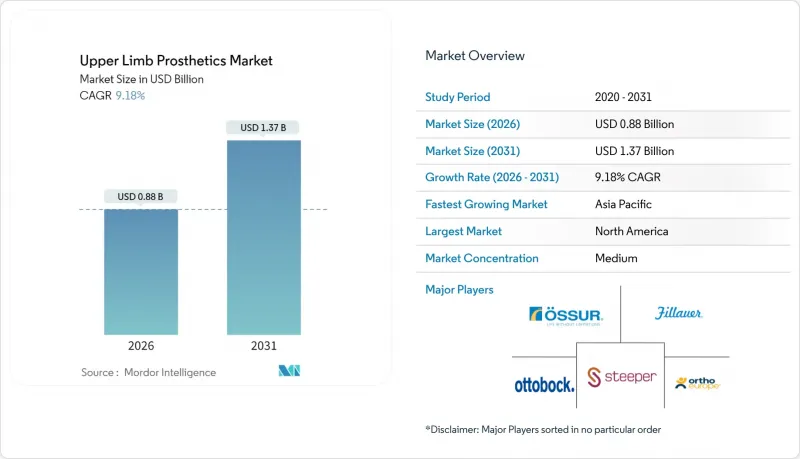
상지 보철물 시장은 2025년에 8억 1,000만 달러로 평가되었고, 2026년 8억 8,000만 달러에서 2031년까지 13억 7,000만 달러에 이를 것으로 예측됩니다.
예측 기간(2026-2031년)의 CAGR은 9.18%로 예상됩니다.
뇌-컴퓨터 인터페이스의 급속한 발전, 고소득 경제권에서의 상환 범위 확대, 군사 연구에서 민간 제품으로의 꾸준한 기술 이전이 성장을 뒷받침하고 있습니다. 당뇨병 관련 절단 수술 및 외상 사례 증가로 환자층이 확대되는 한편, 인공지능을 접목한 근전도의족 시스템은 기능성과 사용자 수용성을 향상시키고 있습니다. 탄탄한 벤처 자금 조달이 제품 개발을 가속화하는 반면, 공급망의 불안정성과 높은 비용이 보급을 억제하고 있으며, 특히 개발도상국에서 두드러지게 나타나고 있습니다.
세계 상지 보철물 시장 동향과 인사이트
외상성 및 당뇨병 관련 절단 사례 증가
절단 역학에서 당뇨병이 사지 손실의 주요 원인으로 부상하고 있으며, 분쟁과 사고로 인한 외상도 여전히 중요한 요인으로 작용하고 있습니다. 생존자들은 건강 상태의 변화에 따라 적응력이 높은 장치가 필요하기 때문에 인지적 부담을 최소화하는 직관적인 솔루션에 대한 수요가 증가하고 있습니다. 인공지능 컨트롤러는 잔존 근육 신호를 학습하고 절단 부위의 부피 변화에 적응하기 때문에 일상적인 착용 시간이 연장됩니다. 의료진으로부터 복잡한 양측 의수족의 적합에 대한 의뢰가 증가하고 있으며, 신체의 일부로 인식되는 신경통합형 의족에 대한 관심이 높아지고 있습니다. 역학 및 기술 혁신과 함께 대상 인구층의 확대와 삶의 질 향상으로 상지 보철물 시장은 성장하고 있습니다.
근전식-바이오닉 기술의 급속한 확산
근전기의수는 과거에는 기본적인 파지 기능에 국한되어 있었으나, 현재는 신경 자극을 통한 개별 손가락 제어와 촉각 피드백을 실현하고 있습니다. 뇌-컴퓨터 인터페이스는 국소적인 촉각을 가능하게 하고, 물체의 가장자리와 움직임을 감지할 수 있게 되었습니다. 메디케어의 새로운 코드 L6700이 패턴인식 모듈을 적용대상으로 지정됨에 따라 환자 본인부담금이 줄어들고, 훈련기간도 단축되었습니다. 환각통 완화를 위한 알티우스 직접 신경자극 시스템의 FDA 승인도 기기 도입을 더욱 촉진하고 있습니다. 이러한 발전과 함께 기계식 스위치를 신경 지령으로 대체하면서 상지 보철물 시장이 가속화되고 있습니다.
고비용 장비 및 유지보수
첨단 바이오닉 암은 보통 10만원 이상이며, 배터리 교체, 소프트웨어 업데이트, 정기적인 재조정이 필요하며, 연간 수천 달러의 유지보수 비용이 추가됩니다. 중진국에서의 상환 격차로 인해 많은 환자들이 미용용 기기로 타협할 수밖에 없어 스마트 시스템의 보급을 가로막고 있습니다. 프랑스의 요금 인하는 이미 제품 철수 경고를 불러일으키고 있으며, 비용 억제가 접근성에 역효과를 낼 수 있음을 보여주고 있습니다. 보훈처의 골통합형 임플란트 보험 적용은 모든 절단 환자에게 적용되지 않는 선택적 특혜입니다. 따라서 높은 총소유비용이 상지 보철물 시장을 압박하고 있으며, 특히 국민보험제도가 예산 압박에 직면한 국가에서 두드러지게 나타나고 있습니다.
부문 분석
2025년 기준 근전동 시스템은 상지 보철물 시장의 25.40%를 차지할 것이며, 3D 프린팅을 통한 모듈형 대체품은 2031년까지 연평균 9.94%의 연평균 복합 성장률(CAGR)로 확대될 것입니다. 근전 제어는 잔존 근육 신호를 분석하여 비례적인 파지력과 개별 손가락 동작을 실현. 이분법적인 신체 동력 후크에서 비약적인 진화를 거듭하고 있습니다. 대학에서는 근전도와 근전도를 결합하여 손의 움직임을 97%의 정확도로 예측하는 데 성공하여 원활한 의도 인식의 길을 열었습니다. 케이블 제어와 전자 제어를 융합한 하이브리드 솔루션은 전력이 부족할 때 사용자에게 대안을 제공하고, 원격지 상지 보철물 산업의 확장에 기여하고 있습니다.
분산형 제조의 부상은 상지 보철물 시장을 더욱 촉진하고 있습니다. 오픈소스 플랫폼을 통해 의료 기관은 데스크톱 프린터로 모듈식 의수를 제작하고, 공장에서 기다릴 필요 없이 부품을 교체할 수 있게 되었습니다. 패턴 인식 컨트롤러(코드 L6700)에 대한 메디케어 적용으로 미국 사용자의 총소유비용이 절감되었습니다. 증강현실 시뮬레이터는 훈련 기간을 수개월에서 수주로 단축시켜 근전기의수 보급의 장애물이었던 문제를 해결하고 있습니다. 이러한 발전과 함께, 저가형 프린팅 디바이스가 가격 중시층을 확보하는 가운데서도 근전기의수족의 우위는 지속될 것이며, 상지 의수 시장에서 프리미엄층과 가치층이 강화될 것으로 보입니다.
2025년 손과 손목 유닛은 상지 보철물 시장 규모의 20.75%를 차지하며 2031년까지 9.28%의 연평균 복합 성장률(CAGR)을 보일 것으로 예측됩니다. 엔드 이펙터의 성능에 초점을 맞춘 것은 식사, 옷 갈아입기, 타이핑과 같은 일상 생활의 필요에 기인합니다. 존스홉킨스 대학의 하이브리드 연성-경질 복합 핸드는 표적화된 신경 자극을 통한 실시간 감각 피드백을 이용하여 물체를 부수지 않고도 섬세한 작업을 가능하게 합니다.
척수 반사 자극의 조사로 비자발적 그립 제어가 가능하여 반복 작업 중 정신적 부담을 줄일 수 있습니다. 어깨와 팔꿈치 구성 요소는 도달 궤도와 하중에 자동으로 적응하는 마이크로프로세서에 의해 개선되었지만 여전히 비싸고 보험 적용 범위가 넓지 않습니다. 다단계 핸드 클래스 II 장비 분류를 통해 제조업체는 예측 가능한 규제 경로를 얻을 수 있으며 단계적 업그레이드를 촉진할 수 있습니다. 사용자의 기대치가 높아짐에 따라 공급업체들은 모듈식 손목, 퀵 체인지 도구, 촉각 스킨을 번들로 제공하여 상지 보철물 시장에서 지갑의 점유율을 확대하고 있습니다.
지역별 분석
북미는 선진적인 보험 적용과 집중적인 R&D 자금으로 인해 2025년 매출의 40.05%를 차지할 것으로 예측됩니다. DARPA의 1억 7,000만 달러 규모의 '혁명적 의족 개발 계획'은 많은 민간 기술 이전을 창출했고, 캐나다의 보편적 의료보험 제도는 안정적인 수요를 보장합니다. 그러나, 이 지역에서는 코로나19 사태로 인해 공급 부족이 발생했고, FDA가 의족 부품의 재고 관리를 강화한 결과, 소아용 부품의 틈새 시장에서 공급 부족이 나타났습니다. 패턴 인식 코드의 지속적인 통합과 재향군인들을 위한 뼈 통합 치료의 보험 적용은 북미 상지 보철물 시장에서의 선도적 지위를 뒷받침하고 있습니다.
아시아태평양은 일본, 중국, 인도의 의료비 지출 증가, 고령화, 정책적 지원을 배경으로 2026년부터 2031년까지 연평균 복합 성장률(CAGR) 8.31%를 나타낼 것으로 예측됩니다. 일본의 의료기기 수입은 견조한 성장세를 유지하고 있으며, 로봇 공학 문화가 바이오닉 암의 보급을 가속화하고 있습니다. 중국에서는 국내 제조업체들이 비용 최적화된 근전기의수술을 대량 생산하고 있지만, 복잡한 승인 절차와 지역별로 다른 보험제도의 차이로 인해 시장 기회가 분열되어 있습니다. 인도의 'Ayushman Bharat' 계획은 저렴한 가격을 촉진하고, 3D 프린팅 장치 시장 창출로 이어지고 있습니다. 디지털 인프라의 격차와 임상의 부족이 성장을 저해하는 요인으로 작용하고 있지만, 전반적인 모멘텀은 아시아태평양 전체 상지 보철물 시장을 견인하고 있습니다.
유럽에서는 상반된 징후가 나타나고 있습니다. 독일과 영국은 오토복 등 세계적인 수출기업을 배경으로 적극적인 기술 혁신을 추진하고 있습니다. 그러나 프랑스에서는 2025년부터 25%의 보험급여 삭감으로 재정 긴축 정책이 부각되면서 첨단 보조기구의 보급을 제한할 가능성이 있습니다. EU의 엄격한 의료기기 규정(MDR)은 컴플라이언스 비용을 증가시키지만, 동시에 국제적인 신뢰도를 높이고 있습니다. 국경을 넘나드는 인수로 인해 외국인 투자자가 현지 성형외과 기업의 60%를 지배하는 상황이 발생하여 국내 가치 유지에 대한 논쟁을 불러일으키고 있습니다. 역풍에도 불구하고 유럽은 여전히 최첨단 기술의 시금석으로 상지 보철물 시장에서 전략적 중요성을 강화하고 있습니다.
기타 특전:
- 엑셀 형식 시장 예측(ME) 시트
- 애널리스트의 3개월간 지원
자주 묻는 질문
목차
제1장 서론
제2장 조사 방법
제3장 주요 요약
제4장 시장 구도
제5장 시장 규모와 성장 예측
제6장 경쟁 구도
제7장 시장 기회와 향후 전망
LSH 26.03.05The upper limb prosthetics market was valued at USD 0.81 billion in 2025 and estimated to grow from USD 0.88 billion in 2026 to reach USD 1.37 billion by 2031, at a CAGR of 9.18% during the forecast period (2026-2031).
Rapid advances in brain-computer interfaces, broader reimbursement in high-income economies, and the steady transfer of military research to civilian products underpin growth. Rising diabetes-related amputations and trauma cases increase patient pools, while myoelectric systems enriched with artificial intelligence improve functionality and user acceptance. Robust venture funding accelerates product pipelines, yet supply-chain volatility and high device costs temper adoption, particularly in developing regions.
Global Upper Limb Prosthetics Market Trends and Insights
Growing Incidence of Traumatic & Diabetes-Related Amputations
Amputation epidemiology now shows diabetes as a central cause of limb loss, and trauma from conflict or accidents remains significant. Survivors often need adaptable devices as health conditions shift, driving demand for intuitive solutions that minimize cognitive load. Artificial-intelligence controllers learn residual muscle signals and adjust to fluctuating stump volume, increasing day-to-day wear time. Providers also report rising referrals for complex bilateral fittings, spurring interest in neurally-integrated limbs perceived as part of the body. Taken together, epidemiology and innovation lift the upper limb prosthetics market by widening addressable populations and improving quality-of-life outcomes.
Rapid Adoption of Myoelectric & Bionic Technologies
Myoelectric hands once limited to basic grasp now deliver individual finger control and touch feedback through targeted nerve stimulation. Brain-computer interfaces enable localized tactile sensations, letting users feel object edges and motion. Medicare's new L6700 code covers pattern-recognition modules, reducing patient co-pay barriers and shortening training times. FDA clearance of the Altius direct nerve-stimulation system for phantom-pain relief further motivates device uptake. Collectively, these milestones accelerate the upper limb prosthetics market by replacing mechanical switches with neural intent.
High Device & Maintenance Costs
Advanced bionic arms routinely list above USD 100,000 and require battery changes, software upgrades, and periodic recalibration that add thousands in annual upkeep. Reimbursement gaps in middle-income economies force many patients to settle for cosmetic devices, depressing the penetration of smart systems. France's tariff cuts have already triggered warnings of product withdrawal, revealing how cost containment can backfire on access. Veterans Affairs coverage of osseointegration implants shows selective generosity that does not extend to all amputees. High total cost of ownership therefore drags on the upper limb prosthetics market, particularly where national insurance schemes face budget pressure.
Other drivers and restraints analyzed in the detailed report include:
- Expanding Reimbursement Frameworks in High-Income Economies
- Industrial 3D-Printing Supply Chains Enable Mass-Custom Sockets
- Limited Clinical Capacity & User Training in Developing Regions
For complete list of drivers and restraints, kindly check the Table Of Contents.
Segment Analysis
Myoelectric systems held a 25.40% share of the upper limb prosthetics market in 2025, while 3D-printed modular alternatives are growing at a 9.94% CAGR to 2031. Myoelectric control interprets residual muscle signals to deliver proportional grip force and individual finger motion, a leap from binary body-powered hooks. Universities demonstrated 97% accuracy in predicting hand movements by combining electromyography with force myography, paving the way for seamless intent recognition. Hybrid solutions that blend cable and electronic control give users a fallback option when power is scarce, helping expand the upper limb prosthetics industry in remote areas.
The rise of distributed manufacturing further fuels the upper limb prosthetics market: open-source platforms let clinics fabricate modular hands on desktop printers and swap parts without factory wait times. Medicare coverage for pattern-recognition controllers under code L6700 reduces the total cost of ownership for U.S. users. Extended-reality simulators shorten training from months to weeks, addressing a historic barrier to myoelectric uptake. Collectively, these advances ensure that myoelectric leadership will persist even as low-cost printed devices capture price-sensitive segments, reinforcing premium and value tiers within the upper limb prosthetics market.
Hand and wrist units contributed 20.75% of the upper limb prosthetics market size in 2025 and are set to grow at a 9.28% CAGR through 2031. The focus on end-effector performance stems from daily living needs such as eating, dressing, and typing. Hybrid soft-rigid hands from Johns Hopkins allow delicate tasks without crushing objects, using real-time sensory feedback through targeted nerve stimulation.
Spinal-reflex stimulation research adds involuntary grip control, reducing mental effort during repetitive tasks. Shoulder and elbow components improve with microprocessors that auto-adapt to reach trajectory and load, yet remain costlier and less widely reimbursed. Class II device classification for multi-degree hands gives manufacturers a predictable regulatory route, encouraging incremental upgrades. As user expectations escalate, suppliers bundle modular wrists, quick-change tools, and haptic skins, expanding the share of wallets inside the upper limb prosthetics market.
The Upper Limb Prosthetics Market is Segmented by Device Type (Body-Powered, Passive, and More), Component (Prosthetic Shoulder, Arm, Elbow, and More), End User (Hospitals, Prosthetic Clinics and More), Amputation Level (Transradial, Transhumeral, and More), Technology (Cable-Operated, and More), and Geography (North America, Europe, Asia Pacific, and More). The Market Sizes and Forecasts are Provided in Terms of Value (USD).
Geography Analysis
North America commanded 40.05% of 2025 revenue thanks to progressive reimbursement and concentrated R&D funding. DARPA's USD 107 million Revolutionizing Prosthetics initiative seeded many civilian spin-offs, while Canada's universal insurance ensures consistent demand. The region nevertheless felt COVID-era supply shortages that led FDA to monitor prosthetic component inventories more closely, exposing pediatric vulnerability to niche part scarcity. Continued integration of pattern-recognition codes and veteran-focused osseointegration coverage sustains North American leadership inside the upper limb prosthetics market.
Asia Pacific is projected to post an 8.31% CAGR from 2026-2031, driven by rising healthcare expenditure, aging populations and policy support in Japan, China and India. Japan's medtech imports remain strong, and its robotics culture hastens acceptance of bionic arms. China's domestic manufacturers scale cost-optimized myoelectric hands, although complex approval pathways and regional insurance disparities segment the opportunity. India's Ayushman Bharat scheme pushes affordability, creating space for 3D-printed devices. Digital infrastructure gaps and clinician shortages temper progress, yet overall momentum elevates the upper limb prosthetics market across Asia Pacific.
Europe shows mixed signals. Germany and the UK innovate aggressively, backed by firms like Ottobock that export worldwide. However, France's 25% reimbursement cut starting 2025 highlights fiscal austerity that may limit advanced fittings. The EU's stringent MDR regulation raises compliance costs but also boosts global credibility. Cross-border acquisitions see foreign investors controlling 60% of local orthopaedic firms, sparking debate over domestic value retention. Despite headwinds, Europe remains a premium technology crucible, reinforcing its strategic importance to the upper limb prosthetics market.
- Ottobock
- Ossur hf
- Blatchford Group
- Fillauer
- Steeper Group
- Willow Wood Global
- Coapt
- Open Bionics
- Psyonic Inc.
- Unlimited Tomorrow Inc.
- Integrum AB
- Mobius Bionics LLC
- Prensilia Srl
- Naked Prosthetics
- Esper Bionics
- Point Designs LLC
- Protunix
- Aether Biomedical
- Human In Motion Robotics
- Hy5 Pro
Additional Benefits:
- The market estimate (ME) sheet in Excel format
- 3 months of analyst support
TABLE OF CONTENTS
1 Introduction
- 1.1 Study Assumptions & Market Definition
- 1.2 Scope of the Study
2 Research Methodology
3 Executive Summary
4 Market Landscape
- 4.1 Market Overview
- 4.2 Market Drivers
- 4.2.1 Growing Incidence Of Traumatic & Diabetes-Related Amputations
- 4.2.2 Rapid Adoption Of Myoelectric & Bionic Technologies
- 4.2.3 Expanding Reimbursement Frameworks In High-Income Economies
- 4.2.4 Industrial 3D-Printing Supply Chains Enable Mass-Custom Sockets
- 4.2.5 Military R&D Spill-Over Into Civilian Upper-Limb Solutions
- 4.2.6 Emergence Of AI-Based Sensory Feedback Systems Enhancing User Acceptance
- 4.3 Market Restraints
- 4.3.1 High Device & Maintenance Costs
- 4.3.2 Limited Clinical Capacity & User-Training In Developing Regions
- 4.3.3 Rare-Earth Magnet Supply Volatility For Micro-Motors
- 4.3.4 High Long-Term Abandonment Rates Due To Comfort / Weight Issues
- 4.4 Supply Chain Analysis
- 4.5 Regulatory Landscape
- 4.6 Technological Outlook
- 4.7 Porter's Five Forces Analysis
- 4.7.1 Threat of New Entrants
- 4.7.2 Bargaining Power of Buyers
- 4.7.3 Bargaining Power of Suppliers
- 4.7.4 Threat of Substitutes
- 4.7.5 Competitive Rivalry
5 Market Size & Growth Forecasts (Value)
- 5.1 By Device Type
- 5.1.1 Body-Powered
- 5.1.2 Passive/Cosmetic
- 5.1.3 Hybrid
- 5.1.4 Myoelectric/Bionic
- 5.2 By Component
- 5.2.1 Prosthetic Shoulder
- 5.2.2 Prosthetic Arm
- 5.2.3 Prosthetic Elbow
- 5.2.4 Prosthetic Wrist/Hand
- 5.2.5 Other Components
- 5.3 By End User
- 5.3.1 Hospitals
- 5.3.2 Prosthetic Clinics & Rehab Centres
- 5.3.3 Home-care & Other End Users
- 5.4 By Amputation Level
- 5.4.1 Transradial
- 5.4.2 Transhumeral
- 5.4.3 Shoulder Disarticulation
- 5.4.4 Partial Hand/Finger
- 5.5 By Technology
- 5.5.1 Cable-Operated
- 5.5.2 Microprocessor-Controlled
- 5.5.3 3D-Printed Modular
- 5.6 Geography
- 5.6.1 North America
- 5.6.1.1 United States
- 5.6.1.2 Canada
- 5.6.1.3 Mexico
- 5.6.2 Europe
- 5.6.2.1 Germany
- 5.6.2.2 United Kingdom
- 5.6.2.3 France
- 5.6.2.4 Italy
- 5.6.2.5 Spain
- 5.6.2.6 Rest of Europe
- 5.6.3 Asia Pacific
- 5.6.3.1 China
- 5.6.3.2 Japan
- 5.6.3.3 India
- 5.6.3.4 South Korea
- 5.6.3.5 Australia
- 5.6.3.6 Rest of Asia Pacific
- 5.6.4 Middle East & Africa
- 5.6.4.1 GCC
- 5.6.4.2 South Africa
- 5.6.4.3 Rest of Middle East & Africa
- 5.6.5 South America
- 5.6.5.1 Brazil
- 5.6.5.2 Argentina
- 5.6.5.3 Rest of South America
- 5.6.1 North America
6 Competitive Landscape
- 6.1 Market Concentration
- 6.2 Market Share Analysis
- 6.3 Company Profiles (includes Global level Overview, Market level overview, Core Segments, Financials as available, Strategic Information, Market Rank/Share for key companies, Products & Services, and Recent Developments)
- 6.3.1 Ottobock SE & Co. KGaA
- 6.3.2 Ossur hf
- 6.3.3 Blatchford Group
- 6.3.4 Fillauer LLC
- 6.3.5 Steeper Group
- 6.3.6 WillowWood Global LLC
- 6.3.7 COAPT LLC
- 6.3.8 Open Bionics Ltd
- 6.3.9 Psyonic Inc.
- 6.3.10 Unlimited Tomorrow Inc.
- 6.3.11 Integrum AB
- 6.3.12 Mobius Bionics LLC
- 6.3.13 Prensilia Srl
- 6.3.14 Naked Prosthetics
- 6.3.15 Esper Bionics
- 6.3.16 Point Designs LLC
- 6.3.17 Protunix
- 6.3.18 Aether Biomedical
- 6.3.19 Human In Motion Robotics
- 6.3.20 Hy5 Pro
7 Market Opportunities & Future Outlook
- 7.1 White-space & Unmet-Need Assessment