

|
시장보고서
상품코드
1934775
스마트 트래커 : 시장 점유율 분석, 업계 동향과 통계, 성장 예측(2026-2031년)Smart Tracker - Market Share Analysis, Industry Trends & Statistics, Growth Forecasts (2026 - 2031) |
||||||
 Mordor Intelligence
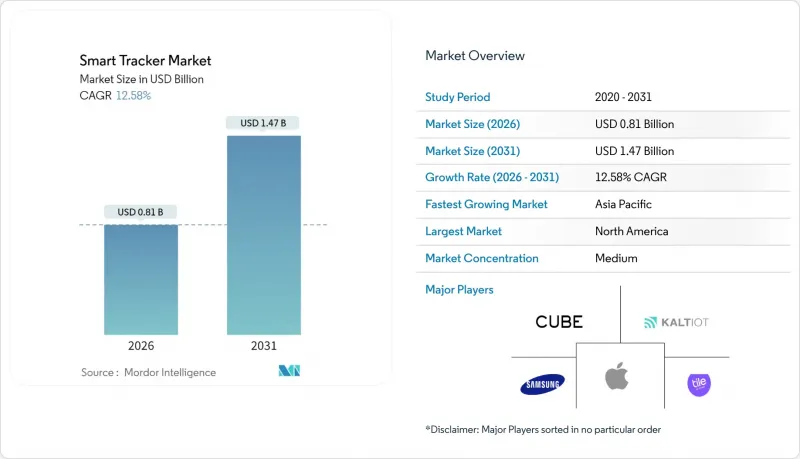
스마트 트래커 시장은 2025년 7억 2,000만 달러에서 2026년 8억 1,000만 달러로 성장할 것으로 예상되며, 2026-2031년 CAGR 12.58%로 성장을 지속하여, 2031년까지 14억 7,000만 달러에 이를 것으로 예측됩니다.
스마트폰 보급률 급증, 초광대역(UWB) 정밀 거리 측정 기술, 그리고 스마트홈 생태계와의 통합으로 분실물 찾기에서 의료 및 기업 자산 관리까지 활용 사례가 확대되고 있습니다. 소비자들은 위치 추적기를 시간 낭비, 스트레스, 생산성 저하를 방지하는 저렴한 보험으로 인식하고 있으며, 기업들은 실시간 위치 파악 및 규제 준수 비용 절감을 통해 위치 추적기 도입을 정당화하고 있습니다. 예를 들어, 애플의 'Find My'나 삼성의 'SmartThings'는 네트워크 효과를 활용하여 위치정보의 정확도와 커버리지를 향상시키고 있습니다. 한편, 규제 당국이 의무화한 개인정보 보호 조치는 개발 비용을 증가시키고, 데이터가 풍부한 서비스에 대한 신뢰 구축에도 기여하고 있습니다.
세계 스마트 트래커 시장 동향 및 인사이트
초광대역(UWB) 및 Bluetooth LE 기술의 급속한 발전
UWB 기술을 통해 트래커는 근접 알림에서 센티미터 단위의 정확도로 진화하여 실내 내비게이션과 고부가가치 자산의 모니터링을 가능하게 했습니다. Apple은 AirTag 업데이트에 2세대 UWB 칩을 내장하고, 삼성은 Galaxy 기기용 SmartTag 2에 UWB를 통합하는 등 UWB의 주류화가 진행되고 있습니다. FiRa 컨소시엄의 상호운용성 프로파일은 기존의 파편화를 해소하고, 공장 및 병원에서의 기업 파일럿 프로젝트의 실용성을 높입니다. 동시에 발전하는 블루투스 LE는 이상적인 조건에서 배터리 수명을 2년 이상 연장하고 통신 거리를 100미터 이상으로 확장합니다. 이러한 프로토콜이 결합되어 가장 효율적인 무선 방식으로 원활하게 전환되는 멀티 프로토콜 장치를 구현하여 소유 비용을 절감하고 스마트 트래커 시장의 잠재적 고객 기반을 확대합니다.
추적과 감시를 가능하게 하는 스마트폰 보급 확대
새로 출시되는 스마트폰은 사실상 전 세계 크라우드 소싱형 위치정보 네트워크의 노드가 됩니다. 애플의 'Find My'는 10억 개 이상의 기기를 커버하고 있으며, 삼성의 SmartThings 네트워크는 안드로이드 기기 전체로 확대되고 있습니다. 100달러 미만의 저렴한 안드로이드 스마트폰은 인도, 나이지리아, 인도네시아 등지에서 처음으로 인터넷에 접속할 수 있도록 해주며, 잠재적인 위치 추적 신호 수를 크게 늘립니다. 네트워크 외부 효과는 위치 추적 서비스의 유용성을 높입니다. 스마트폰 클러스터가 밀집될수록 분실물을 찾는 데 걸리는 시간이 단축되고, 이는 다시 더 많은 사용자를 생태계로 끌어들입니다. 모바일 네트워크 사업자들은 트래픽으로 인한 수익 기회를 인식하고, 현재 5G IoT 요금제에 추적 서비스를 번들로 제공합니다. Verizon의 차량용 서비스가 그 좋은 예입니다.
데이터 프라이버시와 사이버 스토킹에 대한 우려
GDPR(EU 개인정보보호규정) 등의 규제는 명시적 동의와 최소한의 데이터 보유를 요구하고 있으며, 전 세계적으로 군중 위치 정보 기능을 복잡하게 만들고 있습니다. AirTags에 의한 부정 추적 가능성이 보고됨에 따라 Apple과 Google은 정기적인 경고음, 식별자 순환, 주변 사용자에 대한 자동 알림을 도입했습니다. 이러한 조치는 신뢰 구축에 기여하는 한편, 배터리 수명과 위치 정보 업데이트의 정확도를 떨어뜨려 사용자 경험을 다소 떨어뜨리는 결과를 낳고 있습니다. 불필요한 추적 감지 프로토콜에 대한 IETF의 지속적인 노력은 벤더 간 대책 표준화를 목표로 하고 있지만, 컴플라이언스 대응은 개발 비용을 증가시키고 스마트 트래커 시장에서의 기능 배포를 지연시키고 있습니다.
부문 분석
2025년 기준 블루투스는 스마트 트래커 시장 점유율 54.10%를 유지했으며, 거의 모든 최신 스마트폰 및 스마트 워치와 호환되는 것으로 나타났습니다. UWB는 신기술임에도 불구하고 13.02%의 연평균 복합 성장률(CAGR)로 성장을 가속화하고 있으며, 소비자들은 가구 밑이나 혼잡한 창고에서 물건을 식별하는 10센티미터 미만의 정확도에 대해 대가를 지불하는 경향이 있습니다. GPS 및 셀룰러 유형은 휴대폰 전파가 도달하기 어려운 야외 자산 추적을 대상으로 하며, 전 세계 도달 범위에 대한 대가로 높은 전력 소비를 허용합니다. 블루투스, UWB, GPS를 통합한 멀티 프로토콜 칩 세트는 현재 프리미엄 제품 설계의 주류로 자리 잡고 있으며, 디바이스가 상황에 따라 무선 방식을 전환하여 배터리를 절약할 수 있도록 하고 있습니다.
UWB 칩이 규모의 경제에 도달함에 따라 평균 판매 가격은 하락하는 추세로, 중견 벤더의 프로토콜 채택을 촉진하고 있습니다. 그러나, 특히 저렴한 휴대전화가 초기 도입을 뒷받침하는 신흥 경제권에서는 블루투스가 여전히 대량 생산의 기반 기술입니다. 기업용 파일럿 프로젝트에서 UWB와 블루투스를 함께 도입하는 사례가 증가하고 있으며, 이는 스마트 트래커 시장에서 UWB와 블루투스의 결합을 통해 스마트 트래커 시장의 성장을 견인하고 있습니다.
지역별 분석
북미는 2025년 스마트 트래커 시장 점유율 37.10%를 차지했습니다. 성숙한 스마트폰 생태계, 부유층 소비자, 높은 업데이트 빈도를 뒷받침하는 5G 보급에 힘입은 바 큽니다. 미국의 규제는 프라이버시와 혁신의 균형을 유지하고, 기능의 빠른 개선을 가능하게 합니다. 기업 수요는 차량 관리 물류, 의료 자산 추적, 보험사 주도의 손실 방지 프로그램 등으로 확대되고 있습니다.
아시아태평양은 2031년까지 13.55%의 연평균 복합 성장률(CAGR)을 보일 것으로 예측되며, 세계에서 가장 빠르게 성장할 것으로 예측됩니다. 인도와 중국에서는 매년 수백만 명의 신규 스마트폰 사용자가 증가하고 있으며, 네트워크 밀도와 트래커 정확도가 향상되고 있습니다. 정부 주도의 스마트시티 실증사업에서 IoT 센서에 대한 자금 배분이 이루어지고 있으며, 공공 안전과 노인 돌봄을 지원하고 있습니다. 일본에서는 초고령화 사회가 진행되어 2040년까지 57만 명의 간병인 부족이 예측되는 가운데, 의료 및 재택 모니터링 분야에서의 도입이 가속화되고 있습니다. 동남아시아에서는 전자상거래의 성장으로 화물 추적에 대한 수요가 더욱 확대되고 있으며, 스마트 트래커 시장의 지역 내 성장세가 더욱 강화되고 있습니다.
유럽에서는 데이터 집약형 서비스에 대한 사용자들의 신뢰도를 높이는 엄격한 GDPR(EU 개인정보보호규정)(General Data Protection Regulation, 일반개인정보보호법)의 보호 조치에 힘입어 완만한 성장세를 유지하고 있습니다. 회원국 간 표준 조정을 통해 국경을 넘는 물류 추적이 간소화되었습니다. 중동 및 아프리카에서는 통신 인프라 현대화에 따른 도입 초기 단계이지만, 무선 주파수(RF) 부품에 대한 수입 관세가 프리미엄 가격을 억제하는 요인으로 작용하고 있습니다. 남미에서는 환율 변동에 따른 단말기 비용 상승이 문제지만, 도시 지역의 안전 문제로 중산층 소비자층에서 트래커 도입이 진행되고 있습니다. 각 대륙에서 성숙 시장과 신흥 시장이 혼재하는 상황은 스마트 트래커 시장의 균형 잡힌 세계 전망을 유지하고 있습니다.
기타 특전:
- 엑셀 형식 시장 예측(ME) 시트
- 애널리스트 지원(3개월)
자주 묻는 질문
목차
제1장 서론
제2장 조사 방법
제3장 주요 요약
제4장 시장 구도
제5장 시장 규모와 성장 예측
제6장 경쟁 구도
제7장 시장 기회와 향후 전망
LSH 26.03.05The smart tracker market is expected to grow from USD 0.72 billion in 2025 to USD 0.81 billion in 2026 and is forecast to reach USD 1.47 billion by 2031 at 12.58% CAGR over 2026-2031.
Rapid smartphone penetration, ultra-wideband (UWB) precision ranging, and integration with smart-home ecosystems are expanding use cases from lost-item recovery to healthcare and enterprise asset management. Consumers increasingly view trackers as inexpensive insurance against time, stress, and productivity losses, while enterprises justify deployments through real-time visibility and regulatory compliance savings. Vendors differentiate through ecosystem breadth rather than hardware alone, as Apple's Find My and Samsung's SmartThings leverage network effects to boost location accuracy and coverage. Meanwhile, privacy safeguards mandated by regulators keep development costs elevated but also build trust in data-rich services.
Global Smart Tracker Market Trends and Insights
Rapid Advancements in Ultra-Wideband and Bluetooth LE Technologies
UWB has shifted trackers from proximity alerts to centimeter-level precision, enabling indoor navigation and high-value asset monitoring. Apple embedded second-generation UWB chips in AirTag updates, while Samsung integrated UWB into SmartTag 2 for Galaxy devices, signaling mainstream adoption. The FiRa Consortium's interoperability profiles address earlier fragmentation, making enterprise pilots viable for factories and hospitals. Parallel gains in Bluetooth LE lengthen battery life beyond two years and push range past 100 meters in ideal conditions. Together, these protocols unlock multiprotocol devices that switch seamlessly to the most efficient radio, reducing cost of ownership and widening the addressable base for the smart tracker market.
Growing Penetration of Smartphones Enabling Tracking and Monitoring
Each new smartphone effectively becomes a node in a global crowd-sourced location network. Apple's Find My spans more than 1 billion devices, and Samsung's SmartThings network continues to grow across Android hardware. Affordable sub-USD 100 Android handsets ignite first-time internet access across India, Nigeria, and Indonesia, multiplying potential tracker pings. Network externalities elevate tracker utility: denser smartphone clusters shorten the time to locate a lost item, which in turn pulls more users into the ecosystem. Mobile network operators recognize the traffic-driven revenue opportunity and now bundle tracking services into 5G IoT plans, exemplified by Verizon's fleet offerings.
Data-Privacy and Cyber-Stalking Concerns
Regulations such as GDPR require explicit consent and minimal data retention, complicating global crowd-location features. Following reports of AirTags enabling unauthorized tracking, Apple and Google introduced periodic beeps, rotating identifiers, and automatic notifications to nearby users. These measures build trust but reduce battery life and granularity of location updates, slightly dampening user experience. Ongoing IETF work on unwanted-tracking detection protocols aims to standardize mitigations across vendors, but compliance increases development cost and slows feature rollouts in the smart tracker market.
Other drivers and restraints analyzed in the detailed report include:
- Integration of Trackers into Multiprotocol Smart-Home Ecosystems
- Rising Incidences of Misplaced Personal Items
- Lack of Global Interoperability Standards
For complete list of drivers and restraints, kindly check the Table Of Contents.
Segment Analysis
Bluetooth retained 54.10% smart tracker market share in 2025, aligned with nearly every modern smartphone and smartwatch. UWB, although nascent, is accelerating at a 13.02% CAGR as consumers pay for sub-10-centimeter precision that pinpoints items under furniture or within crowded warehouses. GPS and cellular variants target outdoor asset tracking where phone density is sparse, accepting higher power draw in exchange for global reach. Multiprotocol chipsets combining Bluetooth, UWB, and GPS now dominate premium product designs, letting devices switch radios based on context to conserve battery.
As UWB chips reach economies of scale, average selling prices are falling, encouraging mid-tier vendors to include the protocol. Nevertheless, Bluetooth remains the volume cornerstone, especially in emerging economies where affordable phones anchor initial adoption. Enterprise pilots increasingly specify UWB plus Bluetooth to future-proof deployments, reinforcing the technology's climb within the smart tracker market.
The Smart Tracker Market Report is Segmented by Technology (Cellular, Bluetooth, GPS, UWB, and NFC), Application (Personal Item Tracking, Luggage Tracking, Pet Tracking, Kids and Senior Safety, Enterprise Inventory and Asset Tracking, and Vehicle Tracking), End User (Consumer, Commercial, Industrial and Logistics, Healthcare, and Government and Defense), and Geography. The Market Forecasts are Provided in Terms of Value (USD).
Geography Analysis
North America commanded 37.10% smart tracker market share in 2025, buoyed by mature smartphone ecosystems, affluent consumers, and 5G rollouts that support high update frequencies. U.S. regulations strike a balance between privacy and innovation, allowing rapid feature iterations. Enterprise demand spans fleet logistics, healthcare asset tracking, and insurance-sponsored loss-prevention programs.
Asia Pacific is projected to log a 13.55% CAGR through 2031, the fastest worldwide. India and China add millions of first-time smartphone users annually, elevating network density and tracker accuracy. Government-backed smart city pilots allocate funding for IoT sensors, supporting public safety and elderly care. Japan's super-aged society drives healthcare and home-monitoring deployments as the nation grapples with a forecast 570,000 caregiver shortfall by 2040. Southeast Asian e-commerce growth further increases parcel-tracking demand, reinforcing region-wide momentum in the smart tracker market.
Europe maintains moderate expansion, aided by stringent GDPR safeguards that engender user trust in data-heavy services. Standards harmonization across member states simplifies cross-border logistics tracking. Middle East and Africa witness early-stage adoption tied to telecom infrastructure modernization, though import tariffs on RF components temper premium pricing. South America faces currency fluctuations that raise device costs, but urban safety concerns propel tracker uptake among middle-class consumers. The blend of mature and emerging scenarios across continents preserves a balanced global outlook for the smart tracker market.
- Tile Inc.
- Samsung Electronics Co., Ltd.
- Apple Inc.
- Cube Tracker Inc.
- Kaltio Technologies Oy
- PB Inc. (Pebblebee)
- Chipolo d.o.o.
- XY Labs, Inc.
- Garmin Ltd.
- Jiobit Inc.
- Invoxia SA
- HButler International Pty. Ltd. (Orbit)
- Wistiki SAS
- Nut Technology Co., Ltd.
- Filo S.r.l.
- Satotech Limited (TagoBee)
- Trackimo Inc.
- Loc8tor Ltd.
- Rinex Technology Co., Ltd.
Additional Benefits:
- The market estimate (ME) sheet in Excel format
- 3 months of analyst support
TABLE OF CONTENTS
1 INTRODUCTION
- 1.1 Study Assumptions and Market Definition
- 1.2 Scope of the Study
2 RESEARCH METHODOLOGY
3 EXECUTIVE SUMMARY
4 MARKET LANDSCAPE
- 4.1 Market Overview
- 4.2 Market Drivers
- 4.2.1 Growing penetration of smartphones enabling tracking and monitoring
- 4.2.2 Rising incidences of misplaced personal items
- 4.2.3 Rapid advancements in ultra-wideband and Bluetooth LE technologies
- 4.2.4 Declining average selling prices of low-power wireless chipsets
- 4.2.5 Integration of trackers into multiprotocol smart-home ecosystems
- 4.2.6 Expansion of item tracking services bundled by mobile network operators
- 4.3 Market Restraints
- 4.3.1 Lack of global interoperability standards
- 4.3.2 Data-privacy and cyber-stalking concerns
- 4.3.3 Short product replacement cycles increasing e-waste
- 4.3.4 Import tariffs on key RF components in emerging markets
- 4.4 Industry Value Chain Analysis
- 4.5 Impact of Macroeconomic Factors
- 4.6 Technological Outlook
- 4.6.1 Smart-home IoT integration trends
- 4.7 Regulatory Landscape
- 4.8 Porter's Five Forces Analysis
- 4.8.1 Bargaining Power of Suppliers
- 4.8.2 Bargaining Power of Buyers
- 4.8.3 Threat of New Entrants
- 4.8.4 Threat of Substitute Products
- 4.8.5 Intensity of Competitive Rivalry
- 4.9 Investment Analysis
5 MARKET SIZE AND GROWTH FORECASTS (VALUE)
- 5.1 By Technology
- 5.1.1 Cellular
- 5.1.2 Bluetooth
- 5.1.3 GPS
- 5.1.4 UWB
- 5.1.5 NFC
- 5.2 By Application
- 5.2.1 Personal Item Tracking
- 5.2.2 Luggage Tracking
- 5.2.3 Pet Tracking
- 5.2.4 Kids and Senior Safety
- 5.2.5 Enterprise Inventory and Asset Tracking
- 5.2.6 Vehicle Tracking
- 5.3 By End User
- 5.3.1 Consumer
- 5.3.2 Commercial
- 5.3.3 Industrial and Logistics
- 5.3.4 Healthcare
- 5.3.5 Government and Defense
- 5.4 By Geography
- 5.4.1 North America
- 5.4.1.1 United States
- 5.4.1.2 Canada
- 5.4.1.3 Mexico
- 5.4.2 Europe
- 5.4.2.1 Germany
- 5.4.2.2 France
- 5.4.2.3 United Kingdom
- 5.4.2.4 Italy
- 5.4.2.5 Spain
- 5.4.2.6 Russia
- 5.4.2.7 Rest of Europe
- 5.4.3 Asia Pacific
- 5.4.3.1 China
- 5.4.3.2 Japan
- 5.4.3.3 India
- 5.4.3.4 South Korea
- 5.4.3.5 Australia
- 5.4.3.6 Southeast Asia
- 5.4.3.7 Rest of Asia Pacific
- 5.4.4 South America
- 5.4.4.1 Brazil
- 5.4.4.2 Argentina
- 5.4.4.3 Rest of South America
- 5.4.5 Middle East
- 5.4.5.1 Saudi Arabia
- 5.4.5.2 United Arab Emirates
- 5.4.5.3 Turkey
- 5.4.5.4 Rest of Middle East
- 5.4.6 Africa
- 5.4.6.1 South Africa
- 5.4.6.2 Nigeria
- 5.4.6.3 Kenya
- 5.4.6.4 Rest of Africa
- 5.4.1 North America
6 COMPETITIVE LANDSCAPE
- 6.1 Market Concentration
- 6.2 Strategic Moves
- 6.3 Market Share Analysis
- 6.4 Company Profiles (includes Global level overview, Market level overview, Core Segments, Financials as available, Strategic Information, Market Rank/Share for key companies, Products and Services, and Recent Developments)
- 6.4.1 Tile Inc.
- 6.4.2 Samsung Electronics Co., Ltd.
- 6.4.3 Apple Inc.
- 6.4.4 Cube Tracker Inc.
- 6.4.5 Kaltio Technologies Oy
- 6.4.6 PB Inc. (Pebblebee)
- 6.4.7 Chipolo d.o.o.
- 6.4.8 XY Labs, Inc.
- 6.4.9 Garmin Ltd.
- 6.4.10 Jiobit Inc.
- 6.4.11 Invoxia SA
- 6.4.12 HButler International Pty. Ltd. (Orbit)
- 6.4.13 Wistiki SAS
- 6.4.14 Nut Technology Co., Ltd.
- 6.4.15 Filo S.r.l.
- 6.4.16 Satotech Limited (TagoBee)
- 6.4.17 Trackimo Inc.
- 6.4.18 Loc8tor Ltd.
- 6.4.19 Rinex Technology Co., Ltd.
7 MARKET OPPORTUNITIES AND FUTURE OUTLOOK
- 7.1 White-space and unmet-need assessment


