|
시장보고서
상품코드
1934795
태국의 윤활유 : 시장 점유율 분석, 업계 동향과 통계, 성장 예측(2026-2031년)Thailand Lubricants - Market Share Analysis, Industry Trends & Statistics, Growth Forecasts (2026 - 2031) |
||||||
 Mordor Intelligence
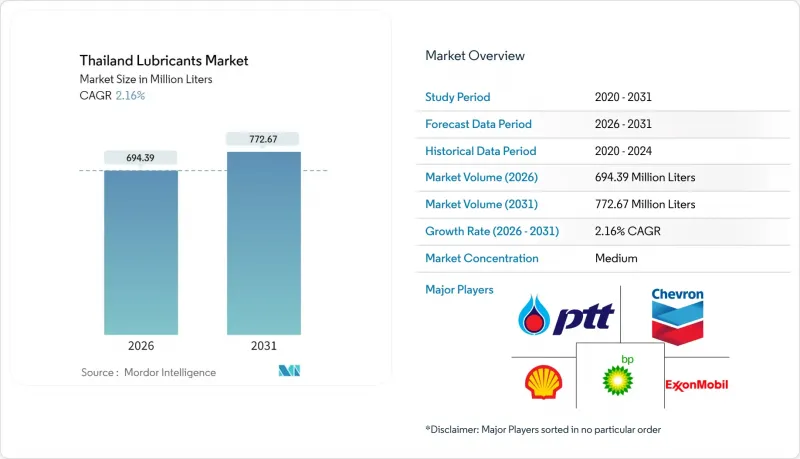
태국의 윤활유 시장은 2025년 6억 7,970만 리터에서 2026년에는 6억 9,439만 리터로 성장하며, 2026-2031년에 CAGR 2.16%로 추이하며, 2031년까지 7억 7,267만 리터에 달할 것으로 예측되고 있습니다.
전기화로 인한 내연기관(ICE)용 오일 수요 감소는 태국이 동남아시아에서 픽업트럭 생산기지로서의 역할을 지속하고 있다는 점과 완성차 및 부품의 지역 유통센터로서의 지위를 통해 상쇄되고 있습니다. 70억 달러가 넘는 데이터센터 건설과 동부 경제 회랑(EEC)에 대한 지속적인 투자가 특수 냉각수 및 고성능 산업용 오일의 소비를 주도하고 있습니다. 상품 수출 회복, 물류 분야의 GDP 기여도 0.4%, 제품 규격 강화 및 합성유로 전환을 지원하는 유로5 디젤 품질 기준 시행 등 거시적 요인이 작용하고 있습니다. 저가의 아세안 수입품과의 경쟁 압력은 주류 광유 블렌드의 이익률을 압박하고 있지만, EV용 유체, 액체 냉각 솔루션, 메탄올 대응 선박용 윤활유에서 프리미엄화 기회는 확대되고 있습니다.
태국의 윤활유 시장 동향 및 전망
팬데믹 이후 제조업과 수출의 회복
공급망 혼란이 완화되면서 공장 가동률이 개선되고 2024년 1분기 투자위원회(BOI) 승인 금액이 13% 증가했습니다. 특히 전자기기, 자동차, 기계 관련 사업에 집중하고 있습니다. 금속 가공 활동의 활성화와 가동 시간 연장으로 정밀 가공 라인의 유압유, 절삭유, 내마모성 그리스에 대한 수요가 증가하고 있습니다. 수출 지향 기업은 반합성 및 완전 합성 블렌드를 선호하는 더 엄격한 점도 허용 오차를 지정합니다. 생산 일정이 안정화되면서 2023년 물류 병목 현상으로 지연되었던 윤활유 조달 사이클도 회복되고 있습니다. 태국의 윤활유 시장은 다국적 OEM을 위한 안정적인 제품 공급을 실현하는 태국에 구축된 공급업체 네트워크의 혜택을 누리고 있습니다.
상용차 fleet 확대 및 E-Commerce 물류 확대
2024년에는 온라인 소매의 보급률이 총 소매 매출의 18%를 넘어설 것으로 예상되며, 택배업체와 제3자 물류업체들의 차량 증강을 촉진하고 있습니다. 주행거리 증가는 특히 도심의 스톱앤고 노선을 운행하는 배송 밴의 경우, 오일 교환 빈도 증가로 이어집니다. 사업체에서는 연료 소비량 절감과 오일 교환 주기 연장을 목적으로 SAE 10W-30의 합성유 채택이 증가하고 있습니다. 이는 윤활유의 초기 비용을 총 운영 비용 절감과 맞바꾸는 선택입니다. 태국 정부의 4,500억 바트 규모의 재정 부양책에 따른 지방 도로 개선으로 인해 운송 시간은 단축되는 반면, 평균 속도는 상승하고 차축과 변속기의 온도 부하가 증가하고 있습니다. 이에 따라 높은 유막 강도를 가진 기어 오일이 요구되고 있습니다.
전기자동차 보급 가속화로 내연기관 윤활유 시장 축소 전망
2022-2024년 배터리 전기자동차 등록대수는 5배 증가하여 전체 신차 소형차의 9%에 달했습니다. 이는 대당 5만-10만 바트의 보조금 제도가 지원하고 있습니다. EV는 크랭크케이스 오일에 대한 수요를 없애고 자동 변속기 오일의 용량을 감소시켜 자동차 윤활유의 주요 공급원이 축소되고 있습니다. 방콕의 차량군에서는 충전 인프라 보조금을 이용하기 위해 택시와 라스트 마일 배송 밴을 배터리 전기자동차 모델로 전환하고 있습니다. 그러나 e-액슬, 배터리 트레이, 열 관리 서브시스템의 제조는 조립용 그리스 및 유전체 냉각제에 대한 새로운 수요를 창출하여 태국의 윤활유 시장에 부분적인 상쇄 효과를 가져왔습니다.
부문 분석
자동차 엔진오일은 2025년 기준 태국의 윤활유 시장 점유율의 46.89%를 차지하며, 연간 200만 대 이상의 자동차 생산량과 2,100만 대 이상의 자동차 및 픽업트럭의 애프터마켓 정비 수요를 반영하고 있습니다. 일본 업체와의 공장 충진 계약으로 기본 공급량을 안정적으로 확보하는 한편, 호주와 중동 픽업트럭 중심의 수출이 연말 선적 시기를 앞두고 수요가 급증하고 있습니다.
그리스는 2031년까지 3.17%의 가장 높은 CAGR을 달성할 것으로 예측됩니다. 이는 쉘의 공장 확장(연간 15,000톤 생산)으로 태국이 동남아시아 최대 그리스 공급기지가 될 것이기 때문입니다. 동부경제회랑(EEC)의 포장 공장에 도입된 정밀 로봇과 컨베이어 시스템에는 물 세척에 의한 유출에 강한 리튬 복합 그리스가 선호되고 있습니다. 태국의 윤활유 시장내 그리스 규모는 2031년까지 4만 6,200톤을 넘어설 것으로 예상되며, 특수 제품 매출에서 점유율이 확대될 것으로 전망됩니다. 동시에 도심 승용차의 자동변속기 보급률이 95%에 육박하는 것을 배경으로 변속기 오일 수요는 안정적으로 유지될 것입니다.
태국의 윤활유 시장 보고서는 제품 유형(자동차 엔진오일, 산업용 엔진오일, 변속기 오일, 기어오일, 브레이크 오일, 유압유, 그리스 등), 최종사용자 산업(자동차, 선박, 항공우주, 중장비 등), 기유 유형(광유 기반 윤활유, 반합성 윤활유 등)으로 분류됩니다. 합성윤활유 등) 별로 분류되어 있습니다. 시장 예측은 수량(리터) 단위로 제공됩니다.
기타 특전:
- 엑셀 형식 시장 예측(ME) 시트
- 애널리스트의 3개월간 지원
자주 묻는 질문
목차
제1장 서론
제2장 조사 방법
제3장 개요
제4장 시장 구도
제5장 시장 규모와 성장 예측
제6장 경쟁 구도
제7장 시장 기회와 향후 전망
제8장 CEO을 위한 주요 전략적 과제
KSA 26.03.05The Thailand Lubricants Market is expected to grow from 679.70 Million Liters in 2025 to 694.39 Million Liters in 2026 and is forecast to reach 772.67 Million Liters by 2031 at 2.16% CAGR over 2026-2031.
The softer demand for internal-combustion-engine (ICE) oils from electrification is balanced by Thailand's continued role as Southeast Asia's pickup-truck production hub and its position as a regional distribution center for finished vehicles and components. Ongoing data center construction valued at above USD 7 billion, along with steady investment in the Eastern Economic Corridor (EEC), drives the consumption of specialty cooling fluids and high-performance industrial oils. Macro factors, such as a rebound in merchandise exports, a 0.4% GDP contribution from logistics, and the enforcement of Euro 5 diesel quality standards, which tighten product specifications and support the shift toward synthetic formulations. Competitive pressure from lower-cost ASEAN imports keeps margins thin for mainstream mineral oil blends, yet premiumization opportunities in EV fluids, immersion-cooling solutions, and methanol-compatible marine lubricants are expanding.
Thailand Lubricants Market Trends and Insights
Post-pandemic rebound in manufacturing and exports
Factory utilization improved after supply-chain disruptions eased, and Board of Investment approvals rose 13% in value during Q1 2024, with a focus on electronics, automotive, and machinery ventures. Higher metalworking activity and longer operating hours raise demand for hydraulic oils, cutting fluids, and anti-wear greases in precision machining lines. Export-oriented firms specify tighter viscosity tolerances that favor semi-synthetic and full-synthetic blends. Production scheduling stability also restores lubricant procurement cycles that had been delayed during 2023's logistics bottlenecks. The Thailand lubricants market benefits from the country's established supplier network, which provides consistent product availability for multinational OEMs.
Expansion of commercial-vehicle fleet and e-commerce logistics
Online retail penetration exceeded 18% of total retail sales in 2024, prompting fleet additions among parcel carriers and third-party logistics firms. Vehicle-kilometer-traveled growth translates into higher oil drain frequency, particularly for delivery vans operating stop-start urban routes. Operators are increasingly adopting SAE 10W-30 synthetics to reduce fuel consumption and extend drain intervals, trading upfront lubricant costs for lower total operating expenses. Provincial road upgrades under Thailand's THB 450 billion fiscal stimulus reduce transit times but increase average speeds, elevating axle and transmission temperature loads that require high-film-strength gear oils.
Accelerated EV adoption shrinking ICE lubricant pool
Registrations of battery electric cars grew fivefold between 2022 and 2024, reaching 9% of all new light-duty vehicles, supported by subsidies of THB 50,000-100,000 per unit. EVs eliminate demand for crankcase oils and reduce automatic transmission-fluid volumes, shrinking the core automotive lubricant reservoir. Fleets in Bangkok are shifting taxis and last-mile delivery vans to battery electric models to capitalize on charging infrastructure grants. However, manufacturing of e-axles, battery trays, and thermal-management subsystems introduces new requirements for assembly greases and dielectric coolants, providing a partial offset for the Thailand lubricants market.
Other drivers and restraints analyzed in the detailed report include:
- Industrial automation boosting demand for high-performance synthetics
- Data-center buildouts driving specialty cooling and genset lubricants
- Stricter mineral-oil disposal regulations
For complete list of drivers and restraints, kindly check the Table Of Contents.
Segment Analysis
Automotive engine oil captured 46.89% of Thailand lubricants market share in 2025, reflecting annual vehicle output above 2 million units and a robust aftermarket servicing fleet that exceeds 21 million cars and pickups. Factory-fill contracts with Japanese OEMs ensure baseline volume stability, while pickup-centric exports to Australia and the Middle East create incremental demand spikes leading up to year-end shipping windows.
Greases deliver the highest 3.17% CAGR through 2031 as Shell's plant expansion to 15,000 tonnes per year turns Thailand into Southeast Asia's largest grease supply base. Precision robotics and conveyor systems installed in EEC packaging plants prefer lithium-complex greases tolerant to water washout. The Thailand lubricants market size for greases is projected to exceed 46,200 tonnes by 2031, accounting for a growing share of specialty product revenue. Concurrently, transmission-fluid demand holds steady, bolstered by automatic-gearbox penetration approaching 95% in urban passenger cars.
The Thailand Lubricants Market Report is Segmented by Product Type (Automotive Engine Oil, Industrial Engine Oil, Transmission Fluids, Gear Oil, Brake Fluids, Hydraulic Fluids, Greases, and More), End-User Industry (Automotive, Marine, Aerospace, Heavy Equipment, and More), and Base Stock Type (Mineral Oil-Based Lubricants, Semi-Synthetic Lubricants, and More). The Market Forecasts are Provided in Terms of Volume (Liters).
List of Companies Covered in this Report:
- Bangchak Corporation Public Company Limited
- BP p.l.c.
- Chevron Corporation
- ENEOS Corporation
- ExxonMobil Corporation
- FUCHS
- Idemitsu Kosan Co., Ltd. (Apollo (Thailand) Co., Ltd.)
- MOTUL ( Thailand ) Co., Ltd.
- P.S.P. Specialties Public Company Limited
- PETRONAS Lubricants International
- PTT PUBLIC COMPANY LIMITED
- Shell Thailand
- Siam Pan Group Public Co., Ltd.
- Total Energies
- Valvoline
Additional Benefits:
- The market estimate (ME) sheet in Excel format
- 3 months of analyst support
TABLE OF CONTENTS
1 Introduction
- 1.1 Study Assumptions and Market Definition
- 1.2 Scope of the Study
2 Research Methodology
3 Executive Summary
4 Market Landscape
- 4.1 Market Overview
- 4.2 Market Drivers
- 4.2.1 Post-pandemic Rebound in Manufacturing and Exports
- 4.2.2 Expansion of Commercial-vehicle Fleet and E-commerce Logistics
- 4.2.3 Industrial Automation Boosting Demand for High-performance Synthetics
- 4.2.4 Data-center Buildouts Driving Specialty Cooling/genset Lubricants
- 4.2.5 Biodiesel (B20) Mandate Raising Engine-oil Change Frequency
- 4.3 Market Restraints
- 4.3.1 Accelerated EV Adoption Shrinking ICE Lubricant Pool
- 4.3.2 Stricter Mineral-oil Disposal Regulations
- 4.3.3 Margin Pressure from Low-cost ASEAN Imports
- 4.4 Value Chain Analysis
- 4.5 Regulatory Framework
- 4.6 End-User Trends
- 4.6.1 Automotive Industry
- 4.6.2 Manufacturing Industry
- 4.6.3 Power Generation Industry
- 4.7 Porter's Five Forces
- 4.7.1 Bargaining Power of Suppliers
- 4.7.2 Bargaining Power of Buyers
- 4.7.3 Threat of New Entrants
- 4.7.4 Threat of Substitutes
- 4.7.5 Degree of Competition
5 Market Size and Growth Forecasts (Volume)
- 5.1 By Product Type
- 5.1.1 Automotive Engine Oil
- 5.1.2 Industrial Engine Oil
- 5.1.3 Transmission Fluids
- 5.1.4 Gear Oil
- 5.1.5 Brake Fluids
- 5.1.6 Hydraulic Fluids
- 5.1.7 Greases
- 5.1.8 Process Oil (Including Rubber Process Oil & White Oil)
- 5.1.9 Metalworking Fluids
- 5.1.10 Turbine Oil
- 5.1.11 Transformer Oil
- 5.1.12 Other Product Types
- 5.2 By End-user Industry
- 5.2.1 Automotive
- 5.2.1.1 Passenger Vehicles
- 5.2.1.2 Commercial Vehicles
- 5.2.1.3 Two-Wheelers
- 5.2.2 Marine
- 5.2.3 Aerospace
- 5.2.4 Heavy Equipment
- 5.2.4.1 Construction
- 5.2.4.2 Mining
- 5.2.4.3 Agriculture
- 5.2.5 Industrial
- 5.2.5.1 Power Generation
- 5.2.5.2 Metallurgy & Metalworking
- 5.2.5.3 Textiles
- 5.2.5.4 Oil and Gas
- 5.2.5.5 Other End-Use Industries
- 5.2.1 Automotive
- 5.3 By Base Stock Type
- 5.3.1 Mineral Oil-Based Lubricants
- 5.3.2 Synthetic Lubricants
- 5.3.3 Semi-Synthetic Lubricants
- 5.3.4 Bio-Based Lubricants
6 Competitive Landscape
- 6.1 Market Concentration
- 6.2 Strategic Moves
- 6.3 Market Share**(%)/Ranking Analysis
- 6.4 Company Profiles (includes Global level Overview, Market level overview, Core Segments, Financials as available, Strategic Information, Market Rank/Share, Products & Services, Recent Developments)
- 6.4.1 Bangchak Corporation Public Company Limited
- 6.4.2 BP p.l.c.
- 6.4.3 Chevron Corporation
- 6.4.4 ENEOS Corporation
- 6.4.5 ExxonMobil Corporation
- 6.4.6 FUCHS
- 6.4.7 Idemitsu Kosan Co., Ltd. (Apollo (Thailand) Co., Ltd.)
- 6.4.8 MOTUL ( Thailand ) Co., Ltd.
- 6.4.9 P.S.P. Specialties Public Company Limited
- 6.4.10 PETRONAS Lubricants International
- 6.4.11 PTT PUBLIC COMPANY LIMITED
- 6.4.12 Shell Thailand
- 6.4.13 Siam Pan Group Public Co., Ltd.
- 6.4.14 Total Energies
- 6.4.15 Valvoline
7 Market Opportunities and Future Outlook
- 7.1 White-space and Unmet-need Assessment