|
시장보고서
상품코드
1934839
미국의 원료의약품(API) : 시장 점유율 분석, 업계 동향과 통계, 성장 예측(2026-2031년)United States Active Pharmaceutical Ingredients (API) - Market Share Analysis, Industry Trends & Statistics, Growth Forecasts (2026 - 2031) |
||||||
 Mordor Intelligence
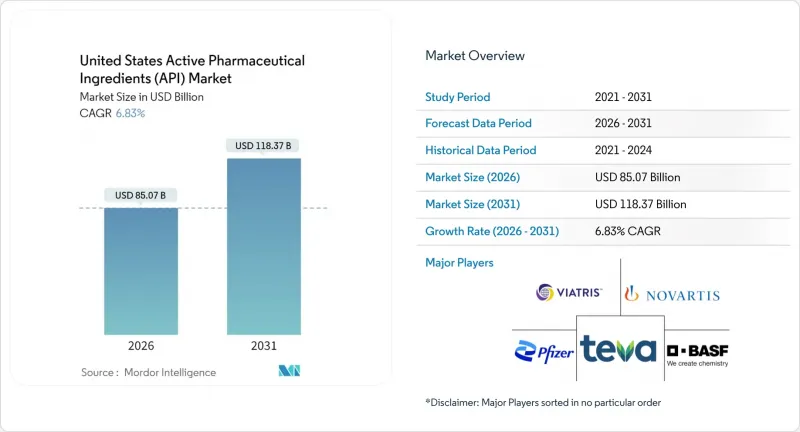
미국에서 원료의약품(API) 시장 규모는 2026년에는 850억 7,000만 달러로 추정되고 있습니다.
이는 2025년 796억 3,000만 달러에서 성장한 수치이며, 2031년에는 1,183억 7,000만 달러에 달할 것으로 예측됩니다. 2026-2031년 연평균 복합 성장률(CAGR) 6.83%를 나타낼 것으로 예측됩니다.
COVID-19로 인해 드러난 공급망 취약성과 높아진 지정학적 리스크에 따라 2020년 이후 주요 제약사들의 제조 투자 약속은 1,600억 달러가 넘습니다. mRNA 기술의 혁신과 바이오로직스 파이프라인의 확장으로 복잡한 고분자 원료에 대한 수요가 증가하는 반면, 종양학 분야의 고효능 화합물로의 전환으로 인해 자본은 특수 격리 시설에 재분배되고 있습니다. 연속생산 기술과 AI를 활용한 품질관리 시스템은 생산성 향상을 통해 사이클 타임 단축과 메디케어 가격 압력에 대응하고 있습니다. 노스캐롤라, 인디애나, 미시간의 전략적 클러스터 형성은 숙련된 인력, 규제 당국, 물류 거점의 집적화를 통해 리드타임을 단축하고 있습니다.
미국 원료의약품(API) 시장 동향 및 인사이트
미국 공급망 다변화 및 국내 API 제조에 대한 인센티브 제공
340억 달러 규모의 연방정부 프로그램과 일라이 릴리의 270억 달러 규모의 공장 확장 계획이 결합되어 국내 API 생산의 원가 계산이 재구성되었습니다. 세액공제, 가속상각 등의 혜택으로 인해 중국이 기존에 35-40% 가량의 비용 우위를 가지고 있던 것이 축소되고 있습니다. API 혁신센터는 1,400만 달러의 보조금을 지원받아 5년내 저분자 의약품 공급원의 25%를 국내로 회귀시키는 임무를 맡고 있습니다.
첨단 바이오의약품 및 mRNA 치료제 파이프라인의 급격한 증가
바이오의약품 위탁개발생산기관(CDMO)은 연간 9-11%씩 성장하고 있으며, 저분자 의약품의 성장률을 상회하고 있습니다. 이는 맞춤형 의료가 첨단 발효기술과 지질시스템 기술을 필요로 하기 때문입니다. 후지필름의 12억 달러 규모의 노스캐롤라이나 공장 확장으로 바이오리액터 용량이 16만 리터 증가했습니다. 클로다는 mRNA 치료용 지질 생산의 미국 확대를 위해 미국 정부로부터 7,500만 달러의 지원을 확보했습니다. AI 지원 워크플로우를 통해 생물제제 처리 능력이 20% 향상되었습니다.
메디케어 약가 협상에 따른 가격 하락
미국 의료보험서비스센터(CMS)의 첫 번째 협상에서 10개의 고 수요 의약품에 대해 22-80%의 가격 인하가 이루어졌으며, 한 번의 협상으로 연간 매출에서 60억 달러가 절감되었습니다. 2025년 대상은 15개 제품(항암제 4개)으로 확대되어 업스트림 API 공급업체에 직접적으로 영향을 미치는 종합적인 비용 재설정의 선례가 확립되었습니다. 협상은 동일 유효성분을 공유하는 모든 적응증을 대상으로 하므로 제조업체는 API 비용을 최저 마진 이용 사례에 연동시켜야 하며, 규정 적용 제외 대상인 바이오시밀러나 제네릭 의약품으로 전환하지 않는 한 수익성이 압박을 받게 됩니다.
부문 분석
2025년 기준, 무역회사 계열 공급업체는 미국 원료의약품(API) 시장의 64.58%를 차지하며, 2031년까지 연평균 복합 성장률(CAGR) 7.05%로 자체 생산 체제를 크게 상회할 것으로 예측됩니다. CDMO는 CRDMO로 진화하여 신약개발, CMC, 상업적 공급을 하나의 워크플로우로 통합하여 개발기간을 50% 단축하고 있습니다. 오프라인 매장이 없는 가상 제약기업은 가장 빠르게 성장하는 고객층으로, 소량, 고복잡성 주문을 촉진함으로써 상사형 유연성이 유리합니다. 연속 생산에 대한 전문성을 바탕으로 이들 공급업체는 배치 간 전환을 며칠이 아닌 몇 시간 만에 할 수 있으며, 이는 자체 생산 부문에서는 보기 드문 능력입니다.
전략적 제휴가 민간 기업의 우위를 강화하고 있습니다. 레시팜과 엑셀라의 제휴로 노스캐롤라이나 주에 연간 1억 단위의 생산능력을 갖춘 무균라인이 개설되었습니다. 상사형 공장은 혁신적인 설비를 통해 FDA의 신속 승인 제도의 혜택을 받아 검증 주기를 단축하고 있습니다. 여러 대형 제약사들은 잉여 원자로를 상사 자회사로 전환하여 품질관리를 유지하면서 설비 가동률을 향상시키고 있습니다. 과거 오염 사고 이후 강화된 실사 기준은 기존 CDMO에 유리한 평판 해자를 형성하고 있습니다. 메디케어 협상으로 인한 상품화 의약품의 이익률 하락에 따라 혁신기업은 자체 네트워크에서 달성하기 어려운 5-10%의 추가 효율을 상사에게 요구하고 있습니다.
합성화학은 2025년 매출의 70.88%를 차지했으며, 바이오텍 API는 맞춤형 의료의 확대로 CAGR 7.12%로 증가하고 있습니다. 바이러스 벡터, mRNA, 재조합 단백질 생산에는 스테인리스강 및 일회용 바이오리액터가 필수적이며, 입방미터당 설비 투자 금액이 저분자 의약품의 기준을 크게 상회합니다. 과거 용제계 합성을 전문으로 하던 기업도 M&A나 합작투자를 통해 하이브리드 생산체제를 추구하고 있습니다.
연속적인 바이오프로세스를 통해 하이브리드 플랜트는 플로우 케미컬 라인에 공통적인 실시간 분석을 활용할 수 있으며, 학습 곡선을 평준화할 수 있습니다. 업스트림 공정의 수렴은 세포 생존율과 용매 순도를 모두 모니터링하는 PAT 센서에 나타나며, 작업자의 교육 시간을 단축시킵니다. 그럼에도 불구하고 20만 리터 포유류 배양시설 1기당 비용이 약 8억 달러에 달하므로 선발업체는 규모의 경제를 누리고 후발업체는 이를 재현하기 위해 고군분투하고 있습니다. 합성 모듈과 생물학적 모듈 간의 규제 조화가 미완성되어 이중 감사 체제를 강요당하고 있습니다. 이로 인해 컴플라이언스 비용이 12-15% 증가하는 한편, 해외 모방 생산 능력의 확대도 억제되고 있습니다.
미국 원료의약품(API) 시장은 사업 형태(자체 생산 API와 외부 조달 API), 합성 유형(합성 및 바이오테크놀러지), 약물 유형(제네릭과 브랜드), 용도(순환기, 종양학, 호흡기, 신경학, 정형외과, 안과, 기타 용도)에 따라 세분화되어 있습니다. 세분화되어 있습니다. 이 보고서에서는 상기 부문 시장 규모(단위: 10억 달러)를 제시합니다.
기타 특전:
- 엑셀 형식 시장 예측(ME) 시트
- 애널리스트의 3개월간 지원
자주 묻는 질문
목차
제1장 서론
제2장 조사 방법
제3장 개요
제4장 시장 구도
제5장 시장 규모와 성장 예측(금액-달러)
제6장 경쟁 구도
제7장 시장 기회와 향후 전망
KSA 26.03.05United States Active Pharmaceutical Ingredients market size in 2026 is estimated at USD 85.07 billion, growing from 2025 value of USD 79.63 billion with 2031 projections showing USD 118.37 billion, growing at 6.83% CAGR over 2026-2031.
Supply-chain fragilities exposed by COVID-19 and escalating geopolitical risk have prompted more than USD 160 billion in pledged Big Pharma manufacturing investments since 2020. mRNA breakthroughs and a broader biologics pipeline are intensifying demand for complex large-molecule ingredients, while oncology's pivot toward high-potency compounds reallocates capital toward specialized containment facilities. Continuous manufacturing and AI-enabled quality systems are shortening cycle times and mitigating Medicare price pressures through productivity gains. Strategic clustering in North Carolina, Indiana, and Michigan compresses lead times by colocating skilled labor, regulators, and logistics nodes.
United States Active Pharmaceutical Ingredients (API) Market Trends and Insights
Diversifying U.S. Supply-Chain Incentives for Domestic API Manufacturing
A USD 34 billion federal program, coupled with Eli Lilly's USD 27 billion factory build-out, has reset the cost calculus for on-shore API production. Incentives such as tax credits and accelerated depreciation shrink China's historical 35-40% cost edge. The API Innovation Center is tasked with reshoring 25% of small-molecule supply within five years under a USD 14 million grant.
Surge in Advanced Biologics & mRNA Therapy Pipelines
Biologics CDMOs are expanding 9-11% a year, outpacing small-molecule growth because personalized medicine needs sophisticated fermentation and lipid-system capabilities. Fujifilm's USD 1.2 billion North Carolina upgrade adds 160,000 L of bioreactor capacity. Croda secured USD 75 million in government backing to expand U.S. lipid production for mRNA therapies. AI-assisted workflows are boosting biologics throughput by 20%.
Price Erosion from Medicare Drug Price Negotiations
Initial CMS talks slashed prices by 22-80% for ten high-volume drugs, stripping USD 6 billion from annual sales in a single round. The 2025 list broadens to 15 products, four of them oncology agents, setting a precedent for across-the-board cost resets that ripple directly to upstream API suppliers. Because negotiations group all indications sharing an active ingredient, manufacturers must peg API costs to the lowest-margin use case, squeezing profitability unless they pivot toward biosimilars and generics exempt from the rules.
Other drivers and restraints analyzed in the detailed report include:
- Federal Funding for Pandemic-Preparedness Stockpiles
- Growing Demand for High-Potency APIs from the Oncology Boom
- Shortage of Skilled Process Chemists & Engineers
For complete list of drivers and restraints, kindly check the Table Of Contents.
Segment Analysis
Merchant providers captured 64.58% of the United States Active Pharmaceutical Ingredients market in 2025, and their 7.05% CAGR through 2031 far outpaces captive operations. CDMOs are evolving into CRDMOs that knit discovery, CMC, and commercial supply into one workflow, trimming development timelines by 50%. Virtual pharmaceutical firms without bricks-and-mortar plants represent the fastest-growing client block, driving small-volume, high-complexity orders that favor merchant flexibility. Continuous-manufacturing expertise lets these providers swing between batches in hours instead of days, a capability captive units rarely match.
Strategic alliances reinforce merchant leadership: Recipharm's pact with Exela opens a North Carolina sterile line able to run 100 million units annually. Merchant plants also gain FDA fast-track benefits for innovative equipment, shortening validation cycles. Several Big Pharma companies are spinning surplus reactors into merchant subsidiaries, boosting asset utilization while preserving quality oversight. Heightened due-diligence standards after past contamination events create a reputational moat favoring established CDMOs. As Medicare negotiations lower margins on commoditized drugs, innovators lean on merchants to squeeze out 5-10% extra efficiency that captive networks often cannot unlock.
Synthetic chemistry still delivered 70.88% of 2025 revenue, yet biotech APIs are climbing at 7.12% CAGR as personalized medicine scales. Viral-vector, mRNA, and recombinant-protein workloads demand stainless-steel and single-use bioreactors, driving capex per cubic meter far above small-molecule norms. Firms that once specialized in solvent-based synthesis now pursue hybrid footprints through M&A or joint ventures.
Continuous bioprocessing lets hybrid plants exploit real-time analytics common to flow-chemistry lines, smoothing the learning curve. Upstream convergence shows in PAT sensors that monitor both cell viability and solvent purity, reducing training hours for operators. Still, each 200,000 L mammalian suite costs roughly USD 800 million, so first movers enjoy scale economics that late entrants struggle to replicate. Regulatory harmonization between synthetic and biologic modules remains incomplete, forcing dual audit tracks that raise compliance spend by 12-15% but also slow copy-cat capacity abroad.
The United States Active Pharmaceutical Ingredients (API) Market is Segmented by Business Mode (Captive API and Merchant API), Synthesis Type (Synthetic and Biotech), Drug Type (Generic and Branded), and Application (Cardiology, Oncology, Pulmonology, Neurology, Orthopedic, Ophthalmology, and Other Applications). The Report Offers the Value (in USD Billion) for the Above Segments.
List of Companies Covered in this Report:
- Pfizer
- Merck
- Viatris
- Teva Pharmaceutical Industries
- BASF
- Cambrex
- Catalent
- Thermo Fisher Scientific (Patheon)
- Johnson & Johnson
- Amgen
- Bristol-Myers Squibb
- Gilead Sciences
- Abbvie
- Eli Lilly and Company
- Novartis Pharmaceuticals Corp.
- Sun Pharmaceutical Industries Inc. (Taro)
- Dr. Reddy's Laboratories Inc.
- Lupin
- Lonza Group
- Aurobindo Pharma
Additional Benefits:
- The market estimate (ME) sheet in Excel format
- 3 months of analyst support
TABLE OF CONTENTS
1 Introduction
- 1.1 Study Assumptions & Market Definition
- 1.2 Scope of the Study
2 Research Methodology
3 Executive Summary
4 Market Landscape
- 4.1 Market Overview
- 4.2 Market Drivers
- 4.2.1 Diversifying U.S. supply-chain incentives for domestic API manufacturing
- 4.2.2 Surge in advanced biologics & mRNA therapy pipelines
- 4.2.3 Federal funding for pandemic-preparedness stockpiles
- 4.2.4 Growing demand for high-potency APIs (HPAPIs) from oncology boom
- 4.2.5 Adoption of continuous manufacturing technologies
- 4.2.6 Contract development & manufacturing outsourcing surge among virtual pharma
- 4.3 Market Restraints
- 4.3.1 Price erosion from Medicare Drug Price Negotiations
- 4.3.2 Environmental compliance costs for U.S. API plants
- 4.3.3 Shortage of skilled process chemists & engineers
- 4.3.4 Rising competition from Indian & Chinese low-cost producers
- 4.4 Value / Supply-Chain Analysis
- 4.5 Regulatory Landscape
- 4.6 Technological Outlook
- 4.7 Porter's Five Forces
- 4.7.1 Threat of New Entrants
- 4.7.2 Bargaining Power of Buyers/Consumers
- 4.7.3 Bargaining Power of Suppliers
- 4.7.4 Threat of Substitute Products
- 4.7.5 Intensity of Competitive Rivalry
5 Market Size & Growth Forecasts (Value - USD)
- 5.1 By Business Mode
- 5.1.1 Captive API
- 5.1.2 Merchant API
- 5.2 By Synthesis Type
- 5.2.1 Synthetic
- 5.2.2 Biotech
- 5.3 By Molecule Size
- 5.3.1 Small-Molecule
- 5.3.2 Large-Molecule / Biologics
- 5.4 By Potency
- 5.4.1 High-Potency APIs (HPAPI)
- 5.4.2 Low/Medium-Potency APIs
- 5.5 By Application
- 5.5.1 Cardiology
- 5.5.2 Pulmonology
- 5.5.3 Oncology
- 5.5.4 Ophthalmology
- 5.5.5 Neurology
- 5.5.6 Orthopedic
- 5.5.7 Other Applications
- 5.6 By End-User
- 5.6.1 Domestic Pharma Manufacturers
- 5.6.2 Multinational Pharma Subsidiaries (KSA)
- 5.6.3 CDMOs / CMOs
- 5.6.4 Hospitals & Research Institutes
6 Competitive Landscape
- 6.1 Market Concentration
- 6.2 Strategic Moves
- 6.3 Market Share Analysis
- 6.4 Company Profiles (includes Global level Overview, Market level overview, Core Segments, Financials as available, Strategic Information, Market Rank/Share for key companies, Products & Services, and Recent Developments)
- 6.4.1 Pfizer Inc.
- 6.4.2 Merck & Co., Inc.
- 6.4.3 Viatris Inc.
- 6.4.4 Teva Pharmaceutical Industries Ltd.
- 6.4.5 BASF Corporation
- 6.4.6 Cambrex Corporation
- 6.4.7 Catalent, Inc.
- 6.4.8 Thermo Fisher Scientific (Patheon)
- 6.4.9 Johnson & Johnson
- 6.4.10 Amgen Inc.
- 6.4.11 Bristol-Myers Squibb Company
- 6.4.12 Gilead Sciences, Inc.
- 6.4.13 AbbVie Inc.
- 6.4.14 Eli Lilly and Company
- 6.4.15 Novartis Pharmaceuticals Corp.
- 6.4.16 Sun Pharmaceutical Industries Inc. (Taro)
- 6.4.17 Dr. Reddy's Laboratories Inc.
- 6.4.18 Lupin Pharmaceuticals, Inc.
- 6.4.19 Lonza Group
- 6.4.20 Aurobindo Pharma USA
7 Market Opportunities & Future Outlook
- 7.1 White-space & Unmet-Need Assessment