
|
시장보고서
상품코드
1934846
사이버 보안 소프트웨어 : 시장 점유율 분석, 업계 동향과 통계, 성장 예측(2026-2031년)Cybersecurity Software - Market Share Analysis, Industry Trends & Statistics, Growth Forecasts (2026 - 2031) |
||||||
 Mordor Intelligence
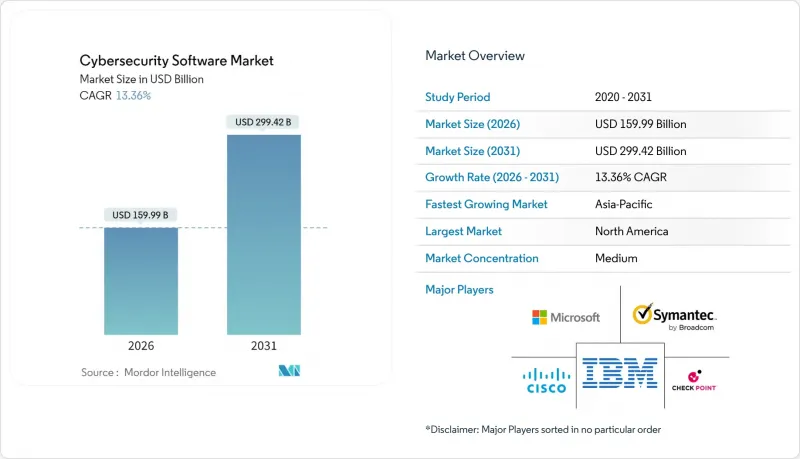
2026년 사이버 보안 소프트웨어 시장 규모는 1,599억 9,000만 달러로 추정되고 있으며, 2025년 1,411억 3,000만 달러에서 계속 성장하고 있습니다.
2031년의 예측에서는 2,994억 2,000만 달러에 달하며, 2026-2031년에 CAGR 13.36%로 확대가 전망되고 있습니다.
클라우드 퍼스트 의무화, 제로 트러스트 프레임워크 도입 확대, AI를 활용한 공격 증가가 통합 보안 플랫폼에 대한 수요를 촉진하고 있습니다. 클라우드 배포 모델은 이미 전체 지출의 3분의 2를 차지하고 있으며, 기업이 툴의 난립을 줄이고 측정 가능한 위험 감소를 추구하면서 플랫폼 통합이 진행되고 있습니다. 규제 위반에 대한 벌금과 사건 공개 규정 강화로 조달 결정이 가속화되고 있으며, 적극적인 투자는 대기업에서 중소기업으로 확대되고 있습니다. 아이덴티티, 클라우드, 분석 기능을 단일 아키텍처로 통합하는 벤더들은 사이버 보안 소프트웨어 시장에서 큰 기회를 얻고 있습니다.
세계 사이버 보안 소프트웨어 시장 동향 및 인사이트
클라우드 퍼스트 도입과 제로 트러스트 의무화 추진
제로 트러스트 프레임워크는 전략적 비전에서 운영상의 현실로 전환되고 있으며, 81%의 조직이 2026년까지 도입할 계획을 가지고 있습니다. 주요 업체들은 현재 보안 바이 디자인을 클라우드 서비스에 통합하고 있으며, 마이크로소프트의 사이버 보안 매출은 2024년 200억 달러를 돌파할 것으로 예상되며, 벤더들의 기세를 지원하고 있습니다. 애널리스트에 따르면 최근 산업 사고의 68%는 IT 시스템 침해에서 시작되었으며, 제로 트러스트 프로젝트와 운영 탄력성의 연관성이 강화되고 있다고 합니다. 멀티 클라우드 환경이 복잡해짐에 따라 기업은 환경을 가로지르는 통일된 정책 적용을 중요시하게 되었고, 통합 플랫폼에 대한 수요가 증가하고 있습니다. 단일 스택 내에서 ID 관리, 액세스 제어, 네트워크 세분화를 통합하는 공급자가 조달 우선순위를 차지하고 있습니다. 그 결과, 플랫폼 구독을 장기 계약으로 고정하는 움직임이 꾸준히 증가하고 있습니다.
AI 기반 멀티벡터 사이버 공격의 급증
정보 탈취형 악성코드 사례는 2024년 500% 급증하는 반면, 서비스형 랜섬웨어(RaaS) 사업자는 공격자의 진입장벽을 낮추었습니다. 공격자들이 정찰과 악용을 자동화하면서 API 취약점이 1,205% 증가하여 기존 방어책을 압도하고 있습니다. 주목할 만한 체인지 헬스케어(Change Healthcare) 침해 사건은 1억 명이 피해를 입었고, 2,200만 달러의 몸값이 지불되었으며, AI를 활용한 공격 캠페인이 비즈니스에 미치는 영향을 보여주었습니다. 클라우드 스트라이크는 현재 예측 분석을 강화하기 위해 하루 84조 건의 위협 시그널을 처리하고 있으며, 이는 군비 경쟁의 격화 양상을 반영하고 있습니다. 이사회는 AI 기반 리스크를 전략적 위협으로 인식하고 있으며, 광범위한 IT 지출을 재검토하는 가운데 예산 보호를 위해 AI 기반 리스크를 다루는 경향이 증가하고 있습니다.
지속적인 인력 부족과 임금 상승
일본에서만 20만 명 이상의 사이버 보안 전문가가 부족하며, 현지 전문가들은 시간당 약 135.50달러(기존 대비 상승)를 벌고 있습니다. 2024년 OT 공격이 73% 증가했음에도 불구하고 운영 기술(OT) 보안 기술은 더욱 부족합니다. 기업은 부족한 부분을 보완하기 위해 매니지드 보안 서비스나 AI 기반 자동화로 전환하고 있지만, 모두 문화 변화와 도입 투자가 필요합니다. 이러한 부족은 고급 보안 프로그램의 총소유비용을 증가시키고, 대규모 배포를 지연시키고 있습니다. 지속적인 임금 상승 압력은 시간이 지남에 따라 벤더의 가격 책정 모델에 영향을 미쳐 사이버 보안 소프트웨어 시장의 성장률을 억제할 수 있습니다.
부문 분석
2025년 아이덴티티 및 액세스 관리(IAM)는 사이버 보안 소프트웨어 시장 점유율의 25.10%를 차지하여 아이덴티티가 기업 방어의 주요 제어 기반이 되었음을 보여줍니다. 클라우드 보안 솔루션은 기업이 멀티 클라우드 및 하이브리드 워크로드를 보호하면서 2031년까지 14.60%의 연평균 복합 성장률(CAGR)을 보일 것으로 예측되며, 전체 제품군 중 가장 높은 성장률을 보일 것으로 전망됩니다. 사이버아크가 15억 4,000만 달러에 베나피(Benafi)를 인수한 것은 머신 아이덴티티 거버넌스의 중요성이 커지고 있음을 보여줍니다. 또한 DevSecOps의 확산과 개인정보보호 규제 강화에 따라 용도 및 데이터 보안 관련 사이버 보안 소프트웨어 시장 규모도 확대되고 있습니다.
아이덴티티, 클라우드, 데이터, 인프라의 각 계층을 아우르는 통합 플랫폼에 대한 수요가 증가하고 있습니다. 인프라 및 네트워크 보호는 여전히 하이브리드 환경의 핵심이며, NIST가 2024년 세 가지 양자 내성 알고리즘을 확정함에 따라 새로운 포스트 양자암호화 솔루션은 실험실에서 파일럿 단계로 이동하고 있습니다. 고객들은 운영 오버헤드를 줄이기 위해 여러 기능을 단일 제어 패브릭에 통합할 수 있는 벤더를 점점 더 선호하고 있습니다.
클라우드 배포는 2025년 66.85%의 점유율을 차지하며 2031년까지 연평균 복합 성장률(CAGR) 13.62%로 확대될 것으로 예상되며, 사이버 보안 소프트웨어 시장에서 돌이킬 수 없는 추세를 확고히 하고 있습니다. 마이크로소프트는 Azure에 AI 위협 분석과 포스트 양자암호화를 강화하고, 하이퍼스케일러가 고급 기능을 자체 스택에 직접 통합할 수 있는 방법을 제시했습니다. On-Premise 구현은 꾸준히 감소하는 추세, 규제상 데이터 거주 규칙이 적용되는 영역에서는 지속될 것입니다.
하이브리드 전략은 환자 데이터와 같은 민감한 워크로드에 대해 클라우드의 민첩성과 현장 제어를 결합합니다. 의료기관은 2015년 이후 공격 건수가 300% 급증한 것을 계기로 클라우드 보안으로 단호하게 전환했습니다. 엣지 컴퓨팅은 위치 정보를 인식한 정책 적용을 필요로 하는 세 번째 축으로 부상하고 있습니다. 클라우드, On-Premise, 엣지를 아우르는 일관된 워크로드 보호 기능을 제공할 수 있는 벤더가 조달 주기에서 우위를 점하고 있습니다.
사이버 보안 소프트웨어 시장은 제공(용도 보안, 클라우드 보안, 데이터 보안 등), 도입 모델(On-Premise, 클라우드), 최종사용자 업종(은행, 금융서비스 및 보험(BFSI), 의료, 제조 등), 조직 규모(대기업, 중소기업(SME)), 그리고 지역별로 구분됩니다. 시장 예측은 금액(USD)으로 제공됩니다.
지역별 분석
북미는 성숙한 벤더 생태계, 강력한 벤처 자금 조달, SEC 사건 공개 규정 등의 규제 요건으로 인해 24.35%로 가장 규모가 큰 지역 점유율을 차지하고 있습니다. 마이크로소프트의 보안 매출은 200억 달러를 넘어섰고, CrowdStrike는 2025년 46억 달러의 연간 경상매출을 보고해 이 지역의 규모를 보여주고 있습니다. 국경 간 공급망 요구 사항으로 인해 캐나다와 멕시코에서 도입이 촉진되고 있습니다. 사이버보험의 보험료가 안정화되고 있으며, 기업 전반의 기본 방어체계가 강화되고 있음을 시사하고 있습니다.
아시아태평양은 2031년까지 연평균 복합 성장률(CAGR) 13.42%로 가장 빠르게 성장하는 지역으로, 급속한 디지털화와 위협 증가(전 세계 전체 침해사고의 31% 차지)가 주도하고 있습니다. 중국의 사이버 보안 지출은 정부 지침에 따라 2023년까지 386억 달러 이상에 달할 것으로 예측됩니다. 일본은 2029년까지 132억 5,000만 달러의 시장 규모를 예상하고 있지만, 심각한 인력 부족에 직면해 있습니다. 한국에서는 AI SPERA와 같은 혁신적인 스타트업이 육성되고 있으며, 이 회사는 Criminal IP 플랫폼 확장을 위해 850만 달러를 조달했습니다. 이 지역의 사이버 보험 보험료는 연간 약 50%의 속도로 증가하고 있으며, 이는 위험 이전 메커니즘이 성숙해졌음을 의미합니다.
유럽에서는 GDPR(EU 개인정보보호규정), NIS2, 그리고 입증 가능한 관리를 의무화하는 새로운 AI 규제에 따라 꾸준한 확대가 이루어지고 있습니다. 독일, 영국, 프랑스가 지출을 주도하고, 동유럽 국가들은 EU 통합 속에서 도입을 가속화하고 있습니다. 중동 및 아프리카에서는 걸프협력회의(GCC)의 스마트 시티 프로젝트와 아랍에미리트(UAE) 및 사우디아라비아의 국가 사이버 전략에 힘입어 높은 성장세를 보이고 있습니다. 남아프리카공화국, 나이지리아, 이집트는 대륙의 초기 단계의 선두주자이지만, 노동력 개발은 여전히 제약이 되고 있습니다. 데이터 주권 규정과 언어 선호도에 따라 제품을 현지화하는 벤더는 이러한 신흥 하위 지역에서 이익을 얻을 수 있습니다.
기타 특전:
- 엑셀 형식 시장 예측(ME) 시트
- 3개월간의 애널리스트 지원
자주 묻는 질문
목차
제1장 서론
제2장 조사 방법
제3장 개요
제4장 시장 구도
제5장 시장 규모와 성장 예측
제6장 경쟁 구도
제7장 시장 기회와 향후 전망
The cybersecurity software market size in 2026 is estimated at USD 159.99 billion, growing from 2025 value of USD 141.13 billion with 2031 projections showing USD 299.42 billion, growing at 13.36% CAGR over 2026-2031.
Cloud-first mandates, rising adoption of zero-trust frameworks, and the growing volume of AI-enabled attacks are reinforcing demand for unified security platforms. Cloud deployment models already command two-thirds of total spending, while platform consolidation continues as enterprises reduce tool sprawl and seek measurable risk reduction. Escalating regulatory fines and incident-disclosure rules are accelerating procurement decisions, and proactive investment is spreading from large enterprises to small and medium businesses. Vendors that integrate identity, cloud, and analytics functions into a single architecture are capturing outsized opportunity within the cybersecurity software market.
Global Cybersecurity Software Market Trends and Insights
Cloud-first Adoption and Zero-trust Mandates
Zero-trust frameworks are moving from strategic vision to operational reality, with 81% of organizations planning deployments by 2026. Major providers now embed security-by-design into cloud services, and Microsoft's cybersecurity revenue surpassed USD 20 billion in 2024, underscoring vendor momentum. Analysts confirm that 68% of recent industrial incidents started with IT system compromise, tightening the link between zero-trust projects and operational resilience. Multicloud complexity is prompting enterprises to favor unified policy enforcement across environments, which is driving up demand for integrated platforms. Providers that combine identity, access, and network segmentation within a single stack are gaining procurement preference. The result is a steady uptick in long-term contracts that lock in platform subscriptions.
Surge in AI-driven, Multi-vector Cyber-attacks
Information-stealing malware cases spiked 500% in 2024, while ransomware-as-a-service shops lowered entry barriers for attackers. API vulnerabilities rose 1,205% as adversaries automated reconnaissance and exploitation, overwhelming traditional defenses. The high-profile Change Healthcare breach affected 100 million people and involved a USD 22 million ransom payment, demonstrating the business impact of AI-enabled campaigns. CrowdStrike now processes 84 trillion daily threat signals to sharpen predictive analytics, reflecting escalating arms-race dynamics. Boards increasingly treat AI-driven risk as a strategic threat, translating into budget protection even amid broader IT spending reviews.
Persistent Talent Deficit and Wage Inflation
Japan alone needs over 200,000 additional cybersecurity professionals, and specialists there earn about USD 135.50 per hour, up from prior levels. Operational-technology security skills are scarcer still, even as OT attacks rose 73% in 2024. Companies are shifting to managed security services and to AI-based automation to fill gaps, but both require cultural change and onboarding investments. The shortfall increases the total cost of ownership for advanced security programs and slows large-scale rollouts. Over time, persistent wage pressure will influence vendor pricing models and could moderate the cybersecurity software market growth rate.
Other drivers and restraints analyzed in the detailed report include:
- Expanding Regulatory Fines and SEC Incident-disclosure
- Tool Sprawl Causing ROI Fatigue in C-suites
For complete list of drivers and restraints, kindly check the Table Of Contents.
Segment Analysis
Identity and Access Management commanded 25.10% of the cybersecurity software market share in 2025, illustrating that identity is now the primary control plane for enterprise defense. Cloud security solutions are forecast to register a 14.60% CAGR through 2031, the fastest of all offerings, as businesses secure multicloud and hybrid workloads. CyberArk's USD 1.54 billion acquisition of Venafi spotlights the growing importance of machine-identity governance. The cybersecurity software market size tied to application and data security is also rising as DevSecOps gains ground and privacy regulations tighten.
Demand is coalescing around integrated platforms that span identity, cloud, data, and infrastructure layers. Infrastructure and network protection remains core for hybrid environments, while emerging post-quantum cryptography solutions move from labs to pilots after NIST finalized three quantum-resistant algorithms in 2024. Customers increasingly prefer vendors that can knit multiple functions into a single control fabric to lower operational overhead.
Cloud deployments captured 66.85% share in 2025 and are expected to grow at 13.62% CAGR through 2031, cementing irreversible migration trends in the cybersecurity software market. Microsoft enhanced Azure with AI threat analytics and post-quantum encryption, showing how hyperscalers embed advanced capabilities directly into their stacks. On-premises implementations decline steadily yet persist where regulatory data-residency rules apply.
Hybrid strategies combine cloud agility with on-site controls for sensitive workloads such as patient data. Healthcare organizations moved decisively to cloud security after seeing a 300% jump in attacks since 2015. Edge computing is emerging as a third pillar requiring location-aware policy enforcement. Vendors able to protect workloads consistently across cloud, on-premises, and edge win favor in procurement cycles.
Cybersecurity Software Market is Segmented by Offering (Application Security, Cloud Security, Data Security and More), Deployment Model (On-Premises, Cloud), End-User Vertical (BFSI, Healthcare, Manufacturing and More), Organization Size (Large Enterprises, Small and Medium Enterprises (SMEs)), and by Geography. The Market Forecasts are Provided in Terms of Value (USD).
Geography Analysis
North America accounts of 24.35% the largest regional share through a mature vendor ecosystem, strong venture funding, and regulatory mandates such as SEC incident-disclosure rules. Microsoft's security revenue surpassed USD 20 billion, and CrowdStrike reported USD 4.6 billion annual recurring revenue in 2025, showcasing regional scale. Cross-border supply-chain requirements are boosting adoption in Canada and Mexico. Cyber-insurance premiums have stabilized, suggesting improving baseline defenses across enterprises.
Asia-Pacific is the fastest-growing region with a 13.42% CAGR through 2031, driven by rapid digitization and elevated threat volume that accounts for 31% of global incidents. China's cybersecurity outlays are projected to top USD 38.6 billion by 2023, propelled by government directives. Japan expects a USD 13.25 billion market by 2029 but faces significant talent shortages. South Korea nurtures innovative startups like AI SPERA, which raised USD 8.5 million to scale its Criminal IP platform. The region's cyber-insurance premiums are growing near 50% annually, signaling maturation of risk-transfer mechanism.
Europe shows steady expansion under GDPR, NIS2, and emerging AI regulations requiring demonstrable controls. Germany, the United Kingdom, and France lead spending, while Eastern European states accelerate adoption amid EU integration. The Middle East and Africa exhibit high-growth pockets, led by Gulf Cooperation Council smart-city projects and national cyber strategies in the UAE and Saudi Arabia. South Africa, Nigeria, and Egypt are early continental leaders, though workforce development remains a constraint. Vendors that localize offerings to data-sovereignty rules and language preferences stand to gain within these emerging sub-regions.
- IBM
- Microsoft
- Cisco
- Check Point
- Broadcom (Symantec)
- Fortinet
- F5
- Palo Alto Networks
- Proofpoint
- CyberArk
- Zscaler
- Mandiant (Google)
- Sophos
- CrowdStrike
- Okta
- Cloudflare
- Trend Micro
- Rapid7
- SentinelOne
- Qualys
Additional Benefits:
- The market estimate (ME) sheet in Excel format
- 3 months of analyst support
TABLE OF CONTENTS
1 INTRODUCTION
- 1.1 Study Assumptions and Market Definition
- 1.2 Scope of the Study
2 RESEARCH METHODOLOGY
3 EXECUTIVE SUMMARY
4 MARKET LANDSCAPE
- 4.1 Market Overview
- 4.2 Market Drivers
- 4.2.1 Cloud-first adoption and zero-trust mandates
- 4.2.2 Surge in AI-driven, multi-vector cyber-attacks
- 4.2.3 Expanding regulatory fines (e.g., SEC incident-disclosure)
- 4.2.4 Shift to API-centric architectures (new attack surface)
- 4.2.5 OT/IT convergence in critical infrastructure
- 4.2.6 Rising cyber-insurance premiums drive proactive security
- 4.3 Market Restraints
- 4.3.1 Persistent talent deficit and wage inflation
- 4.3.2 Tool sprawl causing ROI fatigue in C-suites
- 4.3.3 Legacy technical debt in public sector and SMBs
- 4.3.4 Sovereign-cloud and data-residency conflicts
- 4.4 Supply-Chain Analysis
- 4.5 Regulatory Landscape
- 4.6 Technological Outlook
- 4.7 Porter's Five Forces Analysis
- 4.7.1 Bargaining Power of Suppliers
- 4.7.2 Bargaining Power of Consumers
- 4.7.3 Threat of New Entrants
- 4.7.4 Threat of Substitutes
- 4.7.5 Intensity of Competitive Rivalry
- 4.8 Assesment of Macroeconomic Factors on the market
5 MARKET SIZE AND GROWTH FORECASTS (VALUE)
- 5.1 By Offering
- 5.1.1 Application Security
- 5.1.2 Cloud Security
- 5.1.3 Data Security
- 5.1.4 Identity and Access Management
- 5.1.5 Infrastructure / Network Protection
- 5.1.6 Others
- 5.2 By Deployment Model
- 5.2.1 On-premises
- 5.2.2 Cloud
- 5.3 By End-User Vertical
- 5.3.1 BFSI
- 5.3.2 Healthcare
- 5.3.3 Manufacturing
- 5.3.4 Government and Defense
- 5.3.5 IT and Telecommunications
- 5.3.6 Others
- 5.4 By Organization Size
- 5.4.1 Large Enterprises
- 5.4.2 Small and Medium Enterprises (SMEs)
- 5.5 By Geography
- 5.5.1 North America
- 5.5.1.1 United States
- 5.5.1.2 Canada
- 5.5.1.3 Mexico
- 5.5.2 South America
- 5.5.2.1 Brazil
- 5.5.2.2 Argentina
- 5.5.2.3 Rest of South America
- 5.5.3 Europe
- 5.5.3.1 Germany
- 5.5.3.2 United Kingdom
- 5.5.3.3 France
- 5.5.3.4 Italy
- 5.5.3.5 Spain
- 5.5.3.6 Rest of Europe
- 5.5.4 Asia-Pacific
- 5.5.4.1 China
- 5.5.4.2 Japan
- 5.5.4.3 India
- 5.5.4.4 South Korea
- 5.5.4.5 Australia
- 5.5.4.6 Southeast Asia
- 5.5.4.7 Rest of Asia-Pacific
- 5.5.5 Middle East and Africa
- 5.5.5.1 Middle East
- 5.5.5.1.1 Saudi Arabia
- 5.5.5.1.2 United Arab Emirates
- 5.5.5.1.3 Turkey
- 5.5.5.1.4 Rest of Middle East
- 5.5.5.2 Africa
- 5.5.5.2.1 South Africa
- 5.5.5.2.2 Nigeria
- 5.5.5.2.3 Egypt
- 5.5.5.2.4 Rest of Africa
- 5.5.5.1 Middle East
- 5.5.1 North America
6 COMPETITIVE LANDSCAPE
- 6.1 Market Concentration
- 6.2 Strategic Moves
- 6.3 Market Share Analysis
- 6.4 Company Profiles (includes Global level Overview, Market level overview, Core Segments, Financials as available, Strategic Information, Market Rank/Share for key companies, Products and Services, and Recent Developments)
- 6.4.1 IBM
- 6.4.2 Microsoft
- 6.4.3 Cisco
- 6.4.4 Check Point
- 6.4.5 Broadcom (Symantec)
- 6.4.6 Fortinet
- 6.4.7 F5
- 6.4.8 Palo Alto Networks
- 6.4.9 Proofpoint
- 6.4.10 CyberArk
- 6.4.11 Zscaler
- 6.4.12 Mandiant (Google)
- 6.4.13 Sophos
- 6.4.14 CrowdStrike
- 6.4.15 Okta
- 6.4.16 Cloudflare
- 6.4.17 Trend Micro
- 6.4.18 Rapid7
- 6.4.19 SentinelOne
- 6.4.20 Qualys
7 MARKET OPPORTUNITIES AND FUTURE OUTLOOK
- 7.1 White-space and Unmet-need Assessment