
|
시장보고서
상품코드
1934850
표면 처리 화학제품 : 시장 점유율 분석, 업계 동향과 통계, 성장 예측(2026-2031년)Surface Treatment Chemicals - Market Share Analysis, Industry Trends & Statistics, Growth Forecasts (2026 - 2031) |
||||||
 Mordor Intelligence
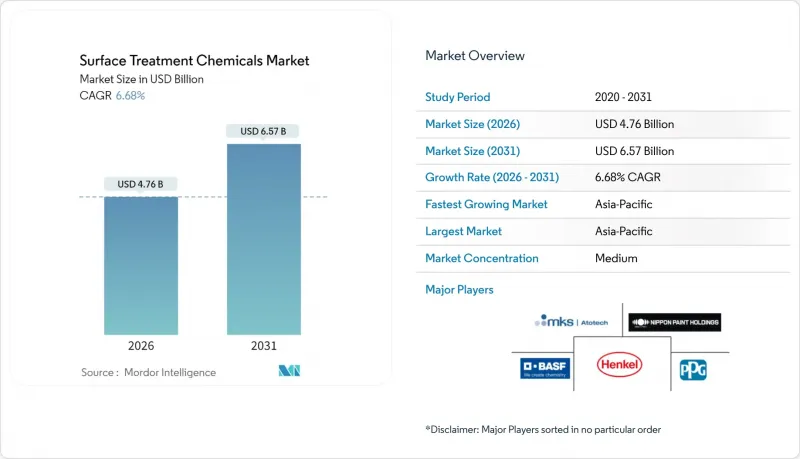
표면 처리 화학제품 시장 규모는 2026년에는 47억 6,000만 달러로 추정되며, 2025년 44억 6,000만 달러에서 성장이 전망됩니다.
2031년에는 65억 7,000만 달러에 달할 것으로 예상되며, 2026-2031년 연평균 복합 성장률(CAGR) 6.68% 성장할 것으로 전망됩니다.
자동차의 전동화, 반도체 패키징의 회복, 내식성 시스템을 필요로 하는 해상 풍력발전 설비의 설치가 강력한 성장 모멘텀을 가져오고 있습니다. 아시아 생산 기지가 신규 생산 능력의 대부분을 차지하는 반면, 북미의 생산 회귀 프로그램과 유럽의 지속가능성 규제로 인해 고성능, 크롬을 함유하지 않은 배합에 대한 프리미엄 수요가 재조정되고 있습니다. 반도체 등급의 순도, 다금속 적합성, 바이오 혁신성을 겸비한 공급업체는 전통적 금속 마감 화학물질의 중요성이 감소하는 가운데, 확대되는 가치 영역을 확보하고 있습니다. 표면처리 화학제품 시장은 육가크롬에 대한 규제 강화로 인한 규제 수렴의 혜택을 누리고 있습니다. 이로 인해 최종사용자는 엄격한 산업 보건 및 환경 기준을 충족하는 대체 코팅제 및 세정제를 사용해야 하는 상황에 처해 있습니다.
세계 표면처리 화학제품 시장 동향과 인사이트
아시아에서 자동차 생산의 급속한 확대
아시아 자동차 제조업체들은 알루미늄과 강재 간의 상호 오염을 방지할 수 있는 세정제에 의존하는 다용도한 차량 구조를 확대하고 있습니다. 전기자동차 배터리 하우징, 구조용 주조 부품, 열관리 플레이트는 혼합 합금을 견디면서 갈바닉 부식을 일으키지 않는 정밀 에칭 및 변환 코팅이 요구됩니다. 2024년 1분기 전자기기 부문 매출이 10% 증가하여 3억 9,400만 달러의 매출을 기록했습니다. 이는 자동차의 전동화가 반도체 등급 화학물질에 대한 수요를 증가시키고 있음을 보여줍니다. 그러나 지역적 통합은 위험을 집중시키고 있습니다. 중국의 갈륨 및 게르마늄 수출 규제로 인해 트랙션 인버터에 내장된 파워 디바이스용 도금 공급에 차질을 빚고 있습니다. 아시아 지역에 다양한 거점을 두고 원자재 조달처를 분산시킨 공급업체는 이러한 취약성을 줄이면서 지속적인 생산량 증가를 활용하고 있습니다.
전자기기의 소형화가 요구하는 고정밀 도금
반도체 패키징 재료 매출은 2023년 하락세를 거쳐 2025년에는 260억 달러에 달할 것으로 예상되며, 전체 첨단 기판 라인의 가동률도 회복될 것으로 전망됩니다. 플립칩 및 웨이퍼 레벨 패키지에서는 무전해 니켈, 침지금, 무산화 클리너에 대해 ±1μm의 두께 공차가 요구됩니다. 듀폰의 일본내 포토레지스트 사업 확대와 스미토모화학의 2030년까지 3,000억 엔의 칩 소재 매출 목표는 초순수 처리 약품에 대한 수요 증가를 지원하고 있습니다. 미량 오염물질을 1조분의 1 이하의 임계치 이하로 제어할 수 없는 기존 금속 가공제 업체를 대신해 저결함, 고선택성 배합을 제공하는 공급업체가 부상하고 있습니다. 과도한 자본 집약도와 엄격한 클린룸 프로토콜은 진입 장벽을 높이고, 인증된 벤더에게 두 자릿수 기여 이익률을 지원하는 프리미엄 가격 책정을 가능하게 합니다.
6가 크롬 규제 강화
유럽연합(EU), 캘리포니아, 영국은 2024년 육가크롬의 병행 금지 조치를 시행할 예정이며, 공급망 전체에서 누적 3억 3,100만 달러-10억 7,000만 달러의 규제 대응 비용이 발생할 것으로 추정됩니다. 대체 경로로는 3가 크롬, PVD 스퍼터링, 세라믹 티타늄 질화물 실러 등이 있습니다. 항공우주 프라임 제조업체들은 대체 기술에 대해 수년에 걸친 인증 주기를 요구하므로 도금 공장이 라인을 개조하는 동안 단기적인 생산 능력에 대한 압박을 받고 있습니다. 불화지르코네이트 또는 몰리브덴산염 실링 화학물질을 조기에 채택한 기업은 항공 안전 규정이 부품이 내공성 검증을 통과한 후 공급업체 변경을 억제하므로 단독 공급원으로서의 지위를 확보하고 있습니다. 중소규모의 도급 공장은 자본 장벽에 직면하고 있으며, 이는 시장 통합을 가속화할 수 있습니다.
부문 분석
표면처리 화학제품 시장에서 전환 코팅은 2025년 매출액의 42.39%를 차지할 것으로 예상되며, 자동차, 항공우주, 일반 산업 용도장 라인이 그 핵심을 이루고 있습니다. 반도체 패키지 공장 및 적층제조 거점들이 초저잔류조를 요구하는 가운데, 세정제는 6.77%의 가장 빠른 CAGR을 나타낼 것으로 예측됩니다. 이 차이는 양극화를 보여준다: 범용 인산염계 변환 처리는 대량 수요를 모으는 반면, 이익률은 낮습니다. 한편, 정밀 세정제는 순도와 선택성 기준으로 인해 높은 가격대를 유지하고 있습니다. 규제 당국은 슬러지 및 에너지 사용량을 줄이는 지르코늄-티타늄 시스템으로의 전환을 추진하고 있으며, 강력한 배합 기술 지적재산권(IP)을 보유한 공급업체들의 차별화를 더욱 촉진하고 있습니다. 전문 제조업체는 세정제 및 변환 처리 번들 패키지를 활용하여 다년간의 플랜트 감사 계약을 체결함으로써 고객 이탈을 억제하고 있습니다.
알루미늄 배터리 케이스용 2세대 아노다이징 첨가제는 용접성을 유지하면서 내마모성을 강화합니다. 바이오 유래 실러, 크롬 프리 하이브리드 필름과 같은 다른 유형은 의료기기 및 풍력 터빈 블레이드의 틈새 사양에 대응합니다. OEM(Original Equipment Manufacturer)들이 전 세계 재료 사양을 표준화하면서 대륙을 넘나들며 일관된 화학 성분을 제공하는 공급업체들이 마스터 서비스 계약을 따내고 있습니다. 그 결과, 표면처리 화학제품 시장에서는 욕조 수명 연장, 발포 제어, 폐수 처리성 향상을 위한 첨가제 패키지로 연구 예산이 이동하고, 리터당 단가가 아닌 수명주기 비용을 중심으로 경쟁이 심화되고 있습니다.
표면처리 화학제품 보고서는 화학 유형별(세정제, 화학변환 코팅 등), 기질별(금속, 플라스틱, 기타 재료), 최종사용자 산업별(자동차, 건설, 전자, 산업 기계, 기타), 지역별(아시아태평양, 북미, 유럽, 남미, 중동 및 아프리카)로 분류되어 있습니다. 시장 예측은 금액 기준(USD)으로 제공됩니다.
지역별 분석
아시아태평양은 2025년 표면처리 화학제품 시장 매출의 42.88%를 차지하며 2031년까지 연평균 복합 성장률(CAGR) 7.05%로 확대될 것으로 예측됩니다. 중국에서는 국내 경기부양책이 전기자동차(EV) 공급망에 힘을 실어주면서 2025년 화학업체들의 이익이 회복될 것으로 예상되고 있습니다. 인도의 특수화학제품 매출은 2025년 3,000억 달러에 달할 것으로 예상되며, 스마트폰 조립 및 자동차 수출을 위한 고부가가치 코팅 수요를 지원할 것으로 전망됩니다.
북미에서는 1조 2,000억 달러 규모의 '인프라 투자 및 일자리 창출법'으로 산업 기반이 강화되어 중장비 및 교량용 도료 수요를 지원하고 있습니다. 애리조나, 텍사스, 뉴욕의 반도체 공장은 1등급 클린룸 기준을 충족하는 초순수 세정제의 지역적 소비를 촉진하고 있습니다. 캐나다 해상풍력발전 공급망 확대로 ISO 20340 인증 코팅에 대한 수요가 더욱 확대될 것으로 예측됩니다. 성장률은 아시아에 비해 뒤처지지만, 엄격한 환경 규제와 R&D 클러스터와의 근접성으로 인해 고부가가치 매출 기회가 창출되고 있습니다.
유럽은 해양 에너지 및 항공우주 분야에서 기술 리더십을 유지하고 있습니다. 2025년 NORSOK M-501 Rev 7이 시행되면 장기 침수 및 화재 노출에 대해 검증된 코팅이 요구됩니다. 그린딜 정책에 따라 바이오 화학물질이 추진되고 있습니다. 독일과 스칸디나비아 국가들은 리그닌 유래 수지에 보조금을 지급하여 용제계 크로메이트의 단계적 폐지를 가속화하고 있습니다. 남미와 중동 및 아프리카는 각각 다른 속도로 부상하고 있습니다. 브라질의 프리솔트 유전에는 고온 부식 방지제가 필요하며, 걸프협력회의 회원국은 자동차 수출 통로와 관련된 알루미늄 압연 공장에 투자하고 있습니다. 총 생산량은 여전히 미미하지만, 현지 생산 의무화로 인해 다국적 공급업체들은 서비스 허브를 설립해야 하며, 산업화가 가속화됨에 따라 선구자적 우위를 발휘하고 있습니다.
기타 특전:
- 엑셀 형식 시장 예측(ME) 시트
- 3개월간의 애널리스트 지원
자주 묻는 질문
목차
제1장 서론
제2장 조사 방법
제3장 개요
제4장 시장 구도
제5장 시장 규모와 성장 예측
제6장 경쟁 구도
제7장 시장 기회와 향후 전망
KSA 26.03.05Surface Treatment Chemicals Market size in 2026 is estimated at USD 4.76 billion, growing from 2025 value of USD 4.46 billion with 2031 projections showing USD 6.57 billion, growing at 6.68% CAGR over 2026-2031.
Strong momentum flows from automotive electrification, semiconductor packaging recovery, and offshore wind installations that demand corrosion-resistant systems. Asian manufacturing hubs account for most new capacity, while North American reshoring programs and European sustainability mandates redirect premium demand toward high-performance, chromium-free formulations. Suppliers that combine semiconductor-grade purity, multi-metal compatibility, and bio-based innovation capture rising value pools as legacy metal-finishing chemistries lose relevance. The surface treatment chemicals market benefits from regulatory convergence that penalizes hexavalent chromium, forcing end-users to adopt alternative coatings and cleaners that comply with strict occupational health and environmental limits.
Global Surface Treatment Chemicals Market Trends and Insights
Rapid Expansion of Automotive Production in Asia
Asia's automakers are scaling multi-material vehicle architectures that depend on cleaners able to prevent cross-contamination between aluminum and steel. Electric-vehicle battery housings, structural castings, and heat-management plates require precision etching and conversion coatings that tolerate mixed alloys without galvanic corrosion. Element Solutions recorded 10% electronics-segment sales growth to USD 394 million in Q1 2024, illustrating how automotive electrification lifts semiconductor-grade chemical volumes. Regional consolidation nonetheless concentrates risk: Chinese export controls on gallium and germanium disrupt plating supply for power-devices embedded in traction inverters. Suppliers with diversified Asian footprints and redundant raw-material sources mitigate these vulnerabilities while capitalizing on sustained output gains.
Electronics Miniaturisation Demanding High-Precision Plating
Semiconductor packaging materials revenues are forecast to climb to USD 26 billion in 2025 after a 2023 downturn, restoring capacity utilization across advanced substrate lines. Flip-chip and wafer-level packages impose +-1 µm thickness tolerances on electroless nickel, immersion gold, and oxide-free cleaners. DuPont's photoresist expansion in Japan and Sumitomo Chemical's JPY 300 billion chip-materials sales goal by 2030 underscore the pull for ultra-pure treatment chemicals. Suppliers that deliver low-defect, high-selectivity formulations displace traditional metal finishers whose processes cannot control trace contaminants below parts-per-trillion thresholds. Outsized capital intensity and strict cleanroom protocols raise barriers, enabling premium pricing that supports double-digit contribution margins for qualified vendors.
Regulatory Clamp-Down on Hexavalent Chromium
The European Union, California, and the United Kingdom enacted parallel bans on hexavalent chromium during 2024, triggering cumulative compliance outlays estimated between USD 331 million and USD 1.07 billion across the supply chain. Transition pathways include trivalent chromium, PVD sputtering, and ceramic titanium-nitride sealers. Aerospace primes impose multiyear qualification cycles for alternatives, tightening near-term capacity as plating shops retrofit lines. Early adopters of fluorozirconate or molybdate sealing chemistries secure sole-source positions because flight-safety regulations discourage supplier substitutions once parts pass airworthiness validation. Smaller job shops face capital barriers that may accelerate market consolidation.
Other drivers and restraints analyzed in the detailed report include:
- Stringent Anti-Corrosion Standards in Wind-Turbine Towers
- On-Site 3D-Printed Metal Parts Requiring Post-Print Surface Prep
- Shift Toward Bio-Based Coatings Reduces Legacy Chemical Demand
For complete list of drivers and restraints, kindly check the Table Of Contents.
Segment Analysis
Conversion coatings generated 42.39% of 2025 revenue within the surface treatment chemicals market, anchored by automotive, aerospace, and general-industrial paint lines. Cleaners are projected to post the fastest 6.77% CAGR as semiconductor packaging plants and additive-manufacturing hubs demand ultra-low residue baths. This divergence signals a bifurcation: commodity phosphate-based conversions attract volume but modest margins, whereas precision cleaners command high price points due to purity and selectivity thresholds. Regulators are driving a shift to zirconium and titanium systems that lower sludge and energy usage, further differentiating suppliers that possess strong formulation IP. Specialty players leverage bundled cleaner-conversion packages to lock in multi-year plant audits, limiting churn.
Second-generation anodizing additives for aluminum battery enclosures strengthen wear resistance while maintaining weldability. Other types, including bio-derived sealers and chromium-free hybrid films, address niche specifications in medical instruments and wind-turbine blades. As OEMs standardize global material specifications, suppliers that offer consistent chemistries across continents win master-service agreements. Consequently, the surface treatment chemicals market sees a migration of research budgets toward additive packages that improve bath longevity, foaming control, and wastewater treatability, intensifying competition on lifecycle cost rather than per-liter pricing.
The Surface Treatment Chemicals Report is Segmented by Chemical Type (Cleaner, Chemical Conversion Coating, and More), Base Material (Metal, Plastic and Other Materials), End-User Industry (Automotive, Construction, Electronics, Industrial Machinery, and Others), and Geography (Asia-Pacific, North America, Europe, South America, and Middle-East and Africa). The Market Forecasts are Provided in Terms of Value (USD).
Geography Analysis
Asia-Pacific contributed 42.88% of 2025 revenue within the surface treatment chemicals market and is expanding at a 7.05% CAGR to 2031. China forecasts a profit rebound for its chemical producers in 2025 amid a domestic stimulus that boosts EV supply chains. India's specialty-chemical turnover is scheduled to reach USD 300 billion in 2025, feeding demand for high-value coatings used in smart-phone assembly and automotive exports.
North America is reinforcing its industrial base through the USD 1.2 trillion Infrastructure Investment and Jobs Act, which underpins heavy-equipment and bridge-coating demand. Semiconductor fabs in Arizona, Texas, and New York fuel localized consumption of ultra-pure cleaners that meet Class 1 cleanroom thresholds. Canada's offshore wind supply-chain build-out further widens the need for ISO 20340-certified coatings. Although growth rates trail Asia, premium margin opportunities arise from tight environmental regulations and proximity to research and development clusters.
Europe retains technological leadership in offshore energy and aerospace. The implementation of NORSOK M-501 Rev 7 in 2025 demands coatings validated for long-term immersion and fire exposure. Green-deal policies advance bio-based chemistries; Germany and Scandinavia subsidize lignin-derived resins, accelerating the phase-out of solvent-borne chromates. South America and Middle East Africa are emerging at different paces: Brazil's pre-salt oilfields require high-temperature corrosion inhibitors, while Gulf Cooperation Council states invest in aluminum rolling mills linked to automotive export corridors. Although combined volumes remain modest, local production mandates push multinational suppliers to establish service hubs, unlocking early-mover advantages as industrialization accelerates.
- Aalberts Surface Technologies GmbH
- ALANOD GmbH and Co. KG
- Asterion LLC
- BASF
- Bulk Chemicals Inc.
- ChemTech Surface Finishing Pvt. Ltd.
- Dow
- Element Solutions Inc
- Henkel AG and Co. KGaA
- MKS | Atotech
- Nihon Parkerizing Co., Ltd.
- Nippon Paint Holdings Co. Ltd.
- OC Oerlikon Management AG
- PPG Industries, Inc.
- Quaker Chemical Corporation
- The Sherwin-Williams Company
- YUKEN INDUSTRY CO.,LTD.
Additional Benefits:
- The market estimate (ME) sheet in Excel format
- 3 months of analyst support
TABLE OF CONTENTS
1 Introduction
- 1.1 Study Assumptions and Market Definition
- 1.2 Scope of the Study
2 Research Methodology
3 Executive Summary
4 Market Landscape
- 4.1 Market Overview
- 4.2 Market Drivers
- 4.2.1 Rapid Expansion of Automotive Production in Asia
- 4.2.2 Electronics Miniaturisation Demanding High-Precision Plating
- 4.2.3 Stringent Anti-Corrosion Standards in Wind-Turbine Towers
- 4.2.4 On-Site 3D-Printed Metal Parts Requiring Post-Print Surface Prep
- 4.2.5 Surge in Aluminium Use in EV Platforms Necessitating Multi-Metal Cleaners
- 4.3 Market Restraints
- 4.3.1 Regulatory Clamp-Down on Hexavalent Chromium
- 4.3.2 Shift Toward Bio-Based Coatings Reduces Legacy Chemical Demand
- 4.3.3 Rising Total-Cost-of-Ownership of Captive Metal Finishing Lines
- 4.4 Value Chain Analysis
- 4.5 Porter's Five Forces
- 4.5.1 Bargaining Power of Suppliers
- 4.5.2 Bargaining Power of Buyers
- 4.5.3 Threat of New Entrants
- 4.5.4 Threat of Substitutes
- 4.5.5 Degree of Competition
5 Market Size and Growth Forecasts (Value)
- 5.1 By Chemical Type
- 5.1.1 Cleaner
- 5.1.2 Chemical Conversion Coating
- 5.1.3 Anodizing Chemicals
- 5.1.4 Other Types of Chemicals
- 5.2 By Base Material
- 5.2.1 Metal
- 5.2.2 Plastic
- 5.2.3 Other Base Materials (Glass, Alloys, Wood)
- 5.3 By End-User Industry
- 5.3.1 Automotive and Transportation
- 5.3.2 Construction
- 5.3.3 Electronics
- 5.3.4 Industrial Machinery
- 5.3.5 Others (Oil and Gas Pipeline, Power, Military, Packaging, etc.)
- 5.4 Geography
- 5.4.1 Asia-Pacific
- 5.4.1.1 China
- 5.4.1.2 India
- 5.4.1.3 Japan
- 5.4.1.4 South Korea
- 5.4.1.5 ASEAN
- 5.4.1.6 Rest of Asia-Pacific
- 5.4.2 North America
- 5.4.2.1 United States
- 5.4.2.2 Canada
- 5.4.2.3 Mexico
- 5.4.3 Europe
- 5.4.3.1 Germany
- 5.4.3.2 United Kingdom
- 5.4.3.3 France
- 5.4.3.4 Italy
- 5.4.3.5 Spain
- 5.4.3.6 Russia
- 5.4.3.7 Rest of Europe
- 5.4.4 South America
- 5.4.4.1 Brazil
- 5.4.4.2 Argentina
- 5.4.4.3 Rest of South America
- 5.4.5 Middle-East and Africa
- 5.4.5.1 Saudi Arabia
- 5.4.5.2 South Africa
- 5.4.5.3 Rest of Middle-East and Africa
- 5.4.1 Asia-Pacific
6 Competitive Landscape
- 6.1 Market Concentration
- 6.2 Strategic Moves
- 6.3 Market Share (%)/Ranking Analysis
- 6.4 Company Profiles (includes Global level Overview, Market level overview, Core Segments, Financials as available, Strategic Information, Market Rank/Share for key companies, Products and Services, and Recent Developments)
- 6.4.1 Aalberts Surface Technologies GmbH
- 6.4.2 ALANOD GmbH and Co. KG
- 6.4.3 Asterion LLC
- 6.4.4 BASF
- 6.4.5 Bulk Chemicals Inc.
- 6.4.6 ChemTech Surface Finishing Pvt. Ltd.
- 6.4.7 Dow
- 6.4.8 Element Solutions Inc
- 6.4.9 Henkel AG and Co. KGaA
- 6.4.10 MKS | Atotech
- 6.4.11 Nihon Parkerizing Co., Ltd.
- 6.4.12 Nippon Paint Holdings Co. Ltd.
- 6.4.13 OC Oerlikon Management AG
- 6.4.14 PPG Industries, Inc.
- 6.4.15 Quaker Chemical Corporation
- 6.4.16 The Sherwin-Williams Company
- 6.4.17 YUKEN INDUSTRY CO.,LTD.
7 Market Opportunities and Future Outlook
- 7.1 White-space and Unmet-Need Assessment