|
시장보고서
상품코드
1934861
은 : 시장 점유율 분석, 업계 동향과 통계, 성장 예측(2026-2031년)Silver - Market Share Analysis, Industry Trends & Statistics, Growth Forecasts (2026 - 2031) |
||||||
 Mordor Intelligence
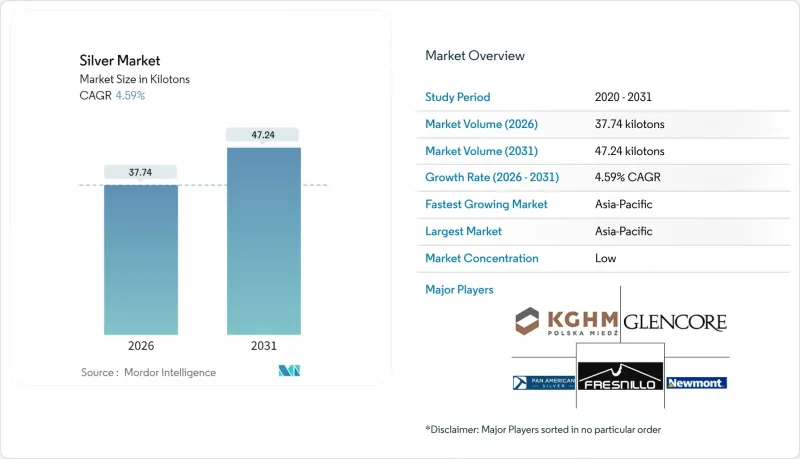
은 시장은 2025년에 36.08 킬로톤으로 평가되었으며, 2026년 37.74 킬로톤에서 2031년까지 47.24 킬로톤에 달할 것으로 예측되며, 예측 기간(2026-2031년) 동안 CAGR은 4.59%로 전망됩니다.
이러한 확대는 귀금속으로서의 가치와 산업 원료로서의 필수성이라는 은의 이중적 역할을 반영하고 있으며, 2024년 총 수요는 약 12억 온스에 달해 역대 두 번째로 높은 연간 수요를 기록할 것으로 예상됩니다. 2021년 이후 5년 연속 공급 부족(2024년 2억 1,500만 온스 부족)으로 인해 재고가 부족해지면서 과거 주로 금괴 투자 심리에 의존하던 가격 형성 메커니즘이 변화하고 있습니다. 전자기기의 소형화, 태양광발전(PV) 설비의 급속한 확장, 신흥 항균 응용 분야가 최종 용도의 다양성을 강화하여 은 산업을 단일 부문의 변동성으로부터 보호하고 있습니다. 광산 폐수에 대한 지속적인 규제 압력과 2025년 8월 은이 미국의 중요 광물로 지정된 것은 공급 환경이 다른 산업용 금속에 비해 탄력적이지 않다는 것을 보여주며, 2차 회수 경로의 중요성을 더욱 높이고 있습니다.
세계 은 시장 동향과 인사이트
전자기기 소형화와 5G 부품 수요
5G를 위해 설계된 통신 장비는 높은 주파수를 지원하기 위해 낮은 저항의 상호연결이 필요하기 때문에 4G 장비에 비해 단위당 약 3-5배의 은을 사용하게 됩니다. 반도체 소자의 미세화는 미세한 구조로 인해 도체와 고도의 열 인터페이스가 증가하기 때문에 역설적으로 칩당 은 사용량을 증가시킵니다. 시스템 인 패키지(SiP) 및 3차원 칩 적층 기술은 기존의 와이어 본딩을 넘어 은의 역할을 확대하고 있습니다. 반면, 엣지 컴퓨팅과 AI 워크로드는 은의 높은 열전도율로 인해 효과적으로 관리할 수 있는 전력 밀도를 요구합니다. 전기자동차(EV)의 보급도 순풍을 타고 있습니다. 배터리 전기자동차 1대당 25-50g의 은이 함유되어 있어 내연기관차(15-28g)보다 훨씬 더 많은 은을 함유하고 있습니다. 고급 자동차 제조업체들이 첨단 운전자 보조 시스템(ADAS)을 표준으로 장착함에 따라 추가 레이더, 라이더, 고속 데이터 라인으로 인해 은의 사용량은 더욱 증가할 것입니다.
대규모 태양광발전용 PV 설비의 급속한 확대
태양전지용 산업용 은 수요는 업계가 PERC에서 은을 많이 사용하는 TOPCon 및 이종접합 설계로 전환함에 따라 2015년 6,000만 온스에서 2024년 2억 3,200만 온스로 증가할 것으로 예상됩니다. 차세대 양면 모듈은 패널 당 최대 20%의 은페이스트 증량이 필요하며, 중국 시장의 주요 제조업체들은 2025년 상반기에만 212GW의 설비 용량을 도입했습니다. 전력사업자용 개발에서는 은 소비량/와트 효율이 약간 개선된 대형 웨이퍼를 선호하지만, 도입량이 효율 향상을 크게 상회하기 때문에 총 소비량은 증가하는 추세입니다. 국제에너지기구(IEA)의 넷 제로 달성 시나리오에 따르면, 2030년까지 연간 630GW의 태양광발전 설비가 추가로 도입되어야 하며, 이는 연간 3억-4억 온스의 은 수요가 발생한다는 것을 의미합니다. 미국, 인도, 유럽연합(EU)의 현지 조달 정책은 지역 조달 전략을 재구축하는 동시에 은 시장의 현물 가격이 광업의 혼란에 민감하게 반응하는 것을 강화시키고 있습니다.
광업의 중금속 배출 규제 상한선
미국 환경보호청(EPA)은 현재 폐수 중 은 농도를월 0.0122mg/L로 제한하고 있으며, 광산 사업자는 고비용의 수처리 시스템 설치가 의무화되어 허가 기간이 최대 15년까지 연장되는 사태가 발생하고 있습니다. 캐나다, 호주, 유럽연합(EU)의 유사한 기준은 환경 관리로 평가되는 지역에서 프로젝트의 자본 집약도를 높이고 있습니다. 1차 은 공급량의 72%가 베이스 메탈 채굴의 제품별 공급량이기 때문에 사업자들은 은의 규제 준수 비용과 구리 및 아연의 수익성을 비교 검토하여 확장 계획을 늦추는 사례도 볼 수 있습니다. 물 스트레스 지역의 새로운 무방류 의무는 공정 용수 재활용 요건을 높여 복잡성을 더하고 전체 프로젝트 물 순환 비용을 두 배로 증가시킬 수 있습니다. 과거의 부채도 심각한 문제입니다. 일부 생산자들은 연간 잉여현금흐름의 최대 20%를 복구충당금으로 충당하고 있으며, 이로 인해 은 시장에서 기존 광구 탐사에 투입되는 자금이 감소하고 있습니다.
부문 분석
순은은 2025년 은 시장 점유율의 71.61%를 차지했습니다. 이는 전자기기, 태양광발전, 의료기기의 엄격한 전도성 및 내식성 기준을 충족하는 99.9% 이상의 순도 때문입니다. 잘 구축된 정제 인프라가 안정적인 제품 등급을 제공하기 때문에 OEM 제조업체는 다국적 생산 기지의 품질 관리 프로토콜을 효율화할 수 있다는 점이 이 부문의 강점입니다. 대학 주도의 지방산 기반 용해 기술 연구는 2차 회수율 향상을 약속하며, 채굴 규모를 비례적으로 확대하지 않고도 순은의 공급 가능성을 높입니다. 이러한 혁신은 이미 연간 수천 톤을 소비하는 대규모 태양광 패널 제조업체의 투입 비용 절감에 기여할 수 있습니다. 한편, 알젠티움 실버는 고급 주얼리 브랜드와 장인 제조업체들이 우수한 변색 저항성을 채택함에 따라 2031년까지 CAGR 4.68%로 확대될 것으로 예상됩니다. 이를 통해 고수익 제품 라인을 구축하여 고가의 원자재 투입을 정당화할 수 있습니다.
순은의 우위는 재생에너지 설비 확대와 반도체 생산능력 증설로 더욱 강화될 것입니다. 모두 가혹한 열 사이클 하에서 장치 고장을 방지하기 위해 고순도 은을 요구하기 때문입니다. 따라서 아시아태평양과 유럽의 국가 탈탄소화 목표가 진전됨에 따라 순은의 시장 규모는 계속 확대될 것으로 예상됩니다. 알젠티움 실버는 커스텀 디자인 및 3D 프린팅 주얼리 분야의 수요 확대와 더불어 소비자 직거래가 가능한 EC 플랫폼의 성장도 견인하고 있습니다. 그러나 그 총량은 여전히 비교적 작은 규모입니다. 동전과 각종 특수합금은 화폐 제조, 브레이징, 항균 표면처리와 같은 틈새시장을 차지하고 있으며, 부문 매출의 10% 미만을 차지하지만, 고유한 특성으로 인해 가격 프리미엄을 정당화할 수 있는 분야에서는 특히 높은 수익률을 제공합니다.
은 시장 보고서는 종류별(순은, 스털링 실버, 알젠티움 실버, 코인 실버, 기타), 용도별(물리적 투자, 전기/전자, 사진 필름, 브레이징 합금/납땜, 보석/은제품, 제약/바이오메디컬, 기타 용도), 지역별(아시아태평양, 북미, 유럽, 남미, 중동 및 아프리카, 중동/북미, 유럽, 아시아태평양, 남미, 중동 및 아프리카, 아프리카, 중동/북미, 유럽, 아시아태평양, 아시아태평양, 아프리카, 아시아태평양, 아시아태평양, 유럽, 아시아태평양) 북미, 유럽, 남미, 중동 및 아프리카)로 분류됩니다.
지역별 분석
2025년 아시아태평양의 소비 점유율 57.35%는 은 시장에서 아시아태평양이 제조 거점이자 재생에너지의 중심지로서의 위상을 뒷받침하고 있습니다. 중국이 2025년 상반기에만 6개월 동안 212GW의 태양광발전 설비를 도입했다는 사실은 은을 많이 사용하는 기술에 대한 이 지역의 높은 수요를 보여줍니다. 인도에서는 활발한 보석 수요와 전자기기 조립 증가가 이를 보완하고, 한국과 일본에서는 고정밀 반도체 및 센서 제조가 수요를 견인합니다. 각국 정부는 전략 자재의 국내 공급망을 우선시하고, 가전제품과 태양광 모듈에서 사용한 은을 회수하는 재활용 시설에 대한 투자를 촉진합니다. 이를 통해 공급 안정성이 강화되었습니다.
북미에서는 자동차 전동화, 데이터센터 확장, 의료기기 제조를 기반으로 성숙하면서도 진화하는 수요를 볼 수 있습니다. 2025년 8월 미국이 은을 중요 광물로 지정하기로 한 결정은 광산 허가 효율화와 전략적 비축 가능성을 열어 은 시장 역학에 변화를 가져올 수 있습니다. 캐나다에 구축된 금괴 제련 생태계와 멕시코의 대규모 1차 은광은 대륙 전역의 가공업체를 지원하는 연속적인 공급 우위를 제공합니다. 유럽의 소비는 빠른 태양광 도입을 필요로 하는 적극적인 순 제로 목표와 순환 경제 실천을 촉진하는 규제에 의해 뒷받침되고 있으며, 전자폐기물 회수 및 금속 회수 공장에 대한 투자를 촉진하고 있습니다.
남미는 여전히 공급 측면에서 필수적이며, 페루, 멕시코, 칠레가 채굴량의 3분의 1 이상을 공급하고 있습니다. 그러나 지역 주민의 반대, 물 사용 제한, 로열티를 둘러싼 논쟁이 확장 계획의 과제가 되고 있습니다. 은 시장에서 중동 및 아프리카는 현재 전 세계 수요의 일부에 불과하지만, 의료 인프라 확충과 통신망 업그레이드가 은 수요 증가로 이어지고 있습니다. 많은 아프리카 국가에는 미개발된 은광상이 존재하며, 책임감 있는 채굴 기준에 따라 개발된다면 향후 10년간 세계 공급원을 다양화할 수 있는 잠재력이 있습니다.
기타 특전:
- 엑셀 형식의 시장 예측(ME) 시트
- 애널리스트의 3개월간 지원
자주 묻는 질문
목차
제1장 소개
제2장 조사 방법
제3장 주요 요약
제4장 시장 구도
제5장 시장 규모와 성장 예측
제6장 경쟁 구도
제7장 시장 기회와 향후 전망
KSM 26.03.09The Silver Market was valued at 36.08 kilotons in 2025 and estimated to grow from 37.74 kilotons in 2026 to reach 47.24 kilotons by 2031, at a CAGR of 4.59% during the forecast period (2026-2031).
The expansion reflects silver's dual role as a precious asset and an indispensable industrial input that pushed total demand to nearly 1.2 billion ounces in 2024-the second-highest annual level on record. Five consecutive annual supply deficits since 2021, including a 215 million-ounce shortfall in 2024, have tightened inventories and altered pricing signals that once relied mainly on bullion investment sentiment. Electronics miniaturization, rapid photovoltaic (PV) build-outs, and emerging antimicrobial uses are reinforcing end-use diversity and buffering the silver industry from single-sector swings. Ongoing regulatory pressure on mine effluents, coupled with silver's August 2025 designation as a U.S. critical mineral, underscores a supply landscape that is less elastic than most industrial metals, intensifying the importance of secondary recovery channels.
Global Silver Market Trends and Insights
Electronics Miniaturization and 5G Component Demand
Telecommunications hardware built for 5G uses roughly three to five times more silver per unit than 4G equivalents, as higher frequencies require low-resistance interconnects. Semiconductor device scaling paradoxically raises silver intensity per chip because finer geometries call for more conductors and advanced thermal interfaces. System-in-package and three-dimensional chip stacking widen silver's role beyond traditional wire bonding, while edge-computing and AI workloads push power densities that only silver's high thermal conductivity can manage effectively. Electric vehicles add momentum; each battery electric model contains 25-50 grams of silver compared with 15-28 grams in internal-combustion cars. As premium automakers standardize advanced driver-assistance systems, additional radar, lidar and high-speed data lines further elevate silver use.
Rapid PV Build-out for Utility-Scale Solar
Industrial silver demand from solar cells climbed from 60 million ounces in 2015 to 232 million ounces in 2024 as the industry shifted from PERC to silver-intensive TOPCon and heterojunction designs. Next-generation bifacial modules require up to 20% more silver paste per panel, and market-leading manufacturers in China installed 212 GW of capacity in the first half of 2025 alone. Utility developers favor larger wafers that modestly improve silver-per-watt metrics, yet total consumption rises because deployment volumes vastly outpace efficiency gains. International Energy Agency net-zero pathways call for annual solar additions of 630 GW through 2030, implying PV demand of 300-400 million ounces per year. Localization policies in the United States, India, and the European Union are reshaping regional sourcing strategies and reinforcing silver market spot-price sensitivity to mining disruptions.
Regulatory Caps on Heavy-Metal Discharge in Mining
The U.S. Environmental Protection Agency now limits silver concentrations in effluent to 0.0122 mg/L monthly, compelling miners to install costly water-treatment systems and extending permitting timelines to as long as 15 years. Similar standards in Canada, Australia, and the European Union increase capital intensity for projects in jurisdictions respected for environmental stewardship. Because 72% of the primary silver supply is a byproduct of base-metal mining, operators often weigh silver compliance costs against copper or zinc revenues, occasionally delaying expansions. Emerging zero-liquid-discharge mandates in water-stressed regions add further complexity by raising process-water recycling requirements that can double overall project water-circulation costs. Legacy liabilities are material as well; some producers channel up to 20% of annual free cash flow toward remediation provisions, diminishing funds available for brown-field exploration in the silver market.
Other drivers and restraints analyzed in the detailed report include:
- Recovery of Photographic/X-ray Film Usage in Emerging Healthcare
- Emergence of Silver-Based Antimicrobial Coatings for Packaged Foods
- Silver Substitution by Aluminum and Copper in Wiring
For complete list of drivers and restraints, kindly check the Table Of Contents.
Segment Analysis
Fine Silver accounted for 71.61% of the silver market share in 2025, thanks to its minimum 99.9% purity that satisfies stringent conductivity and corrosion-resistance standards in electronics, photovoltaics, and medical devices. The segment benefits from established refining infrastructure that delivers consistent product grades, allowing OEMs to streamline quality protocols across multinational production footprints. University-led research into fatty-acid-based dissolution technologies promises to lift secondary recovery rates, improving Fine Silver availability without proportionate mining expansion. These innovations could moderate input costs for large PV pastemakers who already consume thousands of metric tons annually. Meanwhile, Argentium Silver is projected to grow at 4.68% CAGR through 2031 as luxury jewelry brands and artisan manufacturers adopt its enhanced tarnish resistance, leading to higher-margin product lines that justify premium raw-material inputs.
Fine Silver's commanding position is reinforced by expanding renewable-energy installations and semiconductor capacity additions, both of which specify high-purity silver to prevent device failure under demanding thermal cycles. The silver market size for Fine Silver is therefore set to widen in tandem with national decarbonization targets across Asia-Pacific and Europe. Argentium's appeal in custom design and 3D-printed jewelry also taps growth in e-commerce platforms that enable direct-to-consumer sales, although its overall volume remains comparatively small. Coin Silver and various specialty alloys occupy niche spaces in coinage, brazing and antimicrobial surfaces, collectively capturing less than 10% of segment revenues yet offering outsized margins where unique property sets warrant price premiums.
The Silver Market Report is Segmented by Type (Fine Silver, Sterling Silver, Argentium Silver, Coin Silver, Other Types), Application (Physical Investment, Electrical and Electronics, Photographic Films, Brazing Alloys and Solders, Jewelry and Silverware, Pharmaceuticals and Biomedical, Other Applications), and Geography (Asia-Pacific, North America, Europe, South America, Middle-East and Africa).
Geography Analysis
Asia-Pacific's 57.35% consumption share in 2025 underscores its status as both manufacturing hub and renewable-energy epicenter within the silver market. China's installation of 212 GW of solar capacity in just six months of 2025 exemplifies the region's appetite for silver-intensive technologies. India complements with vigorous jewelry demand and rising electronics assembly, while South Korea and Japan add high-precision semiconductor and sensor fabrication. Regional governments prioritize domestic supply chains for strategic materials, catalyzing investments in recycling facilities that can capture end-of-life silver from appliances and PV modules, thereby reinforcing supply security.
North America exhibits mature yet evolving demand anchored by automotive electrification, data-center build-outs and medical-device manufacturing. The U.S. decision in August 2025 to classify silver as a critical mineral paves the way for streamlined mine permitting and possible strategic stockpiles that could alter silver market dynamics. Canada's established bullion-refining ecosystem and Mexico's large primary-silver mines provide contiguous supply advantages that support downstream fabricators across the continent. European consumption is buoyed by aggressive net-zero targets that require rapid solar deployment, and by regulations that promote circular-economy practices, spurring investment in e-waste collection and metal recovery plants.
South America remains integral on the supply front; Peru, Mexico and Chile collectively deliver more than one-third of mined output, yet community opposition, water-use restrictions and royalty debates challenge expansion plans. In the silver market, the Middle East and Africa account for a small share of global demand today, but healthcare infrastructure build-outs and telecom network upgrades are translating into incremental silver requirements. Many African nations hold untapped silver prospects that, if developed under responsible mining standards, could diversify global supply over the next decade.
- Americas Gold & Silver Corporation
- Avino Silver & Gold Mines Ltd.
- Coeur Mining, Inc.
- First Majestic Silver Corp.
- Fortuna Silver Mines Inc.
- Fresnillo plc
- Glencore
- Hecla Mining Company
- Hindustan Zinc
- Hochschild Mining PLC
- Honey Badger Silver Inc
- IMPACT Silver Corp.
- Industrias Penoles
- KGHM
- MAG Silver Corp
- Newmont Corporation
- Orla Mining Ltd.
- Pan American Silver Corp
- Polymetal International plc
- Royal Gold Inc.
- Silvercorp Metals Inc.
- SSR Mining Inc.
- Wheaton Precious Metals Corp.
Additional Benefits:
- The market estimate (ME) sheet in Excel format
- 3 months of analyst support
TABLE OF CONTENTS
1 Introduction
- 1.1 Study Assumptions and Market Definition
- 1.2 Scope of the Study
2 Research Methodology
3 Executive Summary
4 Market Landscape
- 4.1 Market Overview
- 4.2 Market Drivers
- 4.2.1 Electronics miniaturisation and 5G component demand
- 4.2.2 Rapid PV build-out for utility-scale solar
- 4.2.3 Recovery of photographic/X-ray film usage in emerging healthcare
- 4.2.4 Emergence of silver-based antimicrobial coatings for packaged foods
- 4.2.5 Growing investment demand amid inflation-hedging
- 4.3 Market Restraints
- 4.3.1 Regulatory caps on heavy-metal discharge in mining
- 4.3.2 Silver substitution by aluminium/copper in wiring
- 4.3.3 High price volatility discouraging long-term contracts
- 4.4 Value Chain Analysis
- 4.5 Regulatory Landscape
- 4.6 Porter's Five Forces
- 4.6.1 Bargaining Power of Suppliers
- 4.6.2 Bargaining Power of Buyers
- 4.6.3 Threat of New Entrants
- 4.6.4 Threat of Substitutes
- 4.6.5 Degree of Competition
5 Market Size and Growth Forecasts (Volume)
- 5.1 By Type
- 5.1.1 Fine Silver
- 5.1.2 Sterling Silver
- 5.1.3 Argentium Silver
- 5.1.4 Coin Silver
- 5.1.5 Other Types
- 5.2 By Application
- 5.2.1 Physical Investment (Bars and Coins)
- 5.2.2 Electrical and Electronics
- 5.2.3 Photographic Films
- 5.2.4 Brazing Alloys and Solders
- 5.2.5 Jewelry and Silverware
- 5.2.6 Pharmaceuticals and Biomedical
- 5.2.7 Other Applications
- 5.3 By Geography
- 5.3.1 Production Analysis
- 5.3.1.1 United States
- 5.3.1.2 Argentina
- 5.3.1.3 Australia
- 5.3.1.4 Bolivia
- 5.3.1.5 Chile
- 5.3.1.6 China
- 5.3.1.7 India
- 5.3.1.8 Mexico
- 5.3.1.9 Peru
- 5.3.1.10 Poland
- 5.3.1.11 Russia
- 5.3.1.12 Rest of the World
- 5.3.2 Consumption Analysis
- 5.3.2.1 Asia-Pacific
- 5.3.2.1.1 China
- 5.3.2.1.2 India
- 5.3.2.1.3 Japan
- 5.3.2.1.4 South Korea
- 5.3.2.1.5 Rest of Asia-Pacific
- 5.3.2.2 North America
- 5.3.2.2.1 United States
- 5.3.2.2.2 Canada
- 5.3.2.2.3 Mexico
- 5.3.2.3 Europe
- 5.3.2.3.1 Germany
- 5.3.2.3.2 United Kingdom
- 5.3.2.3.3 Italy
- 5.3.2.3.4 France
- 5.3.2.3.5 Russia
- 5.3.2.3.6 Rest of Europe
- 5.3.2.4 South America
- 5.3.2.4.1 Brazil
- 5.3.2.4.2 Argentina
- 5.3.2.4.3 Rest of South America
- 5.3.2.5 Middle-East and Africa
- 5.3.2.5.1 Saudi Arabia
- 5.3.2.5.2 South Africa
- 5.3.2.5.3 Rest of Middle-East and Africa
- 5.3.2.1 Asia-Pacific
- 5.3.1 Production Analysis
6 Competitive Landscape
- 6.1 Market Concentration
- 6.2 Strategic Moves
- 6.3 Market Share**/Ranking Analysis
- 6.4 Company Profiles (includes Global level Overview, Market level overview, Core Segments, Financials as available, Strategic Information, Market Rank/Share for key companies, Products and Services, and Recent Developments)
- 6.4.1 Americas Gold & Silver Corporation
- 6.4.2 Avino Silver & Gold Mines Ltd.
- 6.4.3 Coeur Mining, Inc.
- 6.4.4 First Majestic Silver Corp.
- 6.4.5 Fortuna Silver Mines Inc.
- 6.4.6 Fresnillo plc
- 6.4.7 Glencore
- 6.4.8 Hecla Mining Company
- 6.4.9 Hindustan Zinc
- 6.4.10 Hochschild Mining PLC
- 6.4.11 Honey Badger Silver Inc
- 6.4.12 IMPACT Silver Corp.
- 6.4.13 Industrias Penoles
- 6.4.14 KGHM
- 6.4.15 MAG Silver Corp
- 6.4.16 Newmont Corporation
- 6.4.17 Orla Mining Ltd.
- 6.4.18 Pan American Silver Corp
- 6.4.19 Polymetal International plc
- 6.4.20 Royal Gold Inc.
- 6.4.21 Silvercorp Metals Inc.
- 6.4.22 SSR Mining Inc.
- 6.4.23 Wheaton Precious Metals Corp.
7 Market Opportunities and Future Outlook
- 7.1 White-space and Unmet-Need Assessment