|
시장보고서
상품코드
1934917
크로스 도메인 솔루션 : 시장 점유율 분석, 업계 동향과 통계, 성장 예측(2026-2031년)Cross-Domain Solution - Market Share Analysis, Industry Trends & Statistics, Growth Forecasts (2026 - 2031) |
||||||
 Mordor Intelligence
크로스 도메인 솔루션 시장은 2025년 38억 1,000만 달러에서 2026년에는 42억 4,000만 달러로 성장하며, 2026-2031년에 CAGR 11.41%로 추이하며, 2031년까지 72억 9,000만 달러에 달할 것으로 예측됩니다.
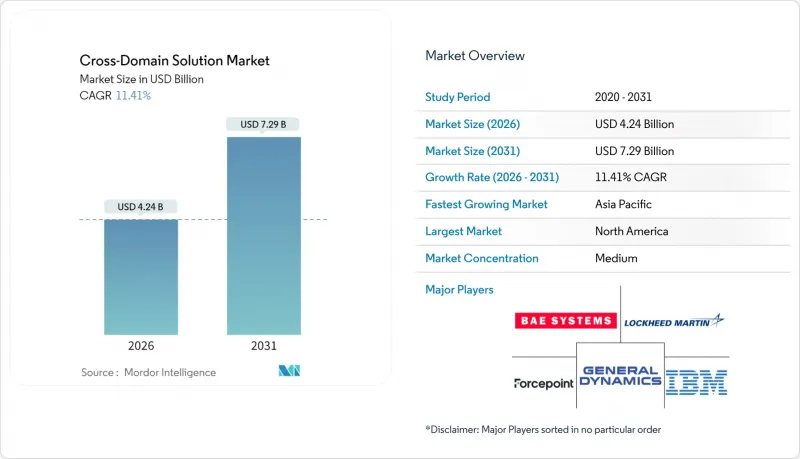
이러한 성장은 기밀 데이터 증가, 의무화된 제로 트러스트 개념, 노후화된 에어갭형 인프라를 대체하는 현대화 프로그램에 의해 촉진되고 있습니다. 특히 국방기관, 정보기관, 중요 인프라 사업자 수요가 가장 높으며, 이들 조직은 여러 보안 도메인 간 데이터 마이그레이션이 필요하면서도 유출 위험을 피해야 합니다. 데이터 다이오드 등 하드웨어 어플라이언스가 여전히 도입의 주류를 차지하고 있지만, 정부용 클라우드 인클로저가 성숙해짐에 따라 클라우드 호스트형 게이트웨이와 매니지드 서비스 도입이 증가하고 있습니다. 지정학적 긴장은 지출을 더욱 가속화하고 있으며, 특히 인도 태평양 지역에서는 정부가 사이버 방어를 처음부터 구축하는 중입니다. 한편, 인증 주기의 장기화와 인력 부족으로 인해 단기적인 도입이 억제되고 있으며, 기존 방산 대기업과 틈새 전문업체가 공존하는 시장을 형성하고 있습니다.
세계 크로스 도메인 솔루션 시장 동향 및 인사이트
기밀성이 요구되는 멀티 도메인 데이터 흐름 급증
기밀로 취급되는 센서, 위성, ISR 플랫폼은 현재 SECRET, TOP SECRET, 연합 네트워크 간에 교환되어야 하는 테라바이트 규모의 데이터를 매일 생성하고 있습니다. 미 국방부의 Raise-the-Bar 프로그램은 2020년 이후 300% 증가한 기밀 트래픽을 처리하기 위해 자동화된 크로스 도메인 파이프라인을 명시적으로 요구하고 있으며, 수동으로 스니커즈넷 전송은 더 이상 현실적이지 않습니다. NATO의 공동 작전으로 인해 각 기관은 기밀성을 유지하면서 실시간 협업을 가능하게 하는 인증된 크로스 도메인 게이트웨이를 도입해야 하며, 이를 통해 원활한 데이터 공유에 대한 요구가 더욱 증폭되고 있습니다.
미 국방부와 NATO의 엄격한 제로 트러스트 요구 사항
2025년 국방부 제로 트러스트 전략은 모든 트랜잭션에 대한 지속적인 검증을 규정하고 있으며, 크로스 도메인 솔루션은 세분화된 ID 확인과 행동 분석의 통합을 요구하고 있습니다. NATO 회원국들도 비슷한 접근 방식을 채택하고 있으며, 2024년까지 사이버 보안 현대화에 1,500억 달러를 투자할 계획입니다. NIST SP 800-207을 준수하고 공통 표준 평가를 통과한 업체는 현재 프리미엄 가격을 제시할 수 있는 반면, 기존 경계 기반 제품은 빠르게 대체되고 있습니다.
복잡한 다중 기관 인증 주기
제품은 공통 기준 EAL4+ 시험 외에도 NIAP, NSA, NCDSMO의 심사를 통과해야 하며, 이로 인해 납기가 18-24개월 연장됩니다. NATO 회원국들은 각각 독자적인 인증 체계를 운영하고 있으며, 벤더들은 중복된 평가를 요구받게 되어 신규 진입 장벽이 높아지고 있습니다.
부문 분석
2025년 하드웨어 어플라이언스는 크로스 도메인 솔루션 시장의 52.55%를 차지했습니다. 이는 엄격한 군용 테스트 기준을 충족하는 고보증 데이터 다이오드에 대한 수요 증가에 힘입은 것입니다. 한편, 서비스 시장은 CAGR 14.23%로 확대될 것으로 예측됩니다. 이는 기관들이 기술력 부족을 보완하기 위해 운영 관리 서비스로 전환하고 있기 때문입니다. 관리 서비스 크로스 도메인 솔루션 시장 규모는 예산이 제한된 프로그램에서 운영 비용을 우선시하는 추세를 반영하여 자본 구매보다 빠른 속도로 성장할 것으로 예측됩니다. 24시간 365일 모니터링, 패치 관리, 지속적인 인증 지원을 패키지로 제공하는 벤더들은 예측 가능한 비용과 컴플라이언스 보장을 원하는 고객들의 관심을 끌고 있습니다.
하드웨어 분야도 정지된 상태는 아닙니다. 현재 공급업체들은 FPGA 기반 정책 엔진을 내장하고 클라우드 게이트웨이와 통합하는 가상화 다이오드 기능을 제공합니다. 그러나 조달팀은 여전히 최고 수준의 기밀을 위해 물리적으로 격리된 전송 전용 채널을 선호합니다. 예측 기간 중 성공적인 벤더는 하드웨어의 신뢰성과 소프트웨어 정의 오케스트레이션을 통합하고, 변조 방지 경로를 유지하면서 제로 트러스트 스택에 쉽게 통합할 수 있는 업체들이 될 것입니다.
전송 게이트웨이는 2025년 매출의 48.23% 점유율을 유지했으나, 액세스 중심 제품은 15.54%의 연평균 복합 성장률(CAGR)을 보일 것으로 예측되며, 이 속도는 2031년까지 크로스 도메인 솔루션 시장 상황을 재편할 가능성이 있습니다. 아이덴티티 기반 접근 제어는 제로 트러스트의 이념과 완벽하게 일치하며, 관리자가 특정 데이터세트에 대한 시간 제한적이고 상황 인식적인 접근 권한을 부여할 수 있도록 합니다. 이를 통해 도메인 간 파일을 일괄적으로 이동시킬 필요가 없습니다. 액세스 게이트웨이의 크로스 도메인 솔루션 시장 점유율은 기업용 IAM(Identity Management) 및 SIEM(Security Information Event Management) 플랫폼과 직접 연동할 수 있는 능력에 힘입어 상승세를 보이고 있습니다.
전송 전문 벤더들은 현재 속성 기반 접근제어 요소를 통합하고 있으며, 접근제어 전문가들은 파일 전송 기능이나 프로토콜 분리 기능을 추가하고 있으며, 통합 플랫폼의 미래상을 제시하고 있습니다. 그 결과, 별도의 스택을 유지하는 것은 감사의 복잡성과 수명주기 비용을 증가시키기 때문에 구매자들은 통합 정책 엔진을 제공하는 공급업체를 점점 더 많이 고려하고 있습니다.
지역별 분석
북미는 미 국방부의 8,410억 달러의 예산과 확립된 인증 프로세스에 힘입어 2025년 매출의 41.45%를 차지할 것으로 예측됩니다. 록히드마틴과 같은 주요 계약업체는 2024년 매출이 710억 7,000만 달러에 달할 것으로 예상되며, 지속적인 교차 도메인 배포 및 업그레이드 파이프라인을 보장하고 있습니다. AWS 시크릿 리전(AWS Secret Region) 및 Azure Government Secret과 같은 연방 정부 클라우드 인클로저는 임팩트 레벨 6 기밀 워크로드를 위한 턴키 호스팅을 제공함으로써 도입을 가속화하고 있습니다.
아시아태평양은 17.02%의 연평균 복합 성장률(CAGR)로 가장 빠르게 성장하는 시장입니다. 일본의 2025년 국방 예산 7,340억 달러, 호주의 REDSPICE 사이버 구상, 그리고 인도에서 진행 중인 삼군 현대화는 국내 및 유럽과 미국의 게이트웨이 벤더들에게 비옥한 토양을 제공합니다. QUAD 파트너십은 공통의 상호운용성 벤치마크를 설정하고 있으며, 이를 준수하는 벤더는 다국적 지휘통제 프로젝트에서 유리한 출발을 할 수 있습니다.
유럽은 NATO의 디지털 혁신 구상과 EU 사이버 보안 인증 프레임워크를 통해 꾸준한 추진력을 유지하고 있으며, 이를 통해 여러 국가의 승인 절차를 간소화할 수 있습니다. 독일, 프랑스, 영국은 자국내 데이터 주권 법규를 충족시키면서 연합 데이터 공유를 지원하는 크로스 도메인 플랫폼에 대한 투자를 진행하고 있습니다.
다른 지역에서는 중동 및 아프리카 시장이 발전 중이지만 전략적 중요성을 가지고 있습니다. 사우디아라비아 국가사이버보안청은 에너지 시설에 다이오드 기반 세분화를 의무화하고, 남아프리카공화국 국방부는 향후 위성 지상국에 교차 도메인 보호 기능을 통합할 계획입니다.
기타 특전:
- 엑셀 형식 시장 예측(ME) 시트
- 애널리스트 지원(3개월)
자주 묻는 질문
목차
제1장 서론
제2장 조사 방법
제3장 개요
제4장 시장 구도
제5장 시장 규모와 성장 예측
제6장 경쟁 구도
제7장 시장 기회와 향후 전망
The cross-domain solution market is expected to grow from USD 3.81 billion in 2025 to USD 4.24 billion in 2026 and is forecast to reach USD 7.29 billion by 2031 at 11.41% CAGR over 2026-2031.
This growth is driven by rising classified data volumes, mandatory zero-trust initiatives, and modernization programs that replace aging air-gapped infrastructure. Demand is strongest among defense agencies, intelligence services, and critical-infrastructure operators that must move data between multiple security domains without risking leakage. Hardware appliances such as data diodes still dominate deployments, yet cloud-hosted gateways and managed services are gaining traction as government cloud enclaves mature. Geopolitical tensions further accelerate spending, especially in the Indo-Pacific region where governments are building cyber defenses from the ground up. Meanwhile, prolonged certification cycles and talent shortages temper near-term adoption, creating a market where established defense primes and niche specialists coexist.
Global Cross-Domain Solution Market Trends and Insights
Escalating Volume of Multi-Domain Classified Data Flows
Classified sensors, satellites, and ISR platforms now generate terabytes of data daily that must cross between SECRET, TOP SECRET, and coalition networks. Manual sneaker-net transfers are no longer feasible, and the U.S. DoD's Raise-the-Bar program explicitly demands automated cross-domain pipelines to cope with a 300% jump in classified traffic since 2020. NATO's joint operations further amplify requirements for seamless yet compartmented data sharing, pushing agencies toward certified cross-domain gateways that assure confidentiality while enabling real-time collaboration.
Stringent Zero-Trust Mandates in U.S. DoD and NATO
The 2025 DoD Zero Trust Strategy stipulates continuous verification for every transaction, forcing cross-domain solutions to embed granular identity checks and behavioral analytics. NATO allies mirror the approach, having earmarked USD 150 billion for cybersecurity modernization in 2024. Vendors able to prove alignment with NIST SP 800-207 and to pass Common Criteria evaluations now command premium pricing, while legacy perimeter-based products face rapid displacement.
Complex Multi-Authority Certification Cycles
Products must clear NIAP, NSA, and NCDSMO reviews on top of Common Criteria EAL4+ testing, adding 18-24 months to delivery schedules. Each NATO nation also runs its own scheme, prompting vendors to pursue duplicate evaluations and increasing barriers for new entrants.
Other drivers and restraints analyzed in the detailed report include:
- Rapid Proliferation of AI/ML Decision-Support Systems
- Growing Use of Commercial Cloud Enclaves for Secret Workloads
- Scarcity of Cross-Domain-Aware DevSecOps Talent
For complete list of drivers and restraints, kindly check the Table Of Contents.
Segment Analysis
Hardware appliances captured 52.55% of the cross-domain solution market in 2025, propelled by high-assurance data diodes that satisfy rigorous military test criteria. At the same time, services are forecast to grow at a 14.23% CAGR as agencies pivot toward managed operations to offset skills shortages. The cross-domain solution market size for managed services is therefore expected to expand faster than capital purchases, reflecting an operating-expense preference among budget-constrained programs. Vendors that bundle 24/7 monitoring, patch management, and continuous accreditation support increasingly appeal to customers seeking predictable costs and compliance guarantees.
The hardware segment is not static; suppliers now embed FPGA-based policy engines and offer virtualized diode functions that integrate with cloud gateways. Nevertheless, procurement teams still favor physically isolated transmit-only channels for the highest classification tiers. Over the forecast period, successful vendors will be those fusing hardware reliability with software-defined orchestration, thereby easing integration into zero-trust stacks while preserving tamper-resistant pathways.
Transfer gateways maintained a 48.23% share of 2025 revenues, yet access-centric products are slated for a 15.54% CAGR, a pace that could redraw the cross-domain solution market landscape by 2031. Identity-driven access controls align neatly with zero-trust doctrine, letting administrators grant time-bounded, context-aware entry to specific datasets instead of bulk-moving files across domains. The cross-domain solution market share for access gateways is boosted by their ability to hook directly into enterprise IAM and SIEM platforms.
Transfer-focused vendors now embed attribute-based access elements, while access specialists add file-transfer and protocol break functions, hinting at a converged platform future. As a result, buyers increasingly shortlist suppliers that deliver unified policy engines, since maintaining separate stacks inflates audit complexity and lifecycle costs.
Cross-Domain Solution Market Report is Segmented by Component (Hardware, Software, Services), Solution Type (Access Solutions, Transfer Solutions, Other Types), Deployment (Cloud, On-Premises), End-User (Aerospace and Defense, Law-Enforcement and Security Agencies, Critical Infrastructure Operators, Others), and by Geography. The Market Forecasts are Provided in Terms of Value (USD).
Geography Analysis
North America generated 41.45% of 2025 revenues, undergirded by the U.S. DoD's USD 841 billion appropriation and well-established certification pathways. Prime contractors such as Lockheed Martin logged USD 71.07 billion in 2024 sales, guaranteeing a sustained pipeline of cross-domain deployments and upgrades. Federal cloud enclaves, including AWS Secret Region and Azure Government Secret, accelerate adoption by offering turnkey hosting for classified workloads at Impact Level 6.
Asia-Pacific is the fastest-growing theatre at 17.02% CAGR. Japan's record USD 734 billion 2025 defense budget, Australia's REDSPICE cyber initiative, and India's ongoing tri-service modernization create fertile ground for indigenous and Western gateway suppliers. The QUAD partnership sets common interoperability benchmarks, giving compliant vendors a head start in multi-nation command-and-control projects.
Europe maintains steady momentum through NATO's Digital Transformation vision and the EU Cybersecurity Certification Framework, which simplifies multi-state approvals. Germany, France, and the United Kingdom invest in cross-domain platforms that support coalition data sharing while satisfying domestic data-sovereignty statutes.
Elsewhere, Middle East and Africa markets are nascent yet strategic: Saudi Arabia's National Cybersecurity Authority mandates diode-based segmentation for energy facilities, and South Africa's defense forces plan to embed cross-domain guards in forthcoming satellite-ground stations.
- BAE Systems plc
- Lockheed Martin Corporation
- General Dynamics Corporation
- Forcepoint LLC
- IBM Corporation
- Advenica AB
- Cisco Systems Inc.
- Everfox Inc.
- Owl Cyber Defense Solutions LLC
- 4Secure Ltd.
- Raytheon Technologies Corp.
- Northrop Grumman Corp.
- Airbus Defence and Space
- Thales Group
- Leonardo S.p.A.
- Rohde and Schwarz GmbH and Co. KG
- Ultra Intelligence and Communications
- Seceon Inc.
- Waterfall Security Solutions Ltd.
- Belden Inc.
Additional Benefits:
- The market estimate (ME) sheet in Excel format
- 3 months of analyst support
TABLE OF CONTENTS
1 INTRODUCTION
- 1.1 Study Assumptions and Market Definition
- 1.2 Scope of the Study
2 RESEARCH METHODOLOGY
3 EXECUTIVE SUMMARY
4 MARKET LANDSCAPE
- 4.1 Market Overview
- 4.2 Market Drivers
- 4.2.1 Escalating volume of multi-domain classified data flows
- 4.2.2 Stringent zero-trust mandates in U.S. DoD and NATO
- 4.2.3 Rapid proliferation of AI/ML decision-support systems requiring air-gapped feeds
- 4.2.4 Growing use of commercial cloud enclaves for secret workloads
- 4.2.5 Space-to-ground telemetry security gaps in new satellite constellations
- 4.2.6 Surge in OT-IT convergence across critical infrastructure
- 4.3 Market Restraints
- 4.3.1 Complex multi-authority certification cycles
- 4.3.2 Scarcity of cross-domain aware DevSecOps talent
- 4.3.3 Lack of interoperability standards for data-diode protocols
- 4.3.4 High TCO for small-footprint deployments
- 4.4 Supply-Chain Analysis
- 4.5 Regulatory Landscape
- 4.6 Technological Outlook
- 4.7 Porter's Five Forces Analysis
- 4.7.1 Bargaining Power of Suppliers
- 4.7.2 Bargaining Power of Consumers
- 4.7.3 Threat of New Entrants
- 4.7.4 Threat of Substitute Products
- 4.7.5 Intensity of Competitive Rivalry
- 4.8 Macroeconomic Impact Assessment
5 MARKET SIZE AND GROWTH FORECASTS (VALUE)
- 5.1 By Component
- 5.1.1 Hardware
- 5.1.2 Software
- 5.1.3 Services
- 5.2 By Solution Type
- 5.2.1 Access Solutions
- 5.2.2 Transfer Solutions
- 5.2.3 Other Types
- 5.3 By Deployment
- 5.3.1 Cloud
- 5.3.2 On-Premises
- 5.4 By End-user
- 5.4.1 Aerospace and Defense
- 5.4.2 Law-Enforcement and Security Agencies
- 5.4.3 Critical Infrastructure Operators
- 5.4.4 Others
- 5.5 By Geography
- 5.5.1 North America
- 5.5.1.1 United States
- 5.5.1.2 Canada
- 5.5.1.3 Mexico
- 5.5.2 South America
- 5.5.2.1 Brazil
- 5.5.2.2 Argentina
- 5.5.2.3 Rest of South America
- 5.5.3 Europe
- 5.5.3.1 United Kingdom
- 5.5.3.2 Germany
- 5.5.3.3 France
- 5.5.3.4 Italy
- 5.5.3.5 Spain
- 5.5.3.6 Russia
- 5.5.3.7 Rest of Europe
- 5.5.4 Asia-Pacific
- 5.5.4.1 China
- 5.5.4.2 Japan
- 5.5.4.3 India
- 5.5.4.4 South Korea
- 5.5.4.5 Australia and New Zealand
- 5.5.4.6 Rest of Asia-Pacific
- 5.5.5 Middle East and Africa
- 5.5.5.1 Middle East
- 5.5.5.1.1 Saudi Arabia
- 5.5.5.1.2 UAE
- 5.5.5.1.3 Turkey
- 5.5.5.1.4 Rest of Middle East
- 5.5.5.2 Africa
- 5.5.5.2.1 South Africa
- 5.5.5.2.2 Nigeria
- 5.5.5.2.3 Kenya
- 5.5.5.2.4 Rest of Africa
- 5.5.5.1 Middle East
- 5.5.1 North America
6 COMPETITIVE LANDSCAPE
- 6.1 Market Concentration
- 6.2 Strategic Moves
- 6.3 Market Share Analysis
- 6.4 Company Profiles (includes Global level Overview, Market level overview, Core Segments, Financials as available, Strategic Information, Market Rank/Share for key companies, Products and Services, and Recent Developments)
- 6.4.1 BAE Systems plc
- 6.4.2 Lockheed Martin Corporation
- 6.4.3 General Dynamics Corporation
- 6.4.4 Forcepoint LLC
- 6.4.5 IBM Corporation
- 6.4.6 Advenica AB
- 6.4.7 Cisco Systems Inc.
- 6.4.8 Everfox Inc.
- 6.4.9 Owl Cyber Defense Solutions LLC
- 6.4.10 4Secure Ltd.
- 6.4.11 Raytheon Technologies Corp.
- 6.4.12 Northrop Grumman Corp.
- 6.4.13 Airbus Defence and Space
- 6.4.14 Thales Group
- 6.4.15 Leonardo S.p.A.
- 6.4.16 Rohde and Schwarz GmbH and Co. KG
- 6.4.17 Ultra Intelligence and Communications
- 6.4.18 Seceon Inc.
- 6.4.19 Waterfall Security Solutions Ltd.
- 6.4.20 Belden Inc.
7 MARKET OPPORTUNITIES AND FUTURE OUTLOOK
- 7.1 White-space and Unmet-Need Assessment