

|
시장보고서
상품코드
1937321
방광 스캐너 : 시장 점유율 분석, 업계 동향과 통계, 성장 예측(2026-2031년)Bladder Scanners - Market Share Analysis, Industry Trends & Statistics, Growth Forecasts (2026 - 2031) |
||||||
 Mordor Intelligence
방광 스캐너 시장은 2025년 1억 6,940만 달러에서 2026년에는 1억 7,960만 달러로 성장할 것으로 예상되며, 2026년부터 2031년까지 CAGR 6.02%를 기록하며 2031년까지 2억 4,060만 달러에 달할 것으로 예측됩니다.
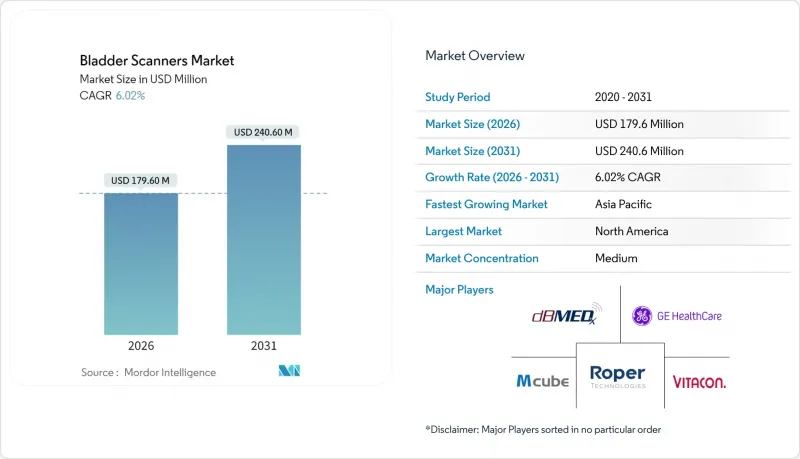
이러한 성장 궤적은 고령화, 카테터 관련 요로감염(CAUTI) 예방 의무화, 인공지능 탑재 초음파 기술의 융합이 병상에서의 방광용적 평가를 재정의하는 가운데 안정적인 수요가 지속되고 있음을 보여줍니다. 메디케어-메디케이드 서비스 센터(CMS)의 규제 모니터링 강화로 인해, 병원, 외래 수술 센터(ASC), 장기요양시설에서는 비침습적 스캔 장비의 도입이 우선순위가 되고 있으며, CAUTI 지표와 연동하여 상환이 이루어지고 있습니다. 현장 초음파(POCUS) 소견과 병원 내 진단의 일치율이 79.5%에 달한다는 임상적 근거가 응급의료 분야에서의 빠른 보급을 촉진하고 있습니다. 한편, 벨라슨의 ImageSense AI 엔진은 100mL 이상에서 ±7.5%의 정확도를 달성하여 지불자 측의 객관적인 측정 요구사항을 충족합니다. 자본 제약과 운영자 기술 부족이 지방 및 개발도상국에서의 보급을 가로막고 있지만, 유연한 임대 모델과 간소화된 사용자 인터페이스가 도입 장벽을 낮추기 시작했습니다.
세계 방광 스캐너 시장 동향 및 인사이트
고령화와 CAUTI 예방의 의무화
전 세계적으로 평균 수명이 연장됨에 따라 요폐 발생률이 증가하고 있으며, 임상의들은 정확성을 유지하면서 불필요한 카테터 삽입을 줄일 수 있는 스캐너를 도입하고 있습니다. CMS의 품질 프로그램은 CAUTI(카테터 관련 요로감염) 치료 결과에 따라 지불을 연동하고 있으며, 방광 스캐너를 도입한 기관에서는 카테터 사용률을 80% 감소시키는데 성공하여 본 기술이 감염 관리의 핵심 도구로 주목받고 있습니다.
응급 의료 및 수술 전후 치료에서 현장 진료 초음파의 통합성 강화
휴대용 스캐너는 카트형 장비에 버금가는 화질을 구현하여 분 단위의 신속한 선별 판정을 지원합니다. 수술 후 회복 촉진(ERAS) 프로토콜은 카테터 관련 합병증을 억제하고 퇴원 시기를 앞당기기 위해 수술 중 스캐닝을 더욱 촉진하고 있습니다.
소규모 진료소의 높은 초기 비용과 한정된 예산으로 인한 어려움
기본형 스캐너는 15,000-40,000달러로 유지보수 계약에 따라 총비용이 두 배로 늘어날 수 있어, 환급액이 적고 환자 수가 적은 병원에서는 도입이 어렵습니다. 리스나 종량제 모델이 등장하고 있지만, 개인 개업의들의 투자 회수율은 여전히 낮은 수준입니다.
부문 분석
3D 스캐너는 기존 2D 모델로는 달성할 수 없는 체적 정확도를 제공함으로써 2025년 방광 스캐너 시장 점유율의 52.18%를 차지할 것으로 예상됩니다. 카테터 측정값과의 평균 오차가 11.17%인 것으로 입증됨에 따라 이 부문은 2031년까지 CAGR 6.04%로 확대될 것으로 예상됩니다. 예산이 한정된 환경에서는 여전히 2D 장비가 선호되지만, AI 지원 알고리즘의 진화로 전문가 측정값과의 상관관계가 0.97까지 향상되어 성능 차이가 줄어들고 있습니다.
3D 스캐너의 성장 모멘텀은 객관적인 방광 용량 데이터 제출을 의무화하는 상환 규정의 강화에 달려있습니다. 한편, 부품 비용의 감소로 인해 고기능 모델이 3차 의료기관 외의 의료기관에서도 사용할 수 있게 되었습니다. 동시에, 2D 시스템은 저렴한 가격과 클라우드 기반 분석 기능을 결합하여 시간이 지남에 따라 기능을 향상시키면서 일차 의료 및 스크리닝 환경을 타겟으로 하고 있습니다. 두 카테고리 모두 지역마다 다른 정확도와 가격의 균형을 충족시킴으로써 방광 스캐너 시장의 성장 궤도를 강화하고 있습니다.
2025년 기준 휴대용/카트형 시스템은 방광 스캐너 시장 규모의 60.74%를 차지할 것으로 예상됩니다. 많은 병원들이 기존 영상 진단실을 유지하면서 바퀴가 달린 장비를 선호하는 경향이 있기 때문입니다. 그러나 태블릿이나 스마트폰에 연결되는 2파운드 미만의 폼팩터로 혼잡한 응급실에서 침대 옆에서 사용할 수 있는 핸드헬드 장치는 6.38%의 CAGR로 계속 성장하고 있습니다.
휴대용 모델의 매력은 환자 회전율 향상과 초음파 검사 기술자에 대한 의존도 감소에 있으며, 이는 당일 퇴원을 목표로 하는 외래 수술 센터에 있어 매우 중요한 장점입니다. 탁상형 스캐너는 소형 고정식 워크스테이션을 중시하는 비뇨기과 전문 클리닉을 위한 틈새 시장을 담당하고 있습니다. 대학에서 개발 중인 연속 모니터링용 임플란트는 다음 단계의 시장 세분화 진화를 시사하고 있지만, 상용화 일정은 현재 방광 스캐너 시장 수익 모델에서 제외되어 있습니다.
지역별 분석
북미는 2025년 전 세계 매출의 38.74%를 차지했으며, 이는 카테터 관련 요로감염(CAUTI) 감소를 평가하는 CMS(미국 의료보험서비스센터)의 지불 모델과 임상의들 사이에서 널리 보급된 AI 탑재 초음파 장비에 대한 숙련도가 기반이 되고 있습니다. 2026년 예정된 FDA(미국 식품의약국)의 품질 시스템 업데이트는 제조 표준을 조화시키고 공급자의 조달 위험을 감소시킬 것으로 예상됩니다.
아시아태평양은 2031년까지 CAGR 6.85%로 성장할 것으로 예상되며, 이는 의료 투자 확대와 가속화되는 POCUS(Point of Care Ultrasound) 교육 프로그램의 기반이 될 것으로 보입니다. 중국과 인도는 3차 의료기관이 외과 병동용 3D 스캐너를 도입하면서 수요량 확대를 주도하고 있으며, 일본과 한국은 국가 디지털 헬스 전략에 따라 AI 알고리즘을 중시하고 있습니다. 호주와 동남아시아 시장에서는 제한된 임상 공간에 대응할 수 있는 휴대용 유닛을 선호하고 있습니다.
유럽에서는 CE 마크의 표준화와 방광 스캐너를 국가 품질 프레임워크에 통합하는 감염 예방 캠페인으로 인해 균형 잡힌 성장을 보이고 있습니다. 독일, 프랑스, 이탈리아, 스페인, 영국에서는 공적 보험을 통한 상환을 기반으로 도입이 진행되고 있으며, 중남미 국가에서는 기부자 자금 조달을 통해 도입이 진행되고 있습니다. 남미와 중동 및 아프리카는 인프라 구축에 있어 고부담 비뇨기과 환경을 위한 저렴하고 훈련하기 쉬운 양식이 우선시되는 만큼 아직은 개발 중이지만 유망한 시장입니다.
기타 특전:
- 엑셀 형식의 시장 예측(ME) 시트
- 애널리스트의 3개월간 지원
자주 묻는 질문
목차
제1장 소개
제2장 조사 방법
제3장 주요 요약
제4장 시장 구도
제5장 시장 규모와 성장 예측
제6장 경쟁 구도
제7장 시장 기회와 향후 전망
KSM 26.03.05The Bladder Scanner market is expected to grow from USD 169.40 million in 2025 to USD 179.6 million in 2026 and is forecast to reach USD 240.6 million by 2031 at 6.02% CAGR over 2026-2031.
This trajectory underscores steady demand as aging populations, catheter-associated urinary tract infection (CAUTI) prevention mandates, and artificial-intelligence-enabled ultrasound technologies converge to redefine bedside bladder volume assessment. Heightened regulatory scrutiny from the Centers for Medicare & Medicaid Services (CMS) ties reimbursement to CAUTI metrics, prompting hospitals, ambulatory surgical centers (ASCs), and long-term-care facilities to prioritize non-invasive scanning devices. Clinical evidence supporting 79.5% concordance between point-of-care ultrasound (POCUS) findings and in-house diagnostics fuels rapid emergency-medicine uptake. Meanwhile, Verathon's ImageSense AI engine achieves +-7.5% accuracy above 100 mL, satisfying payer demands for objective measurement. Capital constraints and operator-skill gaps continue to restrict penetration in rural and developing areas, yet flexible leasing models and simplified user interfaces are beginning to mitigate adoption barriers.
Global Bladder Scanners Market Trends and Insights
Aging population and CAUTI-prevention mandates
Global life expectancy gains translate into higher urinary-retention incidence, prompting clinicians to adopt scanners that reduce unnecessary catheter insertions while preserving accuracy. CMS quality programs link payments to CAUTI outcomes, and facilities using bladder scanners have documented 80% catheter-reduction success, spotlighting the technology as a core infection-control tool.
Point-of-care ultrasound integration in emergency and peri-operative care
Handheld scanners achieve near-cart-based image quality, supporting rapid triage decisions where minutes matter. Enhanced Recovery After Surgery (ERAS) pathways further incentivize intra-operative scanning to limit catheter-associated complications and speed discharge timelines.
High capital cost and limited budgets in small practices
Base-model scanners cost USD 15,000-40,000, and service contracts can double lifetime outlay, discouraging adoption where reimbursements are low and patient volumes modest. Leasing and pay-per-use models are emerging, yet return-on-investment remains marginal for solo practitioners.
Other drivers and restraints analyzed in the detailed report include:
- AI-enabled 3D volume measurement improving reimbursement eligibility
- Nursing-home CAUTI penalty programs
- Shortage of trained operators in rural settings
For complete list of drivers and restraints, kindly check the Table Of Contents.
Segment Analysis
3D scanners generated 52.18% of the Bladder Scanner market share in 2025 by delivering volumetric accuracy that conventional 2D models cannot match. The segment is forecast to expand at 6.04% CAGR to 2031 as evidence compares mean errors of 11.17% against catheter-derived volumes. 2D devices remain preferred where budgets are tight; however, AI-assisted algorithms have narrowed the gap, posting 0.97 correlation with expert measurements.
Growth momentum for 3D scanners hinges on reimbursement rules that increasingly mandate objective bladder-volume evidence, while declining component costs make premium models accessible beyond tertiary hospitals. In parallel, 2D systems target primary-care and screening settings by coupling lower price tags with cloud-based analytics that upgrade over time. Both categories reinforce the Bladder Scanner Market trajectory by meeting diverse accuracy-versus-affordability thresholds across geographies.
Portable/cart-based systems held 60.74% of the Bladder Scanner market size in 2025 as many hospitals retain established imaging suites that favor wheeled devices. Nevertheless, handheld units are advancing at 6.38% CAGR, spurred by sub-2 lb form factors tethered to tablets or smartphones that facilitate bedside use in crowded emergency rooms.
The appeal of hand-carried models lies in faster patient turnover and reduced dependence on ultrasound technologists, a pivotal benefit for ASCs striving for same-day discharge. Bench-top scanners serve niche urology clinics that value compact, fixed workstations. Continuous-monitoring implants under university development hint at the next segmentation evolution, yet commercialization timelines place them beyond current Bladder Scanner Market revenue modeling.
The Bladder Scanner Market Report is Segmented by Product Type (2D Ultrasound Bladder Scanners, and More), Portability (Portable/Cart-Based, and More), Technology (AI-Enabled Imaging, Conventional Imaging), End User (Hospitals & Clinics, Ambulatory Surgical Centers, and More), Application (Urology, Obstetrics & Gynecology, and More), and Geography (North America, and More). The Market Forecasts are Provided in Terms of Value (USD).
Geography Analysis
North America generated 38.74% of global revenue in 2025, anchored by CMS payment models that reward CAUTI reduction and by widespread AI-enabled ultrasound familiarity among clinicians. Ongoing FDA quality-system updates slated for 2026 are expected to harmonize manufacturing benchmarks, reducing procurement risk for providers.
Asia-Pacific is forecast to post a 6.85% CAGR through 2031, underpinned by expanding healthcare investments and accelerating POCUS training programs. China and India spearhead volume demand as tertiary centers adopt 3D scanners for surgical wards, while Japan and South Korea emphasize AI algorithms that align with national digital-health strategies. Australia and Southeast-Asian markets favor portable units compatible with constrained clinical footprints.
Europe shows balanced growth amid CE-mark standardization and infection-prevention campaigns integrating bladder scanners into national quality frameworks. Germany, France, Italy, Spain, and the United Kingdom drive adoption based on public-insurance reimbursement, whereas Central and Eastern European countries adopt through donor-funded procurement. South America and Middle East & Africa remain nascent yet promising as infrastructure upgrades prioritize affordable, easy-to-train modalities in high-burden urological settings.
- Abbott (BioTelemetry)
- AliveCor
- BIOTRONIK
- BPL
- Cardiac Insight Inc.
- CardioComm Solutions
- Compumed Inc.
- EDAN Instruments
- Fukuda Denshi Co.
- GE Healthcare
- Hillrom (Baxter)
- iRhythm Technologies
- Medtronic
- Mindray
- Nihon Kohden
- OSI Systems (Spacelabs)
- Koninklijke Philips
- Schiller
- Shenzhen Creative
- Welch Allyn
Additional Benefits:
- The market estimate (ME) sheet in Excel format
- 3 months of analyst support
TABLE OF CONTENTS
1 Introduction
- 1.1 Study Assumptions & Market Definition
- 1.2 Scope of the Study
2 Research Methodology
3 Executive Summary
4 Market Landscape
- 4.1 Market Overview
- 4.2 Market Drivers
- 4.2.1 Rising cardiovascular-disease prevalence
- 4.2.2 Rapid adoption of AI-enabled ECG devices
- 4.2.3 Accelerating shift to remote & home cardiac monitoring
- 4.2.4 Government-funded mass screening programs
- 4.2.5 ECG integration into consumer wearable ecosystems (smartwatches, earbuds)
- 4.2.6 Insurer-led preventive-care reimbursement models
- 4.3 Market Restraints
- 4.3.1 Fragmented reimbursement in emerging markets
- 4.3.2 Shortage of ECG-trained technicians
- 4.3.3 Cyber-security & data-privacy risks in cloud ECG platforms
- 4.3.4 Algorithm bias affecting signal accuracy for women & dark-skin populations
- 4.4 Value / Supply-Chain Analysis
- 4.5 Regulatory Landscape
- 4.6 Technological Outlook
- 4.7 Porter's Five Forces
- 4.7.1 Threat of New Entrants
- 4.7.2 Bargaining Power of Suppliers
- 4.7.3 Bargaining Power of Buyers
- 4.7.4 Threat of Substitutes
- 4.7.5 Competitive Rivalry
5 Market Size & Growth Forecasts (Value, USD)
- 5.1 By Product Type
- 5.1.1 Resting ECG Systems
- 5.1.2 Stress ECG Systems
- 5.1.3 Holter Monitors
- 5.1.4 Event Recorders
- 5.1.5 Wearable / Patch ECG Devices
- 5.1.6 ECG Management Software
- 5.2 By Lead Type
- 5.2.1 Single-Lead ECG
- 5.2.2 3-6 Lead ECG
- 5.2.3 12-Lead ECG
- 5.2.4 15/18-Lead Advanced ECG
- 5.3 By End User
- 5.3.1 Hospitals & Clinics
- 5.3.2 Ambulatory Surgical Centers
- 5.3.3 Home Settings / Remote Patients
- 5.3.4 Diagnostic Labs & Cardiac Centers
- 5.4 By Technology
- 5.4.1 Analog ECG Devices
- 5.4.2 Digital / Cloud-connected ECG Devices
- 5.5 By Geography
- 5.5.1 North America
- 5.5.1.1 United States
- 5.5.1.2 Canada
- 5.5.1.3 Mexico
- 5.5.2 Europe
- 5.5.2.1 Germany
- 5.5.2.2 United Kingdom
- 5.5.2.3 France
- 5.5.2.4 Italy
- 5.5.2.5 Spain
- 5.5.2.6 Rest of Europe
- 5.5.3 Asia-Pacific
- 5.5.3.1 China
- 5.5.3.2 Japan
- 5.5.3.3 India
- 5.5.3.4 South Korea
- 5.5.3.5 Rest of Asia-Pacific
- 5.5.4 Middle East and Africa
- 5.5.4.1 GCC
- 5.5.4.2 South Africa
- 5.5.4.3 Rest of Middle East and Africa
- 5.5.5 South America
- 5.5.5.1 Brazil
- 5.5.5.2 Argentina
- 5.5.5.3 Rest of South America
- 5.5.1 North America
6 Competitive Landscape
- 6.1 Market Concentration
- 6.2 Strategic Moves
- 6.3 Market Share Analysis
- 6.4 Company Profiles (includes Global level Overview, Market level overview, Core Segments, Financials as available, Strategic Information, Market Rank/Share for key companies, Products & Services, and Recent Developments)
- 6.4.1 Abbott (BioTelemetry)
- 6.4.2 AliveCor Inc.
- 6.4.3 Biotronik SE & Co. KG
- 6.4.4 BPL Medical Technologies
- 6.4.5 Cardiac Insight Inc.
- 6.4.6 CardioComm Solutions
- 6.4.7 Compumed Inc.
- 6.4.8 EDAN Instruments
- 6.4.9 Fukuda Denshi Co.
- 6.4.10 GE Healthcare
- 6.4.11 Hillrom (Baxter)
- 6.4.12 iRhythm Technologies
- 6.4.13 Medtronic plc
- 6.4.14 Mindray Medical International
- 6.4.15 Nihon Kohden Corporation
- 6.4.16 OSI Systems (Spacelabs)
- 6.4.17 Philips Healthcare
- 6.4.18 Schiller AG
- 6.4.19 Shenzhen Creative
- 6.4.20 Welch Allyn
7 Market Opportunities & Future Outlook
- 7.1 White-space & Unmet-Need Assessment


