|
시장보고서
상품코드
1937322
체인톱 : 시장 점유율 분석, 업계 동향과 통계, 성장 예측(2026-2031년)Chainsaw - Market Share Analysis, Industry Trends & Statistics, Growth Forecasts (2026 - 2031) |
||||||
 Mordor Intelligence
체인톱 시장은 2025년 47억 9,000만 달러에서 2026년에는 49억 9,000만 달러로 성장할 것으로 예상되며, 2026년부터 2031년까지 CAGR 4.14%를 기록하며 2031년까지 61억 1,000만 달러에 달할 것으로 예측됩니다.
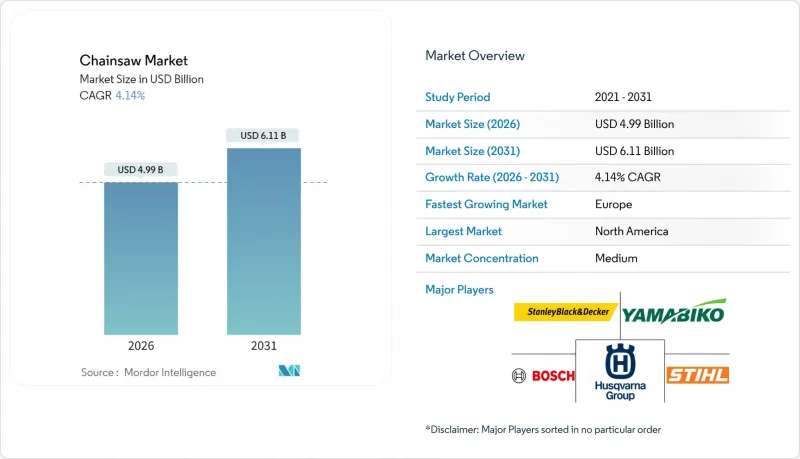
환경 규제 강화로 인해 시장은 전기 체인톱으로의 전환기를 맞이하고 있습니다. 배터리 성능 향상, 인체공학적 디자인 개선, 디지털 기능 추가 등으로 전기 모델과 가솔린 모델의 성능 차이가 줄어들어 전문가 및 일반 가정 사용자들에게 더욱 매력적으로 다가갈 수 있게 되었습니다. 시장 경쟁은 중간 정도이며, 몇몇 주요 업체들이 큰 점유율을 차지하고 있는 반면, 중소업체들은 제품 차별화 및 지역 특화 전략으로 전문 분야에 집중하고 있습니다. 각 업체들은 온라인 판매 채널을 확장하고 고객이 제품을 효과적으로 평가할 수 있도록함으로써 상업 및 주거 부문 모두에서 교체율을 높이고 있습니다. 지속가능성에 대한 관심 증가와 낮은 유지보수 장비에 대한 수요가 구매 패턴을 형성하고 있습니다. 도시 조경 활동의 확대와 DIY 트렌드에 따라 체인톱의 용도는 임업을 넘어 일반 가정과 정원 유지관리까지 확대되고 있습니다.
세계 체인톱 시장 동향 및 인사이트
대규모 목조건축에 대한 도시 목재 수요 증가
대량 목재 건축의 성장과 함께 목재 가공에 대한 수요는 기존의 벌채를 넘어서는 수준으로 확대되고 있습니다. 크로스 라미네이트 및 집성재와 같은 엔지니어드 우드 제품은 제어된 제조 환경에서 진동을 최소화한 정밀한 절단이 필요합니다. 이에 따라 정밀한 절단과 정숙성을 제공하는 전기 체인톱의 채택이 증가하고 있습니다. 부가가치 가공업체들은 집진 시스템과 통합이 가능하고 안정적인 토크를 발휘하는 무선 모델을 선호합니다. 건축 기법의 발전으로 체인톱의 용도는 원목 벌목에서 건축 및 엔지니어링 용도로 확대되었고, 배터리 기술과 인체공학적 설계가 중요하게 여겨지게 되었습니다. 이러한 변화는 도시 개발 프로젝트 및 제조 시설의 공급업체에게 새로운 기회를 창출하고 있습니다.
늘어나는 태풍 후 벌목 활동
이상기후가 빈번하게 발생함에 따라 피해지역에서 신속한 목재 제거의 필요성이 높아지고 있습니다. 쓰러진 나무가 도로를 막거나, 인프라를 손상시키거나, 중장비가 진입할 수 없는 지역에 쓰러진 경우, 체인톱은 복구 작업에 필수적인 장비입니다. 이러한 작업에서는 험난한 지형에 대응할 수 있는 경량, 휴대성, 고출력 모델이 요구됩니다. 안전 규제가 강화됨에 따라 첨단 제동 시스템 및 디지털 경보 기능을 갖춘 체인톱에 대한 수요가 증가하고 있습니다. 이러한 불규칙한 벌목 수요는 장비의 사용 빈도와 교체 수요가 급증하게 됩니다. 내구성이 뛰어난 고성능 공구 제조업체들은 복구 기간 동안 수요 증가를 경험하고 있으며, 재해 대응 및 산림 관리에서 체인톱의 중요성이 부각되고 있습니다.
최종사용자 안전 책임 보험 비용 증가
보험 비용의 증가는 수목 관리 회사 및 소규모 계약자의 장비 선택에 영향을 미칩니다. 고급 배터리식 체인톱은 성능과 환경 측면에서 우수하지만 초기 투자 비용이 높습니다. 보험사들은 기존 모델과 최신 모델 모두에 대해 동일한 책임 요건을 부과하고 있어 기술 도입이 제한되고 있습니다. 전자부품의 수리비용은 면책금액의 증가로 이어져 구매자의 망설임을 불러일으키고 있습니다. 이러한 재정적 요인으로 인해 특히 소규모 사업자의 설비 교체와 시장 성장이 둔화되고 있습니다. 보험료와 수리 위험의 조합이 도입 장벽으로 작용하여 제조업체는 비용 효율적인 설계와 명확한 안전 인증을 개발해야 합니다.
부문 분석
가솔린 체인톱은 뛰어난 토크와 원격지 및 열악한 환경에서의 신뢰성으로 인해 시장 규모의 61.78%를 차지하며 선두를 유지하고 있습니다. 배터리 인프라가 제한적인 지방의 벌목이나 중작업용으로는 여전히 필수 불가결한 모델입니다. 전기식 부문은 특히 엄격한 소음 및 배기가스 규제가 있는 도시 지역에서 확대되고 있습니다. 코드식 체인톱은 지자체 규제와 실내 가공 수요에 힘입어 CAGRCAGR 4.26%로 꾸준히 성장하고 있습니다.
배터리식 체인톱은 IP 규격 대응 하우징과 원심 클러치를 탑재하여 가솔린식 체인톱에 버금가는 성능을 구현하면서 진화를 거듭하고 있습니다. 리튬 배터리의 밀도, 냉각 시스템, 펌웨어의 개선으로 내구성과 효율성이 향상되었습니다. 조경업자와 나무의사들 사이에서 멀티 툴 지원 배터리 플랫폼의 채택이 증가하고 있습니다. 연료 의존도를 낮추기 위해 원격지에서는 태양광 충전소가 등장하고 있습니다. 스파크가 발생하지 않는 작업이 요구되는 제재소나 화재 발생 위험이 높은 지역에서는 공압식 및 유압식 체인톱이 특수한 용도로 존재감을 유지하고 있습니다.
지역별 분석
북미는 2025년 체인톱 시장 매출의 33.62%를 차지했습니다. 광활한 산림 면적, 허리케인 복구 작업, DIY 문화의 확산이 그 배경입니다. 이 지역의 수요는 정부의 재조림 프로그램 및 산불 방지 대책, 특히 산업용 가솔린 체인톱에 대한 수요에 의해 주도되고 있습니다. 유틸리티 사업자들이 식생 관리를 외부에 위탁하는 경향이 강화되면서 방진 기술을 갖춘 내구성 높은 체인톱에 대한 수요가 증가하고 있습니다. 교외 지역의 수목 관리 업체들은 소음 규제에 대응하기 위해 배터리 구동 모델로 전환을 추진하고 있습니다. 제조업체는 운송 리스크를 최소화하고 납기를 단축하기 위해 현지에 배터리 팩 조립 공장을 설립했습니다. 시장은 전문가와 소비자 수요의 결합으로 계속 성장하고 있으며, 규제 요건과 기술 혁신이 구매 결정에 영향을 미치고 있습니다. 특히 정숙성이 요구되는 도심이나 주택가에서는 전기 모델의 채택이 증가하는 추세입니다.
유럽은 환경 규제와 대규모 목조건축의 발전을 배경으로 2031년까지 CAGR 4.18%의 가장 높은 성장률을 보이고 있습니다. 이 지역의 엔지니어링 목재 제품에 대한 집중은 실내 제조 환경에 적합한 정밀한 절단 공구를 필요로 하며, 저소음과 높은 토크를 실현하는 배터리식 체인톱의 도입을 촉진하고 있습니다. 지자체 소음 규제와 배출가스 규제로 인해 전문 사용자와 주거용 사용자 모두 성능을 유지하면서 규제 요건을 충족하는 무선 모델을 선택하는 경향이 있습니다. 지역 내 제조 시설은 생산능력을 확장하고, 기업들은 배터리 기술 개발에 투자하고 있습니다. 유럽의 체인톱 시장은 지속가능성, 안전, 운영 효율성에 대한 지역적 관심사를 반영하고 있습니다. 도시 지역의 확대와 지속가능한 건축 기법의 보급으로 정숙성 및 무공해 공구에 대한 수요는 지속적으로 증가하고 있습니다.
아시아태평양에서는 인도, 인도네시아, 베트남의 도시화와 인프라 프로젝트의 증가가 성장 기회를 보여주고 있습니다. 현지 제조업체는 비용 효율적인 생산능력을 활용하고, 국제 기업은 지역 공급망을 확장하고 있습니다. 태풍 피해 지역의 자연재해 대응을 위해 가볍고 휴대 가능한 체인톱에 대한 수요가 증가하고 있습니다. 아프리카에서는 농업 관행과 자원 접근에 영향을 받아 체인톱의 사용은 농림업과 토지 개발과 상관관계가 있습니다. 중동 시장은 산림피복이 제한적임에도 불구하고, 도시 조경과 공공시설물 유지관리에 초점을 맞추고 있습니다. 남미에서는 주로 농업용 개간 및 선택적 벌목 작업에서 일관적이면서도 다양한 수요가 유지되고 있습니다. 이 지역에서는 비용 효율성, 제품 내구성, 유지보수 용이성을 우선시하고 인프라가 발전함에 따라 배터리 구동 공구의 채택이 점차 증가하고 있습니다.
기타 특전:
- 엑셀 형식의 시장 예측(ME) 시트
- 애널리스트의 3개월간 지원
자주 묻는 질문
목차
제1장 소개
제2장 조사 방법
제3장 주요 요약
제4장 시장 구도
제5장 시장 규모와 성장 예측
제6장 경쟁 구도
제7장 시장 기회와 향후 전망
KSM 26.03.05The chainsaw market is expected to grow from USD 4.79 billion in 2025 to USD 4.99 billion in 2026 and is forecast to reach USD 6.11 billion by 2031 at 4.14% CAGR over 2026-2031.
The market is experiencing a transition toward electric chainsaws due to stricter environmental regulations. Enhanced battery performance, improved ergonomics, and digital features are reducing the performance gap between electric and gas-powered models, increasing their appeal to professional users and homeowners. The market exhibits moderate competition, with several major manufacturers controlling a substantial market share, while smaller companies focus on specialized segments through product differentiation and regional approaches. Companies are expanding their online sales channels, enabling customers to evaluate products effectively, which drives replacement rates in both commercial and residential sectors. The increasing focus on sustainability and demand for low-maintenance equipment is shaping buying patterns. The expansion of urban landscaping activities and DIY trends has broadened chainsaw applications beyond forestry to include general home and garden maintenance.
Global Chainsaw Market Trends and Insights
Increasing Urban-wood Demand for Mass-timber Construction
The growth of mass-timber construction has expanded wood-processing requirements beyond traditional logging. Engineered wood products, including cross-laminated and glued-laminated timber, require precise cutting with minimal vibration in controlled fabrication environments. This has increased the adoption of electric chainsaws, which provide precise cuts and quiet operation. Value-added processors prefer cordless models that integrate with dust extraction systems and deliver consistent torque. The evolution of construction methods has expanded chainsaw applications from raw log harvesting to architectural and engineering uses, where battery technology and ergonomic design are crucial. This transformation creates opportunities for suppliers in urban development projects and fabrication facilities.
Growing Post-storm Salvage Logging Activities
The increasing frequency of extreme weather events has heightened the need for rapid timber removal in storm-affected areas. Chainsaws are essential for salvage operations when fallen trees block roads, damage infrastructure, or lie in areas inaccessible to heavy equipment. These operations require lightweight, portable, and powerful models for difficult terrain. Enhanced safety regulations have increased demand for chainsaws with advanced braking systems and digital alerts. These irregular salvage requirements create unexpected spikes in equipment usage and replacement needs. Manufacturers of durable, high-performance tools experience increased demand during recovery periods, highlighting chainsaws' importance in disaster response and forest management.
Heightened End-user Safety Liability Insurance Costs
Increasing insurance costs affect tree-service firms and small contractors' equipment decisions. Advanced battery-powered chainsaws offer improved performance and environmental benefits but require a higher initial investment. Insurance providers maintain similar liability requirements for both traditional and modern models, limiting technology adoption. Electronic component repair costs lead to higher deductibles, causing buyer hesitation. These financial factors slow fleet updates and market growth, particularly among smaller operations. The combination of insurance premiums and repair risks creates adoption barriers, requiring manufacturers to develop cost-effective designs and clear safety certifications.
Other drivers and restraints analyzed in the detailed report include:
- Rising DIY Culture and E-commerce Tool Bundles
- Government Incentives for Low-emission Battery Equipment
- Skilled-operator Labor Shortages
For complete list of drivers and restraints, kindly check the Table Of Contents.
Segment Analysis
Gas-powered chainsaws dominate the chainsaw market size with a 61.78% share due to their superior torque and reliability in remote and demanding environments. These models remain essential for rural logging and heavy-duty applications where battery infrastructure is limited. The electric segment is expanding, particularly in urban areas with strict noise and emission regulations. Corded electric chainsaws show steady growth at 4.26% CAGR, supported by municipal regulations and indoor fabrication requirements.
Battery-powered chainsaws continue to advance, featuring IP-rated housings and centrifugal clutches that provide gas-like performance. Improvements in lithium battery density, cooling systems, and firmware enhance durability and efficiency. The market sees increased adoption of multi-tool battery platforms among landscapers and arborists. Solar-compatible charging stations are emerging in remote locations to reduce fuel dependency. Pneumatic and hydraulic chainsaws maintain a specialized presence in mills and fire-prone areas requiring spark-free operation.
The Chainsaw Market Report is Segmented by Product Type (Gas-Powered, Electric-Powered, and More), by End-User (Residential and Industrial), by Distribution Channel (Offline Retail and Online Platforms), and by Geography (North America, Europe, Asia-Pacific, South America, The Middle East, and Africa). The Market Forecasts are Provided in Terms of Value (USD).
Geography Analysis
North America accounts for 33.62% of the chainsaw market revenue in 2025, supported by extensive forest coverage, hurricane recovery operations, and widespread DIY practices. The region's demand is driven by government reforestation programs and wildfire prevention efforts, particularly for industrial-grade gas-powered chainsaws. The increasing trend of utilities outsourcing vegetation management has heightened demand for durable chainsaws with anti-vibration technology. Tree-care companies in suburban areas are transitioning to battery-powered units to meet noise regulations. Manufacturers have established local battery pack assembly facilities to minimize shipping risks and reduce delivery times. The market continues to grow through a combination of professional and consumer use, with regulatory requirements and innovation influencing purchase decisions. The adoption of electric models is increasing, particularly in urban and residential areas where quiet operation is essential.
Europe exhibits the highest growth rate at 4.18% CAGR through 2031, driven by environmental regulations and mass-timber construction advancement. The region's focus on engineered wood products necessitates precise cutting tools suitable for indoor manufacturing environments. This has increased the uptake of battery-powered chainsaws that offer low noise levels and high torque. Municipal noise restrictions and emissions regulations are directing both professional and residential users toward cordless models that maintain performance while meeting compliance requirements. Regional manufacturing facilities are increasing production capacity, while companies invest in battery technology development. The European chainsaw market reflects the region's focus on sustainability, safety, and operational efficiency. The expansion of urban areas and sustainable construction methods continues to increase demand for quiet, zero-emission tools.
Asia-Pacific demonstrates growth opportunities as urbanization and infrastructure projects increase in India, Indonesia, and Vietnam. Local manufacturers leverage cost-efficient production capabilities, while international companies expand regional supply chains. Natural disaster response in typhoon-affected areas increases demand for lightweight, portable chainsaws. In Africa, chainsaw use correlates with agroforestry and land development, influenced by agricultural practices and resource access. The Middle East market focuses on landscaping and municipal maintenance in urban areas despite limited forest coverage. South America maintains consistent but varied demand, primarily from agricultural clearing and selective logging operations. These regions prioritize cost-effectiveness, product durability, and maintenance simplicity, with gradual increases in battery-powered tool adoption as infrastructure develops.
- STIHL Group
- Robert Bosch GmbH
- Husqvarna Group
- Stanley Black & Decker Inc.
- Yamabiko Corporation
- Makita Corporation
- The Toro Company
- SUMEC Group Corporation (SIMOMACH)
- STIGA SpA (GGP Group)
- Einhell Germany AG
- Emak SPA
- Koki Holdings Co., Ltd. (Kohlberg Kravis Roberts)
- Honda Motor Co., Ltd.
- AL-KO GMBH
- Taizhou Bison Machinery Co., Ltd.
Additional Benefits:
- The market estimate (ME) sheet in Excel format
- 3 months of analyst support
TABLE OF CONTENTS
1 Introduction
- 1.1 Study Assumptions and Market Definition
- 1.2 Scope of the Study
2 Research Methodology
3 Executive Summary
4 Market Landscape
- 4.1 Market Overview
- 4.2 Market Drivers
- 4.2.1 Increasing Urban-wood Demand for Mass-timber Construction
- 4.2.2 Growing Post-storm Salvage Logging Activities
- 4.2.3 Rising DIY Culture and E-commerce Tool Bundles
- 4.2.4 Government Incentives for Low-emission Battery Equipment
- 4.2.5 Surge in Premium Outdoor Furniture Manufacturing
- 4.2.6 Land Clearing for Crop Expansion
- 4.3 Market Restraints
- 4.3.1 Heightened End-user Safety Liability Insurance Costs
- 4.3.2 Noise-abatement Bylaws in Peri-urban Zones
- 4.3.3 Tightening Deforestation-free Supply-chain Regulations
- 4.3.4 Skilled-operator Labor Shortages
- 4.4 Regulatory Landscape
- 4.5 Technological Outlook
- 4.6 Porter's Five Forces Analysis
- 4.6.1 Bargaining Power of Buyers
- 4.6.2 Bargaining Power of Suppliers
- 4.6.3 Threat of New Entrants
- 4.6.4 Threat of Substitutes
- 4.6.5 Intensity of Competitive Rivalry
5 Market Size and Growth Forecasts
- 5.1 By Product Type
- 5.1.1 Gas-powered
- 5.1.2 Electric-powered
- 5.1.3 Battery-powered
- 5.1.4 Pneumatic/ Hydraulic
- 5.2 By End-user
- 5.2.1 Residential
- 5.2.2 Industrial
- 5.3 By Distribution Channel
- 5.3.1 Offline Retail
- 5.3.2 Online Platforms
- 5.4 By Geography
- 5.4.1 North America
- 5.4.1.1 United States
- 5.4.1.2 Canada
- 5.4.1.3 Mexico
- 5.4.1.4 Rest of North America
- 5.4.2 Europe
- 5.4.2.1 Germany
- 5.4.2.2 United Kingdom
- 5.4.2.3 France
- 5.4.2.4 Italy
- 5.4.2.5 Russia
- 5.4.2.6 Spain
- 5.4.2.7 Rest of Europe
- 5.4.3 Asia-Pacific
- 5.4.3.1 China
- 5.4.3.2 Japan
- 5.4.3.3 India
- 5.4.3.4 Australia
- 5.4.3.5 South Korea
- 5.4.3.6 Rest of Asia-Pacific
- 5.4.4 South America
- 5.4.4.1 Brazil
- 5.4.4.2 Argentina
- 5.4.4.3 Rest of South America
- 5.4.5 Middle East
- 5.4.5.1 Saudi Arabia
- 5.4.5.2 United Arab Emirates
- 5.4.5.3 Rest of Middle East
- 5.4.6 Africa
- 5.4.6.1 South Africa
- 5.4.6.2 Nigeria
- 5.4.6.3 Rest of Africa
- 5.4.1 North America
6 Competitive Landscape
- 6.1 Market Concentration
- 6.2 Strategic Moves
- 6.3 Market Share Analysis
- 6.4 Company Profiles (Includes Global Level Overview, Market Level Overview, Core Segments, Financials as Available, Strategic Information, Market Rank/Share for Key Companies, Products and Services, and Recent Developments)
- 6.4.1 STIHL Group
- 6.4.2 Robert Bosch GmbH
- 6.4.3 Husqvarna Group
- 6.4.4 Stanley Black & Decker Inc.
- 6.4.5 Yamabiko Corporation
- 6.4.6 Makita Corporation
- 6.4.7 The Toro Company
- 6.4.8 SUMEC Group Corporation (SIMOMACH)
- 6.4.9 STIGA SpA (GGP Group)
- 6.4.10 Einhell Germany AG
- 6.4.11 Emak SPA
- 6.4.12 Koki Holdings Co., Ltd. (Kohlberg Kravis Roberts)
- 6.4.13 Honda Motor Co., Ltd.
- 6.4.14 AL-KO GMBH
- 6.4.15 Taizhou Bison Machinery Co., Ltd.