

|
시장보고서
상품코드
1937335
디메틸에테르 : 시장 점유율 분석, 업계 동향과 통계, 성장 예측(2026-2031년)Dimethyl Ether - Market Share Analysis, Industry Trends & Statistics, Growth Forecasts (2026 - 2031) |
||||||
 Mordor Intelligence
디메틸에테르 시장은 2025년 795만 톤에서 2026년에는 843만 톤으로 성장하여 2026년부터 2031년까지 CAGR 6.00%를 기록하며 2031년까지 1,128만 톤에 달할 것으로 예측됩니다.
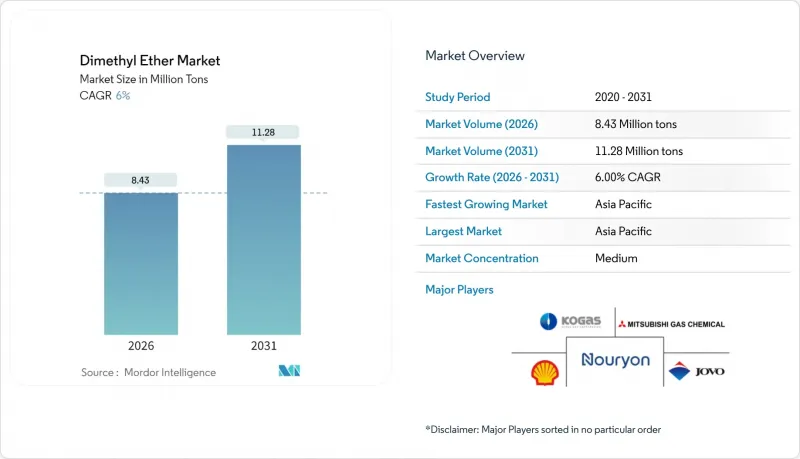
초저유황 요구사항에 대한 규제 움직임, 탄소 중립 목표로의 전환, 그리고 기존 LPG 물류망에 원활하게 부합하는 디메틸에테르(DME)의 특성이 강력한 수요 확대의 기반을 형성하고 있습니다. 아시아태평양은 중국의 석탄가스화 네트워크와 비용 우위를 활용하여 성장을 견인하고 있으며, 일본과 한국은 에너지 안보 다변화를 위해 DME를 도입하고 있습니다. 현재 천연가스 유래 생산량이 주류를 이루고 있지만, 바이오 DME 생산 경로의 급속한 기술 발전은 장기적인 공급 곡선을 재조정할 수 있는 원료 구조의 변화를 시사하고 있습니다. 경쟁은 중간 정도에 머물러 있으며, 기존 메탄올 탈수 방식과 새로운 CO2 수소화 기술을 모두 보유한 생산자들은 그린 수소 공급 확대에 따라 선택권을 확보하고 있습니다.
세계 디메틸에테르 시장 동향과 인사이트
LPG 혼합용도의 수요 확대
인도네시아, 말레이시아, 태국의 가정용 에너지 프로그램은 LPG 대체 목표를 추진하고 있으며, 이는 직접적으로 디메틸에테르 시장의 수요를 증가시키고 있습니다. 인도네시아의 LPG 15% 대체 계획만으로도 수입비용을 3억 8,800만 달러 절감할 수 있으며, 기존 스토브 및 실린더와의 호환성(드롭인 호환성)으로 인해 DME는 정치적으로도 매력적인 선택이 될 수 있습니다. 이 대체 경로는 변동이 심한 프로판 가격에 대한 재정적 리스크를 줄이는 동시에 유틸리티가 고가의 장비 개보수를 미룰 수 있게 해줍니다. 생산자는 약간의 효율성 향상보다 연료 비용의 안정성을 중시하는 기존 고객 기반으로부터 혜택을 받을 수 있습니다. 팜유 폐기물 및 쌀겨를 활용한 바이오매스 DME 병행 시범사업은 지역 순환형 경제정책과 부합하며, 농촌의 소득 향상에 기여할 수 있습니다. 이러한 요인들이 복합적으로 작용하여 원유 가격의 변동에도 불구하고 견조한 지역 수요를 뒷받침하고 있습니다.
운송 부문 및 산업용 보일러의 연료 수요 증가
전 세계적으로 대형 차량의 배기가스 배출 기준이 강화되는 가운데, 차량 관리자들은 디젤의 성능을 유지하면서 미립자 물질을 배출하지 않는 연료를 찾아야 하는 상황에 직면해 있습니다. DME는 세탄가가 55-60으로 매연을 거의 발생시키지 않기 때문에 후처리 장치 개조가 아닌 연료 전환을 통한 규제 적합화가 가능합니다. 중국에서는 광산, 항만, 농업협동조합이 이미 DME를 지역 디젤 연료 풀에 혼합하여 성(省)급 PM 규제를 달성했습니다. 산업용 보일러도 비슷한 경향을 보이고 있습니다. 저NOx 버너를 도입하는 제조업체는 기존 LPG 저장 탱크를 활용할 수 있기 때문에 DME가 허용 가능한 비용 범위 내에서 CO2 배출량을 추가로 감축할 수 있다고 인식하고 있습니다. 따라서 정책 입안자들이 더욱 엄격한 대기 질 기준을 시행함에 따라 디메틸에테르 시장은 운송 및 공정 열 응용 분야 전반에 걸쳐 잠재적인 시장 규모가 확대되고 있습니다.
대규모 합성 및 탈수 공정의 높은 설비 투자/운영 비용
메탄올에서 DME를 생산하는 복합 플랜트 건설에는 특수 반응기와 고층 증류탑이 필요하며, 이로 인해 자본집약도가 연간 생산능력 1톤당 18,000달러를 초과하여 저마진 연료 시장에서 수익성이 압박을 받게 됩니다. 운영비용은 유틸리티 가격의 영향을 받기 쉬우며, 칸막이벽 증류탑을 통해 증기 수요를 최적화하면 44.5%의 비용 절감이 가능하지만, 상업적으로 검증된 사례는 아직은 제한적입니다. 신흥국 신규 프로젝트의 경우, 차입 비용이 10%를 초과하기 때문에 자금 조달의 문턱이 더 높습니다. 따라서 투자자들은 기존 설비의 개보수나 모듈형 스키드를 선호하는 경향이 있으며, 대규모 플랜트 발표가 줄어들면서 디메틸에테르 시장의 확장 속도가 둔화될 가능성이 있습니다.
부문 분석
2025년 생산량의 64.10%를 천연가스 원료가 차지하며, 북미, 중동, 러시아의 기존 수증기 개질 설비를 통해 비용 우위를 유지했습니다. 이들 설비는 기존 메탄올 플랜트에 부수적으로 설치되기 때문에 증설 탈수 라인의 현금 비용 손익분기점은 톤당 350달러 미만으로, 천연가스 원료인 디메틸에테르 시장에서의 우위를 지속하고 있습니다. 석탄 가스화 공정은 중국 생산 기지의 기반이 되고 있지만, 환경 규제와 탄소 시장에 대한 영향으로 수익률은 점차 축소되는 추세입니다.
재생에너지로의 전환은 분명하며, 바이오 DME는 CAGR 8.42%로 확대되고 있습니다. 오베론 퓨얼스의 미국 생산능력 연간 2억 갤런 이상 증설 계획, EU 컨소시엄의 목질계 바이오매스 가스화 기술 개발 등이 규모 확대의 사례입니다. 캘리포니아주 저탄소 연료 기준(LCFS) 및 EU 재생에너지 지침 II에 따른 크레딧은 톤당 85-190달러의 현금화 가능한 탄소 프리미엄을 가져와 바이오 기반 경로의 프로젝트 경제성에 유리하게 작용하고 있습니다. 전해조 비용의 하락에 따라 직접 CO2 수소화 기술은 화석 원료의 기존 지위를 더욱 위협하고 디메틸에테르 시장의 공급측 역학을 재구성할 가능성이 있습니다.
디메틸에테르 보고서는 원료별(천연가스, 석탄, 바이오 기반 제품), 용도별(추진제, LPG 혼합, 연료, 기타 용도), 지역별(아시아태평양, 북미, 유럽, 남미, 중동 및 아프리카)로 분류되어 있습니다. 시장 예측은 톤 단위로 제공됩니다.
지역별 분석
아시아태평양은 2025년 전 세계 생산량의 86.20%를 차지하며 6.10%의 가장 높은 CAGR을 유지했습니다. 중국은 산시성과 내몽골 자치구에 연간 100만 톤 이상의 석탄으로 DME를 생산하는 복합시설을 보유하고 있어 비용 우위를 유지하고 있습니다. 대기질 달성 크레딧에 연동된 지방정부 차원의 보조금이 국가 차원의 탄소가격제도가 강화되는 상황에서도 수익률을 보호하고 있습니다. 일본과 한국은 연료 다변화 노력을 심화시키고 있습니다. 도쿄의 수소 로드맵은 해상 연료 보급을 위해 DME 등 액체 캐리어를 언급하고 있으며, 국내 정유사들은 LPG 수입 터미널에 혼합펌프를 도입하고 있습니다. 이들은 디메틸에테르 시장을 형성하는 주요 발전입니다.
북미는 생산량에서는 크게 뒤쳐져 있지만, 재생 가능한 DME 기술에서는 세계를 선도하고 있습니다. 캘리포니아의 재생 연료 크레딧 제도는 연방 RIN과 주정부의 LCFS 인센티브를 결합하여 저탄소 강도 제품에 대해 톤당 1,400달러 이상의 순이익을 창출하여 센트럴 밸리의 낙농 폐기물 유래 DME 클러스터에 대한 자본 유입을 촉진하고 있습니다. 캐나다는 청정연료 규제를 통한 정책의 형평성을 높이 평가하고 있으며, 이는 국경을 초월한 조화의 가능성을 시사하고, 대응 가능한 트럭 차량의 규모 확대로 이어질 수 있습니다. 멕시코는 농업용 DME-디젤 혼합 연료를 모색하고 있지만, 인프라 자금 조달 장벽으로 인해 보급이 지연되고 있습니다.
유럽에서는 DME 도입을 그린딜의 요구와 일치시키고 있습니다. 스웨덴의 BioDME 실증 프로젝트는 리그노셀룰로오스계 경로를 실증하고, 덴마크의 Power-to-X 로드맵은 CO2 네거티브 경로를 위한 DME를 명시하고 있습니다. 독일 기관은 훔볼트 연구소의 연구를 지원하여 연료전지 트럭 탑재형 DME→수소 재변환용 고분자 전해질 막 개질기를 개발 중으로, 가치사슬 전반의 혁신을 보여주고 있습니다. 중동의 가스 생산국들은 LNG 액화 설비 투자를 피하기 위한 수익화 수단으로 DME 수출을 고려하고 있습니다. 한편, 아프리카 시장에서는 가정용 LPG의 가격 적정화에 초점을 맞추고 있으며, 보조금에 의존하는 단계적 진입 경로가 제시되고 있습니다. 이러한 요인들이 디메틸에테르 시장의 지역별 동향을 주도하고 있습니다.
기타 특전:
- 엑셀 형식의 시장 예측(ME) 시트
- 애널리스트의 3개월간 지원
자주 묻는 질문
목차
제1장 소개
제2장 조사 방법
제3장 주요 요약
제4장 시장 구도
제5장 시장 규모와 성장 예측
제6장 경쟁 구도
제7장 시장 기회와 향후 전망
KSM 26.03.09The Dimethyl Ether market is expected to grow from 7.95 million tons in 2025 to 8.43 million tons in 2026 and is forecast to reach 11.28 million tons by 2031 at 6.00% CAGR over 2026-2031.
Regulatory moves toward ultra-low-sulfur requirements, the pivot to carbon-neutral targets, and dimethyl ether's (DME) seamless fit in existing LPG logistics create a strong demand runway. Asia-Pacific anchors momentum, leveraging China's coal gasification network and cost advantage, while Japan and Korea deploy DME for energy-security diversification. Natural-gas-based output dominates volumes today, yet rapid technology gains in bio-DME routes point to a structural feedstock shift that could recalibrate long-term supply curves. Competitive intensity stays moderate; producers with both conventional methanol-dehydration and emerging CO2 hydrogenation know-how secure optionality as green-hydrogen availability scales.
Global Dimethyl Ether Market Trends and Insights
Growing Demand from LPG Blending Applications
Household energy programs across Indonesia, Malaysia, and Thailand push LPG substitution targets that directly lift volumes in the dimethyl ether market. Indonesia's 15% LPG replacement plan alone could save USD 388 million in import costs and make DME politically attractive due to drop-in compatibility with existing stoves and cylinders. The substitution pathway reduces fiscal exposure to volatile propane prices while letting utilities defer expensive appliance retrofits. Producers benefit from a ready customer base that values fuel cost stability more than marginal efficiency gains. Parallel biomass-to-DME pilots using palm-oil waste and rice husks align with local circular-economy mandates and strengthen rural incomes. These converging factors underpin resilient regional demand even if oil price swings occur.
Increasing Fuel Demand from Transportation and Industrial Boilers
Emission standards for heavy-duty vehicles tighten globally, prompting fleet managers to explore fuels that match diesel performance without diesel's particulate profile. DME offers a 55-60 cetane score and produces virtually no soot, allowing compliance upgrades through fuel switching rather than after-treatment retrofits. Mines, ports and agricultural cooperatives in China already blend DME into on-site diesel pools to meet provincial PM limits. Industrial boilers follow a similar arc; manufacturers installing low-NOx burners find that DME delivers incremental CO2 reductions at acceptable cost because it leverages installed LPG storage tanks. The dimethyl ether market therefore enjoys an expanding total addressable volume across transport and process-heat end-uses while policy-makers enforce stricter air-quality benchmarks.
High Capex/OPEX for Large-Scale Synthesis and Dehydration
Building methanol-to-DME complexes demands specialized reactors and tall distillation columns that lift capital intensity beyond USD 18,000 per ton per year of capacity, squeezing returns in low-margin fuel markets. Operating expenditure remains sensitive to utility prices; steam-demand optimization via dividing-wall columns can trim costs by 44.5%, but commercial references stay limited. Financing hurdles are more acute for greenfield projects in emerging economies where borrowing costs exceed 10%. Investors therefore favor brownfield retrofits or modular skids, tempering mega-plant announcements and potentially slowing the dimethyl ether market expansion rate.
Other drivers and restraints analyzed in the detailed report include:
- Government Incentives for Ultra-Low-Sulfur Household Fuels
- Modular Bio-DME Plants Leveraging Green H2 and Captured CO2
- Competition from LNG, LPG and Green Methanol
For complete list of drivers and restraints, kindly check the Table Of Contents.
Segment Analysis
Natural-gas feedstock generated 64.10% of 2025 output, and retained cost superiority through established steam-reforming assets in North America, the Middle East, and Russia. Because these assets piggyback on legacy methanol units, incremental dehydration lines reach cash-cost breakeven below USD 350 per ton, sustaining natural-gas leadership in the dimethyl ether market. Coal-gasification pathways underpin China's production clusters, but environmental penalties and carbon-market exposure gradually compress margins.
The renewable pivot is unmistakable: bio-DME grows at 8.42% CAGR. Scale-ups include Oberon Fuels' plan to lift U.S. capacity beyond 200 million gallons per year and EU consortia targeting woody-biomass gasification. Credits under California's Low Carbon Fuel Standard and the EU's Renewable Energy Directive II deliver monetizable carbon premiums of USD 85-190 per ton, tipping project economics in favor of bio-routes. As electrolyzer costs fall, direct CO2 hydrogenation could further challenge fossil feedstock incumbency, reshaping supply-side dynamics in the dimethyl ether market.
The Dimethyl Ether Report is Segmented by Source (Natural Gas, Coal, and Bio-Based Products), Application (Propellants, LPG Blending, Fuel, and Other Applications), and Geography (Asia-Pacific, North America, Europe, South America, and Middle-East and Africa). The Market Forecasts are Provided in Terms of Volume (Tons).
Geography Analysis
Asia-Pacific commanded 86.20% of global volume in 2025, sustaining the highest regional CAGR at 6.10%. China retains a cost advantage through coal-to-DME complexes in Shaanxi and Inner Mongolia, each exceeding 1 million tons per year. Provincial subsidies tied to air-quality attainment credits shield margins even as national carbon pricing tightens. Japan and Korea deepen fuel diversification efforts; Tokyo's hydrogen roadmap cites liquid carriers like DME for maritime bunkering, while Korean refiners deploy blend pumps at LPG import terminals-key developments shaping the dimethyl ether market.
North America trails distantly but leads the technology curve in renewable DME. California's renewable-fuel credit stack, layering federal RINs with state LCFS advantages, yields netbacks over USD 1,400 per ton for low-CI product, drawing capital toward dairy-waste-to-DME clusters in the Central Valley. Canada evaluates policy parity via its Clean Fuel Regulations, signaling cross-border harmonization potential that could enlarge addressable truck-fleet volumes. Mexico explores DME-diesel blends for agriculture, but infrastructure finance hurdles slow uptake.
Europe aligns DME adoption with Green Deal imperatives. Sweden's BioDME demonstration confirmed lignocellulosic pathways, and Denmark's Power-to-X roadmap lists DME for CO2-negative shipping routes. German agencies sponsor Fraunhofer research on polymer-electrolyte-membrane reformers that reconvert DME to hydrogen on board fuel-cell trucks, illustrating deep value-chain innovation. Middle East gas-rich producers weigh DME export options as a monetization lever that avoids LNG liquefaction capital, while African markets focus on household LPG affordability, implying gradual, subsidy-dependent entry pathways-factors guiding regional trajectories in the dimethyl ether market.
- Biofriends Inc.
- DME-Aerosol LLC
- Dongguan Jovo Warehousing Services Co., Ltd.
- GRILLO-Werke AG
- Gruppo SIAD
- Korea Gas Corporation
- Mitsubishi Gas Chemical Company, Inc.
- Nouryon
- Oberon Fuels, Inc.
- Shell PLC
- Sichuan Lutianhua Co., Ltd.
- The Chemours Company
Additional Benefits:
- The market estimate (ME) sheet in Excel format
- 3 months of analyst support
TABLE OF CONTENTS
1 Introduction
- 1.1 Study Assumptions and Market Definition
- 1.2 Scope of the Study
2 Research Methodology
3 Executive Summary
4 Market Landscape
- 4.1 Market Overview
- 4.2 Market Drivers
- 4.2.1 Growing Demand from LPG Blending Applications
- 4.2.2 Increasing Fuel Demand from Transportation and Industrial Boilers
- 4.2.3 Government Incentives for Ultra-Low-Sulfur Household Fuels
- 4.2.4 Modular Bio-DME Plants Leveraging Green H2 and Captured CO2
- 4.2.5 DME as a Hydrogen Carrier for Long-Haul Fuel-Cell Logistics
- 4.3 Market Restraints
- 4.3.1 High Capex/OPEX For Large-Scale Synthesis and Dehydration
- 4.3.2 Competition from LNG, LPG, and Green Methanol
- 4.3.3 Methanol Feedstock Price Volatility Amid E-Methanol Boom
- 4.4 Value Chain Analysis
- 4.5 Porter's Five Forces
- 4.5.1 Bargaining Power of Suppliers
- 4.5.2 Bargaining Power of Buyers
- 4.5.3 Threat of New Entrants
- 4.5.4 Threat of Substitutes
- 4.5.5 Rivalry Among Existing Competitors
5 Market Size and Growth Forecasts (Volume)
- 5.1 By Source
- 5.1.1 Natural Gas
- 5.1.2 Coal
- 5.1.3 Bio-based Products
- 5.2 By Application
- 5.2.1 Propellants
- 5.2.2 LPG Blending
- 5.2.3 Fuel
- 5.2.4 Other Applications
- 5.3 By Geography
- 5.3.1 Asia-Pacific
- 5.3.1.1 China
- 5.3.1.2 Japan
- 5.3.1.3 India
- 5.3.1.4 South Korea
- 5.3.1.5 Indonesia
- 5.3.1.6 Thailand
- 5.3.1.7 Vietnam
- 5.3.1.8 Malaysia
- 5.3.1.9 Rest of Asia-Pacific
- 5.3.2 North America
- 5.3.2.1 United States
- 5.3.2.2 Canada
- 5.3.2.3 Mexico
- 5.3.3 Europe
- 5.3.3.1 Germany
- 5.3.3.2 United Kingdom
- 5.3.3.3 France
- 5.3.3.4 Italy
- 5.3.3.5 Spain
- 5.3.3.6 Russia
- 5.3.3.7 Nordic Countries
- 5.3.3.8 Turkey
- 5.3.3.9 Rest of Europe
- 5.3.4 South America
- 5.3.4.1 Brazil
- 5.3.4.2 Argentina
- 5.3.4.3 Colombia
- 5.3.4.4 Rest of South America
- 5.3.5 Middle-East and Africa
- 5.3.5.1 Saudi Arabia
- 5.3.5.2 United Arab Emirates
- 5.3.5.3 Qatar
- 5.3.5.4 Egypt
- 5.3.5.5 Nigeria
- 5.3.5.6 South Africa
- 5.3.5.7 Rest of Middle-East and Africa
- 5.3.1 Asia-Pacific
6 Competitive Landscape
- 6.1 Market Concentration
- 6.2 Strategic Moves
- 6.3 Market Share (%)/Ranking Analysis
- 6.4 Company Profiles (includes Global level Overview, Market level overview, Core Segments, Financials as available, Strategic Information, Market Rank/Share for key companies, Products and Services, and Recent Developments)
- 6.4.1 Biofriends Inc.
- 6.4.2 DME-Aerosol LLC
- 6.4.3 Dongguan Jovo Warehousing Services Co., Ltd.
- 6.4.4 GRILLO-Werke AG
- 6.4.5 Gruppo SIAD
- 6.4.6 Korea Gas Corporation
- 6.4.7 Mitsubishi Gas Chemical Company, Inc.
- 6.4.8 Nouryon
- 6.4.9 Oberon Fuels, Inc.
- 6.4.10 Shell PLC
- 6.4.11 Sichuan Lutianhua Co., Ltd.
- 6.4.12 The Chemours Company
7 Market Opportunities and Future Outlook
- 7.1 White-space and Unmet-Need Assessment


