|
시장보고서
상품코드
1937337
바이오차 : 시장 점유율 분석, 업계 동향과 통계, 성장 예측(2026-2031년)Biochar - Market Share Analysis, Industry Trends & Statistics, Growth Forecasts (2026 - 2031) |
||||||
 Mordor Intelligence
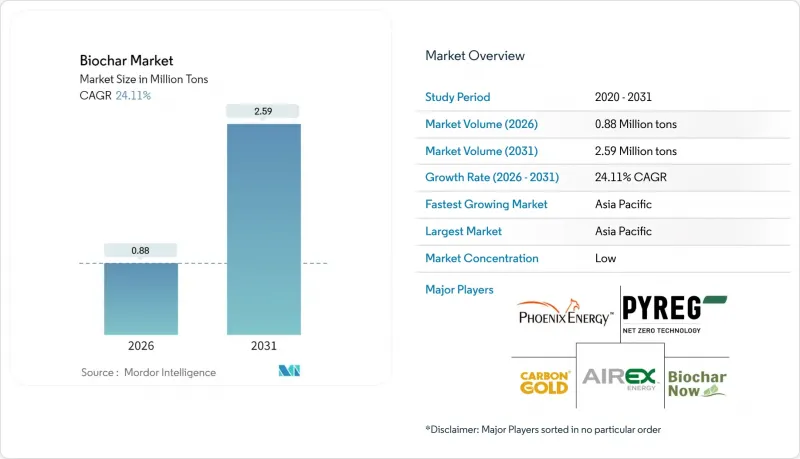
바이오차 시장 규모는 2026년에 88만 톤으로 추정되고, 2025년 71만 톤에서 성장하여 2031년에는 259만 톤에 달할 것으로 예측됩니다.
2026년부터 2031년까지 CAGR 24.11%로 확대될 것으로 예상됩니다.
급속한 규모 확대는 기후변화 대응 정책 지원, 네거티브 배출 기술에 대한 수요, 토양 건강 회복을 위한 농업에 대한 압력 증가와 밀접한 관련이 있습니다. 고가의 탄소배출권, 확대되는 산업 사용 사례, 단위 비용 절감 기술의 발전으로 수익원이 확대되고 있으며, 특히 명확한 탄소 제거 프로토콜이 있는 지역에서는 프로젝트 자금 조달 가능성이 향상되고 있습니다. 현재 아시아태평양은 바이오차 시장에서 약 40.26%의 점유율을 차지하고 있으며, 북미와 유럽연합의 강력한 정부 인센티브가 신규 생산능력 확대를 촉진하고 있습니다. 고가의 목질 바이오매스에서 농업 잔재물로 원료가 다양화되면서 수년간의 공급 제약이 완화되고 있습니다. 동시에 분산형 열분해 유닛의 도입으로 물류 거리가 단축되고, Scope 3 배출량이 감소하여 바이오탄의 기후변화 대책으로서의 신뢰성이 강화되고 있습니다.
세계 바이오차 시장 동향과 전망
유기농업, 재생 농업의 수요 증가
유기농 농가들은 프리미엄 인증에 필요한 높은 토양 유기탄소 점수를 추구하면서 합성자재를 바이오차로 대체하고 있습니다. 미국에서는 이미 20개 주에서 NRCS 토양 탄소 개정 808 표준을 시행하고 있으며, 검증된 바이오탄 적용에 대해 생산자에게 보조금을 지급하고 있습니다. 수확량 시험에서 첫해에 약 9%의 생산성 향상이 확인되었으며, 특히 양분이 부족한 토양에서는 6시즌 후 누적 20% 이상의 수확량 증가 효과가 나타났습니다. 미처리 바이오매스 유래 바이오탄은 미국 농무부(USDA) 인증 유기농 시스템에서 사용이 허용되고 있으며, 이러한 규제 완화는 주요 시장 장벽을 제거하여 프리미엄 가격 책정을 뒷받침하고 있습니다. 바이오 숯을 먼저 여과재나 가축 깔개로 활용하고, 나중에 밭에 다시 환원하는 캐스케이드 활용 개념은 수입원을 다양화하고 순환경제의 요구에 부합하는 것입니다. 투입재 가격이 계속 변동하는 가운데, 생산자들은 바이오탄을 안정적인 영양 공급과 장기적인 탄소배출권 확보를 위한 헤지 수단으로 인식하고 있습니다.
네거티브 탄소 소재 및 폐기물 가치화에 대한 정부 우대 조치
정책적 수단이 수요를 가속화하고 있습니다. 인플레이션 억제법은 섹션 45Q 및 45V의 세액공제를 확대하여 탄소 이용 경로를 포함시킴으로써 적격 바이오탄 시설이 IRS에 수명주기 분석을 제출한 후 현금화 가능한 인증서를 청구할 수 있도록 했습니다. 이와 병행하여, 유럽위원회의 탄소 제거 인증 프레임워크는 바이오탄 전용 정량화 규칙을 수립 중에 있으며, 이를 통해 영속성 증명이 표준화되어 기관투자자의 자본을 유치할 수 있을 것으로 기대됩니다. 워싱턴 주를 비롯한 미국 여러 주에서는 개정된 대기 정화법에 따라 화염식 킬른을 합법화하여 원료 수송 거리를 단축하는 분산형 생산 모델을 실현할 수 있게 되었습니다. 이러한 특혜는 컴플라이언스 리스크를 줄이고 부채상환비율을 개선하여 민간 투자자들의 대규모 프로젝트 참여를 촉진할 수 있습니다.
높은 생산 비용과 물류 비용
원료 조달, 전처리, 열분해 변환의 각 공정이 큰 비용 요인이 되기 때문에 단위당 경제성은 여전히 과제입니다. 학술적 비용 곡선에 따르면, 수분 함량, 공장 규모, 지역별 에너지 요금에 따라 완전 부하 생산 비용은 톤당 106-170달러로 추산됩니다. 부피 밀도가 낮기 때문에 40피트 컨테이너에 적재할 수 있는 바이오탄의 톤수는 합성 비료에 비해 훨씬 적고, 장거리 운송의 톤당 운임이 높아집니다. 생산자는 원료 공급처를 따라 이동식 열분해 장비를 도입하거나 물류 효율화를 위해 철도 연결 허브를 건설하는 방법을 선택하는데, 두 전략 모두 소규모 사업자가 자금 조달에 어려움을 겪을 정도로 자본 지출이 필요합니다. 자동화된 고처리량 플랜트가 보급되기 전까지는 규모의 경제 효과는 완만하게 나타날 것입니다.
부문 분석
저속 및 중속 열분해 시스템은 안정적인 처리 능력, 유연한 원료 대응 범위, 바이오 오일 및 합성 가스를 포함한 제품군으로 인해 2025년 기준 바이오차 시장의 44.72%를 차지했습니다. 이러한 특성으로 인해 사업자는 핵심인 바이오탄 판매 외에도 전력 및 열에너지 수익을 쌓을 수 있어 전체 프로젝트의 내부수익률(IRR) 향상에 기여하고 있습니다. 자본 집약적인 로터리 킬른 설계는 대규모 시설에서 주류를 이루는 반면, 소규모 레토르트 장비는 재생 농업을 목적으로 하는 농장 내 프로그램에 활용되고 있습니다. 연속 공급형 반응기의 보급 확대는 공정 제어의 개선을 촉진하고, 수율의 안정성 향상과 배출가스의 엄격한 관리를 실현합니다. 이를 통해 대기질에 민감한 지역에서의 허가 취득이 용이해졌습니다.
대체 공정이 주목받는 이유는 고가의 예비 건조 없이도 고수분 기판을 처리할 수 있다는 점입니다. 수열탄화는 180-260℃에서 작동하며, 하수 슬러지를 토양 개량재 및 에너지 용도에 적합한 탄소가 풍부한 하이드로차르로 전환합니다. 가스화 시스템은 낮은 찰 수율이 낮은 것, 열전병합발전 모듈과의 통합이 용이하며, 도시폐기물 관리자가 폐기물을 기저부하 전력과 찰 제품별로 변환할 수 있도록 합니다. 일본과 독일의 연구개발 컨소시엄에서는 마이크로파 보조 열분해의 파일럿 테스트를 진행하고 있습니다. 이는 에너지 효율 향상과 체류시간 단축을 약속하는 기술이며, 기존 열화학 처리법과의 비용 차이를 줄일 수 있는 가능성을 가지고 있습니다. 예측 기간 동안 이러한 신흥 시스템은 CAGR 24.63%로 확대될 것으로 예상되며, 열분해 기술의 우위를 점진적으로 약화시키면서 새로운 원료 클래스의 진입으로 전체 바이오차 시장 규모를 확대할 것으로 예상됩니다.
2025년, 신뢰할 수 있는 임업 잔류물, 균일한 입자 크기, 예측 가능한 탄소를 생성하는 화학 성분으로 인해 목재 바이오매스는 총량의 61.15%를 차지합니다. 브리티시컬럼비아주, 스칸디나비아 등 목재 자원이 풍부한 지역에서는 산불 위험 감소를 위한 간벌 프로그램을 시행하고 있으며, 바이오차 플랜트가 다년 계약으로 확보할 수 있는 저부가가치 잔재물을 지속적으로 공급받고 있습니다. 침엽수 유래 분획에는 리그닌 함량이 높아 고정 탄소율 향상에 기여합니다. 이 지표는 탄소배출권 감사기관이 영속성 계산에서 중요하게 여기는 지표입니다.
옥수수 줄기, 잎, 껍질, 사탕수수박의 상업적 공급 계약에 진입함에 따라 경쟁 구도가 변화하고 있습니다. 이동식 열분해-건조 장치는 고비용의 포장 운송을 피하고, 발생지에서 벌크 잔류물을 전환하는 물류적 타당성을 입증했습니다. 폐기물 소각 금지와 매립세 등으로 경제성이 부가가치화로 기울고 있는 가운데, 농업잔재물은 2031년까지 CAGR 25.05%로 확대될 것으로 예측됩니다. 하수 슬러지와 가축 분뇨는 영양이 풍부한 최종 제품을 제공하지만, 유럽 비료 규정에 따라 더 엄격한 오염 물질 기준을 충족해야 합니다. 브라질과 인도의 대도시 지역에서는 폐수처리, 재생에너지, 바이오차크 크레딧 판매를 결합한 민관협력을 모색하고 있으며, 바이오차크 시장 전체에서 원료 포트폴리오의 확장을 시사하고 있습니다.
바이오차 시장 보고서는 기술별(열분해, 가스화 시스템 등), 원료별(목재 바이오매스, 농업 잔재 등), 형태별(분말, 펠릿/과립, 액체 현탁액 등), 용도별(농업, 축산 등), 지역별(아시아태평양, 북미, 유럽, 남미, 중동 및 아프리카)로 분류됩니다. 시장 예측은 톤 단위로 제공됩니다.
지역별 분석
아시아태평양은 풍부한 바이오매스 자원 기반, 새로운 탄소 제거 목표, 그리고 공공 R&D 자금의 확충을 배경으로 2025년 세계 출하량의 39.88%를 차지했습니다. 중국에서만 연간 200편 이상의 바이오탄 관련 논문을 발표하여 반응기 설계, 농학 시험, 탄소배출권 프로토콜 개발의 선도적 위치를 뒷받침하고 있습니다. 지방정부의 보조금 지원으로 농촌 지역의 열분해 장비의 자본 비용이 절감되어 소규모 지자체에서도 작물 잔류물을 국가 토양 복원 목표를 충족하는 제품으로 전환할 수 있게 되었습니다.
북미는 생산량에서는 2위이지만, 상업적 탄소배출권 거래에서는 1위입니다. 마이크로소프트의 태평양 북서부 시설에서 95,000 tCO2e의 다년간 조달 계약과 같이 높은 관심을 받고 있는 기업 판매 계약은 예측 가능한 수익 기반을 제공하고 부채 조달의 위험을 줄여줍니다. 생산 세액 공제부터 미국 농무부의 비용 분담 보조금에 이르기까지 연방 정부의 혜택은 공장 단위의 투자를 더욱 촉진하고 있습니다. 성숙한 규제 프레임워크가 도입을 가속화하는 한편, 성장률은 신흥 아시아 지역에 비해 완만할 것으로 예상됩니다. 이는 선행 기업들이 이미 쉽게 구할 수 있는 원재료의 대부분을 확보했기 때문입니다.
유럽에서는 품질 기준과 정책 일관성을 중심으로 클러스터화가 진행되고 있습니다. EU의 탄소배출권 검증 규정(중)은 회원국의 조사 방법의 조정을 촉진하고, 배출권 거래를 용이하게 할 것입니다. 엄격한 국내 넷제로 기한에 직면한 스칸디나비아 국가에서는 폐목재를 열분해하여 열에너지와 고탄소 바이오탄을 공급하는 지역 난방 연계 시범운영이 진행되고 있습니다. 반면, 라틴아메리카와 사하라 이남 아프리카는 풍부한 농업 잔여물을 바탕으로 장기적인 성장 여력이 있지만, 자금 조달과 인프라 구축이 늦어지고 있습니다. 개발금융기관들은 이러한 프론티어 시장을 개척할 수 있는 혼합자본펀드를 시범운영하고 있으며, 2028년 이후 세계 바이오차 시장에 상당한 증분톤수를 추가할 가능성이 있습니다.
기타 특전:
- 엑셀 형식의 시장 예측(ME) 시트
- 애널리스트의 3개월 지원
자주 묻는 질문
목차
제1장 소개
제2장 조사 방법
제3장 주요 요약
제4장 시장 구도
제5장 시장 규모와 성장 예측
제6장 경쟁 구도
제7장 시장 기회와 향후 전망
KSM 26.03.09Biochar market size in 2026 is estimated at 0.88 Million tons, growing from 2025 value of 0.71 Million tons with 2031 projections showing 2.59 Million tons, growing at 24.11% CAGR over 2026-2031.
Rapid scale-up is tied to supportive climate policies, the need for negative-emission technologies, and mounting pressure on agriculture to restore soil health. Premium carbon-credit pricing, a widening set of industrial use-cases, and technology advances that cut unit costs are expanding revenue streams and improving project bankability, especially in regions with clear carbon-removal protocols. Asia-Pacific leads today's biochar market with an estimated 40.26% volume share, while robust government incentives in North America and the European Union encourage new capacity additions. Feedstock diversification away from high-cost woody biomass toward agricultural residues is easing long-standing supply constraints. At the same time, distributed pyrolysis units are shrinking logistics distances and lowering scope-3 emissions, reinforcing biochar's climate credentials.
Global Biochar Market Trends and Insights
Rising Demand from Organic and Regenerative Farming
Organic farmers are replacing synthetic inputs with biochar as they chase higher soil-organic-carbon scores required for premium certification. Twenty US states have already activated the NRCS Soil Carbon Amendment 808 standard, which reimburses growers for verified biochar applications. Yield trials show first-year productivity gains near 9% and cumulative boosts that exceed 20% after six seasons, especially in nutrient-poor soils. Biochar qualifies for use in USDA-certified organic systems when sourced from untreated biomass, a rule that removes a major market barrier and supports premium pricing. The cascading-use concept-deploying biochar first in filtration or livestock bedding and later reincorporating it into fields-multiplies income streams and aligns with circular-economy mandates. As input prices remain volatile, growers view biochar as a hedge that locks in stable nutrient supply and long-term carbon credits.
Government Incentives for Negative-Carbon Materials and Waste Valorization
Policy levers are accelerating demand. The Inflation Reduction Act broadened Section 45Q and 45V tax credits to include carbon-utilisation pathways, letting qualified biochar facilities claim monetisable certificates once lifecycle analyses are filed with the IRS. In parallel, the European Commission's Carbon Removal Certification Framework is drafting biochar-specific quantification rules that should standardise permanence proofs and attract institutional capital. Several US states, notably Washington, have legalised flame-cap kilns under updated clean-air codes, clearing the way for distributed production models that shorten feedstock haulage. These incentives lower compliance risk and improve debt-service coverage ratios, nudging private investors toward large-scale projects.
High Production and Logistics Costs
Unit economics remain challenging because feedstock, preprocessing, and thermal conversion each add sizeable cost blocks. Academic cost curves place fully-loaded production between USD 106 and USD 170 per ton depending on moisture content, plant scale, and regional energy tariffs. Low bulk density means a 40-foot container carries far fewer tonnes of biochar than of synthetic fertiliser, inflating per-tonne freight costs on long-haul routes. Producers either adopt mobile pyrolysis units that follow feedstock sources or build rail-linked hubs to capture logistics efficiencies, yet both strategies demand capital outlays that small operators struggle to finance. Until automated, high-throughput plants gain traction, scale economies will arrive slowly.
Other drivers and restraints analyzed in the detailed report include:
- Carbon-Credit Monetisation for Soil Sequestration Projects
- Expanding Horticulture and Greenhouse Adoption
- Availability of Low-Cost Substitutes
For complete list of drivers and restraints, kindly check the Table Of Contents.
Segment Analysis
Slow and intermediate pyrolysis systems held 44.72% of biochar market share in 2025 thanks to reliable throughput, flexible feedstock windows, and a coproduct slate that includes bio-oil and syngas. These attributes let operators layer electricity or heat revenue onto core biochar sales, raising overall project internal-rate-of-return figures. Capital-intensive rotary-kiln designs dominate high-volume installations, while smaller retort units serve on-farm programmes that target regenerative agriculture. The wider diffusion of continuous-feed reactors has triggered process-control improvements, enabling better yield consistency and tighter emissions control, an aspect that simplifies permitting in air-quality-sensitive regions.
Alternative routes are gaining mindshare because they process high-moisture substrates without costly pre-drying. Hydrothermal carbonisation runs at 180-260 °C and converts sewage sludge into carbon-rich hydrochar suitable for soil amendment or energy applications. Gasification systems, though producing lower char yields, integrate readily with combined-heat-and-power modules, allowing municipal waste managers to transform refuse into baseload electricity and char by-products. R&D consortia in Japan and Germany are piloting microwave-assisted pyrolysis that promises higher energy efficiency and reduced residence times, innovations that could narrow cost gaps against incumbent thermochemical options. Over the forecast window, these emerging systems are anticipated to grow at a 24.63% CAGR, gradually diluting pyrolysis dominance yet collectively lifting the biochar market size as new feedstock classes come online.
Woody biomass provided 61.15% of total volume in 2025 due to reliable forestry residues, uniform particle sizes, and chemical compositions that yield predictable char quality. Timber-rich geographies such as British Columbia and Scandinavia run dedicated thinning programmes to mitigate wildfire risk, generating a continuous stream of low-value residues that biochar plants can secure on multi-year contracts. High lignin content in conifer fractions also enhances fixed-carbon percentages, a metric prized by carbon-credit auditors for permanence calculations.
The competitive landscape is shifting as corn stover, rice husks, and sugarcane bagasse enter commercial supply agreements. Mobile torrefaction and pyrolysis rigs have demonstrated the logistical viability of converting loose residues where they are generated, bypassing costly bale transport. Agricultural residues are forecast to expand at 25.05% CAGR to 2031, helped by waste-burn bans and landfill taxes that tilt economics toward valorisation. Sewage sludge and animal manure offer nutrient-enriched end-products but must clear tighter contaminant hurdles under European fertiliser regulations. Large urban centres in Brazil and India are exploring public-private partnerships that marry wastewater treatment, renewable power, and biochar credit sales, pointing to an eventual broadening of feedstock portfolios across the biochar market.
The Biochar Market Report is Segmented by Technology (Pyrolysis, Gasification Systems, and More), Feedstock (Woody Biomass, Agricultural Residues, and More), Form (Powder, Pellets/Granules, and Liquid Suspension), Application (Agriculture, Animal Farming, and More), and Geography (Asia-Pacific, North America, Europe, South America, and Middle East and Africa). The Market Forecasts are Provided in Terms of Volume (Tons).
Geography Analysis
Asia-Pacific captured 39.88% of global shipments in 2025, reflecting an abundant biomass resource base, emerging carbon-removal targets, and generous public R&D funding. China alone publishes over 200 peer-reviewed biochar papers each year, underpinning its leadership in reactor design, agronomic testing, and carbon-credit protocol development. Provincial subsidies lower the capital cost of rural pyrolysis units, enabling small municipalities to turn crop residues into products that meet national soil-restoration goals.
North America ranks second in volume but leads in commercial carbon-credit transactions. High-profile corporate offtake agreements, including Microsoft's multi-year procurement of 95,000 tCO2e from Pacific-Northwest facilities, provide predictable revenue tails that derisk debt financing. Federal incentives-ranging from production tax credits to USDA cost-share grants-further catalyse plant-level investment. Although the region's mature regulatory framework accelerates deployment, growth rates will moderate compared with emerging Asia because early movers have already secured a large share of easily accessible feedstocks.
Europe clusters around quality standards and policy alignment. Draft EU rules governing carbon-removal verification encourage member states to harmonise methodologies, facilitating cross-border trade in removal credits. Scandinavian countries, confronted with stringent national net-zero deadlines, are testing district-heating link-ups where waste-wood pyrolysis supplies both thermal energy and high-carbon biochar. Meanwhile, Latin America and Sub-Saharan Africa present long-term upside tied to abundant agricultural residues yet lag on financing and infrastructure. Development-finance institutions are piloting blended-capital funds that could unlock these frontier markets, potentially adding significant incremental tonnage to the global biochar market after 2028.
- Airex Energy
- Applied Carbon
- Arsta Eco
- Biochar Now LLC
- BIOSORRA
- Black Owl Biochar.
- Carbofex Ltd.
- Carbon Gold Ltd
- CharGrow
- Karr Group
- Myno Carbon
- Pacific Biochar Benefit Corporation
- Phoenix Energy
- Pyreg GmbH
- Standard Bio AS
- Swiss Biochar GmbH
- Wakefield Biochar
- Wonjin Group
Additional Benefits:
- The market estimate (ME) sheet in Excel format
- 3 months of analyst support
TABLE OF CONTENTS
1 Introduction
- 1.1 Study Assumptions and Market Definition
- 1.2 Scope of the Study
2 Research Methodology
3 Executive Summary
4 Market Landscape
- 4.1 Market Overview
- 4.2 Market Drivers
- 4.2.1 Rising Demand from Organic and Regenerative Farming
- 4.2.2 Government Incentives for Negative-Carbon Materials and Waste Valorization
- 4.2.3 Carbon-Credit Monetisation for Soil Sequestration Projects
- 4.2.4 Expanding Horticulture and Greenhouse Adoption
- 4.2.5 Biochar-Enhanced Asphalt and Concrete for Green Construction
- 4.3 Market Restraints
- 4.3.1 High Production and Logistics Costs
- 4.3.2 Availability of Low-Cost Substitutes
- 4.3.3 Regulatory Ambiguity on Fertiliser Registration
- 4.4 Value Chain Analysis
- 4.5 Porter's Five Forces
- 4.5.1 Bargaining Power of Suppliers
- 4.5.2 Bargaining Power of Buyers
- 4.5.3 Threat of New Entrants
- 4.5.4 Threat of Substitutes
- 4.5.5 Degree of Competition
5 Market Size and Growth Forecasts (Volume)
- 5.1 By Technology
- 5.1.1 Pyrolysis
- 5.1.2 Gasification Systems
- 5.1.3 Other Technologies (Hydrothermal Carbonization)
- 5.2 By Feedstock
- 5.2.1 Woody Biomass
- 5.2.2 Agricultural Residues
- 5.2.3 Animal Manure
- 5.2.4 Sewage Sludge and Organic Waste
- 5.3 By Form
- 5.3.1 Powder
- 5.3.2 Pellets/Granules
- 5.3.3 Liquid Suspension
- 5.4 By Application
- 5.4.1 Agriculture
- 5.4.2 Animal Farming
- 5.4.3 Industrial Uses
- 5.4.4 Other Applications (Construction Materials, Energy, etc.)
- 5.5 By Geography
- 5.5.1 Asia-Pacific
- 5.5.1.1 China
- 5.5.1.2 Japan
- 5.5.1.3 India
- 5.5.1.4 South Korea
- 5.5.1.5 ASEAN Countries
- 5.5.1.6 Rest of Asia-Pacific
- 5.5.2 North America
- 5.5.2.1 United States
- 5.5.2.2 Canada
- 5.5.2.3 Mexico
- 5.5.3 Europe
- 5.5.3.1 Germany
- 5.5.3.2 United Kingdom
- 5.5.3.3 France
- 5.5.3.4 Italy
- 5.5.3.5 Spain
- 5.5.3.6 Russia
- 5.5.3.7 NORDIC Countries
- 5.5.3.8 Rest of Europe
- 5.5.4 South America
- 5.5.4.1 Brazil
- 5.5.4.2 Argentina
- 5.5.4.3 Rest of South America
- 5.5.5 Middle East and Africa
- 5.5.5.1 Saudi Arabia
- 5.5.5.2 South Africa
- 5.5.5.3 Rest of Middle East and Africa
- 5.5.1 Asia-Pacific
6 Competitive Landscape
- 6.1 Market Concentration
- 6.2 Strategic Moves
- 6.3 Market Share(%)/Ranking Analysis
- 6.4 Company Profiles {(includes Global level Overview, Market level overview, Core Segments, Financials as available, Strategic Information, Market Rank/Share for key companies, Products and Services, and Recent Developments)}
- 6.4.1 Airex Energy
- 6.4.2 Applied Carbon
- 6.4.3 Arsta Eco
- 6.4.4 Biochar Now LLC
- 6.4.5 BIOSORRA
- 6.4.6 Black Owl Biochar.
- 6.4.7 Carbofex Ltd.
- 6.4.8 Carbon Gold Ltd
- 6.4.9 CharGrow
- 6.4.10 Karr Group
- 6.4.11 Myno Carbon
- 6.4.12 Pacific Biochar Benefit Corporation
- 6.4.13 Phoenix Energy
- 6.4.14 Pyreg GmbH
- 6.4.15 Standard Bio AS
- 6.4.16 Swiss Biochar GmbH
- 6.4.17 Wakefield Biochar
- 6.4.18 Wonjin Group
7 Market Opportunities and Future Outlook
- 7.1 White-space and Unmet-Need Assessment