
|
시장보고서
상품코드
1937346
미국의 세라믹 타일 : 시장 점유율 분석, 업계 동향과 통계, 성장 예측(2026-2031년)US Ceramic Tiles - Market Share Analysis, Industry Trends & Statistics, Growth Forecasts (2026 - 2031) |
||||||
 Mordor Intelligence
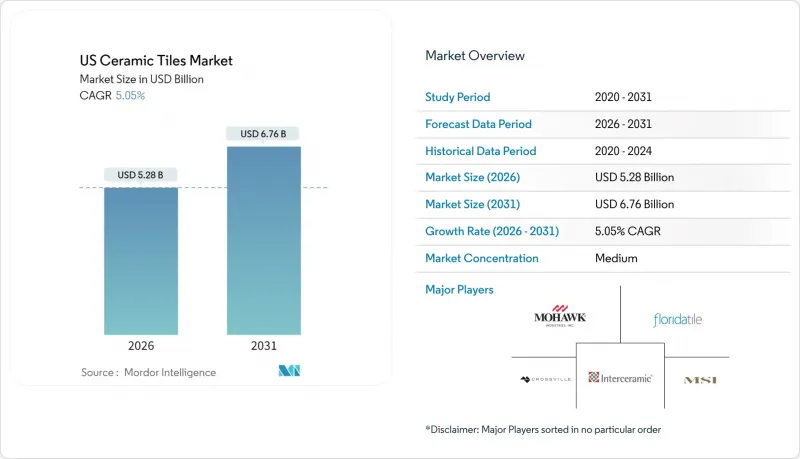
미국 세라믹 타일 시장은 2025년 50억 3,000만 달러에서 2026년에는 52억 8,000만 달러로 성장할 것으로 예상되며, 2026년부터 2031년까지 CAGR 5.05%를 기록하며 2031년까지 67억 6,000만 달러에 달할 것으로 예측됩니다.
주택 리모델링 수요 증가, 선벨트 지역의 꾸준한 주택 착공 건수, 저VOC 건축자재에 대한 규제 혜택이 이러한 확대를 뒷받침하고 있습니다. 국내 업체들은 반덤핑 관세로 인한 저가 수입품의 감소와 천연가스 가격 하락으로 소성비용이 억제되어 경쟁력 있는 국내 생산이 뒷받침되면서 점유율을 확대하고 있습니다. 디지털 인쇄 기술, 대형 도자기질 슬래브, 바닥 난방 대응 설계의 보급으로 사용 가능성과 평균 판매가격이 확대되고 있습니다. 한편, 숙련된 시공자 인력 부족과 리지드 코어 LVT(라미네이트 비닐 타일)와의 경쟁 심화가 절대적인 물량 성장을 억제하고 있습니다.
미국 세라믹 타일 시장 동향 및 분석
선벨트 주 주택 착공 건수 호조세
선벨트 지역의 건설 수요는 다른 지역이 둔화되는 가운데서도 계속 수요를 지탱하고 있으며, 플로리다주의 건설자재 매출은 2024년 9억 9,760만 달러에 달할 것으로 예상됩니다. 양호한 기후, 인구 유입, 기업 지원 정책으로 건축 허가 건수는 비교적 안정적이며, 타일 제조업체의 예측 가능한 수주를 뒷받침하고 있습니다. 제조업체들은 이러한 수요가 많은 지역을 중심으로 물류 네트워크를 최적화하여 운송 비용과 납기를 단축하고 있습니다. 고온 기후에서의 에너지 절약 기준은 세라믹의 축열 효과를 평가하고 건축가의 사양 선택을 촉진하고 있습니다. 내습성과 내구성을 갖춘 타일의 매력은 지속적인 기후 적응 투자로 인해 더욱 높아졌습니다.
대형 도자기질 슬래브 채용 확대
이음새가 없는 표면에 대한 건축적 선호가 이음새와 시공 시간을 줄여주는 6mm 및 12mm 도자기 패널의 보급을 가속화하고 있습니다. 루이빌타일이 2025년 출시한 6mm 패널은 프리컷 사양이 시공자 부족을 해결하면서 프리미엄 가격을 실현한 좋은 예입니다. 달토일이 KBIS 2025에서 선보인 초대형 슬래브 '원쿼츠(ONE Quartz)'는 반복적인 패턴 없이 대리석의 미학을 유동인구가 많은 지역까지 확장한 제품입니다. 디지털 잉크젯 기술의 발전으로 매크로 표면에 사진처럼 사실적인 줄무늬를 재현할 수 있게 되어 기존의 정사각형 타일과 차별화를 꾀하고 있습니다. 자본집약적인 슬래브가마와 연마라인은 진입장벽이 되어 규모의 우위를 가진 기존 기업이 유리합니다. 이 형식은 의료, 호텔, 고급 주택 프로젝트의 위생 트렌드와도 부합합니다.
천연가스 가격 변동으로 가마 비용 증가
에너지 비용은 도자기 생산 예산의 약 30%를 차지하며, 그 중 90%를 천연가스가 공급하고 있습니다. 2024년 MMBtu당 2.21달러로 바닥을 찍은 후, EIA는 2026년까지 4달러 이상 상승할 것으로 전망하고 있어 가마산업 사업자들에게 압박 요인으로 작용하고 있습니다. 대형 그룹은 다년 계약이나 코제너레이션을 통한 헤지로 리스크를 줄이고 있지만, 중소규모의 독립 사업자들은 수익률 압박과 가격 전가에 직면해 있습니다. 에너지 가격의 변동은 석탄가마를 보유한 지역의 수입품과의 가격 경쟁력도 재조정하여 경쟁력 있는 가격 책정을 복잡하게 만들고 있습니다. 전기 가마에 대한 투자는 장기적인 안정성을 제공하지만, 많은 자본과 전력망 업그레이드가 필요하기 때문에 보급에 시간이 걸립니다.
부문 분석
2025년 현재, 도자기 타일은 미국 세라믹 타일 시장 점유율의 55.12%를 차지하고 있습니다. 이는 낮은 수분 흡수율과 실내외 연속성에 대한 적합성을 반영한 결과입니다. 첨단 잉크젯 인쇄 기술을 통해 깊은 줄무늬, 콘크리트 질감, 섬유 질감 등을 재현할 수 있어 기존의 디자인 제약이 사라졌습니다. 제조사들은 2cm 두께의 포장용 타일과 6mm 두께의 박형 패널로 개발을 진행하고 있으며, 통기성 외벽재에서 가구 상판까지 용도를 확장하고 있습니다. 유약 도자기는 여전히 가격 대비 성능이 중요시되는 상황에서 여전히 유효하며, 가치 중심의 소매 제품군을 뒷받침하고 있습니다. 무광택 쿼리타일은 마찰계수 0.8 이상의 성능이 요구되는 상업용 주방에 적합합니다. 모자이크와 핸드메이드 형식은 주문 제작 틈새 시장을 차지하고 있으며, 평방피트당 평균 가격의 몇 배에 달하는 가격이 책정되는 경우가 많습니다. 재활용 유리 프릿과 폐열회수를 통한 탄소배출량 감소로 카테고리 전반에 걸쳐 지속가능성 인증이 강화되고 있습니다. 이러한 조합은 혁신이 미국 세라믹 타일 시장에서 주류와 전문 수요를 동시에 충족시킬 수 있다는 것을 보여줍니다.
유럽식 컨티뉴어 플러스 프레스에 대한 투자로 1.6m×3.2m 슬래브를 포함한 무한한 도자기 사이즈가 가능하며, 3번의 가공으로 조리대용 블랭크로 절단할 수 있습니다. 이 라인은 노동력을 줄이면서 생산량과 수율을 향상시켜 범용 타일이 가격 압박에 직면한 상황에서도 수익률의 안정성을 유지할 수 있도록 도와줍니다. 제조업체들은 독자적인 유약을 활용하여 항균, 미끄럼 방지 또는 태양 반사 표면을 구현함으로써 의료, 교통, 외장재 사양에 진입할 수 있는 기회를 창출하고 있습니다. 국내 생산능력의 확대는 공급망 단축과 적시 보충을 보장함으로써 미국 세라믹 타일 시장을 향후 관세 충격으로부터 보호할 수 있습니다. 지속적인 기술 혁신을 통해 도자기질 타일은 성장 동력이자 대체 바닥재에 대한 경쟁 우위를 구축해 나가고 있습니다.
바닥재 용도는 2025년 기준 미국 세라믹 타일 시장 규모의 68.05%를 차지하며, 욕실, 주방, 교통량이 많은 상업용 통로에 뿌리를 두고 있습니다. 내하중 성능, 내오염성, 영구 마모 보증은 시설 관리자의 우선순위에 부합합니다. 다층 주택 프로젝트에서는 내하중 제한 완화로 인해 대형 도자기 패널의 채택이 증가하여 소유자의 접합부 유지보수 부담을 경감시키고 있습니다. 한편, 벽면 클래딩은 5.36%의 가장 빠른 CAGR을 기록했으며, 통일감을 위해 동일한 석재풍의 디자인을 수직으로 전개하는 트렌드가 주도하고 있습니다. 소매점에서는 방화 기준을 충족시키면서 고급스러운 브랜드 이미지를 전달하기 위해 타일을 사용한 액센트 월을 채택하고 있습니다. 의료시설의 복도에는 강력한 화학 세정을 견딜 수 있는 타일로 된 허리 벽을 채택하고 있습니다. 지붕재는 틈새시장이지만 단열과 방수 성능을 원하는 지중해풍 고급 주택에서 수요가 확대되고 있습니다. 이러한 추세는 미국 세라믹 타일 시장이 모든 표면의 미적, 기능적, 규제적 요구에 유연하게 대응하고 있음을 보여줍니다.
고접착성, 저 VOC 매스틱의 발전으로 경화시간이 단축되어 개보수 공사기간 단축에 대응하는 벽면 시공이 가능해졌습니다. 기계식 클립 시스템을 통해 20mm의 통기성 외벽을 개보수 공사에서도 실현할 수 있어 건축 외피의 에너지 부하를 크게 줄일 수 있습니다. 각 제조사들은 트림, 문턱, 둥근 테두리 옵션을 갖춘 샘플 라이브러리를 제공하여 전체 공간의 사양 결정을 용이하게 합니다. 마케팅에서는 평면 전체에 통일된 소재가 시각적으로 어수선함을 줄이고 향후 보수 시 차이를 줄일 수 있다는 점을 강조하고 있습니다. 소비자들이 벽면을 자기표현의 캔버스로 인식하면서 메탈릭, 패브릭, 기하학적 엠보싱 타일의 점유율이 확대되고 있습니다. 이러한 추세는 바닥용 타일의 판매량이 안정적으로 유지되는 가운데, 미국 세라믹 타일 시장 전체에서 벽용 부문의 성장을 견인하고 있습니다.
기타 특전:
- 엑셀 형식의 시장 예측(ME) 시트
- 애널리스트 지원(3개월)
자주 묻는 질문
목차
제1장 소개
제2장 조사 방법
제3장 주요 요약
제4장 시장 구도
제5장 시장 규모와 성장 예측(금액 : 달러)
제6장 경쟁 구도
제7장 시장 기회와 향후 전망
KSM 26.03.05The United States ceramic tiles market is expected to grow from USD 5.03 billion in 2025 to USD 5.28 billion in 2026 and is forecast to reach USD 6.76 billion by 2031 at 5.05% CAGR over 2026-2031.
Strong residential remodeling demand, steady Sun Belt housing starts, and regulatory preferences for low-VOC building materials underpin this expansion. Domestic producers are gaining ground as antidumping duties reduce low-priced imports, while favorable natural-gas prices lower firing costs and support competitive local manufacturing . Digital printing, large-format porcelain slabs, and radiant-floor compatible designs are widening application potential and average selling prices. At the same time, labor shortages in qualified installers and intensifying competition from rigid-core LVT restrain absolute volume growth.
US Ceramic Tiles Market Trends and Insights
Resilient Housing Starts in Sun Belt States
Sun Belt construction continues to anchor demand even as other regions cool, with Florida's construction materials revenue reaching USD 997.6 million in 2024. Favorable climate, population inflows, and pro-business policies keep building permits comparatively stable, supporting predictable orders for tile producers. Manufacturers optimize logistics networks around these high-volume corridors, trimming freight costs and delivery lead times. Energy-efficient codes in hot climates reward the thermal-mass benefits of ceramic, nudging architects toward specification. Ongoing climate-adaptation investments further elevate tile's appeal because of its moisture resistance and durability.
Growing Adoption of Large-Format Porcelain Slabs
Architectural preference for seamless surfaces is accelerating 6 mm and 12 mm porcelain panels, which reduce grout lines and installation time. Louisville Tile's 6 mm panels launched in 2025 demonstrate how pre-cut formats address installer scarcity while commanding premium pricing. Daltile's ONE Quartz extra-large slabs unveiled at KBIS 2025 extend marble aesthetics into high-traffic zones without repeat patterns. Digital inkjet advances generate photorealistic veining on macro surfaces, differentiating from conventional squares. Capital-intensive slab kilns and polishing lines act as entry barriers, favoring incumbents with scale advantages. The format also aligns with hygiene trends in healthcare, hospitality, and luxury residential projects.
Volatile Natural-Gas Prices Inflating Kiln Costs
Energy constitutes roughly 30% of porcelain production budgets, and natural gas supplies 90% of that load. After bottoming at USD 2.21 per MMBtu in 2024, EIA projects prices will climb past USD 4.00 by 2026, pressuring kiln operators. Larger groups hedge exposure through multiyear contracts and co-generation, but smaller independents face squeezed margins or pass-through price hikes. Energy volatility also resets parity against imports from regions with coal-fired kilns, complicating competitive pricing. Investments in electric kilns offer long-run stability yet require substantial capital and grid upgrades, delaying widespread adoption.
Other drivers and restraints analyzed in the detailed report include:
- Energy-Efficient Radiant-Heated Flooring Demand
- Post-Covid Commercial Renovation Wave
- Labor Shortages in Qualified Tile Installers
For complete list of drivers and restraints, kindly check the Table Of Contents.
Segment Analysis
Porcelain holds 55.12% of United States ceramic tiles market share as of 2025, reflecting its low water-absorption rating and suitability for indoor-outdoor continuity. Advanced inkjet printing now renders deep veining, concrete patina, and textile textures, erasing historical design constraints. Manufacturers expand into 2 cm thick pavers and 6 mm thin panels, broadening end-uses from ventilated facades to furniture tops. Glazed ceramic remains relevant where cost sensitivity outweighs performance, sustaining value-oriented retail assortments. Unglazed quarry tiles cater to commercial kitchens that require coefficient-of-friction ratings exceeding 0.8. Mosaic and handmade formats occupy bespoke niches, often commanding multiples of average price per square foot. Sustainability credentials strengthen across categories as recycled glass frit and waste-heat recovery lower embodied carbon. Collectively, the mix illustrates how innovation allows the United States ceramic tiles market to serve mainstream and specialist demand simultaneously.
Investment in European-style Continua+ presses enables endless porcelain sizes, including 1.6 m-by-3.2 m slabs that cut to countertop blanks in three passes. These lines boost throughput and yield while reducing labor, supporting margin resilience even as commodity squares face price compression. Producers leverage proprietary glazes to deliver antimicrobial, anti-slip, or solar-reflective surfaces that open doors to healthcare, transportation, and exterior cladding specifications. Domestic capacity expansion also shields the United States ceramic tiles market from future tariff shocks by shortening supply chains and ensuring just-in-time replenishment. Continuous technological improvements position porcelain as both the growth engine and the competitive moat against substitute floorings.
Floor layouts account for 68.05% of United States ceramic tiles market size in 2025, rooted in bathrooms, kitchens, and high-traffic commercial corridors. Heavy-duty ratings, stain resistance, and lifetime wear warranties align with facility manager priorities. In multistory residential projects, dead-load limits increasingly permit large porcelain panels, reducing grout maintenance for owners. Conversely, wall cladding registers the fastest CAGR at 5.36%, propelled by design trends that run identical stone looks vertically for cohesion. Retail stores embrace tile feature walls to convey premium branding while meeting fire-code requirements. Health-care corridors adopt tiled wainscoting to survive aggressive chemical cleaning. Roofing, though niche, grows in Mediterranean-style luxury builds seeking thermal insulation and rain-shedding performance. These dynamics show the United States ceramic tiles market flexibly adapting to aesthetic, functional, and regulatory needs across surfaces.
Advances in high-bond, low-VOC mastics shorten cure times, allowing accelerated wall installations that fit compressed renovation schedules. Mechanical clip systems make 20 mm ventilated facades viable even for retrofit, slashing building-envelope energy loads. Manufacturers pack sample libraries with matching trims, thresholds, and bullnose options to encourage full-room specifications. Marketing emphasizes that uniform material across planes reduces visual clutter and future touch-up variance. As consumers view walls as canvases for personal expression, tile with metallic, fabric-inspired, or geometric relief finishes gains share. Collectively, these trends keep floor volume stable while elevating wall-segment growth within the broader United States ceramic tiles market.
The United States Ceramic Tiles Market Report is Segmented by Product Type (Porcelain Tiles, Glazed Ceramic Tiles and More), Application (Floor, Wall, Roofing), End-User (Residential, Commercial), Construction Type (New Construction, Renovation and Replacement), Distribution Channel (Specialty Stores and More), and Geography (Northeast, Midwest and More). The Market Forecasts are Provided in Terms of Value (USD).
List of Companies Covered in this Report:
- Mohawk Industries (Dal-Tile, Marazzi, American Olean)
- Florida Tile
- Crossville Inc.
- Interceramic USA
- MSI Surfaces
- Emser Tile
- Porcelanosa USA
- Roca Tile USA
- Bedrosians Tile & Stone
- Anatolia Tile + Stone
- Walker Zanger
- Artistic Tile
- American Wonder Porcelain
- Mariner USA
- Dal-Tile Mexico Imports
- StonePeak Ceramics
- LAUFEN Bathrooms (U.S.)
- Florim USA
- IWT Florida (Tesoro)
- Vitromex USA
Additional Benefits:
- The market estimate (ME) sheet in Excel format
- 3 months of analyst support
TABLE OF CONTENTS
1 Introduction
- 1.1 Study Assumptions & Market Definition
- 1.2 Scope of the Study
2 Research Methodology
3 Executive Summary
4 Market Landscape
- 4.1 Market Overview
- 4.2 Market Drivers
- 4.2.1 Resilient housing starts in Sun-Belt states
- 4.2.2 Growing adoption of large-format porcelain slabs
- 4.2.3 Energy-efficient radiant-heated flooring demand
- 4.2.4 Post-Covid commercial renovation wave
- 4.2.5 Indoor-air-quality regulations favoring low-VOC tiles
- 4.2.6 FEMA resilience grants for flood-resistant building materials
- 4.3 Market Restraints
- 4.3.1 Volatile natural-gas prices inflating kiln firing costs
- 4.3.2 Labor shortages in qualified tile installers
- 4.3.3 Competition from LVT/SPC rigid core flooring
- 4.3.4 PFAS litigation risk in certain glaze additives
- 4.4 Industry Value Chain Analysis
- 4.5 Porter's Five Forces Analysis
- 4.5.1 Threat of New Entrants
- 4.5.2 Bargaining Power of Suppliers
- 4.5.3 Bargaining Power of Buyers
- 4.5.4 Threat of Substitutes
- 4.5.5 Competitive Rivalry
- 4.6 Insights into the Latest Trends and Innovations in the Market
- 4.7 Insights on Recent Developments (New Product Launches, Strategic Initiatives, Investments, Partnerships, JVs, Expansion, M&As, etc.) in the Industry
5 Market Size & Growth Forecasts (Value in USD)
- 5.1 By Product Type
- 5.1.1 Porcelain Tiles
- 5.1.2 Glazed Ceramic Tiles
- 5.1.3 Unglazed Ceramic Tiles
- 5.1.4 Mosaic Tiles
- 5.1.5 Others (Decorative, Patterned, Handmade)
- 5.2 By Application
- 5.2.1 Floor
- 5.2.2 Wall
- 5.2.3 Roofing
- 5.3 By End-User
- 5.3.1 Residential
- 5.3.2 Commercial
- 5.3.2.1 Hospitality (Hotels, Resorts)
- 5.3.2.2 Retail Spaces
- 5.3.2.3 Offices & Institutions
- 5.3.2.4 Healthcare
- 5.3.2.5 Educational Facilities
- 5.3.2.6 Transport Hubs (Airports, Metro, Bus Terminals)
- 5.3.2.7 Other Commercial Users
- 5.4 By Construction Type
- 5.4.1 New Construction
- 5.4.2 Renovation and Replacement
- 5.5 By Distribution Channel
- 5.5.1 Specialty Tile & Stone Stores
- 5.5.2 Home Improvement & DIY Stores
- 5.5.3 Online Retail
- 5.5.4 Direct Sales to Contractors
- 5.6 By Geography
- 5.6.1 Northeast
- 5.6.2 Midwest
- 5.6.3 Southeast
- 5.6.4 Southwest
- 5.6.5 West
6 Competitive Landscape
- 6.1 Market Concentration
- 6.2 Strategic Moves
- 6.3 Market Share Analysis
- 6.4 Company Profiles (includes Global level Overview, Market level overview, Core Segments, Financials as available, Strategic Information, Market Rank/Share for key companies, Products & Services, and Recent Developments)
- 6.4.1 Mohawk Industries (Dal-Tile, Marazzi, American Olean)
- 6.4.2 Florida Tile
- 6.4.3 Crossville Inc.
- 6.4.4 Interceramic USA
- 6.4.5 MSI Surfaces
- 6.4.6 Emser Tile
- 6.4.7 Porcelanosa USA
- 6.4.8 Roca Tile USA
- 6.4.9 Bedrosians Tile & Stone
- 6.4.10 Anatolia Tile + Stone
- 6.4.11 Walker Zanger
- 6.4.12 Artistic Tile
- 6.4.13 American Wonder Porcelain
- 6.4.14 Mariner USA
- 6.4.15 Dal-Tile Mexico Imports
- 6.4.16 StonePeak Ceramics
- 6.4.17 LAUFEN Bathrooms (U.S.)
- 6.4.18 Florim USA
- 6.4.19 IWT Florida (Tesoro)
- 6.4.20 Vitromex USA
7 Market Opportunities & Future Outlook
- 7.1 AI-assisted design personalization portals
- 7.2 Carbon-neutral tile certifications & EPD labeling