
|
시장보고서
상품코드
1937347
보트 및 선박 정비, 수리, 점검(MRO) : 시장 점유율 분석, 업계 동향과 통계, 성장 예측(2026-2031년)Boat And Ship MRO - Market Share Analysis, Industry Trends & Statistics, Growth Forecasts (2026 - 2031) |
||||||
 Mordor Intelligence
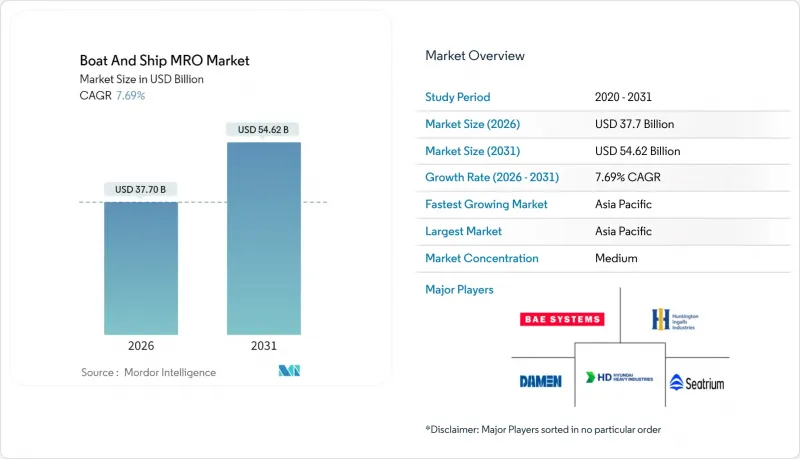
보트 및 선박 정비, 수리, 점검(MRO) 시장은 2025년 350억 1,000만 달러에서 2026년에는 377억 달러로 성장하여 2026년부터 2031년까지 CAGR 7.69%를 기록하며 2031년까지 546억 2,000만 달러에 달할 것으로 예측됩니다.
이러한 확장은 노후화된 세계 선단의 유지보수와 기존에는 임의적이었던 개보수 작업을 표준 유지보수 주기에 포함시켜야 하는 엄격한 환경 규제에 대응해야 하는 이중의 필요성에서 비롯되었습니다. 상업적 무역량 증가, 예지보전 도입, 국방 함대 현대화 등이 결합되어 보트 및 선박 MRO 시장의 성장 전망을 견인하고 있습니다. 독립 조선소는 비용 측면에서 유연성을 활용하는 반면, OEM 관련 시설은 디지털 진단 기술 및 대체 연료에 대한 전문 지식을 도입하여 경쟁적 입지를 재구축하고 있습니다. 지역별 수요는 중국의 생산능력 확대와 일본의 기술 업그레이드에 힘입어 아시아태평양에 편중되어 있습니다. 그러나 북미와 유럽 사업자들은 온실가스 규제에 대응하기 위해 고부가가치 개보수 프로젝트를 추진하고 있어 전 세계적으로 균형 잡힌 기회 환경이 유지되고 있습니다.
세계 보트 및 선박 유지보수, 수리 및 점검(MRO) 시장 동향 및 인사이트
국제해사기구(IMO)의 환경 규제 강화
해양환경보호위원회(MEPC)가 2030년까지 배출량 20% 감축 목표를 설정함에 따라 전 세계적으로 개보수 수요가 발생하고 있습니다[1]. 기존 선박 에너지 효율 지수(EEISI)에 따라 엔진 조정, 선체 재설계, 대체 연료의 통합이 의무화되어 있습니다. 동시에 FuelEU Maritime은 CO2 초과 배출량 1톤당 2,400유로(2,640달러)의 벌금을 부과하기 때문에 암모니아나 수소를 연료로 하는 추진 장치로의 전환에 자본이 집중되는 경제적 긴급성이 생겨나고 있습니다.
노후화되는 세계 선박 선단
상선대의 평균 선령이 22.1년으로 증가함에 따라 정기적인 유지보수, 수리, 정비(MRO)의 빈도와 비용이 증가하고 있습니다. 20년 이상 된 컨테이너선은 적재 중량 톤당 더 높은 유지비가 발생하며, 젊은 선박의 3.2배에 달하는 압류율에 직면해 있습니다. 이로 인해 운항사는 스케줄과 보험료율을 지키기 위한 예방적 작업을 해야 하는 상황에 처해 있습니다. 특히 벌크 화물선과 유조선은 선체의 건전성과 추진 시스템의 신뢰성이 안전 마진과 용선 수익성에 직접적인 영향을 미치기 때문에 위험에 노출되어 있습니다.
높은 자본 집약도 및 도크 용량 부족
2024년에는 전 세계 도크 가동률이 크게 상승하고, 유지보수 일정이 3.2주 연장되며, 프로젝트 비용이 증가합니다. 중형 부두와 초대형 부두 건설에 대한 수요가 높아 단기적으로 용량 부족을 해소하기 어렵습니다. 셈부코프 마린과 케펠의 통합은 규모의 경제가 자본 지출 부담 증가에 대응할 수 있는 방법을 보여줍니다.
부문 분석
2025년 상용 선박은 보트 및 선박 MRO 시장의 62.64%를 차지했습니다. 이는 높은 가동률과 18-24개월마다 풀 사이클 정비를 의무화하는 규제 요건을 반영합니다. 밸러스트 수처리 시스템, 스크러버 개조, 연료 전환은 도크 용량에 대한 지속적인 수요를 창출하고 있습니다. 해양지원선, 페리선, 조사선은 재생에너지 설비 확충과 심해 광물자원 탐사 등으로 CAGR 7.98%의 틈새시장을 형성하고 있습니다. 보트급 선박은 관광업 회복의 혜택을 받고 있지만, 주로 유리섬유 선체와 선외기 서비스에 의존하고 있습니다.
15년 이상 선박에 대한 IACS 검사 코드 개정으로 특히 벌크선 및 탱커에서 구조 평가의 빈도가 증가하고 있습니다. 500만-5,000만 달러 규모의 슈퍼요트 개조는 소유주들이 고급스러운 인테리어와 탈탄소 추진 시스템을 원하기 때문에 전문적이면서도 수익성이 높은 분야로 계속 존재하고 있습니다.
2025년 상업 서비스는 무역 확대로 인해 보트 및 선박 MRO 시장의 61.58%를 차지했습니다. 한편, 국방 관련 업무는 사이버 보안, 센서, 무기 시스템 업그레이드 및 안전 시설 요구사항에 힘입어 2031년까지 9.21%로 성장할 것으로 예상됩니다. 민간 선박 수요는 지중해 및 카리브해 지역 조선소의 계절적 고급 요트 개조에 따른 수요와 연동됩니다.
32억 달러 규모의 콜롬비아급 잠수함 인프라 투자는 원자력 추진 시스템에 대한 확장된 자체 유지보수 프로토콜을 입증하고 있습니다. IoT 분석 기술을 통해 상업적 운항자는 항해 계획에 정비를 통합함으로써 다운타임을 최대 30%까지 줄일 수 있습니다.
지역별 분석
아시아태평양은 2025년 보트 및 선박 MRO 시장 점유율의 39.05%를 차지하며 2031년까지 CAGR 8.44%의 전망으로 선두를 달리고 있습니다. 중국은 2024년 세계 신조선 톤수에서 주요 점유율을 차지할 것이며, 유럽의 분석 플랫폼을 도입하는 파트너십을 통해 강화된 조선소 기반을 MRO로 이끌고 있습니다. 일본의 LNG 및 해군 전문 분야에서는 미쓰비시 중공업의 예측 시스템을 활용하여 운영 비용을 절감. 한편, 한화오션 등 국내 기업 그룹은 모듈식 건조를 통해 도크 시간을 단축하고 있습니다.
유럽은 프리미엄 서비스 거점으로서의 지위를 유지하고 있으며, 이탈리아와 스페인의 슈퍼요트 개조 클러스터를 보유하고 있습니다. 배출 규제 강화와 FuelEU Maritime의 시행으로 개보수 투자가 가속화되고 있습니다. 독일 엔지니어링 기업은 전 세계 개보수 프로토콜에 영향을 미치는 기술 표준을 수립하고, 튀르키예 이스탄불-안탈리아 회랑은 중저가 상업용 선박 및 요트 프로젝트가 밀집되어 있습니다.
북미는 해군 현대화와 존스 법의 보호에 의존하고 있습니다. 미국 해군의 정비 예산은 연안 조선소 네트워크를 지원하고, 캐나다의 북극해 항로는 내빙급 선박의 수리 수요를 창출하고 있습니다. 노동력 부족이 자동화 투자를 촉진하고 있으며, 제너럴 다이나믹스 NASSCO의 증강현실 검사 시스템 등이 그 예입니다. 중동의 자유무역지대 조선소는 세제 혜택으로 경쟁력을 높이고, 남미는 친환경 개조 보조금으로 연안 관광선을 겨냥하고, 아프리카는 신흥 해양 에너지 지원 선박이 현지 부두 개발을 촉진하는 등 다양한 추세를 볼 수 있습니다.
기타 특전:
- 엑셀 형식의 시장 예측(ME) 시트
- 애널리스트의 3개월 지원
자주 묻는 질문
목차
제1장 소개
제2장 조사 방법
제3장 주요 요약
제4장 시장 구도
제5장 시장 규모와 성장 예측(금액(달러))
제6장 경쟁 구도
제7장 시장 기회와 향후 전망
KSM 26.03.09The Boat & Ship MRO market is expected to grow from USD 35.01 billion in 2025 to USD 37.7 billion in 2026 and is forecast to reach USD 54.62 billion by 2031 at 7.69% CAGR over 2026-2031.
This expansion stems from the dual necessity of maintaining an aging global fleet and complying with stricter environmental mandates that pull previously optional retrofit work inside standard maintenance cycles . Greater commercial-trade volumes, predictive maintenance adoption, and defense fleet modernization collectively reinforce the Boat & Ship MRO market growth outlook. Independent yards leverage cost agility, while OEM-affiliated facilities introduce digital diagnostics and alternative-fuel expertise that reshape competitive positioning. Regional demand skews toward Asia-Pacific, driven by China's capacity expansion and Japan's technology upgrades, yet North American and European operators pursue high-value retrofit projects to meet greenhouse-gas rules, sustaining a balanced global opportunity landscape.
Global Boat And Ship MRO Market Trends and Insights
Stricter IMO Environmental Mandates
The Marine Environment Protection Committee's 20% emission-cut target for 2030 triggers retrofit demand worldwide [1]. The Energy Efficiency Existing Ship Index obliges engine tweaks, hull re-engineering, and alternative-fuel integrations. In parallel, FuelEU Maritime penalties of EUR 2,400 (USD 2,640) per ton of excess CO2 create economic urgency that funnels capital into propulsion conversions capable of running on ammonia or hydrogen .
Aging Global Vessel Fleet
The average merchant fleet age of 22.1 years increases routine MRO frequency and cost. Container ships older than 20 years incur higher maintenance spend per deadweight ton and face detention rates 3.2 times those of younger vessels, pushing operators toward preventative work that safeguards schedules and insurance rates. Bulk carriers and tankers are particularly exposed because hull integrity and propulsion reliability directly affect safety margins and charter viability.
High Capital Intensity and Dock-Capacity Scarcity
Global dry-dock utilization reached a significant share in 2024, stretching maintenance schedules by 3.2 weeks and inflating project costs. Building a mid-sized dock and ultra-large floating docks places high demands, limiting near-term capacity relief. The Sembcorp Marine-Keppel consolidation reveals how scale economies counter rising capex burdens .
Other drivers and restraints analyzed in the detailed report include:
- Growth in Commercial Marine Trade
- Naval Fleet Modernization Budget
- Marine-Fuel Price Volatility Limiting Budgets
For complete list of drivers and restraints, kindly check the Table Of Contents.
Segment Analysis
Commercial ships held 62.64% of the Boat & Ship MRO market in 2025, reflecting high utilization and regulatory obligations that require full-cycle maintenance every 18-24 months. Ballast-water systems, scrubber retrofits, and fuel conversions place continual demand on dock capacity. Offshore support vessels, ferries, and research craft contribute an 7.98% CAGR niche, enabled by renewable-energy build-outs and deep-sea mining exploration. Boat-class craft benefit from tourism rebound yet rely mostly on fiberglass-hull and outboard-engine service.
Upgraded IACS inspection codes for vessels older than 15 years elevate structural-assessment frequency, especially for bulkers and tankers. Superyacht refits ranging from USD 5-50 million remain a specialized but lucrative subset as owners seek luxury interiors and decarbonized propulsion.
Commercial services captured 61.58% of the Boat & Ship MRO market share in 2025 due to trade growth, whereas defense work grew at 9.21% through 2031, supported by cybersecurity, sensor, and weapon-system upgrades with secure-facility requirements. Private-vessel demand follows seasonal luxury-yacht refits in Mediterranean and Caribbean yards.
The USD 3.2 billion Columbia-class submarine infrastructure investment demonstrates scaled in-house maintenance protocols for nuclear propulsion. IoT analytics allow commercial operators to reduce downtime up to 30%, integrating maintenance within voyage planning.
The Boat & Ship MRO Market Report is Segmented by Vessel Type (Boat, Yacht, Commercial Vessels, and Other Types), Vessel Application (Private, Commercial, and Defense), MRO Type (Engine MRO, Component MRO, and More), Service Provider Type (Independent Yards, OEM-Affiliated MROs, and More), and Geography (North America, South America, Europe, and More). The Market Forecasts are Provided in Terms of Value (USD).
Geography Analysis
Asia-Pacific dominated with a 39.05% of the Boat & Ship MRO market share in 2025 and an 8.44% CAGR outlook toward 2031. China delivered a major share of global new-build tonnage in 2024 and funnels the same yard base toward MRO, reinforced by partnerships that import European analytics platforms. Japan's LNG and naval specialization leverages predictive systems from Mitsubishi Heavy Industries to trim operating costs, while South Korean groups such as Hanwha Ocean deploy modular construction to shorten dock time.
Europe remains a premium-service hub, hosting Italy's and Spain's super-yacht refit clusters. Tighter emissions rules and FuelEU Maritime enforcement accelerate retrofit spend. Germany's engineering houses craft technical standards that ripple through worldwide retrofit protocols, and Turkey's Istanbul-Antalya corridor attracts mid-priced commercial and yacht projects.
North America banks on naval modernization and Jones Act protections. The U.S. Navy maintenance allotment sustains coastal yard networks, while Canada's Arctic shipping lanes generate ice-class repair demand. Labor tightness fuels automation investments such as General Dynamics NASSCO's augmented-reality inspection suites. The rest of world shows divergent trends: Middle Eastern free-zone yards compete on tax advantages, South America targets coastal tourism craft supported by green-retrofit grants, and Africa's emerging offshore-energy support craft catalyze local dry-dock development.
- Huntington Ingalls Industries Inc.
- Zamakona Yards
- Abu Dhabi Shipbuilding Co.
- Bender CCP, Inc.
- Mitsubishi Heavy Industries Ltd.
- Bath Iron Works (General Dynamics)
- Rhoads Industries Inc.
- BAE Systems plc
- Damen Shipyards Group
- Hyundai Heavy Industries Co.
- General Dynamics NASSCO
- Seatrium Limited
- ST Engineering
- Fincantieri S.p.A.
- Rolls-Royce Power Systems
- Caterpillar Inc. (Cat Marine)
- Wartsila Corporation
- ABB Group (ABB Marine & Ports)
Additional Benefits:
- The market estimate (ME) sheet in Excel format
- 3 months of analyst support
TABLE OF CONTENTS
1 Introduction
- 1.1 Study Assumptions & Market Definition
- 1.2 Scope of the Study
2 Research Methodology
3 Executive Summary
4 Market Landscape
- 4.1 Market Overview
- 4.2 Market Drivers
- 4.2.1 Stricter IMO Environmental Mandates
- 4.2.2 Aging Global Vessel Fleet
- 4.2.3 Growth in Commercial Marine Trade
- 4.2.4 Naval Fleet Modernization Budget
- 4.2.5 Predictive-Maintenance Adoption by Mid-Sized Yards
- 4.2.6 Green-Retrofit Subsidies for Coastal Tourism Craft
- 4.3 Market Restraints
- 4.3.1 High Capital Intensity and Dock-Capacity Scarcity
- 4.3.2 Marine-Fuel Price Volatility Limiting Budgets
- 4.3.3 Skilled Labor Gap in Composite-Hull Repair
- 4.3.4 Cyber-Security Compliance Cost for Connected Vessels
- 4.4 Value / Supply-Chain Analysis
- 4.5 Regulatory Landscape
- 4.6 Technological Outlook
- 4.7 Porter's Five Forces
- 4.7.1 Threat of New Entrants
- 4.7.2 Bargaining Power of Buyers
- 4.7.3 Bargaining Power of Suppliers
- 4.7.4 Threat of Substitutes
- 4.7.5 Intensity of Competitive Rivalry
5 Market Size & Growth Forecasts (Value (USD))
- 5.1 By Vessel Type
- 5.1.1 Boat
- 5.1.2 Yacht
- 5.1.3 Commercial Vessels
- 5.1.4 Other Types
- 5.2 By Vessel Application
- 5.2.1 Private
- 5.2.2 Commercial
- 5.2.3 Defense
- 5.3 By MRO Type
- 5.3.1 Engine MRO
- 5.3.2 Component MRO
- 5.3.3 Dry-dock / Hull
- 5.3.4 Modifications and Retrofits
- 5.3.5 Other Types
- 5.4 By Service Provider Type
- 5.4.1 Independent Yards
- 5.4.2 OEM-Affiliated MROs
- 5.4.3 In-house Operator Facilities
- 5.5 By Geography
- 5.5.1 North America
- 5.5.1.1 United States
- 5.5.1.2 Canada
- 5.5.1.3 Rest of North America
- 5.5.2 South America
- 5.5.2.1 Brazil
- 5.5.2.2 Argentina
- 5.5.2.3 Rest of South America
- 5.5.3 Europe
- 5.5.3.1 Germany
- 5.5.3.2 United Kingdom
- 5.5.3.3 France
- 5.5.3.4 Spain
- 5.5.3.5 Russia
- 5.5.3.6 Rest of Europe
- 5.5.4 Asia-Pacific
- 5.5.4.1 China
- 5.5.4.2 India
- 5.5.4.3 Japan
- 5.5.4.4 South Korea
- 5.5.4.5 Rest of Asia-Pacific
- 5.5.5 Middle East and Africa
- 5.5.5.1 United Arab Emirates
- 5.5.5.2 Saudi Arabia
- 5.5.5.3 Turkey
- 5.5.5.4 Egypt
- 5.5.5.5 South Africa
- 5.5.5.6 Rest of Middle East and Africa
- 5.5.1 North America
6 Competitive Landscape
- 6.1 Market Concentration
- 6.2 Strategic Moves
- 6.3 Market Share Analysis
- 6.4 Company Profiles (Includes Global Level Overview, Market Level Overview, Core Segments, Financials as Available, Strategic Information, Market Rank/Share for Key Companies, Products and Services, SWOT Analysis, and Recent Developments)
- 6.4.1 Huntington Ingalls Industries Inc.
- 6.4.2 Zamakona Yards
- 6.4.3 Abu Dhabi Shipbuilding Co.
- 6.4.4 Bender CCP, Inc.
- 6.4.5 Mitsubishi Heavy Industries Ltd.
- 6.4.6 Bath Iron Works (General Dynamics)
- 6.4.7 Rhoads Industries Inc.
- 6.4.8 BAE Systems plc
- 6.4.9 Damen Shipyards Group
- 6.4.10 Hyundai Heavy Industries Co.
- 6.4.11 General Dynamics NASSCO
- 6.4.12 Seatrium Limited
- 6.4.13 ST Engineering
- 6.4.14 Fincantieri S.p.A.
- 6.4.15 Rolls-Royce Power Systems
- 6.4.16 Caterpillar Inc. (Cat Marine)
- 6.4.17 Wartsila Corporation
- 6.4.18 ABB Group (ABB Marine & Ports)
7 Market Opportunities & Future Outlook
- 7.1 White-space & Unmet-need Assessment