|
시장보고서
상품코드
1938977
자동차용 시트 : 시장 점유율 분석, 업계 동향과 통계, 성장 예측(2026-2031년)Automotive Seats - Market Share Analysis, Industry Trends & Statistics, Growth Forecasts (2026 - 2031) |
||||||
 Mordor Intelligence
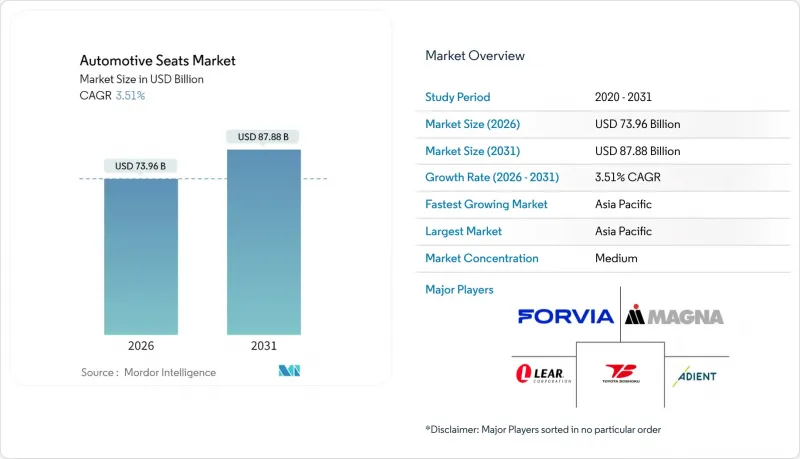
2026년 자동차용 시트 시장 규모는 739억 6,000만 달러로 추정되며, 2025년 714억 5,000만 달러에서 성장이 전망됩니다. 2031년까지의 예측에서는 878억 8,000만 달러에 달하며, 2026-2031년에 CAGR 3.51%로 확대할 전망입니다.
전동화, 자동 운전 기능, 고급스러운 편안함에 대한 선호도가 높아지면서 시트 프레임, 쿠션, 전자장치의 재설계를 촉진하고 있으며, 성장세는 계속 견고하게 유지되고 있습니다. 자동차 제조업체들은 배터리 무게를 줄이기 위해 경량 구조를 지속적으로 채택하고 있으며, 소비자들은 전동식, 통풍, 마사지 기능을 갖춘 제품을 선호하는 경향이 있으며, 평균 판매 가격이 상승하고 있습니다. 원자재 가격 변동과 엄격한 안전 규제로 인해 전체 밸류체인에 비용 압박이 가중되고 있지만, Tier 1 공급업체는 차량 프로그램과의 긴밀한 협력을 통해 가격 우위를 유지하고 있습니다. 아시아태평양은 중국, 인도, 일본 공장이 내연기관 및 전기자동차 플랫폼의 생산 능력을 확대하면서 물량 수요와 기술 도입을 주도하고 있습니다.
세계 자동차 시트 시장 동향과 인사이트
세계 소형차 생산량 증가, 특히 SUV의 성장세
2024년에는 SUV가 전 세계 자동차 판매량의 54%를 차지할 것으로 예상되며, 차량 1대당 시트 장착 대수가 증가할 것으로 예측됩니다. 이로 인해 강화된 사이드 볼스터, 다열 시트 구성, 고급 트림에 대한 수요가 증가하고 있습니다. 아시아태평양 제조업체들은 가처분 소득 증가와 도시화로 인한 SUV 보급률 상승의 혜택을 누리고 있습니다. 전기 SUV가 더 많은 추진력을 얻고 있습니다. 2023년 SUV 판매의 20%가 순수 전기자동차로, 경량화된 프레임과 배터리 질량을 상쇄하는 통합 열 관리 시스템의 신규 수주를 촉진하고 있습니다. 국제에너지기구(IEA)의 보고서에 따르면 대부분의 SUV는 여전히 화석연료로 구동되고 있으며, 능동적 냉각 및 난방 기능과 무게 최적화 쉘을 통합한 전동화 시트 기술에 큰 잠재력을 가지고 있습니다.
전동, 통풍, 마사지 기능이 있는 시트에 대한 소비자 수요 증가
과거 고급 브랜드에 국한되었던 프리미엄 기능이 중급 부문 모델에도 보급되고 있습니다. 리아코퍼레이션의 ComfortMax 플랫폼은 난방 및 환기 응답 시간을 40% 단축하고, 조립 공정의 복잡성을 절반으로 줄여 OEM의 대규모 도입을 가능하게 합니다. 환기 시트는 CAGR 6.12%로 가장 빠르게 성장하는 기술 분야로, 열적 쾌적성이 EV의 항속거리 유지에 기여하기 때문입니다. 마사지 시스템에는 생체 피드백 기능이 내장되어 있으며, 탑승자의 스트레스 감소를 실현합니다. 시트를 웰니스 거점으로 탈바꿈시키고, 소프트웨어 업그레이드를 통해 지속적인 수입원을 개발하고 있습니다.
가죽, 폼, 고성능성 고분자 가격 변동
2020-2021년까지 철강 가격이 두 배 이상 상승하여 차량 1대당 원재료 비용이 2,200달러에서 4,125달러로 증가하여 시트 공급업체들의 이익률이 압박을 받고 있습니다. 시트 쿠션의 90% 이상을 차지하는 폴리우레탄 폼은 유가 변동에 연동되므로 제조업체는 프로그램 중간에 발생하는 비용 급등을 전가하기 어려운 상황에 직면해 있습니다. 공급업체들은 폼 사용량을 줄이기 위해 쿠션 형태를 재설계하거나 재생 폴리머 블렌드를 채택하여 대응하고 있습니다.
부문 분석
합성피혁은 2025년 자동차 시트 시장 점유율의 48.20%를 차지할 것으로 예상되며, 연평균 5.35%의 연평균 복합 성장률(CAGR)을 보일 것으로 예측됩니다. 이는 합리적인 가격과 고급스러움이라는 두 가지 매력을 인정받고 있다는 증거입니다. OEM 프로그램에서는 균일한 질감, 내오염성, 간편한 세척성을 중시하여 차량 서비스에서 보증 클레임 감소에 기여하고 있습니다. 직물은 엔트리 모델에서 확고한 지위를 유지하고, 가죽은 하이엔드 시장에서 존재감을 유지하는 반면, 지속가능성에 대한 우려와 조달 변동성 문제에 직면해 있습니다. OEM 업체들이 순환형 소재를 추구하는 가운데 아마, 대마 등 천연섬유가 시트백이나 쿠션 보강재로 채택되고 있지만, 가격 프리미엄이 보급량에 대한 장벽으로 작용하고 있습니다.
토요타의 SofTex 트림은 제조시 CO2 배출량이 천연가죽보다 85% 낮으며, 차량 평균 배출량 목표 달성에 기여하고 있습니다. 콘티넨탈과 마그나는 혼합 재료용 접착제를 없애고 재활용을 용이하게 하는 바이오폼 패드를 프로토타입으로 제작했습니다. 이러한 개발은 유럽의 순환경제 지침에 대응하기 위해 차량 수명 종료시 단순 분해를 목적으로 하는 단일 소재 쿠션으로의 전환을 시사하고 있습니다.
2025년에도 수동 조절식 시트가 세계 점유율의 57.80%를 차지할 것으로 예상되며, 이는 신흥 시장과 기본형 등급의 비용 중시 경향을 반영하고 있습니다. 반면, 환기 기능이 있는 시트는 CAGR 5.89%를 기록해 추운 지역과 따뜻한 지역 모두에서 열적 쾌적성이 높게 평가되고 있음을 보여줍니다. 열선 시트는 북미에서 표준을 유지하고 있으며, 전동 조절식 시트는 복잡한 공조 시스템과의 통합을 필요로 하지 않고 메모리 기능 및 허리 지지 모듈을 제공하여 경제 차량과 고급 차량의 가교 역할을 하고 있습니다.
자세와 활력 징후를 추적하는 스마트 시트는 프리미엄 EV에서 빠르게 진화하고 있습니다. 현대트랜시스는 저에너지 탄소섬유 히터, 다이내믹 바디케어 알고리즘, 경사형 워크인 기능을 기아 EV9에 패키징하여 소프트웨어로 정의된 편안함을 대량 생산할 수 있는 길을 보여주었습니다. 또한 공급업체는 무선 업데이트 지원 제어 장치를 내장하여 판매 시점을 넘어 매출을 확대할 수 있는 미래 기능의 출시를 가능하게 합니다.
지역별 분석
아시아태평양은 매출의 46.40%, CAGR 3.69% 전망으로 1위를 유지. 중국의 전기자동차 붐, 인도의 급성장하는 소형 SUV 부문, 일본의 시트 전자장비에 대한 지속적인 투자가 주도하고 있습니다. 중국에서는 2025년까지 신차 판매에서 EV 보급률이 45%를 나타낼 것으로 예측되며, 시트 공급업체들은 경량 프레임과 통합 냉각 설계 개발에 주력하고 있습니다. 인도에서는 전기 세발자전거와 배달용 밴에 대한 보조금 정책으로 인해 사용 빈도가 높은 사이클에 적합한 내구성과 낮은 유지보수성을 갖춘 트림에 대한 수요가 가속화되고 있습니다. 도요타 방직과 같은 일본의 혁신가들은 스윙 체어 동작과 개인 맞춤형 오디오를 갖춘 릴랙스 시트를 발표하여 이 지역의 종합적인 탑승자 편의에 대한 노력을 보여주고 있습니다.
유럽에서는 배출가스 감축과 재활용성에 초점을 맞추었습니다. 규제 강화로 인해 재료의 추적 가능성과 수명주기 탄소 회계가 요구되고 있으며, 바이오 폼을 사용하거나 쉽게 분리할 수 있는 커버가 있는 시트가 권장되고 있습니다. 볼보의 트럭용 시트 플랫폼은 기존 설계 대비 40%의 CO2 감축을 주장하며, 규제 적합성과 운전자의 편안함을 동시에 만족시키는 것을 입증하고 있습니다. 북미에서는 픽업트럭과 SUV의 점유율이 높고, 중급 모델에서 통풍기능이 있는 시트와 열선 시트가 표준화가 진행되고 있습니다. 공급업체는 디트로이트와 멕시코의 제조 거점과 가까운 입지를 활용하여 금속 스탬핑 가공 및 쿠션 생산의 현지화를 추진. 이를 통해 물류 리스크를 줄이고 미국 MCA(지역 조달 기준)의 지역 조달 요건을 충족하고 있습니다.
중동, 아프리카, 남미는 장기적인 확장 가능성을 가지고 있습니다. 각국 정부는 자동차 산업 생태계 구축을 위해 현지 조립을 지원하고 있으며, 가혹한 도로 환경에 대응하는 간소화된 저비용의 벤치 시트와 점프 시트에 대한 수요가 발생하고 있습니다. 승차 공유 및 미니버스 분야의 차량 구매는 서비스 인프라가 제한된 환경에서도 가동 시간을 유지하고, 청소가 쉬운 합성피혁과 빠른 교체가 가능한 시트 모듈에 대한 수요를 개발하고 있습니다.
기타 특전:
- 엑셀 형식 시장 예측(ME) 시트
- 애널리스트 지원(3개월)
자주 묻는 질문
목차
제1장 서론
제2장 조사 방법
제3장 개요
제4장 시장 구도
제5장 시장 규모와 성장 예측(금액(달러))
제6장 경쟁 구도
제7장 시장 기회와 향후 전망
KSA 26.03.05The automotive seat market size in 2026 is estimated at USD 73.96 billion, growing from 2025 value of USD 71.45 billion with 2031 projections showing USD 87.88 billion, growing at 3.51% CAGR over 2026-2031.
Growth stays positive as electrification, autonomous driving features, and a rising preference for premium comfort push redesigns of seat frames, cushions, and electronics. Automakers continue to specify lighter structures to compensate for battery weight, while consumers favor powered, ventilated, and massage functions that lift average selling prices. Raw-material volatility and stringent safety rules place cost pressure across the value chain, yet Tier-1 suppliers maintain pricing leverage because of their deep integration with vehicle programs. Asia Pacific leads volume demand and technology adoption as Chinese, Indian, and Japanese plants expand capacity for both internal-combustion and electric platforms.
Global Automotive Seats Market Trends and Insights
Rising Global Light-Vehicle Production, Especially SUVs
SUVs reached 54% of global car sales in 2024, increasing seat content per vehicle and lifting demand for reinforced side bolsters, multi-row configurations, and premium trim. Asia Pacific manufacturers benefit as disposable income and urbanization lift SUV penetration. Electric SUVs draw further momentum; 20% of 2023 SUV sales were fully electric, triggering new orders for lightweight frames and integrated thermal management that offset battery mass. The International Energy Agency reports that most SUVs still run on fossil fuel, leaving substantial potential for electrified seat innovation that integrates active cooling, heating, and weight-optimized shells .
Growing Consumer Demand for Powered, Ventilated & Massage Seats
Premium features once limited to luxury brands increasingly appear in mid-segment models. Lear Corporation's ComfortMax platform cuts heating and ventilation response times by 40% and halves assembly complexity, enabling OEM rollouts at scale . Ventilated seats represent the fastest-growing technology slice at 6.12% CAGR because thermal comfort helps EVs preserve driving range. Massage systems now incorporate biometric feedback to reduce occupant stress, transforming seats into wellness hubs and opening recurring revenue through software-enabled upgrades.
Volatile Prices of Leather, Foam & Advanced Polymers
Steel prices more than doubled between 2020 and 2021, and raw-material content per vehicle rose from USD 2,200 to USD 4,125, compressing margins for seat suppliers. Polyurethane foam, covering more than 90% of seat cushions, tracks oil price swings, exposing manufacturers to cost spikes that are difficult to pass through mid-program. Suppliers respond by redesigning cushion geometries to reduce foam volume and by qualifying recycled polymer blends.
Other drivers and restraints analyzed in the detailed report include:
- Automaker Push for Lightweight Seats to Meet CO2 Targets
- Electrified Skateboard Platforms Enabling Flexible Cabin Layouts
- Stringent Safety & Homologation Testing Costs
For complete list of drivers and restraints, kindly check the Table Of Contents.
Segment Analysis
Synthetic leather held 48.20% of the automotive seat market share in 2025 and is projected to grow at a 5.35% CAGR, underscoring its dual appeal of affordability and premium look. Original-equipment programs value their consistent grain, stain resistance, and simplified cleaning, which lowers warranty claims in fleet service. Fabric remains entrenched in entry models, whereas genuine leather persists at the top end but faces sustainability concerns and sourcing volatility. Natural fibers such as flax and hemp enter seat backs and cushion reinforcements as OEMs pursue circular materials, but price premiums still limit volume deployment.
Toyota's SofTex trim produces 85% lower CO2 during manufacture than genuine leather, helping the company align with fleet-average emissions goals. Continental and Magna prototype bio-foam pads that ease recycling by eliminating mixed material adhesives. Such developments signal a shift toward mono-material cushions designed for straightforward disassembly at vehicle end-of-life to meet European circular-economy directives.
Manual adjusters still anchor 57.80% of global share in 2025, reflecting cost sensitivity in emerging markets and base trims. Ventilated variants, however, post a 5.89% CAGR, showing how buyers reward thermal comfort in both hot and cold climates. Heated options remain a staple in North America, while power adjusters form a bridge between economy and luxury lines, offering memory profiles and lumbar modules without complex HVAC integration.
Smart seats that track posture and vital signs are advancing quickly in premium EVs. Hyundai Transys packages low-energy carbon-fiber heaters, dynamic body-care algorithms, and tilt-away walk-in functions within the Kia EV9, proving a mass-production path for fully software-defined comfort. Suppliers are also embedding over-the-air-enabled control units, allowing future features unlock that spread revenue beyond the point of sale.
The Automotive Seat Market Report is Segmented by Material Type (Synthetic Leather, Fabric, and More), Technology (Standard (Manual) Seats, Powered Seats, and More), Sales Channel (OEM and Aftermarket), Vehicle Type (Passenger Cars, Light Commercial Vehicles, and More), Seat Type (Bench/Split-Bench Seats, Bucket Seats, and More), and Geography (North America, and More). The Market Forecasts are Provided in Terms of Value (USD).
Geography Analysis
Asia Pacific leads with 46.40% revenue and a 3.69% CAGR outlook, fueled by China's electric-vehicle boom, India's fast-growing compact-SUV segment, and Japan's sustained investment in seat electronics. China is forecast to reach 45% EV penetration in new-car sales in 2025, keeping seat suppliers busy with lighter frames and integrated cooling designs. Indian policies that subsidize electric three-wheelers and delivery vans accelerate demand for durable, low-maintenance trim suited to high-usage duty cycles. Japanese innovators such as Toyota Boshoku unveil relaxation seats with swing-chair motion and personalized audio, demonstrating the region's push toward holistic passenger comfort.
Europe focuses on emissions reduction and recyclability. Regulations tighten material traceability and lifecycle carbon accounting, encouraging seats built from bio-based foams and easily separable covers. FORVIA's truck seat platform claims 40% lower CO2 than conventional designs, proving compliance can coexist with driver comfort. North America, characterized by high pickup and SUV share, shows rising standardization of ventilated and heated seats in mid-trim models. Suppliers leverage proximity to Detroit and Mexico fabrication hubs to localize metal stamping and cushion production, reducing logistics risk and meeting US-MCA regional-content rules.
The Middle East, Africa, and South America provide long-run expansion potential. Governments support local assembly to develop automotive ecosystems, creating opportunities for simplified, cost-efficient bench and jump seats that meet rugged-road requirements. Fleet purchases in ride-hailing and mini-bus sectors open demand for easy-clean synthetic leather and quick-swap seat modules that preserve uptime in environments with limited-service infrastructure.
- Adient PLC
- Lear Corporation
- Forvia SE
- Toyota Boshoku Corporation
- Magna International Inc.
- NHK Spring Co. Ltd
- Recaro Holding GmbH
- TS Tech Co. Ltd
- Tachi-S Co. Ltd
- Yanfeng Seating
- Hyundai Transys
- Gentherm Inc.
- Martur Fompak
- Grammer AG
- Freedman Seating
Additional Benefits:
- The market estimate (ME) sheet in Excel format
- 3 months of analyst support
TABLE OF CONTENTS
1 Introduction
- 1.1 Study Assumptions & Market Definition
- 1.2 Scope of the Study
2 Research Methodology
3 Executive Summary
4 Market Landscape
- 4.1 Market Overview
- 4.2 Market Drivers
- 4.2.1 Rising global light-vehicle production, especially SUVs
- 4.2.2 Growing consumer demand for powered, ventilated & massage seats
- 4.2.3 Automaker push for lightweight seats to meet CO2 targets
- 4.2.4 Electrified skateboard platforms enabling flexible cabin layouts
- 4.2.5 Mobility-as-a-Service fleets needing easy-clean, high-durability trim
- 4.2.6 AI-driven occupant-monitoring systems requiring smart sensor-laden seats
- 4.3 Market Restraints
- 4.3.1 Volatile prices of leather, foam & advanced polymers
- 4.3.2 Stringent safety & homologation testing costs
- 4.3.3 Slow refresh cycles for seat architectures at legacy OEMs
- 4.3.4 Rise of alternative comfort systems reducing demand for premium seats
- 4.4 Value / Supply-Chain Analysis
- 4.5 Regulatory Landscape
- 4.6 Technological Outlook
- 4.7 Porter's Five Forces
- 4.7.1 Bargaining Power of Suppliers
- 4.7.2 Bargaining Power of Consumers
- 4.7.3 Threat of New Entrants
- 4.7.4 Threat of Substitute Products
- 4.7.5 Intensity of Competitive Rivalry
5 Market Size & Growth Forecasts (Value (USD))
- 5.1 By Material Type
- 5.1.1 Synthetic Leather
- 5.1.2 Genuine Leather
- 5.1.3 Fabric
- 5.1.4 Natural Fiber and Others
- 5.2 By Technology
- 5.2.1 Standard (Manual) Seats
- 5.2.2 Powered Seats
- 5.2.3 Ventilated Seats
- 5.2.4 Heated Seats
- 5.2.5 Massage Seats
- 5.2.6 Smart / AI-Integrated Seats
- 5.3 By Sales Channel
- 5.3.1 OEM
- 5.3.2 Aftermarket
- 5.4 By Vehicle Type
- 5.4.1 Passenger Cars
- 5.4.2 Light Commercial Vehicles
- 5.4.3 Medium and Heavy Commercial Vehicles
- 5.4.4 Two-Wheelers and Three-Wheelers
- 5.5 By Seat Type
- 5.5.1 Bench / Split-Bench Seats
- 5.5.2 Bucket Seats
- 5.5.3 Captain / Individual Seats
- 5.5.4 Child Safety Seats
- 5.5.5 Folding / Jump Seats
- 5.6 By Geography
- 5.6.1 North America
- 5.6.1.1 United States
- 5.6.1.2 Canada
- 5.6.1.3 Rest of North America
- 5.6.2 South America
- 5.6.2.1 Brazil
- 5.6.2.2 Argentina
- 5.6.2.3 Rest of South America
- 5.6.3 Europe
- 5.6.3.1 Germany
- 5.6.3.2 United Kingdom
- 5.6.3.3 France
- 5.6.3.4 Italy
- 5.6.3.5 Spain
- 5.6.3.6 Russia
- 5.6.3.7 Rest of Europe
- 5.6.4 Asia Pacific
- 5.6.4.1 China
- 5.6.4.2 India
- 5.6.4.3 Japan
- 5.6.4.4 South Korea
- 5.6.4.5 Rest of Asia Pacific
- 5.6.5 Middle East and Africa
- 5.6.5.1 Saudi Arabia
- 5.6.5.2 United Arab Emirates
- 5.6.5.3 Egypt
- 5.6.5.4 Turkey
- 5.6.5.5 South Africa
- 5.6.5.6 Rest of Middle East and Africa
- 5.6.1 North America
6 Competitive Landscape
- 6.1 Market Concentration
- 6.2 Strategic Moves
- 6.3 Market Share Analysis
- 6.4 Company Profiles (includes Global Level Overview, Market Level Overview, Core Segments, Financials as Available, Strategic Information, Market Rank/Share for Key Companies, Products and Services, SWOT Analysis, and Recent Developments)
- 6.4.1 Adient PLC
- 6.4.2 Lear Corporation
- 6.4.3 Forvia SE
- 6.4.4 Toyota Boshoku Corporation
- 6.4.5 Magna International Inc.
- 6.4.6 NHK Spring Co. Ltd
- 6.4.7 Recaro Holding GmbH
- 6.4.8 TS Tech Co. Ltd
- 6.4.9 Tachi-S Co. Ltd
- 6.4.10 Yanfeng Seating
- 6.4.11 Hyundai Transys
- 6.4.12 Gentherm Inc.
- 6.4.13 Martur Fompak
- 6.4.14 Grammer AG
- 6.4.15 Freedman Seating
7 Market Opportunities & Future Outlook
- 7.1 White-space & Unmet-Need Assessment