|
시장보고서
상품코드
1939003
무균 포장 : 시장 점유율 분석, 업계 동향과 통계, 성장 예측(2026-2031년)Aseptic Packaging - Market Share Analysis, Industry Trends & Statistics, Growth Forecasts (2026 - 2031) |
||||||
 Mordor Intelligence
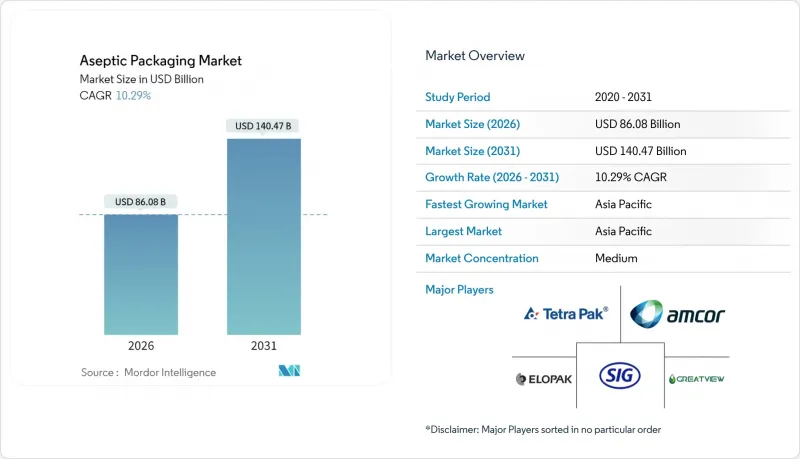
무균 포장 시장은 2025년에 780억 5,000만 달러로 평가되며, 2026년 860억 8,000만 달러에서 2031년까지 1,404억 7,000만 달러에 달할 것으로 예측됩니다. 예측 기간(2026-2031년)의 CAGR은 10.29%로 전망됩니다.
보존성 식품 및 음료에 대한 수요 증가, 식품 안전 규제 강화, 콜드체인 비용 절감의 필요성으로 인해 무균 및 상온 유통 포맷의 매력이 증가하고 있습니다. 브랜드 오너들은 냉장 인프라가 미비한 지역에서 즉석섭취(RTD) 기능성 음료와 보존성 유제품에 대한 수요 증가에 대응하기 위해 무균라인을 확충하고 있습니다. 동시에 바이오의약품 제조 및 개인 맞춤형 치료의 발전으로 무균 포장 시장에서 의약품 분야의 매출 기반이 확대되고 있습니다. 알루미늄을 사용하지 않은 고배리어성 카톤과 PFAS 프리 코팅과 같은 재료 과학의 혁신을 통해 제조업체는 무균성을 유지하면서 새로운 지속가능성 요건을 충족할 수 있습니다. 컨버터와 수지 제조업체 간의 통합은 변동이 심한 폴리머 시장에서 구매력을 강화하고 있습니다. 한편, 디지털 인쇄 기술은 증가하는 SKU(재고 관리 단위)에 적합한 비용 효율적인 소량 생산을 가능하게 합니다.
세계 무균 포장 시장 동향 및 인사이트
즉석 기능성 음료의 급성장
기능성 RTD 음료는 미량영양소, 프로바이오틱스, 식물성 성분을 상온에서 최대 12개월 동안 보존할 수 있는 무균 솔루션이 요구되고 있습니다. 각 브랜드는 산소, 빛, 자외선을 차단하는 고차단성 카톤과 다층 병을 채택하여 편의점에서의 라스트마일 배송을 용이하게 하고 있습니다. 미국, 중국, 태국의 음료 충전 제조업체는 스포츠 영양음료, 에너지 음료, 식물성 단백질 음료의 신제품 출시에 대응하기 위해 시간당 4만 8,000병 이상의 처리 능력을 갖춘 신형 고속 무균 라인을 도입했습니다. 식품 등급의 무균성과 의약품 등급의 유효성 검증의 경계가 좁아지고 있으므로 바이알 및 앰플 공급업체들은 프리미엄 포지셔닝을 원하는 음료 고객을 확보하는 데 주력하고 있습니다. 원료 공급업체들은 무균 가공을 통한 장기 보존성으로 인해 보존료를 줄이고 유효 성분을 늘릴 수 있으며, 클린 라벨링과 소매 가격 상승을 지원할 수 있다고 지적하고 있습니다.
신흥 아시아에서 상온보관 유제품 유통 확대
인도, 베트남, 인도네시아에서는 관리가 느슨한 냉장 공급망에서 무균 상온 보관이 가능한 우유와 요구르트로의 전환이 빠르게 진행되고 있습니다. 도시 유제품 가공업체들은 전력망 불안정으로 인해 냉장비용이 급등하는 지방에 공급하기 위해 UHT 살균장치와 브릭팩 충진기에 투자하고 있습니다. 중국에서는 2024년 상온 보존 음료에 재구성 분유 사용 금지가 결정됨에 따라 순유 무균 라인에 대한 설비 투자가 잇따르고 있으며, 135℃ 살균이 가능한 저산성 카톤 라미네이트에 대한 수요가 증가하고 있습니다. 다국적 브랜드는 원유 확보와 농장 인근에 모듈식 무균 마이크로 플랜트 도입을 목적으로 현지 협동조합과 합작 사업을 운영하고 있습니다. 이를 통해 도로 운송 비용의 대폭적인 절감과 부패 방지를 실현하고 있습니다. 그 결과, 무균 포장 시장은 아시아 신흥 국가 정부의 장기적인 식량안보 정책에서 필수적인 요소로 자리 잡고 있습니다.
다층 폴리머 가격 변동성
폴리에틸렌과 폴리프로필렌 가격은 2024년 파운드당 5센트씩 상승하여 컨버터들의 이익률을 압박하고 분기별 추가 요금을 발생시켰습니다. 나프타, 에탄과 같은 원료 시장의 변동은 카톤 주둥이, 캡, 배리어 필름의 예산 수립을 복잡하게 만들고 있습니다. 대규모 구매자는 다년 계약을 통해 수지를 헤지하는 반면, 소규모 충전업체는 현물 가격 변동으로 인해 피해를 입었고, 핫필라인을 무균 설비로 교체하는 자본 프로젝트가 지연되고 있습니다. 크래커 단지의 예기치 못한 가동 중단과 운송 병목 현상 등 세계 수지 공급의 구조적 제약으로 인해 가격 변동은 당분간 지속될 것으로 예측됩니다.
부문 분석
무균 포장 시장에서 카톤은 유제품, 주스, RTD 커피 분야에서 높은 침투율로 인해 2025년 매출의 63.30%를 차지할 것으로 예측됩니다. 직사각형 모양은 팔레트 효율성과 매장 진열 면적을 극대화하고, 새로운 빨대 없는 캡은 플라스틱 감소 목표에 부합합니다. 한편, 바이알 및 앰플은 주사제, 백신, 세포치료제의 보급으로 2031년까지 연평균 복합 성장률(CAGR) 12.98%로 확대될 것으로 예측됩니다. 바이알 및 앰플 무균 포장 시장 규모는 인체용 및 동물용 의약품 분야에서의 채택을 반영하여 2031년까지 109억 4,000만 달러에 달할 것으로 예측됩니다. 병은 여전히 스무디와 같은 고점도 음료와 재밀봉이 가능한 대형 포맷이 소비의 편의성을 높여주는 향이 있는 우유에서 중요한 역할을 하고 있습니다. 캔은 높은 펑크 저항성으로 인해 UHT 코코넛 워터, 고산성 과일 퓌레 등 틈새 시장에서 입지를 다지고 있지만, 알루미늄 가격 변동과 젊은 소비자들이 종이 기반 포장을 선호하는 경향으로 인해 성장이 억제되고 있습니다. 파우치 기반의 백인박스 시스템은 컴팩트한 운송과 개봉 후 장기보관성을 원하는 외식업 사업자들이 선호하고 있습니다. 또한 1회용 스파우트가 달린 파우치는 유아용 음료나 스포츠 영양젤의 휴대성을 제공합니다.
탄소발자국 감소를 추구하는 것은 제품 수준의 혁신을 촉진하고 있습니다. SIG가 2025년에 출시한 완전 재활용이 가능하고 알루미늄을 사용하지 않는 1리터 용기는 상온에서 12개월의 유통기한을 유지하며, 유럽의 주요 유제품 브랜드가 조기에 채택했습니다. 한편, 유리 바이알 제조업체는 불활성 접촉면을 유지하면서 무게를 30% 줄인 폴리머 오버 글라스 복합 용기를 개발하여 전 세계 백신 캠페인의 운송시 배출량 감소에 기여하고 있습니다. 신소재의 등장과 함께 배리어 성능, 재활용성, 충전 속도에 대한 제품 수준의 차별화가 무균 포장 시장에서 경쟁 우위를 지속적으로 형성할 것입니다.
지역별 분석
아시아태평양은 2025년 매출의 38.05%를 차지했으며, 중국, 인도, 인도네시아가 주도했습니다. 인도의 국가 영양 프로그램은 2027년까지 포장우유 보급률을 15% 이상으로 끌어올리는 것을 목표로 하고 있으며, 무균 포장 능력에 대한 공공 및 민간 투자를 촉진하고 있습니다. SIG가 구자라트 주에 건설한 9,000만 유로 규모의 신규 공장은 연간 40억 팩의 생산 능력을 추가하여 현지 유제품 및 음료용 요구르트에 공급할 예정입니다. 중국에서는 UHT 카톤에 재구성 분유 충전을 금지하는 정책으로 인해 가공업체들은 보다 신뢰할 수 있는 제조업체로 전환해야 하며, 가격 규율이 강화되고 이익률이 향상되고 있습니다. 동남아시아의 한 스타트업은 이동 중 소비를 잡기 위해 250ml의 슬림한 카톤에 담긴 비타민 강화차를 출시하고 있습니다.
남미는 가장 빠르게 성장하는 지역으로 2031년까지 연평균 복합 성장률(CAGR) 14.02%로 확대될 것으로 예측됩니다. 브라질에서는 인플레이션 압력으로 인해 소비자들이 대용량 및 상온 보관이 가능한 제품을 선택하는 경향이 강해져 2024년 포장 식품 시장 규모는 1,136억 달러에 달할 것으로 예측됩니다. 디젤 연료와 전력 비용의 급등으로 내륙 물류센터에 대한 투자는 상온 보관 제품을 우선적으로 투자하고 있습니다. 아르헨티나의 유제품 수출업체는 냉장 보관이 필요 없는 유당이 없는 우유를 칠레와 페루로 운송하기 위해 플렉서블 파우치 라인을 활용하고 있습니다. 북미와 유럽에서는 물량 확대가 아닌 지속가능성을 중시하는 소재 전환으로 한 자릿수 중반의 성장이 예상됩니다. EU의 PFAS 금지 조치는 실리콘 산화물 기반 종이 용기 배리어 소재의 상용화를 촉진하고, 미국 충전업체들은 노동력 부족을 보완하기 위해 고주의 구역에 로봇을 도입하고 있습니다. 중동 및 아프리카은 규모는 작지만 인구 증가와 정부의 식량안보 전략과 연계된 장기적인 성장 여력을 가지고 있습니다. 이집트 산업단지에는 지역 공급을 목적으로 한 UFlex사의 2억 달러 규모의 라미네이트 보드 단지가 위치하고 있습니다.
기타 특전:
- 엑셀 형식 시장 예측(ME) 시트
- 애널리스트의 3개월간 지원
자주 묻는 질문
목차
제1장 서론
제2장 조사 방법
제3장 개요
제4장 시장 구도
제5장 시장 규모와 성장 예측
제6장 경쟁 구도
제7장 시장 기회와 향후 전망
KSA 26.03.05The aseptic packaging market was valued at USD 78.05 billion in 2025 and estimated to grow from USD 86.08 billion in 2026 to reach USD 140.47 billion by 2031, at a CAGR of 10.29% during the forecast period (2026-2031).
Growing demand for shelf-stable foods and beverages, stricter food-safety rules, and the need to trim cold-chain costs are reinforcing the appeal of sterile, ambient-distribution formats. Brand owners are scaling aseptic lines to meet rising demand for ready-to-drink (RTD) functional beverages and for shelf-stable dairy in regions where refrigeration infrastructures remain patchy. At the same time, biologics manufacturing and personalized therapies are widening the pharmaceutical revenue base for the aseptic packaging market. Material science breakthroughs-such as aluminum-free high-barrier cartons and PFAS-free coatings-help manufacturers comply with new sustainability mandates without sacrificing sterility. Consolidation among converters and resin producers is bolstering purchasing leverage in a volatile polymer market, while digital printing is enabling cost-effective short runs that suit proliferating stock-keeping units.
Global Aseptic Packaging Market Trends and Insights
Rapid Growth of RTD Functional Beverages
Functional RTD drinks now demand aseptic solutions that lock in sensitive micronutrients, probiotics, and botanicals for up to 12 months at ambient temperatures. Brands are selecting high-barrier cartons and multilayer bottles that offer oxygen, light, and UV protection while easing last-mile distribution in convenience stores. Beverage fillers in the United States, China, and Thailand have installed new high-speed aseptic lines rated above 48,000 bottles per hour to serve sports-nutrition, energy-tea, and plant-based protein launches. The overlap between food-grade sterility and pharmaceutical-grade validation is narrowing, encouraging suppliers of vials & ampoules to court beverage customers seeking premium positioning. Ingredient suppliers note that the longer shelf life afforded by aseptic processing allows them to blend less preservative and more active compounds, supporting cleaner labels and higher retail prices.
Expansion of Ambient Dairy Distribution in Emerging Asia
India, Vietnam, and Indonesia are rapidly upgrading from loosely supervised chilled supply chains to aseptic shelf-stable milk and yogurt. Urban dairy processors are investing in UHT sterilizers and brick-pack fillers to reach rural districts where grid instability inflates refrigeration costs. In China, the 2024 decision to prohibit reconstituted milk powder in shelf-stable beverages elicited a wave of capex for pure-milk aseptic lines, driving demand for low-acid carton laminates that can withstand 135 °C sterilization. Multinational brands are forming joint ventures with local cooperatives to secure raw milk and deploy modular aseptic micro-plants close to farms, slashing road-haul costs and mitigating spoilage. As a result, the aseptic packaging market is becoming integral to the long-term food-security agendas of emerging Asian governments.
Volatility in Multilayer Polymer Prices
Polyethylene and polypropylene prices rose by 5 cents per pound in 2024, tightening converter margins and prompting quarterly surcharges. Fluctuating naphtha and ethane feedstock markets complicate budgeting for carton spouts, caps, and barrier films. While large purchasers hedge through multi-year resin contracts, small fillers experience spot-price pain that slows capital projects aimed at replacing hot-fill lines with aseptic equipment. Structural constraints in global resin supply, including unplanned outages at cracker complexes and shipping bottlenecks, signal that price volatility will persist for the near term.
Other drivers and restraints analyzed in the detailed report include:
- Stringent Food-Safety Regulations Pushing Sterile Packaging Adoption
- Inflation-Linked Shift From Cold-Chain to Shelf-Stable Logistics
- High Initial CAPEX for Aseptic Filling Lines
For complete list of drivers and restraints, kindly check the Table Of Contents.
Segment Analysis
Cartons secured 63.30% of 2025 revenue within the aseptic packaging market thanks to deep penetration in dairy, juice, and RTD coffee. Their rectangular footprint maximizes pallet efficiency and shelf facings, and new straw-less closures appeal to plastic-reduction goals. Meanwhile, vials & ampoules are expanding at a 12.98% CAGR through 2031 as injectable biologics, vaccines, and cell therapies proliferate. The aseptic packaging market size for vials & ampoules is projected to reach USD 10.94 billion by 2031, reflecting adoption in both human and veterinary medicine. Bottles remain important for high-viscosity drinks such as smoothies and for flavored milk where larger resealable formats enhance consumption convenience. Cans hold niche positions in UHT coconut water and high-acid fruit purees due to their robust puncture resistance, though growth is tempered by aluminum price swings and by younger consumers' preference for paper-based packs. Pouch-based bag-in-box systems attract food-service operators seeking compact shipping and extended post-opening shelf life; single-serve spouted pouches offer portability for early-childhood beverages and sports nutrition gels.
The pursuit of carbon-footprint cuts is stimulating product-level innovation. SIG's 2025 launch of a fully recyclable, aluminum-free 1 L carton that maintains a 12-month ambient shelf life won early adoption from leading European dairy brands. Separately, glass vial manufacturers have developed polymer-over-glass hybrid containers that reduce weight by 30% while retaining inert contact surfaces, easing freight emissions in global vaccine campaigns. As new materials emerge, product-level differentiation in barrier performance, recyclability, and filling speed will continue to shape competitive advantage within the aseptic packaging market.
Aseptic Packaging Market Report is Segmented by Product (Cartons, Bottles, Cans, Bags and Pouches, and More), Material Composition (Paper and Paperboard, Plastics, Glass, Metal, Composite Laminates), Application (Beverage, Food, Pharmaceuticals, Personal Care and Cosmetics), and Geography. The Market Forecasts are Provided in Terms of Value (USD).
Geography Analysis
Asia-Pacific held 38.05% of revenues in 2025, driven by China, India, and Indonesia. National nutrition programs in India aim to increase packaged milk penetration above 15% by 2027, catalyzing public-private investment in aseptic capacity. SIG's EUR 90 million green-field plant in Gujarat adds 4 billion pack annual output devoted to local dairy and drinkable yogurt. China's policy forbidding reconstituted milk powder in UHT cartons is pushing processors toward higher-integrity manufacturers, reinforcing price discipline and lifting margins. Southeast Asian start-ups are launching vitamin-fortified teas in 250 mL slim cartons to capture on-the-go consumption.
South America is the fastest growing region, projected to rise at 14.02% CAGR through 2031. Brazil's packaged-food market reached USD 113.6 billion in 2024 as inflationary pressures encouraged consumers to favor large-format, shelf-stable purchases. Investments in inland distribution centers favor ambient products due to high diesel and electricity costs. Argentina's dairy exporters are leveraging flexible pouch lines to ship lactose-free milk to Chile and Peru without refrigeration. North America and Europe show mid-single-digit growth, propelled by sustainability-driven material swaps rather than volume expansion. The EU PFAS ban stimulates the commercialization of silicon-oxide-based carton barriers, while US fillers adopt robotics in high-care zones to offset labor shortages. The Middle East and Africa, although smaller in value, present long-term upside tied to demographic growth and government food-security strategies. Egypt's industrial zones host UFlex's USD 200 million laminated-board complex aimed at regional supply
- Tetra Pak International SA
- SIG Combibloc Group
- Amcor PLC
- Elopak ASA
- IPI SRL (Coesia Group)
- DS Smith PLC
- Smurfit Kappa Group
- Mondi PLC
- Uflex Limited
- Schott AG
- Gerresheimer AG
- Toyo Seikan Group
- CDF Corporation
- BIBP Sp. z o.o.
- Nampak Ltd
- Greatview Aseptic Packaging
- Liqui-Box (Graphic Packaging)
- OPLATEK Group
- Sealed Air Corporation
- ProAmpac
Additional Benefits:
- The market estimate (ME) sheet in Excel format
- 3 months of analyst support
TABLE OF CONTENTS
1 INTRODUCTION
- 1.1 Study Assumptions and Market Definition
- 1.2 Scope of the Study
2 RESEARCH METHODOLOGY
3 EXECUTIVE SUMMARY
4 MARKET LANDSCAPE
- 4.1 Market Overview
- 4.2 Market Drivers
- 4.2.1 Rapid growth of RTD functional beverages
- 4.2.2 Expansion of ambient dairy distribution in emerging Asia
- 4.2.3 Stringent food-safety regulations pushing sterile packaging adoption
- 4.2.4 Inflation-linked shift from cold-chain to shelf-stable logistics (under-reported)
- 4.2.5 Shift toward sustainable, lightweight packaging mandates
- 4.2.6 Rise of digital?print-enabled short SKUs for D2C brands (under-reported)
- 4.3 Market Restraints
- 4.3.1 Volatility in multilayer polymer prices
- 4.3.2 High initial CAPEX for aseptic filling lines
- 4.3.3 Limited recycling infrastructure for aluminum-foil laminates (under-reported)
- 4.3.4 Regulatory uncertainty around PFAS barrier coatings (under-reported)
- 4.4 Value / Supply-Chain Analysis
- 4.5 Regulatory Landscape
- 4.6 Technological Outlook
- 4.7 Porter's Five Forces Analysis
- 4.7.1 Bargaining Power of Suppliers
- 4.7.2 Bargaining Power of Buyers
- 4.7.3 Threat of New Entrants
- 4.7.4 Threat of Substitutes
- 4.7.5 Intensity of Competitive Rivalry
- 4.8 Pricing Analysis
- 4.9 Aseptic Packaging for Beverages - Demand Insights
5 MARKET SIZE AND GROWTH FORECASTS (VALUE)
- 5.1 By Product
- 5.1.1 Cartons
- 5.1.2 Bottles
- 5.1.3 Cans
- 5.1.4 Bags and Pouches
- 5.1.5 Vials and Ampoules
- 5.2 By Material Composition
- 5.2.1 Paper and Paperboard
- 5.2.2 Plastics (PP, PE, PET)
- 5.2.3 Glass
- 5.2.4 Metal (Aluminum, Steel)
- 5.2.5 Composite Laminates
- 5.3 By Application
- 5.3.1 Beverage
- 5.3.1.1 Ready-to-drink (RTD) Beverages
- 5.3.1.2 Dairy-based Beverages
- 5.3.2 Food
- 5.3.2.1 Processed Food
- 5.3.2.2 Fruits and Vegetables
- 5.3.2.3 Dairy Food
- 5.3.3 Pharmaceuticals
- 5.3.4 Personal Care and Cosmetics
- 5.3.1 Beverage
- 5.4 By Geography
- 5.4.1 North America
- 5.4.1.1 United States
- 5.4.1.2 Canada
- 5.4.1.3 Mexico
- 5.4.2 Europe
- 5.4.2.1 United Kingdom
- 5.4.2.2 Germany
- 5.4.2.3 France
- 5.4.2.4 Italy
- 5.4.2.5 Rest of Europe
- 5.4.3 Asia-Pacific
- 5.4.3.1 China
- 5.4.3.2 Japan
- 5.4.3.3 India
- 5.4.3.4 South Korea
- 5.4.3.5 Rest of Asia-Pacific
- 5.4.4 Middle East
- 5.4.4.1 Israel
- 5.4.4.2 Saudi Arabia
- 5.4.4.3 United Arab Emirates
- 5.4.4.4 Turkey
- 5.4.4.5 Rest of Middle East
- 5.4.5 Africa
- 5.4.5.1 South Africa
- 5.4.5.2 Egypt
- 5.4.5.3 Rest of Africa
- 5.4.6 South America
- 5.4.6.1 Brazil
- 5.4.6.2 Argentina
- 5.4.6.3 Rest of South America
- 5.4.1 North America
6 COMPETITIVE LANDSCAPE
- 6.1 Market Concentration
- 6.2 Strategic Moves
- 6.3 Market Share Analysis
- 6.4 Company Profiles {(includes Global level Overview, Market level overview, Core Segments, Financials as available, Strategic Information, Market Rank/Share for key companies, Products and Services, and Recent Developments)}
- 6.4.1 Tetra Pak International SA
- 6.4.2 SIG Combibloc Group
- 6.4.3 Amcor PLC
- 6.4.4 Elopak ASA
- 6.4.5 IPI SRL (Coesia Group)
- 6.4.6 DS Smith PLC
- 6.4.7 Smurfit Kappa Group
- 6.4.8 Mondi PLC
- 6.4.9 Uflex Limited
- 6.4.10 Schott AG
- 6.4.11 Gerresheimer AG
- 6.4.12 Toyo Seikan Group
- 6.4.13 CDF Corporation
- 6.4.14 BIBP Sp. z o.o.
- 6.4.15 Nampak Ltd
- 6.4.16 Greatview Aseptic Packaging
- 6.4.17 Liqui-Box (Graphic Packaging)
- 6.4.18 OPLATEK Group
- 6.4.19 Sealed Air Corporation
- 6.4.20 ProAmpac
7 MARKET OPPORTUNITIES AND FUTURE OUTLOOK
- 7.1 White-space and Unmet-Need Assessment