|
시장보고서
상품코드
1939011
베릴륨 : 시장 점유율 분석, 업계 동향과 통계, 성장 예측(2026-2031년)Beryllium - Market Share Analysis, Industry Trends & Statistics, Growth Forecasts (2026 - 2031) |
||||||
 Mordor Intelligence
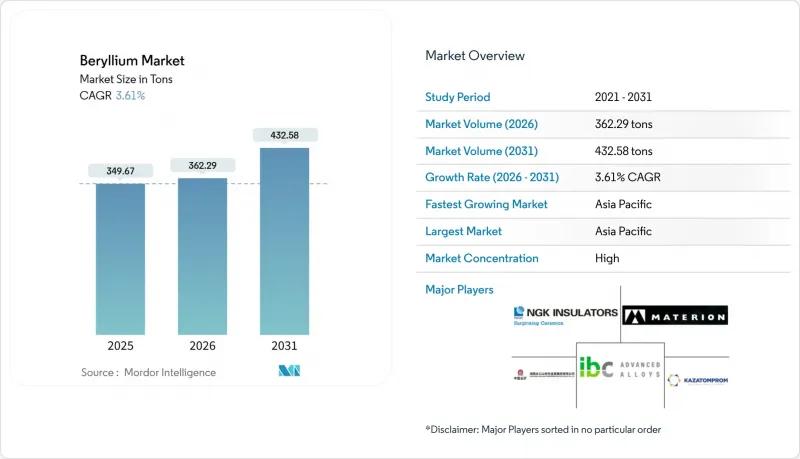
베릴륨 시장은 2025년에 337.26톤으로 평가되며, 2026년 349.67톤에서 2031년까지 418.86톤에 달할 것으로 예측되고 있습니다. 예측 기간(2026-2031년)의 CAGR은 3.68%로 전망되고 있습니다.
견고한 성장은 독보적인 강성 중량비, 우수한 열전도율, 중성자 투과성 등의 특성으로 인해 국방, 항공우주, 전자기기, 신흥 청정에너지 시스템에서 핵심 소재로서 입지를 다지고 있습니다. 5G 인프라 확대, 재사용 로켓 계획, 첨단 전력전자 플랫폼의 발전이 수요를 증가시키는 반면, 직업적 노출 규제 강화와 카자흐스탄과 중국으로공급망 집중은 비용과 안보 측면의 압박 요인으로 작용하고 있습니다. 아시아태평양이 소비를 주도하는 가운데, 미국 생산자들의 전략적 통합 노력으로 미국내 회복력이 강화되고 있습니다. 경쟁적 차별화는 고부가가치 용도를 위한 가볍고 내구성이 뛰어난 부품, 합금 기술 혁신, 분말야금 가공, 신속한 시제품 제작 능력에 초점을 맞추었습니다.
세계 베릴륨 시장 동향 및 인사이트
5G 및 밀리미터파 기지국용 RF 필터에 베릴륨 구리 합금 채택 확대
세계에서 5G가 확산되면서 전기적, 기계적 특성과 내식성을 동시에 만족시키는 구리 베릴륨이 필수적인 고주파 RF 커넥터에 대한 수요가 전례 없는 규모로 증가하고 있습니다. 각 밀리미터파 기지국에서는 4G 장비보다 노드당 베릴륨 구리 사용량이 증가하여 전체 소비량이 두 배로 증가했습니다. 가공 기술의 지속적인 개선으로 24GHz 이상 시스템에 필수적인 초박형 정밀 스트립 제조가 가능해졌습니다. 5G 인프라는 국가 중요 인프라로 분류되므로 공급 안정성 측면에서 베릴륨 시장에 대한 전략적 관심이 더욱 높아지고 있습니다. 아시아태평양이 수요의 중심지이지만, 북미와 유럽의 사업자들은 고순도 합금을 선호하는 엄격한 사양을 유지하고 있습니다.
재사용 발사체에서 경량-고강성 구조물 수요 증가
일회용에서 재사용 가능한 발사 시스템으로의 전환은 질량 증가 없이 반복되는 열적, 진동적 극한 환경을 견딜 수 있는 재료에 의존하고 있습니다. 베릴륨의 비강성은 강철의 6배이지만 무게는 4분의 1에 불과하므로 경량 광학 벤치, 센서 마운트, 구조 패널을 실현할 수 있습니다. AlBeMet, 베릴륨-알루미늄 복합재료인 베릴륨-알루미늄 복합재료는 온도 변화에도 치수 안정성이 뛰어나며, 이는 제임스 웹 우주망원경의 경면 부문의 성능을 통해 입증된 바 있습니다. 민간 발사체 사업자들이 연간 수백 회 발사를 목표로 하고 있는 가운데, 내구성이 뛰어난 베릴륨 부품에 대한 수요도 마찬가지로 증가하고 있습니다.
엄격한 직업적 노출 한도 및 높아지는 규정 준수 비용
미국 산업안전보건국(OSHA)은 허용 노출 한계치를 2μg/m3에서 0.2μg/m3로 낮추고, 생산업체에 환기시설 강화, 격리조치, 의료감시 시스템 도입을 의무화했습니다. 이로 인해 단가가 상승하고 있습니다. 유럽에서는 REACH 승인제도에 따라 동등한 규제가 적용되고 있으며, 규제 환경은 더욱 엄격해지고 있습니다. 소규모 가공업체들은 이러한 비용 부담으로 어려움을 겪고 있으며, 산업 구조조정이 가속화되면서 진입장벽이 높아져 전체 공급 확대에 제약을 받고 있습니다.
부문 분석
2025년 기준 합금은 베릴륨 시장 점유율의 72.86%를 차지하며, 2031년까지 연평균 복합 성장률(CAGR) 3.95%로 확대될 것으로 예상되며, 고성능 플랫폼에서 핵심적인 역할을 할 것으로 예측됩니다. 이 범주 내에서 구리 베릴륨 합금은 통신 커넥터 분야를 지배하고, 알루미늄 베릴륨 금속 기반 복합재료는 항공우주 구조물의 경량화를 실현하고 있습니다. 합금 조성은 강도, 전도성, 열적 특성에 따라 조정할 수 있으므로 제조업체는 새로운 설계 제약에 대응하는 새로운 조성 개발에 많은 연구개발 예산을 투자하고 있습니다.
순금속은 합금화가 중성자 및 열 성능을 저해하는 핵 반사재와 우주 광학 분야에서 계속 활용되고 있습니다. 베릴륨 산화물 세라믹은 극한의 열전도율이 요구되는 고밀도 파워 모듈에서 틈새 시장이지만 중요한 역할을 담당하고 있습니다. 분말야금 기술의 발전과 열간 등방성 프레스법으로 10년 전에는 불가능했던 복잡한 형상이 가능해지면서 합금 기술의 발전이 전체 베릴륨 시장의 성장을 촉진하고 있음을 알 수 있습니다.
베릴륨 보고서는 제품 유형별(합금, 금속, 세라믹, 기타), 최종사용자 산업별(산업 부품, 자동차, 의료, 항공우주 및 방위, 석유 및 가스 및 기타 에너지, 기타), 지역별(아시아태평양, 북미, 유럽, 유럽, 남미, 중동 및 아프리카)로 분류되어 있습니다. 시장 예측은 톤 단위로 제공됩니다.
지역별 분석
아시아태평양은 2025년 생산량의 37.62%를 차지할 것으로 예상되며, 중국이 전자기기 생산과 5G 기지국 구축을 주도하면서 2031년까지 연평균 복합 성장률(CAGR) 4.08%를 나타낼 것으로 전망됩니다. 국내 가공업체는 업스트림 정광과 하류 합금화를 통합하여 거의 폐쇄적인 공급 루프를 유지함으로써 국제적인 변동으로부터 현지 소비자를 보호하고 있습니다. 일본과 한국은 자동차 전동화와 고정밀 반도체 제조 장비를 통해 상당한 수요를 창출하고 있으며, 인도의 우주 프로그램 확대로 인해 지역내 항공우주 수요가 증가하고 있습니다.
북미는 마테리언의 유타-오하이오 복합시설에서 세계 유일의 광산에서 제련소까지 일관 생산 체제를 구축하여 공급망 내결함성을 지원하고 있습니다. 성숙한 항공우주 및 방위산업이 안정적인 기저부하 소비를 보장하고, 인플레이션 억제법에 따른 우대 조치로 베릴륨 산화물 기판을 필요로 하는 국내 EV 배터리 및 전력 전자제품 제조를 촉진하고 있습니다. 캐나다와 멕시코는 항공우주 조립 산업 및 신흥 전기자동차 수출 거점을 통해 점진적인 성장을 더하고 있습니다.
유럽에서는 엄격한 직업 규제와 견고한 응용 수요가 균형을 이루고 있습니다. 대륙 전체의 EV 보급 가속화와 재생에너지 설비 확충으로 고성능 열관리 소재에 대한 요구가 높아지고 있으며, 베릴륨 합금과 세라믹이 유리합니다. NGK 벨리코 프랑스는 EU의 지속가능성 목표에 부합하는 저탄소 가공 경로의 선구자입니다. 중동, 아프리카 및 남미는 여전히 작은 시장이지만, 베릴텍 르완다와 같은 새로운 가공 사업은 지역적 다각화를 위한 초기 단계를 보여주고 있습니다.
기타 특전:
- 엑셀 형식 시장 예측(ME) 시트
- 애널리스트의 3개월 지원
자주 묻는 질문
목차
제1장 서론
제2장 조사 방법
제3장 개요
제4장 시장 구도
제5장 시장 규모와 성장 예측
제6장 경쟁 구도
제7장 시장 기회와 향후 전망
KSA 26.03.05The Beryllium Market was valued at 337.26 tons in 2025 and estimated to grow from 349.67 tons in 2026 to reach 418.86 tons by 2031, at a CAGR of 3.68% during the forecast period (2026-2031).
Robust growth stems from the metal's unmatched stiffness-to-weight ratio, superior thermal conductivity, and neutron transparency that position it as a linchpin material across defense, aerospace, electronics, and nascent clean-energy systems. Rising 5G infrastructure roll-outs, reusable launch vehicle programs, and advanced power-electronics platforms elevate demand, while tightening occupational-exposure rules and supply-chain concentration in Kazakhstan and China create cost and security pressures. Strategic integration efforts by U.S. producers strengthen domestic resilience even as Asia-Pacific leads consumption. Competitive differentiation centers on alloy innovation, powder-metallurgy processing, and rapid-prototyping capability that deliver lighter, more durable components for high-value applications.
Global Beryllium Market Trends and Insights
Rising Adoption of Be-Cu Alloys in 5G And mm-wave Base-Station RF Filters
Global 5G roll-outs drive unprecedented volumes of high-frequency RF connectors that mandate copper-beryllium for its simultaneous electrical, mechanical, and corrosion-resistant performance. Each mmWave base station uses more Be-Cu per node than 4G equipment, multiplying overall consumption. Continuous processing improvements now yield ultra-thin precision strip essential for 24 GHz-plus systems. Because 5G infrastructure is classified as critical national infrastructure, security-of-supply considerations amplify strategic interest in the beryllium market. Asia-Pacific remains the demand epicenter, yet North American and European operators maintain stringent specifications that favor high-purity alloys.
Growing Requirement for Lightweight, High-Stiffness Structures in Reusable Launch Vehicles
The shift from expendable to reusable launch systems hinges on materials that survive repeated thermal and vibrational extremes without mass penalties. Beryllium's specific stiffness is six times that of steel at one-quarter the weight, enabling lighter optical benches, sensor mounts, and structural panels. Beryllium-aluminum composites such as AlBeMet and Beralcast deliver dimensional stability across temperature swings, validated by the performance of the James Webb Space Telescope mirror segments. As commercial launch providers target hundreds of sorties per year, demand for durable beryllium components scales in tandem.
Stringent Occupational-Exposure Limits and Rising Compliance Costs
OSHA cut permissible exposure thresholds from 2 µg/m3 to 0.2 µg/m3, obligating producers to install enhanced ventilation, isolation, and medical-surveillance systems that elevate unit costs. Europe applies comparable restrictions under REACH authorization, further tightening the regulatory envelope. Smaller processors struggle to absorb these expenses, accelerating industry consolidation and raising entry barriers that constrain overall supply expansion.
Other drivers and restraints analyzed in the detailed report include:
- Escalating Demand for Thermal-Management Materials in Advanced EV Power Electronics
- Defense Modernization Programs Boosting Satellite, Missile-Seeker and Optical-Sensor Volumes
- Volatility of Beryllium Concentrate Supply from Kazakhstan and China
For complete list of drivers and restraints, kindly check the Table Of Contents.
Segment Analysis
Alloys captured 72.86% of the beryllium market share in 2025 and are projected to expand at a 3.95% CAGR through 2031, confirming their central role in high-performance platforms. Within this category, copper-beryllium alloys dominate telecommunications connectors, while aluminum-beryllium metal-matrix composites unlock weight savings in aerospace structures. Because alloy formulations can be tuned for strength, conductivity, or thermal properties, producers devote significant research and development budgets to new compositions that address emerging design constraints.
Pure metal continues to serve nuclear reflectors and space-optics segments where alloying would impair neutron or thermal performance. Beryllium-oxide ceramics fill niche but critical positions in high-density power modules that require extreme thermal conductivity. Powder-metallurgy advances and hot-isostatic-pressing routes enable intricate geometries unprecedented a decade ago, underscoring how alloy progress propels overall beryllium market momentum.
The Beryllium Report is Segmented by Product Type (Alloys, Metals, Ceramics, and Other Product Types), End-User Industry (Industrial Components, Automotive, Healthcare, Aerospace and Defense, Oil and Gas and Other Energy, and More), and Geography (Asia-Pacific, North America, Europe, South America, and Middle-East and Africa). The Market Forecasts are Provided in Terms of Volume (Tons).
Geography Analysis
Asia-Pacific generated 37.62% of 2025 volume and is forecast to log a 4.08% CAGR through 2031 as China spearheads electronics production and 5G base-station deployment. Domestic processors integrate upstream concentrate and downstream alloying, sustaining a largely closed supply loop that buffers local consumers from international volatility. Japan and South Korea contribute sizeable volumes through automotive electrification and high-precision semiconductor tooling, while India's expanding space program lifts regional aerospace demand.
North America anchors supply-chain resilience with the world's only fully integrated mine-to-mill operation at Materion's Utah-Ohio complex. Mature aerospace and defense sectors ensure stable base load consumption, and the Inflation Reduction Act incentives bolster domestic EV battery and power-electronics manufacturing that rely on Be-O substrates. Canada and Mexico add incremental growth via aerospace assembly and emerging EV export hubs.
Europe balances stringent occupational regulations with robust application demand. The continent's accelerated EV adoption and renewable-energy build-out intensify requirements for high-performance thermal-management materials, favoring beryllium alloys and ceramics. NGK Berylco France pioneers lower-carbon processing routes aligned with EU sustainability goals. While Middle East-Africa and South America remain smaller markets, new processing ventures such as BerylTech Rwanda illustrate early steps toward geographic diversification.
- American Beryllia Inc.
- American Elements
- Belmont Metals
- Hunan Shuikoushan Nonferrous Metals Group Co., Ltd.
- IBC Advanced Alloys
- JSC Ulba Metallurgical Plant (JSC NAC Kazatomprom)
- Materion Corporation
- NGK INSULATORS, LTD.
- Rockland Resources Ltd.
- Texas Mineral Resources Corp.
- Tropag Oscar H. Ritter Nachf GmBH
- Xiamen Beryllium Copper Technologies Co. , Ltd.
- Xinjiang Xinxin Mining Industry Co. Ltd
Additional Benefits:
- The market estimate (ME) sheet in Excel format
- 3 months of analyst support
TABLE OF CONTENTS
1 Introduction
- 1.1 Study Assumptions and Market Definition
- 1.2 Scope of the Study
2 Research Methodology
3 Executive Summary
4 Market Landscape
- 4.1 Market Overview
- 4.2 Market Drivers
- 4.2.1 Rising Adoption of Be-Cu Alloys in 5G and mm-wave Base-Station RF Filters
- 4.2.2 Growing Requirement for Lightweight, High-Stiffness Structures in Reusable Launch Vehicles
- 4.2.3 Escalating Demand for Thermal Management Materials in Advanced EV Power Electronics
- 4.2.4 Defense Modernization Programs Boosting Satellite, Missile-Seeker and Optical Sensor Volumes
- 4.2.5 Emerging Need for Neutron-Transparent Be Reflectors in Small Modular Reactors (SMRs)
- 4.3 Market Restraints
- 4.3.1 Stringent Occupational?Exposure Limits and Rising Compliance Costs
- 4.3.2 Volatility of Beryllium Concentrate Supply from Kazakhstan and China
- 4.3.3 Accelerating Research and Development on Aluminum and Titanium Metal-Matrix Composites as Substitutes
- 4.4 Value Chain Analysis
- 4.5 Porter's Five Forces Analysis
- 4.5.1 Bargaining Power of Suppliers
- 4.5.2 Bargaining Power of Buyers
- 4.5.3 Threat of New Entrants
- 4.5.4 Threat of Substitutes
- 4.5.5 Competitive Rivalry
5 Market Size and Growth Forecasts (Value)
- 5.1 By Product Type
- 5.1.1 Alloys
- 5.1.2 Metals
- 5.1.3 Ceramics
- 5.1.4 Other Product Types
- 5.2 By End-user Industry
- 5.2.1 Industrial Components
- 5.2.2 Automotive
- 5.2.3 Healthcare
- 5.2.4 Aerospace and Defense
- 5.2.5 Oil and Gas and Other Energy
- 5.2.6 Electronics and Telecommunication
- 5.2.7 Other End-user Industries
- 5.3 By Geography
- 5.3.1 Asia-Pacific
- 5.3.1.1 China
- 5.3.1.2 Japan
- 5.3.1.3 India
- 5.3.1.4 South Korea
- 5.3.1.5 Rest of Asia-Pacific
- 5.3.2 North America
- 5.3.2.1 United States
- 5.3.2.2 Canada
- 5.3.2.3 Mexico
- 5.3.3 Europe
- 5.3.3.1 Germany
- 5.3.3.2 United Kingdom
- 5.3.3.3 France
- 5.3.3.4 Italy
- 5.3.3.5 Russia
- 5.3.3.6 Rest of Europe
- 5.3.4 South America
- 5.3.4.1 Brazil
- 5.3.4.2 Argentina
- 5.3.4.3 Rest of South America
- 5.3.5 Middle-East and Africa
- 5.3.5.1 Saudi Arabia
- 5.3.5.2 South Africa
- 5.3.5.3 Rest of Middle-East and Africa
- 5.3.1 Asia-Pacific
6 Competitive Landscape
- 6.1 Market Concentration
- 6.2 Strategic Moves
- 6.3 Market Share (%)/Ranking Analysis
- 6.4 Company Profiles (includes Global-level Overview, Market-level Overview, Core Segments, Financials, Strategic Information, Market Rank/Share, Products and Services, Recent Developments)
- 6.4.1 American Beryllia Inc.
- 6.4.2 American Elements
- 6.4.3 Belmont Metals
- 6.4.4 Hunan Shuikoushan Nonferrous Metals Group Co., Ltd.
- 6.4.5 IBC Advanced Alloys
- 6.4.6 JSC Ulba Metallurgical Plant (JSC NAC Kazatomprom)
- 6.4.7 Materion Corporation
- 6.4.8 NGK INSULATORS, LTD.
- 6.4.9 Rockland Resources Ltd.
- 6.4.10 Texas Mineral Resources Corp.
- 6.4.11 Tropag Oscar H. Ritter Nachf GmBH
- 6.4.12 Xiamen Beryllium Copper Technologies Co. , Ltd.
- 6.4.13 Xinjiang Xinxin Mining Industry Co. Ltd
7 Market Opportunities and Future Outlook
- 7.1 White-space and Unmet-Need Assessment