
|
시장보고서
상품코드
1939013
컨테이너형 데이터센터 : 시장 점유율 분석, 업계 동향과 통계, 성장 예측(2026-2031년)Containerized Data Center - Market Share Analysis, Industry Trends & Statistics, Growth Forecasts (2026 - 2031) |
||||||
 Mordor Intelligence
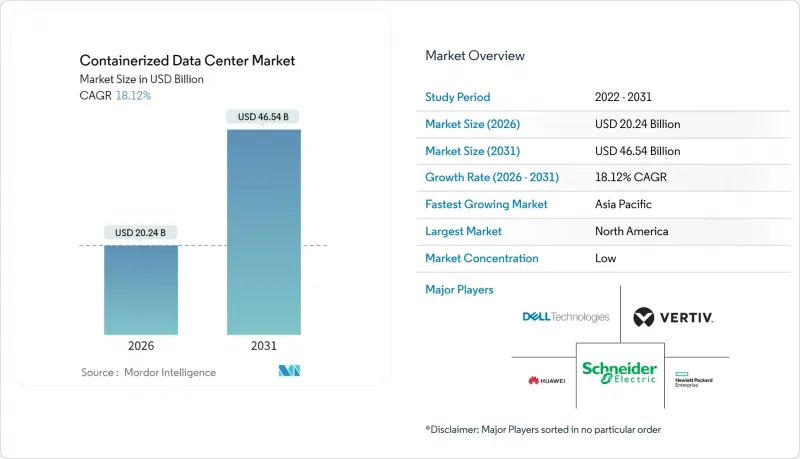
컨테이너형 데이터센터 시장 규모는 2026년에는 202억 4,000만 달러로 추정되고 있으며, 2025년 171억 3,000만 달러에서 성장하고 있습니다. 2031년의 예측에서는 465억 4,000만 달러에 달하며, 2026-2031년에 CAGR 18.12%로 성장할 것으로 전망되고 있습니다.
5G 구축, 엣지 컴퓨팅, 보다 엄격한 지속가능성 요구사항에 따른 신속한 도입 능력에 대한 수요가 급증함에 따라 주문 잔고는 계속 증가하고 있습니다. 하이퍼스케일 사업자들은 수년간의 구축 지연을 해소하기 위해 컨테이너 모듈을 활용하고 있으며, 기업은 데이터 주권 규정에 대응하기 위해 컨테이너 모듈을 도입하고 있습니다. 조립식 구조로 인한 효율화로 전력사용효율(PUE) 개선과 총소유비용(TCO) 절감을 실현하고, 모빌리티가 경쟁적 차별화 요소로 작용하고 있습니다. 업체들은 액체 냉각, 열 회수, 원자력 또는 수소 마이크로그리드를 결합하여 미활용 전력의 활용을 추진하고 있습니다. 이에 따라 컨테이너형 데이터센터 시장은 지속적인 두 자릿수 성장이 예상됩니다.
세계 컨테이너형 데이터센터 시장 동향 및 인사이트
엣지/5G 구축으로 마이크로 사이트 가속화 촉진
통신사들은 초저지연 서비스를 지원하기 위해 수천 개의 마이크로 엣지 노드를 배치하고 있습니다. 구매 주문에서 가동 개시까지 몇 주 만에 가능한 모듈형 유닛이 선택되었습니다. 2024년 5월 ANSI/TIA-942-C 표준 개정으로 유형 A와 유형 B의 마이크로 엣지 평가 기준이 신설되어 사업자에게 통일된 컴플라이언스 경로를 제공하고, 조달 주기를 가속화합니다. 컨테이너 폼팩터를 통해 프로바이더는 커버리지 맵의 진화에 따라 용량을 재배치할 수 있으며, 밀집된 도심부터 지방의 빈 공간까지 컨테이너 데이터센터 시장에서의 입지를 강화할 수 있습니다. 수요는 자율주행차, 산업용 IoT, AR/VR에 이르기까지 다양하며, 모두 네트워크 엣지에서 10밀리초 미만의 안정적인 지연이 요구됩니다. 현재 각 벤더들은 5G 무선 장비, MEC 서버, 배터리 저장 장치를 단일 리프트 유닛에 통합하여 도입 기간과 자본 리스크를 압축하고 있습니다. 5G의 밀집도가 2026년에 정점을 찍는 가운데, 제2의 프라이빗 네트워크 프로젝트가 마이크로사이트 프로젝트 파이프라인을 유지합니다.
Tier 1 허브의 용량 부족
버지니아 북부, 실리콘밸리, 런던의 토지, 전력, 허가 병목 현상으로 인해 신규 하이퍼스케일 프로젝트의 가동은 2028년까지 연기되었으며, 사업자들은 8-12주 내에 가동 가능한 모듈형 임시 용량을 임대해야만 했습니다. 이를 통해 컨테이너형 데이터센터 시장은 일시적인 용량 증설에서 전략적 거점 구축으로 전환하고 있으며, 전력망의 제약 속에서도 클라우드 기업이 고객 SLA를 유지할 수 있도록 지원하고 있습니다. 버지니아주 부동산 투자자에 따르면 변전소 업그레이드 예정지 인근의 모듈형 캠퍼스는 20% 이상의 임대료 프리미엄이 발생하고 있다고 합니다. 기업은 모듈을 인허가 지연이나 전력 공급 제한에 대한 보험으로 간주하고 있으며, 영구적인 시설 가동 후 유닛을 재배치할 계획인 경우가 많습니다.
제한된 랙 밀도와 하이퍼스케일 수요의 격차
ISO 표준 40피트 컨테이너는 일반적으로 랙당 10-15kW를 지원하며, 단일 모듈의 IT 전력은 60-180kW로 제한됩니다. 반면, 전용으로 설계된 하이퍼스케일 시설의 경우, 동일한 면적에서 20-40kW의 밀도와 300-500kW의 전력 공급을 실현합니다. 랙당 수백 개의 GPU를 필요로 하는 AI 및 HPC 클러스터는 여러 개의 컨테이너 또는 특수 액체 냉각 개조가 필요하며, 이는 MW당 자본비용을 증가시킵니다. 이러한 밀도 격차는 도쿄나 프랑크푸르트와 같이 부동산 가격이 높은 시장에서는 더욱 두드러집니다. 이곳에서는 1평방미터당 프리미엄이 부과됩니다. 업체들은 침지형 콜드 플레이트 설계로 대응하고 있지만, 도입 실적은 아직 제한적입니다. 밀도 격차가 해소될 때까지 일부 하이퍼스케일 아키텍트들은 주변 부하나 전환 부하를 위해 컨테이너화 시스템을 유보할 것입니다.
부문 분석
2025년 기준, 자산 관리를 중시하는 BFSI(은행, 금융, 보험) 업계와 정부 기관의 요청에 따라 구매 옵션이 컨테이너형 데이터센터 시장의 77.60%를 차지할 것으로 예측됩니다. 그러나 CFO가 가동률을 추적하는 운영 비용 모델로 전환함에 따라 임대/서비스형 화이트스페이스는 19.74%의 연평균 복합 성장률(CAGR)로 성장하고 있습니다. 초기 도입 기업은 모니터링 및 업데이트 서비스가 세트 제공됨으로써 인력 부담이 줄어들고, 기술 노후화 위험을 피할 수 있다는 점을 지적하고 있습니다. Hewlett-Packard Enterprise의 '시설 서비스'는 다년간의 성능 SLA를 보장하며, 기존 벤더가 구독 경제를 수용하고 있음을 보여줍니다.
리스는 중견기업을 위한 고사양 용량을 대중화하고, 2차 도시 지역 및 엣지 이용 사례에서 컨테이너형 데이터센터 시장 확대를 촉진하고 있습니다. 스타트업은 초기 자본 지출을 피할 수 있고, 대기업은 잔존가치 리스크를 줄일 수 있습니다. 계약기간 종료 후 모듈 반납, 이전, 교환의 유연성은 변동이 심한 AI 워크로드 특성에도 적합합니다. 보안 분류 및 맞춤형 설계가 임대 편의성을 능가하는 분야에서는 구매 모델이 지속되겠지만, 서비스 이용 곡선은 2031년까지 가파른 상승 곡선을 그릴 것으로 예측됩니다.
2025년 기준 ISO 40피트 표준 쉘은 컨테이너형 데이터센터 시장 규모의 54.10%를 차지할 것으로 예상되며, 세계 화물 표준에 대한 적합성과 낮은 랙 단가가 강점입니다. 한편, 커스텀/올인원 스키드는 19.18%의 연평균 복합 성장률(CAGR)로 성장하여 고밀도 랙 배치, 직접 칩 냉각, 내장형 UPS를 통합했습니다. AI/애널리틱스 클러스터에 대한 호소력을 높이고 있습니다. UL 2755 인증은 고정 시설과 동등한 안전성을 보장하고 기업의 조달 장벽을 완화합니다.
맞춤형 열 환경에 대한 수요가 증가함에 따라 공급업체들은 비표준 설치 공간에서 30kW 이상의 랙과 열 재사용 루프를 설계해야 하고, 평균 판매 가격은 상승하는 반면, 신규 시설 건설에 비해 도입 기간은 단축되고 있습니다. 2026년 이후 랙 전력이 증가함에 따라 많은 하이퍼스케일 설계자들은 GPU를 재생에너지 공급 지점 근처에 배치할 수 있는 현실적인 유일한 수단으로 커스텀 스키드에 주목하고 있습니다. ISO 표준 20피트 컨테이너는 틈새 시장이지만, 통신 엣지 쉘터나 공간 제약이 있는 도심의 옥상 설치에 여전히 유용합니다.
컨테이너형 데이터센터 시장은 소유 형태(구매, 임대, 서비스형 화이트스페이스), 컨테이너 유형(ISO 20피트, ISO 40피트, 커스텀/올인원 스키드), 설치 장소(코어/캠퍼스, 엣지/마이크로, 원격/혹독한 환경), 최종사용자 산업(IT, 통신, BFSI(은행, 보험, 금융, 보험) 등), 지역별로 세분화되어 있습니다. 최종사용자 산업(IT, 통신, BFSI(은행, 금융, 보험 등), 그리고 지역별로 분류됩니다. 시장 예측은 금액 기준(USD)으로 제공됩니다.
지역별 분석
북미는 2025년 매출의 29.05%를 차지할 것으로 예상되며, 텍사스, 조지아, 앨버타의 암호화폐 채굴 시설을 하이퍼스케일 AI 캠퍼스로 전환한 것이 견인차 역할을 할 것으로 예측됩니다. 미국에서는 신규 전력망 연결을 위한 수년간의 대기열을 피하기 위해 모듈을 도입하고, 캐나다에서는 타르샌드 모니터링 및 북극권 광대역 게이트웨이를 위해 내환경성 포드를 채택하고 있습니다. 멕시코의 니어쇼어링의 부흥으로 마킬라도라 공장 소유주는 미국 물류 거점과 실시간 품질 데이터를 동기화하는 엣지포드의 도입을 추진하고 있습니다. 이러한 추세와 함께 컨테이너형 데이터센터 시장은 대륙 전체를 아우르는 전략적 기반으로 강화되고 있습니다.
아시아태평양은 18.01%의 연평균 복합 성장률(CAGR)로 가장 빠르게 성장하고 있으며, 중국, 인도, 아세안 국가에서 5G 매크로 기지국 건설과 스마트 시티 실증이 확대되고 있습니다. 각 부처는 도시계획의 변화에 따라 추후 설치장소를 변경할 수 있는 컨테이너 클러스터에 대해 허가 절차를 신속히 처리하고 있습니다. 인도의 데이터 현지화 규제는 마이크로 리저널 포드에 대한 수요를 불러일으키고 있으며, 클라우드 사업자가 소비 지역 근처에서 시민 데이터를 격리할 수 있도록 허용하고 있습니다. 일본과 호주에서는 강구조 모듈이 가진 내진성, 내사이클론성을 높이 평가했습니다. 이러한 다양한 수요 요인이 복합적으로 작용하여 이 지역의 수주 파이프라인은 견고하게 유지되고 있습니다.
기타 특전:
- 엑셀 형식 시장 예측(ME) 시트
- 애널리스트의 3개월간 지원
자주 묻는 질문
목차
제1장 서론
제2장 조사 방법
제3장 개요
제4장 시장 구도
제5장 시장 규모와 성장 예측
제6장 경쟁 구도
제7장 시장 기회와 향후 전망
KSA 26.03.05The containerized data center market size in 2026 is estimated at USD 20.24 billion, growing from 2025 value of USD 17.13 billion with 2031 projections showing USD 46.54 billion, growing at 18.12% CAGR over 2026-2031.
Surging demand for rapid-deployment capacity, driven by 5G rollouts, edge computing, and stricter sustainability mandates, continues to lengthen order books. Hyperscale operators use container modules to bridge multi-year construction lags, while enterprises deploy them to meet data-sovereignty rules. Prefabricated efficiencies are tightening power usage effectiveness (PUE) margins and lowering total cost of ownership, making mobility a competitive differentiator. Vendors combine liquid cooling, heat-recovery, and nuclear or hydrogen micro-grids to unlock stranded power, positioning the containerized data center market for sustained double-digit expansion.
Global Containerized Data Center Market Trends and Insights
Edge/5G build-outs accelerate micro-sites
Telecom carriers are rolling out thousands of micro edge nodes to support ultra-low-latency services, choosing modular units that move from purchase order to "lights on" in weeks. The May 2024 ANSI/TIA-942-C update created Type A and Type B micro-edge ratings, giving operators a uniform compliance path and accelerating procurement cycles. Container form factors let providers relocate capacity as coverage maps evolve, strengthening the containerized data center market presence in dense urban cores and rural gaps alike. Demand spans autonomous vehicles, industrial IoT, and AR/VR, all of which require consistent sub-10 ms latency at the network edge. Vendors now bundle 5G radios, MEC servers, and battery storage into single-lift units, compressing deployment timelines and capital risk. As 5G densification peaks in 2026, a second wave of private-network projects will keep micro-site pipelines active.
Capacity shortages in Tier-1 hubs
Land, power, and permitting bottlenecks in Northern Virginia, Silicon Valley, and London have pushed new hyperscale projects into 2028 commissioning windows, forcing operators to lease interim modular capacity that can be live in 8-12 weeks. The containerized data center market thus shifts from temporary overflow to strategic footprint, enabling cloud firms to preserve customer SLAs despite grid constraints. Real-estate investors in Virginia report occupancy premiums topping 20% for modular campuses positioned near substation upgrades. Enterprises view the modules as insurance against entitlement delays and grid curtailments, and many plan to redeploy units once permanent halls come online.
Limited rack density vs hyperscale needs
ISO 40-foot boxes typically support 10-15 kW per rack, capping a single module at 60-180 kW IT power, whereas purpose-built hyperscale suites reach 20-40 kW densities and 300-500 kW in comparable floor area. AI and HPC clusters demanding hundreds of GPUs per rack therefore require multiple containers or specialized liquid-cooling retrofits, inflating capital cost per MW. The density gap is magnified in high-real-estate markets like Tokyo and Frankfurt, where every square meter carries a premium. Vendors answer with immersed cold-plate designs, yet deployment proof points remain limited. Until density parity closes, some hyperscale architects will reserve containerized systems for peripheral or transitional loads.
Other drivers and restraints analyzed in the detailed report include:
- Energy-efficient prefabrication lowers TCO
- SMR-powered micro-grids enable off-grid DCs
- Legacy estate integration complexity
For complete list of drivers and restraints, kindly check the Table Of Contents.
Segment Analysis
The Purchase option held 77.60% of containerized data center market share in 2025, fueled by BFSI and government mandates for asset control. However, Lease/"White-Space-as-a-Service" is growing at 19.74% CAGR as CFOs pivot to OpEx models that track utilization. Early adopters note that bundled monitoring and refresh services reduce staffing burdens and de-risk technology obsolescence. Hewlett Packard Enterprise's Facility-as-a-Service offering guarantees performance SLAs over multi-year terms, signaling that incumbent vendors embrace subscription economics.
Leasing democratizes high-spec capacity for mid-tier firms, swelling the containerized data center market footprint across secondary metros and edge use cases. Start-ups avoid upfront capital outlays, while large enterprises offload residual-value risk. The flexibility to return, relocate, or swap modules after the term also fits volatile AI workload profiles. Purchase models will persist where security classification or custom engineering outweigh leasing's convenience, yet the service curve is poised to steepen through 2031.
ISO 40-foot shells retained 54.10% of containerized data center market size in 2025, benefiting from global freight standards and lower per-rack cost. Customized/All-in-One Skids, advancing at 19.18% CAGR, integrate higher rack counts, direct-to-chip liquid cooling, and on-board UPS, appealing to AI and analytics clusters. UL 2755 certification assures safety parity with fixed facilities, easing enterprise procurement hurdles.
Demand for bespoke thermal envelopes pushes vendors to engineer 30 kW-plus racks and heat-reuse loops inside nonstandard footprints, lifting average selling price yet compressing deployment times compared with greenfield halls. As rack power escalates post-2026, many hyperscale architects view custom skids as the only pragmatic route to situate GPUs near renewable feed-in points. ISO 20-foot boxes, while niche, remain relevant for telecom edge shelters and space-constrained urban rooftops.
Containerized Data Center Market is Segmented by Ownership Type ( Purchase, Lease / "White-Space-As-A-Service"), Container Type (ISO 20-Ft, ISO 40-Ft, Customized/All-in-One Skids), Deployment Location ( Core / Campus, Edge / Micro, Remote / Harsh-Environment), End User Industry (IT and Telecommunications, BFSI and More), and by Geography. The Market Forecasts are Provided in Terms of Value (USD).
Geography Analysis
North America held 29.05% of 2025 revenue, anchored by hyperscale conversions of crypto mines into AI campuses across Texas, Georgia, and Alberta. The United States absorbs modules to circumvent multi-year queue backlogs for new grid interconnects, while Canada employs ruggedized pods for tar-sand monitoring and Arctic broadband gateways. Mexico's near-shoring renaissance drives maquiladora plant owners to install edge pods that sync real-time quality data with US logistics hubs. Together these trends reinforce the containerized data center market as a strategic overlay across the continent.
Asia-Pacific, the fastest-growing region at 18.01% CAGR, scales 5G macro builds and smart-city pilots across China, India, and ASEAN. Provinces grant accelerated permits for container clusters that can later shift sites as urban plans evolve. India's data-localization rulebook boosts demand for micro-regional pods, allowing cloud providers to ring-fence citizen data near consumption zones. Japan and Australia value seismic and cyclone resilience inherent in steel-framed modules. Collectively, diversified drivers keep the region's order pipeline robust.
- Vertiv
- Schneider Electric
- Huawei Technologies
- Dell Technologies
- Hewlett Packard Enterprise
- IBM Corporation
- Cisco Systems
- Rittal GmbH and Co. KG
- Delta Electronics
- Eaton Corporation
- Johnson Controls
- PCX Corporation
- BMarko Structures
- Baselayer Technology
- Flexenclosure (Xerxes)
- Cirrascale Cloud Services
- ZTE Corporation
- AST Modular (subs. of Schneider)
- Cannon Technologies
- EdgeMicro / EDJX
- Compass Datacenters
- EdgeConneX
- Vertiv (Emerson Network Power legacy)
- Stulz GmbH
Additional Benefits:
- The market estimate (ME) sheet in Excel format
- 3 months of analyst support
TABLE OF CONTENTS
1 INTRODUCTION
- 1.1 Study Assumptions and Market Definition
- 1.2 Scope of the Study
2 RESEARCH METHODOLOGY
3 EXECUTIVE SUMMARY
4 MARKET LANDSCAPE
- 4.1 Market Overview
- 4.2 Market Drivers
- 4.2.1 Portability and rapid deployment
- 4.2.2 Edge/5G build-outs accelerate micro-sites
- 4.2.3 Data-center capacity shortages in Tier-1 hubs
- 4.2.4 Energy-efficient prefabrication lowers TCO
- 4.2.5 SMR-powered micro-grids enable off-grid DCs
- 4.2.6 Crypto-to-AI site conversions unlock stranded power
- 4.3 Market Restraints
- 4.3.1 Limited rack and compute density vs hyperscale needs
- 4.3.2 Integration complexity with legacy DC estates
- 4.3.3 ISO-container supply-chain bottlenecks
- 4.3.4 Liquid-cooling retrofits raise CAPEX
- 4.4 Supply-Chain Analysis
- 4.5 Regulatory Landscape
- 4.6 Technological Outlook
- 4.7 Porter's Five Forces
- 4.7.1 Bargaining Power of Suppliers
- 4.7.2 Bargaining Power of Buyers
- 4.7.3 Threat of New Entrants
- 4.7.4 Threat of Substitutes
- 4.7.5 Intensity of Rivalry
- 4.8 Assesment of Macroeconomic Factors on the Market
5 MARKET SIZE AND GROWTH FORECASTS (VALUE)
- 5.1 By Ownership Type
- 5.1.1 Purchase
- 5.1.2 Lease / White-Space-as-a-Service
- 5.2 By Container Type
- 5.2.1 ISO 20-ft
- 5.2.2 ISO 40-ft
- 5.2.3 Customized/All-in-One Skids
- 5.3 By Deployment Location
- 5.3.1 Core / Campus
- 5.3.2 Edge / Micro
- 5.3.3 Remote / Harsh-Environment
- 5.4 By End-User Industry
- 5.4.1 IT and Telecommunications
- 5.4.2 BFSI
- 5.4.3 Government and Defense
- 5.4.4 Healthcare
- 5.4.5 Education
- 5.4.6 Others
- 5.5 By Geography
- 5.5.1 North America
- 5.5.1.1 United States
- 5.5.1.2 Canada
- 5.5.1.3 Mexico
- 5.5.2 South America
- 5.5.2.1 Brazil
- 5.5.2.2 Argentina
- 5.5.2.3 Rest of South America
- 5.5.3 Europe
- 5.5.3.1 Germany
- 5.5.3.2 United Kingdom
- 5.5.3.3 France
- 5.5.3.4 Netherlands
- 5.5.3.5 Rest of Europe
- 5.5.4 Asia-Pacific
- 5.5.4.1 China
- 5.5.4.2 Japan
- 5.5.4.3 India
- 5.5.4.4 South Korea
- 5.5.4.5 Australia and New Zealand
- 5.5.4.6 Rest of Asia-Pacific
- 5.5.5 Middle East and Africa
- 5.5.5.1 Middle East
- 5.5.5.1.1 United Arab Emirates
- 5.5.5.1.2 Saudi Arabia
- 5.5.5.1.3 Turkey
- 5.5.5.1.4 Rest of Middle East
- 5.5.5.2 Africa
- 5.5.5.2.1 South Africa
- 5.5.5.2.2 Egypt
- 5.5.5.2.3 Nigeria
- 5.5.5.2.4 Rest of Africa
- 5.5.5.1 Middle East
- 5.5.1 North America
6 COMPETITIVE LANDSCAPE
- 6.1 Market Concentration
- 6.2 Strategic Moves
- 6.3 Market Share Analysis
- 6.4 Company Profiles (includes Global level Overview, Market level overview, Core Segments, Financials as available, Strategic Information, Market Rank/Share for key companies, Products and Services, and Recent Developments)
- 6.4.1 Vertiv
- 6.4.2 Schneider Electric
- 6.4.3 Huawei Technologies
- 6.4.4 Dell Technologies
- 6.4.5 Hewlett Packard Enterprise
- 6.4.6 IBM Corporation
- 6.4.7 Cisco Systems
- 6.4.8 Rittal GmbH and Co. KG
- 6.4.9 Delta Electronics
- 6.4.10 Eaton Corporation
- 6.4.11 Johnson Controls
- 6.4.12 PCX Corporation
- 6.4.13 BMarko Structures
- 6.4.14 Baselayer Technology
- 6.4.15 Flexenclosure (Xerxes)
- 6.4.16 Cirrascale Cloud Services
- 6.4.17 ZTE Corporation
- 6.4.18 AST Modular (subs. of Schneider)
- 6.4.19 Cannon Technologies
- 6.4.20 EdgeMicro / EDJX
- 6.4.21 Compass Datacenters
- 6.4.22 EdgeConneX
- 6.4.23 Vertiv (Emerson Network Power legacy)
- 6.4.24 Stulz GmbH
7 MARKET OPPORTUNITIES AND FUTURE OUTLOOK
- 7.1 White-space and Unmet-Need Assessment