|
시장보고서
상품코드
1939021
아시아태평양의 사이버 보안 : 시장 점유율 분석, 업계 동향과 통계, 성장 예측(2026-2031년)APAC Cybersecurity - Market Share Analysis, Industry Trends & Statistics, Growth Forecasts (2026 - 2031) |
||||||
 Mordor Intelligence
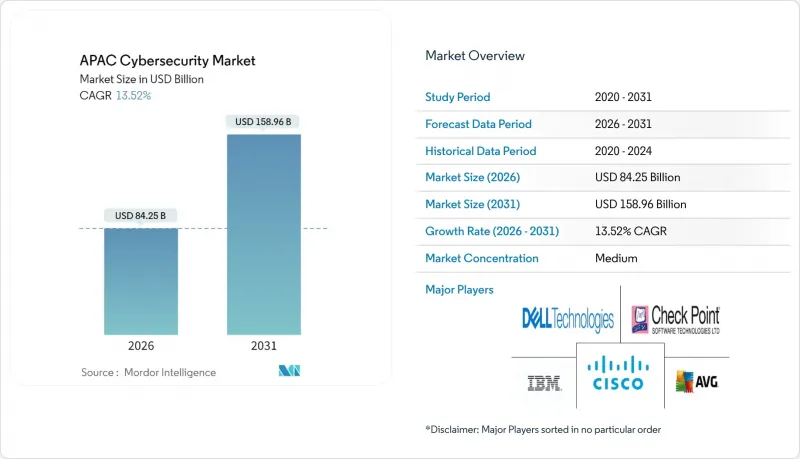
아시아태평양의 사이버 보안 시장은 2025년에 742억 2,000만 달러로 평가되며, 2026년 842억 5,000만 달러에서 2031년까지 1,589억 6,000만 달러에 달할 것으로 예측됩니다. 예측 기간(2026-2031년)의 CAGR은 13.52%로 전망됩니다.
국가 지원 공격 증가, 5G 확산 가속화, 디지털 결제 사기의 급증, 만성적인 인력 부족으로 인해 예산 우선순위가 재편되고 있으며, 지역 데이터 보호 규정으로 인해 지역 기반 공급업체에 유리한 방향으로 조달이 전환되고 있습니다. 경쟁의 초점은 제품 기능보다는 분절된 규제 환경에서 주권적 클라우드 아키텍처, AI 기반 관리형 감지, 통합된 IT-OT 보안을 제공할 수 있는 능력에 맞추어지고 있습니다. 특히 내부 보안 전문 지식이 부족한 중견 시장 부문에서 지역 특화 위협 인텔리전스와 확장 가능한 매니지드 서비스를 결합하는 공급자에게는 많은 기회가 있습니다.
아시아태평양 사이버 보안 시장 동향 및 인사이트
정부의 데이터 주권 의무화, 아시아태평양 국가 사이버 보안 지출 증가 가속화
2025년 시행되는 중국의 '네트워크 데이터 보안 관리 조례'는 중국내 데이터 처리를 의무화하고, 중국 내에서 사업을 영위하는 다국적 기업을 위해 별도의 보안 스택을 구축할 것을 요구하고 있습니다. 싱가포르가 새롭게 개편한 'Cyber Essentials' 프로그램은 정부 계약을 벤더 인증과 연계하여 현지 공급업체에 대한 수요를 촉진하고 있습니다. 호주의 REDSPICE 구상은 정보기관을 위한 소버린 클라우드에 20억 호주달러를 할당하여 정책이 사이버 보안 지출에 직접적으로 반영되는 실례를 보여주고 있습니다. 벤더들은 시장 접근성 유지를 위해 R&D 센터 및 SOC의 현지화를 추진하고 있으며, 국내 전문업체들은 컴플라이언스 대응을 통해 우위를 점하고 있습니다.
5G 도입으로 일본, 한국, 인도 통신사업자에게 새로운 네트워크 위협 요소 발생
높은 처리량의 5G 아키텍처는 기존의 경계 방어 툴로는 보호할 수 없는 마이크로 슬라이싱과 엣지 컴퓨팅 노드를 도입합니다. 일본의 '사이버 공격의 사전차단을 인정하는 법률'은 통신망을 대상으로 한 사이버 위협에 대한 선제적 차단을 허용하고 있습니다. 한국에서는 2024년 공공 네트워크에 대한 해킹 시도가 156만 건이 발생했으며, 그 중 80%가 5G 및 IoT 엔드포인트를 대상으로 한 것으로 나타났습니다. 인도 통신사들은 침해 사고의 57%가 서비스 지연을 유발한다고 보고했으며, 이는 제로 트러스트 및 AI 기반 분석의 시급성을 강조하고 있습니다. 이에 따라 통신사업자 환경에 최적화된 SASE(Secure Access Service Edge) 플랫폼 및 가상화 방화벽에 대한 수요가 증가하고 있습니다.
아시아태평양 신흥 경제권의 심각한 사이버 보안 인력 부족으로 서비스 비용 상승 전망
이 지역에는 280만 개의 사이버 보안 관련 일자리가 미충원되어 매니지드 서비스의 확장성을 제한하고, 중소기업(SME)의 예산을 초과하는 급여 수준을 높이고 있습니다. 필리핀은 공인 전문가가 200명에 불과한 반면, 싱가포르는 3,000명에 달하고, 프로젝트 지연이 심화되고 있습니다. 베트남은 2025년까지 1,000명의 전문가와 5,000명의 엔지니어를 양성하기 위해 인재양성 프로그램에 1억 달러를 책정했습니다. OT 보안과 클라우드 아키텍처 분야의 인력 부족이 가장 심각하며, 기업은 기능을 아웃소싱하거나 도입을 미루면서 대응 가능한 수요를 억제하고 있습니다.
부문 분석
2025년 기준 솔루션이 매출의 57.05%를 차지했으나, 기업이 인력 부족에 직면하면서 관리형 보안 서비스는 2031년까지 연평균 복합 성장률(CAGR) 20.86%로 확대될 것으로 예측됩니다. 아시아태평양 사이버 보안 시장에서는 24시간 365일 SOC 모니터링, 위협 헌팅, 사고 대응을 성과 기반 SLA로 제공하는 업체들이 우위를 점하고 있습니다. 엔사인포보안는 2024년 아시아태평양에서 유일하게 세계 MSSP Top 10에 진입하며 아시아태평양의 매니지드 서비스 성숙도가 높아졌음을 보여주고 있습니다.
내부 분석가들의 인건비 상승과 더불어 침해사고에 대한 이사회 차원의 책임 추궁으로 인해 대기업에서도 외부 SOC와 보안 툴 공동 관리를 추진하고 있습니다. AI를 통한 선별과 자동화를 통해 MSSP는 중견기업 고객에게 수익성 높은 서비스를 제공할 수 있게 되어 채택이 확대되고 있습니다. 그 결과, 플랫폼 기반 서비스 제공에 대한 투자가 가속화되고, 공급자들은 차별화를 위해 XDR, SOAR, 머신러닝 분석을 통합하고 있습니다.
2025년 기준, On-Premise 도입은 아시아태평양 사이버 보안 시장 점유율의 61.88%를 차지할 것으로 예측됩니다. 이는 규제 대상 업종이 여전히 데이터에 대한 물리적 통제를 중시하고 있기 때문입니다. 그러나 원격근무 의무화 및 멀티 클라우드 배포의 진전에 따라 클라우드 네이티브 보안은 22.8%의 연평균 복합 성장률(CAGR)로 성장하고 있습니다. HashCorp의 조사에 따르면 지역 기업의 70%가 멀티 클라우드를 통해 비즈니스 목표를 달성하고 있으며, 90%가 보안을 성공의 결정적 요인으로 평가했습니다.
조직은 클라우드 서비스 프로바이더(CSP)와 엣지 노드에 걸쳐 있는 워크로드를 보호하기 위해 제로 트러스트 네트워크와 컨테이너 보안을 도입하고 있습니다. 기술력 부족은 여전히 문제이며(31%는 클라우드 전문성 부족을 지적), 벤더들은 로우코드 정책 오케스트레이션과 매니지드 SASE 서비스를 통해 대응하고 있습니다. 그 결과 신규 프로젝트에서는 클라우드 배포이 우세해지고 있으며, 레거시 시스템의 전환 경로로 하이브리드 아키텍처가 부상하고 있습니다.
APAC 사이버 보안 시장 보고서는 업계를 제공 형태(솔루션, 서비스), 구축 모드(On-Premise, 클라우드), 최종사용자 산업(은행, 금융서비스 및 보험(BFSI), 의료, IT 및 통신, 산업 및 방위, 제조, 소매 및 E-Commerce, 에너지, 유틸리티, 기타), 최종사용자 기업 규모(중소기업(SME), 대기업(대기업), 기타), 국가별로 분석합니다. 유틸리티, 기타), 최종사용자 기업 규모별(중소기업(SME), 대기업), 국가별로 분석했습니다.
기타 특전:
- 엑셀 형식 시장 예측(ME) 시트
- 애널리스트의 3개월간 지원
자주 묻는 질문
목차
제1장 서론
제2장 조사 방법
제3장 개요
제4장 시장 구도
제5장 시장 세분화
제6장 경쟁 구도
제7장 시장 기회와 향후 전망
KSA 26.03.05The APAC cybersecurity market was valued at USD 74.22 billion in 2025 and estimated to grow from USD 84.25 billion in 2026 to reach USD 158.96 billion by 2031, at a CAGR of 13.52% during the forecast period (2026-2031).
Heightened state-sponsored attacks, accelerating 5G roll-outs, surging digital-payment fraud, and chronic talent shortages are reshaping budget priorities, while local data-protection rules are recasting procurement in favor of regionally domiciled vendors. Competition now hinges less on product features and more on the ability to deliver sovereign-cloud architectures, AI-driven managed detection, and integrated IT-OT security across fragmented regulatory environments. Opportunities abound for providers that combine localized threat intelligence with scalable managed services, especially in mid-market segments underserved by in-house security expertise.
APAC Cybersecurity Market Trends and Insights
Government Data-Sovereignty Mandates Accelerating Domestic Cybersecurity Spend Across APAC
China's Network Data Security Management Regulations taking effect in 2025 require in-country data processing and create separate security stacks for multinationals operating inside China. Singapore's refreshed Cyber Essentials program ties government contracts to vendor certification, driving local provider demand. Australia's REDSPICE initiative allocates AUD 2 billion to a sovereign cloud for the intelligence community, illustrating how policy translates directly into cybersecurity outlays. Vendors now localize R&D centers and SOCs to preserve market access, while homegrown specialists gain a compliance-driven edge.
5G Roll-Outs Creating New Network Threat Surfaces for Telcos in Japan, South Korea and India
High-throughput 5G architectures introduce micro-slicing and edge-compute nodes that traditional perimeter tools cannot secure. Japan's Active Cyber Defense law authorizes pre-emptive disruption of cyber threats targeting telecom networks. South Korea logged 1.56 million hacking attempts on public networks in 2024, 80% aimed at 5G and IoT endpoints. India's operators report that 57% of breaches result in service slowdowns, highlighting the urgency for zero-trust and AI-driven analytics. Consequently, demand is rising for secure access service edge (SASE) platforms and virtualized firewalls optimized for carrier environments.
Acute Cybersecurity Talent Shortage Inflating Service Costs in Emerging APAC Economies
The region accounts for 2.8 million unfilled cyber roles, restricting managed-service scalability and pushing salaries beyond SME budgets. The Philippines counts only 200 certified specialists versus Singapore's 3,000, amplifying project delays. Vietnam earmarked USD 100 million for workforce programs to train 1,000 experts and 5,000 engineers by 2025. Scarcity is most severe in OT security and cloud architecture, forcing enterprises to outsource functions or postpone deployments, dampening addressable demand.
Other drivers and restraints analyzed in the detailed report include:
- Surge in Digital-Payment and E-Commerce Fraud Driving Security Investments in Southeast Asia
- Escalating State-Sponsored Attacks on APAC Critical Infrastructure Stimulating OT Security Adoption
- Fragmented Regional Compliance Regimes Complicating Solution Standardization
For complete list of drivers and restraints, kindly check the Table Of Contents.
Segment Analysis
Solutions retained 57.05% revenue in 2025, yet managed security services are projected to expand 20.86% CAGR through 2031 as enterprises confront staffing gaps. The APAC cybersecurity market favors providers that bundle 24X7 SOC monitoring, threat hunting, and incident response under outcome-based SLAs. Ensign InfoSecurity became the only APAC firm to reach the global top-10 MSSP list in 2024, signaling the region's ascent in managed-service maturity.
Rising wages for in-house analysts, coupled with board-level accountability for breaches, push even large enterprises to co-manage security tools with external SOCs. AI-assisted triage and automation enable MSSPs to serve mid-market clients profitably, widening adoption. As a result, investment in platform-based service delivery is accelerating, with providers embedding XDR, SOAR, and machine-learning analytics to differentiate.
On-premise installations held 61.88% of APAC cybersecurity market share in 2025 because regulated sectors still favor physical control over data. Cloud-native security, however, is growing at 22.8% CAGR, propelled by remote-work mandates and multi-cloud adoption. A HashiCorp survey showed 70% of regional firms hit business targets via multi-cloud, with 90% rating security the defining success factor.
Organizations are embracing zero-trust networking and container security to protect workloads that span CSPs and edge nodes. Skills shortages remain a headwind-31% cite limited cloud expertise-but vendors counter with low-code policy orchestration and managed SASE offerings. Consequently, cloud deployments increasingly win green-field projects, while hybrid architectures emerge as a transition path for legacy systems.
The APAC Cybersecurity Market Report Segments the Industry Into by Offering (Solutions, and Services), Deployment Mode (On-Premise, and Cloud), End-User Vertical (BFSI, Healthcare, IT and Telecom, Industrial and Defense, Manufacturing, Retail and E-Commerce, Energy and Utilities, Manufacturing, and Others), and End-User Enterprise Size (Small and Medium Enterprises (SMEs), and Large Enterprises), and Country.
List of Companies Covered in this Report:
- Cisco Systems, Inc.
- IBM Corporation
- Huawei Technologies Co., Ltd.
- Palo Alto Networks, Inc.
- Check Point Software Technologies Ltd.
- Fortinet, Inc.
- Kaspersky Lab
- Broadcom, Inc. (Symantec Enterprise Division)
- BAE Systems plc
- NEC Corporation
- Infosys Limited
- Tata Consultancy Services Limited
- Darktrace plc
- Zscaler, Inc.
- CrowdStrike Holdings, Inc.
- F5, Inc.
- Sophos Ltd.
- Okta, Inc.
- SentinelOne, Inc.
- Rapid7, Inc.
- Imperva, Inc
Additional Benefits:
- The market estimate (ME) sheet in Excel format
- 3 months of analyst support
TABLE OF CONTENTS
1 INTRODUCTION
- 1.1 Study Assumptions and Market Definition
- 1.2 Scope of the Study
2 RESEARCH METHODOLOGY
3 EXECUTIVE SUMMARY
4 MARKET LANDSCAPE
- 4.1 Market Overview
- 4.2 Market Drivers
- 4.2.1 Government Data-Sovereignty Mandates Accelerating Domestic Cybersecurity Spend Across APAC
- 4.2.2 5G Roll-Outs Creating New Network Threat Surfaces for Telcos in Japan, South Korea and India
- 4.2.3 Surge in Digital Payments and E-commerce Fraud Driving Security Investments in Southeast Asia
- 4.2.4 Escalating State-Sponsored Attacks on APAC Critical Infrastructure Stimulating OT Security Adoption
- 4.2.5 SME Cloud Migration Wave Necessitating Cloud Workload Protection in China and ASEAN
- 4.2.6 National Cybersecurity Incentive Programs (e.g., SG Cyber Safe, REDSPICE) Catalyzing Market Growth
- 4.3 Market Restraints
- 4.3.1 Acute Cybersecurity Talent Shortage Inflating Service Costs in Emerging APAC Economies
- 4.3.2 Fragmented Regional Compliance Regimes Complicating Solution Standardization
- 4.3.3 High Price Sensitivity Among APAC SMEs Limiting Adoption of Advanced Solutions
- 4.3.4 Supply-Chain Disruptions from Export Controls on Security Hardware Components
- 4.4 Evaluation of Critical Regulatory Framework
- 4.5 Value Chain Analysis
- 4.6 Technological Outlook
- 4.7 Porter's Five Forces
- 4.7.1 Bargaining Power of Suppliers
- 4.7.2 Bargaining Power of Buyers
- 4.7.3 Threat of New Entrants
- 4.7.4 Threat of Substitutes
- 4.7.5 Competitive Rivalry
- 4.8 Key Use Cases and Case Studies
- 4.9 Impact on Macroeconomic Factors of the Market
- 4.10 Investment Analysis
5 MARKET SEGMENTATION
- 5.1 By Offering
- 5.1.1 Solutions
- 5.1.1.1 Application Security
- 5.1.1.2 Cloud Security
- 5.1.1.3 Data Security
- 5.1.1.4 Identity and Access Management
- 5.1.1.5 Infrastructure Protection
- 5.1.1.6 Integrated Risk Management
- 5.1.1.7 Network Security Equipment
- 5.1.1.8 Endpoint Security
- 5.1.1.9 Other Services
- 5.1.2 Services
- 5.1.2.1 Professional Services
- 5.1.2.2 Managed Services
- 5.1.1 Solutions
- 5.2 By Deployment Mode
- 5.2.1 On-Premise
- 5.2.2 Cloud
- 5.3 By End-User Vertical
- 5.3.1 BFSI
- 5.3.2 Healthcare
- 5.3.3 IT and Telecom
- 5.3.4 Industrial and Defense
- 5.3.5 Manufacturing
- 5.3.6 Retail and E-commerce
- 5.3.7 Energy and Utilities
- 5.3.8 Manufacturing
- 5.3.9 Others
- 5.4 By End-User Enterprise Size
- 5.4.1 Small and Medium Enterprises (SMEs)
- 5.4.2 Large Enterprises
- 5.5 By Country
- 5.5.1 China
- 5.5.2 Japan
- 5.5.3 India
- 5.5.4 South Korea
- 5.5.5 Australia and New Zealand
- 5.5.6 Singapore
- 5.5.7 Rest of Asia Pacific
6 COMPETITIVE LANDSCAPE
- 6.1 Market Concentration
- 6.2 Strategic Moves
- 6.3 Market Share Analysis
- 6.4 Company Profiles {(includes Global level Overview, Market level overview, Core Segments, Financials as available, Strategic Information, Market Rank/Share for key companies, Products and Services, and Recent Developments)}
- 6.4.1 Cisco Systems, Inc.
- 6.4.2 IBM Corporation
- 6.4.3 Huawei Technologies Co., Ltd.
- 6.4.4 Palo Alto Networks, Inc.
- 6.4.5 Check Point Software Technologies Ltd.
- 6.4.6 Fortinet, Inc.
- 6.4.7 Kaspersky Lab
- 6.4.8 Broadcom, Inc. (Symantec Enterprise Division)
- 6.4.9 BAE Systems plc
- 6.4.10 NEC Corporation
- 6.4.11 Infosys Limited
- 6.4.12 Tata Consultancy Services Limited
- 6.4.13 Darktrace plc
- 6.4.14 Zscaler, Inc.
- 6.4.15 CrowdStrike Holdings, Inc.
- 6.4.16 F5, Inc.
- 6.4.17 Sophos Ltd.
- 6.4.18 Okta, Inc.
- 6.4.19 SentinelOne, Inc.
- 6.4.20 Rapid7, Inc.
- 6.4.21 Imperva, Inc
7 MARKET OPPORTUNITIES AND FUTURE OUTLOOK
- 7.1 White-space and Unmet-Need Assessment