
|
시장보고서
상품코드
1939073
슈퍼커패시터 : 시장 점유율 분석, 업계 동향과 통계, 성장 예측(2026-2031년)Supercapacitors - Market Share Analysis, Industry Trends & Statistics, Growth Forecasts (2026 - 2031) |
||||||
 Mordor Intelligence
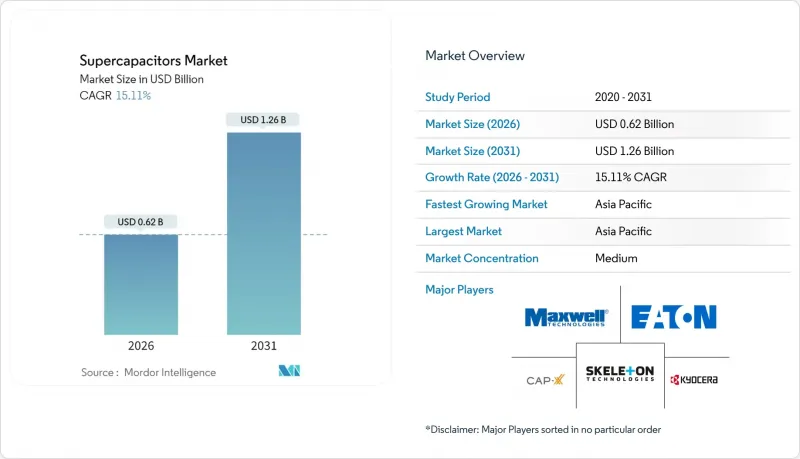
슈퍼커패시터 시장은 2025년 5억 4,000만 달러에서 2026년에는 6억 2,000만 달러로 성장하여 2026년부터 2031년까지 CAGR 15.11%를 기록하며 2031년까지 12억 6,000만 달러에 달할 것으로 예측됩니다.
이러한 성장은 유럽연합의 48볼트 마일드 하이브리드 의무화 등 전기화 규제, 인공지능(AI) 수요 확대에 따른 데이터센터의 무정전 전원 수요, 빠른 주파수 응답을 위해 배터리와 슈퍼커패시터를 결합한 송전망 현대화 프로젝트가 뒷받침하고 있습니다. 지원되고 있습니다. 중국은 생산 및 연구 거점으로서의 지위를 계속 유지하고 있지만, 한국 업체들은 리튬이온 배터리 점유율이 감소하는 가운데 에너지 저장 시스템으로 중심축을 옮기고 있습니다. 제품 혁신은 에너지 밀도를 배터리 수준으로 높이는 하이브리드 설계와 초박형 웨어러블을 가능하게 하는 그래핀 전극에 초점을 맞추고 있습니다. 활성탄 가격 및 이온 액체 전해질을 둘러싼 공급망 리스크는 단기적인 수익률을 억제하는 한편, 지역 분산을 촉진하는 요인으로 작용하고 있습니다.
세계 슈퍼커패시터 시장 동향 및 인사이트
전기버스 차량에 회생제동용 슈퍼커패시터 모듈이 빠르게 보급되고 있습니다.
도시 교통기관에서는 배터리와 슈퍼커패시터를 결합한 회생제동시스템 도입을 확대하고 있으며, 배터리 단독 시스템에 비해 최대 85% 더 많은 운동 에너지를 회수하고 있습니다. 메르세데스-벤츠의 인투로 하이브리드 버스는 수백만 번의 충방전 사이클을 열화 없이 견딜 수 있는 48V 슈퍼커패시터 팩을 채택해 연료 소비를 5% 절감했습니다. 중국 도시들이 선구적으로 도입을 추진하여 현재는 하이브리드 차량 기지를 전력망에 연결하여 차량 충전과 계통 안정화 서비스 모두에 활용하고 있습니다. 시스템 공급업체는 주행 경로의 지형에 따라 슈퍼커패시터와 배터리의 전력 이동을 제어하는 알고리즘을 통합하여 총소유비용을 절감할 수 있습니다. 전기 버스 조달이 증가함에 따라 이 기능은 대중교통 전기화에서 슈퍼커패시터 시장의 경쟁력을 강화하고 있습니다.
그리드 스케일 배터리-슈퍼커패시터 하이브리드 저장 시스템
전력회사는 순간적인 주파수 조정 능력으로 인해 슈퍼커패시터를 높이 평가하고 있습니다. 실증시험에서 단독 리튬이온 어레이 대비 주파수 저하율이 17.43% 감소하여 배터리 단독 솔루션 대비 3.2배의 경제적 이점을 확인했습니다. 미국 에너지부는 셀 생산의 자동화가 진행됨에 따라 2030년까지 전력 저장의 균등화 비용이 kWh당 0.337달러에 달할 것으로 예측하고 있습니다. 또한, 슈퍼커패시터는 코발트나 니켈을 사용하지 않기 때문에 환경적인 측면에서도 사업자들에게 우월성을 인정받고 있습니다. 이러한 요인으로 인해 슈퍼커패시터 시장은 재생에너지 비율이 높은 시나리오에서 장시간 저장 배터리를 보완하는 중요한 계통 형성 자원으로 자리매김하고 있습니다.
주택 도입을 제한하는 인증의 격차(IEC 62391)
IEC 62391 시험 절차는 특히 중소기업의 경우 인증 획득 기간을 연장하고 비용을 증가시킵니다. 비교 연구에 따르면, 이 표준은 Maxwell 및 QC/T 741-2014 프로토콜보다 시간이 더 오래 걸리며, 제품 출시가 최대 12개월 지연되는 것으로 나타났습니다. 고전류 테스트에 대한 과도한 강조는 일반적인 가정용 전력 프로파일과 일치하지 않습니다. 이러한 관리적 장벽은 간소화된 적합성 평가로 새로운 수요가 창출될 수 있는 주택용 에너지 저장 분야로의 슈퍼커패시터 시장 침투를 지연시키고 있습니다.
부문 분석
전기 이중층 커패시터는 기존 생산 라인과 산업용 전력 버퍼링에서 입증된 내구성을 반영하여 2025년 슈퍼커패시터 시장에서 54.62%의 점유율을 유지했습니다. 하이브리드 슈퍼커패시터는 배터리와 같은 에너지 저장과 기존 커패시터의 전력 공급을 융합하여 2031년까지 17.62%의 CAGR을 달성할 것으로 예상됩니다. 이 하이브리드 방식은 몇 초간의 전압 강하를 견딜 수 있는 동시에 더 긴 방전 프로파일을 유지할 수 있는 디바이스를 원하는 OEM의 요구에 부응하는 방식입니다.
리튬이온 커패시터의 변형 등 급속한 연구 개발의 발전으로 에너지 밀도 차이가 줄어들고 작동 온도 범위가 확대되고 있습니다. 자동차 인버터 및 계통연계형 시스템 시범 프로젝트에서 100만 사이클 이상의 사이클 수명이 입증되었습니다. 이러한 특성으로 인해 하이브리드 타입은 슈퍼커패시터 업계에서 차세대 성능 표준으로 자리매김하고 있습니다.
모듈 어셈블리는 통합 밸런스 회로와 버스, 크레인, 풍력 터빈에 대한 드롭인 호환성으로 인해 2025년 슈퍼커패시터 시장의 57.12%를 차지할 것으로 예상됩니다. 그러나 그리드 사업자와 전기자동차 제조업체들이 고전압 스택(800V 이상)을 선택하는 추세로 인해 팩 구성은 연간 16.95%의 성장이 예상됩니다. 전력회사가 서브세컨드 주파수 응답을 위해 도입을 추진함에 따라, 팩 레벨 제품의 슈퍼커패시터 시장 규모는 2031년까지 두 배로 증가할 수 있습니다.
셀 제품은 기판 레벨의 통합과 비용에 대한 중요성이 여전히 중요한 웨어러블 기기 및 산업용 컨트롤러에서 그 존재 의미를 유지하고 있습니다. 각 벤더들은 현재 50볼트 단위로 에너지 용량을 확장할 수 있는 모듈식 구조를 제공하여 프로젝트 설계 주기를 단축하고 있습니다. 고급 열 관리 기능을 통해 열악한 환경에서의 적용 범위가 더욱 확대되고 있습니다.
지역별 분석
중국은 2025년 활성탄 처리 규모와 고 영향력 논문의 65.4%를 발표하는 심층 연구 기반에 힘입어 전 세계 수익의 27.88%를 차지하였습니다. 전기자동차 제조사와 국가 지원 송전망 프로젝트에서 나오는 국내 수요가 물량 성장을 뒷받침하고 있습니다. 국내 에너지 저장 컨텐츠를 우선시하는 국가 정책은 슈퍼커패시터 시장의 공급망 생태계를 더욱 강화하고 있습니다.
한국 및 아시아 지역 전체에서는 LG 에너지 솔루션, 삼성SDI, SK ON의 200억 달러 이상의 신규 생산능력 투자에 힘입어 2031년까지 CAGR 15.96%를 기록할 것으로 예상됩니다. 한국 기업은 전극 코팅 기술을 활용하여 북미 전력회사를 위한 팩 레벨 축전 시스템 개발을 추진하고 있습니다. 일본은 고신뢰성 자동차 모듈용 정밀 제조기술을 제공하고, 동남아시아 국가들은 공급기반 다변화를 위해 조립공장을 유치하고 있습니다.
미국은 인플레이션 억제법 특혜를 활용하여 생산의 현지화와 하이퍼스케일 데이터센터용 슈퍼커패시터 기반 UPS 유닛 도입을 추진하고 있습니다. 유럽은 규제 주도의 자세를 유지하고 있으며, 유로7 규제 프레임워크는 자동차 수요를 촉진하고, 전력망 현대화 기금은 하이브리드 저장 파일럿 플랜트를 지원하고 있습니다. 라틴아메리카와 중동의 신흥 지역에서는 마이크로그리드 안정화를 위한 슈퍼커패시터 팩이 시험적으로 도입되고 있으며, 이는 슈퍼커패시터 시장의 장기적인 성장 가능성을 시사하고 있습니다.
기타 특전:
- 엑셀 형식의 시장 예측(ME) 시트
- 애널리스트의 3개월간 지원
자주 묻는 질문
목차
제1장 소개
제2장 조사 방법
제3장 주요 요약
제4장 시장 구도
제5장 시장 규모와 성장 예측
제6장 경쟁 구도
제7장 시장 기회와 향후 전망
KSM 26.03.09The supercapacitors market is expected to grow from USD 0.54 billion in 2025 to USD 0.62 billion in 2026 and is forecast to reach USD 1.26 billion by 2031 at 15.11% CAGR over 2026-2031.
Growth is supported by electrification rules such as the European Union's 48-volt mild-hybrid mandate, datacenter demand for uninterruptible power during artificial-intelligence (AI) surges, and grid-modernization projects that blend batteries with supercapacitors for rapid frequency response. China continues to anchor production and research, while Korean manufacturers pivot toward energy-storage systems as their lithium-ion share slips. Product innovation centres on hybrid designs that lift energy density toward battery-like levels and graphene electrodes that enable ultra-thin wearables. Supply-chain risks around activated-carbon prices and ionic-liquid electrolytes temper near-term margins but also encourage regional diversification.
Global Supercapacitors Market Trends and Insights
Rapid adoption of regenerative-braking supercapacitor modules in e-bus fleets
Urban transit agencies are scaling regenerative-braking systems that pair batteries with supercapacitors, recovering up to 85% more kinetic energy than battery-only setups. Mercedes-Benz's Intouro hybrid bus cut fuel use by 5% using a 48-volt supercapacitor pack that endures millions of charge cycles without degradation. Chinese cities were first movers and now link hybrid depots to the grid for both vehicle charging and grid-stability services. System suppliers integrate algorithms that shift power between supercapacitors and batteries to match route topography, which lowers total cost of ownership. As electric-bus procurements rise, this capability strengthens the competitive position of the supercapacitors market in mass-transit electrification.
Grid-scale battery-supercapacitor hybrid storage
Utilities value supercapacitors for instant frequency regulation. Demonstrations showed a 17.43% reduction in frequency-drop rates versus standalone lithium-ion arrays, delivering economic benefits 3.2-times greater than battery-only solutions. The U.S. Department of Energy projects levelized storage costs of USD 0.337 per kWh by 2030 as automated cell production scales. Operators also cite environmental advantages because supercapacitors avoid cobalt and nickel. These factors position the supercapacitors market as an essential grid-forming resource that complements long-duration batteries under high-renewable penetration scenarios.
Certification gaps (IEC 62391) limiting residential adoption
IEC 62391 testing procedures prolong qualification timelines and raise costs, especially for smaller firms. Comparative studies show the standard takes longer than Maxwell and QC/T 741-2014 protocols, stretching product launches by up to 12 months. The heavy focus on high-current testing is mismatched with typical household power profiles. This administrative hurdle slows the supercapacitors market from penetrating residential energy-storage segments where simplified compliance would unlock new demand.
Other drivers and restraints analyzed in the detailed report include:
- Graphene-based electrode breakthroughs enabling ultra-thin wearables
- EU 48 V mild-hybrid mandate accelerating demand for 12-48 V modules
- Energy-density plateau (~10 Wh/kg) restricting long-range EV penetration
For complete list of drivers and restraints, kindly check the Table Of Contents.
Segment Analysis
Electric Double-Layer Capacitors maintained a 54.62% share of the supercapacitors market in 2025, reflecting established production lines and proven durability in industrial power buffering. Hybrid Supercapacitors are on track for an 17.62% CAGR to 2031 as they merge battery-like energy storage with classic capacitor power delivery. The hybrid approach answers OEM calls for devices that can ride through seconds-long voltage dips and also sustain longer discharge profiles.
Rapid R&D advances, including lithium-ion capacitor variants, narrow the energy-density gap and extend operating temperatures. Pilot projects in automotive inverters and grid-forming systems showcase cycle lifetimes beyond one million cycles. These traits position hybrids as the next performance benchmark within the supercapacitors industry.
Module assemblies captured 57.12% of the supercapacitors market in 2025 thanks to integrated balancing circuitry and drop-in compatibility for buses, cranes, and wind turbines. Pack configurations, however, are projected to grow 16.95% annually as grid operators and EV makers opt for higher-voltage stacks that exceed 800 V. The supercapacitors market size for pack-level products could double by 2031 as utilities deploy them for sub-second frequency response.
Cell products retain relevance in wearables and industrial controllers where board-level integration and cost sensitivity remain critical. Vendors now offer modular architectures that let customers scale energy in 50-volt increments, shortening project design cycles. Advanced thermal-management features further widen adoption across harsh-duty environments.
The Supercapacitors Market Report is Segmented by Configuration (Type) (Electric Double-Layer Capacitors (EDLC), Pseudo Capacitors, and Hybrid Supercapacitors), Form Factor (Cell, Module, and Pack), Mounting Type (Discrete Components) (Surface-Mount, Radial Leaded, Snap-In, and More), End-User Industry (Consumer Electronics, Energy and Utilities, and More), and Geography. The Market Forecasts are Provided in Terms of Value (USD).
Geography Analysis
China controlled 27.88% of global revenue in 2025 due to scale in activated-carbon processing and a deep research base that publishes 65.4% of high-impact papers. Domestic demand from electric-vehicle makers and state-backed grid projects underpins volume growth. State policies that prioritise local energy-storage content further entrench supply-chain ecosystems for the supercapacitors market.
Korea and the broader Asia region are set for a 15.96% CAGR through 2031, propelled by LG Energy Solution, Samsung SDI, and SK On investments that exceed USD 20 billion in new capacity. Korean firms channel expertise in electrode coatings toward pack-level storage systems aimed at North American utilities. Japan contributes precision manufacturing for high-reliability automotive modules, while Southeast Asian nations attract assembly plants seeking diversified supply bases.
The United States leverages Inflation Reduction Act incentives to localise production and deploy supercapacitor-based UPS units in hyperscale datacenters. Europe remains regulation-driven, with the Euro 7 framework spurring automotive demand and grid-modernization funds supporting hybrid storage pilot plants. Emerging regions in Latin America and the Middle East trial supercapacitor packs for microgrid stability, signalling long-term addressable growth for the supercapacitors market.
List of Companies Covered in this Report:
- Maxwell Technologies Inc. (Tesla)
- Skeleton Technologies SA
- CAP-XX Ltd.
- Eaton Corporation plc
- Panasonic Holdings Corp.
- LS Mtron Ltd.
- Kyocera Corp.
- Nippon Chemi-Con Corp.
- Supreme Power Solutions Co.
- Shanghai Aowei Technology Development Co.
- Samwha capacitor Group
- Nanoramic Laboratories (FastCAP)
- Nawa Technologies SAS
- Cornell Dubilier Electronics Inc.
- Toyo capacitor Co.
- Shenzhen Topmay Electronic Co.
- Liaoning Brother Electronics Technology Co.
- Chengdu ZT-Energy Tech Co.
- Loxus Inc.
- Nantong Jianghai capacitor Co. Ltd
- Beijing HCC Energy
- Jinzhou Kaimei Power Co. Ltd (KAM)
- Shanghai Green Tech Co. Ltd (GTCAP)
- Shenzhen Topmay Electronic Co. Ltd
- SEMG (Seattle Electronics Manufacturing Group (HK) Co. Ltd)
- Shanghai Pluspark Electronics Co. Ltd
Additional Benefits:
- The market estimate (ME) sheet in Excel format
- 3 months of analyst support
TABLE OF CONTENTS
1 INTRODUCTION
- 1.1 Study Assumptions and Market Definition
- 1.2 Scope of the Study
2 RESEARCH METHODOLOGY
3 EXECUTIVE SUMMARY
4 MARKET LANDSCAPE
- 4.1 Market Overview
- 4.2 Market Drivers
- 4.2.1 Rapid adoption of regenerative-braking supercapacitor modules in e-bus fleets
- 4.2.2 Grid-scale battery-supercapacitor hybrid storage
- 4.2.3 Graphene-based electrode breakthroughs enabling ultra-thin wearables
- 4.2.4 EU 48 V mild-hybrid mandate accelerating demand for 12-48 V modules
- 4.2.5 Supercapacitor-based UPS deployment by Datacenter hyperscalers to meet ESG targets
- 4.3 Market Restraints
- 4.3.1 Activated-carbon precursor price volatility inflating BOM costs
- 4.3.2 Certification gaps (IEC 62391) limiting the residential adoption
- 4.3.3 Energy-density plateau (~10 Wh/kg) restricting long-range EV penetration
- 4.3.4 Ionic-liquid electrolyte supply-chain bottlenecks elongating lead-times
- 4.4 Regulatory and Technological Outlook (Electrode Material, Capacity Ratings, Electrolyte, Voltage Range)
- 4.5 Impact of Macroeconomic Factors and Trade Tarrifs
- 4.6 Porter's Five Forces Analysis
- 4.6.1 Bargaining Power of Suppliers
- 4.6.2 Bargaining Power of Buyers
- 4.6.3 Threat of New Entrants
- 4.6.4 Threat of Substitutes
- 4.6.5 Intensity of Competitive Rivalry
- 4.7 Investment and Funding Analysis
5 MARKET SIZE AND GROWTH FORECASTS (VALUES)
- 5.1 By Configuration (Type)
- 5.1.1 Electric Double-Layer Capacitors (EDLC)
- 5.1.2 Pseudocapacitors
- 5.1.3 Hybrid Supercapacitors
- 5.2 By Form Factor
- 5.2.1 Cell
- 5.2.2 Module
- 5.2.3 Pack
- 5.3 By Mounting Type (Discrete Components)
- 5.3.1 Surface-Mount
- 5.3.2 Radial Leaded
- 5.3.3 Snap-in
- 5.3.4 Screw Terminal
- 5.4 By End-User Industry
- 5.4.1 Consumer Electronics
- 5.4.1.1 Wearables
- 5.4.1.2 Smartphones and Tablets
- 5.4.1.3 SSD and Memory Backup
- 5.4.2 Energy and Utilities
- 5.4.2.1 Grid Frequency Regulation
- 5.4.2.2 Renewable Integration (Wind, Solar)
- 5.4.2.3 Microgrid and UPS
- 5.4.3 Industrial Equipment
- 5.4.3.1 Robotics and Automation
- 5.4.3.2 Power Tools
- 5.4.3.3 Heavy Machinery and Cranes
- 5.4.4 Automotive and Transportation
- 5.4.4.1 Passenger Cars
- 5.4.4.1.1 48 V Mild Hybrid
- 5.4.4.1.2 Start-Stop Micro Hybrid
- 5.4.4.2 Commercial Vehicles
- 5.4.4.2.1 Buses
- 5.4.4.2.2 Trucks
- 5.4.4.3 Rail and Tram
- 5.4.4.4 Aviation and Aerospace
- 5.4.4.1 Passenger Cars
- 5.4.5 Data Centers and Telecom
- 5.4.6 Defense and Space
- 5.4.7 Others (Medical Devices, Agri-drones)
- 5.4.1 Consumer Electronics
- 5.5 By Geography
- 5.5.1 United States
- 5.5.2 Europe
- 5.5.3 China
- 5.5.4 Japan
- 5.5.5 Korea and Rest of Asia-Pacific
- 5.5.6 Rest of the World
6 COMPETITIVE LANDSCAPE
- 6.1 Market Concentration
- 6.2 Strategic Moves
- 6.3 Market Share Analysis
- 6.4 Company Profiles (includes Global Level Overview, Market Level Overview, Core Segments, Financials, Strategic Information, Market Rank/Share, Products and Services, Recent Developments)
- 6.4.1 Maxwell Technologies Inc. (Tesla)
- 6.4.2 Skeleton Technologies SA
- 6.4.3 CAP-XX Ltd.
- 6.4.4 Eaton Corporation plc
- 6.4.5 Panasonic Holdings Corp.
- 6.4.6 LS Mtron Ltd.
- 6.4.7 Kyocera Corp.
- 6.4.8 Nippon Chemi-Con Corp.
- 6.4.9 Supreme Power Solutions Co.
- 6.4.10 Shanghai Aowei Technology Development Co.
- 6.4.11 Samwha capacitor Group
- 6.4.12 Nanoramic Laboratories (FastCAP)
- 6.4.13 Nawa Technologies SAS
- 6.4.14 Cornell Dubilier Electronics Inc.
- 6.4.15 Toyo capacitor Co.
- 6.4.16 Shenzhen Topmay Electronic Co.
- 6.4.17 Liaoning Brother Electronics Technology Co.
- 6.4.18 Chengdu ZT-Energy Tech Co.
- 6.4.19 Loxus Inc.
- 6.4.20 Nantong Jianghai capacitor Co. Ltd
- 6.4.21 Beijing HCC Energy
- 6.4.22 Jinzhou Kaimei Power Co. Ltd (KAM)
- 6.4.23 Shanghai Green Tech Co. Ltd (GTCAP)
- 6.4.24 Shenzhen Topmay Electronic Co. Ltd
- 6.4.25 SEMG (Seattle Electronics Manufacturing Group (HK) Co. Ltd)
- 6.4.26 Shanghai Pluspark Electronics Co. Ltd
7 MARKET OPPORTUNITIES AND FUTURE OUTLOOK
- 7.1 White-space and Unmet-Need Assessment