|
시장보고서
상품코드
1939087
자동차 조명 : 시장 점유율 분석, 업계 동향과 통계, 성장 예측(2026-2031년)Automotive Lighting - Market Share Analysis, Industry Trends & Statistics, Growth Forecasts (2026 - 2031) |
||||||
 Mordor Intelligence
2026년 자동차 조명 시장 규모는 257억 달러로 추정되며, 2025년 244억 5,000만 달러에서 성장하여 2031년에는 329억 8,000만 달러에 달할 것으로 예측됩니다.
2026년부터 2031년까지 연평균 성장률(CAGR) 5.12%에 달할 것으로 예상됩니다.
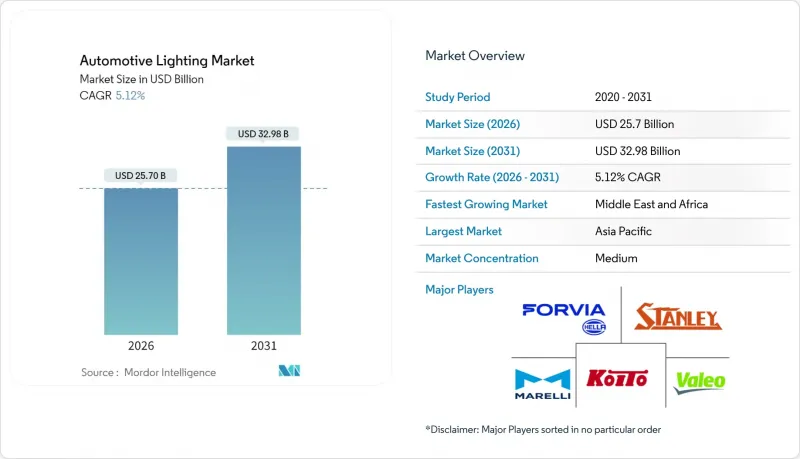
시장의 성장은 주로 세계 에너지 절약 정책의 강화, LED의 급속한 보급, 더 스마트하고 개인화 가능한 조명 모듈에 대한 수요 증가와 관련이 있습니다. 자동차 제조업체들은 전력 소모가 큰 할로겐 솔루션에서 저전력 부하와 풍부한 기능을 제공하는 고도로 통합된 LED, OLED, 레이저 플랫폼으로 계속 전환하고 있습니다. 전기자동차의 생산 확대는 절약되는 와트 단위의 중요성을 증가시키고 있으며, 주요 지역에서의 적응형 주행 빔의 승인은 프리미엄 기능의 채택을 가속화하고 있습니다. 공급 측면에서는 조명 전문 기업과 반도체 공급업체의 전략적 제휴로 개발 주기가 단축되고, ADAS(첨단 운전자 보조 시스템) 통신을 지원하는 디지털 광 투사 기술의 기회가 확대되고 있습니다. 아시아태평양은 제조 거점으로서의 지위를 유지하고 있지만, 정책 입안자들의 안전 기준 조화와 충전 인프라 구축이 진행되고 있는 중동 및 아프리카이 가장 빠른 판매량 증가가 예상됩니다.
세계 자동차 조명 시장 동향과 인사이트
LED 보급 의무화
정책 입안자들은 CO2 감축 목표 달성을 위해 에너지 소비가 많은 램프를 단계적으로 폐지하고 LED를 모든 차량 부문에 보급하고 있습니다. 유럽 차량 계산에 따르면, LED의 완전한 도입으로 연간 1.48 테라 와트시의 절감 효과를 기대할 수 있습니다. 미국은 2024년 FMVSS 108을 개정하여 적응형 주행빔을 합법화하고, LED 헤드램프의 채택을 더욱 촉진하고 있습니다. UN 규정 148은 승인 코드를 통일하여 차세대 디바이스의 전 세계 형식 인증을 용이하게 하고 있습니다.
스마트 조종석과 앰비언트 경험에 대한 수요 증가
인테리어 모듈은 현재 수천 개의 RGB LED를 조합하여 인포테인먼트 신호와 연동되는 웰니스 중심의 캐빈을 만들고 있습니다. 메르세데스-벤츠의 디지털 라이트는 200만 화소 이상의 픽셀을 탑재하여 도로 표지판을 투사하여 운전자의 인지도를 높입니다. 실험실 연구를 통해 고급 보정이 직접 조명 가이드의 색상 정확도와 균일성을 향상시키고 고급 대시보드의 핫스팟 아티팩트를 제거할 수 있다는 것이 확인되었습니다.
고급 모듈의 높은 초기 비용
아우디 Q5와 같은 고급 모델에 채택된 디지털 OLED 테일램프는 18개의 개별 제어 가능한 부문을 사용하여 부품 원가(BOM)와 금형 비용을 높이고 있습니다. 탠덤 적층형 OLED 프로토타입은 46,000시간의 수명으로 77%의 외부 양자 효율을 달성했지만, 제조의 복잡성으로 인해 대량 생산으로의 전환을 제한하고 있습니다. 마이크로 LED로 대체하면 전조등 어셈블리에서 30W와 1kg의 경량화를 실현할 수 있지만, 설비 투자 비용은 여전히 높습니다.
부문 분석
승용차 부문은 2025년 매출에서 68.92%의 점유율을 차지하며 자동차 조명 시장을 주도했습니다. 반면, 이륜차 부문은 7.15%의 가장 빠른 CAGR을 기록할 것으로 예상됩니다. 전기 스쿠터가 배터리 지속시간을 확보하기 위해 저전력 LED를 우선시하는 추세로 인해 이륜차용 자동차 조명 시장 규모는 확대될 것으로 예상됩니다. Fiem Industries는 3년 이내에 생산라인을 도입할 예정인 80개 이상의 오토바이용 LED 프로젝트를 공개하고 있습니다. 소형 상용차 차량은 밀집된 도시 지역에서 라스트 마일 안전성을 높이기 위해 어댑티브 헤드램프에 의존하고 있습니다. 중대형 트럭의 업그레이드는 완만하지만, 가시성 테이프와 주행등 의무화로 인해 지속적인 개조 수요가 유지되고 있습니다.
멀티 센서 융합 기술을 적용한 적응형 LED 헤드램프는 2025년 출시되는 중국 국산 세단 여러 차종에 처음 적용되었으며, 커브길 조명 사각지대 해소를 위해 이륜차 모델에도 확대 적용되었습니다. 고급 승용차에서는 이미 디지털 라이트 프로젝션 기술과 특징적인 DRL 패턴이 브랜드 아이덴티티를 강화하기 위해 적용되고 있지만, 차량 사업자들은 내구성과 루멘당 비용에 중점을 두고 있습니다. 예측 기간 내에 소형 LED와 방열판이 필요 없는 광학계로 인해 기존 고급 차량에 한정되어 있던 ADB 기능을 저가형 스쿠터에도 도입할 수 있게 될 것입니다.
2025년 기준 외장 모듈 분야가 자동차 조명 시장의 78.02%를 차지했지만, 내장 솔루션은 CAGR 7.88%로 추격하고 있습니다. 루프와 풋웰 영역에는 공조 제어 및 인포테인먼트 기능과 연동되는 주소 지정이 가능한 RGB 어레이가 배치되어 있으며, 연구를 통해 야간 운전 시 운전자의 피로를 줄이는 데 도움이 되는 조화로운 색온도가 효과적이라는 것이 확인되었습니다.
전조등은 기술 시험장으로서의 역할을 유지하고 있습니다: FMVSS(미국 연방 자동차 안전 표준)의 업데이트는 적응형 주행 빔을 허용하고, LED가 마주 오는 차량에 대한 눈부심을 동적으로 차단할 수 있도록 허용합니다. 고급 SUV에 탑재되는 OLED 테일램프는 복잡한 형상 전체에 걸쳐 균일한 밝기를 구현하는데, 이는 개별 LED로는 불가능합니다. ADAS 경고를 반영하는 실내용 라이트바는 현재 레벨3 자율주행 패키지에 내장되어 있으며, 차량 내부의 분위기와 외부 램프의 동작을 연동하고 있습니다.
지역별 분석
아시아태평양은 자동차 조명 시장을 주도하며 2025년 매출의 32.22%를 차지할 것으로 예상되며, 세계 자동차 제조업체의 생산 거점으로서의 입지를 확고히 하고 있습니다. 중국의 1등급 공급업체는 현재 유엔 규정 148에 부합하는 적응형 LED 모듈을 수출하고 있으며, 기존 일본 및 유럽 제조업체 외에 선택의 폭을 넓혀가고 있습니다. 광동성 현지 유력 기업에 따르면, 스마트 조명 관련 계약이 2024년 매출의 41.5%를 차지했다고 합니다. 아판은 멀티센서 전조등 융합 기술을 정교하게 발전시키고 있으며, 인도의 이륜차 붐은 통근용 오토바이 전체에 대한 LED 수요를 가속화하고 있습니다.
중동 및 아프리카는 6.88%의 가장 빠른 CAGR을 보일 것으로 예상됩니다. 걸프만 국가들이 전기자동차 충전 회랑을 정비하고, EU의 눈부심 기준을 준수하는 국가 안전 기준을 도입하고 있기 때문입니다. 사우디는 2025년까지 경차 판매 500만대 이상, UAE는 2050년까지 전기자동차 보급률 50%를 목표로 하고 있습니다. 두 정책 모두 에너지 절약형 램프에 대한 수요를 촉진하고 있습니다. 각국 정부도 광생물학적 안전성 감사를 추진하고 있으며, OEM 제조업체는 시장 진입 전에 청색광 비율 검증을 요구하고 있습니다.
유럽과 북미는 에너지 절약 지침과 고급차 보급률에 힘입어 각각 4.65%, 5.35%의 성장이 예상됩니다. EU의 CO2 기준은 전기 부하 절감에 성공한 자동차 제조업체를 우대하기 때문에 LED는 쉽게 도입할 수 있는 대안으로 자리매김하고 있습니다. 미국에서는 FMVSS 적응형 빔 승인 후 활동이 활발해지고 있으며, 국내 트럭 플랫폼에서는 2026년 생산 주기에 디지털 라이트 업데이트가 계획되어 있습니다. 남미는 지역 조립업체들이 세계 규격의 조명 모듈을 통합한 공통 플랫폼 아키텍처를 채택하고, 단가 절감과 애프터마켓 인증 간소화로 인해 6.55%의 CAGR로 성장할 것으로 예상됩니다.
기타 특전:
- 엑셀 형식의 시장 예측(ME) 시트
- 애널리스트 지원(3개월)
자주 묻는 질문
목차
제1장 소개
제2장 조사 방법
제3장 주요 요약
제4장 시장 구도
제5장 시장 규모와 성장 예측
제6장 경쟁 구도
제7장 시장 기회와 향후 전망
KSM 26.03.09Automotive lighting market size in 2026 is estimated at USD 25.7 billion, growing from 2025 value of USD 24.45 billion with 2031 projections showing USD 32.98 billion, growing at 5.12% CAGR over 2026-2031.
The market's growth is primarily linked to stricter global energy-efficiency policies, rapid LED penetration, and rising demand for smarter, personalization-ready lighting modules. Automakers continue to shift away from power-hungry halogen solutions toward highly integrated LED, OLED, and laser platforms that deliver lower electrical loads and richer functionality. Intensifying electric-vehicle production magnifies the importance of every watt saved, while adaptive driving beam approvals in key regions accelerate premium feature uptake. On the supply side, strategic partnerships between lighting specialists and semiconductor suppliers are shortening development cycles and unlocking digital-light projection opportunities that support advanced driver-assistance systems (ADAS) communication. Asia-Pacific remains the manufacturing hub, yet the Middle East and Africa promise the fastest volume gains as policymakers harmonize safety rules and build charging infrastructure.
Global Automotive Lighting Market Trends and Insights
LED-penetration mandates
Policymakers are phasing out energy-intensive lamps to meet CO2-reduction targets, pushing LEDs into every vehicle segment. European fleet calculations show potential savings of 1.48 TWh per year when full LED deployment is achieved. The United States amended FMVSS 108 in 2024, legalising adaptive driving beams and further incentivising LED headlamp adoption. UN Regulation 148 unifies approval codes, easing global homologation for next-generation devices.
Smart-cockpit and ambient-experience demand
Interior modules now blend thousands of RGB LEDs to create wellness-centric cabins that synchronise with infotainment cues. Mercedes-Benz DIGITAL LIGHT packs over 2 million pixels and projects road symbols to augment driver awareness. Laboratory studies confirm that advanced calibration improves colour accuracy and uniformity in direct-lit guides, removing hotspot artefacts in premium dashboards.
High upfront cost of advanced modules
Digital OLED tail-lamps in luxury models such as the Audi Q5 use 18 individually addressable segments that raise BOM and tooling costs. Tandem-stack OLED prototypes achieve 77% external quantum efficiency at 46,000-hour lifetimes, yet manufacturing complexity limits mass-market migration. Micro-LED replacements can shave 30 W and 1 kg from a headlamp assembly, but capital equipment costs remain significant.
Other drivers and restraints analyzed in the detailed report include:
- EV energy-efficiency requirements
- Digital-light projection for ADAS/V2X
- Semiconductor and raw-material volatility
For complete list of drivers and restraints, kindly check the Table Of Contents.
Segment Analysis
The passenger cars segment dominated the Automotive Lighting Market with a 68.92% Share in 2025 revenues. Meanwhile, Two-wheelers are expected to register the fastest 7.15% CAGR. The automotive lighting market size within Two-wheelers will climb as e-scooters prioritize low-draw LEDs to preserve battery autonomy. Fiem Industries disclosed more than 80 active LED projects for bikes scheduled to hit assembly lines within three years. Light commercial fleets lean on adaptive headlamps to increase last-mile safety in dense urban corridors. Medium and heavy trucks upgrade more slowly, but mandatory conspicuity tape and running-light laws still feed a steady retrofit pipeline.
Adaptive LED headlamps using multi-sensor fusion debuted on several 2025 domestic Chinese sedans and cascaded to motorcycle variants to counter bend-lighting blind spots. Passenger-car premium trims already bake in digital-light projection and signature DRL patterns to reinforce brand identity, whereas fleet operators concentrate on durability and cost per lumen. Over the forecast horizon, small-format LEDs and heatsink-free optics will let low-cost scooters adopt ADB features previously limited to luxury cars.
Exterior modules segment dominated the Automotive Lighting Market with a 78.02% share in global revenues in 2025, but Interior solutions are set to outpace with an 7.88% CAGR. Roof and foot-well zones now host addressable RGB arrays that coordinate with climate controls and infotainment events. Studies confirm that harmonized color temperature can cut driver fatigue during night-time commutes.
Headlamps remain technology testbeds: FMVSS updates permit adaptive driving beams, letting LEDs dynamically mask glare for oncoming traffic. OLED tail lights in premium SUVs deliver uniform luminance across complex shapes, which is impossible with discrete LEDs. Interior light bars that mirror ADAS warnings are now bundled with Level-3 autonomy packages, linking ambient cues to external lamp behavior.
The Automotive Lighting Market Report is Segmented by Vehicle Type (Passenger Cars, Light Commercial Vehicles, and More), Application (Exterior (Headlamps, Taillights, Fog Lamps, and More) and Interior (Ambient/Footwell and Roof/Dome)), Technology (Halogen, Xenon / HID, LED, Laser and More), Sales Channel (OEM and Aftermarket), and Geography. The Market Forecasts are Provided in Terms of Value (USD) and Volume (Units).
Geography Analysis
Asia-Pacific dominated the Automotive Lighting Market and holds 32.22% of 2025 revenues, cementing its role as a production center for global carmakers. Chinese tier-one suppliers now export adaptive LED modules compliant with UN Regulation 148, widening market options beyond traditional Japanese and European incumbents. Local champions in Guangdong reported that smart-lighting contracts accounted for 41.5% of 2024 revenue. Apan refines multi-sensor headlamp fusion, while India's two-wheeler boom accelerates LED demand across commuter bikes.
The Middle East and Africa are expected to log the fastest 6.88% CAGR as Gulf states build EV charging corridors and roll out national safety codes that mirror EU glare thresholds. Saudi Arabia targets more than 5 million light-vehicle sales by 2025, and the UAE aims for 50% EV penetration by 2050, both policies fuelling the need for energy-efficient lamps. Governments also pursue photobiological safety audits, prompting OEMs to validate blue-light ratios before market entry.
Europe and North America are expected to expand at 4.65% and 5.35%, respectively, sustained by energy-conservation directives and premium-vehicle density. EU CO2 standards reward automakers who cut electrical loads, positioning LEDs as low-hanging fruit. The United States sees heightened activity after FMVSS adaptive-beam approval, with domestic truck platforms planning digital-light updates in 2026 production cycles. South America advances at 6.55% CAGR as regional assemblers adopt consolidated platform architectures that integrate global-spec lighting modules, reducing cost per unit and easing aftermarket certification.
- Koito Manufacturing Co. Ltd
- Stanley Electric Co. Ltd
- Valeo SE
- Forvia-HELLA GmbH & Co. KGaA
- Marelli Holdings Co. Ltd
- Tungsram Group
- Hyundai Mobis Co.
- Lumax Industries Ltd
- ams-OSRAM AG
- ZKW Group GmbH
- SL Corporation
- Nichia Corporation
- Continental AG
- DENSO Corporation
- Lear Corporation
- Bosch Mobility Lighting Modules
- LG Innotek Co.
- Panasonic Automotive Lighting
- Seoul Semiconductor Co.
Additional Benefits:
- The market estimate (ME) sheet in Excel format
- 3 months of analyst support
TABLE OF CONTENTS
1 Introduction
- 1.1 Study Assumptions & Market Definition
- 1.2 Scope of the Study
2 Research Methodology
3 Executive Summary
4 Market Landscape
- 4.1 Market Overview
- 4.2 Market Drivers
- 4.2.1 LED-penetration mandates
- 4.2.2 Smart-cockpit & ambient-experience demand
- 4.2.3 EV energy-efficiency requirements
- 4.2.4 Digital-light projection for ADAS/V2X
- 4.2.5 OTA-enabled lighting personalisation
- 4.2.6 Safety-visibility regulations
- 4.3 Market Restraints
- 4.3.1 High upfront cost of advanced modules
- 4.3.2 Semiconductor & raw-material volatility
- 4.3.3 Stricter glare/photobiological safety caps
- 4.3.4 End-of-life recycling liabilities
- 4.4 Value / Supply-Chain Analysis
- 4.5 Regulatory Landscape
- 4.6 Technological Outlook
- 4.7 Porter's Five Forces
- 4.7.1 Threat of New Entrants
- 4.7.2 Bargaining Power of Buyers
- 4.7.3 Bargaining Power of Suppliers
- 4.7.4 Threat of Substitutes
- 4.7.5 Intensity of Competitive Rivalry
5 Market Size & Growth Forecasts (Value)
- 5.1 By Vehicle Type
- 5.1.1 Passenger Cars
- 5.1.2 Light Commercial Vehicles
- 5.1.3 Medium & Heavy Commercial Vehicles
- 5.1.4 Two-Wheelers
- 5.2 By Application
- 5.2.1 Exterior
- 5.2.1.1 Headlamps
- 5.2.1.2 Taillights
- 5.2.1.3 Daytime Running Lights (DRLs)
- 5.2.1.4 Fog Lamps
- 5.2.2 Interior
- 5.2.2.1 Ambient / Footwell
- 5.2.2.2 Roof / Dome
- 5.2.1 Exterior
- 5.3 By Technology
- 5.3.1 Halogen
- 5.3.2 Xenon / HID
- 5.3.3 LED
- 5.3.4 Laser
- 5.3.5 OLED
- 5.4 By Sales Channel
- 5.4.1 OEM
- 5.4.2 Aftermarket
- 5.5 By Geography
- 5.5.1 North America
- 5.5.1.1 United States
- 5.5.1.2 Canada
- 5.5.1.3 Rest of North America
- 5.5.2 South America
- 5.5.2.1 Brazil
- 5.5.2.2 Argentina
- 5.5.2.3 Rest of South America
- 5.5.3 Europe
- 5.5.3.1 Germany
- 5.5.3.2 United Kingdom
- 5.5.3.3 France
- 5.5.3.4 Italy
- 5.5.3.5 Rest of Europe
- 5.5.4 Asia-Pacific
- 5.5.4.1 China
- 5.5.4.2 Japan
- 5.5.4.3 India
- 5.5.4.4 South Korea
- 5.5.4.5 Rest of Asia-Pacific
- 5.5.5 Middle East and Africa
- 5.5.5.1 United Arab Emirates
- 5.5.5.2 Saudi Arabia
- 5.5.5.3 South Africa
- 5.5.5.4 Rest of Middle East and Africa
- 5.5.1 North America
6 Competitive Landscape
- 6.1 Market Concentration
- 6.2 Strategic Moves
- 6.3 Market Share Analysis
- 6.4 Company Profiles (includes Global level Overview, Market level overview, Core Segments, Financials as available, Strategic Information, Market Rank/Share for key companies, Products & Services, and Recent Developments)
- 6.4.1 Koito Manufacturing Co. Ltd
- 6.4.2 Stanley Electric Co. Ltd
- 6.4.3 Valeo SE
- 6.4.4 Forvia-HELLA GmbH & Co. KGaA
- 6.4.5 Marelli Holdings Co. Ltd
- 6.4.6 Tungsram Group
- 6.4.7 Hyundai Mobis Co.
- 6.4.8 Lumax Industries Ltd
- 6.4.9 ams-OSRAM AG
- 6.4.10 ZKW Group GmbH
- 6.4.11 SL Corporation
- 6.4.12 Nichia Corporation
- 6.4.13 Continental AG
- 6.4.14 DENSO Corporation
- 6.4.15 Lear Corporation
- 6.4.16 Bosch Mobility Lighting Modules
- 6.4.17 LG Innotek Co.
- 6.4.18 Panasonic Automotive Lighting
- 6.4.19 Seoul Semiconductor Co.
7 Market Opportunities & Future Outlook
- 7.1 White-space & Unmet-Need Assessment