
|
시장보고서
상품코드
1939090
클라우드 스토리지 : 시장 점유율 분석, 업계 동향과 통계, 성장 예측(2026-2031년)Cloud Storage - Market Share Analysis, Industry Trends & Statistics, Growth Forecasts (2026 - 2031) |
||||||
 Mordor Intelligence
2026년 클라우드 스토리지 시장 규모는 1,792억 6,000만 달러로 추정되며, 2025년 1,452억 3,000만 달러에서 계속 성장하고 있습니다. 2031년까지의 예측에서는 5,138억 6,000만 달러에 달하며, 2026-2031년에 CAGR 23.45%로 확대가 전망되고 있습니다.
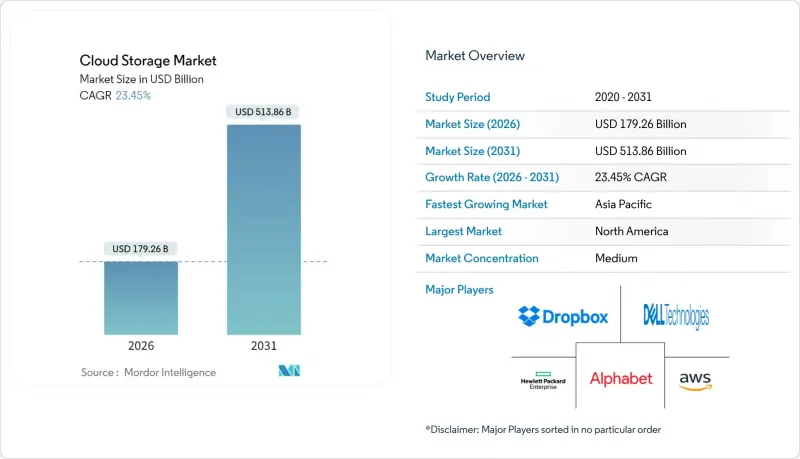
생성형 AI의 도입, 데이터 주권의 의무화, 현대적이고 에너지 효율적인 인프라에 대한 수요는 기업의 전환을 가속화하고 전 세계 스토리지 아키텍처를 재구성하고 있습니다. 하이퍼스케일러의 투자 강화, 아시아태평양의 소버린 클라우드 지출 증가, 중소기업의 꾸준한 도입으로 전 세계 잠재 고객 기반이 확대되고 있습니다. 한편, 인플레이션에 연동된 건설비용은 저전력 기술의 혁신을 촉진하고 있습니다. 오브젝트 스토리지가 AI 워크로드를 지배하고, 하이브리드 구축이 가장 빠르게 성장하고 있으며, 아시아태평양이 지역적 확장을 주도하고 있습니다. 각 업체들이 AI 최적화 용량, 주권 클라우드 존, 탄소 인식형 서비스 제공을 추구하고 있는 가운데, 경쟁 업체들 간의 적대적 관계는 여전히 치열한 상황입니다.
세계 클라우드 스토리지 시장 동향 및 인사이트
생성형 AI가 주도하는 지식 근로자를 위한 용도의 데이터 폭발(2025년 이후)
생성형 AI 워크로드로 인해 기업의 데이터 양은 기하급수적으로 증가하고 있습니다. 회전식 디스크가 레이턴시 목표를 달성하기 위해 고군분투하는 가운데, AI 학습 환경용 SSD(SSD)에 대한 수요는 매년 35%씩 증가하고 있습니다. 단일 트레이닝 실행의 스토리지 실적는 2025년 30TB에서 2030년까지 100TB로 증가할 것으로 예측됩니다. 한편, 신제품에 AI 기능이 탑재되면서 추론 노드의 성장은 더욱 가속화될 것입니다. 비용 모델에 따르면 데이터 처리 비용이 모델 개발 비용을 초과하는 것으로 나타났으며, 벤더들은 계층화 및 압축 최적화에 대한 압박을 받고 있습니다. 하이퍼스케일러는 고처리량 NVM 베이스 클러스터와 병렬 액세스를 위해 조정된 오브젝트 스토리지 버킷을 우선시하는 형태로 스토리지 계층의 재설계를 진행하고 있습니다.
미디어 및 게임 분야의 엣지-투-클라우드 워크플로우 가속화
미디어 및 게임 스튜디오는 클라우드 우선의 파이프라인을 채택하고 있으며, 스트리밍 및 실시간 렌더링의 확대로 인해 97%가 2025년에 스토리지 예산을 늘릴 계획이라고 답했습니다. 클라우드 게임의 44%의 연평균 복합 성장률(CAGR)을 달성하기 위해서는 지역 간 50밀리초 미만의 지연시간을 유지하는 분산형 캐시가 필요합니다. 그러나 이들 기업은 스토리지 예산의 51%를 API 호출과 엑스트래픽에 사용하고 있으며, 요금 회피를 위해 멀티클라우드 배치를 추진하고 있습니다. 2024년 엣지 컴퓨팅 지출은 2,320억 달러에 달할 것으로 예상되며, 공급업체들은 원활한 자산 흐름을 위해 On-Premise 게이트웨이와 하이퍼스케일 아카이브를 통합해야 합니다.
지속가능한 데이터 주권의 복잡성
미국의 CLOUD법부터 중국의 국경 간 데이터 유통 규정까지 다양한 규제로 인해 조직은 파편화된 스토리지 환경을 운영해야 하고, 현지 법규를 충족하기 위해 데이터세트를 복제해야만 합니다. 법적 불확실성은 컴플라이언스 비용을 증가시키고, 기업이 중복된 관할권 주장을 피하기 위해 세계 진출을 지연시키고 있습니다.
부문 분석
2025년 부문 매출은 퍼블릭 클라우드가 58.45%를 차지했으나, 데이터 거주지 규제 강화에 따라 하이브리드 아키텍처는 2031년까지 연평균 복합 성장률(CAGR) 25.55%로 확대될 것으로 예측됩니다. 기업은 지연과 컴플라이언스 목표를 달성하기 위해 On-Premise 노드와 퍼블릭 클라우드의 확장성을 결합하고 있습니다. 정부의 주권적 프레임워크가 하이브리드 수요를 더욱 촉진하는 한편, 엣지 투자로 인해 마이크로 지역이 통합 풀에 통합되고 있습니다. 현재 기업 워크로드의 82%가 하이브리드 환경에서 관리되고 있으며, 올 퍼블릭 전략으로 전환하는 것이 입증되고 있습니다.
두 번째 성장 축은 AI 트레이닝 클러스터에 있습니다. 처리량 확보를 위해 로컬 GPU 인접성이 필요하며, 부하 급증시 클라우드 버스트가 필요합니다. 조직은 사이트 간 정책 조정을 위해 제어면 소프트웨어를 채택하여 벤더 종속성을 줄이고 비용을 최적화하고 있습니다. 벤더는 통합 모니터링 기능, 자동 데이터 계층화, 마켓플레이스 생태계로 차별화를 꾀합니다. 예산 배분이 재조정되는 가운데, 클라우드 스토리지 시장에서는 배포 모델이 유동적인 정책 기반 패브릭으로 수렴하고, 코어, 엣지, 주권 영역을 넘나들 것으로 예측됩니다.
오브젝트 리포지토리는 2025년 51.05%의 매출을 창출하고, 비정형 데이터의 폭발적인 증가에 따라 2031년까지 연평균 24.4%의 성장률을 보일 것으로 예측됩니다. 오브젝트 플랫폼용 클라우드 스토리지 시장 규모는 생성된 AI 코퍼스의 요구에 부합하는 본질적인 확장성, 풍부한 메타데이터, 오류 수정 인코딩의 경제성 등의 이점을 누리고 있습니다. 파일 및 블록 계층은 레거시 워크로드 및 OLTP용으로 유지되지만, 페타바이트 규모의 병렬 액세스를 견딜 수 있는 오브젝트 계층에 자리를 내어줍니다.
혁신은 멀티테넌트 네임스페이스 분리, 인라인 암호화, 스테이징 없이 트레이닝 노드에 공급되는 GPU 직접 파이프라인에 초점을 맞추었습니다. 마이크로닉스의 32TB NVMe SSD 출시는 플래시 기반 오브젝트 클러스터로의 전환을 강조하고 있습니다. 특허 출원은 성능과 내구성을 증폭시키는 오류 수정 부호화 캐시와 분산 해시 인덱스의 진보를 보여줍니다. AI 도입이 확대되는 가운데, 오브젝트 스토리지는 클라우드 스토리지 시장에서 컨텐츠, 모델 체크포인트, 벡터 데이터베이스를 지원하는 기반이 될 것입니다.
클라우드 스토리지 시장 보고서는 도입 모드(프라이빗 클라우드, 퍼블릭 클라우드 등), 스토리지 유형(파일 스토리지, 오브젝트 스토리지 등), 기업 규모(중소기업 및 대기업), 용도(백업 및 복구, 용도 관리 등), 최종사용자 산업(은행, 금융서비스 및 보험(BFSI), 제조, 유통, 소매, E-커머스 등), 지역별로 세분화되어 있습니다. 등), 최종사용자 산업(은행, 금융서비스 및 보험(BFSI), 제조, 소매 및 E-Commerce 등), 지역별로 분류되어 있습니다.
지역별 분석
북미는 하이퍼스케일러 기업의 본사 입지 및 AI 도입의 조기 전개가 수요를 견인하며 2025년 37.40%의 매출 점유율을 차지할 것으로 예측됩니다. 데이터센터 전력 수요는 2028년까지 연평균 16%의 성장세를 보일 것으로 예상되지만, 전력망 병목 현상과 인허가 절차의 지연이 일정에 영향을 미치고 있습니다. 클라우드 기반 고객확인(KYC) 확인과 같은 규제안은 국경을 초월한 워크플로우를 분절시킬 수 있으며, 기업을 멀티 리전 아키텍처로 전환하게 하는 요인이 될 수 있습니다. 하드웨어 부족으로 인해 간헐적으로 용량이 제한되는 반면, 지속적인 투자로 혁신과 지출에서 선도적 인 위치를 유지하고 있습니다.
아시아태평양은 정부의 디지털화 프로그램, 소버린 클라우드 의무화, AI 도입 확대로 인해 24.6%의 연평균 복합 성장률(CAGR)을 보이고, 성장을 주도하고 있습니다. 중국에서는 현지 공급업체와 정책적 지원으로 2025년 지출액이 460억 달러에 달할 것으로 예측됩니다. 인도 서비스 시장은 2024년 상반기 52억 달러 규모에 달할 것으로 예상되며, 2028년까지 255억 달러를 목표로 하고 있습니다. 호주와 일본은 지역 특화 프레임워크를 추진하고 있으며, 지역 데이터센터용량의 13.3% CAGR은 거주지 준수 구역의 확장을 지원하고 있습니다.
유럽에서는 GDPR(EU 개인정보보호규정)에 따라 꾸준히 성장하고 있으며, 산업별 규범이 암호화 및 데이터 최소화 기능을 촉진하고 있습니다. 브라질, 멕시코, 칠레가 하이퍼스케일러 투자를 유치하고 있는 가운데, 2029년까지 라틴아메리카의 코로케이션 거래는 100억 달러에 달할 것으로 예측됩니다. 아프리카 수요는 매년 25-30%씩 증가하고 있지만, 전 세계 매출에서 차지하는 비중은 1% 미만입니다. 현지 업체들은 가격과 통화의 유연성으로 차별화를 꾀하고 있습니다. 이러한 추세는 지역 생태계와 세계 연결성이 공존하는 다극화된 클라우드 스토리지 시장을 지원하고 있습니다.
기타 특전:
- 엑셀 형식 시장 예측(ME) 시트
- 애널리스트 지원(3개월)
자주 묻는 질문
목차
제1장 서론
제2장 조사 방법
제3장 개요
제4장 시장 구도
제5장 시장 규모와 성장 예측
제6장 경쟁 구도
제7장 시장 기회와 향후 전망
KSA 26.03.05The cloud storage market size in 2026 is estimated at USD 179.26 billion, growing from 2025 value of USD 145.23 billion with 2031 projections showing USD 513.86 billion, growing at 23.45% CAGR over 2026-2031.
Generative-AI adoption, data-sovereignty mandates, and the need for modern, energy-efficient infrastructure are accelerating enterprise migration and reshaping storage architectures worldwide. Intensifying hyperscaler investment, rising sovereign-cloud spend across Asia Pacific, and steady SME adoption are widening the global addressable base while inflation-linked construction costs spur innovation in low-power technologies. Object storage dominates AI workloads, hybrid deployment grows fastest, and Asia Pacific leads regional expansion. Competitive rivalry remains high as providers pursue AI-optimized capacity, sovereign-cloud zones, and carbon-aware services.
Global Cloud Storage Market Trends and Insights
Gen-AI-led data explosion in knowledge-worker apps (2025+)
Generative-AI workloads are multiplying enterprise data volumes by an order of magnitude. Solid-state drive demand for AI training environments is climbing 35% per year as spinning disks struggle to meet latency targets. Storage footprints for single training runs are set to scale from 30 TB in 2025 to 100 TB by 2030, while inference nodes grow even faster as new products embed AI features. Cost models now reveal that data-handling charges eclipse model-development expenses, pushing vendors to optimize tiering and compression. Hyperscalers are redesigning storage layers to favor high-throughput NVM-based clusters and object storage buckets tuned for parallel access.
Edge-to-cloud workflow acceleration in media and gaming
Media and gaming studios are embracing cloud-first pipelines; 97% plan to raise storage budgets in 2025 as streaming and real-time rendering expand. Cloud gaming's 44% CAGR requires distributed caches that maintain <50 ms latency across regions. Yet, these firms spend 51% of storage budgets on API calls and egress traffic, catalyzing multi-cloud placement to avoid fees. Edge-compute spend is forecast at USD 232 billion in 2024, pushing providers to integrate on-premise gateways with hyperscale archives for seamless asset flows.
Persistent data-sovereignty complexity
Divergent regulations-from the U.S. CLOUD Act to China's cross-border flow rules-force organizations to operate fragmented storage footprints and duplicate datasets to meet local statutes. Legal uncertainty raises compliance spend and slows global rollouts as firms navigate overlapping jurisdictional claims.
Other drivers and restraints analyzed in the detailed report include:
- Government stimulus for sovereign cloud frameworks
- ESG-driven storage optimization and carbon-aware workloads
- Escalating egress-fee backlash and vendor lock-in risk
For complete list of drivers and restraints, kindly check the Table Of Contents.
Segment Analysis
The segment's revenue in 2025 reflected a 58.45% public-cloud lead, yet hybrid architectures are on track for a 25.55% CAGR to 2031 as data residency laws tighten. Enterprises blend on-premise nodes with public scalability to meet latency and compliance goals. Governments' sovereign frameworks further propel hybrid demand, while edge investments embed micro-regions into unified pools. Hybrid environments now manage 82% of enterprise workloads, validating the shift away from all-public strategies.
A second growth vector lies in AI training clusters that require local GPU adjacency for throughput yet still need cloud bursts for spikes. Organizations adopt control-plane software to orchestrate policies across sites, mitigating lock-in and optimizing cost. Vendors differentiate via integrated observability, automated data-tiering, and marketplace ecosystems. As budgets reallocate, the cloud storage market will see deployment models converge into fluid, policy-driven fabrics spanning core, edge, and sovereign zones.
Object repositories generated 51.05% revenue in 2025 and will compound at 24.4% through 2031 as unstructured data explodes. The cloud storage market size for object platforms benefits from intrinsic scalability, rich metadata, and erasure-coding economics that align with generative-AI corpus needs. File and block tiers persist for legacy and OLTP workloads but cede share to object layers hardened for petabyte-scale parallel access.
Innovation centers on multi-tenant namespace isolation, in-line encryption, and GPU-direct pipelines that feed training nodes without staging. Micron's roll-out of 32 TB NVMe SSDs underscores the migration toward flash-based object clusters. Patent filings reveal advances in erasure-coded caching and distributed-hash indexing, amplifying performance and durability. As AI adoption broadens, object storage will underpin content, model checkpoints, and vector databases within the cloud storage market.
The Cloud Storage Market Report is Segmented by Deployment Mode (Private Cloud, Public Cloud, and More), Storage Type (File Storage, Object Storage, and More), Enterprise Size (SMEs and Large Enterprises), Application (Backup and Recovery, Application Management, and More), End-User Industry (BFSI, Manufacturing, Retail and E-Commerce, and More), and Geography.
Geography Analysis
North America held 37.40% revenue in 2025 as hyperscaler headquarters and early AI adoption drove demand. Data-center power needs are on a 16% annual trajectory to 2028, though transmission bottlenecks and permitting delays pressure timelines. Regulatory proposals such as cloud know-your-customer (KYC) checks may fragment cross-border workflows, nudging enterprises toward multi-region architectures. Hardware shortages intermittently constrain capacity, but continuous investment sustains leadership in innovation and spend.
Asia Pacific is the growth engine, charting a 24.6% CAGR courtesy of government digitization programs, sovereign-cloud mandates, and rising AI adoption. China's spending will hit USD 46 billion in 2025, buoyed by local vendors and policy support. India's services market reached USD 5.2 billion in H1 2024 and targets USD 25.5 billion by 2028. Australia and Japan advance localized frameworks, while a 13.3% CAGR in regional data-center capacity underscores the build-out of residency-compliant zones.
Europe grows steadily under GDPR, with sectoral codes pushing encryption and data-minimization features. Latin America's colocation pipeline could reach USD 10 billion by 2029 as Brazil, Mexico, and Chile court hyperscaler investment. Africa's demand rises 25-30% annually, yet represents <1% global revenue; local providers differentiate on price and currency flexibility. These dynamics confirm a multipolar cloud storage market where regional ecosystems coexist with global connectivity.
- Amazon Web Services Inc.
- Microsoft Corporation
- Google LLC (Alphabet)
- Alibaba Cloud (Alibaba Group)
- IBM Corporation
- Oracle Corporation
- Dell Technologies Inc.
- Hewlett Packard Enterprise
- NetApp Inc.
- Dropbox Inc.
- Box Inc.
- Wasabi Technologies
- Backblaze Inc.
- Tencent Cloud
- OVHcloud
- Rackspace Technology
- Hitachi Vantara
- Fujitsu Limited
- pCloud AG
- Tresorit AG
- Iron Mountain
Additional Benefits:
- The market estimate (ME) sheet in Excel format
- 3 months of analyst support
TABLE OF CONTENTS
1 INTRODUCTION
- 1.1 Study Assumptions and Market Definition
- 1.2 Scope of the Study
2 RESEARCH METHODOLOGY
3 EXECUTIVE SUMMARY
4 MARKET LANDSCAPE
- 4.1 Market Overview
- 4.2 Macroeconomic Impact Assessment
- 4.3 Market Drivers
- 4.3.1 Increase in cloud adoption across organizations
- 4.3.2 Rising demand for low-cost, high-speed storage access
- 4.3.3 Edge-to-cloud workflow acceleration in media and gaming
- 4.3.4 Gen-AI-led data explosion in knowledge-worker apps (2025+)
- 4.3.5 Government stimulus for sovereign cloud frameworks
- 4.3.6 ESG-driven storage optimization and carbon-aware workloads
- 4.4 Market Restraints
- 4.4.1 Persistent data-sovereignty complexity
- 4.4.2 Escalating egress-fee backlash and vendor lock-in risk
- 4.4.3 Multi-cloud data-sprawl security gaps
- 4.4.4 Limited last-mile bandwidth in frontier markets
- 4.5 Value Chain Analysis
- 4.6 Regulatory Landscape
- 4.7 Technological Outlook
- 4.8 Porter's Five Forces Analysis
- 4.8.1 Threat of New Entrants
- 4.8.2 Bargaining Power of Suppliers
- 4.8.3 Bargaining Power of Buyers
- 4.8.4 Threat of Substitutes
- 4.8.5 Industry Rivalry
- 4.9 Investment Analysis
5 MARKET SIZE AND GROWTH FORECASTS (VALUE)
- 5.1 By Deployment Mode
- 5.1.1 Private Cloud
- 5.1.2 Public Cloud
- 5.1.3 Hybrid Cloud
- 5.2 By Storage Type
- 5.2.1 File Storage
- 5.2.2 Object Storage
- 5.2.3 Block Storage
- 5.3 By Enterprise Size
- 5.3.1 SMEs
- 5.3.2 Large Enterprises
- 5.4 By Application
- 5.4.1 Backup and Recovery
- 5.4.2 Data Management and Archiving
- 5.4.3 Application Management
- 5.4.4 Collaboration and Content Services
- 5.5 By End-user Industry
- 5.5.1 BFSI
- 5.5.2 Healthcare and Life Sciences
- 5.5.3 Government and Public Sector
- 5.5.4 Manufacturing
- 5.5.5 Retail and E-commerce
- 5.5.6 IT and Telecom
- 5.5.7 Media and Entertainment
- 5.5.8 Others
- 5.6 By Geography
- 5.6.1 North America
- 5.6.1.1 United States
- 5.6.1.2 Canada
- 5.6.1.3 Mexico
- 5.6.2 South America
- 5.6.2.1 Brazil
- 5.6.2.2 Argentina
- 5.6.3 Europe
- 5.6.3.1 Germany
- 5.6.3.2 United Kingdom
- 5.6.3.3 France
- 5.6.3.4 Russia
- 5.6.4 Asia Pacific
- 5.6.4.1 China
- 5.6.4.2 India
- 5.6.4.3 Japan
- 5.6.4.4 South Korea
- 5.6.4.5 ASEAN
- 5.6.4.6 Rest of Asia Pacific
- 5.6.5 Middle East and Africa
- 5.6.5.1 Middle East
- 5.6.5.1.1 Saudi Arabia
- 5.6.5.1.2 Turkey
- 5.6.5.2 Africa
- 5.6.5.2.1 South Africa
- 5.6.5.1 Middle East
- 5.6.1 North America
6 COMPETITIVE LANDSCAPE
- 6.1 Market Concentration
- 6.2 Strategic Moves
- 6.3 Market Share Analysis
- 6.4 Company Profiles (includes Global level Overview, Market level overview, Core Segments, Financials as available, Strategic Information, Market Rank/Share for key companies, Products and Services, and Recent Developments)
- 6.4.1 Amazon Web Services Inc.
- 6.4.2 Microsoft Corporation
- 6.4.3 Google LLC (Alphabet)
- 6.4.4 Alibaba Cloud (Alibaba Group)
- 6.4.5 IBM Corporation
- 6.4.6 Oracle Corporation
- 6.4.7 Dell Technologies Inc.
- 6.4.8 Hewlett Packard Enterprise
- 6.4.9 NetApp Inc.
- 6.4.10 Dropbox Inc.
- 6.4.11 Box Inc.
- 6.4.12 Wasabi Technologies
- 6.4.13 Backblaze Inc.
- 6.4.14 Tencent Cloud
- 6.4.15 OVHcloud
- 6.4.16 Rackspace Technology
- 6.4.17 Hitachi Vantara
- 6.4.18 Fujitsu Limited
- 6.4.19 pCloud AG
- 6.4.20 Tresorit AG
- 6.4.21 Iron Mountain
7 MARKET OPPORTUNITIES AND FUTURE OUTLOOK
- 7.1 White-space and Unmet-need Assessment