|
시장보고서
상품코드
1939166
바이탈 사인 모니터링 : 시장 점유율 분석, 업계 동향과 통계, 성장 예측(2026-2031년)Vital Sign Monitoring - Market Share Analysis, Industry Trends & Statistics, Growth Forecasts (2026 - 2031) |
||||||
 Mordor Intelligence
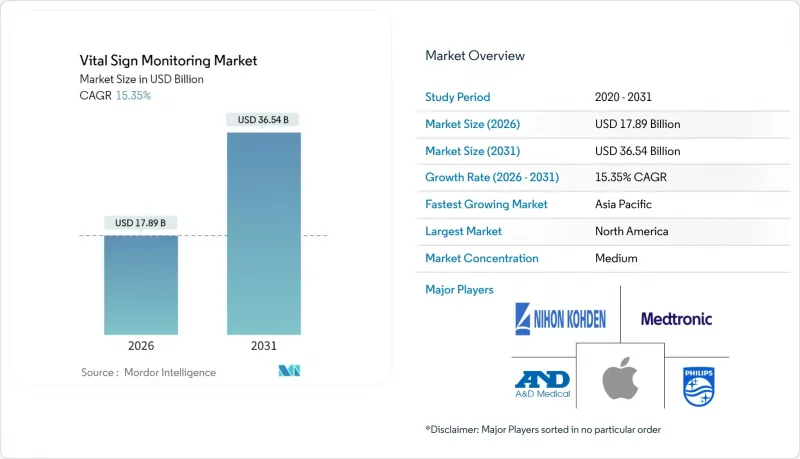
바이탈 사인 모니터링 시장 규모는 2026년에는 178억 9,000만 달러로 추정되고 있으며, 2025년 155억 1,000만 달러에서 성장하고 있습니다. 2031년의 예측에서는 365억 4,000만 달러에 달하며, 2026-2031년에 CAGR 15.35%로 성장할 것으로 전망되고 있습니다.
이러한 급격한 성장은 의료 분야가 예방적, 데이터베이스 치료 모델로 전환하고 있음을 반영합니다. 이 모델은 응급 입원을 피하고 재입원을 억제하기 위해 지속적인 생리적 모니터링에 의존하고 있습니다. 센서의 소형화, 인공지능 알고리즘의 성숙, 5G의 광범위한 보급으로 지연 시간이 50밀리초 미만으로 감소하여 병원, 외래, 재택 환경을 넘나드는 실시간 임상 개입이 가능해졌습니다. 특히 미국과 유럽 일부 지역에서는 디지털 헬스 분야의 보험 적용 범위가 확대되면서 의료 서비스 프로바이더의 구매 의욕이 높아지고 있습니다. 한편, 웨어러블 기기의 의료용 측정값에 대한 소비자 수용도가 높아지면서 기존 전문가용 기기와 CE(Consumer Electronics)제품의 경계가 허물어지고 있으며, 기기 제조업체들에게 새로운 수입원이 열리고 있습니다.
세계 바이탈 사인 모니터링 시장 동향 및 인사이트
만성질환 및 생활습관병 증가 추세
2020-2024년 심혈관 질환으로 인한 사망률은 전 세계에서 18.6% 상승할 것으로 예상되며, 의료 시스템은 지속적인 심장 모니터링 툴로 자원을 전환해야 합니다. 현재 미국 성인의 48%가 심장질환을 앓고 있으며, 부정맥과 야간 고혈압을 포착하는 휴대용 모니터링 솔루션에 우선적으로 자금이 배정되고 있습니다. 2024년 성인 당뇨병 환자 수가 5억 3,700만 명에 달할 것으로 예상에 따라 혈당뿐만 아니라 혈압과 심박수를 추적하는 다항목 모니터에 대한 수요가 증가하고 있습니다. 보험사들은 연간 4조 1천억 달러에 달하는 만성질환 부담에 직면해 있으며, 치료 결과 개선을 입증하는 원격 모니터링 플랫폼을 평가하여 통합 바이탈 사인 솔루션 도입을 가속화하고 있습니다. 이러한 역학적 요인들이 결합되어 바이탈 사인 모니터링 시장의 장기적인 확장을 지원하고 있습니다.
원격의료 및 원격 환자 모니터링 도입 가속화
메디케어가 2024년 16개 원격 모니터링 청구 코드(수혜자 1인당월약 188달러 상당)에 대한 상환을 결정함에 따라 의료 서비스 프로바이더의 경제 구조가 재편되었습니다. 유나이티드헬스케어는 2025년 웨어러블 기기 보험 적용 범위 확대에 이어 예방의료에 대한 보험자 측의 공감대 형성을 시사하고 있습니다. 현재 의료 시스템에서는 EHR 내에 모니터링 대시보드를 내장하여 전체 집단에 대한 계층화 및 실시간 알림을 지원하고 있습니다. 엣지 컴퓨팅과 5G 네트워크는 50밀리초 미만의 데이터 전송을 가능하게 하여 임상의가 증상 악화 후가 아닌 초기 단계에 개입할 수 있게 되었습니다. 의료 서비스 프로바이더들은 지속적인 바이탈 사인 모니터링을 일상적인 만성질환 관리 경로에 통합하여 바이탈 사인 모니터링 시장의 지속적인 수요를 촉진하고 있습니다.
데이터 프라이버시와 사이버 보안의 과제
2024년 의료정보 유출로 1억 3,300만 건의 기록이 유출되어 HIPAA 위반 벌금으로 7,500만 달러의 벌금이 발생했습니다. 커넥티드 모니터링 장비는 공격 대상 영역을 확대하고 있으며, IoMT 취약점은 전년 대비 45% 증가했습니다. 유럽 의료기기 규제(MDR)의 경우, 사이버 보안 감사로 인해 승인에 6-12개월의 추가 기간이 발생하여 제품 출시가 지연되고 있습니다. 사내 정보 보안 체계가 미흡한 의료 서비스 프로바이더는 지속적인 스트리밍 기기 도입에 신중을 기하고, 주문 건수를 억제하고 있습니다. 설계 단계부터 보안을 고려한 아키텍처가 표준이 되기 전까지는 데이터 유출에 대한 우려가 바이탈 사인 모니터링 시장의 보급 속도를 억제할 것입니다.
부문 분석
2025년 바이탈 사인 모니터링 시장 점유율은 의료기기가 50.72%를 차지했습니다. 이는 검증된 정확도 기준과 병원의 구매 관행에 의해 지원됩니다. 혈압계는 공식적인 상환 체계와 확립된 임상 프로토콜로 인해 매출의 근간을 이루고 있습니다. 호흡기 건강에 대한 경각심이 높아짐에 따라 맥박 산소 농도계의 판매가 증가하고 있으며, Masimo의 FDA 승인 OTC 모델이 소비자 접근성을 확대하고 있습니다. 체온 및 호흡수 측정 모듈은 원격의료 소프트웨어와 연동이 가능해져 임상적 가치 제안을 강화하고 있습니다.
소비자 웨어러블 기기는 CAGR 17.30%로 성장하고 있으며, 스마트 워치를 통한 심전도, 혈중 산소포화도, 혈압 추정치에 대한 규제 수용이 진행되고 있음을 반영하고 있습니다. Apple의 Series 10은 심전도 검사에서 진단 수준의 심전도 일치율을 달성했으며, 14일간 착용할 수 있는 스마트 패치가 가장 빠르게 성장하는 하위 카테고리로 부상하고 있습니다. 임상적 유효성이 입증되고 있는 가운데, 기기 제조업체들은 알고리즘의 상호 라이선싱을 통해 웰니스와 의료 영역을 융합하고 있습니다. 두 카테고리의 수렴은 비전통적 진입자를 끌어들여 전체 바이탈 사인 모니터링 시장을 확대시키고 있습니다.
2025년 기준, 집중치료 도입과 수술 전후 모니터링으로 인해 병원이 매출의 51.48%를 차지했습니다. 그러나 입원기간 단축을 요구하는 지불자 측의 압력으로 인해 모니터링 책임이 외래로 전환되는 추세가 가속화되고 있습니다. 외래진료센터에서는 컴팩트 모니터를 활용하여 당일 퇴원을 지원하는 한편, AI 강화 대시보드를 통해 건강 악화를 조기에 감지하고 케어팀의 개입을 유도하고 있습니다.
재택의료 환경은 메디케어 어드밴티지(Medicare Advantage)와 민간 보험사들이 원격 환자 모니터링(RPM) 패키지를 상환하는 움직임에 힘입어 18.10%의 연평균 복합 성장률(CAGR)로 성장하고 있습니다. 소비자들은 Wi-Fi 및 셀룰러 연결 장치를 직접 설치하는 경향이 증가하고 있으며, 임상의들은 원격 데이터를 전자의무기록에 통합하는 것을 받아들이고 있습니다. 이러한 모멘텀은 분산형 케어 모델을 정착시키고, 바이탈 사인 모니터링 시장을 병동이 아닌 환자 거주지 중심으로 재편하고 있습니다.
지역별 분석
북미는 2025년 매출의 41.88%를 차지할 것으로 예상되며, 메디케어의 상환제도와 연간 291억 달러 규모의 디지털 헬스케어 인프라 투자가 주도하고 있습니다. 높은 1인당 지출과 성숙한 전자건강기록(EHR) 보급률은 원격 모니터링의 통합을 용이하게 하고 있습니다. 캐나다에서는 지방 의료인력 부족 완화를 위해 원격 모니터링을 도입하고, 멕시코에서는 보험 적용 범위가 제한적이지만 도시 중산층이 스마트 워치 보급을 추진하고 있습니다.
아시아태평양은 16.10%의 연평균 복합 성장률(CAGR)로 가장 빠르게 성장하고 있습니다. 중국의 '건강중국 2030' 계획은 마을 원격의료 거점을 포함한 의료 IT 확충에 8,500억 달러를 책정하고 있습니다. 일본의 초고령화 사회는 자립생활을 지원하는 재택 모니터링 수요를 촉진하고 있습니다. 니혼코덴의 구독형 번들은 자본 장벽을 낮춥니다. 인도의 'Ayushman Bharat Digital Mission'은 14억 명의 시민을 전자 건강 ID로 연결하여 거대한 잠재 고객층을 창출하고 있지만, 기기 가격은 현지 소득 수준에 맞게 조정해야 합니다.
유럽에서는 엄격한 GDPR(EU 개인정보보호규정)과 MDR 규제가 이슈가 되고 있는 반면, 소비자 신뢰 구축에 기여하며 꾸준한 성장세를 보이고 있습니다. 독일의 디지털 의료법에 따라 의사가 보험 적용 건강 앱을 처방할 수 있게 되었고, 프랑스에서는 고혈압 원격 모니터링 패키지가 시범 운영되고 있습니다. 중동은 석유 잉여금을 스마트 병원 프로젝트에 투자하고 있지만, 아프리카에서는 인프라 격차가 가정 보급의 장벽으로 작용하고 있습니다. 남미에서는 브라질을 중심으로 민관 컨소시엄이 AI 지원형 심전도 모니터링 시범운영을 진행 중입니다. 이러한 지역별 동향이 맞물리면서 바이탈 사인 모니터링 시장의 매출 기반이 다양해지고 있습니다.
기타 특전:
- 엑셀 형식 시장 예측(ME) 시트
- 애널리스트 지원(3개월)
자주 묻는 질문
목차
제1장 서론
제2장 조사 방법
제3장 개요
제4장 시장 구도
제5장 시장 규모와 성장 예측
제6장 경쟁 구도
제7장 시장 기회와 향후 전망
KSA 26.03.05vital signs monitoring market size in 2026 is estimated at USD 17.89 billion, growing from 2025 value of USD 15.51 billion with 2031 projections showing USD 36.54 billion, growing at 15.35% CAGR over 2026-2031.
This rapid trajectory reflects the healthcare sector's shift toward preventive, data-driven care models that rely on continuous physiologic surveillance to avert emergency admissions and curb readmissions. Pervasive sensor miniaturization, the maturation of artificial-intelligence algorithms, and broad 5G coverage are lowering latency to sub-50 milliseconds, enabling real-time clinical interventions across hospital, ambulatory, and home settings. Digital health reimbursement expansions, especially in the United States and parts of Europe, are reinforcing purchasing confidence among providers. Meanwhile, consumer acceptance of medical-grade metrics in wearables is dissolving the historic divide between professional devices and consumer electronics, opening fresh revenue streams for device makers.
Global Vital Sign Monitoring Market Trends and Insights
Rising Prevalence of Chronic and Lifestyle Diseases
Cardiovascular mortality climbed 18.6% globally between 2020 and 2024, prompting health systems to shift resources to continuous cardiac surveillance tools. As 48% of U.S. adults now live with some form of heart disease, ambulatory monitoring solutions that capture arrhythmia and nocturnal hypertension are gaining priority funding. Diabetes prevalence reached 537 million adults in 2024, reinforcing demand for multi-parameter monitors that track glucose alongside blood pressure and heart rate. Payers face a USD 4.1 trillion annual chronic-disease burden and are rewarding remote monitoring platforms that demonstrate outcome improvements, accelerating procurement of integrated vital-sign solutions. Collectively, these epidemiologic forces underpin the long-run expansion of the vital signs monitoring market.
Accelerating Adoption of Telehealth and Remote Patient Monitoring
Medicare's 2024 decision to reimburse 16 remote-monitoring billing codes-worth roughly USD 188 in monthly revenue per beneficiary-has reshaped provider economics. UnitedHealthcare followed by broadening wearable-device coverage in 2025, signaling payer alignment around preventive care. Health systems now embed monitoring dashboards within EHRs to support population-wide stratification and real-time alerts. Edge computing and 5G networks permit sub-50 millisecond data transmission, letting clinicians intervene during early episodes rather than after deterioration. As reimbursement solidifies and infrastructure matures, providers are embedding continuous vital-sign feeds into routine chronic-care pathways, fueling sustained demand within the vital signs monitoring market.
Data Privacy and Cybersecurity Challenges
Healthcare breaches exposed 133 million records in 2024, triggering USD 75 million in HIPAA penalties. Connected monitoring devices expand attack surfaces, and IoMT vulnerabilities rose 45% year over year. Europe's Medical Device Regulation adds six to twelve months to approvals due to cybersecurity audits, delaying launches. Providers lacking in-house infosec depth hesitate to implement continuous streaming devices, dampening orders. Until secure-by-design architectures become standard, data-leak fears will moderate the adoption speed of the vital signs monitoring market.
Other drivers and restraints analyzed in the detailed report include:
- Continuous Technological Advancements in Sensor and Connectivity Technologies
- Growing Preference for Home Healthcare and Self-Management
- High Capital Costs and Pricing Pressure
For complete list of drivers and restraints, kindly check the Table Of Contents.
Segment Analysis
Medical devices accounted for 50.72% of the vital signs monitoring market share in 2025, underpinned by proven accuracy standards and hospital purchasing norms. Blood-pressure monitors remain the revenue anchor, benefiting from formal reimbursement grids and entrenched clinical protocols. Pulse-oximeter sales climbed after renewed respiratory-health vigilance, and FDA-cleared over-the-counter models by Masimo are widening consumer access. Temperature and respiratory-rate modules now integrate with telehealth software, strengthening the clinical value proposition.
Consumer wearables are advancing at a 17.30% CAGR, reflecting evolving regulatory acceptance of smartwatch-driven ECG, SPO2, and blood-pressure estimates. Apple's Series 10 achieved diagnostic-level ECG concordance in peer-reviewed trials, and smart patches that remain adhered for 14 days are emerging as the highest-growth sub-group. As clinical validation mounts, device-makers are cross-licensing algorithms, blending wellness and medical domains. The convergence of the two categories is drawing non-traditional entrants and expanding the overall vital signs monitoring market.
Hospitals controlled 51.48% of revenue in 2025, owing to critical-care deployments and peri-operative monitoring. However, payer pressure to shorten inpatient stays is accelerating the hand-off of monitoring responsibilities to outpatient settings. Ambulatory centers leverage compact monitors to support same-day discharge, while AI-augmented dashboards flag early deterioration for care-team intervention.
Home-care settings are growing at an 18.10% CAGR as Medicare Advantage and private payers reimburse RPM bundles. Consumers increasingly self-install Wi-Fi or cellular-connected devices, and clinicians accept remote data into electronic charts. This momentum is cementing distributed care models, reshaping the vital signs monitoring market around the patient's residence rather than the hospital ward.
The Vital Signs Monitoring Market Report is Segmented by Product (Consumer Wearables and Medical Devices), End-User (Hospitals & Clinics, and More), Form Factor (Hand-Held Devices, and More), Distribution Channel (Hospital & Clinic Procurement, and More), and Geography (North America, Europe, Asia-Pacific, Middle East & Africa, South America). The Market Forecasts are Provided in Terms of Value (USD).
Geography Analysis
North America commanded 41.88% of revenue in 2025, propelled by Medicare reimbursement and USD 29.1 billion in annual digital-health infrastructure outlays. High per-capita spending and mature EHR penetration simplify remote-monitoring integration. Canada deploys telemonitoring to alleviate rural-provider shortages, while Mexico's urban middle class drives smartwatch uptake despite limited insurer coverage.
Asia-Pacific is the fastest-growing region at a 16.10% CAGR. China's Healthy China 2030 plan earmarks USD 850 billion for health IT expansions, including village telehealth hubs. Japan's super-aged demographic propels demand for home monitors that support independent living; Nihon Kohden's subscription bundles lower capital hurdles. India's Ayushman Bharat Digital Mission links 1.4 billion citizens to electronic health IDs, creating a vast prospective pool, though device pricing must align with local income levels.
Europe posts steady growth as stringent GDPR and MDR regulations, although challenging, build consumer trust. Germany's Digital Healthcare Act allows physicians to prescribe reimbursed health apps, and France is piloting remote-monitoring bundles for hypertension. The Middle East invests oil surpluses into smart-hospital projects, but infrastructure gaps restrain pervasive home adoption in Africa. South American momentum centers on Brazil, where public-private consortia trial AI-assisted cardiac monitoring. Collectively, regional dynamics diversify revenue dependencies for the vital signs monitoring market.
- Medtronic
- Apple
- Masimo
- Contec Medical Systems
- GE Healthcare
- iRhythm Technologies
- BioBeat Technologies
- Nihon Kohden
- OMRON
- A&D Company
- Mindray
- Koninklijke Philips
- Hill-Rom / Baxter
- Nonin Medical
- Welch Allyn / Hill-Rom
- Microlife Corp.
- SunTech Medical
- Smiths Group
- Abbott Laboratories
- Vivalink
Additional Benefits:
- The market estimate (ME) sheet in Excel format
- 3 months of analyst support
TABLE OF CONTENTS
1 Introduction
- 1.1 Study Assumptions & Market Definition
- 1.2 Scope Of The Study
2 Research Methodology
3 Executive Summary
4 Market Landscape
- 4.1 Market Overview
- 4.2 Market Drivers
- 4.2.1 Rising Prevalence of Chronic and Lifestyle Diseases
- 4.2.2 Accelerating Adoption of Telehealth and Remote Patient Monitoring
- 4.2.3 Continuous Technological Advancements in Sensor and Connectivity Technologies
- 4.2.4 Growing Preference for Home Healthcare and Self-Management
- 4.2.5 Increasing Healthcare Expenditure and Infrastructure Digitization
- 4.2.6 Supportive Government Policies and Reimbursement Frameworks
- 4.3 Market Restraints
- 4.3.1 Data Privacy and Cybersecurity Challenges
- 4.3.2 High Capital Costs and Pricing Pressure
- 4.3.3 Stringent Regulatory Compliance and Approval Timelines
- 4.3.4 Accuracy and Reliability Concerns in Wearable Measurements
- 4.4 Regulatory Landscape
- 4.5 Technological Outlook
- 4.6 Porter's Five Forces Analysis
- 4.6.1 Threat Of New Entrants
- 4.6.2 Bargaining Power Of Buyers
- 4.6.3 Bargaining Power Of Suppliers
- 4.6.4 Threat Of Substitutes
- 4.6.5 Intensity Of Competitive Rivalry
5 Market Size & Growth Forecasts (Value, USD)
- 5.1 By Product
- 5.1.1 Consumer Wearables
- 5.1.1.1 Smartwatches
- 5.1.1.2 Fitness & Activity Trackers
- 5.1.1.3 Smart Patches
- 5.1.1.4 Other Wearables
- 5.1.2 Medical Devices
- 5.1.2.1 Blood Pressure Monitors (Analog & Digital)
- 5.1.2.2 Pulse Oximeters (Fingertip, Hand-Held & Others)
- 5.1.2.3 Temperature Monitoring Devices
- 5.1.2.4 Respiratory-Rate Monitors
- 5.1.1 Consumer Wearables
- 5.2 By End-User
- 5.2.1 Hospitals & Clinics
- 5.2.2 Ambulatory & Health Centres
- 5.2.3 Home-Care Settings
- 5.3 By Form Factor
- 5.3.1 Hand-Held Devices
- 5.3.2 Table-Top / Bedside Monitors
- 5.3.3 Wrist-Worn Wearables
- 5.3.4 Patch-Based Devices
- 5.3.5 Ring / Other Miniaturised Form Factors
- 5.4 By Distribution Channel
- 5.4.1 Hospital & Clinic Procurement
- 5.4.2 Retail Pharmacies
- 5.4.3 Online / E-Commerce
- 5.4.4 Direct-To-Consumer
- 5.4.5 OEM / ODM B2B Sales
- 5.5 Geography
- 5.5.1 North America
- 5.5.1.1 United States
- 5.5.1.2 Canada
- 5.5.1.3 Mexico
- 5.5.2 Europe
- 5.5.2.1 Germany
- 5.5.2.2 United Kingdom
- 5.5.2.3 France
- 5.5.2.4 Italy
- 5.5.2.5 Spain
- 5.5.2.6 Rest of Europe
- 5.5.3 Asia-Pacific
- 5.5.3.1 China
- 5.5.3.2 Japan
- 5.5.3.3 India
- 5.5.3.4 Australia
- 5.5.3.5 South Korea
- 5.5.3.6 Rest of Asia-Pacific
- 5.5.4 Middle East & Africa
- 5.5.4.1 GCC
- 5.5.4.2 South Africa
- 5.5.4.3 Rest of Middle East & Africa
- 5.5.5 South America
- 5.5.5.1 Brazil
- 5.5.5.2 Argentina
- 5.5.5.3 Rest of South America
- 5.5.1 North America
6 Competitive Landscape
- 6.1 Market Concentration
- 6.2 Market Share Analysis
- 6.3 Company Profiles (includes Global level Overview, Market level overview, Core Business Segments, Financials, Headcount, Key Information, Market Rank, Market Share, Products and Services, and analysis of Recent Developments)
- 6.3.1 Medtronic plc
- 6.3.2 Apple Inc.
- 6.3.3 Masimo Corporation
- 6.3.4 Contec Medical Systems
- 6.3.5 GE HealthCare
- 6.3.6 iRhythm Technologies
- 6.3.7 BioBeat Technologies
- 6.3.8 Nihon Kohden Corporation
- 6.3.9 Omron Healthcare
- 6.3.10 A&D Company
- 6.3.11 Mindray
- 6.3.12 Koninklijke Philips N.V.
- 6.3.13 Hill-Rom / Baxter
- 6.3.14 Nonin Medical
- 6.3.15 Welch Allyn / Hill-Rom
- 6.3.16 Microlife Corp.
- 6.3.17 SunTech Medical
- 6.3.18 Smiths Medical
- 6.3.19 Abbott Laboratories
- 6.3.20 Vivalink
7 Market Opportunities & Future Outlook
- 7.1 White-space & Unmet-Need Assessment