
|
시장보고서
상품코드
1939567
핵의학용 방사성 동위체 : 시장 점유율 분석, 업계 동향과 통계, 성장 예측(2026-2031년)Nuclear Medicine Radioisotopes - Market Share Analysis, Industry Trends & Statistics, Growth Forecasts (2026 - 2031) |
||||||
 Mordor Intelligence
2026년 핵의학용 방사성 동위 원소 시장 규모는 77억 4,000만 달러로 추정되며, 2025년 70억 달러에서 성장하며, 2031년에는 129억 2,000만 달러에 달할 것으로 예측됩니다.
2026-2031년 연평균 성장률(CAGR)은 10.6%를 나타낼 것으로 예측됩니다.
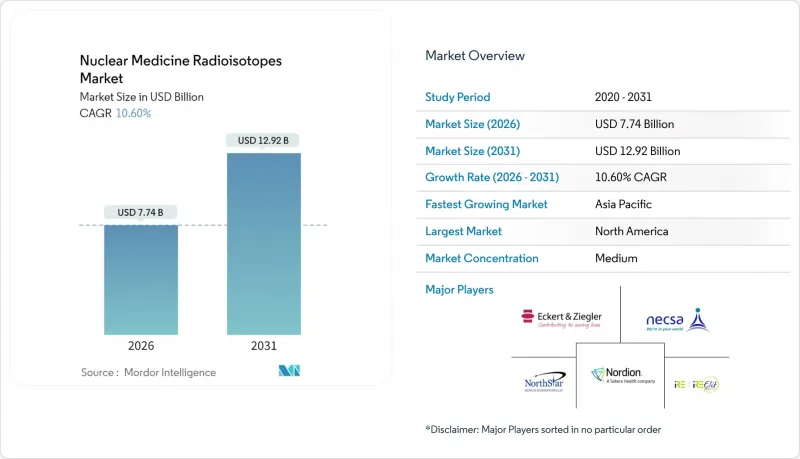
성장의 원동력은 암 발병률 증가, 심장 영상 진단 검사 건수 증가, 저농축 우라늄(LEU) 및 사이클로트론 기반 생산으로공급망 전환에 기인합니다. 진단용 방사성동위원소는 테크네튬99m, 불소18, 갈륨68이 일상적인 SPECT 및 PET 영상 진단을 지원하므로 매출의 86.70%를 차지하며 선두를 유지하고 있습니다. 치료용 동위원소는 루테튬177, 악티늄225, 납212 등 획기적인 알파선 방출체를 중심으로 신속한 규제 승인과 탄탄한 임상 데이터에 힘입어 성장을 가속화하고 있습니다. 플루피리더스 F-18의 심혈관 영역에서의 채택이 PET의 보급을 촉진하는 한편, 종양학 영역의 치료진단 융합기술(테라노스틱스)에 대한 투자와 임상현장의 관심이 집중되고 있습니다. 지역별로는 북미가 첨단화된 의료 인프라와 우호적인 규제 환경을 바탕으로 42.23%의 매출을 차지하고 있습니다. 그러나 아시아태평양은 사이클로트론의 적극적인 도입과 환자 접근성 확대로 인해 가장 높은 성장 가능성을 보이고 있습니다.
세계 핵의학용 방사성동위원소 시장 동향 및 전망
치료 진단용 동위원소를 필요로 하는 암 환자 증가
세계 암 환자 수는 2030년까지 60% 증가할 것으로 예상되며, 영상유도 표적치료가 가능한 동위원소에 대한 수요가 증가하고 있습니다. 루테튬177 PSMA 요법은 전이성 전립선암에서 49.5%의 객관적 반응률을 보였으며, 화학요법 대비 우수한 안전성 프로파일을 유지하고 있습니다. 미국 식품의약국(FDA)은 62.5%의 반응률을 보이며 위장췌장 신경내분비종양에 대한 212Pb-DOTAMTATE를 획기적 치료제로 지정하며 알파선 방출체의 기세를 지원하고 있습니다.
심장병학에서 SPECT 및 PET 이미징의 채택 확대
고령화에 따라 심근 관류 영상에 대한 수요가 증가하는 가운데, 심장병학은 여전히 사용량 기준으로 가장 큰 응용 분야입니다. 풀피리더스 F-18의 승인으로 테크네튬 99m에 대한 의존성에서 벗어날 수 있게 됨과 동시에 우수한 PET 영상 품질과 워크플로우상 이점을 제공합니다. 현재 PET 트레이서의 95%를 공급하고 있는 사이클로트론 기반의 18F 생산은 일상적인 처리 능력 향상과 공급 안정성을 지원하고 있습니다.
표적 치료를 위한 알파선 방출체의 규제 신속화
미국과 유럽의 획기적 치료제 및 우선 심사 제도를 통해 알파선 방출 방사성 의약품 시장 출시 기간이 단축되고 있습니다. 유럽의약품청(EMA)의 조화로운 가이드라인과 진화하는 아시아 프레임워크는 국경을 초월한 개발 효율을 향상시키고 있습니다.
부문 분석
2025년 기준 진단용 동위원소는 핵의학 방사성동위원소 시장의 86.05%를 차지할 것으로 예상되며, 테크네튬99m의 보급이 이를 지원하고 있습니다. 불소18과 갈륨68은 특히 종양학에서 병기 분류와 심장 혈류 검사에서 PET의 급속한 확장을 지원하고 있습니다. 치료용 방사성동위원소는 종양 전문의들이 난치성 암 치료에 루테튬177과 알파선 방출체를 도입하면서 11.12%의 가장 빠른 CAGR을 기록했습니다. 치료용 핵의학용 방사성동위원소 시장 규모는 2026-2031년 사이에 두 배로 증가할 것으로 예측됩니다. 간세포암에서 이트륨90 마이크로스피어, 분화형 갑상선암에서 요오드131의 임상 데이터는 방사성 의약품의 수용성을 강화하고 있습니다.
알파선 방출체 파이프라인의 진전이 장기적인 성장 전망을 높이고 있습니다. 악티늄225는 주변 조직에 대한 손상을 최소화하면서 높은 선 에너지 전달률로 세포 독성을 발휘하지만, 생산 능력에는 여전히 한계가 있습니다. 납 212 발생장치의 획기적인 발전으로 보다 폭넓은 이용 가능성과 비용 절감을 기대할 수 있게 되었습니다. 규제 당국은 엄격한 제조 관리를 요구하고 있으며, 환자의 안전을 보장하는 동시에 투자 수요를 증가시키고 있습니다.
2025년 심장학 분야 매출은 30.85%를 차지할 것으로 예상되며, 이는 확립된 SPECT 프로토콜과 신흥 PET 워크플로우가 이를 지원할 것으로 보입니다. PET 심근 혈류 조영술은 진단 정확도 향상, 프로토콜 단축, 우수한 감쇠 보정을 실현하고 있으며, 이러한 요인들이 전환을 촉진하고 있습니다. 그러나 치료 진단학의 보급과 함께 종양학 분야는 11.54%의 연평균 복합 성장률(CAGR)로 2020년대 중반에 심장병학 분야를 추월할 것으로 예측됩니다. 종양학 적응증에서 핵의학용 방사성동위원소 시장 규모는 2031년까지 66억 8,000만 달러에 달할 것으로 예측됩니다. 전립선암에서 PSMA 표적 영상 및 치료, 신경내분비종양에서 소마토스타틴 수용체 적용은 치료 성과와 삶의 질 향상을 보여주고 있습니다.
신경학 및 갑상선 영역의 응용 분야는 틈새 수요를 유지하고 있습니다. PET 아밀로이드 이미징은 질병 변형 알츠하이머병 치료제와 함께 점진적으로 확대되고 있으며, 요오드 123과 요오드 131은 각각 갑상선 진단 및 절제 요법에서 그 중요성을 유지하고 있습니다.
지역별 분석
북미는 2025년 매출의 41.85%를 차지하며, 약 25억 9,000만 달러의 미국 수요와 사이클로트론, 원자로, 방사성 의약품 약국 등으로 구성된 생태계가 기반이 됩니다. 건설 중인 국내 저농축우라늄(LEU) 몰리브덴99(Mo-99) 시설은 노후화된 외국 원자로에 대한 의존도를 해소하고, 공급 차질로부터 지역을 보호하는 것을 목표로 하고 있습니다. 캐나다는 역사적으로 초크 리버 원자로를 통한 주요 수출국이었으나, 현재는 경쟁을 피하기 위해 소형 모듈 원자로 조사 및 사이클로트론 설비 업그레이드에 투자하고 있습니다. 멕시코는 민관 협력과 국경을 넘나드는 동위원소 물류를 통해 핵의학에 대한 접근성을 확대하고 있습니다.
유럽은 28.05%의 점유율을 차지했으며, 벨기에, 네덜란드, 프랑스, 독일이 대륙의 생산 거점 역할을 하고 있습니다. 프랑스 오라노메드(Orano Med)의 납212 공장은 2025년까지 연간 1만 도즈 생산을 목표로 하고 있으며, 유럽을 알파선 방출 핵종 상용화의 최전선에 위치시키고 있습니다. 독일에는 42개의 의료용 사이클로트론이 촘촘한 네트워크를 형성하여 지역 PET 수요를 공급하고 있습니다. 한편, 영국에서는 프로젝트 아서(Project Arthur)를 통해 2030년까지 국내 Mo-99 공급 체제를 구축하여 의료 서비스가 공급 부족의 영향을 받지 않도록 노력하고 있습니다. 아시아태평양은 11.82%의 가장 빠른 CAGR을 보이고 있으며, 중국과 인도의 사이클로트론 도입이 빠르게 진행되고 있습니다. 중국의 1,200개 핵의학 부문은 2024년 390만 건의 검사를 실시할 예정이며, 정부는 2035년까지 검사 능력을 두 배로 늘릴 계획입니다. 인도의 300개 이상의 센터는 바바 원자력 연구센터의 지원을 받아 원자로와 사이클로트론을 통해 동위원소를 생산하고 있습니다. 한국이 액티늄225의 국내 생산에 착수한 것과 호주가 2033년까지 3억 9,220만 달러의 시장 규모를 예상하고 있는 것은 지역적으로 기회가 확대되고 있음을 보여줍니다. 일본은 SHINE Technologies와 제휴하여 루테튬177의 안정적인 공급을 확보함으로써 전립선암 치료의 연속성을 보장하고 있습니다. 라틴아메리카 및 중동 및 아프리카은 여전히 개발도상국이지만, 꾸준한 인프라 투자가 진행되고 있습니다. 브라질은 상파울루의 사이클로트론 시설을 업그레이드하고, 사우디아라비아는 비전 2030 의료 전략에 따라 치료 진단센터에 대한 자금 지원을 추진하고 있습니다.
기타 특전:
- 엑셀 형식 시장 예측(ME) 시트
- 애널리스트의 3개월간 지원
자주 묻는 질문
목차
제1장 서론
제2장 조사 방법
제3장 개요
제4장 시장 구도
제5장 시장 규모와 성장 예측
제6장 경쟁 구도
제7장 시장 기회와 향후 전망
KSA 26.03.05The nuclear medicine radioisotopes market size in 2026 is estimated at USD 7.74 billion, growing from 2025 value of USD 7 billion with 2031 projections showing USD 12.92 billion, growing at 10.6% CAGR over 2026-2031.
Growth momentum flows from rising cancer prevalence, expanding cardiology imaging volumes, and supply-chain shifts toward low-enriched-uranium (LEU) and cyclotron-based production. Diagnostic radioisotopes retain an 86.70% revenue lead as technetium-99m, fluorine-18, and gallium-68 anchor routine SPECT and PET imaging. Therapeutic isotopes, led by lutetium-177 and breakthrough alpha emitters such as actinium-225 and lead-212, accelerate on the back of regulatory fast-tracking and compelling clinical data. Cardiovascular adoption of flurpiridaz F-18 boosts PET penetration, while oncology theranostics capture investment and clinical enthusiasm. Regionally, North America commands 42.23% revenue on the strength of advanced healthcare infrastructure and a supportive regulatory climate; Asia-Pacific, however, exhibits the highest growth potential thanks to aggressive cyclotron roll-outs and expanding patient access.
Global Nuclear Medicine Radioisotopes Market Trends and Insights
Rising Prevalence of Cancer Requiring Theranostic Isotopes
Global oncology caseloads are projected to surge 60% by 2030, intensifying demand for isotopes that enable image-guided, targeted therapy. Lutetium-177 PSMA therapy posts 49.5% objective responses in metastatic prostate cancer and maintains favorable safety profiles compared with chemotherapy. The U.S. Food and Drug Administration designated 212Pb-DOTAMTATE as a breakthrough for gastroenteropancreatic neuroendocrine tumors following 62.5% response rates, underscoring alpha-emitter momentum.
Growing Adoption of SPECT & PET Imaging in Cardiology
Cardiology remains the largest application by volume as aging demographics elevate myocardial perfusion imaging needs. The clearance of flurpiridaz F-18 removes technetium-99m dependency while providing superior PET image quality and workflow benefits. Cyclotron-based 18F production, now supplying 95% of PET tracers, supports daily throughput increases and supply resilience.
Regulatory Fast-Tracking of Alpha Emitters for Targeted Therapy
Breakthrough and priority-review pathways in the U.S. and Europe compress time-to-market for alpha-emitting radiopharmaceuticals. Harmonized European Medicines Agency guidelines and evolving Asian frameworks improve cross-border development efficiency.
Other drivers and restraints analyzed in the detailed report include:
- Informed Patients, Evolving Markets: The Awareness Effect
- Supply-Chain Shift to LEU-Based Mo-99 Mitigating Shortages
- Short Half-Life Logistics & Waste Challenges
- Aging Reactor Fleet Limiting Isotope Output
For complete list of drivers and restraints, kindly check the Table Of Contents.
Segment Analysis
Diagnostic isotopes held an 86.05% nuclear medicine radioisotopes market share in 2025, underpinned by technetium-99m's ubiquity. Fluorine-18 and gallium-68 support PET's rapid expansion, particularly in oncology staging and cardiology perfusion studies. Therapeutic radioisotopes record the swiftest 11.12% CAGR as oncologists embrace lutetium-177 and alpha emitters for resistant cancers. The nuclear medicine radioisotopes market size for therapeutic agents is forecast to double between 2026 and 2031. Clinical data for yttrium-90 microspheres in hepatocellular carcinoma and iodine-131 in differentiated thyroid cancer reinforce radiopharmaceutical acceptance.
Advancing alpha-emitter pipelines lift long-term growth prospects. Actinium-225 generates high-linear-energy-transfer cytotoxicity with minimal collateral tissue damage, though production remains capacity-limited. Lead-212 generator breakthroughs promise broader accessibility and cost reduction. Regulatory bodies require stringent manufacturing controls, elevating investment needs but safeguarding patient safety.
Cardiology represented 30.85% revenue in 2025 on the back of entrenched SPECT protocols and emerging PET workflows. PET myocardial perfusion delivers higher diagnostic accuracy, shortened protocols, and superior attenuation correction, factors fueling conversion. Oncology, however, is projected to overtake cardiology mid-decade on an 11.54% CAGR as theranostics proliferate. The nuclear medicine radioisotopes market size for oncology indications is projected to reach USD 6.68 billion by 2031. PSMA-targeted imaging and therapy in prostate cancer and somatostatin receptor applications in neuroendocrine tumors showcase outcome improvements and quality-of-life gains.
Neurology and thyroid applications preserve niche demand. PET amyloid imaging expands slowly alongside disease-modifying Alzheimer's drugs, whereas iodine-123 and iodine-131 retain relevance in thyroid diagnostics and ablation therapy respectively.
The Nuclear Medicine Radioisotopes Market Report is Segmented by Type (Diagnostic Radioisotopes [Technetium-99m, Fluorine-18, and More], Therapeutic Radioisotopes [Iodine-131, Lutetium-177, and More]), Application (Oncology, Cardiology, and More), Source (Reactor-Produced Isotopes, and More), End-User (Hospitals, and More), and Geography (North America, and More). The Market Forecasts are Provided in Terms of Value (USD).
Geography Analysis
North America generated 41.85% of 2025 revenue, anchored by roughly USD 2.59 billion U.S. demand and an ecosystem of cyclotrons, reactors, and radiopharmacies. Domestic LEU Mo-99 facilities under construction aim to eliminate reliance on aging foreign reactors and shield the region from supply disruptions. Canada, historically a major exporter via the Chalk River reactor, now invests in small modular reactor research and cyclotron upgrades to retain competitiveness. Mexico broadens nuclear medicine accessibility through public-private partnerships and cross-border isotope logistics.
Europe captured 28.05% share with Belgium, the Netherlands, France, and Germany serving as continental production hubs. France's Orano Med lead-212 plant targets 10,000 annual doses by 2025, positioning Europe at the forefront of alpha-emitter commercialization. Germany's dense network of 42 medical cyclotrons supplies regional PET needs, while the United Kingdom's Project Arthur seeks domestic Mo-99 coverage by 2030 to insulate health services from shortages. Asia-Pacific posts the fastest 11.82% CAGR, led by rapid cyclotron deployment in China and India. China's 1,200 nuclear medicine departments handled 3.9 million procedures in 2024, with government plans to double capacity by 2035. India's 300-plus centers leverage Bhabha Atomic Research Centre support for reactor and cyclotron isotope production. South Korea's move to domestically produce actinium-225 and Australia's USD 392.2 million 2033 market projection illustrate widening regional opportunity circles. Japan partners with SHINE Technologies to secure lutetium-177 supply, ensuring continuity for prostate cancer therapy. Latin America and the Middle East & Africa remain nascent but demonstrate consistent infrastructure investments. Brazil upgrades cyclotron installations in Sao Paulo, while Saudi Arabia funds theranostic centers under Vision 2030 health strategies.
- Curium Pharma
- Cardinal Health
- GE Healthcare
- Siemens Healthineers (PETNET)
- Lantheus Holdings
- Advanced Accelerator Applications (AAA)
- Eckert & Ziegler Radiopharma
- Nordion
- Jubilant Radiopharma
- IBA Radiopharma Solutions
- SHINE Technologies
- NorthStar Medical Radioisotopes
- BWXT Medical
- Isotopia Molecular Imaging
- ITM Isotope Technologies Munich
- Telix Pharmaceuticals
- Cyclotek
- NTP Radioisotopes
- Nusano
- Orano Med
Additional Benefits:
- The market estimate (ME) sheet in Excel format
- 3 months of analyst support
TABLE OF CONTENTS
1 Introduction
- 1.1 Study Assumptions & Market Definition
- 1.2 Scope of the Study
2 Research Methodology
3 Executive Summary
4 Market Landscape
- 4.1 Market Overview
- 4.2 Market Drivers
- 4.2.1 Rising prevalence of cancer requiring theranostic isotopes
- 4.2.2 Growing adoption of SPECT & PET imaging in cardiology
- 4.2.3 Supply-chain shift to LEU-based Mo-99 mitigating shortages
- 4.2.4 Regulatory fast-tracking of alpha-emitters for targeted therapy
- 4.2.5 Expansion of cyclotron networks in emerging economies
- 4.2.6 Rise of theranostic isotope pairings (Ga-68/Lu-177, etc.)
- 4.3 Market Restraints
- 4.3.1 Short half-life logistics & waste challenges
- 4.3.2 Aging reactor fleet limiting isotope output
- 4.3.3 High CAPEX of cyclotrons in developing regions
- 4.3.4 Escalating radiation-safety compliance costs
- 4.4 Value / Supply-Chain Analysis
- 4.5 Regulatory Landscape
- 4.6 Technological Outlook
- 4.7 Porter's Five Forces
- 4.7.1 Bargaining Power of Suppliers
- 4.7.2 Bargaining Power of Buyers
- 4.7.3 Threat of New Entrants
- 4.7.4 Threat of Substitutes
- 4.7.5 Competitive Rivalry
5 Market Size & Growth Forecasts
- 5.1 By Type (Value)
- 5.1.1 Diagnostic Radioisotopes
- 5.1.1.1 Technetium-99m (Tc-99m)
- 5.1.1.2 Fluorine-18 (F-18)
- 5.1.1.3 Iodine-123 (I-123)
- 5.1.1.4 Others
- 5.1.2 Therapeutic Radioisotopes
- 5.1.2.1 Iodine-131
- 5.1.2.2 Lutetium-177
- 5.1.2.3 Yttrium-90
- 5.1.2.4 Others
- 5.1.1 Diagnostic Radioisotopes
- 5.2 By Application (Value)
- 5.2.1 Oncology
- 5.2.2 Cardiology
- 5.2.3 Neurology
- 5.2.4 Thyroid Disorders
- 5.2.5 Others
- 5.3 By Source (Value)
- 5.3.1 Reactor-produced Isotopes
- 5.3.2 Cyclotron-produced Isotopes
- 5.3.3 Generator-produced Isotopes
- 5.4 By End-user (Value)
- 5.4.1 Hospitals
- 5.4.2 Diagnostic Imaging Centers
- 5.4.3 Academic & Research Institutes
- 5.4.4 Pharmaceutical & Biotechnology Companies
- 5.5 By Geography (Value)
- 5.5.1 North America
- 5.5.1.1 United States
- 5.5.1.2 Canada
- 5.5.1.3 Mexico
- 5.5.2 Europe
- 5.5.2.1 Germany
- 5.5.2.2 United Kingdom
- 5.5.2.3 France
- 5.5.2.4 Italy
- 5.5.2.5 Spain
- 5.5.2.6 Rest of Europe
- 5.5.3 Asia-Pacific
- 5.5.3.1 China
- 5.5.3.2 India
- 5.5.3.3 Japan
- 5.5.3.4 South Korea
- 5.5.3.5 Australia
- 5.5.3.6 Rest of Asia-Pacific
- 5.5.4 South America
- 5.5.4.1 Brazil
- 5.5.4.2 Argentina
- 5.5.4.3 Rest of South America
- 5.5.5 Middle East and Africa
- 5.5.5.1 GCC
- 5.5.5.2 South Africa
- 5.5.5.3 Rest of Middle East and Africa
- 5.5.1 North America
6 Competitive Landscape
- 6.1 Market Concentration
- 6.2 Market Share Analysis
- 6.3 Company Profiles (includes Global level Overview, Market level overview, Core Segments, Financials as available, Strategic Information, Market Rank/Share for key companies, Products & Services, and Recent Developments)
- 6.3.1 Curium
- 6.3.2 Cardinal Health
- 6.3.3 GE HealthCare
- 6.3.4 Siemens Healthineers (PETNET)
- 6.3.5 Lantheus Holdings
- 6.3.6 Advanced Accelerator Applications (AAA)
- 6.3.7 Eckert & Ziegler Radiopharma
- 6.3.8 Nordion
- 6.3.9 Jubilant Radiopharma
- 6.3.10 IBA Radiopharma Solutions
- 6.3.11 SHINE Technologies
- 6.3.12 NorthStar Medical Radioisotopes
- 6.3.13 BWXT Medical
- 6.3.14 Isotopia Molecular Imaging
- 6.3.15 ITM Isotope Technologies Munich
- 6.3.16 Telix Pharmaceuticals
- 6.3.17 Cyclotek
- 6.3.18 NTP Radioisotopes
- 6.3.19 Nusano
- 6.3.20 Orano Med
7 Market Opportunities & Future Outlook
- 7.1 White-space & Unmet-Need Assessment