

|
시장보고서
상품코드
1939581
MLaaS(Machine Learning As A Service) : 시장 점유율 분석, 업계 동향과 통계, 성장 예측(2026-2031년)Machine Learning As A Service (MLaaS) - Market Share Analysis, Industry Trends & Statistics, Growth Forecasts (2026 - 2031) |
||||||
 Mordor Intelligence
MLaaS(Machine Learning As A Service) 시장은 2025년에 457억 6,000만 달러로 평가되며, 2026년 615억 8,000만 달러에서 2031년까지 2,718억 8,000만 달러에 달할 것으로 예측됩니다.
예측 기간(2026-2031년)의 CAGR은 34.58%로 예상됩니다.
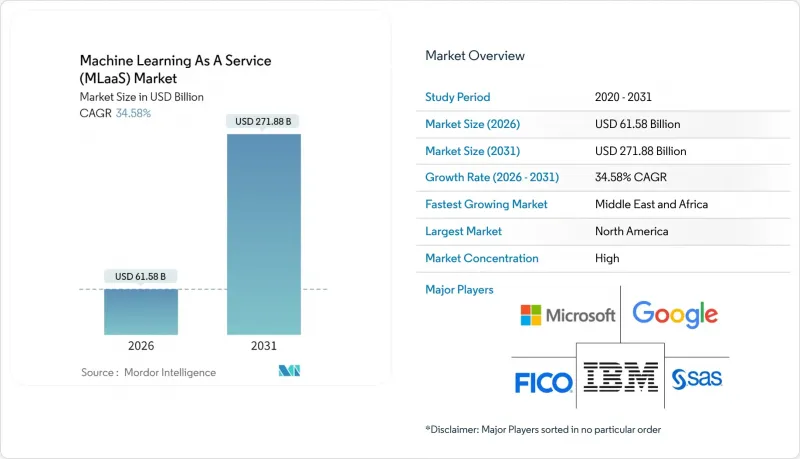
종량제 GPU 인스턴스의 급속한 보급, 생성형 AI 툴키트의 민주화, 기밀 데이터를 국내에 보관하는 소버린 클라우드 프로그램이 결합하여 수요를 가속화하고 있습니다. 또한 기업은 설명가능성 및 데이터 거주성에 대한 규제 요건을 충족시키면서 On-Premise 인프라에 대한 대규모 자본 지출을 피하기 위해 MLaaS로 전환하고 있습니다. 중동 국부펀드의 자본 유입과 싱가포르, EU, 중국의 국가 AI 전략은 규제 준수 클라우드 존의 지역적 확장을 촉진하고 있습니다. 동시에 AI 기반 위협 감지에 대한 보험사의 보험료 할인과 하이퍼스케일 기업의 경쟁적인 가격 책정은 중소기업(SME)의 진입장벽을 더욱 낮추고 있습니다.
세계 MLaaS(Machine Learning As A Service) 시장 동향 및 인사이트
서비스로 제공되는 생성형 AI 툴키트의 급증
주요 클라우드 기반 모델 카탈로그에는 턴키 방식의 미세 조정, 오케스트레이션, 벡터 데이터베이스 커넥터가 표준으로 제공됩니다. 아마존의 Nova 제품군은 Bedrock과 직접 연동되므로 기업은 몇 분에서 몇 시간이 아닌 몇 시간 만에 멀티모달 프로토타입을 테스트할 수 있습니다. Microsoft가 xAI와 협력하여 Azure에서 Grok 3를 호스팅하는 노력은 모델 선택의 다양성을 높이고 API 레이어에 바이어스 감소 텔레메트리를 통합했습니다. 이러한 혁신을 통해 머신러닝에 대한 배경 지식이 부족한 개발자도 텍스트, 이미지, 동영상 추론 기능을 워크플로우에 통합할 수 있게 되었습니다. 기술 요구 사항의 감소는 개념증명(PoC) 주기를 단축하고, 구현 비용을 절감하며, MLaaS(Machine Learning As A Service) 시장의 잠재적 고객 기반을 확대합니다. 기존 종량제를 기반으로 하므로 재무 부문은 고도화된 AI를 운영 비용으로 취급합니다.
아시아 신흥 국가 중소기업의 클라우드 전환 가속화
아세안 지역내 기업의 99%가 중소기업에 해당하며, 정부 정책에 따라 백오피스 업무 및 고객 경험 기능의 디지털화가 추진되고 있습니다. 보조금 지원 광대역, 핀테크를 활용한 소액 대출, 지역 데이터센터의 확장이 결합되며, 2024년에는 클라우드 배포률이 37% 상승할 것으로 예측됩니다. 싱가포르의 국가 클라우드 프로그램은 사전 승인된 MLaaS 크레딧을 번들로 제공하고, 사업자는 설비투자 없이 수요 예측 모델을 도입할 수 있습니다. 베트남과 인도네시아의 수출 지향형 제조업에서는 센서 데이터를 클라우드 호스트형 AutoML 엔진에 직접 연동하는 예지보전 대시보드의 시범 운영이 진행되고 있습니다. 확장성을 위해 클라우드 프로바이더에 의존하는 중소기업이 증가함에 따라 MLaaS 시장은 구독 모델을 선호하는 수백만 명의 신규 및 고성장 테넌트를 확보하고 있습니다.
AI 모델의 지적재산권을 둘러싼 분쟁
자체 데이터로 기반 모델을 미세 조정하는 조직들 사이에서는 파생된 가중치의 소유권을 둘러싼 논쟁이 격화되고 있습니다. OpenAI가 훈련 데이터 권리 문제로 1,500만 유로의 GDPR(EU 개인정보보호규정) 벌금을 부과받은 사건이 부각되면서 리스크 관리 부서는 엄격한 라이선스 계약을 요구하게 되었습니다. 판례가 확립되지 않은 상황에서 법무부서가 계약 조항에 소유권, 보상, 로열티 조건을 명시할 때까지 도입을 지연하거나 동결하는 사례가 증가하고 있습니다. 스타트업 기업은 지적재산권 주장이 다운스트림 매출을 위협하는 경우, 벤처 자금 조달의 단절을 우려하고 있습니다. 이러한 불확실성은 이사회 차원의 리스크 평가를 왜곡시키고, MLaaS(Machine Learning As A Service) 시장의 성장 궤도에서 감점을 초래하고 있습니다.
부문 분석
모델 트레이닝 및 튜닝은 2025년 매출의 30.62%를 차지했으며, 이는 기업이 기반 모델을 전문 데이터세트에 적용하려는 움직임이 가속화됨에 따른 결과입니다. 이 활동으로 인해 생산 워크로드가 급증하면서 가시성이 필수적으로 요구되었습니다. 그 결과, MLOps 및 모니터링은 2031년까지 35.30%의 가장 높은 CAGR을 나타낼 것으로 예상되며, 머신러닝 서비스 시장 규모에서 기초적인 역할을 강화할 것으로 예측됩니다. 현재 통합 툴체인은 데이터 계보 캡처, 공정성 지표, 롤백 트리거를 번들로 제공하여 규제 당국의 지속적인 검증 요청에 대응하고 있습니다.
스타트업 기업은 빠른 프로토타이핑을 위해 로우코드 개발 스튜디오에 계속 의존하고 있지만, 사용량이 급증하면서 매니지드 MLOps로 전환하고 있습니다. 엣지 최적화 런타임이 저지연이 중요한 리테일 및 모빌리티 용도에 적용됨에 따라 추론 및 배포 매출은 꾸준히 성장하고 있습니다. 동영상 분석 프로젝트의 멀티모달 라벨링 수요로 인해 데이터 준비 서비스도 그 속도를 유지하고 있습니다. 전반적으로 서비스 구성은 머신러닝 서비스 시장에서 장기적인 가치 창출을 결정하는 것은 원시 모델 구축이 아니라 거버넌스 및 가동 시간 보장에 있음을 보여줍니다.
2025년 매출의 26.95%는 부정행위 감지가 차지할 것으로 예상되며, 은행은 거래 스트림에서 비정상적인 패턴을 추출하고 있습니다. 다음 물결은 컴퓨터 비전이 담당할 것입니다. 카메라 공급형 예지보전 플랫폼이 계획되지 않은 다운타임을 최대 70%까지 줄임으로써 36.85%의 연평균 복합 성장률(CAGR)을 기록했습니다. 제조업체는 AI 카메라를 레거시 라인에 장착하여 밀리초 단위로 결함을 감지합니다. 공장당 6자릿수 비용 절감을 실현하고 있습니다. 소매업체는 선반 스캐닝 로봇을 도입하여 품절을 방지하고, 병원은 낙상 감지 포드를 도입하여 환자 안전을 개선하고 있습니다.
마케팅 부문에서는 비전 API와 생성 모델을 결합하여 광고 크리에이티브 자동 생성 및 시각적 단서를 통한 오디언스 세그먼테이션을 추진하고 있습니다. 통신사는 구조적 건전성 검사를 위해 타워에 비전 센서를 설치하여 이미지를 클라우드 추론 클러스터로 스트리밍하고 있습니다. 이러한 비전 기술, IoT, MLaaS의 융합은 서비스형 컴퓨터 비전(CVAas)의 다양한 시장 기회를 창출하고 있습니다.
MLaaS 시장 보고서는 서비스 유형(모델 개발, 데이터 준비, 교육, 추론, MLOps), 용도(마케팅, 예지보전, 부정행위 감지, 네트워크 관리, 컴퓨터 비전), 조직 규모(중소기업, 대기업), 최종사용자(IT, 은행, 금융서비스 및 보험(BFSI), 의료, 자동차, 소매, 정부, 기타), 도입 형태(퍼블릭, 프라이빗, 하이브리드 클라우드), 지역별로 분류됩니다. 의료, 자동차, 소매, 정부, 기타), 도입 형태(퍼블릭, 프라이빗, 하이브리드 클라우드), 지역별로 분류되어 있습니다. 예측은 금액(USD)으로 표시됩니다.
지역별 분석
유럽은 MLaaS(Machine Learning As A Service) 시장에서 괄목할 만한 성장을 보이고 있으며, 정부 및 민간 부문의 AI 및 머신러닝 기술에 대한 대규모 투자를 바탕으로 2019-2024년 연간 약 35% 성장률을 나타낼 것으로 예측됩니다. 이러한 성장은 독일, 프랑스, 영국 등 주요 경제권의 강력한 디지털 인프라 구축과 인더스트리 4.0 구상의 확산에 힘입은 바 큽니다. 유럽의 조직들은 특히 산업 자동화, 예지보전, 고객 경험 향상에 MLaaS를 활용하는 데 집중하고 있습니다. 이 지역의 엄격한 데이터 보호 규정, 특히 GDPR(EU 개인정보보호규정)(General Data Protection Regulation)은 안전하고 컴플라이언스를 준수하는 MLaaS 솔루션 개발을 형성하고 데이터 프라이버시 및 보안에 대한 높은 기준을 설정하고 있습니다. 유럽연합 집행위원회의 디지털 혁신과 AI 개발 노력은 MLaaS 도입에 유리한 환경을 조성하고 있으며, 각국의 다양한 AI 전략은 시장 성장을 더욱 가속화하고 있습니다. 또한 이 지역이 지속가능하고 윤리적인 AI 개발에 집중하고 있는 것도 MLaaS 솔루션의 진화에 영향을 미쳐 다양한 분야에서 이러한 기술의 책임감 있는 도입을 보장하고 있습니다.
기타 특전:
- 엑셀 형식 시장 예측(ME) 시트
- 애널리스트의 3개월간 지원
자주 묻는 질문
목차
제1장 서론
제2장 조사 방법
제3장 개요
제4장 시장 구도
제5장 시장 규모와 성장 예측
제6장 경쟁 구도
제7장 시장 기회와 향후 전망
KSA 26.03.06The Machine Learning As A Service Market was valued at USD 45.76 billion in 2025 and estimated to grow from USD 61.58 billion in 2026 to reach USD 271.88 billion by 2031, at a CAGR of 34.58% during the forecast period (2026-2031).
Rapid adoption of pay-per-use GPU instances, the democratization of generative AI toolkits, and sovereign-cloud programs that keep sensitive data inside national borders jointly accelerate demand. Enterprises also gravitate toward MLaaS to meet looming regulatory requirements on explainability and data residency while avoiding large capital outlays on on-premises infrastructure. Capital inflows from sovereign wealth funds in the Middle East and national AI strategies in Singapore, the EU, and China reinforce regional buildouts of compliant cloud zones. At the same time, insurers' premium rebates for AI-based threat detection and hyperscale's' competitive pricing further lower barriers for small and medium enterprises (SMEs).
Global Machine Learning As A Service (MLaaS) Market Trends and Insights
Surge in Gen-AI Toolkits Offered "As-a-Service
Foundation-model catalogues from leading clouds now ship with turnkey fine-tuning, orchestration, and vector-database connectors. Amazon's Nova suite integrates directly with Bedrock so enterprises can test multimodal prototypes in hours rather than quarters. Microsoft's partnership with xAI to host Grok 3 on Azure adds diversity to model choices and embeds bias-mitigation telemetry at the API layer. These innovations allow developers with limited ML backgrounds to embed text, image, and video reasoning into workflows. Lower skill requirements shorten proof-of-concept cycles, slash implementation costs, and boost the Machine Learning as a Service market's addressable base. Because the offerings ride on existing consumption-based billing, finance teams treat advanced AI as an operating expense.
Rapid SME Cloud Migration in Emerging Asia
Across ASEAN, 99% of firms qualify as SMEs, and government policy pushes them to digitize back-office and customer-experience functions. Subsidized broadband, fintech-enabled micro-lending, and regional data-centre expansions combine to lift cloud adoption by 37% in 2024. Singapore's national cloud program bundles pre-approved MLaaS credits, letting merchants deploy demand-forecasting models without capex. Export-oriented manufacturers in Vietnam and Indonesia are piloting predictive-maintenance dashboards that feed sensor data straight to cloud-hosted AutoML engines. As SMEs lean on cloud providers for scalability, the Machine Learning as a Service market gains millions of new, high-growth tenants that prefer subscription models.
AI-Model IP-Ownership Disputes
Organizations fine-tuning foundation models on proprietary data increasingly debate who owns derivative weights. The issue hit center stage when OpenAI drew a EUR 15 million GDPR penalty over training-data rights, spurring risk teams to demand watertight licenses. Without clear case law, legal teams slow or freeze deployments until contract clauses spell out ownership, indemnity, and royalty terms. Start-ups fear venture funding gaps if IP claims threaten downstream revenue. The uncertainty skews board-level risk assessments and subtracts points from the Machine Learning as a Service market growth trajectory.
Other drivers and restraints analyzed in the detailed report include:
- Cyber-Insurance Rebates for AI-Enabled Threat Detection
- Pay-Per-Use GPU Pricing by Hyperscale's
- Rising Sovereign-Cloud Mandates
For complete list of drivers and restraints, kindly check the Table Of Contents.
Segment Analysis
Model Training and Tuning retained 30.62% of 2025 revenue as firms rushed to adapt foundation models to specialty datasets. That activity produced an explosion of production workloads, making observability indispensable. Consequently, MLOps and Monitoring are expected to log the highest 35.30% CAGR, reinforcing its role as the connective tissue of the Machine Learning as a Service market size through 2031. Integrated toolchains now bundle lineage capture, fairness metrics, and rollback triggers, answering regulators' calls for continuous validation.
Start-ups still lean on low-code development studios to prototype quickly, yet they pivot to managed MLOps once usage spikes. Inference and Deployment revenues grow steadily as edge-optimized runtimes enable latency-critical retail and mobility applications. Data Preparation services keep pace thanks to multimodal labelling demands from video-analytic projects. Overall, the service mix shows that governance and uptime assurance, not raw model building, now determine long-term value creation in the Machine Learning as a Service market.
Fraud Detection supplied 26.95% of 2025 sales as banks mined transaction streams for anomalous patterns. The next wave belongs to Computer Vision, which is tracking a 36.85% CAGR thanks to camera-fed predictive-maintenance platforms that cut unplanned downtime by up to 70%. Manufacturers retrofit legacy lines with AI cameras that flag defects in milliseconds, unlocking six-figure savings per plant. Retailers deploy shelf-scanning robots to curb stock-outs, while hospitals adopt fall-detection pods to boost patient safety.
Marketing teams increasingly pair vision APIs with generative models to auto-produce ad creatives and segment audiences by visual cues. Network operators attach vision sensors to towers for structural-integrity checks, streaming imagery into cloud inference clusters. This convergence of vision, IoT, and MLaaS propels a diversified addressable market for Computer-Vision-as-a-Service.
The MLaaS Market Report is Segmented by Service Type (Model Development, Data Preparation, Training, Inference, Mlops), Application (Marketing, Predictive Maintenance, Fraud Detection, Network Management, Computer Vision), Organization Size (SMEs, Large Enterprises), End-User (IT, BFSI, Healthcare, Automotive, Retail, Government, Others), Deployment (Public, Private, Hybrid Cloud), and Geography. Forecasts in Value (USD).
Geography Analysis
Europe has demonstrated remarkable progress in the machine learning as a service market, experiencing approximately 35% growth annually from 2019 to 2024, driven by significant governmental and private sector investments in AI and ML technologies. The region's growth is underpinned by strong digital infrastructure development and the increasing adoption of Industry 4.0 initiatives across major economies like Germany, France, and the United Kingdom. European organizations are particularly focused on leveraging MLaaS for industrial automation, predictive maintenance, and enhanced customer experiences. The region's stringent data protection regulations, particularly GDPR, have shaped the development of secure and compliant MLaaS solutions, setting high standards for data privacy and security. The European Commission's commitment to digital transformation and AI development has created a favorable environment for MLaaS adoption, while various national AI strategies have further accelerated market growth. The region's focus on sustainable and ethical AI development has also influenced the evolution of MLaaS solutions, ensuring responsible implementation of these technologies across various sectors.
- Amazon Web Services, Inc.
- Microsoft Corporation
- Alphabet Inc. (Google Cloud)
- IBM Corporation
- Salesforce, Inc.
- Oracle Corporation
- SAP SE
- Hewlett Packard Enterprise Company
- Alibaba Cloud Computing Co., Ltd.
- Baidu, Inc.
- SAS Institute Inc.
- H2O.ai, Inc.
- DataRobot, Inc.
- BigML, Inc.
- FICO (Fair Isaac Corporation)
- Yottamine Analytics, LLC
- MonkeyLearn, Inc.
- C3.ai, Inc.
- Sift Science, Inc.
- Iflowsoft Solutions, Inc.
Additional Benefits:
- The market estimate (ME) sheet in Excel format
- 3 months of analyst support
TABLE OF CONTENTS
1 INTRODUCTION
- 1.1 Study Assumptions and Market Definition
- 1.2 Scope of the Study
2 RESEARCH METHODOLOGY
3 EXECUTIVE SUMMARY
4 MARKET LANDSCAPE
- 4.1 Market Overview
- 4.2 Market Drivers
- 4.2.1 Surge in Gen-AI toolkits offered "as-a-service"
- 4.2.2 Rapid SME cloud-migration in emerging Asia
- 4.2.3 Cyber-insurance rebates for AI-enabled threat-detection
- 4.2.4 Pay-per-use GPU pricing by hyperscalers
- 4.2.5 Vertical-specific ML model marketplaces
- 4.2.6 National AI-cloud programs (e.g., EU's Gaia-X)
- 4.3 Market Restraints
- 4.3.1 AI-model IP-ownership disputes
- 4.3.2 Rising sovereign-cloud mandates
- 4.3.3 Hidden carbon-cost disclosures
- 4.3.4 Run-time data-bias liabilities
- 4.4 Industry Value-Chain Analysis
- 4.5 Regulatory Landscape
- 4.6 Technological Outlook
- 4.7 Porter's Five Forces Analysis
- 4.7.1 Threat of New Entrants
- 4.7.2 Bargaining Power of Buyers
- 4.7.3 Bargaining Power of Suppliers
- 4.7.4 Threat of Substitutes
- 4.7.5 Competitive Rivalry
5 MARKET SIZE AND GROWTH FORECASTS (VALUE)
- 5.1 By Service Type
- 5.1.1 Model Development Platforms
- 5.1.2 Data Preparation and Annotation
- 5.1.3 Model Training and Tuning
- 5.1.4 Inference and Deployment
- 5.1.5 MLOps and Monitoring
- 5.2 By Application
- 5.2.1 Marketing and Advertising
- 5.2.2 Predictive Maintenance
- 5.2.3 Fraud Detection and Risk Analytics
- 5.2.4 Automated Network Management
- 5.2.5 Computer Vision
- 5.3 By Organization Size
- 5.3.1 Small and Medium-sized Enterprises (SMEs)
- 5.3.2 Large Enterprises
- 5.4 By End-User Industry
- 5.4.1 IT and Telecom
- 5.4.2 BFSI
- 5.4.3 Healthcare and Life-Sciences
- 5.4.4 Automotive and Mobility
- 5.4.5 Retail and E-commerce
- 5.4.6 Government and Defense
- 5.4.7 Others End-User Industry (Energy, Education, etc.)
- 5.5 By Deployment Mode
- 5.5.1 Public Cloud
- 5.5.2 Private Cloud
- 5.5.3 Hybrid / Multi-Cloud
- 5.6 By Geography
- 5.6.1 North America
- 5.6.1.1 United States
- 5.6.1.2 Canada
- 5.6.1.3 Mexico
- 5.6.2 Europe
- 5.6.2.1 United Kingdom
- 5.6.2.2 Germany
- 5.6.2.3 France
- 5.6.2.4 Italy
- 5.6.2.5 Rest of Europe
- 5.6.3 Asia-Pacific
- 5.6.3.1 China
- 5.6.3.2 Japan
- 5.6.3.3 India
- 5.6.3.4 South Korea
- 5.6.3.5 Rest of Asia
- 5.6.4 Middle East
- 5.6.4.1 Israel
- 5.6.4.2 Saudi Arabia
- 5.6.4.3 United Arab Emirates
- 5.6.4.4 Turkey
- 5.6.4.5 Rest of Middle East
- 5.6.5 Africa
- 5.6.5.1 South Africa
- 5.6.5.2 Egypt
- 5.6.5.3 Rest of Africa
- 5.6.6 South America
- 5.6.6.1 Brazil
- 5.6.6.2 Argentina
- 5.6.6.3 Rest of South America
- 5.6.1 North America
6 COMPETITIVE LANDSCAPE
- 6.1 Market Concentration
- 6.2 Strategic Moves
- 6.3 Market Share Analysis
- 6.4 Company Profiles (includes Global-level Overview, Market-level Overview, Core Segments, Financials as available, Strategic Information, Market Rank/Share, Products and Services, Recent Developments)
- 6.4.1 Amazon Web Services, Inc.
- 6.4.2 Microsoft Corporation
- 6.4.3 Alphabet Inc. (Google Cloud)
- 6.4.4 IBM Corporation
- 6.4.5 Salesforce, Inc.
- 6.4.6 Oracle Corporation
- 6.4.7 SAP SE
- 6.4.8 Hewlett Packard Enterprise Company
- 6.4.9 Alibaba Cloud Computing Co., Ltd.
- 6.4.10 Baidu, Inc.
- 6.4.11 SAS Institute Inc.
- 6.4.12 H2O.ai, Inc.
- 6.4.13 DataRobot, Inc.
- 6.4.14 BigML, Inc.
- 6.4.15 FICO (Fair Isaac Corporation)
- 6.4.16 Yottamine Analytics, LLC
- 6.4.17 MonkeyLearn, Inc.
- 6.4.18 C3.ai, Inc.
- 6.4.19 Sift Science, Inc.
- 6.4.20 Iflowsoft Solutions, Inc.
7 Market Opportunities and Future Outlook
- 7.1 White-space and Unmet-Need Assessment


