
|
시장보고서
상품코드
1939617
중국의 종이 포장 : 시장 점유율 분석, 업계 동향과 통계, 성장 예측(2026-2031년)China Paper Packaging - Market Share Analysis, Industry Trends & Statistics, Growth Forecasts (2026 - 2031) |
||||||
 Mordor Intelligence
중국의 종이 포장 시장은 2025년에 917억 5,000만 달러로 평가되며, 2026년 961억 3,000만 달러에서 2031년까지 1,213억 1,000만 달러에 달할 것으로 예측됩니다.
예측 기간(2026-2031년)의 CAGR은 4.77%로 예상됩니다.
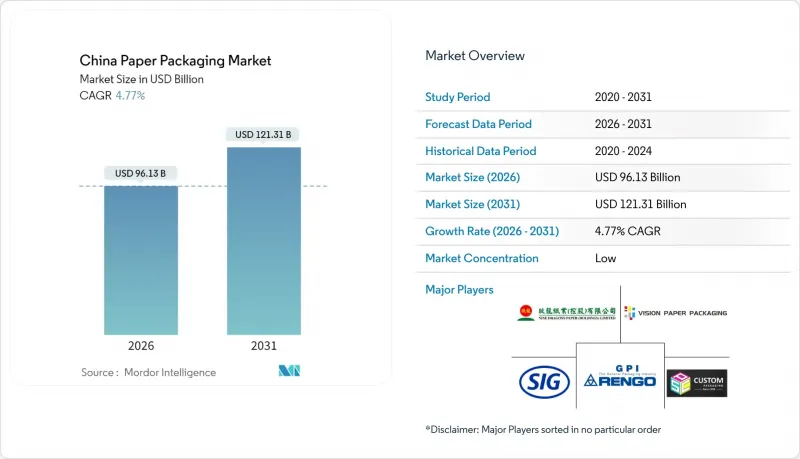
펄프 가격의 변동 주기에도 불구하고 확대가 계속되고 있습니다. 이는 E-Commerce 소포 물량, 정부의 플라스틱 감축 지침, 외식 산업의 성장이 골판지 및 접이식 카톤 형태에 대한 새로운 수요를 불러일으키고 있기 때문입니다. 중국의 국가 탄소배출권 제도가 회수율을 높이는 제조업체에 보상을 제공하면서 재생섬유 채택이 가속화되고 있습니다. 또한 고급 디지털 인쇄를 통해 브랜드는 재고 낭비 없이 단기간에 맞춤형 캠페인을 진행할 수 있습니다. 국내 대기업인 구룡제지산업과 선페이퍼 그룹은 고속 골판지 제조기 및 판지 제조기를 통한 생산능력 확대를 추진하고 있지만, 수입 목재섬유 가격 변동과 변동제 전력요금으로 인해 원가 압박은 여전히 높은 수준입니다. 각 지방마다 다른 녹색 포장 규제 시행 상황이 복잡해지면서 기업은 배합의 현지화, 중금속 및 제한 물질에 대한 GB 43352-2023 표준의 제한치를 충족하는 품질관리 시스템에 대한 투자를 해야 합니다.
중국 종이 포장 시장 동향 및 분석
E-Commerce 소포 취급량 증가
2024년 택배 취급량은 1,745억 개에 달할 것으로 예상되며, 골판지 포장이 상자 재료의 96.17%를 차지하여 중국 종이 포장 시장의 탄탄한 기초 소비를 보장합니다. 베이징과 상하이의 도시형 물류 허브는 라스트마일 비용의 압축과 배송 시간 단축을 실현하는 한편, 여러 번의 취급 주기를 견딜 수 있는 2차 포장 상자에 대한 성능 요구가 더욱 엄격해지고 있습니다. 알리바바가 시범 도입한 로켓배송 서비스(전 세계 1시간 배송 목표)는 극한의 속도가 포장 설계자에게 충격 저항성을 유지하면서 중량 대 강도 비율을 최적화하도록 압박하는 좋은 예입니다. 배송용 골판지에 QR코드를 통한 시리얼라이제이션과 RFID 태그 삽입이 증가하고 있으며, 재고 가시화 및 반품 자동화를 실현하고 있습니다. 이러한 발전과 함께 E-Commerce는 중국 종이 포장 시장의 구조적 기반으로서 확고한 입지를 구축했습니다.
외식 산업과 배달 생태계의 확대
테이크아웃 주문은 상업 중심지에서 고밀도의 폐기물을 발생시키고 있으며, 상위 10%의 지역이 포장 폐기물의 64%를 차지하므로 음식점은 경량 섬유 기반 솔루션으로의 전환을 추진하고 있습니다. 삼양사 등 국내 업체가 개발한 사탕수수 성형 재사용 가능한 트레이는 고급 프랜차이즈 매장에 보급이 확산되고 있으며, 신선도를 추적하는 바이오센서 라벨은 안전성을 훼손하지 않으면서도 배송 범위를 확대하는 데 일조하고 있습니다. 다국적 패스트푸드 체인이 세척 가능한 매장용 용기를 시험 도입하기 시작하면서, 지방정부가 일회용 플라스틱 규제 기준을 강화하는 가운데, 향후 컴플라이언스 준수 방향을 제시하고 있습니다. 이러한 요인들이 복합적으로 작용하여 중국 종이 포장 시장에 더 많은 추진력을 불어넣고 있습니다.
변동하는 폐지 수입 규제와 원료 공급
중국은 2023년 2,800만 톤 시장용 펄프를 수입하여 전년 대비 24% 증가했습니다. 이로 인해 제지 공장은 운송 장애와 관세 변동에 영향을 받기 쉽습니다. 폐섬유 수입금지로 인해 국내 재활용업체들은 거의 풀가동 상태이며, 폐지 가격 상승으로 인해 가공업체들이 종이 평량을 줄여야 하는 상황도 발생하고 있습니다. 완성지 관세 인하는 아세안 제지공장과의 경쟁을 심화시키고, 가격 침체기에는 국내 이익률을 압박할 수 있습니다. 이러한 추세로 인해 중국 종이 포장 시장의 성장 전망은 하향 조정되고 있습니다.
부문 분석
골판지 상자는 가볍고 내압성이 우수한 형태가 택배에서 요구됨에 따라 2025년 중국 종이 포장 시장 규모의 35.62%를 차지했습니다. 동관시 황석금휘의 분당 352미터의 골판지 제조기는 EC 거점에 적시 공급을 보장하는 생산능력 확충의 좋은 예입니다. 그러나 화장품의 고급화에 힘입어 접이식 카톤은 2031년까지 7.68%의 연평균 복합 성장률(CAGR)을 유지하며 골판지의 우위를 잠식할 것으로 예측됩니다. 멀티패스 디지털 인쇄기는 긴 준비 시간 없이 바니싱 효과와 스팟 포일 스탬핑 액센트를 구현하여 고급 뷰티 브랜드가 한정판 인쇄를 통해 높은 이익률을 얻을 수 있도록 합니다. 액체 포장용 카톤은 SIG의 알루미늄 층이 필요 없는 기술을 활용하여 틈새 시장에서 존재감을 유지하고 있으며, 이 기술은 탄소발자국을 61% 감소시키면서 유제품의 유통기한을 보호합니다. 도시 지역의 의료비 지출 증가에 따라 변조 방지 기능이 있는 의약품 슬리브를 포함한 특수 서브 라인은 꾸준히 성장하고 있습니다.
2025년 현재 식품은 중국 종이 포장 시장의 41.05%를 차지하고 있습니다. 이는 테이크아웃 식품 및 음료가 도시 소비를 주도하고 있기 때문입니다. 도시 주요 지역에서는 도시락 수요가 급증하고 있으며, 지자체에서는 재활용 섬유 공장에 공급하는 순환형 수거 시스템을 시범 도입하고 있습니다. 퍼스널케어-화장품 분야는 규모는 작지만, 온라인 뷰티 인플루언서의 부상과 가처분 소득 증가를 배경으로 연 8.07% 성장하고 있습니다. Amkor의 재활용 가능한 파우치와 리필용 포드는 일류 쇼핑몰의 샴푸 리필 스테이션에 채택되어 기능성과 지속가능성의 융합을 구현하고 있습니다. 전자기기 브랜드가 요구하는 정전기 방지 및 방습 라이너는 수익성이 높은 크로스오버 분야이며, 골판지 제조업체는 골판지에 나노 클레이 코팅을 적용하여 대응하고 있습니다. 의료 포장에는 온도 기록용 스마트 라벨이 통합되어 지역 간 콜드체인에서 의약품의 품질 유지를 보장합니다.
중국 종이포장 시장 보고서는 제품 유형별(접이식 상자, 골판지 상자, 종이봉투 및 종이 봉지, 액체 포장용 상자 등), 최종사용자 산업별(식품, 음료, 의료, 의료, 퍼스널케어, 생활용품, 전자제품 등), 소재 유형별(버진 섬유 기반, 재생 섬유 기반), 포장 수준별(1차, 2차, 3차 포장), 지역별(중국)로 분류됩니다. 1차 포장, 2차 포장, 3차 포장), 지역별(중국)로 분류되어 있습니다. 시장 예측은 금액 기준()으로 작성되었습니다.
기타 특전:
- 엑셀 형식 시장 예측(ME) 시트
- 애널리스트의 3개월간 지원
자주 묻는 질문
목차
제1장 서론
제2장 조사 방법
제3장 개요
제4장 시장 구도
제5장 시장 규모와 성장 예측
제6장 경쟁 구도
제7장 시장 기회와 향후 전망
KSA 26.03.06The China paper packaging market was valued at USD 91.75 billion in 2025 and estimated to grow from USD 96.13 billion in 2026 to reach USD 121.31 billion by 2031, at a CAGR of 4.77% during the forecast period (2026-2031).
Expansion continues despite pulp-price cycles because e-commerce parcel volumes, government plastic-reduction mandates, and food-service growth all channel fresh demand into corrugated and folding-carton formats. Recycled fiber adoption accelerates as China's national carbon-credit scheme rewards manufacturers that raise recovered-content ratios, while advanced digital printing lets brands run short, customized campaigns without inventory waste. Domestic leaders such as Nine Dragons Paper and Sun Paper Group extend capacity through high-speed corrugators and board machines, yet volatility in imported wood fiber and dynamic electricity pricing keeps cost pressure high. Provincial variability in green-packaging enforcement adds complexity, prompting firms to localize formulations and invest in quality-control systems that meet GB 43352-2023 limits on heavy metals and restricted substances.
China Paper Packaging Market Trends and Insights
Growth in e-commerce parcel volume
Express delivery handled 174.5 billion items in 2024, with corrugated packaging accounting for 96.17% of box material, ensuring resilient baseline consumption for the China paper packaging market. Metro-based logistics hubs in Beijing and Shanghai compress last-mile costs and shorten delivery times, but they also intensify performance requirements for secondary boxes that must survive multiple handling cycles. Alibaba's pilot rocket-delivery initiative, targeting one-hour global drop-offs, exemplifies how extreme speed pushes packaging designers to optimize weight-to-strength ratios while preserving shock resistance. QR-code serialization and RFID inserts increasingly appear on shipping cartons, enabling inventory visibility and returns automation. Together these developments cement e-commerce as the structural backbone for the China paper packaging market.
Expansion of food-service and delivery ecosystem
Takeaway orders generate high-density waste in core commercial grids where the top 10% of zones account for 64% of packaging discards, driving restaurants to switch to lighter, fiber-based solutions. Reusable, bagasse-molded trays developed by domestic suppliers such as Sumkoka gain traction among premium franchises, while biosensor labels that track freshness support longer delivery radii without safety compromises. Multinational quick-service chains pilot washable dine-in containers, indicating the direction of future compliance as provincial regulators tighten thresholds on single-use plastics. These factors collectively add momentum to the China paper packaging market.
Volatile waste-paper import rules and raw-material supply
China imported 28 million tons of market pulp in 2023, a 24% rise that exposes mills to freight disruptions and tariff shifts. The ban on post-consumer fibre imports keeps domestic recyclers running near full capacity, raising recovered-paper prices and occasionally forcing converters to down-spec grammage. Tariff cuts on finished paper boost competition from ASEAN mills, eroding domestic margins during price troughs. These dynamics trim growth expectations for the China paper packaging market.
Other drivers and restraints analyzed in the detailed report include:
- Government plastic-reduction mandates favouring paper
- Advanced digital printing and smart-packaging integration
- Escalating energy costs amid decarbonisation targets
For complete list of drivers and restraints, kindly check the Table Of Contents.
Segment Analysis
Corrugated boxes generated 35.62% of China paper packaging market size in 2025 as express freight required light, crush-resistant formats. Dongguan Huangshi Jinhui's 352 m-per-minute corrugator exemplifies capacity build-out that secures just-in-time supply for e-commerce hubs. Yet folding cartons, buoyed by cosmetics premiumisation, are pacing a 7.68% CAGR that will erode corrugated dominance through 2031. Multi-pass digital presses support varnish effects and spot-foil accents without forcing long makeready times, letting boutique beauty labels print limited editions that fetch high margins. Liquid packaging cartons maintain niche relevance by leveraging SIG's alu-layer-free technology, which cuts carbon footprints by 61% while safeguarding dairy shelf life. Speciality sub-lines, including tamper-evident pharma sleeves, grow steadily as healthcare spending rises in urban markets.
Food products held 41.05% of China paper packaging market share in 2025 because takeaway dining dominates urban consumption. Meal-box density spikes in grid hotspots, prompting municipalities to trial closed-loop collection that feeds recycled-fibre mills. Personal-care and cosmetics, though smaller, expand 8.07% yearly on the back of online beauty influencers and rising disposable income. Amcor's recycle-ready pouches and refill pods serve shampoo refill stations in tier-one malls, illustrating how functionality merges with sustainability. Electronics brands demand anti-static, moisture-barrier liners, a lucrative cross-over that corrugated suppliers address by grafting nanoclay coatings onto fluting. Healthcare packaging integrates smart labels for temperature logging, ensuring drug integrity across regional cold chains.
The China Paper Packaging Market Report is Segmented by Product Type (Folding Cartons, Corrugated Boxes, Paper Bags and Sacks, Liquid Packaging Cartons, and More), End-User Industry (Food, Beverage, Healthcare, Personal Care, Household Care, Electronics, and More), Material Type (Virgin Fibre-Based, Recycled Fibre-Based), Packaging Level (Primary, Secondary, Tertiary), and Geography (China). Market Forecasts are in Value (USD).
List of Companies Covered in this Report:
- Nine Dragons Paper (Holdings) Ltd
- Lee & Man Paper Mfg Ltd
- Shanying International Holdings Co., Ltd
- Dongguan Vision Paper Products Co., Ltd
- Rengo Co., Ltd
- Oji Holdings Corp (China Packaging)
- SIG Combibloc Group
- Shanghai Custom Packaging Co., Ltd
- Xiamen Hexing Packaging & Printing Co., Ltd
- JML Packaging
- Suneco Box Co., Ltd
- Asia Pulp & Paper (APP) Sinar Mas
- Shanghai DE Printed Box
- Mondi Group
- Smurfit WestRock
- International Paper (China)
- Yutong Packaging Technology
- Zhejiang Jingxing Paper
- Guangdong Yizhou Packaging
Additional Benefits:
- The market estimate (ME) sheet in Excel format
- 3 months of analyst support
TABLE OF CONTENTS
1 INTRODUCTION
- 1.1 Study Assumptions and Market Definition
- 1.2 Scope of the Study
2 RESEARCH METHODOLOGY
3 EXECUTIVE SUMMARY
4 MARKET LANDSCAPE
- 4.1 Market Overview
- 4.2 Market Drivers
- 4.2.1 Growth in e-commerce parcel volume
- 4.2.2 Expansion of food-service and delivery ecosystem
- 4.2.3 Government plastic-reduction mandates favouring paper
- 4.2.4 Advanced digital printing and smart-packaging integration
- 4.2.5 Cross-border e-commerce consolidation boosting corrugated demand
- 4.2.6 National carbon-credit scheme accelerating recycled-content uptake
- 4.3 Market Restraints
- 4.3.1 Volatile waste-paper import rules and raw-material supply
- 4.3.2 Competition from recyclable mono-material plastics
- 4.3.3 Escalating energy costs amid decarbonisation targets
- 4.3.4 Pulp price cycles and domestic wood-pulp shortfall
- 4.4 Supply-Chain Analysis
- 4.5 Regulatory Landscape
- 4.6 Technological Outlook
- 4.7 Porter's Five Forces Analysis
- 4.7.1 Bargaining Power of Suppliers
- 4.7.2 Bargaining Power of Buyers
- 4.7.3 Threat of New Entrants
- 4.7.4 Threat of Substitutes
- 4.7.5 Competitive Rivalry
- 4.8 China Pulp and Paper: Opportunities for Foreign Investors
- 4.9 ESG and Sustainability Initiatives
5 MARKET SIZE AND GROWTH FORECASTS (VALUE)
- 5.1 By Product Type
- 5.1.1 Folding Cartons
- 5.1.2 Corrugated Boxes
- 5.1.3 Paper Bags and Sacks
- 5.1.4 Liquid Packaging Cartons
- 5.1.5 Other Product Types
- 5.2 By End-user Industry
- 5.2.1 Food
- 5.2.2 Beverage
- 5.2.3 Healthcare and Pharmaceuticals
- 5.2.4 Personal Care and Cosmetics
- 5.2.5 Household Care and Detergents
- 5.2.6 Electronics and Electrical Products
- 5.2.7 Other End-user Industries
- 5.3 By Material Type
- 5.3.1 Virgin Fibre-based
- 5.3.2 Recycled Fibre-based
- 5.4 By Packaging Level
- 5.4.1 Primary Packaging
- 5.4.2 Secondary Packaging
- 5.4.3 Tertiary Packaging
6 COMPETITIVE LANDSCAPE
- 6.1 Market Concentration
- 6.2 Strategic Moves
- 6.3 Market Share Analysis
- 6.4 Company Profiles (includes Global level Overview, Market level overview, Core Segments, Financials as available, Strategic Information, Market Rank/Share for key companies, Products and Services, and Recent Developments)
- 6.4.1 Nine Dragons Paper (Holdings) Ltd
- 6.4.2 Lee & Man Paper Mfg Ltd
- 6.4.3 Shanying International Holdings Co., Ltd
- 6.4.4 Dongguan Vision Paper Products Co., Ltd
- 6.4.5 Rengo Co., Ltd
- 6.4.6 Oji Holdings Corp (China Packaging)
- 6.4.7 SIG Combibloc Group
- 6.4.8 Shanghai Custom Packaging Co., Ltd
- 6.4.9 Xiamen Hexing Packaging & Printing Co., Ltd
- 6.4.10 JML Packaging
- 6.4.11 Suneco Box Co., Ltd
- 6.4.12 Asia Pulp & Paper (APP) Sinar Mas
- 6.4.13 Shanghai DE Printed Box
- 6.4.14 Mondi Group
- 6.4.15 Smurfit WestRock
- 6.4.16 International Paper (China)
- 6.4.17 Yutong Packaging Technology
- 6.4.18 Zhejiang Jingxing Paper
- 6.4.19 Guangdong Yizhou Packaging
7 MARKET OPPORTUNITIES AND FUTURE OUTLOOK
- 7.1 White-space and Unmet-Need Assessment