|
시장보고서
상품코드
1939634
스마트 수도 미터 : 시장 점유율 분석, 업계 동향과 통계, 성장 예측(2026-2031년)Smart Water Meter - Market Share Analysis, Industry Trends & Statistics, Growth Forecasts (2026 - 2031) |
||||||
 Mordor Intelligence
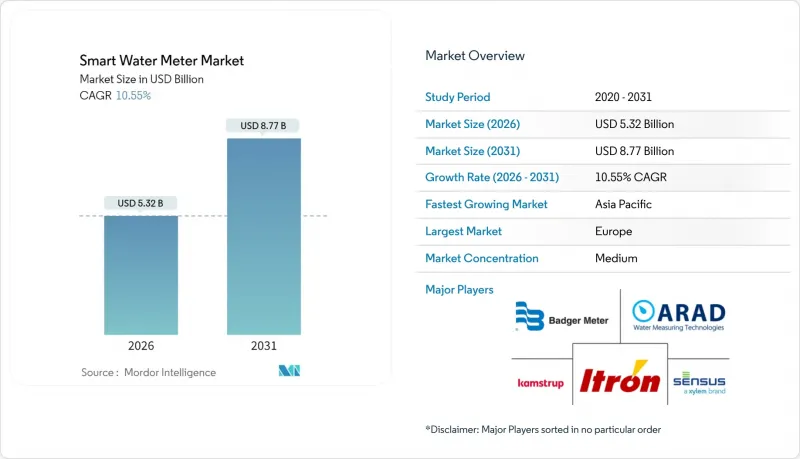
스마트 수도 미터 시장은 2025년에 48억 1,000만 달러로 평가되며, 2026년 53억 2,000만 달러에서 2031년까지 87억 7,000만 달러에 달할 것으로 예측됩니다.
예측 기간(2026-2031년)의 CAGR은 10.55%로 예상됩니다.
유틸리티 사업자들은 기계식 계량기에서 실시간 모니터링, 자동 과금, 데이터베이스 누수 감지를 가능하게 하는 커넥티드 디바이스로의 전환을 계속하고 있습니다. 물 절약에 대한 규제 요건, 노후화된 배수지 교체에 대한 압력 증가, 사물인터넷(IoT) 플랫폼의 확대가 결합되어 유틸리티 업계 전반에 걸쳐 도입이 가속화되고 있습니다. 벤더 간 경쟁은 분석 기능과 양방향 통신의 통합에 초점을 맞추면서 유리한 총소유비용(TCO)을 유지하는 데 초점을 맞추었습니다. 절감액에 따라 지불하는 모델과 같은 자금 조달 옵션의 확대와 검증된 누수 감소를 평가하는 성과 기반 규제는 선진국과 신흥 국가 수요 파이프라인을 더욱 강화할 것입니다.
세계 스마트 수도 미터 시장 동향 및 인사이트
지원적인 정부 규제
의무적인 도입 일정과 물 효율 기준은 유틸리티 사업자들이 컴플라이언스 및 보고 요건을 충족하는 첨단 계측 솔루션으로 전환하도록 유도하고 있습니다. EU 식수 지침은 엔드 투 엔드 모니터링을 요구하고 있으며, 이에 따라 독일과 프랑스에서는 신축 및 대규모 개보수 건물에 스마트 미터 설치를 규정하고 있습니다. 캘리포니아주의 영구적인 물 사용 규정은 집행에 필요한 상세한 데이터를 요구하고 있으며, AMI 도입은 자금 조달 자격의 전제조건이 되고 있습니다. 상수도 유틸리티는 누수 감소 및 고객 참여도 향상 실적을 문서화하여 비용 회수 메커니즘을 확보하고, 투자 리스크를 줄임과 동시에 전국적 확산을 지원합니다. 공급업체는 대량 주문에 따른 단가 절감의 혜택을 누리고, 정책 입안자는 물 절약 진행 상황을 추적할 수 있는 투명한 성과 지표를 확보할 수 있습니다. 지자체, 지역, 국가 차원의 규제는 스마트 수도 미터 시장의 광범위한 보급에 필요한 장기적인 확실성을 보장합니다.
물 이용 효율 개선의 필요성
물 부족 지역의 수도사업자는 커넥티드 미터를 도입하여 고소비 패턴을 파악하고, 행동 변화를 지원하는 시간 단위 데이터를 제공함으로써 고객의 자율성을 촉진합니다. 연속 원격 계측을 사용하는 산업 시설에서는 누수 지점 파악과 공정 최적화를 통해 20-30%의 소비량 감소가 보고되고 있습니다. 토양 수분 감지와 기상 기반 관개 스케줄링을 결합한 농업 시범사업에서 최대 28%의 물 절약 효과를 기록하여 분야 전반의 유용성을 입증했습니다. 효율화를 통한 이익은 에너지 절약으로 이어집니다. 물 생산과 양수가 큰 운영비를 차지하기 때문입니다. 분석 용도를 통한 수요 예측을 통해 상수도 유틸리티는 수요 피크를 평준화하고 설비 확장을 미룰 수 있습니다. 수도사업자가 물 절약과 매출의 분리를 연결함으로써 효율화의 이익이 안정적인 재무 성과로 전환되어 스마트 수도계량기 시장을 촉진합니다.
높은 초기 비용과 사이버 보안 위험성
AMI를 완전히 도입하려면 엔드포인트당 200-400달러의 비용이 소요되며, 이는 자본 예산이 한정된 유틸리티 사업자에게는 어려운 과제입니다. 요금 개정 승인에 몇 년이 소요될 수 있으며, 프로젝트 시작이 지연될 수 있습니다. 사이버 보안 대책, 암호화, 침입 감지, 24시간 모니터링으로 총 프로젝트 비용이 15-25% 더 증가합니다. 소규모 시스템, 특히 개발도상국에서는 우대융자가 없으면 투자가 미뤄지는 경우가 많습니다. 사이버 사고가 발생하면 규제 당국의 감시가 강화되고, 컴플라이언스 비용이 더욱 증가하게 됩니다. 이러한 요인들은 자금 조달 메커니즘이 성숙하고 보안 프레임워크가 표준화될 때까지 스마트 수도 미터 시장의 성장을 전반적으로 억제할 것입니다.
부문 분석
자동 검침 시스템(AMR)은 2025년 기준 스마트 수도 미터 시장 점유율의 57.10%를 차지할 것으로 예상되며, 이는 탄탄한 기반과 비용 효율적인 단방향 데이터 전송을 반영합니다. 많은 유틸리티 사업자들은 현대화 초기 단계에서 AMR을 채택합니다. 이는 대규모 네트워크 구축이 필요 없고, 주행 중 검침을 통해 인건비를 대폭 절감할 수 있기 때문입니다. AMR 관련 스마트 수도 미터 시장 규모는 여전히 크지만, 2세대 도입은 양방향 아키텍처를 우선시하므로 그 성장은 완만하게 성장하고 있습니다.
수도사업자들이 실시간 누수 경보, 원격 차단, 시간 변동형 요금제를 요구함에 따라 첨단 계량 인프라(AMI)는 2031년까지 연평균 복합 성장률(CAGR) 11.55%를 나타낼 것으로 예측됩니다. 셀룰러, NB-IoT, LoRaWAN 모듈의 비용 절감으로 AMI 도입의 주요 장벽이 해소되었습니다. 서비스 프로바이더는 계량기, 분석 툴, 소프트웨어 구독을 패키지화하여 자본 비용을 운영 예산에 분산시키고 있습니다. 풍부한 데이터를 제공하는 AMI 플랫폼은 물 절약 프로그램과의 연계가 용이하여 지역적 보급을 가속화하고 스마트 수도계량기 시장 확대에 기여할 것입니다.
주택용 도입은 유럽과 북미의 신규 주택에 스마트미터 설치 의무화에 따라 2025년 스마트 수도 미터 시장 규모의 58.00%를 차지할 것으로 예측됩니다. 소비자는 물 절약 목표와 구체적인 절약 효과를 연결하는 사용량 포털을 활용할 수 있으며, 안정적인 업데이트 주기가 유지되고 있습니다.
상업용 건물에서는 수도, 에너지, 공조 데이터를 연동하는 시설 관리 소프트웨어의 보급으로 11.85%의 연평균 복합 성장률(CAGR)로 가장 빠른 속도로 도입이 진행되고 있습니다. 고층빌딩 소유주는 운영비 절감과 그린 빌딩 인증 획득을 통해 투자 효과를 정당화하고 있습니다. 소매 체인 및 호텔 그룹은 사이트 간 비교 분석, 숨겨진 누수 발견, 관개 최적화에 분석 기술을 적용하고 있습니다. 지속가능성 보고 프레임워크의 강화와 함께 기업 사용자의 도입 확대가 전체 스마트 수도 미터 시장의 성장을 촉진하고 있습니다.
본 스마트 수도계량기 시장 보고서는 기술별(자동검침/고급 계량 인프라), 용도별(주택용 등), 계량기 유형별(기계식/터빈식, 초음파식, 전자기식), 통신기술별(무선주파수, LoRaWAN/기타 LPWAN 등), 구성요소별(하드웨어, 소프트웨어/분석, 서비스), 도입 형태별(신규설치, 개보수/교체), 지역별로 분석했습니다. 분석, 서비스), 도입 형태별(신규설치, 개보수/교체), 지역별로 분석했습니다.
지역별 분석
유럽은 2025년 36.10%의 매출 점유율로 스마트 수도 미터 시장을 주도했습니다. 이는 물 손실의 추적과 투명한 청구를 의무화하는 EU 지침에 의해 지원됩니다. 각국의 이동 로드맵을 통해 안정적인 입찰 안건을 보장하고, 장기적인 벤더 프레임워크를 통해 조달을 효율화하고 있습니다. 유틸리티는 또한 기후 변화에 대한 내성을 강화하기 위한 복구 자금을 활용하여 지역 전체의 안정적인 수요를 지원하는 AMI(첨단 계량 인프라) 도입에 박차를 가하고 있습니다.
아시아태평양은 2031년까지 12.05%의 연평균 복합 성장률(CAGR)로 가장 빠르게 성장할 것으로 예측됩니다. 중국에서는 대규모 스마트 시티 실증사업에서 지역 디지털 트윈에 계측 기능을 접목하고 있습니다. 한편, 인도의 '자르 지반 미션'은 스마트 단말기를 포함한 농촌 지역 연결에 대한 자금 조달을 진행하고 있습니다. 인도네시아, 베트남 등 동남아시아 국가들은 급속한 도시화에 따라 레거시 자산의 업그레이드가 동시에 진행되어 구식 기술에 따른 침몰 비용을 피하고 있습니다. 정부 보조금, 다자간 융자, 민관 협력이 결합하여 설치 규모가 확대되면서 스마트 수도계량기 시장이 성장하고 있습니다.
북미에서는 노후화된 인프라 교체와 주정부 차원의 물 절약 의무화가 추진되고 있습니다. 캘리포니아 주 전력회사들은 1인당 사용량 제한을 시행하고 원격 차단 기능을 통한 산불 내성 강화를 위해 AMI를 도입하고 있습니다. 캐나다에서는 비수익성 물 회수에 초점을 맞춘 주정부 차원의 현대화 프로그램이 추진되고 있으며, 점진적인 성장이 예상됩니다. 라틴아메리카 브라질의 양허 입찰은 앞으로 큰 기회가 올 것임을 시사하고 있습니다. 한편, 중동 및 아프리카의 유틸리티 사업자들은 자금 조달 상황과 통신망 준비 상황에 따라 도입 진척도가 다르지만, 물 부족 대응과 도난 방지를 위해 스마트 미터를 활용하고 있습니다.
기타 특전:
- 엑셀 형식 시장 예측(ME) 시트
- 애널리스트의 3개월간 지원
자주 묻는 질문
목차
제1장 서론
제2장 조사 방법
제3장 개요
제4장 시장 구도
제5장 시장 규모와 성장 예측
제6장 경쟁 구도
제7장 시장 기회와 향후 전망
KSA 26.03.06The Smart Water Meter market was valued at USD 4.81 billion in 2025 and estimated to grow from USD 5.32 billion in 2026 to reach USD 8.77 billion by 2031, at a CAGR of 10.55% during the forecast period (2026-2031).
Utilities continue to migrate from mechanical meters to connected devices that enable real-time monitoring, automated billing, and data-driven leak detection. Regulatory mandates for conservation, mounting pressure to replace aging distribution assets, and the expansion of Internet of Things platforms combine to accelerate adoption across utility classes. Vendor competition centers on integrating analytics and two-way communications while maintaining a favorable total cost of ownership. Expanding financing options, such as pay-as-you-save models, and performance-based regulation that rewards verified water-loss reduction, further strengthen demand pipelines in developed and emerging economies.
Global Smart Water Meter Market Trends and Insights
Supportive Government Regulations
Mandatory deployment timelines and water-efficiency standards push utilities toward advanced metering solutions that satisfy compliance and reporting needs. The EU Drinking Water Directive requires end-to-end monitoring, prompting Germany and France to stipulate smart meters in all new constructions and major renovations. California's permanent water-use rules demand granular data for enforcement, making AMI rollouts a prerequisite for funding eligibility. Utilities gain cost recovery mechanisms when they document water-loss cuts and customer engagement improvements, which lowers investment risk and supports full-territory deployments. Vendors benefit from volume orders that reduce per-unit costs, while policymakers secure transparent performance metrics to track conservation progress. Across municipal, regional, and national levels, regulation underwrites the long-term certainty needed for widespread Smart Water Meter market adoption.
Need to Improve Water-Use Efficiency
Utilities in water-scarce regions adopt connected meters to identify high-consumption patterns and empower customers with hourly data that supports behavioral changes. Industrial facilities using continuous telemetry report 20-30% consumption cuts after pinpointing leaks and optimizing processes. Agricultural pilots that combine soil-moisture sensing with weather-based scheduling record up to 28% savings, demonstrating cross-sector utility. Efficiency gains also yield energy savings because water production and pumping constitute large operational expenses. Analytics applications forecast demand, allowing utilities to flatten peaks and defer capacity expansion. As utilities tie conservation to revenue decoupling, efficiency gains translate into stable financial performance and propel the Smart Water Meter market forward.
High Upfront Costs and Cybersecurity Risks
Full AMI rollouts cost USD 200-400 per endpoint, challenging utilities with tight capital budgets. Rate-case approvals can stretch over several years, delaying project start dates. Cybersecurity countermeasures, encryption, intrusion detection, and 24-hour monitoring raise the total project expense by an additional 15-25%. Smaller systems, especially in developing economies, often defer investments without concessional finance. High-profile cyber incidents intensify regulatory scrutiny, further elevating compliance costs. These factors collectively weigh on Smart Water Meter market growth until financing mechanisms mature and security frameworks standardize.
Other drivers and restraints analyzed in the detailed report include:
- Reducing Non-Revenue Water Losses
- Smart-City and IoT Platform Integration
- Systems-Integration Complexity
For complete list of drivers and restraints, kindly check the Table Of Contents.
Segment Analysis
Automatic Meter Reading systems accounted for 57.10% of Smart Water Meter market share in 2025, reflecting their entrenched base and cost-efficient one-way data transmission. Many utilities adopt AMR during early modernization phases because drive-by collection sharply reduces manual labor without extensive network build-out. The Smart Water Meter market size attached to AMR remains large, yet its growth moderates as second-generation rollouts favor two-way architectures.
Advanced Metering Infrastructure records an 11.55% CAGR to 2031 as utilities seek real-time leak alerts, remote disconnect, and time-variant pricing schemes. Cellular, NB-IoT, and LoRaWAN modules drop in cost, erasing a key barrier to AMI adoption. Service providers package meters, analytics, and software subscriptions, distributing capital costs over operating budgets. Data-rich AMI platforms integrate easily with conservation programs, accelerating regional penetration and widening the Smart Water Meter market.
Residential deployments formed 58.00% of the Smart Water Meter market size in 2025 after multiple European and North American mandates required smart meters for new housing. Consumers benefit from usage portals that connect conservation goals to tangible savings, sustaining stable replacement cycles.
Commercial buildings show the fastest uptake at a 11.85% CAGR, propelled by facility-management software that pairs water, energy, and HVAC data. High-rise real-estate owners justify investment through lower operating expenses and green-building certifications. Retail chains and hospitality groups apply analytics to benchmark sites, uncover concealed leaks, and optimize irrigation. As sustainability reporting frameworks tighten, enterprise users expand deployments, bolstering overall Smart Water Meter market growth.
The Smart Water Meter Market Report is Segmented by Technology (Automatic Meter Reading & Advanced Metering Infrastructure), Application (Residential, and More), Meter Type (Mechanical/Turbine, Ultrasonic, and Electromagnetic), Communication Technology (Radio-Frequency, LoRaWAN/Other LPWAN, and More), Component (Hardware, Software and Analytics, and Services), Deployment (New Installations and Retrofit/Replacement), and Geography.
Geography Analysis
Europe dominated the Smart Water Meter market with 36.10% revenue share in 2025, anchored by EU directives that compel water-loss tracking and transparent billing. National implementation roadmaps guarantee steady tender pipelines, and long-term vendor frameworks streamline procurement. Utilities also tap recovery funds targeting climate resilience, accelerating district-wide AMI deployments that underpin stable regional demand.
Asia-Pacific registers the fastest expansion, clocking a 12.05% CAGR to 2031. China's extensive smart-city pilots embed metering within neighborhood digital twins, while India's Jal Jeevan Mission finances rural connections that include smart endpoints. Southeast Asian economies such as Indonesia and Vietnam upgrade legacy assets concurrently with rapid urbanization, avoiding sunk costs tied to older technologies. Government grants, multilateral loans, and public-private partnerships combine to scale installations and enlarge the Smart Water Meter market.
North America benefits from aging infrastructure replacement and statewide conservation mandates. California utilities deploy AMI to enforce per-capita usage limits and to support wildfire resilience through remote shut-off capabilities. Canada advances province-level modernization programs focusing on non-revenue water recovery, adding incremental growth. Latin America's concession tenders in Brazil signal sizable upcoming opportunities, while Middle East and Africa utilities leverage smart meters to address scarcity and reduce theft, though deployment progress varies by funding availability and communication-network readiness.
- Arad Ltd.
- Badger Meter Inc.
- Itron Inc.
- Sensus USA Inc. (Xylem Inc.)
- Kamstrup A/S
- Diehl Stiftung and Co. KG
- Zenner International GmbH and Co. KG
- Landis+Gyr Group AG
- Honeywell International Inc.
- Neptune Technology Group Inc. (Roper)
- Aclara Technologies LLC (Hubbell)
- Apator SA
- Axioma Metering
- B Meters Srl
- Datamatic Inc.
- Maddalena S.p.A.
- Suntront Tech Co., Ltd.
- Mueller Systems LLC
- Waviot
- Watertech S.p.A. (Arad)
- Jiangxi Sanchuan Water Meter Co. Ltd.
- Ningbo Water Meter Co. Ltd.
- BETAR Company
- Integra Metering AG
- IESLab Electronic Co. Ltd.
Additional Benefits:
- The market estimate (ME) sheet in Excel format
- 3 months of analyst support
TABLE OF CONTENTS
1 INTRODUCTION
- 1.1 Study Assumptions and Market Definition
- 1.2 Scope of the Study
2 RESEARCH METHODOLOGY
3 EXECUTIVE SUMMARY
4 MARKET LANDSCAPE
- 4.1 Market Overview
- 4.2 Market Drivers
- 4.2.1 Supportive government regulations
- 4.2.2 Need to improve water-use efficiency
- 4.2.3 Reducing non-revenue water (NRW) losses
- 4.2.4 Smart-city and IoT platform integration
- 4.2.5 Pay-as-you-save financing models
- 4.2.6 Drought-driven conservation mandates
- 4.3 Market Restraints
- 4.3.1 High upfront costs and cybersecurity risks
- 4.3.2 Systems-integration complexity
- 4.3.3 Shortage of utility data-analytics talent
- 4.3.4 Battery-life limits in ultrasonic units
- 4.4 Industry Value Chain Analysis
- 4.5 Regulatory Landscape
- 4.6 Technological Outlook
- 4.7 Porter's Five Forces Analysis
- 4.7.1 Bargaining Power of Suppliers
- 4.7.2 Bargaining Power of Buyers
- 4.7.3 Threat of New Entrants
- 4.7.4 Threat of Substitutes
- 4.7.5 Intensity of Competitive Rivalry
- 4.8 ROI Analysis for Smart Meters
- 4.9 Protocol Benchmarking and Comparison
- 4.10 LoRaWAN Implementation Steps and Use-cases
- 4.11 Utility Digitalisation Benefits
- 4.12 Impact of Macroeconomic Factors on the Market
5 MARKET SIZE AND GROWTH FORECASTS (VALUES)
- 5.1 By Technology
- 5.1.1 Automatic Meter Reading (AMR)
- 5.1.2 Advanced Metering Infrastructure (AMI)
- 5.2 By Application
- 5.2.1 Residential
- 5.2.2 Commercial
- 5.2.3 Industrial
- 5.2.4 Agricultural
- 5.3 By Meter Type
- 5.3.1 Mechanical / Turbine
- 5.3.2 Ultrasonic
- 5.3.3 Electromagnetic
- 5.4 By Communication Technology
- 5.4.1 Radio-frequency (Proprietary RF)
- 5.4.2 LoRaWAN / Other LPWAN
- 5.4.3 Cellular (NB-IoT/LTE-M)
- 5.4.4 Wired (M-Bus/Ethernet)
- 5.5 By Component
- 5.5.1 Hardware
- 5.5.2 Software and Analytics
- 5.5.3 Services
- 5.6 By Deployment
- 5.6.1 New Installations
- 5.6.2 Retrofit / Replacement
- 5.7 By Geography
- 5.7.1 North America
- 5.7.1.1 United States
- 5.7.1.2 Canada
- 5.7.1.3 Mexico
- 5.7.2 South America
- 5.7.2.1 Brazil
- 5.7.2.2 Argentina
- 5.7.2.3 Chile
- 5.7.2.4 Rest of South America
- 5.7.3 Europe
- 5.7.3.1 Germany
- 5.7.3.2 United Kingdom
- 5.7.3.3 France
- 5.7.3.4 Italy
- 5.7.3.5 Spain
- 5.7.3.6 Rest of Europe
- 5.7.4 Asia-Pacific
- 5.7.4.1 China
- 5.7.4.2 India
- 5.7.4.3 Japan
- 5.7.4.4 South Korea
- 5.7.4.5 Malaysia
- 5.7.4.6 Singapore
- 5.7.4.7 Australia
- 5.7.4.8 Rest of Asia-Pacific
- 5.7.5 Middle East and Africa
- 5.7.5.1 Middle East
- 5.7.5.1.1 United Arab Emirates
- 5.7.5.1.2 Saudi Arabia
- 5.7.5.1.3 Turkey
- 5.7.5.1.4 Rest of Middle East
- 5.7.5.2 Africa
- 5.7.5.2.1 South Africa
- 5.7.5.2.2 Nigeria
- 5.7.5.2.3 Rest of Africa
- 5.7.5.1 Middle East
- 5.7.1 North America
6 COMPETITIVE LANDSCAPE
- 6.1 Market Concentration
- 6.2 Strategic Moves
- 6.3 Market Share Analysis
- 6.4 Company Profiles (includes Global level Overview, Market level overview, Core Segments, Financials as available, Strategic Information, Market Rank/Share for key companies, Products and Services, and Recent Developments)
- 6.4.1 Arad Ltd.
- 6.4.2 Badger Meter Inc.
- 6.4.3 Itron Inc.
- 6.4.4 Sensus USA Inc. (Xylem Inc.)
- 6.4.5 Kamstrup A/S
- 6.4.6 Diehl Stiftung and Co. KG
- 6.4.7 Zenner International GmbH and Co. KG
- 6.4.8 Landis+Gyr Group AG
- 6.4.9 Honeywell International Inc.
- 6.4.10 Neptune Technology Group Inc. (Roper)
- 6.4.11 Aclara Technologies LLC (Hubbell)
- 6.4.12 Apator SA
- 6.4.13 Axioma Metering
- 6.4.14 B Meters Srl
- 6.4.15 Datamatic Inc.
- 6.4.16 Maddalena S.p.A.
- 6.4.17 Suntront Tech Co., Ltd.
- 6.4.18 Mueller Systems LLC
- 6.4.19 Waviot
- 6.4.20 Watertech S.p.A. (Arad)
- 6.4.21 Jiangxi Sanchuan Water Meter Co. Ltd.
- 6.4.22 Ningbo Water Meter Co. Ltd.
- 6.4.23 BETAR Company
- 6.4.24 Integra Metering AG
- 6.4.25 IESLab Electronic Co. Ltd.
7 MARKET OPPORTUNITIES AND FUTURE OUTLOOK
- 7.1 White-space and Unmet-need Assessment