|
시장보고서
상품코드
1939653
스티렌계 블록 공중합체(SBC) : 시장 점유율 분석, 업계 동향과 통계, 성장 예측(2026-2031년)Styrenic Block Copolymers (SBCs) - Market Share Analysis, Industry Trends & Statistics, Growth Forecasts (2026 - 2031) |
||||||
 Mordor Intelligence
스티렌계 블록 공중합체(SBC) 시장 규모는 2026년에는 323만 톤으로 추정되고 있습니다.
이는 2025년 311만 톤으로부터 성장한 수치이며, 2031년에는 391만 톤에 달할 것으로 예측되고 있습니다. 2026-2031년에는 CAGR 3.87%로 성장이 전망되고 있습니다.
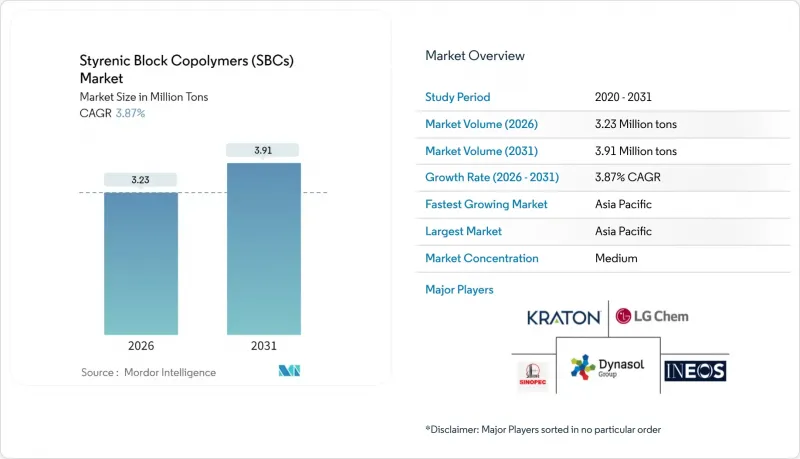
성숙한 수요 기반에도 불구하고 스티렌계 블록공중합체(SBC) 시장은 아스팔트 개질 및 방수포에서 고부가가치 유전체 필름에 이르기까지 다양한 응용 분야로 인해 지속적으로 성장하고 있습니다. 다각화는 생산자를 단일 부문의 순환성으로부터 보호하고, 원료의 통합과 최종사용자와의 지역적 근접성이 점점 더 경쟁 우위를 결정하고 있습니다. 아시아태평양은 정부가 고속도로, 철도망, 고층 건물 등 고분자 개질 아스팔트 및 방수포를 지정하는 건설 프로젝트에 자본을 투입하고 있으므로 성장의 견인차 역할을 하고 있습니다. 동시에 수소화 등급의 특허 만료로 인해 중견 공급업체가 진입할 수 있는 여지가 생겼고, EV용 커패시터용 설포나이드 화학 기술의 혁신은 스티렌계 블록공중합체(SBC) 시장에서 향후 고부가가치 틈새 시장의 가능성을 시사하고 있습니다.
세계 스티렌계 블록 공중합체(SBC) 시장 동향 및 전망
아스팔트 재활용 의무화로 성능 요건 강화
EU와 미국 입법기관은 도로 건설 기준에 최소 재생재 함량을 포함시켰습니다. 이에 따라 설계자들은 타이어 또는 플라스틱 유래 오일이 버진 아스팔트를 대체할 때에도 기계적 무결성을 유지하는 폴리머 시스템을 우선시해야 합니다. 최근 시험에서 SBS 개질 혼합물이 반복적인 동결융해 사이클과 산화 스트레스 하에서 비개질 아스팔트보다 우수한 성능을 발휘하여 더 엄격한 서비스 수명 기준을 충족하는 것으로 확인되었습니다. 불순물 부하가 높은 조건에 적합한 스티렌계 블록공중합체(SBC)를 제공할 수 있는 공급업체는 재활용 원료의 가변성이 배합의 복잡성을 증가시키기 때문에 가격 측면에서 우위를 점하고 있습니다. 자금 조달 메커니즘이 시장 수요를 가속화하는 반면, 지역별 회수 네트워크의 부족과 열분해 장비의 허가 취득에 소요되는 긴 기간이 단기적인 공급 압박 요인으로 작용하고 있습니다. 그 결과, 연방법에서 지방정부 조달에 이르기까지 재활용 의무가 연쇄적으로 확대됨에 따라 스티렌계 블록 공중합체(SBC) 시장은 꾸준한 톤수 성장을 보장하고 있습니다.
아시아태평양의 인프라 붐으로 방수 수요 가속화
중국, 인도, 베트남, 인도네시아의 기록적인 공공 지출은 교량, 지하철, 대규모 주택 단지를 위한 폴리머 개질 방수포의 소비를 지속적으로 자극하고 있습니다. SCG 케미칼이 론슨 단지에 7억 달러를 투자한 설비 업데이트는 아스팔트 및 건축용 방수포에 대한 SBC의 구조적 수요에 대비하여 통합 생산업체가 유연한 에탄 원료로 전환하려는 태도를 보여줍니다. 지역 건설업체들은 열대, 사막, 고산 기후를 횡단하는 고속도로에 SBS 개질 바인더를 지정하여 저온 균열 저항성과 고온 노면 균열 안정성을 보장하고 있습니다. 건설 거점과의 근접성은 운송 비용 절감과 납기 단축을 가져다 주며, 이러한 장점으로 인해 아시아태평양의 스티렌계 블록 공중합체(SBC) 시장 점유율은 2024년 57%를 넘어설 것으로 예측됩니다. 노동력 부족과 허가 절차 지연으로 인해 프로젝트 일정이 지연되는 경우도 있지만, 다년간의 정부 예산은 2030년까지 생산 능력 확장 계획을 수립하는 제조업체의 전망을 지원하고 있습니다.
콜드믹스 기술의 과제는 기존 포장에 대한 과제
캐나다, 독일 및 미국 여러 주 정부 기관에서는 상온에서 경화되는 에멀전 기반의 콜드믹스 포장재를 시험적으로 도입하여 아스팔트 플랜트에서 배출되는 온실가스를 줄이기 위해 노력하고 있습니다. 초기 단계의 현장 성능 평가에서 폴리머를 포함하지 않은 배합으로도 지방도 및 2차선 도로의 사양을 충족시킬 수 있는 가능성을 보여주었으며, 교통량이 상대적으로 적은 지역에서는 SBS 수요가 감소할 수 있습니다. 그러나 교통량이 많은 도시 간선도로에서는 여전히 SBS에 의한 굴착 저항성이 요구됩니다. 도입 장벽으로는 시공자의 숙련도, 미검증된 장기 내구성, 특수 유화제 공급 제한 등을 들 수 있습니다. 따라서 콜드믹스 대체 기술이 특정 하위 부문의 상승 여지를 억제하는 경우, 스티렌계 블록 공중합체(SBC) 시장의 핵심은 고성능 포장재 분야에 머물러 있을 것으로 보입니다.
부문 분석
2025년 스티렌계 블록 공중합체(SBC) 시장에서 스티렌-부타디엔-스티렌(SBS)은 71.48%의 압도적인 점유율을 유지했습니다. 이는 아스팔트, 신발, 감압 접착제 분야에서 비용 대비 성능을 입증한 것입니다. 이 폴리머는 확립된 공급망, 광범위한 가공 기술 숙련도, 배합의 다양성을 가지고 있으며, 대량 생산 응용 분야에서 대체 리스크를 억제합니다. SEBS, SEPS 등 수소화 등급은 생산량은 적지만 자동차 제조업체, 가전 브랜드, 전선 케이블 제조업체들이 내열성, 내자외선성, 내유성 기준치 인상을 요구하면서 2031년까지 4.43%의 가장 빠른 CAGR을 나타낼 것으로 예측됩니다. 수소화 등급 스탈렌계 블록공중합체 시장 규모는 예측 기간 중 약 15만 톤 증가할 것으로 예측됩니다. 이는 특허 관련 로열티 폐지와 등급 선정을 가속화하는 클라우드 지원 CAE 플랫폼의 상용화에 힘입은 바 큽니다.
한편, SIS는 솔벤트계 감압 접착제, 장루 관리 기기, 의료용 드레이프 테이프 분야에서 고유한 점착성과 블룸 저항성이 가격 프리미엄을 상회하는 특수 용도의 지위를 유지하고 있습니다. 각 제조업체들은 핫멜트 가공시 산화 가교를 줄이기 위해 수소화 SIS의 개량을 진행하여 위생용품 용도에 대한 적응 범위를 확대하고 있습니다. 원료 구성의 유연성, 특히 고가의 부타디엔보다 이소프렌을 우선적으로 사용할 수 있는 특성은 SIS 생산자에게 원료 가격 변동에 대한 헤지 수단이 될 수 있습니다. 이러한 추세와 함께 폴리머 유형의 다양화는 스티렌계 블록공중합체(SBC) 시장을 거시경제의 순환성으로부터 보호하는 동시에 장기적인 혁신 로드맵의 토대를 마련하고 있습니다.
세계의 스티렌계 블록공중합체(SBC) 시장을 폴리머 유형별(스티렌부타디엔스티렌(SBS), 스티렌-아이소프렌스티렌(SIS), 수소화 SBC(HSBC)), 용도별(아스팔트 개질, 신발, 폴리머 개질, 접착제-실란트, 기타), 지역별(아시아, 북미, 유럽, 아시아태평양, 중동, 아프리카, 유럽, 일본) 지역별(아시아태평양, 북미, 유럽, 남미, 중동 및 아프리카)로 분석되고 있습니다. 시장 예측은 톤 단위로 제공됩니다.
지역별 분석
아시아태평양이 2025년 스티렌계 블록 공중합체(SBC) 시장의 56.63%를 차지하며 압도적인 점유율을 차지할 것으로 전망되는 배경에는 아시아태평양이 세계 제조 거점이자 인프라 개발의 중심지라는 점이 반영된 것으로 분석됩니다. 중국 연안, 한국, 아세안 정유소 회랑에 위치한 자본집약적 에틸렌-프로파일렌 복합시설이 경쟁력 있는 원료를 공급하는 한편, 국내 건설업체들이 다년간 걸친 고속도로, 항만, 지하철 프로젝트를 통해 안정적인 수요를 확보하고 있습니다. 베트남의 에탄 분해 용량 증설 결정은 이 지역의 원료 조달에 대한 유연성을 보여주며, 인도의 급속한 도시화는 방수막 수요의 지속적인 기반이 되고 있습니다. 정책 주도의 산업화, 전자산업 집적화, 자동차 전동화 가속화 등 수소화 SBC 채택을 촉진하는 요인으로 인해 이 지역의 2031년까지의 예측 CAGR 4.21%는 전 세계 평균을 상회할 것으로 예측됩니다.
북미에서는 고속도로 보수와 공항 활주로 포장재 교체에 수십억 달러를 투자하는 연방 인프라 지출 계획이 시장을 촉진하고 있습니다. 한편, 스티렌계 블록공중합체(SBC) 시장에서는 INEOS Styrolution사가 사니아 공장의 43만톤 규모의 설비를 영구 가동 중단함에 따라 국내 스티렌 공급이 감소했습니다. 이로 인해 시판되는 모노머공급이 타이트해지면서 수직계열화 기업의 우위가 강화되고 있습니다. 아스팔트 재활용 의무화로 인해 바인더 혼합물내 폴리머 농도 증가가 촉진되는 한편, 이 지역의 스타트업 생태계는 EV용 파워 일렉트로닉스용 SBC 기반 유전체 필름을 촉진하고 있습니다. 그러나 셰일가스 액화 제품과 멕시코만 연안의 허리케인으로 인한 원자재 가격의 변동성이 불확실성을 야기하여 증설 계획을 억제하는 요인으로 작용하고 있습니다.
유럽은 스티렌계 블록공중합체(SBC) 시장에서 성숙하면서도 기술적으로 진보된 분야를 차지하고 있으며, 지속가능성과 순환성을 우선시하고 있습니다. 높은 에너지 관세와 엄격한 환경 규제로 인해 생산자들은 최적의 가동률로 공장을 운영해야 하며, 공정 효율을 높이는 동시에 공장을 합리화해야 합니다. 그린딜 및 생산자책임제도 확대와 같은 규제 요인으로 인해 재활용 및 재사용이 가능한 폴리머 시스템에 대한 수요가 증가하고 있으며, 식품 접촉 용도 및 의료용 튜브 분야에서는 SEBS 및 설포나이트 SBC가 선호되고 있습니다.
기타 특전:
- 엑셀 형식 시장 예측(ME) 시트
- 애널리스트의 3개월간 지원
자주 묻는 질문
목차
제1장 서론
제2장 조사 방법
제3장 개요
제4장 시장 구도
제5장 시장 규모와 성장 예측
제6장 경쟁 구도
제7장 시장 기회와 향후 전망
KSA 26.03.06Styrenic Block Copolymers market size in 2026 is estimated at 3.23 Million tons, growing from 2025 value of 3.11 Million tons with 2031 projections showing 3.91 Million tons, growing at 3.87% CAGR over 2026-2031.
Despite a mature demand base, the styrenic block copolymers market continues to benefit from its wide application spread, ranging from asphalt modification and waterproofing membranes to high-value dielectric films. Diversification protects producers from single-sector cyclicality, while feedstock integration and regional proximity to end users increasingly dictate competitive advantage. The Asia-Pacific region remains the growth engine as governments channel capital toward expressways, rail links, and high-rise construction that specify polymer-modified bitumen and membranes. Simultaneously, patent expiries in hydrogenated grades open space for mid-tier suppliers, and breakthroughs in sulfonated chemistries for EV capacitors hint at future premium niches for the styrenic block copolymers market.
Global Styrenic Block Copolymers (SBCs) Market Trends and Insights
Asphalt-Recycling Mandates Drive Performance Requirements
Legislators in the EU and United States have embedded minimum recycled-content thresholds into road construction codes, prompting designers to favor polymer systems that preserve mechanical integrity when tire-derived or plastic-derived oils replace virgin bitumen. Recent trials confirm that SBS-modified mixes outperform unmodified asphalt under repeated freeze-thaw cycles and oxidative stress, thereby meeting tougher service-life criteria. Suppliers capable of tailoring styrenic block copolymers to higher impurity loads enjoy a pricing premium, because recyclate variability increases formulation complexity. Although funding mechanisms accelerate market pull, gaps in regional collection networks and lengthy permitting cycles for pyrolysis units keep short-term supply tight. Consequently, the styrenic block copolymers market secures incremental tonnage growth as recycling mandates cascade from federal statutes to municipal procurement.
APAC Infrastructure Boom Accelerates Waterproofing Demand
Record-level public spending across China, India, Vietnam, and Indonesia continues to stimulate consumption of polymer-modified membranes for bridges, subways, and mega-residential complexes. SCG Chemicals' USD 700 million upgrade at its Long Son complex illustrates how integrated producers pivot to flexible ethane feedstock in anticipation of structural demand for SBCs in asphalt and building membranes. Regional contractors specify SBS-modified binders for expressways that traverse tropical, desert, and alpine climates, thereby guaranteeing low-temperature crack resistance and high-temperature rutting stability. Proximity to construction centers lowers freight cost and shortens delivery lead times, advantages that push APAC's share of the styrenic block copolymers market beyond 57% in 2024. While labor shortages and permitting delays occasionally stall project timelines, multi-year government budgets underpin visibility for producers mapping capacity additions through 2030.
Cold-Mix Technologies Challenge Traditional Applications
Government agencies in Canada, Germany, and several U.S. states have trialed emulsion-based cold-mix pavements that cure at ambient temperature, reducing greenhouse-gas emissions from asphalt plants. Early-stage field performance suggests that polymer-free recipes can meet rural and secondary road specifications, potentially eroding SBS demand where traffic loads are modest. Nonetheless, heavy-traffic urban arterials still require the rutting resistance imparted by SBS. Implementation barriers include contractor familiarity, untested long-term durability, and limited supply of specialized emulsifiers. Hence, although cold-mix alternatives cap upside in certain subsegments, the styrenic block copolymers market retains its core in high-performance pavements.
Other drivers and restraints analyzed in the detailed report include:
- Pandemic-Driven Hygiene Film Applications Create New Demand Vectors
- Sulfonated SBCs Unlock High-Value EV Capacitor Space
- POE/POP Elastomers Replace SBCs in Flexible Packaging
For complete list of drivers and restraints, kindly check the Table Of Contents.
Segment Analysis
Styrene-Butadiene-Styrene retained a commanding 71.48% share of the styrenic block copolymers market in 2025, underscoring cost-aligned performance in asphalt, footwear, and pressure-sensitive adhesives. The polymer enjoys a well-established supply chain, broad processing familiarity, and formulation versatility that limit substitution risk in mass-volume applications. Hydrogenated members such as SEBS and SEPS contributed a smaller tonnage base but registered the fastest 4.43% CAGR to 2031 as automakers, consumer-electronics brands, and wire-and-cable producers specified higher thermal, UV, and oil-resistance thresholds. The styrenic block copolymers market size for hydrogenated grades is projected to increase by nearly 0.15 million tons during the forecast window, buoyed by the collapse of patent-related royalties and the commercialization of cloud-enabled CAE platforms that accelerate grade selection.
In parallel, SIS maintained a specialized role in solvent-borne pressure-sensitive adhesives, ostomy-care appliances, and medical drape tapes where intrinsic tack and bloom resistance outweigh price premiums. Producers have optimized hydrogenated SIS variants to cut oxidative cross-linking during hot-melt processing, broadening their fit for hygiene applications. Feedstock mix flexibility, especially the ability to favor isoprene over high-priced butadiene, gives SIS producers a hedge against raw-material volatility. Collectively, these dynamics ensure that polymer-type diversification shields the styrenic block copolymers market from macroeconomic cyclicality while anchoring long-term innovation roadmaps.
The Styrenic Block Copolymers Report is Segmented by Polymer Type (Styrene-Butadiene-Styrene (SBS), Styrene-Isoprene-Styrene (SIS), and Hydrogenated SBCs (HSBC)), Application (Asphalt Modification, Footwear, Polymer Modification, Adhesives and Sealants, and Others), and Geography (Asia-Pacific, North America, Europe, South America, and Middle-East and Africa). The Market Forecasts are Provided in Terms of Volume (Tons).
Geography Analysis
Asia-Pacific's dominant 56.63% 2025 share of the styrenic block copolymers market reflects its combined status as a global manufacturing hub and infrastructure hot spot. Capital-intensive ethylene and propylene complexes along the Chinese coast, in South Korea, and within the ASEAN refinery corridor provide competitive feedstock; meanwhile, domestic contractors ensure stable off-take through multi-year freeway, port, and metro projects. Vietnam's decision to retrofit ethane cracking capacity underscores the region's flexibility in sourcing, while India's rapid urban migration underpins sustained waterproofing-membrane demand. The region's 4.21% projected CAGR to 2031 outpaces global averages thanks to policy-driven industrialization, electronics clustering, and accelerating vehicle electrification, all catalysts for hydrogenated SBC uptake.
North America is buoyed by federal infrastructure-spending packages that allocate billions toward Interstate rehabilitation and airport runway resurfacing. The styrenic block copolymers market faces reduced domestic styrene supply after INEOS Styrolution permanently idled its 430,000-ton Sarnia unit, tightening merchant monomer availability and advantaging vertically integrated players. Asphalt-recycling mandates drive higher polymer concentrations in binder blends, while the region's start-up ecosystem pushes SBC-based dielectric films for EV power electronics. However, feedstock volatility tied to shale gas liquids and hurricanes along the Gulf Coast introduces uncertainty that tempers expansion plans.
Europe commands a mature yet technologically sophisticated slice of the styrenic block copolymers market, prioritizing sustainability and circularity. High energy tariffs and strict environmental regulations compel producers to operate at optimized utilizations, leading to plant rationalizations but also encouraging process efficiency gains. Regulatory drivers such as the Green Deal and extended producer-responsibility frameworks stimulate demand for recyclable and recycled-compatible polymer systems, favoring SEBS and sulfonated SBCs in food-contact and medical tubing applications.
- Asahi Kasei Corporation
- Avient Corporation
- Dynasol Group
- Eni S.p.A.
- INEOS
- Kraton Corporation
- Kuraray Co., Ltd.
- LCY
- LG Chem
- Sibur
- Sinopec
- TSRC
- ZEON Corporation
Additional Benefits:
- The market estimate (ME) sheet in Excel format
- 3 months of analyst support
TABLE OF CONTENTS
1 Introduction
- 1.1 Study Assumptions and Market Definition
- 1.2 Scope of the Study
2 Research Methodology
3 Executive Summary
4 Market Landscape
- 4.1 Market Overview
- 4.2 Market Drivers
- 4.2.1 Asphalt-Recycling Mandates in EU and U.S.
- 4.2.2 APAC Infrastructure Boom (Expressways, Waterproofing)
- 4.2.3 Pandemic-Driven Rise in Single-Use Hygiene Films
- 4.2.4 Patent Expiry of Kraton's HSBC Grades Unlocking New Entrants
- 4.2.5 Sulfonated SBCs for Next-Gen EV Capacitors
- 4.3 Market Restraints
- 4.3.1 Volatility of Crude-Linked Styrene and Butadiene Feedstocks
- 4.3.2 Asphalt-Free Cold-Mix Road Technologies
- 4.3.3 POE/POP Elastomers Replacing SBCs in Packaging
- 4.4 Value Chain Analysis
- 4.5 Porter's Five Forces
- 4.5.1 Bargaining Power of Suppliers
- 4.5.2 Bargaining Power of Buyers
- 4.5.3 Threat of New Entrants
- 4.5.4 Threat of Substitutes
- 4.5.5 Degree of Competition
5 Market Size and Growth Forecasts (Volume)
- 5.1 By Polymer Type
- 5.1.1 Styrene-Butadiene-Styrene (SBS)
- 5.1.2 Styrene-Isoprene-Styrene (SIS)
- 5.1.3 Hydrogenated SBCs (HSBC)
- 5.2 By Application
- 5.2.1 Asphalt Modification (Paving and Roofing)
- 5.2.2 Footwear
- 5.2.3 Polymer Modification
- 5.2.4 Adhesives and Sealants
- 5.2.5 Other Applications (Medical devices and Wires and Cables)
- 5.3 Geography
- 5.3.1 Asia-Pacific
- 5.3.1.1 China
- 5.3.1.2 India
- 5.3.1.3 Japan
- 5.3.1.4 South Korea
- 5.3.1.5 Malaysia
- 5.3.1.6 Thailand
- 5.3.1.7 Indonesia
- 5.3.1.8 Vietnam
- 5.3.1.9 Rest of Asia-Pacific
- 5.3.2 North America
- 5.3.2.1 United States
- 5.3.2.2 Canada
- 5.3.2.3 Mexico
- 5.3.3 Europe
- 5.3.3.1 Germany
- 5.3.3.2 United Kingdom
- 5.3.3.3 France
- 5.3.3.4 Italy
- 5.3.3.5 Spain
- 5.3.3.6 Russia
- 5.3.3.7 Turkey
- 5.3.3.8 Nordic Countries
- 5.3.3.9 Rest of Europe
- 5.3.4 South America
- 5.3.4.1 Brazil
- 5.3.4.2 Argentina
- 5.3.4.3 Colombia
- 5.3.4.4 Rest of South America
- 5.3.5 Middle-East and Africa
- 5.3.5.1 Saudi Arabia
- 5.3.5.2 United Arab Emirates
- 5.3.5.3 Qatar
- 5.3.5.4 Egypt
- 5.3.5.5 Nigeria
- 5.3.5.6 South Africa
- 5.3.5.7 Rest of Middle-East and Africa
- 5.3.1 Asia-Pacific
6 Competitive Landscape
- 6.1 Market Concentration
- 6.2 Strategic Moves (Mergers and Acquisitions, JV, Capacity)
- 6.3 Market Share (%)/Ranking Analysis
- 6.4 Company Profiles (includes Global level Overview, Market level overview, Core Segments, Financials as available, Strategic Information, Market Rank/Share for key companies, Products and Services, and Recent Developments)
- 6.4.1 Asahi Kasei Corporation
- 6.4.2 Avient Corporation
- 6.4.3 Dynasol Group
- 6.4.4 Eni S.p.A.
- 6.4.5 INEOS
- 6.4.6 Kraton Corporation
- 6.4.7 Kuraray Co., Ltd.
- 6.4.8 LCY
- 6.4.9 LG Chem
- 6.4.10 Sibur
- 6.4.11 Sinopec
- 6.4.12 TSRC
- 6.4.13 ZEON Corporation
7 Market Opportunities and Future Outlook
- 7.1 White-space and Unmet-need Assessment