|
시장보고서
상품코드
1939688
수의용 백신 보조제 : 시장 점유율 분석, 업계 동향과 통계, 성장 예측(2026-2031년)Veterinary Vaccine Adjuvants - Market Share Analysis, Industry Trends & Statistics, Growth Forecasts (2026 - 2031) |
||||||
 Mordor Intelligence
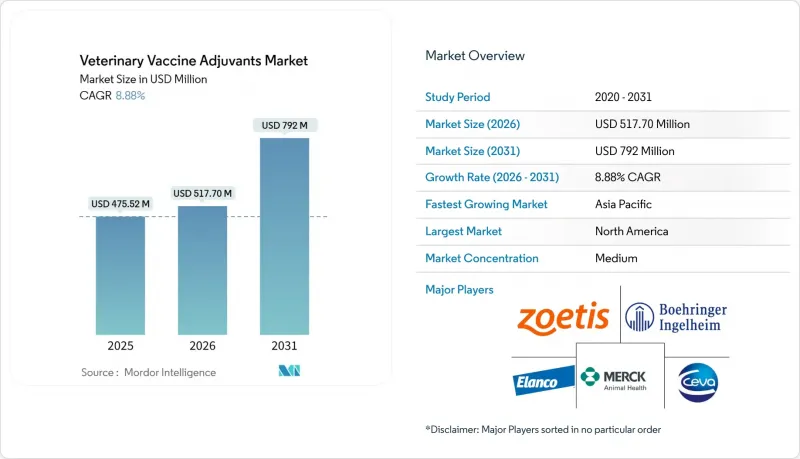
2026년 수의용 백신 보조제 시장 규모는 5억 1,680만 달러로 추정되며, 2025년 4억 9,558만 달러에서 성장이 전망됩니다.
2031년에는 6억 3,732만 달러에 달할 것으로 예상되며, 2026-2031년에 CAGR 4.28%로 확대할 전망입니다.
지속적인 성장은 정밀 면역학, 생명공학의 급속한 발전, 그리고 H5N1 이후 긴급 대책으로 의무화된 백신 효능 강화 정책으로 지원되고 있습니다. 이 분야는 면역 유도 시간을 단축하고 투여량을 줄이는 mRNA 및 나노입자 기술 혁신의 혜택을 받고 있습니다. 한편, 유성 에멀전의 안전성 문제로 인해 제조업체들은 폴리머 및 카보머 시스템으로 전환하고 있습니다. 가축 사육 밀도, 세계 단백질 수요, 인도와 중국의 원헬스(One Health) 자금이 기술 도입을 가속화하는 반면, QS-21과 특수 지질에 대한 단편적인 승인과 공급 리스크가 도입 속도를 제한하고 있습니다. 조에티스(Zoetis), 머크 동물 건강(Merck Animal Health), 엘랑코(Elanco)가 사포닌, TLR, VLP에 초점을 맞추어 전염병 상황에서 신속한 승인을 목표로 하는 신규 진출기업에 대한 점유율 방어에 나서면서 경쟁이 심화되고 있습니다.
세계 수의학 백신 보조제 시장 동향 및 인사이트
늘어나는 세계 동물성 단백질 소비량
인도, 브라질, 중국에서 확대되고 있는 집약적 축산 시스템은 감염 위험을 증가시키고 있으며, 생산자들은 높은 항체가를 유지하면서 재접종 빈도를 줄이는 보조제를 선호하고 있습니다. 몇 주에 걸쳐 항원을 방출하는 폴리머 마이크로스피어는 비용과 콜드체인 부족으로 어려움을 겪는 열대 지역 사업자들이 선호하고 있습니다. 인도는 가축 생산을 촉진하고 연간 단백질 생산량을 20% 증가시킨다는 목표를 세웠으며, 대규모 소와 가금류 사육 사업을 위해 보조금 비용의 일부를 흡수하는 연방 보조금이 형성되어 있습니다. 이 때문에 열 안정성 카보머 블렌드는 남아시아 및 동남아시아에서 높은 입찰 성공률을 보이고 있습니다.
가축질병 발생 증가
2024년 미국 16개 주에서 발생한 H5N1형 조류 인플루엔자 젖소 감염과 유럽의 양떼에서 발생한 블루탱고병의 재발은 교차방어 효과와 빠른 면역 획득을 가능하게 하는 보조제의 필요성을 부각시켰습니다. NS1 결핍 생백신 벡터와 TLR-4 작용제 보조제를 병용한 시험에서 5일 이내 방어 효과가 확인되어, 규제 당국은 유사 후보물질에 대한 지속적인 심사를 시작하게 되었습니다.
유성 보조제에 따른 부작용 및 안전성 문제
상어에서 추출한 스쿠알렌이 함유된 반려동물용 주사제는 주사 부위 부종에 대한 경고가 나오면서 2024년 미국내 유통업체들의 주문량이 두 자릿수 감소했습니다. 크로다의 사탕수수 유래 스쿠알렌은 현재 해양 유래 성분을 배제하고 규제 당국의 감시를 완화하기 위한 재처방 프로그램에 공급되고 있습니다. 재처방, 안정성 시험, 허가 주기로 인해 출시가 12-18개월 지연되고 매출 원가가 상승할 수 있습니다.
부문 분석
2025년 기준, 미립자 및 나노입자 기술이 수의학 백신 보조제 시장의 37.96%를 차지하며 주요 점유율을 차지할 것으로 예측됩니다. 반면, 고분자 및 카보머 계열은 2031년까지 6.05%의 가장 빠른 CAGR을 나타낼 것으로 예측됩니다. 이러한 지속적인 성장은 특히 대규모 가축군의 반복적인 취급을 억제하려는 지역에서 제조업체가 정밀한 항원 방출과 용량 절약 기능에 중점을 두고 있음을 반영합니다. 60-150nm 크기의 나노입자는 수지상 세포로의 흡수를 촉진하므로 추가 접종 횟수 감소 및 인건비 절감으로 이어집니다. 천연 알루미늄은 여전히 비용 제한이 심한 지역에서는 여전히 인기가 있지만, 강력한 T 세포 반응을 유도할 수 없습니다는 점이 향후 수익성을 제한하고 있습니다. 사포닌 유도체, 특히 식물 유래의 QS-21은 식물 추출법과 조직배양법으로 안정적인 공급이 가능해 칠레의 비누나무에 대한 부담 경감과 ESG 점수 향상으로 이어져 호응을 얻고 있습니다.
MPLA에 의한 TLR-4 작용제와 스쿠알렌 미세 방울을 통합한 복합 에멀전은 IgA 분비를 촉진하여 가금류 호흡기 백신으로 주목받고 있습니다. 종간 인플루엔자의 확산이 식량안보를 위협하는 비상 키트에는 병원체 유래 CpG 올리고뉴클레오티드가 채택되어 있습니다. 명반과 인산칼슘에 대한 다년간의 규제 데이터뱅크는 특히 사하라 이남 아프리카 전역의 소 브루셀라증에 대한 국가적 비용으로 저가의 제제에 대한 채택을 보장하고 있습니다. 한편, 나노입자와 폴리머 마이크로스피어는 높은 제조원가에도 불구하고 덴마크와 스페인의 수출 지향형 양돈사업에서 점유율을 확대하고 있습니다. 이들 지역에서는 항생제 무첨가 브랜딩이 고가의 원재료 투입을 정당화해주고 있는 것입니다. 대학들이 VLP 기술을 활용한 보조제를 개발하여 항원부하량을 1/3로 줄이면서 바이러스 중화항체가를 보장하는 제품을 내놓으면서 경쟁은 더욱 치열해질 것으로 보입니다. 공급 충격으로 인한 항원 원료 가격 급등 시에는 이 지표가 특히 중요하게 작용합니다.
지역별 분석
2025년 북미의 39.92% 점유율은 임상적으로 검증된 보조제를 평가하는 미국 농무부(USDA)의 엄격한 라이선스 제도와 원격지의 비육장까지 도달하는 광범위한 콜드체인 네트워크에 의해 지원되고 있습니다. 캔자스주 바이오 제조 구상(700만 달러)와 같은 연방 보조금은 국내 보조제 시제품 생산 능력을 촉진하고 해외 사포닌 추출에 대한 의존도를 낮추고 있습니다. 캐나다는 미국과의 데이터 상호이용을 통해 공급업체가 두 시장에서 테스트 비용을 상각할 수 있는 이점이 있습니다. 한편, 멕시코는 다양한 규모의 목장이 혼재되어 있는 상황에서 매출 압박이 우려되는 지역에서는 경제적인 알루미늄-오일 하이브리드 제제가 채택되고 있습니다.
아시아태평양은 5.22%의 가장 높은 CAGR을 나타낼 것으로 예측됩니다. 인도의 '원헬스 미션'이 주립 수의학 연구소에 지속적인 예산을 투입하고, 중국이 구제역 내성 가축에 대한 보조금 지급을 추진하기 때문입니다. 지역 수요는 현지 보틀링 공장과 연계하여 냉장 완제품 백신의 운송 비용 절감을 실현하고 있습니다. 일본의 반려동물 분야에서는 진료 시간을 단축하는 무침피내 패치가, 호주의 광활한 목축 사업에서는 불규칙한 채집 스케줄에 적합한 내열성 카보머를 중요하게 여깁니다.
유럽에서는 그린 케미스트리와 복지 기준을 중시하고 동물용의약품 규정에 따라 신청 서류 형식이 통일되었지만, 탄소발자국 지표가 용매 사용에 대한 추가 심사를 부과하고 있습니다. 브라질과 아르헨티나에서는 소와 가금류 겸용 시설이 확대되고, 할랄 수출 감사와 항생제 감축 약속을 모두 충족해야 할 필요성 때문에 보조제 선택이 증가하고 있습니다. 중동 및 아프리카 시장에서는 40℃의 운송 환경에도 견딜 수 있는 상온 보관이 가능한 블렌드(대부분 카보머 계열)가 요구되고 있으며, 상온 안정성이 입증된 공급업체에게 새로운 판로가 열리고 있습니다.
기타 특전:
- 엑셀 형식 시장 예측(ME) 시트
- 애널리스트의 3개월간 지원
자주 묻는 질문
목차
제1장 서론
제2장 조사 방법
제3장 개요
제4장 시장 구도
제5장 시장 규모와 성장 예측
제6장 경쟁 구도
제7장 시장 기회와 향후 전망
KSA 26.03.05The veterinary vaccine adjuvants market size in 2026 is estimated at USD 516.8 million, growing from 2025 value of USD 495.58 million with 2031 projections showing USD 637.32 million, growing at 4.28% CAGR over 2026-2031.
Sustained growth rests on precision immunology, rapid biotechnology advances and post-H5N1 emergency policies that mandate higher vaccine potency. The sector benefits from mRNA and nanoparticle innovations that shorten immune-priming times and lower dose volumes, while oil-emulsion safety issues steer manufacturers toward polymer and carbomer systems. Livestock density, global protein demand and One Health funding in India and China accelerate technology adoption, whereas fragmented approvals and supply risks for QS-21 and specialized lipids curb velocity. Competitive intensity grows as Zoetis, Merck Animal Health and Elanco defend share against saponin-, TLR- and VLP-focused newcomers positioning for accelerated approvals during outbreak conditions.
Global Veterinary Vaccine Adjuvants Market Trends and Insights
Expanding Global Animal Protein Consumption
Intensive livestock systems scaling across India, Brazil and China elevate infection risks, so producers favor adjuvants that cut revaccination frequency while preserving high titers. Polymer microspheres that meter antigen over weeks appeal to tropical operators wrestling with cost and cold-chain gaps. India's livestock push, now targeting 20% annual protein output gains, shapes federal grants that absorb part of adjuvant costs for mass cattle and poultry drives. Thermostable carbomer blends hence show strong tender success in South and Southeast Asia.
Rising Incidence of Emerging and Re-Emerging Livestock Diseases
The 2024 H5N1 dairy outbreak across 16 U.S. states, and bluetongue flare-ups in European sheep flocks, highlight the urgency for adjuvants enabling cross-protective, rapid immunity. Trials using NS1-deficient live vectors plus TLR-4 agonist adjuvants delivered protection within five days, which has pushed regulators to issue rolling reviews for comparable candidates.
Adverse Reactions and Safety Concerns with Oil-Based Adjuvants
Companion-animal injections containing shark-sourced squalene prompted site swelling alerts that trimmed U.S. distributor orders by double digits in 2024. Croda's sugarcane-derived squalene now supplies reformulation programs aimed at removing marine inputs and easing scrutiny. Reformulation, stability, and re-licensing cycles can delay launches 12-18 months and inflate cost of goods sold.
Other drivers and restraints analyzed in the detailed report include:
- Strengthening Government Immunization Mandates and Subsidies
- Shift Toward High-Value Subunit and mRNA Veterinary Vaccines
- Complex and Fragmented Regulatory Approval Pathways
For complete list of drivers and restraints, kindly check the Table Of Contents.
Segment Analysis
Particulate and nanoparticle technologies accounted for a dominant 37.96% slice of the veterinary vaccine adjuvants market in 2025, while polymer and carbomer systems are set to clock the fastest 6.05% CAGR through 2031. The sustained rise reflects the premium producers attach to precise antigen release and dose-sparing functionality, especially in regions seeking to suppress repeated handling of large herds. Nanoparticles sized 60-150 nm improve dendritic-cell uptake, meaning fewer booster shots and slimmer labor bills. Native alum remains popular where cost ceilings are strict, yet its inability to spark strong T-cell responses limits future revenue potential. Saponin derivatives, notably plant-based QS-21, gain favor as botanical extraction and tissue-culture methods secure supply, lessening pressure on Chilean soapbark trees and improving ESG scores.
Combination emulsions that integrate MPLA TLR-4 agonism with squalene microdroplets enhance IgA secretion, making them attractive for respiratory poultry vaccines. Pathogen-derived CpG oligonucleotides surface in emergency kits where cross-species influenza spillover threatens food security. The long regulatory databank surrounding alum and calcium phosphate still secures inclusion in value-priced formulations, especially for state-funded bovine brucellosis drives across sub-Saharan Africa. In contrast, nano-particles and polymer microspheres, despite higher COGS, gain share in export-oriented swine operations in Denmark and Spain where zero-antibiotic branding justifies premium inputs. Competition will likely intensify as universities spin out VLP-enabled adjuvants that promise virus-neutralizing titers at one-third the antigen load, a compelling metric when supply shocks raise bulk antigen prices.
The Veterinary Vaccine Adjuvants Market Report is Segmented by Type (Alum & Calcium Salts, and More), Route of Administration (Intramuscular, Subcutaneous, Intradermal, Intranasal/Mucosal, Oral), Animal Type (Livestock, Poultry, Companion Animals, Aquaculture), and Geography (North America, Europe, Asia-Pacific, Middle East & Africa, South America). The Market Forecasts are Provided in Terms of Value (USD).
Geography Analysis
North America's 39.92% share in 2025 is anchored by USDA licensing rigor that rewards clinically vetted adjuvants and by an extensive cold-chain grid reaching remote feedlots. Federal grants such as the USD 7 million Kansas State Biomanufacturing Initiative catalyze domestic adjuvant pilot-lot capacity, mitigating dependence on overseas saponin extraction. Canada benefits from data reciprocity with the U.S., letting suppliers amortize studies across both markets, while Mexico's mixed-scale ranch landscape absorbs economical alum-oil hybrids where margin pressures loom.
Asia-Pacific posts the steepest 5.22% CAGR outlook as India's One Health Mission injects consistent budget lines into state veterinary labs and as China channels subsidies toward FMD-resistant herds. Regional demand collocates with local bottling plants that cut freight on chilled finished vaccines. Japan's companion animal segment rewards needle-free intradermal patches that shrink clinic dwell time, and Australia's extensive pastoral operations prize thermostable carbomers fit for infrequent muster schedules.
Europe stresses green chemistry and welfare norms; the Veterinary Medicines Regulation harmonizes dossier formats, but carbon-footprint metrics exert extra screening on solvent use. Brazil and Argentina expand dual-use cattle-poultry sites, with adjuvant selection driven by the need to satisfy both halal export auditors and antibiotic reduction pledges. Middle East and Africa markets look to shelf-stable blends-often carbomer-based-that tolerate 40 °C transit, opening lanes for suppliers with proven ambient-stability claims.
- Zoetis
- Merck
- SEPPIC (Air Liquide)
- Croda Intl (Avanti / Brenntag Biosector)
- Phibro Animal Health
- SPI Pharma
- Bioveta
- InvivoGen
- OZ Biosciences
- VaxLiant
- Novavax
- Agenus
- GSK Animal Health
- Ceva Sante Animale
- Boehringer Ingelheim
- Elanco
- Vaxine Pty
- Thermo Fisher Scientific
- Montanide ISA (Seppic brand)
Additional Benefits:
- The market estimate (ME) sheet in Excel format
- 3 months of analyst support
TABLE OF CONTENTS
1 Introduction
- 1.1 Study Assumptions & Market Definition
- 1.2 Scope of the Study
2 Research Methodology
3 Executive Summary
4 Market Landscape
- 4.1 Market Overview
- 4.2 Market Drivers
- 4.2.1 Expanding Global Animal Protein Consumption
- 4.2.2 Rising Incidence of Emerging And Re-Emerging Livestock Diseases
- 4.2.3 Strengthening Government Immunization Mandates And Subsidies
- 4.2.4 Shift Toward High-Value Subunit and mRNA Veterinary Vaccines
- 4.2.5 Growing Focus on One Health And Zoonosis Prevention
- 4.2.6 Intensifying Commercial Livestock Intensification in Developing Regions
- 4.3 Market Restraints
- 4.3.1 Adverse Reactions and Safety Concerns with Oil-Based Adjuvants
- 4.3.2 Complex and Fragmented Regulatory Approval Pathways
- 4.3.3 High Development and Scale-Up Costs For Novel Adjuvants
- 4.3.4 Dependency on Limited Sources For Critical Raw Materials
- 4.4 Regulatory Landscape
- 4.5 Porter's Five Forces Analysis
- 4.5.1 Threat of New Entrants
- 4.5.2 Bargaining Power of Buyers
- 4.5.3 Bargaining Power of Suppliers
- 4.5.4 Threat of Substitutes
- 4.5.5 Intensity of Rivalry
5 Market Size & Growth Forecasts (Value, USD)
- 5.1 By Type
- 5.1.1 Alum & Calcium Salts
- 5.1.2 Oil-Emulsion Adjuvants (W/O, O/W, W/O/W)
- 5.1.3 Saponin-based (Quil A, QS-21, flavonoid)
- 5.1.4 Pathogen-derived (MPLA, CpG, TLR agonists)
- 5.1.5 Particulate / Nanoparticle (liposomes, Nano-11, VLPs)
- 5.1.6 Polymer & Carbomer Systems
- 5.1.7 Combination / Next-Gen Emulsions
- 5.1.8 Other Types
- 5.2 By Route of Administration
- 5.2.1 Intramuscular
- 5.2.2 Subcutaneous
- 5.2.3 Intradermal
- 5.2.4 Intranasal / Mucosal
- 5.2.5 Oral
- 5.3 By Animal Type
- 5.3.1 Livestock
- 5.3.1.1 Cattle & Buffalo
- 5.3.1.2 Sheep & Goat
- 5.3.1.3 Swine
- 5.3.2 Poultry
- 5.3.3 Companion Animals
- 5.3.3.1 Canine
- 5.3.3.2 Feline
- 5.3.3.3 Equine
- 5.3.4 Aquaculture
- 5.3.1 Livestock
- 5.4 Geography
- 5.4.1 North America
- 5.4.1.1 United States
- 5.4.1.2 Canada
- 5.4.1.3 Mexico
- 5.4.2 Europe
- 5.4.2.1 Germany
- 5.4.2.2 United Kingdom
- 5.4.2.3 France
- 5.4.2.4 Italy
- 5.4.2.5 Spain
- 5.4.2.6 Rest of Europe
- 5.4.3 Asia-Pacific
- 5.4.3.1 China
- 5.4.3.2 Japan
- 5.4.3.3 India
- 5.4.3.4 Australia
- 5.4.3.5 South Korea
- 5.4.3.6 Rest of Asia-Pacific
- 5.4.4 Middle East & Africa
- 5.4.4.1 GCC
- 5.4.4.2 South Africa
- 5.4.4.3 Rest of Middle East & Africa
- 5.4.5 South America
- 5.4.5.1 Brazil
- 5.4.5.2 Argentina
- 5.4.5.3 Rest of South America
- 5.4.1 North America
6 Competitive Landscape
- 6.1 Market Concentration
- 6.2 Market Share Analysis
- 6.3 Company Profiles (includes Global level Overview, Market level overview, Core Business Segments, Financials, Headcount, Key Information, Market Rank, Market Share, Products and Services, and analysis of Recent Developments)
- 6.3.1 Zoetis
- 6.3.2 Merck Animal Health
- 6.3.3 SEPPIC (Air Liquide)
- 6.3.4 Croda Intl (Avanti / Brenntag Biosector)
- 6.3.5 Phibro Animal Health
- 6.3.6 SPI Pharma
- 6.3.7 Bioveta AS
- 6.3.8 InvivoGen
- 6.3.9 OZ Biosciences
- 6.3.10 VaxLiant
- 6.3.11 Novavax
- 6.3.12 Agenus
- 6.3.13 GSK Animal Health
- 6.3.14 Ceva Sante Animale
- 6.3.15 Boehringer Ingelheim Vetmedica
- 6.3.16 Elanco Animal Health
- 6.3.17 Vaxine Pty
- 6.3.18 Thermo Fisher Scientific, Inc.
- 6.3.19 Montanide ISA (Seppic brand)
7 Market Opportunities & Future Outlook
- 7.1 White-space & Unmet-Need Assessment