|
시장보고서
상품코드
1939689
이산화티타늄 : 시장 점유율 분석, 업계 동향과 통계, 성장 예측(2026-2031년)Titanium Dioxide - Market Share Analysis, Industry Trends & Statistics, Growth Forecasts (2026 - 2031) |
||||||
 Mordor Intelligence
이산화티타늄 시장은 2025년 360.16 킬로톤에서 2026년에는 374.71 킬로톤으로 성장하며, 2026-2031년에 CAGR 4.04%로 추이하며, 2031년까지 456.66 킬로톤에 달할 것으로 예측되고 있습니다.
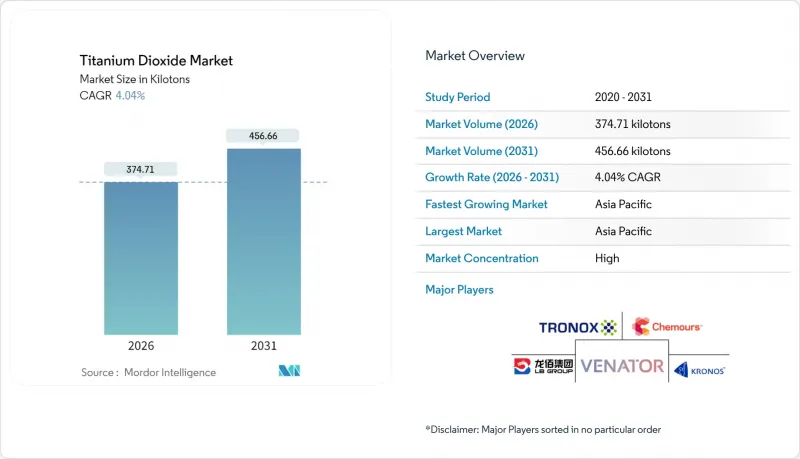
건설, 포장, 자동차 플라스틱, 쿨루프 페인트 분야 수요 증가가 규제 측면의 역풍, 특히 유럽의 카테고리 2 발암물질 표시 의무화 및 중국산 원료에 대한 반덤핑 관세의 영향을 상쇄하고 있습니다. 중국을 공급 거점으로, 인도의 현지화 추진에 힘입어 아시아태평양은 4.92%의 연평균 복합 성장률(CAGR)로 성장하고 있습니다. 제조업체들은 변동하는 일메나이트와 루틸 원료의 비용 압박과 염화법 기술 업그레이드의 균형을 맞추고 있습니다. 켐어스 등 공정 최적화를 통해 대규모 설비투자 없이도 생산능력을 15% 향상시키고 있습니다. 한편, 트로녹스와 같은 수직계열화는 원자재 가격 변동 리스크를 줄이고 있습니다. EU와 다른 지역의 규제 차이는 차별화된 제품 포트폴리오를 촉진하고 지역 간 차익거래의 여지를 창출하고 있습니다.
세계 이산화티타늄 시장 동향 및 전망
아시아태평양의 수성 건축용 도료 수요 급증
중국, 인도, 인도네시아의 휘발성 유기화합물(VOC) 규제 강화로 인해 용제계 도료에서 수성 도료로의 대체가 가속화되고 있으며, 이 지역의 루틸계 안료 수요 증가를 견인하고 있습니다. 지역 페인트 라인에서 은폐력 동등성을 달성하기 위해 분산 기술의 고도화가 진행되고 있으며, 이는 이산화티타늄 시장의 지속적인 물량 성장을 지원하고 있습니다. 인도와 인도네시아의 인프라 부양책이 수요를 더욱 촉진하는 한편, 지역 기반 염화 방식 생산 능력은 공급의 견고성을 보장하고 있습니다. 배합업체들은 저냄새와 안전한 작업 환경을 중요시하고 있으며, 이는 계약자들 사이에서 수용성을 높이고 있습니다. 이러한 전환은 원자재 가격의 변동에도 불구하고 구조적인 순풍으로 작용하고 있습니다.
유럽에서 경량 및 고광택 자동차 플라스틱으로의 전환
EU의 엄격한 자동차 평균 이산화탄소 배출량 규제로 인해 경량화가 설계 전략의 핵심으로 자리 잡고 있습니다. 폴리프로필렌과 폴리카보네이트 트림에 이산화티타늄을 배합하여 도장된 금속 패널에 버금가는 고광택 표면을 구현하면서도 무게를 크게 줄였습니다. 차량 무게가 10% 감소할 때마다 5-7%의 연비 향상을 달성하고 있습니다. 고급 자동차 제조업체는 TIOXIDE TR48과 같은 소수성 등급을 채택하고 있습니다. 이들은 높은 가공 온도에서도 밝기를 잃지 않고 분산됩니다. 이산화티타늄 시장은 이러한 특수 등급이 높은 가격대에서 거래되고 규제에 의한 대체 리스크가 최소화되어 수량뿐만 아니라 가치 측면에서도 성장하고 있습니다.
EU의 TiO2 발암 의심 물질 분류로 인해 라벨 표시 비용 증가
유럽 규정 2025/4에 따라 이산화티타늄을 1% 이상 함유한 분말 제제에는 발암성 경고 표시가 의무화되었습니다. 페인트, 플라스티졸, 인쇄 잉크 공급업체들은 배합 변경, 새로운 포장 디자인, 법적 심사에 직면하여 컴플라이언스 비용 증가에 직면하고 있습니다. 영국과 북미의 서로 다른 규제는 세계 포트폴리오 관리를 복잡하게 만들고 이중 표시 전략을 필요로 합니다. 단기간의 생산 배치는 단위 비용을 높이고 DIY 채널의 임의적 수요를 억제합니다. 유럽 법원이 2022년 위험 표시를 무효로 한 것을 과학적 재평가를 거쳐 2025년 판결을 뒤집어 이산화티타늄 시장의 불확실성이 커지고 있습니다.
부문 분석
2025년 기준 루틸형은 이산화티타늄 시장의 77.60%를 차지할 것으로 예상되며, 이는 높은 굴절률(2.7)과 우수한 내후성을 반영합니다. 이러한 우위는 장기적인 광택 유지가 중요한 야외용 건축용 도료, 자동차 탑코트, 폴리머 마스터배치 분야에서 확고한 입지를 구축하고 있습니다. 광촉매 특성을 통합한 이중 기능 등급은 새로운 자기 세정 표면의 가능성을 개발하여 루틸 유형의 우위를 더욱 강화했습니다.
나머지 수요를 차지하는 아나타제는 의약품 첨가제 및 광촉매 건축자재와 같은 틈새 분야의 성장으로 인해 4.32%의 높은 CAGR로 성장하고 있습니다. 표면 개질 아나타제 등급은 식품 접촉 용지의 보존 기간을 연장하고, 고급 사무용 종이로 평가되는 특유의 푸른빛이 도는 색조를 제공합니다.
황산염법은 저급 일메나이트와 소규모 자본 투자를 활용하여 2025년 이산화티타늄 시장 규모의 64.30%를 차지했습니다. 그러나 산성 황산염 폐기 물류에 대한 규제가 강화됨에 따라 염화물 기반 생산 능력은 4.53%의 연평균 복합 성장률(CAGR)로 확대되고 있습니다. 염화법 공장은 고 TiO2 슬래그 또는 천연 루틸을 사용하여 주로 미량 불순물이 적은 루틸 안료를 생산합니다. 이를 통해 고급 도료 및 마스터배치 분야에서 고가화를 실현할 수 있습니다. 켐아즈에 따르면 350-450℃의 독자적인 저온 염소화 기술을 통해 에너지 사용량을 30% 절감하고 수율을 향상시킬 수 있다고 합니다.
인도의 신흥 생산업체들은 유럽 및 미국 공급업체와의 품질 격차 해소와 배출 규제 강화에 대한 대응책으로 염화법 기술을 채택하고 있습니다. 북미와 유럽에서는 기존 염화법 설비의 증산 프로젝트가 진행 중이며, 신규 투자 없이 5-15% 증산을 목표로 하고 있습니다. 이에 따라 트로녹스 보틀렉 공장 폐쇄 등 지역적 생산능력 감소에도 공급 밸런스는 유지될 것으로 보입니다. 따라서 제조 공정에 따른 비용 차이는 이산화티타늄 시장의 경쟁력을 좌우하는 핵심 요소로 작용하고 있습니다.
이산화티타늄 시장 보고서는 등급별(루틸형과 아나타제형), 공정별(염화법과 황산법), 용도별(페인트/코팅, 플라스틱, 종이/펄프, 화장품, 기타 용도), 최종사용자 산업별(건설, 자동차/운송, 포장, 기타), 지역별(아시아태평양, 북미, 유럽, 기타)로 시장을 세분화하여 조사했습니다. 유럽, 기타)로 산업을 세분화하고 있습니다. 시장 예측은 톤 단위로 제공됩니다.
지역별 분석
아시아태평양은 이산화티타늄 시장의 34.70%를 차지하며 2031년까지 연평균 복합 성장률(CAGR) 4.78%로 가장 빠른 성장률을 보일 것으로 예측됩니다. 중국은 전 세계 TiO2 생산능력의 대부분을 차지하고 있으며, 수출과 증가하는 국내 건축 및 인프라 수요의 균형을 맞추고 있습니다. 안료 품질 향상과 황산염 공정 폐수 배출을 억제하라는 정부 지침에 따라 생산자들은 염화물 기술로의 전환을 강요받고 있으며, 유럽과 미국의 기준을 따르는 움직임을 보이고 있습니다.
북미 이산화티타늄 시장은 내구소비재, 항공우주용 코팅, 포장용 필름이 계속해서 시장을 주도하고 있습니다. 성숙한 환경 규제는 염화물의 생산을 촉진하고, 기업의 ESG에 대한 노력은 저탄소 안료 생산 방법의 연구개발을 촉진하고 있습니다. 유럽 시장은 카테고리 2 발암물질 표시와 중국산 수입품에 대한 확정적 반덤핑 관세라는 두 가지 제약에 의해 형성되고 있습니다. 이러한 조치는 현지 생산 비용을 높이는 동시에 높은 가격대를 정당화할 수 있는 프리미엄급 혁신을 촉진하고 있습니다.
중동 및 아프리카에서는 건설 메가 프로젝트에 힘입어 새로운 잠재력을 발견할 수 있습니다. 걸프협력회의(GCC)의 쿨루프 의무화 및 관광시설 증가로 인해 고알베도 코팅에 대한 수요가 증가하고 있습니다. 국내 TiO2 생산량은 여전히 극히 미미하고 수입 의존도가 높아 운임 변동에 영향을 받기 쉬운 상황입니다.
기타 특전:
- 엑셀 형식 시장 예측(ME) 시트
- 3개월간의 애널리스트 지원
자주 묻는 질문
목차
제1장 서론
제2장 조사 방법
제3장 개요
제4장 시장 구도
제5장 시장 규모와 성장 예측
제6장 경쟁 구도
제7장 시장 기회와 향후 전망
KSA 26.03.05The Titanium Dioxide market is expected to grow from 360.16 kilotons in 2025 to 374.71 kilotons in 2026 and is forecast to reach 456.66 kilotons by 2031 at 4.04% CAGR over 2026-2031.
Rising demand from construction, packaging, automotive plastics, and cool-roof coatings offsets regulatory headwinds, especially Europe's Category 2 carcinogen labeling and anti-dumping duties on Chinese material. Asia-Pacific, anchored by China's supply base and India's localization push, is advancing at a 4.92% CAGR. Manufacturers are balancing cost pressures from volatile ilmenite and rutile feedstock with technology upgrades in the chloride route. Process optimization by players such as Chemours is boosting capacity by 15% without major capital outlays, while vertical integration by Tronox and others mitigates raw-material volatility. Regulatory divergence between the EU and other regions is spurring differentiated product portfolios and creating scope for regional arbitrage.
Global Titanium Dioxide Market Trends and Insights
Surge in Demand for Waterborne Architectural Coatings in Asia-Pacific
Escalating volatile-organic-compound regulations across China, India and Indonesia are accelerating substitution of solvent systems by waterborne paints, driving incremental rutile pigment offtake in the region. Regional coating lines are upgrading dispersion technology to achieve hiding power parity, underpinning continuous volume growth for the titanium dioxide market. Infrastructure stimulus programs in India and Indonesia compound demand, while localized chloride-route capacity secures supply resilience. Formulators emphasize lower odor and safer worksite conditions, bolstering acceptance among contractors. The shift is adding a structural tailwind despite feedstock price swings.
Shift Toward Lightweight, High-Gloss Automotive Plastics in Europe
Stringent EU fleet-average carbon-dioxide limits have placed lightweighting at the center of design strategies. Incorporating titanium dioxide into polypropylene and polycarbonate trim delivers high-gloss surfaces that rival coated metal panels yet weigh markedly less, achieving a 5-7% fuel-efficiency gain per 10% vehicle weight reduction. Premium OEMs adopt hydrophobic grades such as TIOXIDE TR48, which disperse at high processing temperatures without loss of brightness. The titanium dioxide market gains not only in volume but in value because these specialty grades command premium pricing and carry minimal regulatory substitution risk.
EU Classification of TiO2 as Suspected Carcinogen Raising Labeling Costs
European Regulation 2025/4 mandates cancer warnings on powder formulations containing more than or equal to 1% titanium dioxide. Coating, plastisol, and printing-ink suppliers face reformulation, new packaging artwork, and legal reviews, inflating compliance costs. Divergent rules in the United Kingdom and North America complicate global portfolio management, requiring dual labeling strategies. Short-run manufacturing batches raise unit costs, dampening discretionary demand in DIY channels. Although the European Court annulled the hazard label in 2022, the ruling was reversed in 2025 after scientific reassessment, reinforcing uncertainty for the titanium dioxide market.
Other drivers and restraints analyzed in the detailed report include:
- Growth of Laminated Paperboard Packaging for E-Commerce Logistics
- Uptake of UV-Resistant Cool-Roof Coatings in Middle-East Construction
- Volatility in Ilmenite/Rutile Feedstock Prices Impacting Margins
For complete list of drivers and restraints, kindly check the Table Of Contents.
Segment Analysis
Rutile commanded 77.60% of the titanium dioxide market in 2025, reflecting its higher refractive index (2.7) and superior weatherability. This supremacy is entrenched in outdoor architectural coatings, automotive topcoats, and polymer masterbatches where long-term gloss retention is critical. Dual-function grades integrating photocatalytic traits are unlocking new self-cleaning surface opportunities, further entrenching the rutile's lead.
Anatase, accounting for the demand balance, is advancing at a faster 4.32% CAGR thanks to niche growth in pharmaceutical excipients and photocatalytic building materials. Surface-modified anatase grades extend shelf life in food-contact papers and offer distinct bluish undertones valued in premium office papers.
The sulfate route delivered 64.30% of the titanium dioxide market size in 2025 by leveraging lower-grade ilmenite and smaller capital footprints. Nevertheless, chloride-based capacity is expanding at 4.53% CAGR as regulators intensify scrutiny of acidic sulfate waste streams. Chloride plants use high-TiO2 slag or natural rutile and generate primarily rutile pigment with lower trace impurities, enabling higher pricing in premium coatings and masterbatch segments. Chemours reports that proprietary low-temperature chlorination at 350-450 °C can reduce energy use by 30% and improve yield.
Emerging producers in India are adopting chloride technology to achieve quality parity with Western suppliers and to hedge against evolving effluent norms. Incremental debottlenecking projects across North America and Europe aim to squeeze 5-15% extra output from existing chloride assets without greenfield spending, keeping supply balanced despite regional capacity closures such as Tronox's Botlek facility. Process-driven cost differentials, therefore, remain central to titanium dioxide market competitiveness.
The Titanium Dioxide Market Report Segments the Industry by Grade (Rutile and Anatase), Process (Chloride and Sulfate) Application (Paints and Coatings, Plastics, Paper and Pulp, Cosmetics and Other Applications), End-User Industry (Construction, Automotive and Transportation, Packaging, and More) and Geography (Asia-Pacific, North America, Europe, and More). The Market Forecasts are Provided in Terms of Volume (Tons)
Geography Analysis
Asia-Pacific controls 34.70% of the titanium dioxide market and delivers the fastest 4.78% CAGR through 2031. China alone houses a major portion of global TiO2 capacity, balancing exports with rising domestic architectural and infrastructure demand. Government directives to upgrade pigment quality and curb sulfate-process effluent are pushing producers toward chloride technology, replicating Western standards.
North America's titanium dioxide market remains driven by durable goods, aerospace coatings, and packaging films. Mature environmental regulations favor chloride output, and corporate ESG commitments spur research and development into lower-carbon pigment pathways. Europe's market is shaped by dual constraints: Category 2 carcinogen labeling and definitive anti-dumping duties on Chinese imports. These measures elevate local production costs but also encourage premium-grade innovation to justify higher price points.
The Middle-East and Africa present emergent potential propelled by construction megaprojects. Cool-roof mandates in the Gulf Cooperation Council and rising tourism facilities spur high-albedo coating uptake. Domestic TiO2 production remains negligible, driving import dependency and exposure to freight fluctuations.
- Cinkarna Celje
- Evonik Industries AG
- Grupa Azoty S.A.
- Hangzhou Harmony Chemical Co.,Ltd
- INEOS
- ISHIHARA SANGYO KAISHA, LTD.
- Kemipex
- Kronos Worldwide, Inc.
- LB Group
- Precheza
- Shandong Jinhai Titanium Resources Technology Co., Ltd.
- TAYCA Co., Ltd.
- The Chemours Company
- Titanos
- Tronox Holdings Plc
- Venator Materials PLC
- Zhejiang TITAN Design& Engineering CO., Ltd
Additional Benefits:
- The market estimate (ME) sheet in Excel format
- 3 months of analyst support
TABLE OF CONTENTS
1 Introduction
- 1.1 Study Assumptions and Market Definition
- 1.2 Scope of the Study
2 Research Methodology
3 Executive Summary
4 Market Landscape
- 4.1 Market Overview
- 4.2 Market Drivers
- 4.2.1 Surge in Demand for Waterborne Architectural Coatings in Asia-Pacific Boosting Rutile TiO2 Pigment Consumption
- 4.2.2 Shift Toward Lightweight, High-Gloss Automotive Plastics in Europe
- 4.2.3 Growth of Laminated Paperboard Packaging for E-Commerce Logistics
- 4.2.4 Uptake of UV-Resistant Cool-Roof Coatings in Middle-East Construction
- 4.2.5 Localization of Chloride-Route TiO2 Capacity in India
- 4.3 Market Restraints
- 4.3.1 EU Classification of TiO2 as Suspected Carcinogen Raising Labeling Costs
- 4.3.2 Volatility in Ilmenite/Rutile Feedstock Prices Impacting Margins
- 4.3.3 Competitive Pressure from Alternative White Pigments
- 4.4 Value Chain Analysis
- 4.5 Trade Analysis
- 4.6 Porter's Five Forces Analysis
- 4.6.1 Bargaining Power of Suppliers
- 4.6.2 Bargaining Power of Consumers
- 4.6.3 Threat of New Entrants
- 4.6.4 Threat of Substitute Products and Services
- 4.6.5 Degree of Competition
5 Market Size and Growth Forecasts (Volume)
- 5.1 By Grade
- 5.1.1 Rutile
- 5.1.2 Anatase
- 5.2 By Process
- 5.2.1 Chloride
- 5.2.2 Sulfate
- 5.3 By Application
- 5.3.1 Paints and Coatings
- 5.3.2 Plastics
- 5.3.3 Paper and Pulp
- 5.3.4 Cosmetics
- 5.3.5 Other Applications (Leather, Textiles, Rubber)
- 5.4 By End-user Industry
- 5.4.1 Construction
- 5.4.2 Automotive and Transportation
- 5.4.3 Packaging
- 5.4.4 Consumer Goods
- 5.4.5 Other End-user Industries
- 5.5 By Geography
- 5.5.1 Asia-Pacific
- 5.5.1.1 China
- 5.5.1.2 India
- 5.5.1.3 Japan
- 5.5.1.4 South Korea
- 5.5.1.5 ASEAN
- 5.5.1.6 Rest of Asia-Pacific
- 5.5.2 North America
- 5.5.2.1 United States
- 5.5.2.2 Canada
- 5.5.2.3 Mexico
- 5.5.3 Europe
- 5.5.3.1 Germany
- 5.5.3.2 United Kingdom
- 5.5.3.3 France
- 5.5.3.4 Italy
- 5.5.3.5 Nordics
- 5.5.3.6 Rest of Europe
- 5.5.4 South America
- 5.5.4.1 Brazil
- 5.5.4.2 Argentina
- 5.5.4.3 Rest of South America
- 5.5.5 Middle-East and Africa
- 5.5.5.1 Saudi Arabia
- 5.5.5.2 United Arab Emirates
- 5.5.5.3 South Africa
- 5.5.5.4 Egypt
- 5.5.5.5 Rest of Middle-East and Africa
- 5.5.1 Asia-Pacific
6 Competitive Landscape
- 6.1 Market Concentration
- 6.2 Strategic Moves
- 6.3 Market Share Analysis
- 6.4 Company Profiles (includes Global level Overview, Market level overview, Core Segments, Financials as available, Strategic Information, Market Rank/Share for key companies, Products and Services, and Recent Developments)
- 6.4.1 Cinkarna Celje
- 6.4.2 Evonik Industries AG
- 6.4.3 Grupa Azoty S.A.
- 6.4.4 Hangzhou Harmony Chemical Co.,Ltd
- 6.4.5 INEOS
- 6.4.6 ISHIHARA SANGYO KAISHA, LTD.
- 6.4.7 Kemipex
- 6.4.8 Kronos Worldwide, Inc.
- 6.4.9 LB Group
- 6.4.10 Precheza
- 6.4.11 Shandong Jinhai Titanium Resources Technology Co., Ltd.
- 6.4.12 TAYCA Co., Ltd.
- 6.4.13 The Chemours Company
- 6.4.14 Titanos
- 6.4.15 Tronox Holdings Plc
- 6.4.16 Venator Materials PLC
- 6.4.17 Zhejiang TITAN Design& Engineering CO., Ltd
7 Market Opportunities and Future Outlook
- 7.1 White-space and Unmet-Need Assessment
- 7.2 Increased Use of Ultrafine Titanium Dioxide in Cosmetics and Cool-Roofing