
|
시장보고서
상품코드
1939694
베트남의 알루미늄 : 시장 점유율 분석, 업계 동향과 통계, 성장 예측(2026-2031년)Vietnam Aluminum - Market Share Analysis, Industry Trends & Statistics, Growth Forecasts (2026 - 2031) |
||||||
 Mordor Intelligence
베트남의 알루미늄 시장은 2025년 46억 7,000만 달러에서 2026년에는 51억 8,000만 달러로 성장하며, 2026-2031년에 CAGR 10.96%로 추이하며, 2031년까지 87억 1,000만 달러에 달할 것으로 예측되고 있습니다.
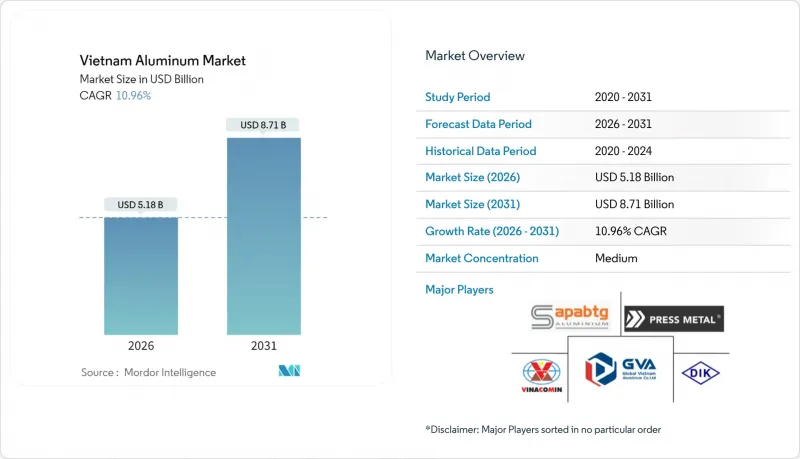
풍부한 보크사이트 매장량, 새로운 알루미나 생산 능력, 이동성 및 건설 분야 수요와 함께 이러한 상승 추세로 인해 베트남 알루미늄 시장은 아시아에서 가장 빠르게 성장하는 밸류체인 중 하나로 자리 매김하고 있습니다. 전기자동차(EV) 생산 증가, 친환경 건축 규제, 포장재 순환성 목표가 구조적 수요를 촉진하는 한편, 58억 톤의 보크사이트 매장량으로 인한 업스트림 공급의 안정성이 장기적인 공급을 지원하고 있습니다. 2030년까지 8개의 가공 시설과 19개의 탐사 프로젝트를 승인하는 정부 결정 866호는 성장을 더욱 촉진하고 있지만, 가동률은 여전히 평균 70%로 여전히 운영의 여지가 있는 것으로 나타났습니다.
베트남 알루미늄 시장 동향 및 전망
자동차 부문의 경량화 추진
자동차 알루미늄 수요는 IATF 16949 인증을 받은 858개공급업체에 의해 강화되고 있으며, 이들은 베트남을 지역 차량 플랫폼에 통합하고 있습니다. 전기자동차 생산에는 배터리 인클로저와 열 관리 시스템을 위해 기존 모델 대비 차량 1대당 약 30% 더 많은 알루미늄을 사용하고 있으며, 베트남은 2030년까지 도시 차량의 50%를 전기화하는 것을 목표로 하고 있습니다. 현지 조달 정책이 부품의 외주화를 촉진하는 한편, 상용차 fleet은 적재량 극대화와 배기가스 배출 기준 준수를 위해 알루미늄 부품을 채택하고 있습니다. 세계은행은 2050년까지 전기자동차 전환으로 인해 650만 개의 제조업 일자리가 창출될 것으로 추정하고 있으며, 이 시나리오는 주조, 압출, 평강 공급망 전반에 걸쳐 금속 수요를 지속시킬 것으로 예상하고 있습니다. OEM의 생산능력 확대에 따라 베트남 알루미늄 시장은 빌릿 잉곳 인수 증가로 인해 신규 2차 제련소의 진입을 촉진하고 있습니다.
공공 및 그린 빌딩 건설의 급성장
2024년 교통 및 전력 시설에 300억 달러의 공공 지출이 투입되어 커튼월, 지붕재, 구조용 압출재에 대한 단기적인 수요가 창출되었습니다. 친환경 인증 건물은 2024년 1분기 430동에 달하며, 인증의 75.69%를 EDGE와 LEED가 차지하며, 재활용성과 단열 효율이 우수한 알루미늄이 채택되고 있습니다. 전력 개발 계획 VIII는 2030년까지 1,350억 달러의 예산을 책정하여 고압 구조물 및 태양전지판 프레임에 대한 알루미늄 수요를 견인할 것입니다. 호치민시의 115억 달러 규모의 고속도로 계획과 12억 달러 규모의 교통 인프라 개선 사업은 압출 프로파일의 소비 확대에 기여할 것입니다.
치솟는 전기요금과 탄소 가격 리스크
알루미늄 제련에는 안정적이고 저렴한 전력이 필수적이지만, 베트남의 평균 산업용 전력 요금은 2024년 상승하여 이익률을 압박할 것으로 예측됩니다. 일부 공장은 가동률이 30-40%로 제한되어 있습니다. EU의 탄소국경조정메커니즘(CBAM)은 3억 766만 달러 상당의 알루미늄 수출에 영향을 미쳐 출하량을 4% 감소시킬 수 있으며, 이는 연간 1,200만 달러의 매출 손실에 해당합니다. 전력 개발 계획 VIII는 시장 기반 가격 책정을 요구하고 있으며, 재생에너지를 확보하지 않는 한, 전기 분해 프로젝트는 압력을 받게 될 것입니다. 수출업체는 탄소강도를 낮추거나 CBAM 수수료를 지불해야 하며, 이는 베트남 알루미늄 시장의 비용 우위를 훼손할 수 있습니다.
부문 분석
2025년 기준 압출재는 창틀, 커튼월, 차량 프로파일에 대한 지속적인 수요로 인해 베트남 알루미늄 시장의 39.42%를 차지할 것으로 예측됩니다. 2027년까지 958억 달러 규모로 확대되는 인프라 투자로 압출 공장은 높은 가동률 유지. 한편 엄격한 LEED 및 EDGE 기준은 아노다이징 처리 및 단열 시스템을 채택한 제품을 평가했습니다. 미국 반덤핑 명령에 대한 대응은 협력 수출업체의 프로세스 개선을 촉진하고 품질 리더십을 강화하고 있습니다. 주조품은 자동차 제조업체들이 EV 플랫폼용 경량 부품의 현지 생산을 추진함에 따라 2031년까지 연평균 복합 성장률(CAGR) 13.62%로 확대될 것으로 예측됩니다.
IATF 16949 인증은 OEM 공급의 전제조건으로 베트남이 아세안 제2의 인증 거점으로 자리매김할 수 있는 기반이 되고 있습니다. 미엔화정밀산업과 같은 제조업체는 매출의 60%를 국내에서 생산하고 나머지는 일본, 미국, 호주로 수출하고 있는데, 이는 중국의 미드스트림 공정에서 경쟁력이 확대되고 있음을 반영합니다.
기타 특전:
- 엑셀 형식 시장 예측(ME) 시트
- 애널리스트의 3개월간 지원
자주 묻는 질문
목차
제1장 서론
제2장 조사 방법
제3장 개요
제4장 시장 구도
제5장 시장 규모와 성장 예측
제6장 경쟁 구도
제7장 시장 기회와 향후 전망
KSA 26.03.05The Vietnam Aluminum Market is expected to grow from USD 4.67 billion in 2025 to USD 5.18 billion in 2026 and is forecast to reach USD 8.71 billion by 2031 at 10.96% CAGR over 2026-2031.
This uptrend positions the Vietnam aluminum market among the fastest-growing value chains in Asia as abundant bauxite reserves, new alumina capacity, and demand from mobility and construction converge. Rising EV production, green-building mandates, and packaging circularity targets foster structural demand, while upstream security from 5.8 billion tonnes of bauxite supports long-term supply. Government Decision 866 authorizing eight processing facilities plus 19 exploration projects through 2030 further underpins growth, although capacity utilization still averages 70%, highlighting operational headroom.
Vietnam Aluminum Market Trends and Insights
Auto-sector Lightweighting Push
Automotive aluminum demand is reinforced by 858 IATF 16949-certified suppliers that integrate Vietnam into regional vehicle platforms. EV production uses nearly 30% more aluminum per unit than conventional models for battery enclosures and thermal systems, and Vietnam targets 50% electric urban vehicles by 2030. Local content policies fuel component outsourcing, while commercial fleets adopt aluminum parts to maximize payload and comply with emission norms. The World Bank estimates the EV transition could generate 6.5 million manufacturing jobs by 2050, a scenario that sustains metal demand across casting, extrusion, and flat-rolled supply chains. As OEMs expand capacity, the Vietnam aluminum market benefits from rising billet and ingot off-take, incentivizing new secondary smelters.
Booming Public and Green-Building Construction
Public spending of USD 30 billion in 2024 on transport and power facilities injected near-term demand for curtain walls, roofing, and structural extrusions. Green-certified buildings rose to 430 in Q1 2024, with EDGE and LEED accounting for 75.69% of certifications, favoring aluminum for its recyclability and thermal efficiency. Power Development Plan VIII earmarks USD 135 billion through 2030, driving aluminum demand for high-voltage structures and solar frames. Ho Chi Minh City's USD 11.5 billion highway program and USD 1.2 billion of transport upgrades boost extruded profile consumption.
High Electricity Tariffs and Carbon-Pricing Exposure
Aluminum smelting requires constant low-cost power, yet Vietnam's average industrial tariff rose in 2024, compressing margins and limiting capacity use to 30-40% in some plants. The EU's Carbon Border Adjustment Mechanism affects USD 307.66 million of aluminum exports and could trim shipments by 4%, translating into USD 12 million revenue loss per year. Power Development Plan VIII calls for market-based pricing, pressuring electrolysis projects unless they secure renewables. Exporters must cut carbon intensity or pay CBAM fees that erode the Vietnam aluminum market's cost advantage.
Other drivers and restraints analyzed in the detailed report include:
- Rebound in Packaging Demand (Food-Drink and Pharmaceuticals)
- Expansion of Domestic Bauxite and Alumina Projects
- Import Dependence for Primary Metal and Billets
For complete list of drivers and restraints, kindly check the Table Of Contents.
Segment Analysis
Extrusions commanded 39.42% of the Vietnam aluminum market in 2025 on the back of sustained demand for window frames, curtain walls, and vehicle profiles. Rising infrastructure outlays valued at USD 95.8 billion through 2027 keep extrusion mills running at high throughput, while strict LEED and EDGE criteria reward anodized and thermally broken systems. Compliance with U.S. antidumping orders incentivizes process upgrades among cooperative exporters, reinforcing quality leadership. Castings are projected to grow at a 13.62% CAGR to 2031 as automakers localize lightweight components for EV platforms.
Certification under IATF 16949 remains a prerequisite for OEM supply and underpins Vietnam's ranking as ASEAN's second-largest certified base. Producers like Mien Hua Precision generate 60% of sales domestically and export the remainder to Japan, the U.S., and Australia, reflecting the country's expanding mid-stream competitiveness.
The Vietnam Aluminum Market Report is Segmented by Processing Type (Castings, Extrusions, Forgings, Flat Rolled Products, and Pigments and Powders) and End-User Industry (Automotive, Aerospace and Defense, Building and Construction, Electrical and Electronics, Packaging, Industrial, and Other End-User Industries). The Market Forecasts are Provided in Terms of Value (USD).
List of Companies Covered in this Report:
- Alcoa Corporation
- Daiki Aluminium Industry Co. Ltd
- Emirates Global Aluminium PJSC
- GARMCO
- Global Vietnam Aluminum Co., Ltd (GVA)
- Kobe Steel Ltd
- Norsk Hydro ASA
- Press Metal
- RusAL
- Sapa Ben Thanh Aluminium Profiles Co., Ltd. (Sapa BTG)
- Vietnam Coal and Mineral Industries Group
Additional Benefits:
- The market estimate (ME) sheet in Excel format
- 3 months of analyst support
TABLE OF CONTENTS
1 Introduction
- 1.1 Study Assumptions and Market Definition
- 1.2 Scope of the Study
2 Research Methodology
3 Executive Summary
4 Market Landscape
- 4.1 Market Overview
- 4.2 Market Drivers
- 4.2.1 Auto-sector lightweighting push
- 4.2.2 Booming public and green-building construction
- 4.2.3 Rebound in packaging demand (food-drink and pharmaceuticals)
- 4.2.4 Expansion of domestic bauxite and alumina projects
- 4.2.5 Rapid EV/battery-housing localisation
- 4.3 Market Restraints
- 4.3.1 High electricity tariffs and carbon-pricing exposure
- 4.3.2 Cheap steel/plastics and composite substitutes
- 4.3.3 Import dependence for primary metal and billets
- 4.4 Value Chain Analysis
- 4.5 Porter's Five Forces
- 4.5.1 Bargaining Power of Suppliers
- 4.5.2 Bargaining Power of Buyers
- 4.5.3 Threat of New Entrants
- 4.5.4 Threat of Substitutes
- 4.5.5 Industry Rivalry
5 Market Size and Growth Forecasts (Value)
- 5.1 By Processing Type
- 5.1.1 Castings
- 5.1.2 Extrusions
- 5.1.3 Forgings
- 5.1.4 Flat Rolled Products
- 5.1.5 Pigments and Powders
- 5.2 By End-user Industry
- 5.2.1 Automotive
- 5.2.2 Aerospace and Defense
- 5.2.3 Building and Construction
- 5.2.4 Electrical and Electronics
- 5.2.5 Packaging
- 5.2.6 Industrial
- 5.2.7 Other End-user Industries
6 Competitive Landscape
- 6.1 Market Concentration
- 6.2 Strategic Moves
- 6.3 Market Share (%)/Ranking Analysis
- 6.4 Company Profiles (includes Global level Overview, Market level overview, Core Segments, Financials as available, Strategic Information, Market Rank/Share for key companies, Products and Services, and Recent Developments)
- 6.4.1 Alcoa Corporation
- 6.4.2 Daiki Aluminium Industry Co. Ltd
- 6.4.3 Emirates Global Aluminium PJSC
- 6.4.4 GARMCO
- 6.4.5 Global Vietnam Aluminum Co., Ltd (GVA)
- 6.4.6 Kobe Steel Ltd
- 6.4.7 Norsk Hydro ASA
- 6.4.8 Press Metal
- 6.4.9 RusAL
- 6.4.10 Sapa Ben Thanh Aluminium Profiles Co., Ltd. (Sapa BTG)
- 6.4.11 Vietnam Coal and Mineral Industries Group
7 Market Opportunities and Future Outlook
- 7.1 White-space and Unmet-need Assessment
- 7.2 Aluminium Recycling and Circular-Economy Plays
- 7.3 High-end EV and Battery-pack Components