

|
시장보고서
상품코드
2122867
시험, 검사 및 인증(TIC) : 시장 점유율 분석, 업계 동향 및 통계, 성장 예측(2026-2031년)Testing, Inspection, And Certification - Market Share Analysis, Industry Trends & Statistics, Growth Forecasts (2026 - 2031) |
||||||
 Mordor Intelligence
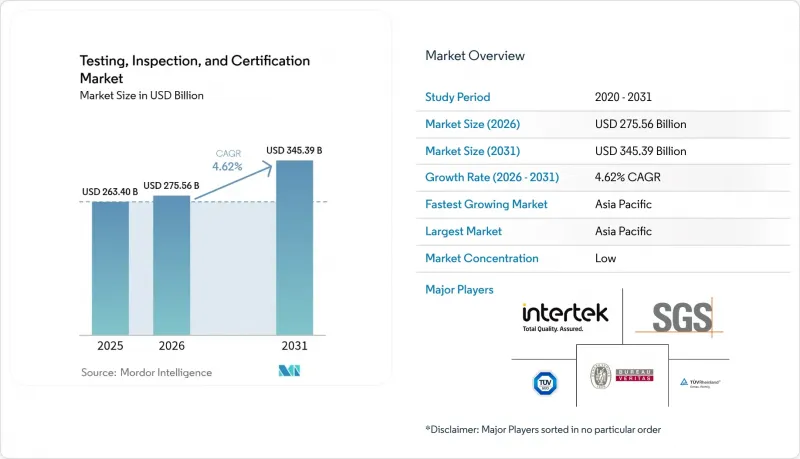
시험, 검사 및 인증(TIC) 시장 규모는 2025년 2,634억 달러로 평가되었습니다. 2026년에는 2,755억 6,000만 달러로 확대되어 2026년부터 2031년에 걸쳐 CAGR 4.62%로 성장을 지속하여, 2031년에는 3,453억 9,000만 달러에 이를 것으로 예측됩니다.

본 보고서는 서비스 유형(시험, 검사 및 인증(TIC)), 조달 형태(사내 실시, 외부 위탁), 업종별(소비재 및 소매, ICT·통신, 기타), 서비스 제공 형태(온사이트, 오프사이트/실험실, 원격/디지털), 지역별(북미, 남미, 기타)로 분류되어 있습니다. 시장 예측은 금액(달러) 기준으로 제시되어 있습니다.
세계의 시험, 검사 및 인증(TIC) 시장 동향 및 인사이트
ESG/탄소 발자국 검증 의무화로 수출 규정 준수 가속화
세계적인 탈탄소화 정책에 따라 탄소 발자국 인증은 단순한 자발적 노력에서 국경을 넘는 무역의 전제조건으로 그 위상이 변화하고 있습니다. EU의 탄소 국경 조정 메커니즘(CBAM)에서는 ISO 14067에 기반한 제품의 탄소 발자국 검증이 의무화되어 있으며, 전 세계 수출업체들에게 인증을 받은 보증의 취득이 권장되고 있습니다. SGS는 30년에 걸친 지속가능성 분야의 전문 지식을 활용하여 검증 프로그램을 확충하고 있는 한편, 뷰로베리타스는 조직 차원의 ESG 인증 제품군을 전개하고 있습니다. SGS가 Worldly와 제휴하여 전개하는 데이터 검증 등의 통합 디지털 플랫폼은 공급망 내 배출량의 지속적인 추적과 독립적인 검증을 결합하여, 감사 가능한 실시간 증거를 요구하는 규제 당국의 의도에 부합하는 것입니다.
AI를 활용한 원격 모니터링이 서비스 제공 모델을 혁신
인공지능(AI) 도구는 반복적인 육안 검사를 자동화하고, 장비 고장을 예측하며, 현장에 직접 방문하지 않고도 지속적인 품질 모니터링을 가능하게 합니다. 디지털 트윈은 물리적 자산을 가상 공간에서 재현하여, 검사원이 이상을 식별하고 성능 매개변수를 거의 실시간으로 검증할 수 있게 합니다. 주요 TIC 제공업체들은 AI 기반 이미지 분석과 센서 융합을 도입한 후 현장 방문 횟수가 최대 50% 감소했다고 보고하고 있습니다. 이동 시간 단축과 피드백 루프의 고속화를 통해 숙련된 기술자를 부가가치가 더 높은 업무에 재배치할 수 있을 뿐만 아니라, 고객의 가동 중단 시간을 줄일 수 있게 됩니다. 북미 및 유럽 규제 당국의 원격 발급 인증서 수용이 확대됨에 따라, 이러한 플랫폼의 대규모 도입이 가속화되고 있습니다.
경쟁에 따른 이익률 압박이 기존 비즈니스 모델을 위태롭게 하고 있다.
수천 개의 소규모 검사 기관이 상품화된 검사 분야에서 경쟁을 벌이고 있어, 일상적인 화학, 재료, 소비재 분석 분야의 가격 결정력이 약화되고 있습니다. 대형 제공업체들은 이에 대응하여 구독형 지속적 모니터링 서비스나 데이터가 풍부한 ESG 검증으로 전환하고 있으며, 고객과의 대화를 단가 중심에서 가치 창출 중심으로 전환하는 것을 목표로 하고 있습니다. 그러나 디지털 플랫폼 구축, IoT 센서 통합, 데이터 분석 관련 직원 교육에는 막대한 설비 투자가 필요하여 중견 기업에게는 과도한 부담이 되고 있습니다. 그 결과 발생하는 서비스 제공 비용 격차로 인해 세계 리더와 지역 전문 업체 간의 격차가 더욱 확대될 위험이 있습니다.
부문별 분석
2025년 시험, 검사 및 인증(TIC) 시장에서 시험 서비스는 61.25%의 점유율을 차지했으며, 이는 제품 개발 및 규정 준수 주기에서 시험 서비스가 수행하는 기초적인 역할을 여실히 보여줍니다. 엄격한 자동차 사이버 보안 규제와 복잡한 5G 무선 주파수 특성으로 인해 시험소는 밀리파 챔버 및 무선 통신 시스템에 대한 투자를 강요받고 있습니다. 또한, UL 솔루션즈가 과열 및 진동 시험 프로토콜을 지원하기 위해 주요 전기차 생산 거점 근처에 시험소를 확장함에 따라, 배터리 평가를 위한 시험, 검사 및 인증(TIC) 시장 규모도 확대되고 있습니다.
인증 서비스는 규모는 작지만 연평균 성장률(CAGR) 4.88%로 가장 높은 성장률을 나타낼 것으로 예측됩니다. ‘사이버 트러스트 마크(Cyber Trust Mark)’와 같은 새로운 프로그램에서는 사이버 보안 라벨 인증에 ISO/IEC 17065 인증 기관의 승인이 필요하기 때문에 적절한 인증을 보유한 기업에게는 새로운 수익원이 되고 있습니다. 탄소 발자국 검증과 관련된 ESG 기준 또한 수요를 더욱 확대시키고 있어, 높은 수익률의 성장을 목표로 하는 공급업체에게 인증은 전략적 우선순위가 되고 있습니다. 검사는 이 두 부문의 중간에 위치해 있으며, 공급망 검증 의무화의 혜택을 누리는 한편, AI를 활용한 원격 시각 검사 도구에 의한 대체 압력에도 직면해 있습니다.
2025년 시험, 검사 및 인증(TIC) 시장에서 아웃소싱 서비스는 74.65%의 점유율을 차지하며 시장을 독점했습니다. 이는 제조업체들이 급증하는 규격에 대응하기 위해 제3자의 전문 지식에 의존했기 때문입니다. 독립 시험 기관은 전자기 호환성(EMC)이나 고에너지 배터리의 극한 시험과 같은 자본 집약적 분야에서 규모의 경제를 발휘하는 한편, 전 세계 거점 네트워크를 통해 다국적 기업이 규정 준수 프로세스를 통일하는 데 기여하고 있습니다. 이러한 추세는 가전 분야에서 가장 두드러지는데, 모델의 업데이트 주기가 빠르기 때문에 최첨단 설비를 유지하는 외부 시험 기관이 유리한 입장에 있습니다.
데이터의 기밀성 및 운영 관리를 중시하는 생명과학, 유틸리티, 방위 관련 기업의 경우, 사내 시험 프로그램이 여전히 필수적이지만 그 시장 점유율은 점차 축소되고 있습니다. 하이브리드형 접근 방식도 부상하고 있으며, 자동차 OEM 제조업체는 설계 검증용 시험 설비를 자사에서 보유하면서도, 세계 시장 진출을 위한 형식 인증 시험은 인증 기관에 위탁하고 있습니다. 이는 내부 감독과 외부 인증이 공존하며 자원을 최적화할 수 있음을 보여줍니다.
지역별 분석
아시아태평양은 2025년에 47.05%의 점유율을 차지하며 수요의 중심을 계속 유지했으며, 예측 기간 동안 5.28%라는 빠른 성장률을 보일 것으로 전망됩니다. 이 지역의 성장은 주로 중국, 인도, 베트남, 인도네시아에서의 제조 거점 확대와 전자, 자동차, 재생 에너지 분야의 국내 기준이 단계적으로 강화됨에 따라 주도되고 있습니다. 국제적인 TIC 그룹은 강화되는 현지 인증 요건에 대응하기 위해 해당 지역의 전기차 배터리 기가팩토리 인근에 대한 시험소 투자를 확대되고 있습니다. 또한, 중산층의 소비 확대에 따라 제품 안전 라벨에 대한 인식이 높아지면서 제3자 보증 제공업체 시장 침투가 가속화되고 있습니다.
북미는 견조한 항공우주, 의료기기 및 첨단 전자 분야를 바탕으로 시험, 검사 및 인증(TIC) 시장에서 2위의 점유율을 차지하고 있습니다. ‘사이버 트러스트 마크’는 자발적인 사이버 보안 표시를 선도적으로 도입하려는 규제 당국의 태도를 보여주며, 무선,암호 기술 및 무선 통신(OTA) 시험 분야에서 시험소의 인증을 촉진하고 있습니다. 또한, 수입업체들이 FDA의 신속한 승인을 얻기 위해 ‘인증 수입업체(QIC)’ 인증을 추구하는 움직임에 힘입어, 식품 안전 분야는 계속해서 안정적인 검사 물량을 뒷받침하고 있습니다.
유럽은 ESG, 사이버 보안, 자동차 기능 안전에 관한 지침을 통합한 치밀한 규제 프레임워크의 혜택을 받고 있습니다. EU의 ‘산림 파괴 규제’나 ‘CBAM(탄소 국경 조정 조치)’과 같은 순환형 경제 대책에서 유럽 대륙이 주도적인 입지를 차지함에 따라, 전 세계 수출업체들은 검증된 지속가능성 인증을 취득하도록 촉진되고 있습니다. 자동차 사이버 보안 및 소프트웨어 업데이트 관리에 관한 UNECE의 R155 및 R156 규정은 새로운 형식 승인 프로그램을 탄생시켰으며, TIC(시험, 검사 및 인증(TIC)) 제공업체들에게 위협 분석, 침투 테스트, 안전한 업데이트 검증을 위한 전문적인 서비스 체계 구축을 촉진하고 있습니다.
기타 혜택 :
- 엑셀 형식 시장 예측(ME) 시트
- 3개월간의 애널리스트 지원
자주 묻는 질문
목차
제1장 서론
제2장 조사 방법
제3장 주요 요약
제4장 시장 구도
제5장 시장 규모 및 성장 예측
제6장 경쟁 구도
제7장 시장 기회 및 향후 전망
KTH 26.09.08According to Mordor Intelligence, the testing inspection certification market size is expected to grow from USD 263.40 billion in 2025 to USD 275.56 billion in 2026 and is forecast to reach USD 345.39 billion by 2031 at 4.62% CAGR over 2026-2031.
This report is Segmented by Service Type (Testing, Inspection, and Certification), Sourcing Type (In-House, and Outsourced), Industry Vertical (Consumer Goods and Retail, ICT and Telecom, and More), Mode of Service Delivery (On-Site, Off-site/Laboratory, and Remote/Digital), and Geography (North America, South America, and More). The Market Forecasts are Provided in Terms of Value (USD).
Global Testing, Inspection, And Certification Market Trends and Insights
Mandatory ESG / Carbon-Footprint Verification Accelerates Export Compliance
Global decarbonization policies are repositioning carbon-footprint certification from a voluntary gesture to a prerequisite for cross-border trade. The EU Carbon Border Adjustment Mechanism requires ISO 14067 product carbon-footprint verification and is encouraging exporters worldwide to secure accredited assurance. SGS has leveraged three decades of sustainability expertise to launch expanded verification programs, while Bureau Veritas has rolled out organization-level ESG certification suites. Integrated digital platforms, such as SGS's data-validation partnership with Worldly, couple continuous supply-chain emissions tracking with independent verification, aligning with regulators' preference for auditable, real-time evidence.
AI-Enabled Remote Monitoring Transforms Service Delivery Models
Artificial intelligence tools are automating repetitive visual checks, predicting equipment failures, and enabling continuous quality monitoring without on-site presence. Digital twins recreate physical assets virtually, permitting inspectors to identify anomalies and validate performance parameters in near real time. Major TIC providers report up to 50% cuts in field visits after adopting AI-supported image analytics and sensor fusion. Savings in travel time and faster feedback loops allow reallocation of skilled technicians to higher-value tasks while reducing customer downtime. Growing acceptance of remotely issued certificates by regulatory bodies in North America and Europe is accelerating the large-scale deployment of these platforms.
Margin Squeeze from Price Competition Pressures Traditional Models
Thousands of small laboratories compete in commoditized testing niches, eroding pricing power for routine chemical, materials, and consumer-product assays. Larger providers are responding by migrating toward subscription-based continuous-monitoring offers and data-rich ESG verification, aiming to shift customer conversations away from unit pricing toward value creation. However, building digital platforms, integrating IoT sensors, and training staff in data analytics entail substantial capital outlays that disproportionately burden mid-tier firms. The resulting cost-to-serve gap risks widening the divide between global leaders and regional specialists.
Other drivers and restraints analyzed in the detailed report include:
- Cyber-Physical Security Certification Drives IoT Testing Demand
- Global Supply-Chain Complexity Intensifies Third-Party Assurance
- Talent Shortages in Specialized Domains Constrain Growth
- Increase in Lead Times Due to Complex Global Supply Chains
For complete list of drivers and restraints, kindly check the Table Of Contents.
Segment Analysis
Testing accounted for 61.25% of the 2025 testing inspection certification market share, underlining its foundational role in product development and compliance cycles. Stringent automotive cybersecurity rules and complex 5G radio frequency characteristics are driving laboratories to invest in millimeter-wave chambers and over-the-air systems. The testing, inspection certification market size for battery evaluations is also expanding as UL Solutions extends laboratories near major EV production clusters to support thermal-runaway and vibration protocols.
Certification services, although smaller, are forecast to record the fastest 4.88% CAGR. New programs such as the Cyber Trust Mark require ISO/IEC 17065-accredited bodies to authorize cybersecurity labels, creating additional revenue streams for firms with the right accreditations. ESG standards linked to carbon-footprint verification further amplify demand, making certification a strategic priority for providers seeking margin-resilient growth. Inspection sits between the two segments, benefiting from supply-chain verification mandates yet facing substitution pressure from AI-enabled remote visual tools.
Outsourced services dominated the 2025 testing, inspection certification market, capturing a 74.65% share as manufacturers relied on third-party expertise to navigate proliferating standards. Independent labs offer scale advantages in capital-intensive domains such as electromagnetic compatibility and high-energy battery abuse testing, while their global footprint helps multinational clients harmonize compliance processes. The trend is strongest in consumer electronics, where rapid model refresh cycles favor external labs that maintain state-of-the-art facilities.
In-house programs remain essential for life-science, utility, and defense entities that insist on data confidentiality and operational control, but their market share is gradually eroding. Hybrid approaches are emerging: automotive OEMs retain design-validation benches yet outsource type-approval testing to accredited bodies for global market entry, illustrating how internal oversight and external certification can coexist to optimize resources.
Complete Report Scope:
- By Service Type
- Testing
- Inspection
- Certification
- By Sourcing Type
- In-house
- Outsourced
- By Industry Vertical
- Consumer Goods and Retail
- ICT and Telecom
- Automotive and Transportation
- Aerospace and Defense
- Oil, Gas and Petrochemicals
- Energy and Utilities
- Industrial Manufacturing and Machinery
- Chemicals and Materials
- Construction and Infrastructure
- Life Sciences and Healthcare
- Food, Agriculture and Beverage
- Others (Environment, Sustainability, etc.)
- By Mode of Service Delivery
- On-site
- Off-site/Laboratory
- Remote / Digital
- By Geography
- North America
- United States
- Canada
- Mexico
- South America
- Brazil
- Argentina
- Rest of South America
- Europe
- Germany
- United Kingdom
- France
- Italy
- Spain
- Russia
- Rest of Europe
- Asia-Pacific
- China
- Japan
- India
- South Korea
- South-East Asia
- Rest of Asia-Pacific
- Middle East and Africa
- Middle East
- Saudi Arabia
- United Arab Emirates
- Turkey
- Rest of Middle East
- Africa
- South Africa
- Nigeria
- Rest of Africa
- Middle East
- North America
Geography Analysis
Asia-Pacific remains the fulcrum of demand with a 47.05% share in 2025 and is expected to grow at a rapid rate of 5.28% during the forecast period. The region is mainly driven by expanding manufacturing footprints in China, India, Vietnam, and Indonesia, and by progressively stringent domestic standards across electronics, automotive, and renewables. International TIC groups have ramped up laboratory investments near EV battery gigafactories in the region to meet escalating local certification requirements. Rising middle-income consumption is also raising awareness of product-safety labels, accelerating market penetration for third-party assurance providers.
North America holds the second-largest slice of the testing, inspection certification market, supported by robust aerospace, medical-device, and advanced electronics sectors. The Cyber Trust Mark shows regulatory willingness to pioneer voluntary cybersecurity labeling, stimulating lab accreditation in wireless, cryptography, and over-the-air testing. Food safety continues to underpin steady inspection volumes as importers seek Qualified Importer Certification to unlock expedited FDA clearance.
Europe benefits from a dense regulatory framework that integrates ESG, cybersecurity, and automotive functional-safety directives. The continent's leadership in circular-economy measures, such as the EU Deforestation Regulation and CBAM, pushes exporters worldwide to obtain verified sustainability certificates. UNECE's R155 and R156 rules for automotive cybersecurity and software update management have spawned new homologation programs, prompting TIC providers to establish specialized tracks for threat analysis, penetration testing, and secure update validation.
- SGS SA
- Bureau Veritas SA
- Intertek Group plc
- TUV SUD AG
- TUV Rheinland AG
- TUV NORD GROUP
- DEKRA SE
- UL Solutions Inc.
- DNV AS
- Applus Servicios Tecnologicos S.A.
- Eurofins Scientific SE
- ALS Limited
- Kiwa N.V.
- Lloyd's Register Group Limited
- RINA S.p.A.
- Element Materials Technology Group
- Centre Testing International Group Co. Ltd.
- SAI Global Pty Ltd
- MISTRAS Group Inc.
- NSF International
- BSI Group (The British Standards Institution)
- Cotecna Inspection SA
- SOCOTEC Group SA
- FLOCERT GmbH
- Perry Johnson Registrars Inc.
Additional Benefits:
- The market estimate (ME) sheet in Excel format
- 3 months of analyst support
TABLE OF CONTENTS
1 INTRODUCTION
- 1.1 Study Assumptions and Market Definition
- 1.2 Scope of the Study
2 RESEARCH METHODOLOGY
3 EXECUTIVE SUMMARY
4 MARKET LANDSCAPE
- 4.1 Market Overview
- 4.2 Market Drivers
- 4.2.1 Increasing regulatory compliance and product-safety mandates
- 4.2.2 Expansion of global supply chains demanding third-party assurance
- 4.2.3 Surge in consumer electronics and IoT product launches
- 4.2.4 AI-enabled remote and continuous monitoring platforms
- 4.2.5 Mandatory ESG / carbon-footprint verification in export markets
- 4.2.6 Cyber-physical security certification for connected products
- 4.3 Market Restraints
- 4.3.1 Margin squeeze from price competition
- 4.3.2 Trade frictions and divergent national standards
- 4.3.3 OEM self-certification via digital twins
- 4.3.4 Talent shortages in niche test domains (battery, 5G, biotech)
- 4.4 Industry Value Chain Analysis
- 4.5 Impact of Macroeconomic Factors
- 4.6 Regulatory Landscape
- 4.7 Technological Outlook
- 4.8 Porter's Five Forces Analysis Analysis
- 4.8.1 Bargaining Power of Buyers
- 4.8.2 Bargaining Power of Suppliers
- 4.8.3 Threat of New Entrants
- 4.8.4 Threat of Substitutes
- 4.8.5 Competitive Rivalry
5 MARKET SIZE AND GROWTH FORECASTS (VALUE)
- 5.1 By Service Type
- 5.1.1 Testing
- 5.1.2 Inspection
- 5.1.3 Certification
- 5.2 By Sourcing Type
- 5.2.1 In-house
- 5.2.2 Outsourced
- 5.3 By Industry Vertical
- 5.3.1 Consumer Goods and Retail
- 5.3.2 ICT and Telecom
- 5.3.3 Automotive and Transportation
- 5.3.4 Aerospace and Defense
- 5.3.5 Oil, Gas and Petrochemicals
- 5.3.6 Energy and Utilities
- 5.3.7 Industrial Manufacturing and Machinery
- 5.3.8 Chemicals and Materials
- 5.3.9 Construction and Infrastructure
- 5.3.10 Life Sciences and Healthcare
- 5.3.11 Food, Agriculture and Beverage
- 5.3.12 Others (Environment, Sustainability, etc.)
- 5.4 By Mode of Service Delivery
- 5.4.1 On-site
- 5.4.2 Off-site/Laboratory
- 5.4.3 Remote / Digital
- 5.5 By Geography
- 5.5.1 North America
- 5.5.1.1 United States
- 5.5.1.2 Canada
- 5.5.1.3 Mexico
- 5.5.2 South America
- 5.5.2.1 Brazil
- 5.5.2.2 Argentina
- 5.5.2.3 Rest of South America
- 5.5.3 Europe
- 5.5.3.1 Germany
- 5.5.3.2 United Kingdom
- 5.5.3.3 France
- 5.5.3.4 Italy
- 5.5.3.5 Spain
- 5.5.3.6 Russia
- 5.5.3.7 Rest of Europe
- 5.5.4 Asia-Pacific
- 5.5.4.1 China
- 5.5.4.2 Japan
- 5.5.4.3 India
- 5.5.4.4 South Korea
- 5.5.4.5 South-East Asia
- 5.5.4.6 Rest of Asia-Pacific
- 5.5.5 Middle East and Africa
- 5.5.5.1 Middle East
- 5.5.5.1.1 Saudi Arabia
- 5.5.5.1.2 United Arab Emirates
- 5.5.5.1.3 Turkey
- 5.5.5.1.4 Rest of Middle East
- 5.5.5.2 Africa
- 5.5.5.2.1 South Africa
- 5.5.5.2.2 Nigeria
- 5.5.5.2.3 Rest of Africa
- 5.5.5.1 Middle East
- 5.5.1 North America
6 COMPETITIVE LANDSCAPE
- 6.1 Market Concentration
- 6.2 Strategic Moves
- 6.3 Market Share Analysis
- 6.4 Company Profiles (includes Global level Overview, Market level overview, Core Segments, Financials as available, Strategic Information, Market Rank/Share for key companies, Products and Services, and Recent Developments)
- 6.4.1 SGS SA
- 6.4.2 Bureau Veritas SA
- 6.4.3 Intertek Group plc
- 6.4.4 TUV SUD AG
- 6.4.5 TUV Rheinland AG
- 6.4.6 TUV NORD GROUP
- 6.4.7 DEKRA SE
- 6.4.8 UL Solutions Inc.
- 6.4.9 DNV AS
- 6.4.10 Applus Servicios Tecnologicos S.A.
- 6.4.11 Eurofins Scientific SE
- 6.4.12 ALS Limited
- 6.4.13 Kiwa N.V.
- 6.4.14 Lloyd's Register Group Limited
- 6.4.15 RINA S.p.A.
- 6.4.16 Element Materials Technology Group
- 6.4.17 Centre Testing International Group Co. Ltd.
- 6.4.18 SAI Global Pty Ltd
- 6.4.19 MISTRAS Group Inc.
- 6.4.20 NSF International
- 6.4.21 BSI Group (The British Standards Institution)
- 6.4.22 Cotecna Inspection SA
- 6.4.23 SOCOTEC Group SA
- 6.4.24 FLOCERT GmbH
- 6.4.25 Perry Johnson Registrars Inc.
7 MARKET OPPORTUNITIES AND FUTURE OUTLOOK
- 7.1 White-space and Unmet-need Assessment


