
|
시장보고서
상품코드
1940562
항공 이미징 : 시장 점유율 분석, 업계 동향과 통계, 성장 예측(2026-2031년)Aerial Imaging - Market Share Analysis, Industry Trends & Statistics, Growth Forecasts (2026 - 2031) |
||||||
 Mordor Intelligence
2026년 항공 이미징 시장 규모는 39억 5,000만 달러로 추정되며, 2025년 33억 9,000만 달러에서 성장하며, 2031년에는 85억 3,000만 달러에 달할 것으로 예측됩니다.
2026-2031년 연평균 성장률(CAGR)은 16.62%를 나타낼 것으로 예측됩니다.
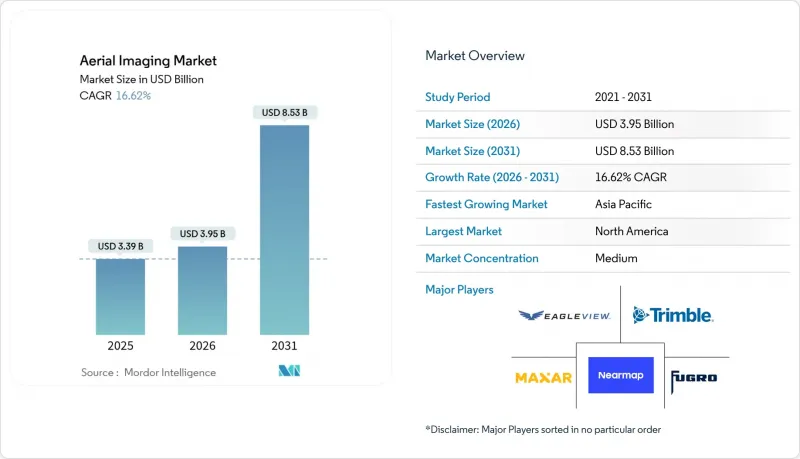
자율비행 시스템, AI를 활용한 영상분석, 5G 대응 위치정보 서비스가 수요 증가의 원동력이 되고 있습니다. 정밀농업 분야에서는 농업용 드론을 통한 처리 면적이 5억 헥타르를 넘어섰으며, 상업적 규모의 도입 실적이 입증되고 있습니다. 기업은 디지털 트윈 구상시 센티미터 단위의 정밀도를 요구하는 경향이 강해지면서, 인프라 모빌리티 및 스마트 시티 사업에서 LiDAR의 빠른 보급을 촉진하고 있습니다. 기존 기업이 M&A를 통한 수직계열화를 추진하는 한편, AI 네이티브 스타트업들이 클라우드 퍼스트의 구독모델로 진입하면서 경쟁이 심화되고 있습니다. 공급 측면에서는 배터리의 발전으로 임무 지속시간이 연장되고, 수요 측면에서는 무인항공기(UAV)에 의한 점검이 유인 비행보다 60% 저렴한 비용으로 최종사용자의 투자 회수 기간이 단축되는 등 경제성이 향상되고 있습니다.
세계 항공 이미징 시장 동향 및 인사이트
위치정보 서비스 확산으로 플랫폼 통합 가속화
2024년 상용 드론의 비행 횟수는 25% 증가했습니다. 5G의 보급과 IoT 게이트웨이를 통해 기업 사용자를 위한 실시간 저지연 데이터 스트리밍이 가능해졌기 때문입니다. UAV에 탑재된 엣지 프로세서는 GPS, RTK, 시각 관성 오도메트리를 융합하여 센티미터 단위의 위치 파악을 실현합니다. 이를 통해 드론은 인프라, 모빌리티, 재난 대응 용도를 위한 이동식 센서 허브로 변모하고 있습니다. 자산 관리 시스템과의 통합을 통해 서비스 프로바이더에게 예측 가능한 매출을 가져다주는 구독 모니터링 모델을 실현합니다. 초신뢰성 통신과 기기내 AI 워크플로우의 결합은 데이터에서 의사결정까지의 주기를 몇 시간에서 몇 분으로 단축시켜 시간적 제약이 있는 이용 사례에서 항공 이미징 시장의 가치 제안을 강화합니다. 확장된 데이터세트는 자율주행차 스택에도 활용되고 있으며, 고해상도 지리 데이터는 모델의 정확도와 안전 표준에 대한 적합성을 향상시키고 있습니다.
UAV 도입으로 데이터 수집의 경제성을 혁신
유인항공기에서 UAV로 대체함으로써 연료비 절감, 인력 절감, 신속한 배치가 가능하며, 최종사용자는 검사 비용을 60% 절감할 수 있다고 보고하고 있습니다. 소비자용 드론에 RTK 모듈과 멀티스펙트럼 탑재 장치가 장착되면서 중소기업에서도 전문적인 영상처리 기술을 이용할 수 있게 되었습니다. 배터리 지속시간의 향상으로 임무시간이 43분까지 연장되고, 자율비행 계획으로 조종사 면허의 제약이 해소되어 도입 기반이 확대되고 있습니다. SaaS 처리 플랫폼은 업로드된 데이터를 몇 시간 내에 행동 가능한 점군 데이터, 오르소모자이크, 식생 지수로 변환하고, On-Premise 서버를 총 비용 계산에서 제외합니다. 이러한 경제성은 경기 사이클을 넘어 벤더의 회복력을 강화하는 지속적인 매출 계약을 지원하고 있습니다.
프라이버시 소송은 업무상 불확실성을 야기
보험사가 부동산 인수 심사에서 드론 활용을 확대하는 가운데 법적 반발이 일어나고 있으며, 리스크 관리자의 61%는 프라이버시 및 배상책임에 대한 우려를 언급했습니다. 미국 제5순회항소법원은 사유지 상공에서 동의 없이 촬영하는 것을 금지하는 텍사스 주법을 지지하는 판결을 내려 상업용 비행 경로를 좁혔습니다. GDPR(EU 개인정보보호규정)은 명시적인 동의 요건과 수백만 유로 규모의 벌금을 부과하며 유럽 사업자의 컴플라이언스 기준을 높이고 있습니다. 공공 부문의 UAS 시스템 도입은 영공 접근을 더욱 복잡하게 만들고, 운영 리스크 프리미엄을 높이고 있습니다. 이러한 불확실성은 위험회피적인 기업의 도입을 지연시키고, 단기적으로 항공영상 시장의 성장을 억제할 수 있습니다.
부문 분석
UAV는 2025년 매출의 46.95%를 차지할 것으로 예상되며, 낮은 운영 비용과 유연한 형태가 점검, 측량, 살포 임무를 지원합니다. 하이브리드 VTOL 시스템은 항공 이미징 시장 규모에서 차지하는 비중은 미미하지만, 활주로가 필요 없고 고정익 항공기 수준의 효율성을 요구하는 국방 및 도시 항공 이동 프로젝트가 증가함에 따라 연간 20.2%의 성장이 예상됩니다. 주요 OEM 업체들은 전기 추진 시스템과 첨단 비행 제어 로직을 통합하고 있으며, 시코르스키의 로터 구동 날개 프로토타입이 40회 이상 모드 전환 착륙에 성공한 것이 이를 증명합니다. 비용 효율성 분석에 따르면 하이브리드 플랫폼은 헬리콥터에 비해 마일당 모니터링 비용을 30% 절감하고, 회전익 항공기만 사용하는 경우보다 더 긴 항속시간을 달성할 수 있다고 합니다. L3 Harris는 모듈식 LiDAR, EO/IR, 하이퍼스펙트럼 탑재가 가능한 하이브리드 쿼드 로터로 임무의 폭을 넓힐 수 있다고 밝혔습니다. Archer Aviation은 방산용 eVTOL 개발을 위해 4억 3,000만 달러의 투자를 약속하며, 이 플랫폼 클래스에 대한 자본 시장의 신뢰를 보여주었습니다. 이러한 추세로 볼 때, 항공 이미징 시장에서는 회전익 항공기의 기동성과 고정익 항공기의 경제성을 융합한 하드웨어의 다양화가 진행될 것으로 예측됩니다.
수직 직하 워크플로는 편리함과 고처리량 카메라로 인해 오르소모자이크 생성에 있으며, 주류입니다. 그러나 LiDAR의 21.3%의 연평균 복합 성장률(CAGR)은 사진 측량만으로는 달성할 수 없는 센티미터급 디지털 트윈에 대한 기업의 긴급한 수요를 반영하고 있습니다. 단일 광자 센서는 현재 초당 1,400만 개의 측정을 달성하고 있으며, 광역 회랑에서의 비행 시간을 단축하고 있습니다. LiDAR와 AI 알고리즘의 통합으로 특징 추출이 가속화되어 원시 데이터인 점군이 며칠이 아닌 몇 시간 만에 분류된 자산으로 변환됩니다. Inertial Labs 및 ideaForge와 같은 파트너십을 통해 UAV 배치시 패키지 무게와 전력 소비를 최적화하고 한 번의 비행으로 커버할 수 있는 면적을 확대할 수 있습니다. 따라서 자율주행차 개발자와 스마트 시티 계획자들이 보다 고밀도의 공간 데이터세트를 요구함에 따라 LiDAR 탑재기를 위한 항공 이미징 시장 규모는 카메라 업그레이드보다 더 큰 폭으로 성장할 것으로 예측됩니다.
지역별 분석
북미는 견고한 방위비 지출, 탄탄한 항공우주 산업 기반, BVLOS 실험을 촉진하는 규제 테스트 회랑을 배경으로 2025년 매출의 36.95%를 차지할 것으로 예측됩니다. 미국은 맥사에게 32억 4,000만 달러 규모의 EOCL 계약을 체결하여 다년간의 영상 수요를 확보하는 한편, 연구개발에 대한 자금 지원과 파급효과를 가져왔습니다. 캐나다에서는 2025년 RPAS 규정에 따라 BVLOS 승인이 공식화되어 주를 넘나드는 파이프라인 검사 업무의 효율성과 유틸리티 분야에서의 도입 확대가 촉진되었습니다. 멕시코의 정밀농업 보조금 제도는 멀티스펙트럼 드론의 구매를 촉진하고, 이 지역에서 국경을 초월한 기술 확산의 중요성을 강조하고 있습니다.
아시아태평양은 2031년까지 연평균 복합 성장률(CAGR) 16.4%를 나타낼 것으로 예측되며, 중국이 견인차 역할을 할 것으로 보입니다. 중국은 전 세계 상용 드론의 70%를 생산하고 있으며, 2029년까지 6,000억 위안 이상의 가치를 지닌 듀얼유즈 플랫폼에 정책적 지원을 집중하고 있습니다. 인도의 생산연계형 장려제도는 국내 UAV 제조를 보조하고, 공공 부문의 농작물 보험 시범사업은 다중 스펙트럼 영상에 대한 수요를 증가시키고 있습니다. 일본과 한국은 5G 구축을 도심항공모빌리티(UAM) 회랑과 연계하여 도시 운영 센터에 원활한 실시간 영상 전송 기반을 마련하고 있습니다. 호주의 대형 광산업체는 LiDAR를 이용한 재고 더미 부피 평가 자동화를 통해 아시아태평양의 고부가가치 기업 도입 점유율 확대에 기여하고 있습니다.
유럽은 엄격한 안전 및 프라이버시 감시를 유지하면서 EASA 기준의 조화로 시장 확실성을 촉진하고 2024년까지 등록 드론 조종자 수는 160만 명에 달할 것으로 예상하고 있습니다. 독일의 센서 엔지니어링 클러스터는 경량 LiDAR를 개발하고, 프랑스는 항공우주 기술을 활용한 멀티모달 이미징 페이로드를 추진하고 있습니다. 브렉시트 이후 영국 민간항공국은 상업 비행 면제를 가속화하고 에너지 부문 회랑 조사를 지원합니다. 남유럽 공동농업정책기금은 정밀살포작업에 대한 농가에 대한 상환을 통해 농촌지역 보급을 확대합니다. 중동 및 아프리카에서는 인프라 회랑과 천연자원 모니터링이 항공 이미징 시장에 대한 새로운 수요를 창출하며 상호보완적으로 성장하고 있습니다.
기타 특전:
- 엑셀 형식 시장 예측(ME) 시트
- 애널리스트의 3개월간 지원
자주 묻는 질문
목차
제1장 서론
제2장 조사 방법
제3장 개요
제4장 시장 구도
제5장 시장 규모와 성장 예측
제6장 경쟁 구도
제7장 시장 기회와 향후 전망
KSA 26.03.06The aerial imaging market size in 2026 is estimated at USD 3.95 billion, growing from 2025 value of USD 3.39 billion with 2031 projections showing USD 8.53 billion, growing at 16.62% CAGR over 2026-2031.
Strong demand momentum arises from autonomous flight systems, AI-powered image analytics, and 5G-enabled location-based services. Precision farming alone has seen agricultural drones treat more than 500 million hectares, validating commercial-scale deployments. Enterprises increasingly favor centimeter-level accuracy for digital-twin initiatives, fueling rapid LiDAR adoption in infrastructure, mobility, and smart-city programs. Competitive intensity heightens as incumbents expand vertically through M&A while AI-native startups enter with cloud-first subscription models. Supply-side economics benefit from battery advances that lengthen mission endurance, while demand-side economics sharpen because UAV inspections cost 60% less than manned flights, accelerating payback periods for end users.
Global Aerial Imaging Market Trends and Insights
Proliferation of Location-Based Services Accelerates Platform Integration
Commercial drone flights grew 25% in 2024 as 5G coverage and IoT gateways enabled real-time, low-latency data streaming for enterprise users. Edge processors mounted on UAVs now fuse GPS, RTK, and visual-inertial odometry to deliver centimeter-level positioning, turning drones into mobile sensor hubs for infrastructure, mobility, and disaster-response applications. Integration with asset-management systems supports subscription monitoring models that offer predictable revenue for service providers. The combination of ultra-reliable communications and AI-on-device workflows shrinks data-to-decision cycles from hours to minutes, strengthening the aerial imaging market's value proposition for time-critical use cases. Growing datasets also feed autonomous-vehicle stacks, where high-resolution geodata increases model accuracy and safety compliance.
UAV Adoption Transforms Data-Collection Economics
End users report 60% inspection-cost reductions when replacing manned aircraft with UAVs, thanks to lower fuel spend, fewer personnel, and faster mobilization. Consumer-grade drones now carry RTK modules and multispectral payloads, democratizing access to professional imaging for small businesses. Battery endurance improvements extend mission times to 43 minutes, and autonomous flight plans remove pilot-license constraints, widening the adopter base. SaaS processing platforms convert uploads into actionable point clouds, orthomosaics, or vegetation indexes within hours, removing on-prem servers from total-cost calculations. The economics underpin recurring-revenue contracts that enhance vendor resilience across economic cycles.
Privacy Litigation Creates Operational Uncertainty
Insurance carriers' growing drone use for property underwriting has triggered legal pushback, with 61% of risk managers citing privacy-liability worries. A U.S. Fifth Circuit ruling upheld Texas statutes that bar image capture over private property without consent, narrowing commercial flight corridors. GDPR imposes explicit-consent requirements and multimillion-euro fines, raising the compliance bar for European operators. Public-sector deployment of counter-UAS systems further complicates airspace access, heightening operational risk premiums. These uncertainties may delay adoption among risk-averse enterprises, moderating aerial imaging market growth in the near term.
Other drivers and restraints analyzed in the detailed report include:
- Smart-City Digital-Twin Projects Drive Infrastructure Investment
- Agricultural Precision-Farming Scales Through Multispectral Innovation
- Regulatory Fragmentation Constrains Scalability
For complete list of drivers and restraints, kindly check the Table Of Contents.
Segment Analysis
UAVs retained 46.95% of 2025 revenue as their low operating costs and flexible form factors support inspection, mapping, and spraying missions. Hybrid-VTOL systems, though only a nascent slice of the aerial imaging market size, are forecast to grow 20.2% annually as defense and urban-air-mobility projects demand runway-less operations with fixed-wing efficiency. Major OEMs integrate electric propulsion and advanced flight-control laws, evidenced by Sikorsky's rotor-blown-wing prototype that completed more than 40 mode-switch landings . Cost-benefit analyses show hybrid platforms cutting per-mile surveillance expense by 30% relative to helicopters while offering longer endurance than rotary-only craft. L3Harris reports its Hybrid Quadrotor can carry modular LiDAR, EO/IR, and hyperspectral payloads, broadening mission portfolios . Investors have committed USD 430 million to Archer Aviation for defense-grade eVTOLs, underscoring cap-table confidence in this platform class . These dynamics suggest the aerial imaging market will diversify hardware fleets, blending rotorcraft agility with fixed-wing economics.
Vertical nadir workflows dominate for orthomosaic generation due to simplicity and high-throughput cameras. However, LiDAR's 21.3% CAGR reflects urgent enterprise need for centimeter-level digital twins that photogrammetry alone cannot deliver. Single-photon sensors now achieve 14 million measurements per second, decreasing flying hours over large corridors. LiDAR integration with AI algorithms expedites feature extraction, converting raw point clouds into classified assets in hours rather than days. Partnerships such as Inertial Labs and ideaForge streamline package weight and power draw for UAV deployment, expanding addressable acreage per flight. The aerial imaging market size for LiDAR payloads is therefore poised to outpace camera upgrades, as autonomous-vehicle developers and smart-city planners seek denser spatial datasets.
The Aerial Imaging Market Report is Segmented by Platform Type (Fixed-Wing Aircraft, Helicopters, and More), Imaging Technique (Vertical Imaging, Oblique Imaging, and More), Application (Geospatial Mapping, Infrastructure Planning, and More), End-User Industry (Government, Energy, and More), and Geography (North America, South America, Middle East and Africa, and More). The Market Forecasts are Provided in Terms of Value (USD).
Geography Analysis
North America delivered 36.95% of 2025 revenue on the strength of defense outlays, an entrenched aerospace industrial base, and regulatory test corridors that catalyze BVLOS experimentation. The United States awarded Maxar a USD 3.24 billion EOCL contract, anchoring multi-year imagery demand and funding R&D spillovers. Canada's 2025 RPAS rules formalized BVLOS approvals, easing cross-province pipeline-inspection workflows and broadening utility-sector uptake. Mexico's precision-ag-subsidy packages accelerate multispectral drone purchases, underscoring the region's cross-border technology diffusion.
Asia-Pacific is forecast to clock a 16.4% CAGR through 2031, led by China, which builds 70% of global commercial drones and channels policy support toward dual-use platforms valued at over 600 billion yuan by 2029. India's Production-Linked Incentive scheme subsidizes domestic UAV manufacturing, while public-sector crop-insurance pilots heighten demand for multispectral imaging. Japan and South Korea align 5G deployment with urban-air-mobility corridors, setting the stage for seamless real-time imagery feeds into city-operations centers. Australia's mining giants automate stockpile volume assessments via LiDAR, boosting APAC's share of high-value enterprise deployments.
Europe maintains stringent safety and privacy oversight yet fosters market certainty through harmonized EASA standards, tallying 1.6 million registered drone operators by 2024. Germany's sensor-engineering clusters advance lightweight LiDAR, while France leverages aerospace expertise for multi-modal imaging payloads. The UK's post-Brexit Civil Aviation Authority accelerates commercial-flight exemptions, supporting energy-sector corridor surveys. Southern Europe's Common Agricultural Policy funds reimburse farmers for precision-spray operations, expanding rural uptake. Complementary growth emerges across the Middle East and Africa, where infrastructure corridors and natural-resource monitoring generate greenfield demand for the aerial imaging market.
- EagleView Technologies Inc.
- Nearmap Ltd
- Fugro N.V.
- Trimble Inc.
- Maxar Technologies Inc.
- DJI Technology Co., Ltd.
- Hexagon AB (Leica Geosystems)
- Airbus Defence and Space
- Terra Flight Aerial Imaging Inc.
- Kucera International Inc.
- Cooper Aerial Surveys Co.
- Digital Aerial Solutions LLC
- SkyIMD Inc.
- Airobotics GmbH (Ondas Holdings)
- Aerobotics (Pty) Ltd
- DroneDeploy Inc.
- Teledyne Technologies Inc.
- ESRI (Environmental Systems Research Institute)
- Landiscor Real-Estate Mapping
- GeoVantage Inc. (Aeroptic LLC)
Additional Benefits:
- The market estimate (ME) sheet in Excel format
- 3 months of analyst support
TABLE OF CONTENTS
1 INTRODUCTION
- 1.1 Study Assumptions and Market Definition
- 1.2 Scope of the Study
2 RESEARCH METHODOLOGY
3 EXECUTIVE SUMMARY
4 MARKET LANDSCAPE
- 4.1 Market Overview
- 4.2 Market Drivers
- 4.2.1 Proliferation of location-based services (5G, IoT)
- 4.2.2 Rapid adoption of UAVs/drones for low-cost data capture
- 4.2.3 Growth in smart-city and infrastructure?digital-twin projects
- 4.2.4 Agricultural demand for crop-health multispectral imaging
- 4.2.5 AI-augmented image analytics reducing processing time (under-reported)
- 4.2.6 Demand for high-resolution geodata to train autonomous-vehicle stacks (under-reported)
- 4.3 Market Restraints
- 4.3.1 Rising data-privacy and surveillance-use lawsuits
- 4.3.2 Fragmented global and local air-regulation regimes
- 4.3.3 Cyber-attacks on aerial imaging data-streams (under-reported)
- 4.3.4 Competition from low-orbit constellation satellites (under-reported)
- 4.4 Value Chain Analysis
- 4.5 Regulatory Landscape
- 4.6 Technological Outlook
- 4.7 Porter's Five Forces Analysis
- 4.7.1 Bargaining Power of Suppliers
- 4.7.2 Bargaining Power of Buyers
- 4.7.3 Threat of New Entrants
- 4.7.4 Threat of Substitutes
- 4.7.5 Intensity of Competitive Rivalry
- 4.8 Investment and Funding Trends
- 4.9 Impact on Macroeconomic Factors
5 MARKET SIZE AND GROWTH FORECASTS (VALUE)
- 5.1 By Platform Type
- 5.1.1 Fixed-wing Aircraft
- 5.1.2 Helicopters
- 5.1.3 UAVs / Drones
- 5.1.4 Hybrid-VTOL Platforms
- 5.1.5 Other Platform Types
- 5.2 By Imaging Technique
- 5.2.1 Vertical (Nadir) Imaging
- 5.2.2 Oblique Imaging
- 5.2.3 Multispectral / Hyperspectral Imaging
- 5.2.4 LiDAR-based Imaging
- 5.2.5 Thermal / IR Imaging
- 5.3 By Application
- 5.3.1 Geospatial Mapping and Land Survey
- 5.3.2 Infrastructure and Urban Planning
- 5.3.3 Asset Inventory and Inspection
- 5.3.4 Environmental and Forestry Monitoring
- 5.3.5 Disaster and Emergency Management
- 5.3.6 Security, Surveillance and Defense
- 5.3.7 Agriculture and Precision Farming
- 5.3.8 Insurance Underwriting and Claims
- 5.3.9 Media and Entertainment
- 5.4 By End-user Industry
- 5.4.1 Government and Public Agencies
- 5.4.2 Construction and Real-Estate
- 5.4.3 Energy, Power and Utilities
- 5.4.4 Oil and Gas
- 5.4.5 Agriculture and Forestry
- 5.4.6 Defense and Homeland Security
- 5.4.7 Insurance
- 5.4.8 Mining and Quarrying
- 5.4.9 Other Industries
- 5.5 By Geography
- 5.5.1 North America
- 5.5.1.1 United States
- 5.5.1.2 Canada
- 5.5.1.3 Mexico
- 5.5.2 Europe
- 5.5.2.1 United Kingdom
- 5.5.2.2 Germany
- 5.5.2.3 France
- 5.5.2.4 Italy
- 5.5.2.5 Rest of Europe
- 5.5.3 Asia-Pacific
- 5.5.3.1 China
- 5.5.3.2 Japan
- 5.5.3.3 India
- 5.5.3.4 South Korea
- 5.5.3.5 Rest of Asia-Pacific
- 5.5.4 Middle East and Africa
- 5.5.4.1 Middle East
- 5.5.4.1.1 Israel
- 5.5.4.1.2 Saudi Arabia
- 5.5.4.1.3 United Arab Emirates
- 5.5.4.1.4 Turkey
- 5.5.4.1.5 Rest of Middle East
- 5.5.4.2 Africa
- 5.5.4.2.1 South Africa
- 5.5.4.2.2 Egypt
- 5.5.4.2.3 Rest of Africa
- 5.5.4.1 Middle East
- 5.5.5 South America
- 5.5.5.1 Brazil
- 5.5.5.2 Argentina
- 5.5.5.3 Rest of South America
- 5.5.1 North America
6 COMPETITIVE LANDSCAPE
- 6.1 Market Concentration
- 6.2 Strategic Moves
- 6.3 Market Share Analysis
- 6.4 Company Profiles (includes Global level Overview, Market level overview, Core Segments, Financials as available, Strategic Information, Market Rank/Share for key companies, Products and Services, and Recent Developments)
- 6.4.1 EagleView Technologies Inc.
- 6.4.2 Nearmap Ltd
- 6.4.3 Fugro N.V.
- 6.4.4 Trimble Inc.
- 6.4.5 Maxar Technologies Inc.
- 6.4.6 DJI Technology Co., Ltd.
- 6.4.7 Hexagon AB (Leica Geosystems)
- 6.4.8 Airbus Defence and Space
- 6.4.9 Terra Flight Aerial Imaging Inc.
- 6.4.10 Kucera International Inc.
- 6.4.11 Cooper Aerial Surveys Co.
- 6.4.12 Digital Aerial Solutions LLC
- 6.4.13 SkyIMD Inc.
- 6.4.14 Airobotics GmbH (Ondas Holdings)
- 6.4.15 Aerobotics (Pty) Ltd
- 6.4.16 DroneDeploy Inc.
- 6.4.17 Teledyne Technologies Inc.
- 6.4.18 ESRI (Environmental Systems Research Institute)
- 6.4.19 Landiscor Real-Estate Mapping
- 6.4.20 GeoVantage Inc. (Aeroptic LLC)
7 MARKET OPPORTUNITIES AND FUTURE OUTLOOK
- 7.1 White-space and Unmet-Need Assessment