|
시장보고서
상품코드
1940579
배양 배지 : 시장 점유율 분석, 업계 동향과 통계, 성장 예측(2026-2031년)Culture Media - Market Share Analysis, Industry Trends & Statistics, Growth Forecasts (2026 - 2031) |
||||||
 Mordor Intelligence
배양 배지 시장은 2025년 68억 1,000만 달러에서 2026년에는 77억 7,000만 달러로 성장하여 2026년부터 2031년까지 CAGR 14.12%를 기록하며 2031년까지 150억 5,000만 달러에 달할 것으로 예측됩니다.
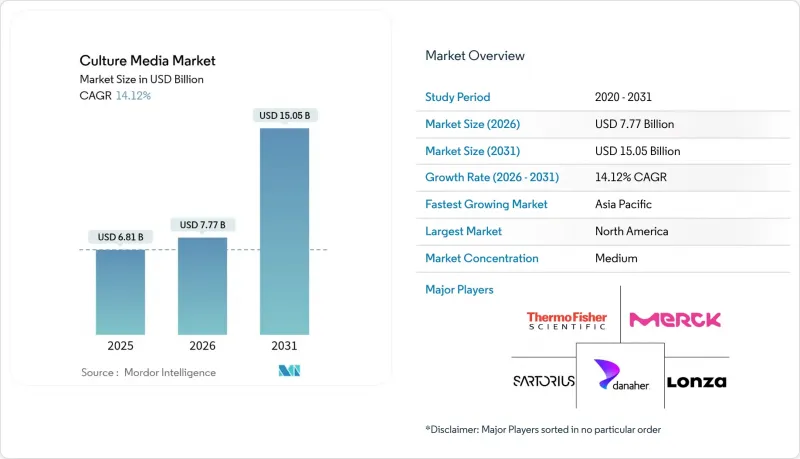
차세대 바이오프로세싱용 소재에 대한 수요 증가, mRNA 백신 생산 라인의 규모 확대, 바이오시밀러 상용화의 가속화가 채용 확대의 주요 요인으로 작용하고 있습니다. 탈수 제제는 공급망 경제성에서 우위를 유지하고 있지만, 발색성 포맷의 인기는 연구소가 자동화 대응 소모품으로 꾸준히 전환하고 있음을 보여줍니다. 지역별로 보면 북미의 수요는 규제 환경과 벤처 자금 조달 파이프라인이 잘 구축되어 있는 북미가 우세합니다. 한편, 아시아태평양은 정책적 지원을 통한 시설 확충이 진행되어 단위 기준 가장 빠른 성장이 예상됩니다. 풀서비스 공급업체들이 원자재 조달, 일회용 장비, 사내 분석 기능을 통합하고 엔드투엔드 워크플로우 지출을 확보하려는 움직임이 가속화됨에 따라 경쟁 압력이 증가하고 있습니다. 국내 바이오프로세스를 우대하는 재정적 인센티브와 자동화된 배지 제조 플랫폼이 결합되어 원자재 가격 상승과 물류 위험에 취약한 시장에서 새로운 기회를 창출하고 있습니다.
세계 배양 배지 시장 동향과 인사이트
혈청 기반에서 동물 유래 성분이 없는 배지로의 전환
규제 당국은 현재 동물 유래 성분을 포함하지 않는 배지를 권장하고 있으며, 제조업체는 혈청 원료 사용을 중단하고 화학적으로 정의된 대체품에 대한 의존도를 높이고 있습니다. 무혈청 배지는 이미 36.32%의 점유율을 차지하고 있으며, FDA의 지침에 따라 외래 병원균에 대한 감시가 강화됨에 따라 그 점유율은 계속 확대되고 있습니다. 줄기세포 배지는 15.85%의 CAGR로 성장하고 있으며, 이는 재생의료 제조업체들이 정의된 화학적 조성을 중요시하는 것을 뒷받침합니다. 머크 KGaA가 항체 및 mRNA 개발을 위해 3억 유로를 투자한 연구센터는 무성분 플랫폼에 대한 자본 유입을 상징합니다. 로트 간 일관성 향상, 다운스트림 공정의 정제 간소화, 오염 위험 감소는 동물 유래 성분을 사용하지 않는 솔루션의 상업적 정당성을 뒷받침하고 배양 배지 시장의 구조적 순풍으로 전환을 촉진하고 있습니다.
mRNA/바이러스 벡터 백신의 신속하고 대규모 생산능력 확대
팬데믹 시기에 구축된 생산 설비는 암 백신, 유전자 치료제, 몽키폭스 예방약으로 방향을 전환하여 특수 바이러스 벡터 배지에 대한 지속적인 수요를 확보하고 있습니다. 바바리안 노르딕이 2025년 말까지 1,000만 회 분량의 원숭이독감 백신을 공급할 계획인 것은 이러한 신규 설비의 지속적인 활용을 반영합니다. 고수율 mRNA 전사와 바이러스 감염성에 최적화된 배지는 동일 시설에서 여러 프로그램을 운영하는 플랫폼 업체에게 매우 중요합니다. 제품 전반에 걸친 표준화를 지원함으로써 배양 배지 공급업체들은 공정 제어 분석 및 일회용 하드웨어 번들을 포함한 파트너십에 가까워지고 있습니다. 이 분야의 시급성을 고려할 때, 구매 계약은 수년에 걸친 경우가 많으며, 배양배지 시장의 고성장 분야에서 사업을 운영하는 벤더의 수익 가시성을 높이고 있습니다.
의약품 원료 가격 상승과 공급망 취약성 증가
아미노산, 성장인자, 고순도 물의 가격 급등과 더불어 운송의 병목현상이 겹치면서 수익률 압박이 지속되고 있습니다. COVID-19 시대의 혼란은 긴 공급망의 취약성을 드러내고, 기업들은 더 큰 안전재고로 헤지하도록 촉구하고 있으며, 그 결과 운전 자금에 대한 수요가 증가하고 있습니다. 이중 소싱 전략은 일부 위험을 감소시키지만, 인증 비용을 상승시키고 소규모 연구소를 불리한 위치에 놓이게 합니다. 그 결과, 정책적 인센티브가 국내 생산을 촉진하고 있음에도 불구하고, 검증 및 자본 프로젝트를 위한 예산의 유연성을 유지해야 하는 최종사용자들 사이에서 비용 전가에 대한 피로감이 확산되면서 배지 시장의 단기적인 성장이 둔화되고 있습니다.
부문 분석
2025년 기준 배양배지 시장의 50.68%를 차지한 것은 탈수제제이며, 장기보존성과 경제적인 운송비용이 그 기반이 되고 있습니다. 그러나 임상 검사 및 식품 검사 분야에서 자동 플레이트 도포 시스템이 보급되면서 발색성 배지는 15.02%의 CAGR로 성장을 가속화하고 있습니다. 이러한 확대는 판독 시간 단축과 인적 오류를 줄일 수 있는 사전 분화 및 발색 배지를 선호하는 연구소의 추세를 보여줍니다. 예측 기간 동안 발색 배지 솔루션은 특히 고처리량 병원 검사실에서 탈수 배지의 기존 점유율을 잠식할 것으로 예상됩니다. 그러나 신흥 경제국의 높은 가격 민감도로 인해 탈수배지 제품은 여전히 큰 기반을 유지하고 있으며, 배양배지 시장의 기반으로서 계속 존재할 것으로 보입니다.
자동화 지원 특성으로 인해 발색성 배지는 바코드 플레이트 추적 및 로봇 배양이 균일한 물리적 특성을 요구하는 전자동 검사 시스템 그룹에 이상적인 조합이 될 수 있습니다. 스택형 자동화 지원 포맷을 공급할 수 있는 업체는 그에 상응하는 큰 점유율을 확보하고 있습니다. 탈수 제제는 여전히 지역 혼합 센터로의 대량 운송에 선호되고 있으며, 구매자는 수분 중량에 대한 비용을 부담하지 않고 수량을 조정할 수 있습니다. 이러한 대조적인 가치 제안을 통해 주요 공급업체들은 전통적인 탈수 제품의 강점과 고수익성 발색 배지 혁신이 결합된 혼합 포트폴리오 전략을 유지하고 있습니다.
무혈청 제품은 2025년 매출의 35.95%를 차지했으며, 이는 이미 정의된 성분에 대한 규제 추진과 소 혈청 위험 회피 추세를 반영합니다. 가장 빠르게 성장하고 있는 하위 카테고리인 줄기세포배양 배지는 피더 세포가 필요 없는 자가 이식 및 동종 이식 요법으로의 업계 전환의 수혜를 받고 있습니다. 성장 예측에 따르면, 재생의료 임상시험이 후기 단계 연구로 전환되는 것을 배경으로 줄기세포배양액은 2031년까지 CAGR 15.28%로 확대될 것으로 예상됩니다.
대규모 항체 및 mRNA 생산에서 화학적으로 정의된 블렌드의 채택은 추적 가능성과 안정적인 성능으로 인해 마찬가지로 강화되었습니다. 공급업체와 세포주 개발 전문가가 협력하여 적중률 최적화를 가속화하는 맞춤형 레시피를 생성하고, 고객을 더 깊숙이 포섭할 수 있도록 보장합니다. 한편, CAR-T, 종양용해성 바이러스 또는 유기체 배양의 특수한 대사 요구에 맞게 조정된 특수 및 맞춤형 배지는 프리미엄 가격대를 형성하고 있으며, 배양 배지 시장 내 수익 구조를 확대하고 있습니다.
지역별 분석
북미는 2025년 배양 배지 시장에서 38.90%의 점유율을 유지하며 2031년까지 CAGR 13.55%로 확대될 것으로 예상됩니다. 미국은 팬데믹 대응 자금으로 조성된 mRNA 인프라를 종양학 및 희귀질환 파이프라인으로 전환하여 지역적 모멘텀을 주도하고 있으며, FDA의 배지 검증에 대한 명확한 지침이 업계의 신뢰를 뒷받침하고 있습니다. 머크 KGaA의 메릴랜드 주에 2억 9천만 달러 규모의 생물학적 안전성 시험 시설 건설과 BD의 주사기 생산능력 확대 등 자본 투자로 인해 공급업체 생태계가 더욱 강화되고 있습니다. 벤처 자금은 세포 치료제 스타트업 기업에 집중되어 있으며, 고성능의 동물 유래 성분을 함유하지 않은 제제에 대한 안정적인 수요를 견인하고 있습니다.
아시아태평양은 15.96%의 CAGR로 가장 빠르게 성장할 것으로 예상되며, 생명공학을 전략 분야로 지정하는 국가 프로그램에 힘입어 성장세를 이어갈 것으로 보입니다. COVID-19 이후 중국의 검사 의뢰 패턴 정상화, 한국의 바이오시밀러 생산에 대한 특혜, 인도의 바이오 공정 관련 수입품에 대한 관세 면제 등이 복합적으로 작용하여 지역 내 배지 수요를 끌어올리고 있습니다. 밀리포아시그마사의 3억 유로 규모의 한국 공장은 다국적 기업이 현지 공급 체제를 구축하려는 자세를 보여주고 있습니다. 호주와 일본 시장은 탄탄한 연구 기반과 조화로운 GMP 프레임워크를 기반으로 평균 이상의 속도로 고사양의 줄기세포배양 배지를 채택하고 있습니다.
유럽은 2025년 매출의 28.35%를 차지하며, 2031년까지 CAGR 12.62%를 목표로 하고 있습니다. 독일, 영국, 프랑스가 주요 3개국을 형성하고 있습니다. 독일 다름슈타트 첨단연구센터는 항체 및 mRNA 분야의 지역 R&D를 강화하고, 영국은 백신 클러스터의 유산과 MHRA의 규제 역량을 활용하고 있습니다. 프랑스의 바이오의약품 혁신을 위한 노력은 무혈청 및 화학적으로 정의된 배양기질에 대한 수요를 지속시키고 있습니다. 유럽의약품청(EMA)의 지침은 회원국 간 문서화 및 품질 요건을 조화시켜 공급업체의 허가 장벽을 낮춥니다. 이를 통해 유럽은 배양기 수출시장으로서 안정성과 경쟁력을 겸비한 지위를 확보하고 있습니다.
기타 특전:
- 엑셀 형식의 시장 예측(ME) 시트
- 애널리스트의 3개월간 지원
자주 묻는 질문
목차
제1장 소개
제2장 조사 방법
제3장 주요 요약
제4장 시장 구도
제5장 시장 규모와 성장 예측(금액 : 달러)
제6장 경쟁 구도
제7장 시장 기회와 향후 전망
KSM 26.03.10The culture media market is expected to grow from USD 6.81 billion in 2025 to USD 7.77 billion in 2026 and is forecast to reach USD 15.05 billion by 2031 at 14.12% CAGR over 2026-2031.
Intensifying demand for next-generation bioprocessing inputs, the scaling-up of mRNA vaccine lines, and accelerating biosimilar commercialization are the principal forces widening adoption. Dehydrated formulations preserve dominance because of supply-chain economy, yet the popularity of chromogenic formats signals laboratories' steady shift to automation-ready consumables. Regional demand tilts toward North America thanks to its established regulatory environment and venture funding pipeline, while Asia-Pacific's policy-backed facility build-out positions the region for the quickest unit expansion. Competitive pressure is rising as full-service suppliers integrate raw-material sourcing, single-use hardware, and in-house analytics to capture end-to-end workflow spending. Fiscal incentives that favor domestic bioprocessing, coupled with automated media-preparation platforms, are unlocking fresh opportunities in a market that remains sensitive to raw-material inflation and logistics risk.
Global Culture Media Market Trends and Insights
Shift from Serum-based to Animal-component-free Media
Regulators now favor media free from animal components, prompting manufacturers to retire serum inputs and increase reliance on chemically-defined alternatives. Serum-free variants already control 36.32% share and continue gaining as FDA guidance heightens scrutiny of adventitious agents. Stem-cell media, expanding at 15.85% CAGR, underscores the premium that regenerative-medicine producers place on defined chemistries. Merck KGaA's EUR 300 million research center for antibody and mRNA development exemplifies capital flowing into component-free platforms. Heightened lot-to-lot consistency, simpler downstream purification, and lower contamination risk anchor the commercial justification for animal-component-free solutions, making the transition a core structural tailwind for the culture media market.
Rapid, Large-scale mRNA / Viral-vector Vaccine Capacity Expansions
Production assets erected during the pandemic have pivoted toward cancer vaccines, gene therapies, and mpox prophylaxis, locking in recurrent demand for specialized viral-vector media. Bavarian Nordic's plan to deliver 10 million mpox doses by end-2025 reflects the sustained use of these green-field facilities. Media optimized for high-yield mRNA transcription and viral infectivity is pivotal for platform manufacturers that run multiple programs through the same suites. By supporting cross-product standardization, culture media suppliers are edging closer to partnerships that include process-control analytics and single-use hardware bundles. Given the sector's urgency, purchase commitments frequently span multi-year horizons, improving revenue visibility for media vendors operating in this high-growth corner of the culture media market.
Pharmaceutical-grade Raw-material Inflation & Supply-chain Fragility
Surging prices for amino acids, growth factors, and high-purity water, compounded by transportation bottlenecks, continue to squeeze margins. COVID-19-era disruptions exposed the vulnerability of lengthy supply chains, prompting companies to hedge with larger safety stocks, thereby increasing working-capital needs. While dual-sourcing strategies alleviate some exposure, they raise qualification costs and place smaller laboratories at a disadvantage. Consequently, although policy incentives are encouraging domestic production, near-term growth in the culture media market is dampened by cost pass-through fatigue among end users who must preserve budget flexibility for validation and capital projects.
Other drivers and restraints analyzed in the detailed report include:
- Biosimilar Manufacturing Boom Creating Bulk-Media Demand
- Adoption of Fully-Automated Media-Preparation Systems in CDMOs & Big Pharma
- Batch-to-batch Variability Hampers Regulatory Approvals for Complex Media
For complete list of drivers and restraints, kindly check the Table Of Contents.
Segment Analysis
Dehydrated formulations accounted for 50.68% of culture media market share in 2025, anchored by long shelf life and economical freight profiles. Chromogenic alternatives, however, are accelerating at a 15.02% CAGR as automated plate-streaking systems proliferate in clinical and food-testing settings. This expansion signals laboratories' preference for pre-differentiated, color-changing substrates that shorten readout times and reduce human error. Over the forecast window, chromogenic solutions are projected to erode dehydrated incumbency, particularly in high-throughput hospital labs. Still, price sensitivity in emerging economies preserves a sizable base for dehydrated products, ensuring they remain a cornerstone of the culture media market.
Automation-friendly characteristics make chromogenic media the logical companion to total laboratory automation suites, where bar-coded plate tracking and robotic incubation demand uniform physical properties. Vendors able to supply ready-stacked, automation-compliant formats are accordingly capturing disproportionate share. Dehydrated formulations remain favored for bulk shipment into regional blending centers, allowing buyers to scale volumes without paying for hydrated weight. The contrasting value propositions sustain a mixed portfolio approach for leading suppliers that balance legacy dehydrated strengths with high-margin chromogenic innovations.
Serum-free products represented 35.95% of revenue in 2025, reflecting the regulatory push toward defined ingredients and away from bovine serum risks. Stem-cell media, the fastest-rising subset, benefits from the sector's pivot toward autologous and allogeneic therapies that require feeder-free conditions. Growth forecasts show stem-cell media climbing 15.28% CAGR through 2031 on the back of regenerative medicine trials entering late-phase studies.
The adoption of chemically defined blends in large-scale antibody and mRNA manufacturing is likewise intensifying, owing to their traceability and consistent performance. Vendor collaborations with cell-line development specialists are producing custom recipes that accelerate titer optimization, assuring deeper customer lock-in. Meanwhile, specialty and custom media tailored for unique metabolic needs of CAR-T, oncolytic viruses, or organoid cultures are commanding premium price points, widening the revenue mix inside the culture media market.
The Culture Media Market Report is Segmented by Media Type (Chromogenic Culture Media, and More), Formulation (Serum-Based Media, and More), Physical State (Liquid Media, and More), End User (Academic & Research Institutes, and More), Preparation Automation (Manual Media Preparation, and Automated Media-Preparation Systems), and Geography (North America, Europe, and More). The Market Forecasts are Provided in Terms of Value (USD).
Geography Analysis
North America retained 38.90% share of the culture media market in 2025 and is projected to expand at a 13.55% CAGR through 2031. The United States anchors regional momentum by repurposing pandemic-funded mRNA infrastructure for oncology and rare-disease pipelines, while the FDA's clear guidance on media validation sustains industry confidence. Capital deployment such as Merck KGaA's USD 290 million biosafety testing facility in Maryland and BD's syringe-capacity expansion further entrenches supplier ecosystems. Venture funding gravitates toward cell-therapy start-ups, reinforcing steady demand for high-performance, animal-component-free formulations.
Asia-Pacific is set to log the swiftest expansion at 15.96% CAGR, buoyed by national programs that treat biotechnology as a strategic sector. China's normalization of laboratory ordering patterns after COVID-19, South Korea's incentives for biosimilar production, and India's duty exemptions on bioprocessing imports all raise regional media volumes. MilliporeSigma's EUR 300 million Korean facility demonstrates multinationals' commitment to localized supply. Australian and Japanese markets, built on strong research bases and harmonized GMP frameworks, adopt high-spec stem-cell media at above-average run rates.
Europe captured 28.35% of 2025 revenue and aims for a 12.62% CAGR by 2031, with Germany, the United Kingdom, and France comprising the leading triad. Germany's Advanced Research Center in Darmstadt amplifies regional R&D in antibodies and mRNA, while the UK benefits from vaccine-cluster legacies and MHRA regulatory capacity. French initiatives for biologics innovation maintain demand continuity for serum-free and chemically defined inputs. EMA guidance that harmonizes documentation and quality requirements across member states lowers authorization hurdles for suppliers, positioning Europe as a stable yet competitive export market for culture media.
- Thermo Fisher Scientific
- Merck KGaA (MilliporeSigma)
- Sartorius
- Danaher Corp. (Cytiva)
- Lonza Group Ltd.
- Beckton Dickinson
- Corning
- Bio-Rad Laboratories
- FUJIFILM Holdings (Irvine Scientific)
- Avantor Inc.
- HiMedia Laboratories Pvt. Ltd.
- GE Healthcare
- Ajinomoto Co. Inc.
- Caisson Laboratories
- PAN-Biotech GmbH
- MP Biomedicals LLC
- KOHJIN Bio Co. Ltd.
Additional Benefits:
- The market estimate (ME) sheet in Excel format
- 3 months of analyst support
TABLE OF CONTENTS
1 Introduction
- 1.1 Study Assumptions & Market Definition
- 1.2 Scope of the Study
2 Research Methodology
3 Executive Summary
4 Market Landscape
- 4.1 Market Overview
- 4.2 Market Drivers
- 4.2.1 Shift from Serum-based to Animal-component-free Media
- 4.2.2 Rapid, Large-scale mRNA / Viral-vector Vaccine Capacity Expansions
- 4.2.3 Biosimilar Manufacturing Boom Creating Bulk-Media Demand
- 4.2.4 Adoption of Fully-Automated Media-Preparation Systems in CDMOs & Big Pharma
- 4.2.5 Fiscal Incentives for On-shore Bioprocessing
- 4.3 Market Restraints
- 4.3.1 Pharmaceutical-grade Raw-material Inflation & Supply-chain Fragility
- 4.3.2 Batch-to-batch Variability Hampers Regulatory Approvals for Complex Media
- 4.3.3 Global Shortage of Skilled Media-optimization Scientists
- 4.4 Supply-Chain Analysis
- 4.5 Technological Outlook
- 4.6 Porter's Five Forces
- 4.6.1 Threat of New Entrants
- 4.6.2 Bargaining Power of Buyers
- 4.6.3 Bargaining Power of Suppliers
- 4.6.4 Threat of Substitutes
- 4.6.5 Competitive Rivalry
5 Market Size & Growth Forecasts (Value in USD)
- 5.1 By Media Type
- 5.1.1 Chromogenic Culture Media
- 5.1.2 Dehydrated Culture Media
- 5.1.3 Prepared / Ready-to-use Culture Media
- 5.2 By Formulation
- 5.2.1 Serum-based Media
- 5.2.2 Serum-free Media
- 5.2.3 Chemically-defined Media
- 5.2.4 Stem-cell Culture Media
- 5.2.5 Specialty / Custom Media
- 5.3 By Physical State
- 5.3.1 Liquid Media
- 5.3.2 Powdered Media
- 5.3.3 Semi-solid / Gel Media
- 5.4 By End User
- 5.4.1 Pharmaceutical & Biotechnology Companies
- 5.4.2 Contract Development & Manufacturing Organizations (CDMOs)
- 5.4.3 Academic & Research Institutes
- 5.4.4 Clinical & Diagnostic Laboratories
- 5.4.5 Food & Beverage Testing Laboratories
- 5.5 By Preparation Automation
- 5.5.1 Manual Media Preparation
- 5.5.2 Automated Media-Preparation Systems
- 5.6 Geography
- 5.6.1 North America
- 5.6.1.1 United States
- 5.6.1.2 Canada
- 5.6.1.3 Mexico
- 5.6.2 Europe
- 5.6.2.1 Germany
- 5.6.2.2 United Kingdom
- 5.6.2.3 France
- 5.6.2.4 Italy
- 5.6.2.5 Spain
- 5.6.2.6 Rest of Europe
- 5.6.3 Asia-Pacific
- 5.6.3.1 China
- 5.6.3.2 Japan
- 5.6.3.3 India
- 5.6.3.4 Australia
- 5.6.3.5 South Korea
- 5.6.3.6 Rest of Asia-Pacific
- 5.6.4 Middle East and Africa
- 5.6.4.1 GCC
- 5.6.4.2 South Africa
- 5.6.4.3 Rest of Middle East and Africa
- 5.6.5 South America
- 5.6.5.1 Brazil
- 5.6.5.2 Argentina
- 5.6.5.3 Rest of South America
- 5.6.1 North America
6 Competitive Landscape
- 6.1 Market Concentration
- 6.2 Company Share Analysis
- 6.3 Company Profiles (includes Global level Overview, Market-level overview, Core Segments, Financials as available, Strategic Information, Market Rank/Share, Products & Services, Recent Developments)
- 6.3.1 Thermo Fisher Scientific Inc.
- 6.3.2 Merck KGaA (MilliporeSigma)
- 6.3.3 Sartorius AG
- 6.3.4 Danaher Corp. (Cytiva)
- 6.3.5 Lonza Group Ltd.
- 6.3.6 Becton, Dickinson and Company
- 6.3.7 Corning Incorporated
- 6.3.8 Bio-Rad Laboratories Inc.
- 6.3.9 FUJIFILM Holdings (Irvine Scientific)
- 6.3.10 Avantor Inc.
- 6.3.11 HiMedia Laboratories Pvt. Ltd.
- 6.3.12 GE HealthCare
- 6.3.13 Ajinomoto Co. Inc.
- 6.3.14 Caisson Laboratories Inc.
- 6.3.15 PAN-Biotech GmbH
- 6.3.16 MP Biomedicals LLC
- 6.3.17 KOHJIN Bio Co. Ltd.
7 Market Opportunities & Future Outlook
- 7.1 White-space & Unmet-need Assessment