|
시장보고서
상품코드
1940594
혈전 관리 기기 : 시장 점유율 분석, 업계 동향과 통계, 성장 예측(2026-2031년)Clot Management Devices - Market Share Analysis, Industry Trends & Statistics, Growth Forecasts (2026 - 2031) |
||||||
 Mordor Intelligence
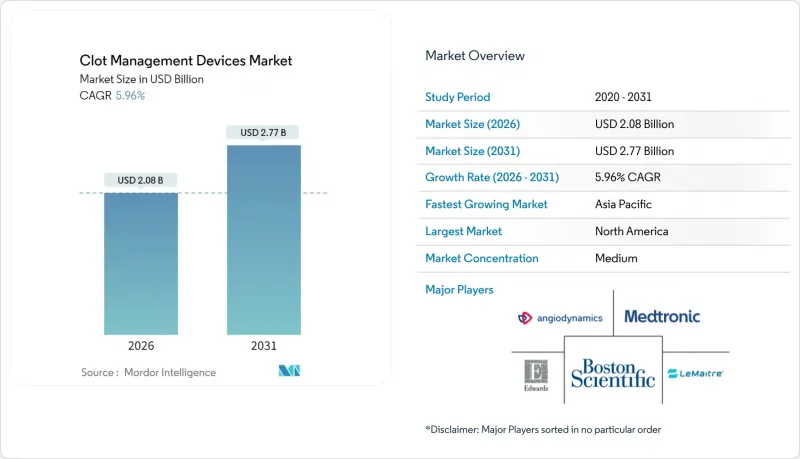
혈전 관리 기기 시장은 2025년 19억 6,000만 달러에서 2026년에는 20억 8,000만 달러로 성장하여 2026년부터 2031년까지 CAGR 5.96%를 기록하며 2031년까지 27억 7,000만 달러에 달할 것으로 예측됩니다.
현재의 확대는 전 세계 심혈관질환의 부담 증가, 허혈성 및 혈전성 사건의 꾸준한 증가, 그리고 외래에서 최소침습적 혈관 중재술로의 현저한 전환을 기반으로 하고 있습니다. 고령화에 따른 인구통계학적 압력과 비만, 고혈압 등 생활습관 관련 위험요인이 맞물리면서 시술 건수는 증가 추세를 유지하고 있습니다. 첨단 기계 설계, 인공지능(AI) 가이드 이미지, 고정밀 내비게이션이 통합된 기술 파이프라인은 시술의 성공률과 안전성을 향상시켜 수요를 강화하고 있습니다. 동시에, 주요 시장의 지불자 개혁은 기계식 혈전제거술에 대한 보험 적용을 확대하여 의료 서비스 제공자가 차세대 시스템을 도입하는 데 있어 재정적 장벽을 완화하고 있습니다. 이러한 요인들로 인해 혈전 관리 기기 시장은 향후 10년간 지속적인 한 자릿수 성장세를 이어갈 것으로 예상됩니다.
세계 혈전 관리 기기 시장 동향 및 인사이트
심혈관질환 및 뇌혈관 질환의 유병률 증가
뇌졸중 및 심근경색 발생률의 증가는 혈전 관리 기기 시장의 가장 강력한 촉진제입니다. 2050년까지 전 세계 뇌졸중 발생 건수는 2,143만 건에 달할 것으로 예상되며, 이러한 급격한 증가는 안전하고 효과적인 혈전제거 솔루션에 대한 수요를 증가시킬 것으로 예상됩니다. 유럽에서는 허혈성 뇌졸중이 이미 전체 뇌졸중 사례의 85%를 차지하고 있어 첨단 리트리버 기술의 채택이 지속되고 있습니다. 미국 내 당뇨병 유병률은 2050년까지 16.3%에서 26.8%로 증가할 것으로 예상되며, 이는 일상적인 진료에서 혈전증의 복잡성을 증가시키고 있습니다. 중저소득 국가에서는 미충족 수요가 두드러지며, 자원의 제약 속에서도 현 시스템에서 77.93%의 재통행률을 기록하고 있습니다. 현재의 장치로는 어려운 혈전의 절반 정도만 제거할 수 있으며, 스탠포드 대학의 밀리스피너와 같은 플랫폼에 기회가 열려 있습니다. 이 장치는 난치성 폐색에 대해 90%에 가까운 효과를 보이고 있습니다.
고령화 인구 기반 확대
고령화는 치료 횟수와 기기 요구 사항을 재구성합니다. 부유한 국가에서는 허혈성 심장질환의 연령 조정 사망률이 감소하고 있지만, 인구학적 모멘텀으로 인해 절대적인 환자 수는 증가하고 있습니다. 허약, 동반 질환, 출혈 위험의 증가로 인해 의료진은 전신 혈전용해 요법보다 제어성이 높은 기계적 시스템을 선택하는 경향이 있습니다. FLASH 레지스트리 데이터는 이러한 경향을 뒷받침하며, 중등도 및 고위험 폐색전증에서 기계적 혈전제거술의 48시간 후 모든 원인에 의한 사망률은 0.3%로 나타났습니다. 의료기기 제조업체들은 현재 노인들에게서 많이 나타나는 석회화 및 굴곡진 혈관 내를 항해하기 위해 더 가느다란 카테터와 첨단 조향 도구를 개발하고 있습니다.
FDA 및 CE의 엄격한 임상 증거 요구 사항
규제 당국은 현재 광범위한 안전 데이터세트를 요구하고 있으며, 이로 인해 개발 주기가 길어지고 신규 시스템 비용이 상승하고 있습니다. 유럽의 새로운 의료기기 규제(MDR)는 시판 후 조사를 강화했지만, 인증기관의 처리 능력을 압박하고 승인 절차를 지연시키고 있습니다. 2025년 초 존슨앤드존슨 메디텍의 바리펄스 카테터 일시 판매 중단 사례에서 알 수 있듯이, 규제 문제가 얼마나 빠르게 상용화를 저해할 수 있는지를 알 수 있습니다. 미국 FDA는 2025년 5월 점탄성 응고 분석기를 특별 관리 대상인 클래스 II로 분류하고 보조 기술에 대한 보다 엄격한 모니터링을 강조하였습니다. 34개 기관에서 997명의 환자를 대상으로 한 EXCELLENT 레지스트리를 포함한 대규모 연구가 신경혈관장치에 대한 최소한의 근거 기준이 되고 있습니다.
부문 분석
기계 및 경피적 혈전제거 시스템은 2025년 혈전 관리 장치 시장에서 36.42%의 점유율을 차지하며 신경혈관 영역, 관상동맥 영역, 말초혈관 영역을 막론하고 주력 솔루션으로 자리매김할 것으로 보입니다. 그 다재다능함과 빠른 기술 혁신이 결합되어 의료 서비스 제공자의 인벤토리에서 핵심적인 역할을 하고 있습니다. 혈전 관리 장치 시장은 흡입력 향상, 개선된 혈전 포착 바스켓, 초기 성공률을 높이는 통합 이미징 기능을 갖춘 플랫폼의 등장으로 지속적으로 성장하고 있습니다. EXCELLENT 레지스트리에서 EMBOTRAP 장치의 초기 재관류율 64.5%, 최종 성공률 94.5%를 확인하여 뇌졸중 치료 가이드라인의 보다 광범위한 권고사항을 뒷받침하는 결과를 확인했습니다. 신경혈관 혈전제거 및 혈전제거 기기는 뇌졸중 환자 수 증가와 약물요법을 능가하는 유효성 데이터에 힘입어 2031년까지 연평균 8.44%의 성장이 예상됩니다. 스탠포드 대학의 밀리스피너가 혈전 부피 95% 감소를 달성한 사례 등 산학협력을 통한 비약적인 기술 혁신이 이 분야의 성장 궤도를 유지하는 좋은 예입니다.
두 번째 계층 카테고리는 틈새시장이지만 안정적인 지위를 유지하고 있습니다. 카테터 유도 혈전용해 장치는 순전히 기계적 수단으로 충분하지 않은 대규모 폐색전증 및 복잡한 심부정맥 혈전증에서 여전히 필수적입니다. 혈전제거용 풍선 카테터는 직경이 작고 병변에 특화된 적응증에 대응하는 반면, 하대정맥 필터는 안전성에 대한 우려와 관찰자 조사로 인해 사용이 감소하는 추세입니다. 그러나 혈전 관리 장치 시장에서는 장기적인 합병증 프로파일의 개선을 전제로 한 신속한 제거를 목적으로 하는 저가형 리트리버 필터에 대한 수요 기회가 남아있습니다. 제품 전반에 걸쳐 AI 강화 가이던스 소프트웨어의 채택이 확대되고 있으며, 혈전 특성의 실시간 시각화 및 최적의 장치 배치가 기대되고 있습니다.
지역별 분석
북미는 2025년에도 혈전 관리 기기 시장의 45.49%를 차지하며 주요 수익원으로 남을 것으로 예상됩니다. 풍부한 상환제도, 광범위한 일차 뇌졸중 센터 인증, 성숙한 외래 시설 네트워크가 다른 지역보다 높은 사용 수준을 뒷받침하고 있습니다. 메디트로닉의 심플리시티 스파이럴 카테터 등에 대한 CMS의 패스스루 승인은 도입 파이프라인을 더욱 강화할 것입니다. 그러나 IVC 필터 분야의 법적 리스크는 제조업체들이 조심스러운 태도를 취하게 만들고, 필터 설계의 단기적인 혁신을 억제할 수 있습니다.
유럽은 두 번째 점유율을 차지하며 5%대 초반의 견조한 성장세를 기록하고 있습니다. 시행상의 병목현상은 있지만, 강화된 유럽 의료기기 규정(MDR)은 추적성과 데이터 투명성 향상을 촉진하고, 시간이 지남에 따라 임상의의 신뢰를 안정화시킬 것으로 기대됩니다. 혈전방지장치 및 혈전제거술에 대한 급여는 조사 대상 11개 EU 회원국 간 차이가 있지만, 전반적인 급여 적용률은 상승 추세에 있습니다. 34개 기관에서 진행된 EXCELLENT 레지스트리로 대표되는 고품질 임상 인프라는 다기관 공동 검증 및 시판 후 조사를 가속화하여 각국의 자금 배분 결정에 기여하고 있습니다.
아시아태평양은 2026년부터 2031년까지 CAGR 6.93%로 가장 빠르게 성장할 것으로 예측되는 지역입니다. 심혈관질환 발생률 증가, 보험 보급률 향상, 대규모 병원 현대화가 장비 도입을 주도하고 있습니다. 신흥 경제국에서 수요와 공급 능력의 격차가 가장 두드러지는데, 한정된 자원에도 불구하고 중저소득 국가에서는 77.93%의 재인구 비율이 확인되어, 시술 자금 조달 환경이 개선되면 잠재적 수요가 크게 존재함을 시사합니다. 다국적 기업들은 국내 판매 대리점과 협력하여 이동식 트레이닝 랩을 구축하여 임상의 채용을 가속화하고 있습니다. 한편, 현지 제조업체들은 가격에 민감한 부문에 대응하기 위해 연구개발을 확대하고 있습니다. 이러한 요인으로 인해 아시아태평양은 향후 5년간 혈전 관리 기기 시장 매출 증가에 있어 주요 지리적 견인차 역할을 할 것으로 예상됩니다.
기타 특전:
- 엑셀 형식의 시장 예측(ME) 시트
- 애널리스트의 3개월 지원
자주 묻는 질문
목차
제1장 소개
제2장 조사 방법
제3장 주요 요약
제4장 시장 구도
제5장 시장 규모와 성장 예측(금액 : 달러)
제6장 경쟁 구도
제7장 시장 기회와 향후 전망
KSM 26.03.10The Clot Management Devices market is expected to grow from USD 1.96 billion in 2025 to USD 2.08 billion in 2026 and is forecast to reach USD 2.77 billion by 2031 at 5.96% CAGR over 2026-2031.
The current expansion rests on the mounting global cardiovascular burden, the steady rise of ischemic and thrombotic events, and a marked pivot toward outpatient, minimally invasive vascular interventions. Demographic pressure from aging societies, coupled with lifestyle-related risk factors such as obesity and hypertension, keeps procedure volumes on an upward trajectory. Technology pipelines that integrate advanced mechanical designs, artificial intelligence-guided imaging, and high-precision navigation reinforce demand by improving procedural success rates and safety profiles. Simultaneously, payer reform in key markets is widening reimbursement coverage for mechanical thrombectomy, easing the financial pathway for providers to adopt next-generation systems. These factors collectively position the clot management devices market for durable mid-single-digit growth through the decade.
Global Clot Management Devices Market Trends and Insights
Rising Prevalence of Cardiovascular & Neurovascular Diseases
Escalating incidences of stroke and myocardial infarction represent the most powerful catalyst for the clot management devices market. Global stroke cases are projected to rise to 21.43 million by 2050, a surge that will swell demand for safe, effective thrombectomy solutions. In Europe, ischemic strokes already account for 85% of all stroke events, sustaining adoption of advanced retriever technology. Metabolic risks compound the challenge: United States diabetes prevalence is forecast to climb from 16.3% to 26.8% by 2050, raising thrombotic complexity in day-to-day practice. Lower-middle-income countries highlight unmet needs, recording 77.93% recanalization rates with existing systems despite resource limitations. Current devices resolve barely one out of two tough clots, opening the door for platforms like Stanford University's milli-spinner, which achieves near-90% efficacy on difficult occlusions.
Expanding Geriatric Population Base
Population aging reshapes procedure volumes and device requirements. While age-standardized mortality from ischemic heart disease is falling in affluent nations, absolute patient counts are rising due to demographic momentum. Frailty, comorbidities, and elevated bleeding risk push providers toward highly controllable mechanical systems rather than systemic thrombolysis. FLASH registry data reinforce this preference: mechanical thrombectomy in intermediate-high-risk pulmonary embolism delivered 0.3% all-cause mortality at 48 hours. Device makers now engineer slimmer catheters and advanced steering tools to navigate calcified, tortuous vessels commonly found in older adults.
Stringent FDA & CE Clinical-Evidence Requirements
Regulators now demand expansive safety datasets, lengthening development cycles and raising costs for novel systems. Europe's new Medical Device Regulation strengthens post-market surveillance but has strained notified-body capacity, prolonging approvals. Temporary sales pauses-such as Johnson & Johnson MedTech's Varipulse catheter in early 2025 demonstrate how quickly regulatory concerns can derail commercialization. In the United States, the FDA placed viscoelastic coagulation analyzers into Class II with special controls in May 2025, underscoring stricter oversight even for adjunct technologies. Large-scale studies, including the EXCELLENT registry with 997 patients across 34 sites, have become the minimum evidence bar for neurovascular devices.
Other drivers and restraints analyzed in the detailed report include:
- Growing Preference for Minimally Invasive Procedures & Shorter LOS
- Increasing Reimbursement Coverage for Mechanical Thrombectomy
- Litigation Risk Tied to Long-Term IVC-Filter Complications
For complete list of drivers and restraints, kindly check the Table Of Contents.
Segment Analysis
Mechanical and percutaneous thrombectomy systems commanded 36.42% of the clot management devices market share in 2025 and remain the workhorse solutions across neurovascular, coronary, and peripheral territories. Their versatility, combined with rapid technical iteration, makes them a central pillar of provider inventories. The clot management devices market continues to benefit from platforms offering higher aspiration power, improved clot-capture baskets, and integrated imaging that elevates first-pass success. The EXCELLENT registry confirmed first-pass recanalization of 64.5% and final rates of 94.5% for EMBOTRAP devices, supporting broader guideline endorsement Stroke. Neurovascular embolectomy and thrombectomy devices are set to grow 8.44% annually through 2031, lifted by rising stroke volumes and efficacy data that surpass pharmacologic therapies. Academic-industry partnerships, such as Stanford's milli-spinner achieving 95% clot-volume reduction, exemplify how step-change engineering will keep the segment on an upward trajectory.
Second-tier categories hold niche, yet stable, positions. Catheter-directed thrombolysis devices remain vital for massive pulmonary embolism and complex deep-vein thrombosis when purely mechanical options are insufficient. Embolectomy balloon catheters address small-caliber, lesion-specific indications, while IVC filters experience usage decay amid safety concerns and observer scrutiny. Nevertheless, the clot management devices market retains opportunities for value-priced retrieval filters designed for rapid extraction, provided long-term complication profiles improve. Across products, AI-augmented guidance software continues to gain traction, promising real-time visualization of clot characteristics and optimized device deployment.
The Clot Management Devices Market is Segmented by Product (Embolectomy Balloon Catheters, Catheter-Directed Thrombolysis Devices, Mechanical/Percutaneous Thrombectomy Devices, Inferior Vena Cava (IVC) Filters, and More), End User (Hospitals, Ambulatory Surgical Centers, Specialty Clinics), and Geography (North America, Europe, Asia-Pacific, and More). The Market Forecasts are Provided in Terms of Value (USD).
Geography Analysis
North America remained the leading revenue contributor, capturing 45.49% of the clot management devices market in 2025. Robust reimbursement, widespread primary-stroke-center certification, and a mature network of ambulatory facilities underpin usage levels that outpace other regions. CMS pass-through approvals for devices such as Medtronic's Symplicity Spyral catheter further strengthen the adoption pipeline. Nevertheless, legal exposures in the IVC filter segment create an undercurrent of caution among manufacturers, potentially curbing near-term innovation in filter design.
Europe delivers the second-largest share and records healthy mid-single-digit expansion. Despite implementation bottlenecks, the enhanced European MDR fosters improved traceability and data transparency, which are expected to stabilize clinician confidence over time. Reimbursement for embolic-protection and thrombectomy varies among the 11 scrutinized EU states, yet overall payment coverage is trending upward. High-quality clinical infrastructures illustrated by the 34-site EXCELLENT registry accelerate multicenter validations and post-market studies that feed national funding decisions.
Asia-Pacific is the fastest-growing region at a projected 6.93% CAGR for 2026-2031. Rising cardiovascular incidence, improving insurance penetration, and large-scale hospital modernization drive equipment uptake. Emerging economies show the starkest need-capacity gap: lower-middle-income settings demonstrated 77.93% recanalization despite limited resources, indicating sizable latent demand once procedural financing improves. Multinationals collaborate with domestic distributors and deploy mobile training labs to speed clinician adoption, while local manufacturers expand R&D to address price-sensitive segments. These factors make Asia-Pacific the primary geographic engine for incremental clot management devices market revenue over the next five years.
- Medtronic
- Boston Scientific
- Penumbra
- Stryker
- Terumo
- Edward Lifesciences
- Teleflex
- Johnson & Johnson
- LeMaitre Vascular
- AngioDynamics
- Inari Medical
- Cook Group
- Cardinal Health
- iVascular S.L.U
- Strub Medical
- Abbott Laboratories
- Terumo
- Beckton Dickinson
- Thrombolex Inc.
- Penumbra (Indigo)
Additional Benefits:
- The market estimate (ME) sheet in Excel format
- 3 months of analyst support
TABLE OF CONTENTS
1 Introduction
- 1.1 Study Assumptions & Market Definition
- 1.2 Scope of the Study
2 Research Methodology
3 Executive Summary
4 Market Landscape
- 4.1 Market Overview
- 4.2 Market Drivers
- 4.2.1 Rising Prevalence of Cardiovascular & Neurovascular Diseases
- 4.2.2 Expanding Geriatric Population Base
- 4.2.3 Growing Preference for Minimally-Invasive Procedures & Shorter LOS
- 4.2.4 Increasing Reimbursement Coverage for Mechanical Thrombectomy
- 4.2.5 Ai-Enabled Clot Imaging & Navigation Tools Broadening Addressable Sites
- 4.2.6 Rapid Adoption of Outpatient Thrombectomy Suites in ASC Settings
- 4.3 Market Restraints
- 4.3.1 Stringent FDA & CE Clinical-Evidence Requirements
- 4.3.2 Competition from Pharmacological Anticoagulants & Thrombolytics
- 4.3.3 High Device Cost Pressures Amid Bundled-Payment Models
- 4.3.4 Litigation Risk Tied to Long-Term IVC-Filter Complications
- 4.4 Technological Outlook
- 4.5 Porter's Five Forces Analysis
- 4.5.1 Threat of New Entrants
- 4.5.2 Bargaining Power of Buyers
- 4.5.3 Bargaining Power of Suppliers
- 4.5.4 Threat of Substitutes
- 4.5.5 Intensity of Competitive Rivalry
5 Market Size & Growth Forecasts (Value in USD)
- 5.1 By Product
- 5.1.1 Embolectomy Balloon Catheters
- 5.1.2 Catheter-Directed Thrombolysis Devices
- 5.1.3 Mechanical/Percutaneous Thrombectomy Devices
- 5.1.4 Inferior Vena Cava (IVC) Filters
- 5.1.5 Neurovascular Embolectomy/Thrombectomy Devices
- 5.2 By End User
- 5.2.1 Hospitals
- 5.2.2 Ambulatory Surgical Centers
- 5.2.3 Specialty Clinics
- 5.3 By Geography
- 5.3.1 North America
- 5.3.1.1 United States
- 5.3.1.2 Canada
- 5.3.1.3 Mexico
- 5.3.2 Europe
- 5.3.2.1 Germany
- 5.3.2.2 United Kingdom
- 5.3.2.3 France
- 5.3.2.4 Italy
- 5.3.2.5 Spain
- 5.3.2.6 Rest of Europe
- 5.3.3 Asia-Pacific
- 5.3.3.1 China
- 5.3.3.2 Japan
- 5.3.3.3 India
- 5.3.3.4 Australia
- 5.3.3.5 South Korea
- 5.3.3.6 Rest of Asia-Pacific
- 5.3.4 Middle East & Africa
- 5.3.4.1 GCC
- 5.3.4.2 South Africa
- 5.3.4.3 Rest of Middle East & Africa
- 5.3.5 South America
- 5.3.5.1 Brazil
- 5.3.5.2 Argentina
- 5.3.5.3 Rest of South America
- 5.3.1 North America
6 Competitive Landscape
- 6.1 Market Concentration
- 6.2 Market Share Analysis
- 6.3 Company Profiles (includes Global level Overview, Market level overview, Core Segments, Financials as available, Strategic Information, Market Rank/Share for key companies, Products & Services, and Recent Developments)
- 6.3.1 Medtronic
- 6.3.2 Boston Scientific Corporation
- 6.3.3 Penumbra Inc.
- 6.3.4 Stryker Corporation
- 6.3.5 Terumo Corporation
- 6.3.6 Edwards Lifesciences
- 6.3.7 Teleflex Incorporated
- 6.3.8 Johnson & Johnson
- 6.3.9 LeMaitre Vascular Inc.
- 6.3.10 AngioDynamics, Inc.
- 6.3.11 Inari Medical
- 6.3.12 Cook Group Incorporated
- 6.3.13 Cardinal Health
- 6.3.14 iVascular S.L.U
- 6.3.15 Strub Medical GmbH & Co. KG
- 6.3.16 Abbott Laboratories
- 6.3.17 Terumo Aortic
- 6.3.18 BD (Becton, Dickinson and Company)
- 6.3.19 Thrombolex Inc.
- 6.3.20 Penumbra (Indigo)
7 Market Opportunities & Future Outlook
- 7.1 White-space & Unmet-need Assessment