
|
시장보고서
상품코드
1940620
알루미늄 뚜껑 및 마개 : 시장 점유율 분석, 업계 동향과 통계, 성장 예측(2026-2031년)Aluminum Caps And Closures - Market Share Analysis, Industry Trends & Statistics, Growth Forecasts (2026 - 2031) |
||||||
 Mordor Intelligence
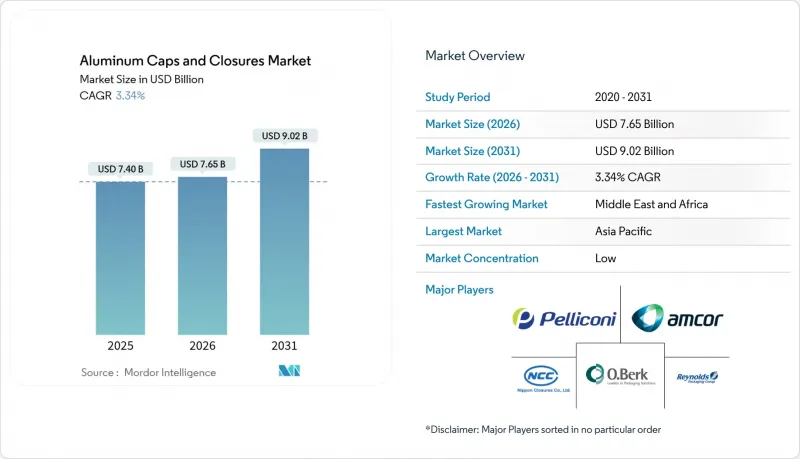
알루미늄 뚜껑 및 마개 시장은 2025년 74억 달러에서 2026년에는 76억 5,000만 달러에 이르고, 2026-2031년 CAGR 3.34%로 성장을 지속하여 2031년까지 90억 2,000만 달러에 달할 것으로 예측됩니다.
수요 증가는 폭발적이지 않고 완만한 속도로 진행되고 있습니다. 이는 주요 음료 부문의 보급률이 성숙 단계에 접어들었기 때문입니다. 그러나 고급 주류 분야 수요 증가, 바이오 의약품 포장에 대한 수요 증가, EU의 지속가능성 규제 강화로 인해 수익성 높은 틈새 시장이 계속 개척되고 있습니다. 유럽의 뚜껑 고정 규제 의무화, 중국의 재활용 알루미늄 사용 장려 정책, 북미의 고급 레디 투 드링크 제품으로의 전환은 브랜드 소유주들에게 기능성과 미적 가치를 향상시킨 뚜껑 재설계를 촉구하고 있습니다. 런던금속거래소(LME) 가격 변동으로 인해 컨버터의 수익률이 압박을 받고 있지만, 무한히 재활용 가능한 소재에 대한 수요 증가는 여전히 코르크, 철강, 플라스틱보다 알루미늄을 우선시하는 요인으로 작용하고 있습니다. 특히 아시아태평양의 추가적인 재활용 능력은 원자재 가격 변동을 상쇄하는 동시에 프리미엄 부문을 저가의 PET 대체재로부터 분리하는 데 기여하고 있습니다.
세계 알루미늄 뚜껑 및 마개 시장 동향 및 인사이트
북미에서 프리미엄 RTD 칵테일용 알루미늄 병의 부상
프리미엄 RTD 칵테일 브랜드는 2024년까지 알루미늄 병을 도입해 고급스러운 포지셔닝을 내세우면서도 재활용성을 유지했습니다. 여러 브랜드가 기존 캔 대비 40-60%의 가격 프리미엄을 기록해 소비자들이 촉감의 견고함과 재밀봉 기능성을 중요하게 여기는 것을 알 수 있습니다. 알루미늄의 장벽 성능은 식물성 추출물을 자외선과 산소로부터 보호하고, 증류주 기반 배합물의 보존 기간을 연장시켜 줍니다. 환경보호단체와의 협업을 통해 지속가능성에 대한 신뢰성을 강화하고, 소형 스틸캔이나 페트병으로는 실현할 수 없는 마케팅 효과를 창출하고 있습니다. 이러한 현상은 유럽 여행 소매 시장에도 영향을 미치고 있으며, 단품 판매용 주류는 변조 방지 기능을 갖춘 세련된 용기를 요구하고 있습니다.
EU 음료 포장에 테더 뚜껑 의무화(지침 2019/904)
2024년 7월부터 EU 역내 식수 병에 테더 뚜껑을 의무적으로 사용하도록 규정되어 탄산음료와 생수 분야에서 재설계 움직임이 활발해지고 있습니다. 초기에는 플라스틱 테더 시스템에 대한 소비자의 반발이 있었으나, 프리미엄 미네랄 워터 및 주스 브랜드는 경첩이 내장된 알루미늄 소재의 스크류 뚜껑을 채택하는 방향으로 전환하였습니다. 알루미늄은 무한한 재활용이 가능하고, 자원 회수 시설에서 쉽게 분리할 수 있는 특성으로 인해 브랜드 소유자는 테더뚜껑 규제와 향후 도입 예정인 금속 회수율 90% 목표를 모두 충족할 수 있습니다. 다국적 기업들은 라인 변경에 따른 복잡성을 피하기 위해 비EU 시장에서의 포장 포맷 통일을 추진하고 있으며, 부가가치가 높은 알루미늄 뚜껑에 대한 단기적인 수요를 확대하고 있습니다.
변동하는 LME 알루미늄 가격, 컨버터의 수익률 압박
알루미늄 잉곳 가격은 2025년 2월 톤당 2,662달러로 6개월 동안 15% 이상 변동했습니다. 장기 고정 계약으로 판매하는 컨버터 업체들은 압박을 받고 있습니다. 헤지 프로그램을 갖추지 못한 중소형 뚜껑 제조업체들은 수익률 하락에 직면하고 있으며, 고도의 리스크 관리 부문을 보유한 다국적 기업에게 매력적인 인수 대상이 되고 있습니다. 러시아의 수출 불확실성, 유럽의 제련 전력 비용 상승, 미국의 새로운 컨테이너 관세 등이 이러한 변동성을 증폭시키고 있습니다. 공급을 안정화하기 위해 주요 컨버터는 재활용 재료 비율을 높이고 스크랩 저항성이 높은 합금 레시피를 검토하고 있으며, 이는 탄소 감축 약속에 부합하는 노력이지만 소둔로 업그레이드에 대한 자본 지출이 필요합니다.
부문 분석
스크류 뚜껑은 음료, 조미료, 의약품 분야에 광범위하게 채택되어 2025년 50.74%의 점유율로 우위를 유지했습니다. 이 점유율은 2025년 알루미늄 뚜껑 및 마개 시장 규모에서 미화 37억 5,000만 달러에 해당하며, 이는 알루미늄 뚜껑 및 마개의 견고한 밀봉 신뢰성을 반영합니다. 이지 오픈 엔드는 규모는 작지만, 캔 커피와 레토르트 식품의 편의 기능에 대한 소비자의 관심이 높아지면서 2031년까지 연평균 6.38%의 가장 빠른 성장세를 보일 것으로 예측됩니다. 연속 나사식 ROPP 뚜껑은 변조 방지성과 고급스러운 시각적 요소를 모두 갖추고 있어 크래프트 스피릿 시장에서 확고한 입지를 구축하고 있습니다. 크라운 코르크는 전통적인 맥주 포장에서 여전히 중요하지만, 슬림 캔으로의 전환이 진행됨에 따라 그 성장은 완만하게 성장하고 있습니다. 러그 뚜껑, 프레스 트위스트 뚜껑, 특수 플립 오프 디자인은 변조에 민감한 식품 및 의약품 용도에 대응하여 범용형에서 용도 특화형 솔루션으로의 부문 변화를 보여주고 있습니다.
보다 안전하고 손가락이 편한 이지 오픈 탭을 구현하는 다이컷 스코어링 기술에 대한 투자가 진행되어 노인용 영양음료 등 새로운 대중 시장을 개척하고 있습니다. 또한, 뚜껑 제조업체는 장식 공간을 손상시키지 않고 추적성을 지원하는 레이저 각인 QR 코드를 통합하여 뚜껑을 제작합니다. 이러한 장식 요소는 단위당 경제성이 높아 원자재 가격 상승 시 이익률을 완충하는 역할을 합니다. 한편, 표준 스크류 뚜껑 형태가 상품화되면서 제조업체들은 pH가 높은 음료의 유통기한을 연장하는 라이너 화학물질의 개선으로 차별화를 꾀하고 있습니다.
2025년 기준 음료 분야는 알루미늄 뚜껑 및 마개 시장의 46.02%(34억 1,000만 달러 상당)를 차지했습니다. 이 부문에는 생수, 탄산음료, 맥주, 와인, 프리미엄 증류주가 포함되며, 각 제품마다 고유한 마감 요건이 있습니다. 프리미엄 알코올 제조업체는 알루미늄을 브랜딩 캔버스로 활용하고, 탄산음료 충전업체는 EU의 테더 규제에 대한 최저 비용 준수를 추구하고 있습니다. 제약 분야 수요는 연평균 6.76% 성장하여 2031년까지 2억 8,400만 달러의 부가가치를 창출할 것으로 예측됩니다. 이러한 성장은 무균 상태를 보장하는 플립 오프 파단 씰을 지정하는 생물학적 제제의 신제품 출시에 힘입은 바 있습니다. 식품 용도는 안정적인 수요를 유지하고 있으며, 부드러운 주입 제어를 위해 금속 러그 뚜껑을 채택한 고급 식용유와 소스가 견인차 역할을 하고 있습니다. 퍼스널케어 브랜드들은 알루미늄의 재활용 가능성을 강조하며 복합소재 뚜껑을 대체하는 움직임을 보이고 있습니다. 재활용이 가능한 알루미늄 에어로졸 용기를 사용한 데오도란트 제품의 출시가 그 증거다.
산업 전반의 학습이 혁신을 가속화하고 있습니다. 음료 캔 공급업체는 화장품 회사와 협력하여 로션 호환성을 고려한 내부 바니시를 개선하여 대응 가능한 시장을 확대하고 있습니다. 산업용 화학물질용 클로저는 틈새 시장이지만, 특수 라이너와 결합하여 알루미늄의 내식성을 활용하고 있습니다. 다양한 용도의 다재다능함이 균형 잡힌 포트폴리오 구축을 지원하며, 특정 부문의 경기 순환에 따른 하락을 헤지하고 있습니다.
알루미늄 뚜껑 및 마개 시장은 뚜껑 유형별(스크류 뚜껑, 크라운 뚜껑, 크라운 코르크, 러그/프레스트 트위스트 등), 용도별(음료, 식품, 의약품, 화장품 및 퍼스널케어 등), 넥 마감 직경별(20mm 이하, 21-30mm 등), 유통 경로별(직접 채널, 간접 채널), 지역별 직접 판매 채널, 간접 판매 채널), 지역별로 분류됩니다. 시장 규모와 예측은 금액 기준(USD)으로 제시됩니다.
지역별 분석
아시아태평양은 중국의 풍부한 음료 생산량과 인도의 포장 제품 확대에 힘입어 2025년 세계 매출의 40.20%를 차지할 것으로 예측됩니다. 2024년 11월 중국이 수입 재생 알루미늄에 대한 관세를 철폐함에 따라 원가 경쟁력이 향상되어 제련소가 1차 금속보다 할인된 가격으로 코일을 공급할 수 있게 되었습니다. 일본과 한국은 기술적 고도화를 가져왔고, 지역 내 뚜껑 프레스기 및 비전 검사 시스템을 수출하고 있습니다. 동남아시아 수요는 도시화와 서유럽 패스트푸드 체인의 변조 방지 뚜껑에 대한 요구로 인해 현지 뚜껑 변환 라인이 활성화되었습니다. 인도에서는 식용유 포장에 대한 QR코드 추적 의무화에 따른 표준 향상으로 프리미엄 러그뚜껑의 가치 점유율이 확대되고, 외자 합작기업의 진입을 촉진하고 있습니다.
중동 및 아프리카은 가장 빠르게 성장하는 시장으로 2031년까지 연평균 복합 성장률(CAGR) 6.89%를 나타낼 것으로 예측됩니다. 나이지리아와 케냐의 음료 투자와 걸프만 국가의 담수화 생수 생산 능력이 수요를 뒷받침하고 있습니다. 그러나 순환 경제 인프라의 부족은 알루미늄 뚜껑 클로저 시장의 침투를 억제하고 있습니다. 이집트가 식품 등급 전용 재활용 공장 설립을 추진하고 있는 것은 진전이지만, 경제적으로 지속 가능한 회수 경로의 확립이 널리 보급되기 위한 전제조건입니다. 남아공은 잘 구축된 알루미늄 제련 기반과 항만 연결성으로 인해 내륙 국가로의 수출 기회를 창출하고 있습니다.
유럽 시장은 성숙한 시장이지만, 규제가 세계 사양을 주도하고 있기 때문에 여전히 매우 중요합니다. 2024년 7월 고정 뚜껑 의무화 기한으로 인해 충전업체는 PET 용기와 알루미늄 용기를 동시에 재설계해야 하며, 뚜껑 전문 제조업체에 엔지니어링 컨설팅 수익을 가져다주었습니다. 독일 기계공학 클러스터는 통합 토크 모니터링 기능을 갖춘 분당 600개의 연속 나사산 나사 뚜껑 기계를 개발하여 성능 기준을 높였습니다. 이탈리아의 한 디자인 회사는 고급 술에 엠보싱과 컬러 시프트 잉크를 맞춤 제작하여 지속가능성 측면에서 코르크에서 알루미늄으로 전환하는 와중에도 고급스러움을 유지하고 있습니다.
북미 시장은 재밀봉이 가능한 알루미늄 병에 담긴 크래프트 음료와 바로 마실 수 있는 칵테일로의 소비자 전환에 힘입어 성장하고 있습니다. 2025년 4월에 발동된 미국의 관세 장벽은 국내 캔 소재 생산을 촉진하고, 공급 부족으로 인한 국내 회귀를 유도하여 뚜껑용 코일 제조업체를 간접적으로 지원했습니다. 주요 맥주 수출국인 멕시코에서는 비용과 공급 리스크의 균형을 맞추기 위해 알루미늄과 스틸 뚜껑 소재를 함께 사용하고 있습니다. 그러나 유럽향 고급 병 라인에서는 알루미늄 뚜껑이 일정한 지위를 유지하고 있습니다. 브라질을 중심으로 남미에서는 자체 뚜껑 제조 모듈을 갖춘 새로운 음료 캔 라인에 대한 투자가 진행되어 리드 타임을 단축하고 있습니다.
기타 특전:
- 엑셀 형식 시장 예측(ME) 시트
- 애널리스트의 3개월간 지원
자주 묻는 질문
목차
제1장 서론
제2장 조사 방법
제3장 주요 요약
제4장 시장 구도
제5장 시장 규모와 성장 예측
제6장 경쟁 구도
제7장 시장 기회와 향후 전망
LSH 26.03.10The aluminium caps and closures market is expected to grow from USD 7.40 billion in 2025 to USD 7.65 billion in 2026 and is forecast to reach USD 9.02 billion by 2031 at 3.34% CAGR over 2026-2031.
Demand growth is paced, not explosive, because penetration in core beverage segments is mature; however, upgrades in premium spirits, biologics packaging, and EU sustainability rules continue to open profitable niches. Mandatory tethered-cap regulations in Europe, recycled-aluminium incentives in China, and a shift toward premium ready-to-drink offerings in North America are prompting brand owners to redesign closures with higher functional and aesthetic value. Volatility in London Metal Exchange (LME) pricing tightens converter margins, yet the push for infinitely recyclable materials still tilts preference toward aluminium over cork, steel, or plastic. Regional cost advantages particularly additional recycled capacity in Asia-Pacific are helping offset raw-material swings while keeping premium segments insulated from low-cost PET alternatives.
Global Aluminum Caps And Closures Market Trends and Insights
Rise of Premium RTD-Cocktail Aluminium Bottling in North America
Premium ready-to-drink cocktail brands introduced aluminium bottles throughout 2024 to signal upscale positioning while retaining recyclability. Several brands recorded 40-60% price premiums versus conventional cans, indicating consumers value tactile rigidity and re-close functionality. The barrier performance of aluminium protects botanical extracts from UV light and oxygen, supporting shelf life for spirit-based formulations. Brand collaborations with environmental non-profits reinforce sustainable credentials, creating a marketing halo that smaller steel or PET formats cannot match. The phenomenon is spilling into European travel-retail channels where single-serve spirits require tamper-evident yet elegant closures.
Mandatory Transition to Tethered Caps in EU Beverage Packaging (Directive 2019/904)
Since July 2024, EU beverage bottles must feature tethered closures, sparking redesign activity across carbonated soft drink and water segments.Early consumer pushback against plastic tethered systems led premium water and juice brands to adopt aluminium screw-top variants with integrated hinge mechanisms. Because aluminium is infinitely recyclable and easily detached in material-recovery facilities, brand owners meet both tethered-cap rules and forthcoming 90% metal-collection targets. Multinationals are harmonizing pack formats across non-EU markets to avoid line-change complexity, magnifying near-term demand for value-added aluminium closures.
Volatile LME Aluminium Prices Compressing Converter Margins
Aluminium ingot reached USD 2,662 per ton in February 2025, swinging more than 15% within six months and squeezing converters that sell on long-term fixed contracts. Smaller closure firms without hedging programs face eroded margins, making them attractive acquisition targets for multinationals with advanced risk-management desks. Russian export uncertainty, elevated European smelting power costs, and new US container duties all amplify volatility. To stabilize supply, leading converters raise recycled content and explore alloy recipes with higher scrap tolerance, an approach aligned with carbon-reduction pledges yet requiring capital spend on upgraded annealing furnaces.
Other drivers and restraints analyzed in the detailed report include:
- Beverage-Grade Recycled Aluminium Capacity Expansions in China
- Pharma Shift to Flip-Off Tear-Down Aluminium Seals for Biologics
- Brand-Owner Switch to PET Tethered Caps in Carbonated Soft Drinks
For complete list of drivers and restraints, kindly check the Table Of Contents.
Segment Analysis
Screw caps retained dominance with 50.74% share in 2025 as they span beverages, condiments, and pharmaceuticals. That share equals USD 3.75 billion of the aluminium caps and closures market size in 2025, reflecting their proven sealing reliability. Easy-open ends, while smaller, are gaining fastest at a 6.38% CAGR through 2031 as consumers gravitate toward convenience features in canned coffee and ready meals. Continuous-thread ROPP variants secure traction in craft spirits because they reconcile tamper evidence with luxury visual cues. Crown corks hold relevance in traditional beer packaging, yet their growth is modest given the migration toward full-body slim cans. Lug, press-twist, and specialized flip-off designs serve tamper-sensitive food and pharma uses, illustrating the segmentation's shift from generalist to application-specific solutions.
Investment is flowing into die-cutting and scoring technologies that create safer, finger-friendly easy-open tabs, unlocking new mass channels like senior-nutrition beverages. Closure makers are also integrating laser-etched QR codes for trace-and-trace compliance without compromising decoration space. These embellishments carry higher unit economics, cushioning margins when raw-material costs rise. In contrast, standard screw-cap formats face commoditization, pressing manufacturers to differentiate through liner chemistry improvements that extend shelf life in aggressive-pH drinks.
Beverages commanded 46.02% share in 2025, equivalent to USD 3.41 billion of the aluminium caps and closures market. The segment covers still water, carbonated drinks, beer, wine, and premium spirits, each with nuanced closure needs. Premium alcohol producers elevate aluminium as a branding canvas, whereas carbonated soft-drink fillers chase lowest cost compliance to EU tethering. Pharmaceutical demand is expanding at a 6.76% CAGR, adding USD 284 million incremental value by 2031. Growth rests on biologic drug launches that specify flip-off tear-down seals to ensure sterile integrity. Food applications remain steady, propelled by gourmet oils and sauces pursuing metal lug caps for smooth pour control. Personal-care brands leverage aluminium's recyclability story to displace mixed-material lids, evidenced by high-profile deodorant launches in recyclable aluminium aerosols.
Cross-sector learning accelerates innovation: beverage can suppliers partner with personal-care companies to adapt internal varnishes for lotion compatibility, broadening addressable markets. Industrial chemical closures, though niche, benefit from aluminium's corrosion resistance when combined with specialty liners. The versatility across end-uses supports balanced portfolio exposure, hedging against cyclical dips in any one sector.
Aluminum Caps and Closures Market is Segmented by Cap Type (Screw Caps, Crown Cork, Lugs/Press Twist, and More), Application (Beverages, Food, Pharmaceutical, Cosmetics and Personal Care, and More), Neck Finish Diameter ( Less Than and Equal To 20mm, 21-30mm, and More), Distribution Channel (Direct Sales Channels, and Indirect Sales Channels) and Geography. The Market Sizes and Forecasts are Provided in Terms of Value (USD).
Geography Analysis
Asia-Pacific anchored 40.20% of global revenue in 2025, driven by China's prolific beverage output and India's packaged-goods expansion. Cost competitiveness improved after November 2024 when China abolished tariffs on imported recycled aluminium, enabling mills to supply coil at discounts versus primary metal. Japan and South Korea added a layer of technological sophistication, exporting closure presses and vision-inspection systems regionally. Southeast Asian demand benefitted from urbanization and Western quick-service restaurant chains insisting on tamper-proof lids, stimulating local cap conversion lines. India's standards upgrade mandating QR traceability for edible-oil packs nudged value share toward premium lug caps, attracting foreign joint ventures.
The Middle East and Africa represent the fastest-growing territory, forecast at 6.89% CAGR through 2031. Beverage investments in Nigeria and Kenya, plus desalinated bottled-water capacity in the Gulf, underpin volume. However, limited circular-economy infrastructure tempers aluminium caps and closures market penetration. Egypt's move to establish a dedicated food-grade recycling mill marks progress, yet widespread adoption awaits proof of economically viable collection streams. South Africa's established aluminium smelter base and port connectivity create export opportunities into landlocked neighbors.
Europe, though mature, remains pivotal because regulation steers global specifications. The July 2024 tethered-cap deadline forced fillers to redesign PET and aluminium containers simultaneously, generating engineering consulting revenue for closure specialists. Germany's mechanical-engineering cluster pioneered continuous-thread screw-top machines capable of 600 cpm with integrated torque monitoring, raising performance benchmarks. Italy's design houses customized embossing and color-shift inks for premium spirits, preserving perceived luxury even as closures migrate from cork to aluminium for sustainability reasons.
North America's market rides consumer migration to craft beverages and ready-to-drink cocktails packaged in resealable aluminium bottles. US tariff barriers imposed in April 2025 boosted domestic can-stock production, indirectly supporting closure coil producers by tightening local supply and encouraging reshoring. Mexico, a major beer exporter, toggles between aluminium and steel closure options to balance cost and supply risk, yet aluminium retains a foothold in premium bottle lines destined for European customers. South America, led by Brazil, invests in new beverage can lines that include in-house closure modules, shortening lead times.
- Amcor plc
- Crown Holdings Inc.
- Silgan Holdings Inc.
- Guala Closures S.p.A
- Tecnocap Group
- Pelliconi and C. SpA
- Nippon Closures Co. Ltd
- Closure Systems International (CSI)
- Berlin Packaging LLC
- Bericap GmbH
- AptarGroup Inc.
- SKS Bottle and Packaging Inc.
- Hicap Closures Co. Ltd
- Federfin Tech SRL
- Rauh GmbH & Co.
- O.Berk Company
- The Cary Company
- Alutop SAS
- Shandong Lipeng Co. Ltd
- Idea Cap SRL
- Easy Open Lid Industry Corp. (Yiwu)
- RPC Group (PET Power)
Additional Benefits:
- The market estimate (ME) sheet in Excel format
- 3 months of analyst support
TABLE OF CONTENTS
1 INTRODUCTION
- 1.1 Study Assumptions and Market Definition
- 1.2 Scope of the Study
2 RESEARCH METHODOLOGY
3 EXECUTIVE SUMMARY
4 MARKET LANDSCAPE
- 4.1 Market Overview
- 4.2 Market Drivers
- 4.2.1 Rise of Premium RTD-Cocktail Aluminium Bottling in North America
- 4.2.2 Mandatory Transition to Tethered Caps in EU Beverage Packaging (Directive 2019/904)
- 4.2.3 Beverage-Grade Recycled Aluminium Capacity Expansions in China
- 4.2.4 Pharma Shift to Flip-Off Tear-Down Aluminium Seals for Biologics
- 4.2.5 Craft Spirits Migration from Cork to Aluminium ROPP in Europe
- 4.2.6 E-commerce Leakage-Testing Protocols Driving Lug Cap Adoption in India
- 4.3 Market Restraints
- 4.3.1 Volatile LME Aluminium Prices Compressing Converter Margins
- 4.3.2 Brand-Owner Switch to PET Tethered Caps in Carbonated Soft Drinks
- 4.3.3 Tin-Free Steel Crown Cork Substitution in Mexican Beer
- 4.3.4 Limited Food-Grade Recycling Streams in Middle East
- 4.4 Supply-Chain Analysis
- 4.5 Technological Outlook
- 4.6 Regulatory Outlook
- 4.7 Porter's Five Forces Analysis
- 4.7.1 Bargaining Power of Suppliers
- 4.7.2 Bargaining Power of Buyers
- 4.7.3 Threat of New Entrants
- 4.7.4 Intensity of Competitive Rivalry
- 4.7.5 Threat of Substitutes
5 MARKET SIZE AND GROWTH FORECASTS (VALUE)
- 5.1 By Cap Type
- 5.1.1 Screw Caps
- 5.1.2 Crown Cork
- 5.1.3 Lug / Press-Twist
- 5.1.4 Easy-Open End
- 5.1.5 Roll-On Pilfer Proof (ROPP)
- 5.1.6 Others (Flip-Off, Tear-Down)
- 5.2 By Application
- 5.2.1 Beverages
- 5.2.1.1 Alcoholic Beverages
- 5.2.1.2 Non-Alcoholic Beverages
- 5.2.2 Food
- 5.2.3 Pharmaceutical
- 5.2.4 Cosmetics and Personal Care
- 5.2.5 Industrial and Household Chemicals
- 5.2.1 Beverages
- 5.3 By Neck Finish Diameter
- 5.3.1 Less than and Equal to 20 mm
- 5.3.2 21-30 mm
- 5.3.3 31-40 mm
- 5.3.4 More than 40 mm
- 5.4 By Distribution Channels
- 5.4.1 Direct Sales Channels
- 5.4.2 Indirect Sales Channels
- 5.5 By Region
- 5.5.1 North America
- 5.5.1.1 United States
- 5.5.1.2 Canada
- 5.5.1.3 Mexico
- 5.5.2 Europe
- 5.5.2.1 Germany
- 5.5.2.2 France
- 5.5.2.3 Italy
- 5.5.2.4 United Kingdom
- 5.5.2.5 Spain
- 5.5.2.6 Rest of Europe
- 5.5.3 Asia-Pacific
- 5.5.3.1 China
- 5.5.3.2 Japan
- 5.5.3.3 India
- 5.5.3.4 South Korea
- 5.5.3.5 ASEAN
- 5.5.3.6 Rest of Asia-Pacific
- 5.5.4 South America
- 5.5.4.1 Brazil
- 5.5.4.2 Argentina
- 5.5.4.3 Rest of South America
- 5.5.5 Middle East and Africa
- 5.5.5.1 Middle East
- 5.5.5.1.1 GCC
- 5.5.5.1.2 Turkey
- 5.5.5.1.3 Rest of Middle East
- 5.5.5.2 Africa
- 5.5.5.2.1 South Africa
- 5.5.5.2.2 Kenya
- 5.5.5.2.3 Rest of Africa
- 5.5.5.1 Middle East
- 5.5.1 North America
6 Competitive Landscape
- 6.1 Market Concentration
- 6.2 Strategic Moves
- 6.3 Market Share Analysis
- 6.4 Company Profiles {(includes Global level Overview, Market level overview, Core Segments, Financials as available, Strategic Information, Market Rank/Share for key companies, Products and Services, and Recent Developments)}
- 6.4.1 Amcor plc
- 6.4.2 Crown Holdings Inc.
- 6.4.3 Silgan Holdings Inc.
- 6.4.4 Guala Closures S.p.A
- 6.4.5 Tecnocap Group
- 6.4.6 Pelliconi and C. SpA
- 6.4.7 Nippon Closures Co. Ltd
- 6.4.8 Closure Systems International (CSI)
- 6.4.9 Berlin Packaging LLC
- 6.4.10 Bericap GmbH
- 6.4.11 AptarGroup Inc.
- 6.4.12 SKS Bottle and Packaging Inc.
- 6.4.13 Hicap Closures Co. Ltd
- 6.4.14 Federfin Tech SRL
- 6.4.15 Rauh GmbH & Co.
- 6.4.16 O.Berk Company
- 6.4.17 The Cary Company
- 6.4.18 Alutop SAS
- 6.4.19 Shandong Lipeng Co. Ltd
- 6.4.20 Idea Cap SRL
- 6.4.21 Easy Open Lid Industry Corp. (Yiwu)
- 6.4.22 RPC Group (PET Power)
7 Market Opportunities and Future Outlook
- 7.1 White-Space and Unmet-Need Assessment