

|
시장보고서
상품코드
1940627
멸균 의료용 포장 : 시장 점유율 분석, 업계 동향과 통계, 성장 예측(2026-2031년)Sterile Medical Packaging - Market Share Analysis, Industry Trends & Statistics, Growth Forecasts (2026 - 2031) |
||||||
 Mordor Intelligence
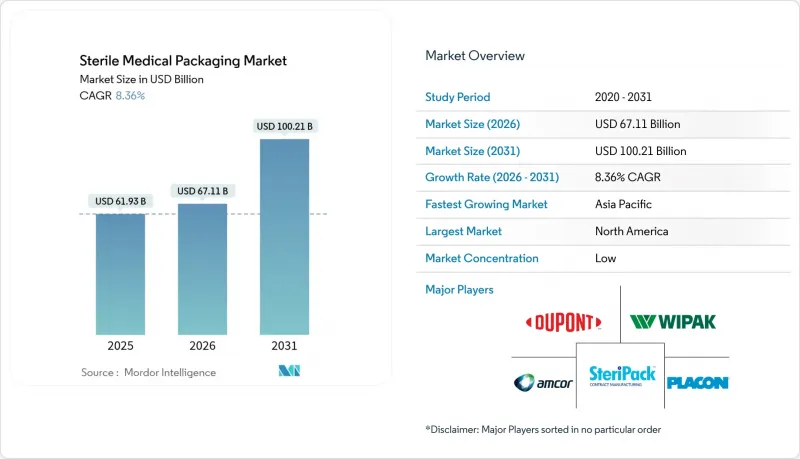
멸균 의료용 포장 시장은 2025년 619억 3,000만 달러에서 2026년에는 671억 1,000만 달러에 이르고, 2026-2031년 CAGR 8.36%로 성장을 지속하여 2031년까지 1,002억 1,000만 달러에 달할 것으로 예측됩니다.
이러한 확장은 무공해 약물 투여로의 결정적인 전환, 세계 표준의 강화, 그리고 급속한 재료 혁신을 반영합니다. 수술 건수 증가, 바이오 의약품 파이프라인의 확대, 일회용 기기로의 전환이 수요를 가속화하는 한편, 에틸렌옥사이드 배출 규제 강화로 인해 제조업체들은 다양한 멸균 방법으로 전환해야 하는 상황에 직면해 있습니다. 디지털 검증 도구, 리스크 기반 품질 시스템, AI 기반 검사 플랫폼은 생산 경제성과 경쟁 전략을 재구축하고 있습니다. 동시에, 지속가능성에 대한 요구는 공급업체에게 고배리어성 재활용 가능 기판의 개발을 요구하고 있으며, 수지 가격의 변동과 재생재 함량 관련 법규는 비용과 기술적 복잡성을 증가시키고 있습니다.
세계 멸균 의료용 포장 시장 동향 및 인사이트
엄격한 감염 관리 규정 및 기준
FDA는 2026년 2월까지 품질 관리 시스템 규정을 ISO 13485:2016을 완전히 준수하고, 멸균 의료용 포장 시장 전체에 위험 기반 검증 및 용기 밀폐성 테스트를 의무화할 예정입니다. EMA의 개정된 GMP 부속서 1은 이미 제약회사들이 1차 포장에 대한 재인증을 받도록 유도하고 있으며, 검증된 멸균 배리어 시스템에 대한 프리미엄 수요를 불러일으키고 있습니다. ISO 11607의 개정은 이러한 위험 관리 원칙을 확장하고, 공급업체에 대한 추적성과 디지털 문서화의 통합을 촉진하고 있습니다. 제약 클러스터에 가까운 멸균 허브의 니어쇼어링은 운송 중 노출을 줄이고 감사 대응을 보장한다는 점에서 이러한 규제를 보완합니다. 웨스트 파마슈티컬 서비스(West Pharmaceutical Services)와 같은 초기 도입 기업들은 이러한 강화된 표준을 준수하는 NovaPure 구성품에 대한 주문이 꾸준히 증가하고 있다고 보고하고 있습니다.
수술 건수 및 만성질환 부담 증가
고령화와 최소침습수술의 보급을 배경으로 2024년 전 세계 수술 건수는 12% 증가했습니다. 재사용 가능한 기구에서 일회용 키트로의 전환이 진행되고 있으며, 복잡한 기구 세트에 대한 멸균 포장에 대한 수요가 증가하고 있습니다. 당뇨병 관리는 이러한 추세를 여실히 보여주고 있습니다. 2024년에는 프리필드 인슐린 펜의 채택이 18% 증가할 것으로 예상되며, 가정 내 온도 변화에 견딜 수 있고 무균성을 유지하는 포장이 요구되고 있습니다. 외래 및 재택 치료로의 전환에 따라 개봉 용이성, 변조 방지 기능, 명확한 사용 설명서 설계에 대한 요구가 증가하고 있습니다. 현재 대규모 포장 공장의 67%에서 도입된 AI 기반 육안 검사는 품질 저하 없이 생산량 증가에 대응할 수 있도록 제조업체를 지원하고 있습니다.
수지 가격 변동과 공급망 혼란
2024년, 에너지 가격 급등과 날씨 관련 공급 장애로 폴리에틸렌 가격은 전년 대비 28% 급등했습니다. 중견 포장업체들은 12-15%의 이익률 압박을 받아 안전재고 수준을 높여야 했고, 운전자금에 대한 압박을 받았습니다. 에틸렌산화물 배출 규제 강화로 인해 생산 능력 중단으로 인해 일시적으로 멸균 리드 타임이 연장되어 상황이 더욱 악화되었습니다. 일부 기업은 다년간의 수지 계약을 체결하거나 필름 압출을 수직 통합하여 변동성을 억제하려고 노력했지만, 단기적인 부담 요인은 여전히 남아있습니다. 법규에 따른 재생재 함량 기준치는 원재료 사양을 더욱 불안정하게 만들고, 광범위한 검증이 필요하며, 운전자금을 부풀리고 있습니다.
부문 분석
플라스틱은 2025년 멸균 의료용 포장 시장의 67.62%를 차지할 것으로 예상되며, 폴리프로필렌의 멸균 사이클 저항성과 폴리에틸렌의 펑크 저항성이 시장을 주도할 것으로 예측됩니다. 그러나 종이 및 판지는 병원의 지속가능성 목표와 재활용 가능성에 대한 브랜드 의약품속에 힘입어 9.98%의 연평균 복합 성장률(CAGR)로 이 부문을 주도하고 있습니다. PETG는 수술용 키트의 가시성 향상을 위해 열성형 트레이에서 PVC를 대체하고 있습니다. 증기 멸균과 플라즈마 멸균을 모두 견딜 수 있는 통기성 코팅 기술로 인해 종이 소재 멸균 의료용 포장 시장 규모는 2031년 106억 4,000만 달러에 달할 것으로 예측됩니다. 그러나 재생 소재의 함유는 장벽 성능의 안정성을 복잡하게 만들기 때문에 재료 과학에 대한 광범위한 투자와 추가적인 보존 기간 테스트가 필요합니다. 사용 후 수지를 블리스 터 웹에 통합하는 공급업체는 ISO 11607을 준수하기 위해 고도의 정제 공정을 채택하고 있습니다. 운송 비용 압력으로 인해 유리 사용량은 감소 추세에 있지만, 습기에 민감한 생물학적 제제 분야에서는 유리의 불활성 특성이 무게 증가라는 단점을 능가하는 틈새 수요를 여전히 지원하고 있습니다.
2세대 플라스틱은 공정 내 첨가제에 의한 선별 용이성이 특징이며, 컴플라이언스 대응책으로 떠오르고 있습니다. 이러한 단일 소재 라미네이트는 기존 재활용을 저해하는 접착제를 제거하여 미생물 차단 성능을 유지하면서 EU의 재활용 소재 25% 함유 목표를 달성할 수 있습니다. 그러나 제약사들은 고위험군 비경구 제제에서 여전히 새로운 폴리머를 권장하는 미국 약전 가이드라인을 준수해야 합니다. 수지 공급업체들이 매스밸런스 인증 원료를 투입하는 가운데, 브랜드 소유주들은 포장의 화학 성분을 변경하지 않고도 지속가능성 크레딧을 주장할 수 있게 되었으며, 2027년까지 채택이 확대될 것으로 예상되는 잠정적인 해결책이 되고 있습니다.
2025년 기준, 열성형 트레이는 멸균 의료용 포장 시장에서 28.26%의 점유율을 차지할 것으로 예상되며, 그 강성과 처리 효율성이 높은 것으로 평가받고 있습니다. 멸균 병 및 용기는 12.18%의 연평균 복합 성장률(CAGR)로 성장세가 둔화되는 반면, 무균 이송 위험을 줄이는 블로우-필-씰(blow-fill-seal) 라인이 무균 이송 리스크를 줄여주는 멸균 병 및 용기 부문은 12.18%의 연평균 복합 성장률(CAGR)로 성장세를 보이고 있습니다. 새로운 BFS 모듈은 시설당 연간 최대 1억 7천만 개를 생산할 수 있어 대중시장용 흡입치료에 적합한 규모를 구현할 수 있습니다. 파우치 및 백은 유연한 공급망 경제성을 활용하여 고처리량 수액 및 투석 회로 분야에서 보급이 확대되고 있습니다.
바이알과 앰플은 여전히 주사제 충전의 기본이지만, 즉시 사용 가능한 형식은 유리 탈열원화 터널에 대한 수요를 잠식하고 있습니다. 즉시 사용 가능한 제품 연합(Gerresheimer, Stevanato Group, SCHOTT Pharma)은 모양과 멸균의 표준화를 목표로 충전 및 마감 공정의 효율화를 위해 노력하고 있습니다. 프리필드시린지는 환자 자가투여를 배경으로 연간 22%의 성장세를 보이고 있으며, 자동주사기 대응 팩은 프리미엄 가격을 유지하고 있습니다. 포장재, 뚜껑, 멸균 마개는 여전히 필수적인 보조 재료이며, 불소 수지 필름을 장착한 신형 엘라스토머 마개는 단백질 바이오 의약품의 약물 성분 상호 작용을 줄일 수 있습니다. 모든 형태의 주사기 시스템 관련 멸균 의료용 포장 시장 규모는 2026년 97억 2,000만 달러에서 2031년 169억 6,000만 달러로 확대될 것으로 예상되며, 이는 기기 간 융합이 진행되고 있다는 것을 뒷받침합니다.
멸균 의료용 포장 시장 보고서는 재료 유형(플라스틱, 종이/판지, 유리 등), 제품 유형(보온병/용기, 멸균 병/용기, 파우치/백, 블리스 터 팩 등), 용도(의약품/생물학적 제제, 수술/의료기기 등), 멸균 방법(화학적, 방사선, 열 등), 지역별로 분류되어 있습니다. 지역별로 분류되어 있습니다. 시장 예측은 금액(USD)으로 표시됩니다.
지역별 분석
북미는 엄격한 규제 감독과 풍부한 생물학적 제제 파이프라인을 배경으로 2025년 멸균 의료용 포장 시장 매출의 38.45%를 차지했습니다. 이 지역의 우위는 지속적인 재투자를 통해 유지되고 있습니다. 게레스하이머가 로어에 건설한 1억 8,000만 달러 규모의 산소 하이브리드 용광로는 배출량을 40% 감소시키고 용해로의 생산 능력을 향상시켜 미국 내 주사제용 유리 공급을 보장하고 있습니다. 향후 시행될 FDA의 QMSR(품질관리시스템 보고)에 대응하기 위해 국내 제조업체들은 디지털 문서화를 강화해야 하며, 클라우드 기반 감사 플랫폼의 도입이 진행되고 있습니다. 그러나 수지 가격 변동과 EPA의 에틸렌옥사이드 규제로 인해 운영비용이 상승함에 따라 주요 제약 클러스터에 인접한 지역으로 멸균 능력을 니어쇼어링(near-shoring)하는 것이 촉진되고 있습니다.
아시아태평양은 가장 빠르게 성장하는 지역으로 2031년까지 연평균 복합 성장률(CAGR) 11.42%를 나타낼 것으로 예측되며, 2028년까지 절대 금액 기준으로는 유럽을 능가할 것으로 보입니다. 중국의 NMPA 개혁은 ICH 가이드라인을 준수하고 수출 장벽을 완화하여 장쑤성과 저장성에 신규 투자를 유치하고 있습니다. 암콜의 셀랑고르 코팅 공장은 아시아 최초의 에어나이프 의료용 라인을 구축하여 성숙한 시장으로부터의 기술 이전을 입증하고 있습니다. 인도 제네릭 의약품 거점에서는 수출 확대를 지원하기 위해 블리스 터 포장 및 BFS(Blow Fill Seal) 설비 증설을 추진하고 있으며, IPA 회원사의 67%가 2026년까지 포장 설비 업그레이드를 계획하고 있습니다. 동남아시아(태국, 베트남)는 비용 효율적인 클린룸 인력을 제공하고, 지역 백신 연합에 서비스를 제공하는 위탁 포장업체를 유치하고 있습니다.
유럽은 혁신의 중심지이며, 포장 폐기물 규정(EU 2025/40)에 따라 2030년까지 플라스틱 포장재의 25% 재활용을 의무화하고 있습니다. OEM 제조업체들은 환경 라벨의 우위를 확보하기 위해 재료비 상승을 받아들이고 있으며, Sadpack의 PharmaGuard가 국가 지속가능성 상을 수상한 것이 이를 증명하고 있습니다. 독일, 이탈리아, 네덜란드에서는 방사선 처리 능력을 확대하여 에틸렌옥사이드(EO) 공급 부족을 보완하고 있습니다. 폴란드 등 동유럽 국가들은 EU의 의약품 수요에 근접하면서도 서유럽의 높은 인건비 부담을 피할 수 있어 라벨 인쇄 및 파우치 가공의 오버플로우 거점으로 부상하고 있습니다.
기타 특전:
- 엑셀 형식 시장 예측(ME) 시트
- 애널리스트 지원(3개월)
자주 묻는 질문
목차
제1장 서론
제2장 조사 방법
제3장 주요 요약
제4장 시장 구도
제5장 시장 규모와 성장 예측
제6장 경쟁 구도
제7장 시장 기회와 향후 전망
LSH 26.03.10The sterile medical packaging market is expected to grow from USD 61.93 billion in 2025 to USD 67.11 billion in 2026 and is forecast to reach USD 100.21 billion by 2031 at 8.36% CAGR over 2026-2031.
This expansion reflects a decisive move toward contamination-free drug delivery, tighter global standards, and rapid material innovation. Heightened surgical volumes, growing biologics pipelines, and the migration to single-use devices are accelerating demand, while stricter emission rules for ethylene oxide are steering manufacturers toward diversified sterilization methods. Digital validation tools, risk-based quality systems, and AI-driven inspection platforms are reshaping production economics and competitive strategy. At the same time, sustainability mandates are pressuring suppliers to engineer high-barrier recyclable substrates, even as resin price volatility and recycled-content legislation add cost and technical complexity.
Global Sterile Medical Packaging Market Trends and Insights
Stringent Infection-Control Regulations and Standards
The FDA will fully align its Quality Management System Regulation with ISO 13485:2016 by February 2026, making risk-based validation and container-closure integrity testing mandatory across the sterile medical packaging market. EMA's revised GMP Annex 1 is already compelling pharmaceutical firms to requalify primary packs, spurring premium demand for validated sterile barrier systems. ISO 11607 amendments extend these risk-management principles, encouraging suppliers to embed traceability and digital documentation. Near-shoring of sterilization hubs close to pharma clusters complements these rules by cutting transit exposures and ensuring audit readiness. Early adopters like West Pharmaceutical Services report stronger order books for NovaPure components that conform to these upgraded standards.
Rise in Surgical Volumes and Chronic Disease Burden
Global procedure counts climbed 12% in 2024, led by aging populations and greater access to minimally invasive surgery. Single-use kits are replacing reusables, multiplying sterile pack demand for complex instrument sets. Diabetes management illustrates the trend: prefilled insulin pen uptake grew 18% in 2024, requiring packs that resist household temperature swings while safeguarding sterility. The shift to outpatient and home settings intensifies design needs for easy-open formats, tamper evidence, and clear instructions. AI-based visual inspection, now operating in 67% of large packaging plants, helps producers keep pace with rising volume without compromising quality.
Volatile Resin Pricing and Supply-Chain Shocks
Polyethylene costs jumped 28% year-over-year in 2024 on energy price spikes and weather-related disruptions. Mid-tier packagers saw 12-15% margin squeeze and were forced to raise safety-stock levels, tying up working capital. Ethylene-oxide emission curbs worsened the picture, as capacity shutdowns briefly raised sterilization lead times. Some firms locked multiyear resin contracts or vertically integrated film extrusion to tame volatility, yet exposure remains a near-term drag. Legislated recycled-content thresholds further destabilize raw-material specifications, demanding extensive validation that inflates working capital.
Other drivers and restraints analyzed in the detailed report include:
- Boom in Biologics and Injectables Needing High-Integrity Packs
- Rapid Material Innovations in High-Barrier Recyclable Plastics and Papers
- Multi-Jurisdiction Regulatory Complexity and Compliance Costs
For complete list of drivers and restraints, kindly check the Table Of Contents.
Segment Analysis
Plastics delivered 67.62% sterile medical packaging market share in 2025, led by polypropylene's sterility-cycle tolerance and polyethylene's puncture resistance. Paper and paperboard, however, are pacing the segment at a 9.98% CAGR, pushed by hospital sustainability targets and brand commitments to recyclability. PETG is replacing PVC in thermoformed trays for clearer visualization of surgical kits. The sterile medical packaging market size for paper formats is on track to reach USD 10.64 billion in 2031, enabled by breathable coatings that pass both steam and plasma sterilization. Yet recycled-content inclusion complicates barrier consistency, prompting widespread investment in material science and additional shelf-life testing. Suppliers integrating post-consumer resin into blister webs use advanced purification stages to preserve ISO 11607 compliance. Though glass usage declines amid freight-cost pressures, niche demand persists for moisture-sensitive biologics where glass's inertness still outweighs its weight penalty.
Second-generation plastics featuring in-process additives for easy sorting are emerging as compliance workarounds. These mono-material laminates eliminate adhesives that previously blocked recyclability, allowing converters to achieve EU's 25% recycled-content target while retaining microbial barrier performance. However, pharmaceutical license holders must reconcile these gains with U.S. Pharmacopeia guidelines, which still favor virgin polymers for high-risk parenterals. As resin suppliers roll out mass-balance certified feedstocks, brand owners can claim sustainability credits without altering pack chemistry, an interim solution expected to boost adoption through 2027.
Thermoform trays retained 28.26% share of the sterile medical packaging market in 2025, valued for rigidity and procedural efficiency. The segment's growth is flattening, while sterile bottles and containers are accelerating at a 12.18% CAGR, supported by blow-fill-seal lines that cut aseptic transfer risk. New BFS modules produce up to 170 million units per facility annually, enabling scale suitable for mass-market inhalation therapies. Pouches and bags capitalize on flexible supply-chain economics, finding traction in high-throughput IV fluid and dialysis circuits.
Vials and ampoules still underpin most injectable fills, but ready-to-use formats are cannibalizing glass depyrogenation tunnels. The Alliance for RTU-Gerresheimer, Stevanato Group, and SCHOTT Pharma-aims to standardize geometry and sterilization, smoothing fill-finish operations. Prefilled syringes exhibit 22% annual growth, fueled by patient self-administration, while autoinjector-compatible packs command premium pricing. Wraps, lids, and sterile closures remain essential adjuncts; newer elastomeric stoppers sporting fluoropolymer films mitigate drug-component interactions for proteinaceous biologics. Across formats, the sterile medical packaging market size attached to syringe systems is forecast to expand from USD 9.72 billion in 2026 to USD 16.96 billion in 2031, underscoring device convergence.
The Sterile Medical Packaging Market Report is Segmented by Material Type (Plastics, Paper and Paperboard, Glass, and More), Product Type (Thermoform Trays, Sterile Bottles and Containers, Pouches and Bags, Blister Packs and More), Application (Pharmaceutical and Biologics, Surgical and Medical Instruments and More), Sterilization Method (Chemical, Radiation, Thermal, and More), and Geography. Market Forecasts are in Value (USD).
Geography Analysis
North America generated 38.45% of the sterile medical packaging market revenue in 2025, backed by stringent regulatory oversight and deep biologics pipelines. The region's dominance is maintained through continual reinvestment: Gerresheimer's USD 108 million oxy-hybrid furnace in Lohr cuts emissions 40% and elevates melter capacity, securing glass supply for U.S. injectables. Compliance with the upcoming FDA QMSR compels domestic producers to upgrade digital documentation, supporting the adoption of cloud-hosted audit platforms. Yet resin price swings and EPA EO rules raise operating costs, encouraging near-shoring of sterilization capacity adjacent to major drug clusters.
Asia-Pacific is the fastest-advancing territory, recording an 11.42% CAGR through 2031 and poised to eclipse Europe in absolute value by 2028. China's NMPA reforms, aligning with ICH guidelines, ease export hurdles, attracting greenfield investments in Jiangsu and Zhejiang. Amcor's Selangor coating plant marks the first air-knife healthcare line in Asia, evidence of technology transfer from mature markets. India's generics hub is scaling blister and BFS capacity to support export ambitions; 67% of IPA members plan packaging upgrades by 2026. Southeast Asia-Thailand, Vietnam-offers cost-effective clean-room labor, drawing contract packagers that service regional vaccine alliances.
Europe remains an innovation stronghold, governed by Packaging Waste Regulation (EU) 2025/40 that forces 25% recycled content in plastic packs by 2030. OEMs accept higher material costs to secure eco-label advantages, evidenced by Sudpack's PharmaGuard winning a national sustainability award. Germany, Italy, and the Netherlands are scaling radiation capacity to offset EO bottlenecks. Eastern European states such as Poland are emerging as overflow sites for label printing and pouch converting, benefiting from proximity to EU pharmaceutical demand without the higher wage overhead of Western Europe.
- Amcor plc
- DuPont de Nemours Inc.
- 3M Company
- Nelipak Healthcare Packaging
- Tekni-Plex Inc.
- Oliver Healthcare Packaging
- Wipak Group
- Steripack Group
- Placon Corporation
- Sonoco Products Co.
- Billerud
- Paxxus Inc.
- Charter Next Generation
- Riverside Medical Packaging
- Technipaq Inc.
- DWK Life Sciences
- Sigma Medical Supplies
- Sterimed Holdings
- West Pharmaceutical Services
- WestRock Company
- Gerresheimer AG
- APTAR Group
Additional Benefits:
- The market estimate (ME) sheet in Excel format
- 3 months of analyst support
TABLE OF CONTENTS
1 INTRODUCTION
- 1.1 Study Assumptions and Market Definition
- 1.2 Scope of the Study
2 RESEARCH METHODOLOGY
3 EXECUTIVE SUMMARY
4 MARKET LANDSCAPE
- 4.1 Market Overview
- 4.2 Market Drivers
- 4.2.1 Stringent infection-control regulations and standards
- 4.2.2 Rise in surgical volumes and chronic disease burden
- 4.2.3 Boom in biologics and injectables needing high-integrity packs
- 4.2.4 Rapid material innovations in high-barrier recyclable plastics and papers
- 4.2.5 Near-shoring of "sterilization-as-a-service" hubs near pharma clusters
- 4.2.6 AI-driven container-closure integrity (CCI) inspection and digital twins
- 4.3 Market Restraints
- 4.3.1 Volatile resin pricing and supply-chain shocks
- 4.3.2 Multi-jurisdiction regulatory complexity and compliance costs
- 4.3.3 Legislative push for minimum recycled content risking pack integrity
- 4.3.4 Shortage of ethylene-oxide (EtO) capacity amid emission curbs
- 4.4 Supply-Chain Analysis
- 4.5 Regulatory Landscape
- 4.6 Technological Outlook
- 4.7 Porter's Five Forces Analysis
- 4.7.1 Threat of New Entrants
- 4.7.2 Bargaining Power of Suppliers
- 4.7.3 Bargaining Power of Buyers
- 4.7.4 Threat of Substitutes
- 4.7.5 Industry Rivalry
- 4.8 Pricing Analysis
5 MARKET SIZE AND GROWTH FORECASTS (VALUE)
- 5.1 By Material Type
- 5.1.1 Plastics
- 5.1.1.1 Polypropylene
- 5.1.1.2 Polyethylene
- 5.1.1.3 Polyethylene-terephthalate glycol
- 5.1.1.4 Polyvinyl Chloride
- 5.1.1.5 Polystyrene
- 5.1.1.6 Other Plastics
- 5.1.2 Paper and Paperboard
- 5.1.3 Glass
- 5.1.4 Other Material Types
- 5.1.1 Plastics
- 5.2 By Product Type
- 5.2.1 Thermoform Trays
- 5.2.2 Sterile Bottles and Containers
- 5.2.3 Pouches and Bags
- 5.2.4 Blister Packs
- 5.2.5 Vials and Ampoules
- 5.2.6 Pre-filled Syringes and Inhalers
- 5.2.7 Wraps and Lids
- 5.2.8 Sterile Closures and Stoppers
- 5.3 By Application
- 5.3.1 Pharmaceutical and Biologics
- 5.3.2 Surgical and Medical Instruments
- 5.3.3 In-Vitro Diagnostics (IVD) Kits and Reagents
- 5.3.4 Medical Implants and Disposables
- 5.3.5 Other Applications
- 5.4 By Sterilization Method
- 5.4.1 Chemical
- 5.4.2 Radiation
- 5.4.3 Thermal
- 5.4.4 Low-temperature Plasma and Ozone
- 5.4.5 Aseptic/Filtration-based
- 5.5 By Geography
- 5.5.1 North America
- 5.5.1.1 United States
- 5.5.1.2 Canada
- 5.5.1.3 Mexico
- 5.5.2 Europe
- 5.5.2.1 Germany
- 5.5.2.2 United Kingdom
- 5.5.2.3 France
- 5.5.2.4 Italy
- 5.5.2.5 Spain
- 5.5.2.6 Netherlands
- 5.5.2.7 Russia
- 5.5.2.8 Rest of Europe
- 5.5.3 Asia-Pacific
- 5.5.3.1 China
- 5.5.3.2 Japan
- 5.5.3.3 India
- 5.5.3.4 South Korea
- 5.5.3.5 Australia and New Zealand
- 5.5.3.6 ASEAN
- 5.5.3.7 Rest of Asia-Pacific
- 5.5.4 Middle East and Africa
- 5.5.4.1 Middle East
- 5.5.4.1.1 Saudi Arabia
- 5.5.4.1.2 United Arab Emirates
- 5.5.4.1.3 Turkey
- 5.5.4.1.4 Rest of Middle East
- 5.5.4.2 Africa
- 5.5.4.2.1 South Africa
- 5.5.4.2.2 Nigeria
- 5.5.4.2.3 Egypt
- 5.5.4.2.4 Rest of Africa
- 5.5.4.1 Middle East
- 5.5.5 South America
- 5.5.5.1 Brazil
- 5.5.5.2 Argentina
- 5.5.5.3 Rest of South America
- 5.5.1 North America
6 COMPETITIVE LANDSCAPE
- 6.1 Market Concentration
- 6.2 Strategic Moves (M&A, JVs, Capacity Expansions)
- 6.3 Market Share Analysis
- 6.4 Company Profiles (includes Global level Overview, Market level overview, Core Segments, Financials as available, Strategic Information, Market Rank/Share, Products and Services, and Recent Developments)
- 6.4.1 Amcor plc
- 6.4.2 DuPont de Nemours Inc.
- 6.4.3 3M Company
- 6.4.4 Nelipak Healthcare Packaging
- 6.4.5 Tekni-Plex Inc.
- 6.4.6 Oliver Healthcare Packaging
- 6.4.7 Wipak Group
- 6.4.8 Steripack Group
- 6.4.9 Placon Corporation
- 6.4.10 Sonoco Products Co.
- 6.4.11 Billerud
- 6.4.12 Paxxus Inc.
- 6.4.13 Charter Next Generation
- 6.4.14 Riverside Medical Packaging
- 6.4.15 Technipaq Inc.
- 6.4.16 DWK Life Sciences
- 6.4.17 Sigma Medical Supplies
- 6.4.18 Sterimed Holdings
- 6.4.19 West Pharmaceutical Services
- 6.4.20 WestRock Company
- 6.4.21 Gerresheimer AG
- 6.4.22 APTAR Group
7 MARKET OPPORTUNITIES AND FUTURE OUTLOOK
- 7.1 White-space and Unmet-needs Assessment


