|
시장보고서
상품코드
1940634
도금 강판 : 시장 점유율 분석, 업계 동향과 통계, 성장 예측(2026-2031년)Coated Steel - Market Share Analysis, Industry Trends & Statistics, Growth Forecasts (2026 - 2031) |
||||||
 Mordor Intelligence
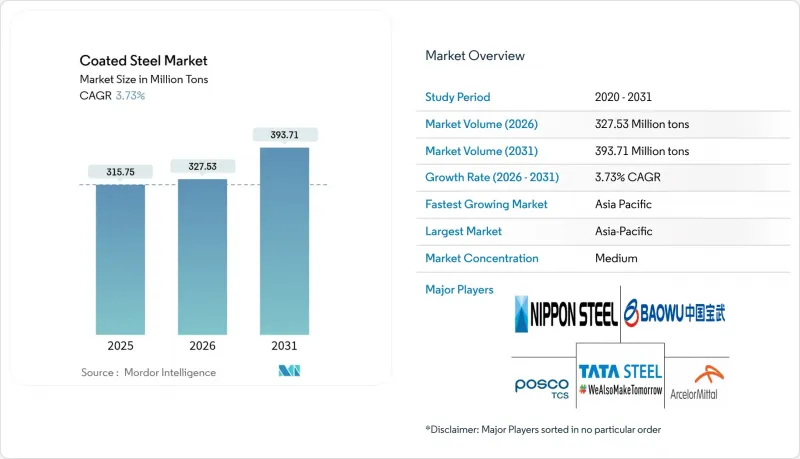
도금 강판 시장은 2025년에 3억 1,575만 톤으로 평가되어 2026년 3억 2,753만 톤에서 2031년까지 3억 9,371만 톤에 이를 것으로 예측됩니다.
예측 기간(2026-2031년)의 CAGR은 3.73%로 예상됩니다.
이러한 성장은 자동차 경량화 프로그램에 따른 견조한 수요, 에너지 절약형 건축 외장재 확대, 주요 생산기지의 지속적인 생산능력 증설을 반영하고 있습니다. 기존 아연 도금 제품에 비해 수명을 연장하는 Zn-Al-Mg 합금 코팅의 상용화가 가속화되면서 이 기세를 더욱 가속화하고 있습니다. 또한, 생산자들은 원자재 가격 변동 위험을 헤지하고 강화되는 탄소 규제에 대응하기 위해 수직계열화와 재생에너지 활용을 통한 운영을 추진하고 있습니다. 무역 구제 조치, 특히 미국의 부식 방지 수입품에 대한 반덤핑 관세는 지역적 공급 흐름을 재구성하는 동시에 국내 투자를 촉진하고 있습니다. 동시에 EU의 탄소국경조정 메커니즘(CBAM)은 제품 내재 배출량 공개를 가속화하여 인증된 저탄소 코팅강이 프리미엄 가격을 받을 수 있도록 하고 있습니다.
세계 도금 강판 시장 동향 및 전망
전기자동차 경량화에 따른 AHSS 기반 코팅강 수요 급증
현재 전기차 제조업체들은 복잡한 성형 공정을 견디고 배터리 인클로저와 충돌 구조물을 보호하는 코팅과 결합된 고강도 강재를 지정하고 있습니다. 아르셀로미탈의 12억 달러 규모의 앨라배마 전기강판 프로젝트는 이러한 추세에 부합하는 전략적 자본 배분을 구현하고 있습니다. Zn-Al-Mg 화학 조성은 레이저 용접식 배터리 팩에 필수적인 엣지 내식성을 제공하여 코팅 AHSS를 기존 자동차 강재와 차세대 모빌리티를 연결하는 가교 역할을 하고 있습니다.
에너지 절약형 건축 외장재에 도장된 코일 채용
냉방 부하 규제에 따라 태양 반사율 0.7 이상, 열방사율 0.8 이상의 도장된 코일의 사용이 촉진되고 있습니다. 아시아개발은행(ADB)의 현지 조사에 따르면, 쿨루프는 열대지역에서 냉방 에너지를 15-20% 절감할 수 있는 것으로 나타났습니다. Kynar 500과 같은 PVDF 기반 코팅은 30년 보증을 제공하고, 수명주기 경제성을 향상시키며, 건설업체가 LEED 및 EU 친환경 설계 기준을 충족할 수 있도록 지원합니다.
아연-알루미늄 가격 변동성
아연 현물 가격은 2024년 말 톤당 25,900위안(전년 대비 19.8% 상승)으로 마감했지만, 광산 가동 중단과 수요 변동으로 인해 2025년 1분기에는 23,370위안까지 하락했습니다. 알루미늄도 비슷한 변동성을 보이고 있으며, 아연-알루미늄-마그네슘 합금 및 알루미늄 도금 라인의 조달을 복잡하게 만들고 있습니다. 비용 전가와 계약의 시차가 겹치는 분야는 수익률 압박이 가장 심각합니다.
부문 분석
2025년 기준 용융아연도금강판은 도금강판 시장 점유율의 63.10%, 약 1억 9,900만 톤을 차지할 것으로 예측됩니다. 2031년까지 연평균 복합 성장률(CAGR) 3.89%가 전통적인 건설, 가전 및 저장 용도의 도금 강판 시장 규모의 기반이 되고 있습니다. 전기아연도금 및 알루미늄 도금 제품은 고정밀 및 고온 용도의 틈새 시장에서 더욱 빠르게 성장하고 있으며, 설비 투자 효율성 측면에서 용융아연도금 라인을 중심으로 생산 능력 확대가 진행되고 있습니다.
코팅강 산업은 '기타' 범주에 속하는 Zn-Al-Mg 합금으로 전환하고 있으며, AM/NS India의 Magnelis는 용융아연도금보다 3-5배 더 긴 내식성을 제공합니다. 제조업체들은 자동차 바디인화이트에 레이저 용접에 적합한 화학적 조성을 통합하고 있으며, 용융아연도금의 생산량이 절대적으로 감소하는 것이 아니라 차세대 코팅으로의 점유율 전환이 점진적으로 진행될 것임을 시사하고 있습니다.
본 "코팅스틸 시장 보고서'는 제품별(용융아연도금, 갈바니, 전기아연도금, 전기아연도금, 알루미늄도금, 기타), 용도별(건축-구조부재, 자동차부품, 가전제품, 파이프-관재, 기타 용도), 지역별(아시아태평양, 북미, 유럽, 남미, 중동 및 아프리카), 지역별(아시아태평양, 북미, 유럽, 남미, 중동 및 아프리카)로 분류되어 있습니다. 분류되어 있습니다. 시장 예측은 수량(톤) 단위로 제공됩니다.
지역별 분석
아시아태평양은 2025년 도금강판 시장 점유율의 61.10%(1억 9,300만 톤 이상)를 차지할 것으로 예상되며, 2031년까지 연평균 4.47%의 연평균 복합 성장률(CAGR)을 보일 것으로 전망됩니다. 중국은 통합 제철소가 다운스트림 라인을 업그레이드하는 데 있어 주도적인 위치에 있으며, 인도, 한국, 일본은 특수 제품을 수출하고 있습니다. 아세안 국가들은 태양광 발전, 물류, 주택 프로젝트를 위한 생산능력을 확대하여 지역 도금강판 시장의 회복력을 높이고 있습니다.
북미는 2위입니다. 미국이 10개국의 내식성 강판에 부과한 반덤핑 관세로 인해 수입 선택의 폭이 좁아지면서 뉴콜의 사우스캐롤라이나주 4억 2,500만 달러 규모의 아연도금 라인과 현대제철의 루이지애나주 58억 달러 규모의 통합 플랜트 등에 대한 투자가 촉진되고 있습니다. 멕시코가 2025년부터 2026년까지 8백만 톤의 생산능력을 추가하면서 니어쇼어링이 강화되고, 이 지역의 코팅강 시장의 균형이 유지되고 있습니다.
유럽에서는 에너지 비용 급등과 CBAM(탄소국경조정기구) 대응이 과제입니다. 생산자는 환경 제품 선언(EPD)을 제시하여 건축 분야에서의 프리미엄 확보와 탄소세 감면을 위해 노력하고 있습니다. 독일, 프랑스, 이탈리아, 영국이 여전히 주요 소비국이지만, 북유럽 제철소는 재생에너지 분야와 선박 분야에 집중하고 있습니다. 순환성과 스크랩 활용에 대한 규제의 확실성이 유럽 도금 강판 시장의 경쟁력을 형성할 것입니다.
기타 특전:
- 엑셀 형식 시장 예측(ME) 시트
- 애널리스트의 3개월간 지원
자주 묻는 질문
목차
제1장 서론
제2장 조사 방법
제3장 주요 요약
제4장 시장 구도
제5장 시장 규모와 성장 예측
제6장 경쟁 구도
제7장 시장 기회와 향후 전망
LSH 26.03.10The Coated Steel Market was valued at 315.75 Million tons in 2025 and estimated to grow from 327.53 Million tons in 2026 to reach 393.71 Million tons by 2031, at a CAGR of 3.73% during the forecast period (2026-2031).
This growth reflects resilient demand from automotive lightweighting programs, expanding energy-efficient building envelopes, and sustained capacity additions in key production hubs. Momentum is reinforced by quicker commercialization of Zn-Al-Mg alloy coatings that extend service life versus conventional galvanized products. Producers are also pursuing vertical integration and renewable-powered operations to hedge raw-material volatility and meet tightening carbon rules. Trade remedies-most notably the United States' anti-dumping duties on corrosion-resistant imports-reshape regional supply flows while favoring domestic investments. At the same time, EU carbon-border pricing accelerates disclosure of embedded emissions, allowing certified low-carbon coated steel to command premiums.
Global Coated Steel Market Trends and Insights
Surging Demand for AHSS-Based Coated Steels in EV Lightweighting
Electric-vehicle producers now specify advanced high-strength steel grades paired with coatings that survive complex forming while protecting battery enclosures and crash structures. ArcelorMittal's USD 1.2 billion Alabama electrical-steel project illustrates strategic capital alignment with this trend. Zn-Al-Mg chemistries offer edge-corrosion resistance crucial for laser-welded battery packs, positioning coated AHSS as a bridge between legacy auto steel and next-generation mobility.
Energy-Efficient Building Envelope Adoption of Pre-Painted Coil
Cooling-load regulations spur use of pre-painted coil achieving solar reflectance above 0.7 and thermal emittance beyond 0.8. Asian Development Bank field work shows cool roofs can cut cooling energy 15-20% in tropical settings. PVDF-based coatings such as Kynar 500 provide 30-year warranties that improve lifecycle economics while helping builders meet LEED and EU Ecodesign thresholds.
Zinc and Aluminum Price Volatility
Spot zinc closed 2024 at RMB 25,900 per ton, up 19.8% year-on-year, before easing to RMB 23,370 in Q1 2025 amid mine disruptions and demand swings. Aluminum shows similar gyrations, complicating procurement for Zn-Al-Mg and aluminized lines. Margin compression is most severe where passing costs downstream meets contract lags.
Other drivers and restraints analyzed in the detailed report include:
- Rapid Rollout of Zn-Al-Mg Alloy Coating Lines in Asia
- Tax-Driven Appliance Replacement Programs (EU and US)
- Aluminum-Composite Facade Substitution
For complete list of drivers and restraints, kindly check the Table Of Contents.
Segment Analysis
Hot-dipped material held 63.10% of coated steel market share in 2025, equating to roughly 199 million tons. Its 3.89% CAGR through 2031 anchors the coated steel market size for traditional construction, appliance, and storage uses. Electro-galvanized and aluminized alternatives grow faster in high-precision or high-temperature niches, but capacity build-outs center on hot-dip lines due to capital efficiency.
The coated steel industry is pivoting toward Zn-Al-Mg alloys classified in the "Others" bucket, where AM/NS India's Magnelis offers 3-5 times galvanized corrosion life. Producers integrate laser-welding-friendly chemistries for auto body-in-white, suggesting hot-dipped volume will gradually cede mix share to next-generation coatings rather than suffer absolute decline.
The Coated Steel Market Report is Segmented by Product Type (Hot-Dipped, Galvannealed, Electro-Galvanized, Aluminized, and Others), Application (Construction and Building Components, Automotive Components, Appliances, Pipe and Tubular, and Other Applications), and Geography (Asia-Pacific, North America, Europe, South America, and Middle East and Africa). The Market Forecasts are Provided in Terms of Volume (Tons).
Geography Analysis
Asia-Pacific commanded 61.10% of coated steel market share in 2025-just over 193 million tons-and is projected at a 4.47% CAGR to 2031. China leads with integrated mills upgrading downstream lines, while India, South Korea, and Japan export specialty products. ASEAN nations expand capacity for solar, logistics, and housing projects, enhancing regional coated steel market resilience.
North America ranks second. U.S. anti-dumping tariffs covering corrosion-resistant sheet from 10 countries have narrowed import options, encouraging investments such as Nucor's USD 425 million South Carolina galvanizing line and Hyundai Steel's USD 5.8 billion Louisiana integrated plant. Mexico's 8 million-ton capacity additions over 2025-2026 reinforce near-shoring, keeping the coated steel market in the hemisphere balanced.
Europe confronts energy-cost spikes and CBAM compliance. Producers showcase Environmental Product Declarations to secure architectural premiums and mitigate carbon levies. Germany, France, Italy, and the United Kingdom remain anchor consumers, while Nordic mills focus on renewables and marine segments. Regulatory certainty on circularity and scrap use will shape Europe's coated steel market competitiveness.
- AM/NS INDIA
- ArcelorMittal
- China Baowu Steel Group Corp., Ltd
- CUMIC STEEL LIMITED
- JFE Steel Corporation
- Jindal Steel
- JSW
- KOBE STEEL, LTD.
- MMK (PJSC)
- Nippon Steel Coated Sheet Corporation
- NLMK
- NS BlueScope
- Nucor Corporation
- POSCO Coated Steel(Thailand) Co.,Ltd.
- Salzgitter Flachstahl GmbH
- SSAB AB
- Tata Steel
- thyssenkrupp Steel
- United States Steel Corporation
- voestalpine Stahl GmbH
Additional Benefits:
- The market estimate (ME) sheet in Excel format
- 3 months of analyst support
TABLE OF CONTENTS
1 Introduction
- 1.1 Study Assumptions and Market Definition
- 1.2 Scope of the Study
2 Research Methodology
3 Executive Summary
4 Market Landscape
- 4.1 Market Overview
- 4.2 Market Drivers
- 4.2.1 Surging Demand for AHSS-Based Coated Steels in EV Lightweighting
- 4.2.2 Energy-Efficient Building Envelope Adoption of Pre-Painted Coil
- 4.2.3 Rapid Rollout of Zn-Al-Mg Alloy Coating Lines In Asia
- 4.2.4 Tax-Driven Appliance Replacement Programs (EU And US)
- 4.2.5 Certified Low-Carbon (EPD/CBAM-Ready) Coated Steels
- 4.3 Market Restraints
- 4.3.1 Zinc And Aluminium Price Volatility
- 4.3.2 Aluminium-Composite Facade Substitution
- 4.3.3 AD/CVD Trade Actions on Coated Sheet
- 4.4 Value Chain Analysis
- 4.5 Porter's Five Forces
- 4.5.1 Bargaining Power of Suppliers
- 4.5.2 Bargaining Power of Buyers
- 4.5.3 Threat of New Entrants
- 4.5.4 Threat of Substitute Products
- 4.5.5 Degree of Competition
5 Market Size and Growth Forecasts (Volume)
- 5.1 By Product Type
- 5.1.1 Hot-dipped
- 5.1.2 Galvannealed
- 5.1.3 Electro-galvanized
- 5.1.4 Aluminized
- 5.1.5 Others Product Types
- 5.2 By Application
- 5.2.1 Construction and Building Components
- 5.2.2 Automotive Components
- 5.2.3 Appliances
- 5.2.4 Pipe and Tubular
- 5.2.5 Other Applications
- 5.3 By Geography
- 5.3.1 Asia-Pacific
- 5.3.1.1 China
- 5.3.1.2 India
- 5.3.1.3 Japan
- 5.3.1.4 South Korea
- 5.3.1.5 ASEAN Countries
- 5.3.1.6 Rest of Asia-Pacific
- 5.3.2 North America
- 5.3.2.1 United States
- 5.3.2.2 Canada
- 5.3.2.3 Mexico
- 5.3.3 Europe
- 5.3.3.1 Germany
- 5.3.3.2 United Kingdom
- 5.3.3.3 France
- 5.3.3.4 Italy
- 5.3.3.5 Russia
- 5.3.3.6 NORDIC Countries
- 5.3.3.7 Rest of Europe
- 5.3.4 South America
- 5.3.4.1 Brazil
- 5.3.4.2 Argentina
- 5.3.4.3 Rest of South America
- 5.3.5 Middle East and Africa
- 5.3.5.1 Saudi Arabia
- 5.3.5.2 South Africa
- 5.3.5.3 Rest of Middle East and Africa
- 5.3.1 Asia-Pacific
6 Competitive Landscape
- 6.1 Market Concentration
- 6.2 Strategic Moves
- 6.3 Market Share (%)/Ranking Analysis
- 6.4 Company Profiles (includes Global level Overview, Market level overview, Core Segments, Financials as available, Strategic Information, Market Rank/Share for key companies, Products and Services, and Recent Developments)
- 6.4.1 AM/NS INDIA
- 6.4.2 ArcelorMittal
- 6.4.3 China Baowu Steel Group Corp., Ltd
- 6.4.4 CUMIC STEEL LIMITED
- 6.4.5 JFE Steel Corporation
- 6.4.6 Jindal Steel
- 6.4.7 JSW
- 6.4.8 KOBE STEEL, LTD.
- 6.4.9 MMK (PJSC)
- 6.4.10 Nippon Steel Coated Sheet Corporation
- 6.4.11 NLMK
- 6.4.12 NS BlueScope
- 6.4.13 Nucor Corporation
- 6.4.14 POSCO Coated Steel(Thailand) Co.,Ltd.
- 6.4.15 Salzgitter Flachstahl GmbH
- 6.4.16 SSAB AB
- 6.4.17 Tata Steel
- 6.4.18 thyssenkrupp Steel
- 6.4.19 United States Steel Corporation
- 6.4.20 voestalpine Stahl GmbH
7 Market Opportunities and Future Outlook
- 7.1 White-space and Unmet-Need Assessment