|
시장보고서
상품코드
1940641
알루미늄 캔 : 시장 점유율 분석, 업계 동향과 통계, 성장 예측(2026-2031년)Aluminum Cans - Market Share Analysis, Industry Trends & Statistics, Growth Forecasts (2026 - 2031) |
||||||
 Mordor Intelligence
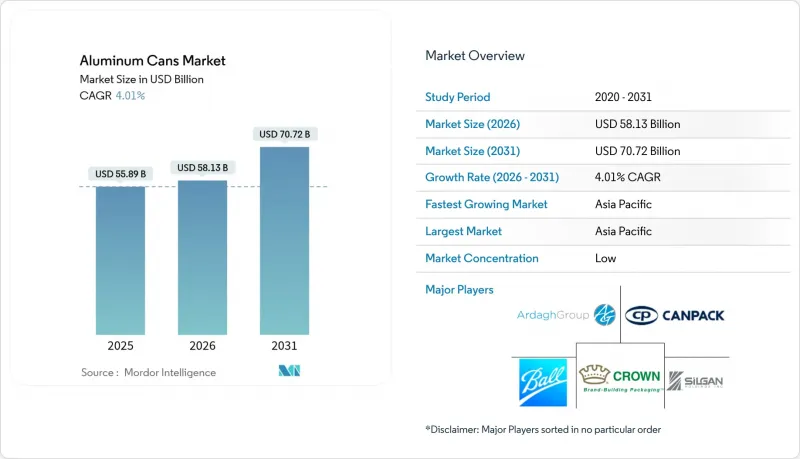
2026년 세계의 알루미늄 캔 시장 규모는 581억 3,000만 달러로 추정되며, 2025년 558억 9,000만 달러에서 성장하여 2031년에는 707억 2,000만 달러에 달할 것으로 예측됩니다.
2026-2031년 연평균 복합 성장률(CAGR) 4.01%를 나타낼 것으로 예측됩니다.
순환형 포장을 장려하는 지속적인 정책적 압력, PET 및 유리에서 전환하는 음료 제조업체의 빠른 채택, 고성장 지역에서의 생산 능력 증가가 결합되어 이러한 꾸준한 확장을 뒷받침하고 있습니다. 유럽연합(EU) 전역에서 2029년까지 90% 회수를 보장하는 보증금 반환 제도는 재활용의 경제성을 크게 개선하고 브랜드 소유자와 컨버터가 폐쇄형 캔 제조에 대한 투자를 가속화하는 요인으로 작용하고 있습니다. 아시아태평양은 도시 지역의 가처분 소득 증가로 주도권을 유지하고, 북미와 유럽은 프리미엄화 및 진화하는 지속가능성 요구 사항을 활용하여 가치 성장을 뒷받침할 것입니다. 생산능력의 병목현상은 지속되고 있지만, 최근 인수 및 신규 공장 건설로 인해 공급 밸런스는 점차 개선될 것으로 예측됩니다. 동시에 프리미엄 음료 출시, 와인 통조림화 이니셔티브, 움푹 들어간 모양에 대한 EC 수요는 추가적인 추진력이 되어 알루미늄 캔 시장을 기존의 탄산 음료 용도를 크게 넘어서는 시장으로 끌어올렸습니다.
세계 알루미늄 캔 시장 동향 및 인사이트
높은 재활용성과 폐쇄 루프 회수 시스템
알루미늄은 야금학적 특성을 영구적으로 유지하기 때문에 플라스틱이나 유리로는 불가능한 진정한 재료 순환성을 실현합니다. 캔 제조업체 협회에 따르면, 지금까지 생산된 알루미늄의 75%는 현재도 사용되고 있으며, 2차 알루미늄 재용해는 1차 제련에 비해 95%의 에너지 절감이 가능하다고 합니다. 유럽 제련소인 콘스테리움, 엘발, 노벨리스, 스페이라는 2024년 4월에 합금 사양을 통일하여 최대 100% 재활용 소재를 사용한 식수 캔을 생산할 수 있게 되었습니다. 이를 통해 금속 1톤당 2.6톤의 CO2 배출량 감소를 실현하고, 과학적 근거에 기반한 기후 목표를 달성하기 위한 충전 제조업체의 운영 비용을 절감할 수 있습니다. 미국의 재활용률은 2023년 43%까지 떨어졌지만, 업계 주도의 투자로 2030년까지 70%, 2050년까지 90%까지 회복을 목표로 하고 있으며, 캔 공장의 장기적인 원료 확보를 위해 노력하고 있습니다. 유럽, 캐나다 및 미국 일부 주에서는 연간 400억 개 이상의 용기를 대상으로 보증금 반환제도를 시행하고 있으며, 회수량이 크게 증가하고 있습니다. 이는 스크랩 프리미엄을 낮추고, 통합 캔 제조업체의 수익률을 향상시킵니다. 이러한 구조적 우위가 결합되어 예측 CAGR을 1.2% 끌어올리며 알루미늄이 순환형 음료 포장의 결정판이라는 평가를 확고히 하고 있습니다.
EPR 및 플라스틱 세금 의무화에 따른 PET/유리에서 알루미늄으로의 전환
확대 생산자책임(EPR) 제도는 재료비 계층구조를 근본적으로 재구성합니다. 영국의 2025년 기준 EPR 수수료는 알루미늄 1톤당 266파운드로 책정되어 PET, 다층 파우치 또는 재활용이 어려운 연포장재에 적용되는 과징금보다 훨씬 낮게 책정되어 있습니다. 캘리포니아주는 2024년 1월, 용기 반환 제도의 대상을 와인 및 주류로 확대하여 대상 식수 캔 시장을 연간 4억 캔 규모로 즉시 확대했습니다. 한편, EU 규정은 2029년까지 일회용 음료 용기의 회수율 90%를 달성하도록 규정하고 있으며, 이 기준은 소비 후 스크랩 가치가 높은 알루미늄에 매우 유리합니다. 호주에서는 2040년까지 식품용 알루미늄의 재활용 비율을 80%까지 달성하도록 의무화하여 환태평양 지역 전체 수요 전망을 강화할 것입니다. 이러한 정책의 시너지 효과로 인해 알루미늄의 매력도가 높아져 중기 성장률 전망치를 1.5% 상향 조정할 수 있게 되었습니다.
플렉서블 PET 및 카톤 형태와의 충돌
다층 종이 용기와 경량 PET 병은 특히 프라이빗 브랜드 주스, 유음료, 상온 보관이 가능한 물과 같이 브랜드 소유자가 재활용성보다 단가를 우선시하는 가격 민감성 부문에서 계속 우위를 점하고 있습니다. 새로운 글리콜 개질 기술로 탄산음료 및 영양 성분에 민감한 혼합 음료에 대한 PET의 유통기한이 연장되어 알루미늄의 기능적 우위가 축소되고 있습니다. 개발도상국에서는 소비자들이 지속가능성 프리미엄을 지불하려는 의지가 여전히 낮아 상품화된 카테고리에서의 보급을 억제하고 있습니다. 그러나 EU와 캐나다의 비재활용 플라스틱 용기 금지 조치와 EPR(확대된 생산자책임재활용(EPR) 기준의 강화로 인해 연포장재의 경쟁 우위는 점차 약화될 것입니다. 그 결과, 2025년부터 2027년까지 알루미늄 캔 시장의 CAGR에 일시적으로 0.8%의 마이너스 영향을 미칠 것으로 예측됩니다.
부문 분석
표준 330mL 및 355mL 바디는 2025년 매출의 55.38%를 차지할 것으로 예상되며, 이 점유율은 충전 라인과의 호환성, 최대 라인 속도, 최적의 팔레트 밀도에 의해 뒷받침됩니다. 이 부문은 최종 사용자의 인지도가 높다는 점도 강점으로 작용하고 있으며, 전 세계 보틀러의 전환 비용 절감에 기여하고 있습니다. 그러나 250mL와 310mL 사이즈로 대표되는 슬림형 캔은 프리미엄 시각적 비율과 혼잡한 소매점 진열대에서의 간판 효과로 인해 4.06%의 연평균 복합 성장률(CAGR)로 빠르게 성장하고 있습니다. 기능성 음료, 저칼로리 음료, 알코올 음료 즉석음료 시장을 대상으로 제품을 개발하는 기업들은 차별화된 선반 점유 효과와 냉장 케이스 내 시인성 향상을 위해 길쭉한 형태를 높이 평가했습니다. 볼의 Dynamark 가변 그래픽 플랫폼을 통해 마케터들은 표준 캔과 슬림 캔 모두에서 라인 중단 없이 한정판 디자인을 출시할 수 있어 재고 리스크를 줄이고 캠페인의 기동성을 높일 수 있습니다. 인쇄기술의 발전으로 인한 단가 하락에 따라 슬림캔은 고수익률 SKU에서 침투율 확대가 예상됩니다. 특수한 모양과 촉감 엠보싱은 아직 개발 중이지만, 소비자 경험을 더욱 풍요롭게 하는 지속적인 혁신을 반영하고 있습니다. 전체 알루미늄 캔 시장에서는 표준적인 대량 생산 형식과 슬림한 프리미엄 변형이 공존할 것으로 예상되며, 후자는 생산 능력 대비 상대적으로 큰 수익 증가를 가져올 것으로 예측됩니다.
표준 바디는 여전히 우수한 물류 경제성을 가지고 있습니다. 355mL 캔 24개들이 케이스는 같은 용량의 유리 용기 팩보다 20% 더 가벼워 운송 시 배출량을 줄이고, 소매점에서의 진열 작업 시 부상 위험을 줄일 수 있습니다. 1990년대부터 채택된 두꺼운 게이지로 금속 가격이 고공행진하는 상황에서도 컨버터에 안정적인 수익률을 보장하고 있습니다. 그러나 브랜드 소유주들은 시각적 효과와 건강 이미지가 온스당 가치를 능가하는 라이프스타일 지향적 시장에서 세련된 캔의 약간의 비용 상승을 흡수할 의향이 있음을 보여주고 있습니다. 2030년까지 정교한 캔 시장 점유율은 두 자릿수에 달할 가능성이 높으며, 기존 라인 설비와의 하위 호환성을 유지하면서 포장 포트폴리오의 폭을 넓힐 수 있습니다. 이러한 캔의 다양화는 알루미늄 캔 시장 전체의 회복력을 강화하고, 틈새 음료 하위 카테고리로의 진입을 고려하는 보틀러의 전환 비용을 낮추는 역할을 할 것입니다.
음료 부문은 2025년 세계 매출의 48.35%를 차지할 것으로 예상되며, 이는 탄산음료와 경량 금속 용기의 100년간의 공생 관계를 반영합니다. 탄산음료, 에너지음료, 스포츠음료는 여전히 주력 제품이며, 캔용 판재 압연공장의 규모의 경제를 확보하고 있습니다. 알코올 탄산수, CBD 함유 탄산수, CBD 토닉, 니트로 커피의 지속적인 두 자릿수 성장은 음료 카테고리의 폭을 더욱 넓혀 주류 탄산음료가 비수기에 접어드는 시기에도 캔 생산라인을 거의 풀가동할 수 있게 해줍니다. 한편, 데오도란트에서 쿠킹 스프레이에 이르는 에어로졸 충전 제품은 CAGR 5.21%로 알루미늄 캔 시장 내에서 가장 빠르게 성장하는 분야가 될 것으로 예측됩니다. 브랜드 오너들은 오일, 분사제, 알코올을 함유한 제형에서 주석 대체품이 열화되는 문제를 해결하는 알루미늄의 내식성을 높이 평가했습니다. 강화된 벽면 다림질 가공 기술로 최대 18bar의 내압 성능을 실현하여 무스, 페인트, 휘핑크림 용기의 전개가 가능해졌습니다.
반려동물 및 인간용 통조림 식품은 시장 점유율은 작지만, 재고 회전과 비상용 비축 구매 행동에 힘입어 연중 안정적인 수요를 보이고 있습니다. 실건 홀딩스는 2024년 펫푸드 캔의 매출이 두 자릿수 성장을 기록할 것으로 예상하고 있으며, 이는 고급 펫푸드가 금속의 산소 차단 특성과 잘 어울린다는 것을 보여줍니다. 제약 및 건강보조식품 분야는 새로운 성장 분야로, 소용량 알루미늄 바이알의 변조 방지 기능과 정밀 계량 특성을 활용하고 있습니다. 최종 사용자의 다양화는 알루미늄 캔 시장을 단일 카테고리의 부진으로부터 더욱 보호하고, 동시에 제조 간접비를 흡수하고 자산 회수를 가속화할 수 있는 여러 가지 성장 벡터를 제공합니다.
지역별 분석
아시아태평양은 전 세계 매출의 40.74%를 차지하고 있으며, 이 지역의 알루미늄 캔 시장 규모는 2031년까지 연평균 5.52% 성장할 것으로 예측됩니다. 이는 중국, 인도, 일본의 중산층 가처분 소득 증가, 도시 편의성 중시 문화, 일회용 플라스틱에 대한 규제 강화 등을 배경으로 하고 있습니다. 중국은 자체 압연 능력과 호황을 누리고 있는 국내 음료 부문을 보유하고 있으며, 수입 의존도를 뛰어넘는 선두를 유지하고 있습니다. 힌달코의 100억 달러 규모의 확장 계획은 현지 콜라 에너지 드링크 알코팝 제조업체의 캔 채용을 염두에 두고 인도 국내 금속 공급을 확대할 예정입니다. 일본의 성숙한 음료 시장은 프리미엄 차와 크래프트 커피 캔의 혁신을 촉진하고 있으며, 아사히 그룹의 순 제로 약속은 조달 전환을 촉진하고 있습니다. 동남아시아도 마찬가지로 호황을 누리고 있으며, NS-Siam United Steel은 주석 생산 강화를 위해 5,850만 달러를 투자하는 동시에 해외의 캔용 강판 공급업체와 협력하고 있습니다. 철강과 알루미늄공급망에서 복합적인 발전 경로를 제시합니다.
북미는 절대규모는 2위이지만, 단위수량으로는 1위입니다. 대신 이 지역에서는 고급스러운 슬림캔, 특수 열변색 캔 등 고수익성 제품 전환에 주력하고 있습니다. 볼사는 2023년 약 490억 개의 용기를 출하하여 지역 알루미늄 캔 시장 점유율의 36%를 차지했으며, 회수 시스템 확대에 따라 재활용 소재 함유량을 크게 향상시켰습니다. 미국 각 주의 용기 보증금 제도 확대와 캐나다의 EPR(확대 생산자 책임) 제도 도입으로 2차 스크랩 공급이 강화되어 캔 본체용 시트의 재활용 함량이 사상 최고치를 기록함. 이로 인해 컨버터(가공업체)의 금속 조달 비용이 감소하고 있습니다.
유럽 시장은 성숙한 시장이며, PET에서 알루미늄으로의 전환을 가속화하기 위해 규제 측면의 노력을 강조하고 있습니다. EU의 90% 회수 목표가 다가옴에 따라 브랜드 오너들은 컴플라이언스 대응을 위해 다년간의 알루미늄 캔 공급 계약을 선지급하여 컨버터들의 수주 기반을 안정화시키고 있습니다. 영국에서 도입 예정인 보증금 반환 제도를 통해 연간 140억 개의 금속 용기가 순환형 경로로 유입되어 원료 공급의 안정성을 강화할 수 있습니다. 독일과 프랑스에서는 캔 와인의 시범 도입을 적극적으로 추진하여 맥주 시장에 구축된 기반을 넘어 확장하고 있습니다. 이러한 요인으로 인해 유럽 제조업체들은 새로운 설비를 도입하고 라인 속도를 높이고 현지 재생 에너지를 통합하여 생산량이 소폭 증가하더라도 지역 내 알루미늄 캔 시장이 가치 기준으로 성장할 수 있도록 보장하고 있습니다.
기타 특전:
- 엑셀 형식 시장 예측(ME) 시트
- 애널리스트의 3개월간 지원
자주 묻는 질문
목차
제1장 서론
제2장 조사 방법
제3장 주요 요약
제4장 시장 구도
제5장 시장 규모와 성장 예측
제6장 경쟁 구도
제7장 시장 기회와 향후 전망
LSH 26.03.10The global aluminum cans market size in 2026 is estimated at USD 58.13 billion, growing from 2025 value of USD 55.89 billion with 2031 projections showing USD 70.72 billion, growing at 4.01% CAGR over 2026-2031.
Sustained policy pressure favoring circular packaging, rapid adoption by beverage producers shifting away from PET and glass, and capacity additions in high-growth regions collectively underpin this steady expansion. Deposit return systems that guarantee 90% collection by 2029 across the European Union sharply improve recycling economics, prompting brand owners and converters to accelerate investments in closed-loop can manufacturing. Asia Pacific retains its leadership position thanks to rising urban disposable incomes, while North America and Europe leverage premiumization and evolving sustainability mandates to support value growth. Capacity bottlenecks persist, yet recent acquisitions and greenfield builds point to a gradually improving supply balance. At the same time, premium beverage launches, wine-in-can initiatives, and e-commerce demand for dent-resistant formats create additional tailwinds that lift the aluminum cans market well beyond traditional carbonated soft drink applications.
Global Aluminum Cans Market Trends and Insights
High Recyclability and Closed-Loop Recovery Systems
Aluminum retains its metallurgical properties indefinitely, enabling genuine material circularity that plastic and glass cannot match. The Can Manufacturers Institute notes that 75% of all aluminum ever produced remains in active use today, and remelting secondary aluminum consumes 95% less energy than primary smelting. European smelters Constellium, Elval, Novelis, and Speira harmonized alloy specifications in April 2024 to allow beverage cans with up to 100% recycled content, cutting carbon emissions by 2.6 tons of CO2 per ton of metal and lowering operating costs for fillers committed to science-based climate targets. U.S. recycling rates slipped to 43% in 2023, but industry-backed investments aim to lift recovery to 70% by 2030 and 90% by 2050, ensuring long-term feedstock security for can plants. Deposit return programs covering more than 40 billion containers annually in Europe, Canada, and select U.S. states materially raise collection volumes, translating into lower scrap premiums and stronger margins for integrated can makers. These structural advantages collectively add 1.2 percentage points to forecast CAGR, cementing aluminum's reputation as the definitive circular beverage package.
Shift from PET/Glass to Aluminum Amid EPR and Plastics-Tax Mandates
Extended Producer Responsibility schemes fundamentally reshape material cost hierarchies. The United Kingdom's 2025 base EPR fee is set at GBP 266 per tonne for aluminum, far below levies applied to PET, multilayer pouches, or difficult-to-recycle flexibles. California expanded its Container Redemption Value program to wine and spirits in January 2024, immediately widening the addressable beverage can universe by 400 million units a year. Meanwhile, EU rules compel 90% collection of single-use beverage containers by 2029, a benchmark that heavily favors aluminum due to its high post-consumer scrap value. Australia will require 80% recycled content in food-grade aluminum by 2040, again reinforcing demand visibility along the entire Pacific Rim. These converging policies collectively boost aluminum's attractiveness and inject an additional 1.5 percentage point lift into medium-term growth forecasts.
Competition from Flexible PET and Carton Formats
Multilayer cartons and lightweight PET bottles continue to dominate price-sensitive segments, especially for private-label juices, dairy drinks, and shelf-stable water, where brand owners prioritize unit cost over recyclability. New glycol-modification techniques have extended PET shelf life for carbonation and sensitive nutrient blends, narrowing aluminum's functional advantage. In developing economies, consumer willingness to pay sustainability premiums remains low, restraining penetration in commoditized categories. However, upcoming bans on non-recyclable plastic formats across the EU and Canada, alongside hard-to-reach EPR thresholds, will gradually erode the competitive edge of flexibles. Net effect is a temporary 0.8% drag on the aluminum cans market CAGR from 2025-2027.
Other drivers and restraints analyzed in the detailed report include:
- Boom in RTD, Craft, and Functional Beverages
- Rapid Growth of Can-Friendly Wine and Spirits Packaging
- Price and Supply Volatility of Primary Aluminum
For complete list of drivers and restraints, kindly check the Table Of Contents.
Segment Analysis
Standard 330-mL and 355-mL bodies retained 55.38% of 2025 revenue, a share underpinned by filling-line compatibility, the highest line speeds, and optimal pallet density. The segment also capitalizes on broad end-user familiarity, which reduces changeover costs for global bottlers. Nevertheless, sleek cans, typified by 250-mL and 310-mL footprints, are advancing swiftly at a 4.06% CAGR thanks to their premium visual ratio and enhanced billboard effect in crowded retail aisles. Beverage formulators serving functional, low-calorie, and alcohol-ready-to-drink segments prize the elongated profile for differentiated shelf blocking and cold-box visibility. Ball's Dynamark variable-graphics platform lets marketers design limited-run art across both standard and sleek formats without line-stopovers, trimming inventory risk and fostering campaign agility. As printing technology lowers per-unit cost, sleek cans should secure incremental penetration in higher-margin SKUs. Specialty shapes and tactile embossing remain nascent but reflect ongoing innovation that further enriches consumer experience. Altogether, the aluminum cans market expects continued coexistence of standard mass-volume formats and sleek premium variants, with the latter responsible for outsized revenue gains relative to capacity installed.
Standard bodies still benefit from superior logistics economics: a 24-count case of 355-mL cans weighs 20% less than an equivalent glass pack, cutting freight emissions and reducing shelf-stack injuries for retailers. Their thicker gauge, tooled since the 1990s, affords converters a stable margin capture even at high metal premiums. Yet brand owners are willing to absorb a slight cost uplift for sleek cans targeting lifestyle positioning where visual disruption and perceived health cues trump per-ounce value. By 2030, sleek units are likely to reach double-digit market share, adding breadth to packaging portfolios while maintaining backward compatibility with legacy line equipment. As such, type diversification reinforces the broader aluminum cans market's resilience and keeps switching costs low for bottlers contemplating entry into niche beverage sub-categories.
Beverages claimed 48.35% of global revenues in 2025, mirroring a century-long symbiosis between carbonated drinks and lightweight metal containers. Carbonated soft drinks, energy shots, and sports hydration products remain workhorse volumes that secure economies of scale for can-sheet rolling mills. Sustained double-digit launches of spiked seltzers, CBD-infused tonics, and nitro-coffee further widen beverage category breadth, allowing can lines to run at near-full utilization even during off-season contractions for mainstream sodas. Meanwhile, aerosol fillings from deodorants to cooking sprays are forecast to post a 5.21% CAGR, marking them the fastest mover within the aluminum cans market. Brand owners appreciate aluminum's corrosion resistance for formulations containing oils, propellants, or alcohols that degrade tinplate alternatives. Enhanced wall ironing processes enable pressure ratings up to 18 bar, paving the way for mousse, paint, and whipped-cream formats as well.
Pet food and human canned foods hold a smaller slice but deliver stable year-round demand anchored in inventory rotation and emergency-stock purchasing behaviors. Silgan Holdings witnessed double-digit pet food can revenue growth in 2024, illustrating premium pet nutrition's alignment with metal's oxygen-barrier features. Pharmaceutical and nutraceutical applications occupy an emerging frontier, leveraging tamper-evidence and precise metering features of small-volume aluminum vials. Collectively, end-user diversification further insulates the aluminum cans market against single-category downturns while providing multiple growth vectors that absorb manufacturing overhead and accelerate asset payback.
The Aluminum Cans Market Report is Segmented by Type (Standard, Sleek, Slim, and More), End-User Industry (Beverage [Alcoholic Beverages, and Non-Alcoholic Beverages], Food [Canned Food, and Pet Food], Aerosol, and More), Structure (2-Piece, and 3-Piece), Capacity (Up To 250 Ml, 251-500 Ml, and Above 500 Ml), and Geography (North America, Europe, Asia Pacific, and More). The Market Forecasts are Provided in Terms of Value (USD).
Geography Analysis
Asia Pacific contributes 40.74% of global sales, and its aluminum cans market size is projected to advance 5.52% annually to 2031, underwritten by rising middle-class disposable incomes, urban convenience culture, and authoritative restrictions on single-use plastics in China, India, and Japan. China retains pole position with in-house rolling capacity and a vibrant domestic beverage sector that collectively eclipses import dependence. Hindalco's USD 10 billion expansion amplifies India's domestic metal supply in anticipation of can adoption by local cola, energy drink, and alcopop producers. Japan's mature beverage environment spurs innovation in premium tea and craft coffee cans, aided by Asahi Group's net-zero pledges driving procurement switch-overs. Southeast Asia is equally dynamic; NS-Siam United Steel allocated USD 58.5 million to bolster tinplate output, yet concurrently partners with foreign can-sheet suppliers, signaling blended development paths for both ferrous and aluminum supply chains.
North America ranks second in absolute size, though its unit volumes plateau. Instead, the region focuses on trading up to sleek, slim, and specialty thermochromic cans that fetch higher margins. Ball shipped roughly 49 billion containers in 2023, representing 36% regional aluminum cans market share and delivering significant recycled content progress as reclamation systems scale. U.S. state-level container deposit expansions plus Canada's EPR rollouts strengthen secondary scrap supply, raising recycled content in can body sheet to record highs and lowering metal purchase costs for converters.
Europe, while mature, leans heavily on regulatory levers to accelerate modal shift from PET to aluminum. With the EU's 90% collection target looming, brand owners pre-pay for compliance by booking multi-year aluminum can supply contracts that stabilize converter order books. The United Kingdom's upcoming deposit return program will funnel 14 billion metal containers into closed-loop paths yearly, solidifying feedstock security. Germany and France aggressively promote wine-in-can pilots, expanding beyond beer's established foothold. These factors allow European producers to deploy new capacity while raising line speeds and integrating on-site renewable energy, ensuring that the aluminum cans market in the bloc grows in value even where volumes edge upward modestly.
- Ball Corporation
- Crown Holdings Inc.
- Ardagh Group S.A.
- Silgan Holdings Inc.
- CAN-PACK S.A.
- Novelis Inc.
- ORG Technology Co. Ltd.
- Toyo Seikan Group Holdings Ltd.
- CPMC Holdings Limited
- Baosteel Packaging Co. Ltd.
- Envases Universales
- Tecnocap Group
- CCL Container Inc.
- Massilly Holding S.A.S
- Nampak Ltd.
- Saudi Arabia Packaging Industry (SAPIN)
- Can-One Berhad
- Alltub Deutschland GmbH
- Baofeng Group Co. Ltd.
- Trivium Packaging B.V.
Additional Benefits:
- The market estimate (ME) sheet in Excel format
- 3 months of analyst support
TABLE OF CONTENTS
1 INTRODUCTION
- 1.1 Study Assumptions and Market Definition
- 1.2 Scope of the Study
2 RESEARCH METHODOLOGY
3 EXECUTIVE SUMMARY
4 MARKET LANDSCAPE
- 4.1 Market Overview
- 4.2 Market Drivers
- 4.2.1 High recyclability and closed-loop recovery systems
- 4.2.2 Shift from PET/glass to aluminum amid EPR and plastics-tax mandates
- 4.2.3 Boom in RTD, craft and functional beverages
- 4.2.4 Rapid growth of can-friendly wine and spirits packaging (under-reported)
- 4.2.5 E-commerce's need for dent-resistant primary packaging (under-reported)
- 4.3 Market Restraints
- 4.3.1 Competition from flexible PET and carton formats
- 4.3.2 Price and supply volatility of primary aluminum
- 4.3.3 Regional can-making capacity bottlenecks (under-reported)
- 4.3.4 Rising Scope-3 decarbonization compliance costs (under-reported)
- 4.4 Industry Supply Chain Analysis
- 4.5 Regulatory Landscape
- 4.6 Technological Outlook
- 4.7 Porter's Five Forces Analysis
- 4.7.1 Bargaining Power of Suppliers
- 4.7.2 Bargaining Power of Buyers
- 4.7.3 Threat of New Entrants
- 4.7.4 Threat of Substitutes
- 4.7.5 Intensity of Competitive Rivalry
5 MARKET SIZE AND GROWTH FORECASTS (VALUE)
- 5.1 By Type
- 5.1.1 Standard
- 5.1.2 Sleek
- 5.1.3 Slim
- 5.1.4 Other Types
- 5.2 By End-user Industry
- 5.2.1 Beverage
- 5.2.1.1 Alcoholic Beverages
- 5.2.1.2 Non-alcoholic Beverages
- 5.2.2 Food
- 5.2.2.1 Canned Food
- 5.2.2.2 Pet Food (Wet and Treats)
- 5.2.3 Aerosol
- 5.2.4 Other End-user Industries
- 5.2.1 Beverage
- 5.3 By Structure
- 5.3.1 2-piece
- 5.3.2 3-piece
- 5.4 By Capacity
- 5.4.1 Up to 250 ml
- 5.4.2 251 - 500 ml
- 5.4.3 More than 500 ml
- 5.5 By Geography
- 5.5.1 North America
- 5.5.1.1 United States
- 5.5.1.2 Canada
- 5.5.1.3 Mexico
- 5.5.2 South America
- 5.5.2.1 Brazil
- 5.5.2.2 Argentina
- 5.5.2.3 Chile
- 5.5.2.4 Rest of South America
- 5.5.3 Europe
- 5.5.3.1 United Kingdom
- 5.5.3.2 Germany
- 5.5.3.3 France
- 5.5.3.4 Italy
- 5.5.3.5 Spain
- 5.5.3.6 Russia
- 5.5.3.7 Rest of Europe
- 5.5.4 Asia Pacific
- 5.5.4.1 China
- 5.5.4.2 India
- 5.5.4.3 Japan
- 5.5.4.4 South Korea
- 5.5.4.5 Australia
- 5.5.4.6 Malaysia
- 5.5.4.7 Rest of Asia Pacific
- 5.5.5 Middle East and Africa
- 5.5.5.1 Middle East
- 5.5.5.1.1 Saudi Arabia
- 5.5.5.1.2 United Arab Emirates
- 5.5.5.1.3 Turkey
- 5.5.5.1.4 Rest of Middle East
- 5.5.5.2 Africa
- 5.5.5.2.1 South Africa
- 5.5.5.2.2 Nigeria
- 5.5.5.2.3 Rest of Africa
- 5.5.5.1 Middle East
- 5.5.1 North America
6 COMPETITIVE LANDSCAPE
- 6.1 Market Concentration
- 6.2 Strategic Moves
- 6.3 Market Share Analysis
- 6.4 Company Profiles (includes Global level Overview, Market level overview, Core Segments, Financials as available, Strategic Information, Market Rank/Share for key companies, Products and Services, and Recent Developments)
- 6.4.1 Ball Corporation
- 6.4.2 Crown Holdings Inc.
- 6.4.3 Ardagh Group S.A.
- 6.4.4 Silgan Holdings Inc.
- 6.4.5 CAN-PACK S.A.
- 6.4.6 Novelis Inc.
- 6.4.7 ORG Technology Co. Ltd.
- 6.4.8 Toyo Seikan Group Holdings Ltd.
- 6.4.9 CPMC Holdings Limited
- 6.4.10 Baosteel Packaging Co. Ltd.
- 6.4.11 Envases Universales
- 6.4.12 Tecnocap Group
- 6.4.13 CCL Container Inc.
- 6.4.14 Massilly Holding S.A.S
- 6.4.15 Nampak Ltd.
- 6.4.16 Saudi Arabia Packaging Industry (SAPIN)
- 6.4.17 Can-One Berhad
- 6.4.18 Alltub Deutschland GmbH
- 6.4.19 Baofeng Group Co. Ltd.
- 6.4.20 Trivium Packaging B.V.
7 MARKET OPPORTUNITIES AND FUTURE OUTLOOK
- 7.1 White-space and Unmet-Need Assessment