|
시장보고서
상품코드
1940695
데이터센터용 발전기 : 시장 점유율 분석, 업계 동향과 통계, 성장 예측(2026-2031년)Data Center Generator - Market Share Analysis, Industry Trends & Statistics, Growth Forecasts (2026 - 2031) |
||||||
 Mordor Intelligence
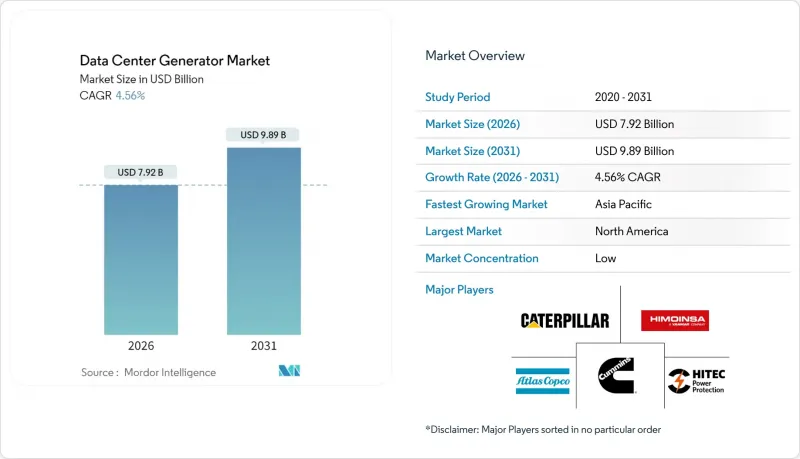
2026년 데이터센터용 발전기 시장 규모는 79억 2,000만 달러로 추정되며, 2025년 75억 7,000만 달러에서 성장하여 2031년에는 98억 9,000만 달러에 달할 것으로 예측됩니다.
2026년부터 2031년까지 CAGR 4.56%로 확대될 것으로 예상됩니다.
이러한 꾸준한 성장은 하이퍼스케일 시설의 급증과 랙 밀도를 메가와트급으로 끌어올리는 새로운 인공지능 클러스터의 물결로 인해 백업 전원 공급장치 설계를 근본적으로 변화시키고 있습니다. 디젤 유닛은 여전히 대부분의 설치 기반을 차지하고 있지만, 탄소 감축 정책, 변동하는 연료 가격, 더 엄격한 Tier 4 규제로 인해 천연가스, 수소, HVO 지원 플랫폼에 대한 관심이 가속화되고 있습니다. 대구경 엔진의 공급망 부족으로 납기가 장기화되는 가운데, 사업자들은 다년 단위의 프레임워크 계약 체결과 지역 조립 거점에서 출하되는 모듈형 블록으로 전환을 추진하고 있습니다. 한편, 구리 가격이 사상 최고치를 경신하면서 발전기 제조 비용을 압박하고 있으며, OEM 제조업체는 수직 통합 움직임을 강화하고 기술 요구 사항이 허용하는 범위 내에서 알루미늄 권선 채택을 확대하고 있습니다. 경쟁 압력은 순수한 마력에서 연료 유연성, 배기가스 규제 준수, 예측 유지보수 분석을 통한 발전기 가동 보장과 함께 디지털 서비스 제공 등 다양한 요소로 옮겨가고 있습니다.
세계 데이터센터 발전기 시장 동향 및 인사이트
급증하는 하이퍼스케일 및 코로케이션 시설의 건설 증가
하이퍼스케일 프로젝트는 현재 100MW를 초과하는 것이 일반화되어 있으며, 사업자는 수십 대의 2.5MW 유닛을 집적하여 정전 시에도 가동시간을 보장하는 N+2 구성의 링을 구축할 수밖에 없습니다. 2024년 구글은 싱가포르의 발전 용량을 35% 증설하기 위해 50억 달러를 투자할 계획이며, 이는 150MW 이상의 추가 예비 발전 용량에 해당합니다. 코로케이션 전문 기업들도 비슷한 규모로 사업을 전개하고 있으며, 프린스턴 디지털 그룹이 말레이시아에 건설 중인 150MW 규모의 캠퍼스에는 부하 차단 시퀀스 효율화를 위해 병렬 배전반이 배치되어 있습니다. 계약 형태는 발전기 공급, 시운전, 장기 유지보수를 일괄 제공하는 경우가 증가하고 있으며, 이를 통해 리드타임 리스크와 가격변동을 억제하고 있습니다. 하이퍼스케일 시설 건설 수요가 확대되는 가운데, OEM 업체들은 물류 병목현상 해소와 국내 조달 우대 조치에 대응하기 위해 동남아시아 및 미국 중서부 지역의 현지 조립 거점을 강화하고 있습니다.
AI 워크로드로 인한 랙 전력 밀도 증가
1MW의 전력을 소비하는 다수의 GPU를 장착한 랙은 기존 발전기군의 안전 마진을 압박하여 용량을 재평가하거나 전면적인 교체가 필요합니다. 커민스는 2025년 1분기 전력 시스템 사업 매출이 19% 증가했다고 발표하며, 그 요인은 AI로 인한 데이터센터 수주 증가라고 밝혔습니다. 사업자들은 전압 강하를 견디지 못하는 수천 개의 상호연결된 가속기를 보호하기 위해 보다 엄격한 전압 조정 대역과 10초 미만의 동적 응답 시간을 지정하고 있습니다. 따라서 발전기 스키드에는 더 큰 발전기, 액티브 고조파 필터, 그리고 높아진 고정자의 열을 방출하는 수랭식 회로가 내장되어 있습니다. 또한, 펌웨어 업그레이드를 통해 플라이휠 UPS 버퍼와 실시간 동기화가 가능해져 그리드에서 이벤트가 발생하더라도 원활한 전환이 보장됩니다.
디젤 발전기를 대상으로 한 탄소배출 규제
캘리포니아주 대기자원국은 비응급 시 가동시간을 제한하고 실시간 모니터링을 의무화하여 사업자들은 고가의 SCR(선택적 촉매 환원) 장치와 미립자 필터 스택을 설치해야만 합니다. 유럽연합에서는 산업배출지침으로 인해 허가 심사가 엄격해져 디젤 의존도가 높은 캠퍼스는 최대 14개월까지 승인이 지연되고 있습니다. 배기 후처리 부품은 엔진 가동 시간 15,000시간마다 교체해야 하므로, 규제 대응으로 인해 라이프사이클 소유비용이 증가합니다. 일부 캠퍼스는 예비 발전 설비를 규제가 느슨한 지역으로 이전하는 대응을 취하는 반면, 이 전략은 지연에 민감한 사용자 요구와 충돌하여 OEM 제조업체에 청정 연소 기술 및 하이브리드 솔루션의 혁신을 압박하고 있습니다.
부문 분석
디젤 발전기는 2025년 수요의 81.25%를 차지했지만, 사업자들이 탄소 부채를 재무적으로 정량화함에 따라 성장 여력은 한계에 다다랐습니다. 보다 엄격한 할당량이 확정되는 2028년 이후에는 디젤 솔루션용 데이터센터 발전기 시장 규모가 소폭 확대된 후 보합세를 보일 것으로 예상됩니다. 수소 및 HVO 지원 플랫폼은 소규모 기반에서 시작했지만, 즉각적인 드롭인 호환성과 정부의 세제 혜택에 힘입어 괄목할 만한 성장을 보이고 있습니다. 유럽 가스망에서 1% 혼합이 보급됨에 따라 수소 지원 유닛의 데이터센터 발전기 시장 점유율은 꾸준히 증가할 것으로 예상됩니다.
규제 특혜로 인해 더욱 가속도가 붙고 있습니다. 독일의 자금 프레임워크 494는 5억 5,000만 유로를 녹색 백업 전원 개조 및 메탄-수소 혼합 연료로 자동 조정되는 이중 연료 엔진의 주문을 촉진하기 위해 사용되었습니다. 동시에, 하이퍼스케일러 기업들은 2030년까지 가격 가시성을 확보하기 위해 재생 디젤 구매 계약을 체결하고 있습니다. 제조사는 연료 특성 변화 시 분사 맵을 재조정하는 무선 펌웨어 업데이트로 대응하여 엔진 수명 연장 및 바이오디젤 오염으로 인한 보증 보호를 실현하고 있습니다. 디젤은 에너지 밀도와 보편적인 가용성으로 인해 여전히 중요하지만, 대체 연료가 혁신의 주목을 받고 있습니다.
1MW 미만의 유닛이 여전히 주류를 차지하고 있습니다. 이는 수천 개의 소규모 엣지 사이트가 로컬 컨텐츠 전송을 보장해야 하기 때문입니다. 그러나 하이퍼스케일 사업의 합리화가 진행되면서 2MW 이상의 단일 블록급에 대한 수요가 가속화되고 있습니다. 데이터센터 발전기 시장에서 2MW 이상 부문은 연평균 13.78%의 복합 성장률이 예상되며, 2031년까지 오랫동안 선두를 유지해 온 1MW 미만 부문과 거의 비슷한 규모에 도달할 것으로 예측됩니다. 사업자들은 이 대형 프레임을 선호합니다. 엔진 수가 적기 때문에 연료 물류가 간소화되고, 예비 부품 재고가 감소하며, 설치 면적이 줄어들기 때문입니다. 이는 연안 지역의 광섬유 상륙 지점 부근의 고비용 구역에서 중요한 고려사항입니다.
OEM 업체들은 배전반과 제어장치를 공장 출고 시 배선이 완료된 모듈식 수용 테스트 부스를 도입하여 현장 시운전 기간을 10일 이내로 단축함으로써 공급망 혼잡을 방지하고 있습니다. 렌탈 업체들은 동시에 1-2MW급 포트폴리오를 확장하고 있으며, 납기 간극을 메우고 있습니다. 계약에는 종종 영구 장비 배송 후 구매 옵션이 포함되는 경우가 많으며, 이러한 유연한 모델은 자본 예산의 예측 가능성을 유지하고, 설정된 날짜까지 랙 준비를 약속하는 코로케이션 계약의 지연 페널티로부터 보호해줍니다.
데이터센터 발전기 시장은 제품 유형(디젤, 천연가스, 수소 및 HVO 대응, 기타), 용량(1MW 미만, 1-2MW, 2MW 이상), 계층 유형(Tier I/II, Tier III, Tier IV), 데이터센터 유형(하이퍼스케일, 엔터프라이즈, 코디네이션), 지역별로 분류됩니다. 코로케이션), 지역별로 분류됩니다. 시장 예측은 금액(달러) 기준으로 제공됩니다.
지역별 분석
북미는 버지니아 북부, 댈러스, 피닉스 등 고밀도 데이터센터 복도의 강점을 바탕으로 2025년 매출의 40.55%를 차지할 것으로 예상했습니다. 투자는 현재 신규 부지 확보보다는 전력 밀도 향상에 중점을 두고 있으며, 사업자는 노후화된 2MW 디젤 발전기를 3.5MW의 Tier 4-Final 모델로 교체하여 벽을 확장하지 않고 화이트 스페이스를 확보하는 방식으로 진행 중입니다. 수소와 바이오가스에 대한 연방 생산 세액 공제는 저탄소 발전기로의 전환을 더욱 촉진하고 있습니다.
아시아태평양은 2031년까지 CAGR 10.42%로 가장 높은 성장세를 보이고 있습니다. 싱가포르는 효율성 향상을 조건으로 데이터센터 허가 모라토리엄을 해제하고, 총 300MW 규모의 5개 프로젝트 계획을 추진 중입니다. 인도의 '디지털 개인정보 보호법'은 국내 클라우드 구축을 촉진하고 있으며, 뭄바이에서만 700MW의 신규 IT 부하가 계획되어 있습니다. 일본에서는 소프트뱅크의 홋카이도 캠퍼스(300MW)가 수력발전을 기반으로 한 그리드를 통합하는 한편, 지진 관련 정전 대책으로 이중 연료 백업을 규정하고 있습니다. 한편, 말레이시아와 인도네시아는 하이퍼스케일러를 위한 토지 양여와 재생에너지 인증서를 제공함으로써 비용 경쟁력 있는 거점으로 부상하고 있습니다. 유럽은 절대 금액으로는 3위이지만, 지속가능성 요구사항에서는 선두를 달리고 있습니다. 암스테르담시는 연간 500톤 이상의 CO2 배출량에 세금을 부과하여 사업자들이 가스 엔진이나 배터리 하이브리드로 전환하도록 유도하고 있습니다. 더블린의 송전 용량 부족은 개발업체들을 스페인과 포르투갈로 밀어내고, 발전 수요를 남쪽으로 재분배하는 결과를 낳고 있습니다. 중동 지역은 풍부한 천연가스와 태양광 자원을 활용하고 있습니다. 두바이 디지털 파크에는 폐열을 지역 냉방 시스템에 재사용하는 흡수식 냉동기가 장착된 가스 발전기가 설치되어 있습니다. 아프리카는 아직 초기 단계이지만 유망한 시장이며, 나이로비와 라고스에서는 불안정한 전력망을 극복하기 위해 400kVA 디젤 발전기를 갖춘 마이크로 모듈형 데이터센터를 도입하고 있습니다.
기타 특전:
- 엑셀 형식의 시장 예측(ME) 시트
- 애널리스트의 3개월간 지원
자주 묻는 질문
목차
제1장 소개
제2장 조사 방법
제3장 주요 요약
제4장 시장 구도
제5장 시장 규모와 성장 예측
제6장 경쟁 구도
제7장 시장 기회와 향후 전망
KSM 26.03.10The data center generator market size in 2026 is estimated at USD 7.92 billion, growing from 2025 value of USD 7.57 billion with 2031 projections showing USD 9.89 billion, growing at 4.56% CAGR over 2026-2031.
This steady climb is rooted in the surge of hyperscale facilities and the new wave of artificial-intelligence clusters that now push rack densities into the megawatt range, fundamentally transforming backup-power design. Diesel units still anchor most installations, but carbon-reduction policies, volatile fuel prices, and stricter Tier 4 rules accelerate interest in natural-gas, hydrogen, and HVO-ready platforms. Supply-chain shortages for large-bore engines lengthen delivery cycles, prompting operators to lock in multi-year framework agreements or pivot toward modular blocks shipped from regional assembly hubs. Meanwhile, copper prices at record highs squeeze alternator manufacturing costs, driving OEMs to intensify vertical-integration moves and to substitute aluminum windings where technical requirements allow. Competitive pressure is therefore shifting from pure horsepower to a broader mix of fuel flexibility, emissions compliance, and digital service offerings that guarantee a generator's readiness with predictive maintenance analytics.
Global Data Center Generator Market Trends and Insights
Surging Hyperscale and Colocation Build-out
Hyperscale projects now regularly exceed 100 MW, forcing operators to aggregate dozens of 2.5 MW units into N+2 rings that guarantee uptime during grid loss. In 2024, Google earmarked USD 5 billion to lift Singapore capacity by 35%, translating into more than 150 MW of incremental standby generation Colocation specialists mirror that scale, exemplified by a 150 MW campus under Princeton Digital Group in Malaysia designed with parallel switchgear lineups to streamline load-shed sequencing. Contract structures increasingly bundle genset supply, commissioning, and long-term service to curb lead-time risk and price volatility. As hyperscale pipelines swell, OEMs strengthen local assembly bases in Southeast Asia and the U.S. Midwest to reduce logistics bottlenecks and to align with domestic-content incentives.
Rising Rack-Power Densities from AI Workloads
GPU-rich racks that consume up to 1 MW each compress the safety margin of legacy generator fleets, prompting capacity re-rating or wholesale replacement. Cummins posted a 19% jump in Power Systems revenue in Q1-2025, attributing the rise to AI-driven data center orders . Operators now specify tighter voltage-regulation bands and dynamic-response times below 10 seconds to protect thousands of interconnected accelerators that cannot tolerate brownouts. Generator skids therefore integrate larger alternators, active harmonic filters, and liquid-cooling circuits that dissipate elevated stator heat. Firmware upgrades also enable real-time synchronization with flywheel UPS buffers, ensuring seamless transition when grid events occur.
Carbon-Emission Regulations Targeting Diesel Gensets
California's Air Resources Board limits non-emergency runtime and enforces real-time monitoring, compelling operators to fit costly SCR and particulate-filter stacks. In the European Union, the Industrial Emissions Directive intensifies permitting scrutiny, delaying approvals by up to 14 months for diesel-heavy campuses. Compliance lifts lifecycle ownership costs as exhaust-after-treatment parts must be replaced every 15,000 engine hours. Some campuses respond by relocating backup yards to less-regulated jurisdictions, yet that strategy collides with latency-sensitive user demands, keeping pressure on OEMs to innovate cleaner combustion or hybrid solutions.
Other drivers and restraints analyzed in the detailed report include:
- Expansion of Edge Data Centers in Emerging Markets
- Transition to Natural-Gas and HVO Gensets for Sustainability
- Shift Toward Battery and Fuel-Cell Alternatives
For complete list of drivers and restraints, kindly check the Table Of Contents.
Segment Analysis
Diesel sets anchored 81.25% of 2025 demand, yet their headroom is capped as operators quantify carbon liabilities in financial terms. The data center generator market size for diesel solutions is projected to expand marginally before plateauing post-2028 once stricter quotas lock in. Hydrogen and HVO-ready platforms, though starting from a small base, exhibit outlier growth, propelled by immediate drop-in compatibility and government tax credits. The data center generator market share for hydrogen-ready units is forecast to climb steadily as 1% blends become commonplace in European gas grids.
Regulatory incentives further tilt momentum. Germany's funding line 494 directs EUR 550 million toward green backup power retrofits, funneling orders toward dual-fuel engines that self-calibrate to methane-hydrogen blends. Simultaneously, hyperscalers sign offtake agreements for renewable diesel to lock price visibility through 2030. Manufacturers respond with over-the-air firmware updates that retune injection maps when fuel properties shift, prolonging engine life and protecting warranties against biodiesel contamination. Diesel therefore remains critical for its energy density and universal availability, but alternative fuels capture the innovation spotlight.
Less than 1 MW units retain dominance because thousands of small edge sites must guarantee local content delivery. However, hyperscale rationalization accelerates demand for single-block ratings beyond 2 MW. Greater than 2 MW slice of the data center generator market is forecast to compound at 13.78% annually, and by 2031 it will nearly equal the long-time less than 1 MW leader. Operators favor these larger frames because fewer engines simplify fuel logistics, reduce spares inventory, and shrink the real-estate footprint-an important consideration on high-cost plots near coastal fiber landings.
OEMs tackle supply-chain congestions with modular factory-acceptance testing booths that pre-wire switchgear and controllers so that field commissioning falls below 10 days. Rental-fleet providers simultaneously grow their 1-2 MW portfolio to bridge delivery gaps; contracts often include a purchase option once permanent gear ships. Such flex models keep capital budgets predictable and guard against late penalties in colocation contracts that promise rack readiness by preset dates.
Data Center Generator Market is Segmented by Product Type (Diesel, Natural Gas, Hydrogen and HVO-Ready, Other Product Types), Capacity (Less Than 1 MW, 1-2 MW, Greater Than 2 MW), Tier Type (Tier I and II, Tier III, Tier IV), Data Center Type (Hyperscale, Enterprise, Colocation), and Geography. The Market Forecasts are Provided in Terms of Value (USD).
Geography Analysis
North America claimed 40.55% of 2025 revenue on the strength of dense data center corridors in Northern Virginia, Dallas, and Phoenix. Investment now centers on power-density upgrades rather than new land acquisition; operators swap aging 2 MW diesels for 3.5 MW Tier 4-Final models to unlock white-space without expanding walls. Federal production tax credits for hydrogen and biogas further sweeten the switch to low-carbon gensets.
Asia-Pacific showcases the strongest momentum with a 10.42% CAGR through 2031. Singapore lifts its moratorium on data center permits in return for efficiency pledges, unlocking a pipeline of 300 MW across five projects. India's Digital Personal Data Protection Act fuels domestic cloud builds, with Mumbai alone planning 700 MW of fresh IT load. In Japan, SoftBank's 300 MW Hokkaido campus integrates hydro-backed grids but still specifies dual-fuel backup to counter seismic-related outages. Meanwhile, Malaysia and Indonesia emerge as cost-competitive hubs by offering land concessions and renewable-energy certificates tailored to hyperscalers. Europe ranks third in absolute value but leads in sustainability mandates. Amsterdam's municipality now caps diesel runtime and levies CO2 fees above 500 t/year, nudging operators toward gas engines and battery hybrids. Dublin's grid-capacity crunch pushes developers to Spain and Portugal, thereby redistributing generator demand southward. The Middle East leverages abundant natural gas and solar resources; Dubai's Digital Park installs gas-fired gensets with absorption chillers that recycle waste heat into district-cooling loops. Africa remains early-stage yet promising, with Nairobi and Lagos deploying micro-modular data centers backed by 400 kVA diesels to overcome unreliable grids.
List of Companies Covered in this Report:
- Caterpillar Inc.
- Cummins Inc.
- Generac Power Systems Inc.
- Rolls-Royce plc (mtu Solutions)
- Kohler Co.
- Mitsubishi Heavy Industries Group
- Atlas Copco AB
- Himoinsa SL
- Aksa Power Generation
- HITEC Power Protection BV
- INNIO Group (Jenbacher/Waukesha)
- Aggreko Ltd.
- Wartsila Corp.
- ABB Ltd.
- Doosan Enerbility Co., Ltd.
- FG Wilson
- Yanmar Holdings Co., Ltd.
- Perkins Engines Co. Ltd.
- Briggs & Stratton LLC
- Baudouin (Weichai)
- HIPOWER SYSTEMS
- GE Vernova
Additional Benefits:
- The market estimate (ME) sheet in Excel format
- 3 months of analyst support
TABLE OF CONTENTS
1 INTRODUCTION
- 1.1 Study Assumptions and Market Definition
- 1.2 Scope of the Study
2 RESEARCH METHODOLOGY
3 EXECUTIVE SUMMARY
4 MARKET LANDSCAPE
- 4.1 Market Overview
- 4.2 Market Drivers
- 4.2.1 Surging hyperscale and colocation build-out
- 4.2.2 Rising rack-power densities from AI workloads
- 4.2.3 Expansion of edge data centers in emerging markets
- 4.2.4 Transition to natural-gas and HVO gensets for sustainability
- 4.2.5 Deployment of trailer-mounted temporary generation fleets
- 4.2.6 Adoption of modular micro-grid-ready generator blocks
- 4.3 Market Restraints
- 4.3.1 Carbon-emission regulations targeting diesel gensets
- 4.3.2 Shift toward battery and fuel-cell alternatives
- 4.3.3 High-horsepower engine supply-chain bottlenecks
- 4.3.4 Urban permitting hurdles on noise and air quality
- 4.4 Value / Supply-Chain Analysis
- 4.5 Regulatory Landscape
- 4.6 Technological Outlook
5 MARKET SIZE and GROWTH FORECASTS (VALUE)
- 5.1 By Product Type
- 5.1.1 Diesel
- 5.1.2 Natural Gas
- 5.1.3 Hydrogen and HVO-Ready
- 5.1.4 Other Product Types
- 5.2 By Capacity
- 5.2.1 Less than 1 MW
- 5.2.2 1 - 2 MW
- 5.2.3 Greater than 2 MW
- 5.3 By Tier Type
- 5.3.1 Tier I and II
- 5.3.2 Tier III
- 5.3.3 Tier IV
- 5.4 By Data Center Type
- 5.4.1 Hyperscale (Owned and Leased)
- 5.4.2 Enterprise (On-premise)
- 5.4.3 Colocation
- 5.5 By Geography
- 5.5.1 North America
- 5.5.2 South America
- 5.5.3 Europe
- 5.5.4 Asia-Pacific
- 5.5.5 Middle East and Africa
6 COMPETITIVE LANDSCAPE
- 6.1 Market Share Analysis
- 6.2 Company Profiles (includes Global level Overview, Market level overview, Core Segments, Financials as available, Strategic Information, Market Rank/Share for key companies, Products and Services, and Recent Developments)
- 6.2.1 Caterpillar Inc.
- 6.2.2 Cummins Inc.
- 6.2.3 Generac Power Systems Inc.
- 6.2.4 Rolls-Royce plc (mtu Solutions)
- 6.2.5 Kohler Co.
- 6.2.6 Mitsubishi Heavy Industries Group
- 6.2.7 Atlas Copco AB
- 6.2.8 Himoinsa SL
- 6.2.9 Aksa Power Generation
- 6.2.10 HITEC Power Protection BV
- 6.2.11 INNIO Group (Jenbacher/Waukesha)
- 6.2.12 Aggreko Ltd.
- 6.2.13 Wartsila Corp.
- 6.2.14 ABB Ltd.
- 6.2.15 Doosan Enerbility Co., Ltd.
- 6.2.16 FG Wilson
- 6.2.17 Yanmar Holdings Co., Ltd.
- 6.2.18 Perkins Engines Co. Ltd.
- 6.2.19 Briggs & Stratton LLC
- 6.2.20 Baudouin (Weichai)
- 6.2.21 HIPOWER SYSTEMS
- 6.2.22 GE Vernova
7 MARKET OPPORTUNITIES AND FUTURE OUTLOOK
- 7.1 White-space and Unmet-Need Assessment