
|
시장보고서
상품코드
1940703
미국의 유지보수, 수리 및 운영(MRO) : 시장 점유율 분석, 업계 동향과 통계, 성장 예측(2026-2031년)United States Maintenance, Repair, And Operations (MRO) - Market Share Analysis, Industry Trends & Statistics, Growth Forecasts (2026 - 2031) |
||||||
 Mordor Intelligence
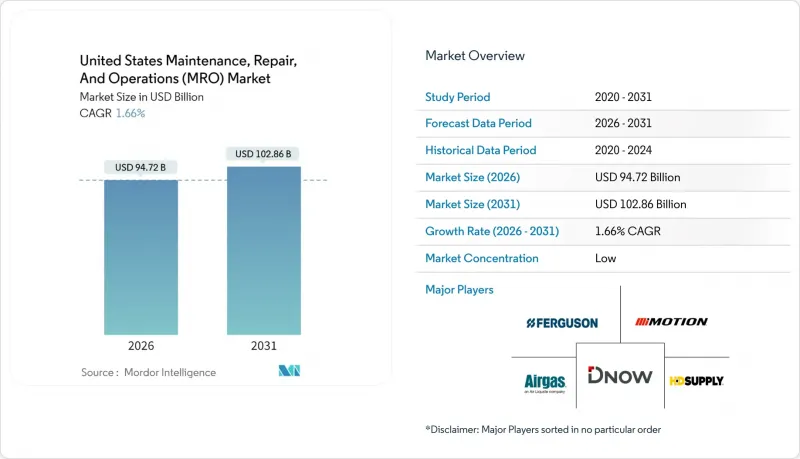
미국의 유지보수, 수리 및 운영(MRO) 시장은 2025년에 931억 7,000만 달러로 평가되었고, 2026년 947억 2,000만 달러에서 2031년까지 1,028억 6,000만 달러에 달할 것으로 예측됩니다.
예측 기간(2026-2031년)의 CAGR은 1.66%로 예상됩니다.
이러한 전망은 구조적인 노동력 부족으로 인한 제약이 있지만, 연방 정부의 인프라 지출과 조달 업무의 급속한 디지털화에 힘입은 시장의 성숙도를 반영하고 있습니다. 산업 자산의 설치 기반 확대, 에너지 절약형 개보수 수요 증가, 예측보전 소프트웨어의 보급 확대가 완만한 성장을 뒷받침하는 기반이 되고 있습니다. 인프라 투자 및 일자리 창출법, CHIPS 및 과학법, 인플레이션 억제법 등의 정책적 인센티브는 반도체 팹, 배터리 공장, 청정 에너지 프로젝트에 대한 자본 투자를 지속적으로 자극하고 있으며, 이는 모두 고부가가치 MRO 서비스에 의존하고 있습니다. 동시에 구매자가 조달 효율화, 거래량 감소, 재고 가시성 향상을 실현하는 통합 온라인 플랫폼으로 전환함에 따라 전자상거래의 침투가 가속화되고 있습니다. 이러한 기회가 있는 반면, 시장은 심각한 숙련공 부족, 유통업체들의 매출 총이익률 감소, 보관 비용 상승과 납기 연장을 초래하는 지속적인 공급망 변동과 같은 문제에 직면해 있습니다. 규모의 경제와 지리적 커버리지 확대를 위한 최근 150억 달러가 넘는 인수합병 사례에서 알 수 있듯이, 렌탈업체와 유통업체 간의 통합은 여전히 주요 경쟁 대응책으로 자리 잡고 있습니다.
미국의 유지보수, 수리 및 운영(MRO) 시장 동향과 인사이트
예지보전을 통한 비용 절감
예지보전 프로그램을 도입한 조직은 계획되지 않은 다운타임을 50% 이상 줄이고, 결함을 70% 이상 줄인 것으로 보고되고 있으며, MRO는 비용 중심에서 가치 창출의 원천으로 전환되고 있습니다. 항공사는 항공기 관리 계약에 상태 모니터링을 통합하는 사례가 증가하고 있으며, 산업 시설에서는 IoT 센서와 분석 플랫폼을 연계하여 서비스 수준 보장을 보장하고 있습니다. 데이터에 기반한 가동률 보증을 제공할 수 있는 벤더는 프리미엄 요금을 책정할 수 있고, 구매자는 라이프사이클 비용 절감과 장비 가동률 향상이라는 혜택을 누릴 수 있습니다. 정부 지원 산업평가센터 증가는 중견 제조업체에 대한 예측기술의 보급을 더욱 촉진하고 있습니다. 예측 솔루션의 규모가 확대됨에 따라 소프트웨어 사용료와 센서 리노베이션 비용이 서비스 제공업체의 지속적인 수익원이 되어 CAGR에 대한 긍정적인 기여를 강화하고 있습니다.
노후화된 산업 자산으로 인한 수리 주기 증가
1950-60년대에 설치된 미국 산업기계의 대부분은 설계 수명을 초과하여 가동되고 있으며, 이는 유지보수 빈도 증가와 자산당 지출 증가를 초래하고 있습니다. 멕시코만 지역의 화학 및 석유화학 시설에 대한 규제 감시가 강화되면서 압력 용기와 배관 시스템에 대한 강제적인 점검이 요구되고 있습니다. 대중교통 분야에서는 차량, 선로, 시설 개보수에 500억-800억 달러 규모의 미처리 프로젝트가 있는 것으로 보고되고 있습니다. 항공 분야에서는 공인 정비사의 평균 연령이 54세에 이르러 안전 위험을 최소화하고 서비스 수명을 연장하는 자산 건전성 관리 프로그램의 필요성이 강조되고 있습니다. 이러한 추세와 함께 검사 서비스, 상태 평가, 수리 부품에 대한 수요가 증가하면서 미국 MRO 시장의 안정적인 수익 성장을 뒷받침하고 있습니다.
제품의 상품화로 인한 수익률 압력
디지털 플랫폼의 가격 투명화로 인해 표준 패스너, 베어링, 소모품에 대한 대리점 마진이 줄어들고 있습니다. 2024년에는 주요 유통업체들이 고객의 최저 비용 공급업체로의 전환과 개인 브랜드 대체품 사용 확대에 따라 분기별 매출 총이익률이 감소할 것으로 예상했습니다. 시장 리더인 그렌저의 점유율은 7%에 불과하며, 업계 가격을 책정할 수 있을 만큼의 규모를 가진 사업자는 존재하지 않습니다. 유통업체들은 수익률 유지를 위해 현장 판매, 키트화, 기술 교육 등 부가가치 서비스를 강화하고 있지만, 이러한 서비스에는 선투자와 긴 회수 기간이 수반되어 단기적인 수익성을 압박하고 있습니다.
부문 분석
산업용 MRO는 2025년 매출의 45.32%를 차지할 것으로 예상되며, 제조업, 광업 및 공정 산업의 광범위한 기계 장비 기반이 뒷받침하고 있습니다. 미국의 산업 유지보수, 수리 및 운영(MRO) 시장 규모는 반도체 제조, 자동차 전동화, 항공우주 조립 분야에 대한 리쇼어링 투자에 의해 주도되고 있습니다. 높은 가동률로 인해 씰, 베어링, 유압 부품의 교체 주기가 안정적입니다. 전기 MRO는 2031년까지 연평균 복합 성장률(CAGR) 2.75%로 확대될 것으로 예상되며, 송전망 현대화 보조금과 플랜트 전기화 의무화로 인해 개폐기, 구동장치, 센서에 대한 수요가 증가하고 있습니다. 연방정부의 인센티브에 따른 에너지 절약 개조가 가속화됨에 따라, 전기 설비 개조 전문 서비스 제공업체가 시장 점유율을 확대하고 있습니다.
시설물 MRO 부문은 HVAC(냉난방공조), 지붕공사, 배관공사를 포함한 빌딩 시스템 유지관리에서 안정적인 수요를 유지하고 있습니다. 한편, '기타' 카테고리에는 의료기기 교정, 통신 기기 유지보수 등 전문적인 틈새 분야가 포함됩니다. 특히 상호연계 시스템에서는 기계적인 작업과 사이버 보안 업무를 모두 관리할 수 있는 기술자가 필요하기 때문에 운영기술(OT)과 정보기술(IT)의 융합으로 기존의 경계가 모호해지고 있습니다. 다분야 통합 팀을 보유한 공급자는 유리한 마진으로 장기 서비스 계약을 체결할 수 있습니다.
2025년 기준, 제조업은 미국 MRO 시장 점유율의 37.62%를 차지하고 있으며, 기계 장비의 유지보수 및 고장 관련 지출로 인한 570억 달러 수요에 힘입어 미국 MRO 시장 점유율의 37.62%를 차지하고 있습니다. 오대호 지역과 멕시코만 연안의 중공업 클러스터에서는 펌프, 밸브, 기어박스 오버홀에 대한 안정적인 수요가 발생하고 있습니다. 그러나 성장률은 의료 분야가 주도할 것으로 예상되며, 병원이 노후화된 인프라를 갱신하고 엄격한 시설 유지보수 기준에 대응하면서 2031년까지 연평균 2.56%의 성장률을 보일 것으로 전망됩니다. 인프라 투자 및 일자리 창출법에 근거한 연방 기금은 병원의 에너지 효율 개선에 수십억 달러를 배정하여 의료 분야의 서비스 대상 시장을 더욱 확대하고 있습니다.
에너지 및 유틸리티 분야는 파이프라인 건전성 프로그램 및 발전소 수명연장 프로젝트에 힘입어 안정적인 기여를 지속하고 있습니다. 항공우주-방산 분야 수요는 기체 가동률 상승에 따라 회복세를 보이고 있으며, 엔진 유지보수 서비스가 고수익 틈새 시장으로 부상하고 있습니다. 건설 주기는 변동 요인이지만, 모듈식 및 오프사이트 제조의 보급 확대로 인해 예방적 유지보수 계획 및 애프터마켓 부품 공급의 기회가 증가하고 있습니다.
기타 특전:
- 엑셀 형식 시장 예측(ME) 시트
- 애널리스트 지원(3개월)
자주 묻는 질문
목차
제1장 서론
제2장 조사 방법
제3장 주요 요약
제4장 시장 구도
제5장 시장 규모와 성장 예측
제6장 경쟁 구도
제7장 시장 기회와 향후 전망
LSH 26.03.10The United States Maintenance, Repair, And Operations Market was valued at USD 93.17 billion in 2025 and estimated to grow from USD 94.72 billion in 2026 to reach USD 102.86 billion by 2031, at a CAGR of 1.66% during the forecast period (2026-2031).
This outlook reflects the market's maturity, limited by structural labor shortages yet supported by federal infrastructure spending and rapid digitalization of procurement. Moderate growth is anchored by an expanding installed base of industrial assets, rising demand for energy-efficient retrofits, and wider use of predictive maintenance software. Policy incentives from the Infrastructure Investment and Jobs Act, the CHIPS and Science Act, and the Inflation Reduction Act continue to stimulate capital investment in semiconductor fabs, battery plants, and clean-energy projects, all of which rely on high-value MRO services. At the same time, e-commerce penetration accelerates as buyers migrate to integrated online platforms that streamline sourcing, reduce transaction volume, and improve inventory visibility. Despite these opportunities, the market contends with acute skilled-labor shortages, shrinking distributor gross margins, and ongoing supply-chain volatility that inflates carrying costs and lengthens lead times. Consolidation among rental and distribution companies remains a primary competitive response, with more than USD 15 billion in recent acquisitions aimed at scale efficiencies and expanded geographic coverage.
United States Maintenance, Repair, And Operations (MRO) Market Trends and Insights
Predictive Maintenance Driven Cost Savings
Organizations adopting predictive programs report eliminating more than 50% of unplanned downtime and cutting defects by over 70%, shifting MRO from a cost center to a value generator. Aviation operators increasingly embed condition-based monitoring in fleet management contracts, and industrial facilities pair IoT sensors with analytics platforms to secure service-level guarantees. Vendors capable of delivering data-backed uptime commitments command premium rates, while buyers benefit from lower lifecycle costs and higher equipment availability. The growing roster of government-funded Industrial Assessment Centers further diffuses predictive know-how across mid-sized manufacturers. As predictive solutions scale, software fees and sensor retrofits become recurring revenue streams for service providers, reinforcing the positive CAGR contribution.
Aging Industrial Assets Increasing Repair Cycles
A large share of U.S. industrial machinery installed during the 1950s-1960s is now operating beyond its design life, driving more frequent maintenance events and higher spend per asset. Chemical and petrochemical facilities in the Gulf Coast face heightened regulatory scrutiny, prompting mandated overhauls of pressure vessels and piping systems. Public transit agencies report a USD 50-80 billion backlog for railcar, track, and facility rehabilitation . In aviation, the average certified mechanic age of 54 years underscores the urgency of asset-integrity management programs that minimize safety risks while extending service life. These dynamics collectively increase demand for inspection services, condition assessments, and refurbishment parts, supporting steady revenue growth for the United States MRO market.
Margin Pressure from Product Commoditization
Price transparency on digital platforms reduces distributor mark-ups across standard fasteners, bearings, and consumables. During 2024, leading distributors reported sequential gross-margin declines as customers migrated to lowest-cost suppliers and expanded use of private-label alternatives. With market leader Grainger holding only 7% share, no participant wields sufficient scale to set industry pricing. Distributors increasingly emphasize value-added services, such as on-site vending, kitting, and technical training, to preserve margins, yet these services entail upfront investment and longer payback periods that strain near-term profitability.
Other drivers and restraints analyzed in the detailed report include:
- E-commerce Penetration of MRO Supplies
- Reshoring Investments Expanding Installed Base
- Supply-Chain Volatility and Inventory Shortages
For complete list of drivers and restraints, kindly check the Table Of Contents.
Segment Analysis
Industrial MRO generated 45.32% of 2025 revenue, underpinned by the extensive machinery base in manufacturing, mining, and process industries. The United States maintenance, repair, and operations market size for industrial applications is fueled by reshoring investments in semiconductor fabrication, automotive electrification, and aerospace assembly. High-hour utilization rates create steady replacement cycles for seals, bearings, and hydraulic components. Electrical MRO, projected to grow at 2.75% CAGR to 2031, benefits from grid-modernization grants and plant electrification mandates that boost demand for switchgear, drives, and sensors. As federal incentives accelerate energy-efficiency upgrades, service providers specializing in electrical retrofits capture incremental market share.
The facility MRO segment maintains stable demand from building-system upkeep, including HVAC, roofing, and plumbing, while the "other" category comprises specialized niches such as medical-device calibration and telecom-equipment servicing. Convergence of operational technology and IT blurs traditional boundaries, particularly as interconnected systems require technicians who can manage both mechanical and cyber-security tasks. Providers that integrate multi-disciplinary teams secure longer-term service agreements at favorable margins.
Manufacturing commanded 37.62% of the United States maintenance, repair, and operations market share in 2025, supported by USD 57 billion in machinery upkeep and additional fault-related spending. Heavy-industry clusters in the Great Lakes and Gulf Coast create consistent demand for pump, valve, and gearbox overhauls. Yet healthcare leads in growth, advancing at 2.56% CAGR through 2031 as hospitals retrofit aging infrastructure and comply with stringent equipment-maintenance standards. Federal funding under the Infrastructure Investment and Jobs Act earmarks billions for hospital energy upgrades, further expanding the healthcare serviceable market.
Energy and utilities remain steady contributors, driven by pipeline-integrity programs and power-plant life-extension projects. Aerospace and defense demand rebounds alongside higher fleet-utilization rates, with engine-maintenance services surfacing as a high-margin niche. Construction cycles introduce volatility, but the rising prevalence of modular and off-site fabrication increases opportunities for pre-emptive maintenance planning and aftermarket parts supply.
The United States Maintenance, Repair, and Operations (MRO) Market Report is Segmented by MRO Type (Industrial, Electrical, and More), End-User Industry (Manufacturing, Energy and Utilities, and More), Sourcing Model (In-House, Outsourced, and More), Maintenance Approach (Preventive, Corrective, and More), and Distribution Channel (Offline, Online, and More). The Market Forecasts are Provided in Terms of Value (USD).
List of Companies Covered in this Report:
- Ferguson PLC
- Motion Industries Inc. (Genuine Parts Company)
- Airgas Inc. (Air Liquide SA)
- DNOW Inc. (DistributionNOW)
- HD Supply Holdings Inc.
- MRC Global Inc.
- Fastenal Company
- MSC Industrial Direct Co. Inc.
- Applied Industrial Technologies
- WESCO International Inc.
- Sonepar SA
- Rexel Holdings USA (Rexel)
- Eastern Power Technologies Inc.
- Consolidated Electrical Distributors Inc.
- Elliot Electric Supply
- Border States Industrial Inc.
- Ferguson PLC
- W.W. Grainger Inc.
- Fastenal Company
- MSC Industrial Direct Co. Inc.
- Distribution Solutions Group Inc.
- The Home Depot Inc. (Interline Brands Inc.)
- Builders Firstsource
- Bluelinx Holdings
Additional Benefits:
- The market estimate (ME) sheet in Excel format
- 3 months of analyst support
TABLE OF CONTENTS
1 INTRODUCTION
- 1.1 Study Assumptions and Market Definition
- 1.2 Scope of the Study
2 RESEARCH METHODOLOGY
3 EXECUTIVE SUMMARY
4 MARKET LANDSCAPE
- 4.1 Market Overview
- 4.2 Market Drivers
- 4.2.1 Predictive maintenance driven cost savings
- 4.2.2 Aging industrial assets increasing repair cycles
- 4.2.3 E-commerce penetration of MRO supplies
- 4.2.4 Reshoring investments expanding installed base
- 4.2.5 Federal incentives for energy-efficient retrofits
- 4.2.6 Additive manufacturing for on-demand spares
- 4.3 Market Restraints
- 4.3.1 Margin pressure from product commoditization
- 4.3.2 Supply-chain volatility and inventory shortages
- 4.3.3 Skilled MRO labor shortage
- 4.3.4 Cyber-security risks in connected equipment
- 4.4 Industry Value Chain Analysis
- 4.5 Regulatory Landscape
- 4.6 Technological Outlook
- 4.7 Porter's Five Forces Analysis
- 4.7.1 Bargaining Power of Suppliers
- 4.7.2 Bargaining Power of Buyers
- 4.7.3 Threat of New Entrants
- 4.7.4 Threat of Substitutes
- 4.7.5 Intensity of Competitive Rivalry
- 4.8 Assessment of Macro-economic Trends on the Market
5 MARKET SIZE AND GROWTH FORECASTS (VALUES)
- 5.1 By MRO Type
- 5.1.1 Industrial MRO
- 5.1.2 Electrical MRO
- 5.1.3 Facility MRO
- 5.1.4 Other MRO Types
- 5.2 By End-User Industry
- 5.2.1 Manufacturing
- 5.2.2 Energy and Utilities
- 5.2.3 Aerospace and Defense
- 5.2.4 Construction
- 5.2.5 Healthcare
- 5.2.6 Other End-user Industries
- 5.3 By Sourcing Model
- 5.3.1 In-house
- 5.3.2 Outsourced (3rd-party/IFM)
- 5.3.3 Integrated Supply (VMI/Integrated-MRO)
- 5.4 By Maintenance Approach
- 5.4.1 Preventive / Scheduled
- 5.4.2 Corrective / Reactive
- 5.4.3 Predictive / Condition-based
- 5.5 By Distribution Channel
- 5.5.1 Offline Distributors
- 5.5.2 Online / E-commerce
- 5.5.3 Direct from OEM
6 COMPETITIVE LANDSCAPE
- 6.1 Market Concentration
- 6.2 Strategic Moves
- 6.3 Market Share Analysis
- 6.4 Company Profiles (includes Global level Overview, Market level overview, Core Segments, Financials as available, Strategic Information, Market Rank/Share for key companies, Products and Services, and Recent Developments)
- 6.4.1 Ferguson PLC
- 6.4.2 Motion Industries Inc. (Genuine Parts Company)
- 6.4.3 Airgas Inc. (Air Liquide SA)
- 6.4.4 DNOW Inc. (DistributionNOW)
- 6.4.5 HD Supply Holdings Inc.
- 6.4.6 MRC Global Inc.
- 6.4.7 Fastenal Company
- 6.4.8 MSC Industrial Direct Co. Inc.
- 6.4.9 Applied Industrial Technologies
- 6.4.10 WESCO International Inc.
- 6.4.11 Sonepar SA
- 6.4.12 Rexel Holdings USA (Rexel)
- 6.4.13 Eastern Power Technologies Inc.
- 6.4.14 Consolidated Electrical Distributors Inc.
- 6.4.15 Elliot Electric Supply
- 6.4.16 Border States Industrial Inc.
- 6.4.17 Ferguson PLC
- 6.4.18 W.W. Grainger Inc.
- 6.4.19 Fastenal Company
- 6.4.20 MSC Industrial Direct Co. Inc.
- 6.4.21 Distribution Solutions Group Inc.
- 6.4.22 The Home Depot Inc. (Interline Brands Inc.)
- 6.4.23 Builders Firstsource
- 6.4.24 Bluelinx Holdings
7 MARKET OPPORTUNITIES AND FUTURE OUTLOOK
- 7.1 White-Space and Unmet-Need Assessment