
|
시장보고서
상품코드
1940775
IT 하드웨어 : 시장 점유율 분석, 업계 동향과 통계, 성장 예측(2026-2031년)IT Hardware - Market Share Analysis, Industry Trends & Statistics, Growth Forecasts (2026 - 2031) |
||||||
 Mordor Intelligence
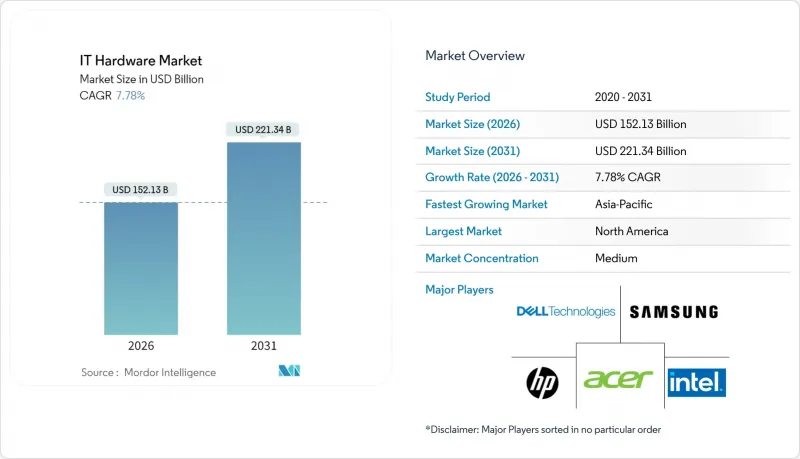
세계의 IT 하드웨어 시장은 2025년에 1,411억 5,000만 달러로 평가되었으며, 2026년 1,521억 3,000만 달러에서 2031년까지 2,213억 4,000만 달러에 달할 것으로 예측됩니다.
예측 기간(2026-2031년) 동안 CAGR은 7.78%로 예상됩니다.
윈도우 10 지원 종료를 앞두고 기업들이 PC를 업데이트하고, AI 지원 서버를 도입하고, 데이터 주권 관련 규제를 준수하려는 움직임이 수요를 가속화하고 있습니다. 북미의 클라우드 제공업체들은 하이퍼스케일 캠퍼스를 계속 확장하고 있으며, 아시아태평양의 제조업체들은 엣지 컴퓨팅을 통해 생산 현대화를 추진하고 있습니다. 반도체 공급 부족과 전자폐기물 규제가 단기적인 모멘텀을 억제하고 있지만, 장기적인 성장 전망을 훼손하지는 않을 것입니다. 컴퓨팅, 스토리지, 네트워크 통합 솔루션을 둘러싼 벤더 간 경쟁이 치열해지고 있습니다. 대기업 조달은 여전히 직접 OEM 거래가 주류를 이루고 있지만, 빠르게 성장하는 온라인 채널을 통해 중소기업도 저렴한 가격으로 엔터프라이즈급 장비를 구입할 수 있게 되었습니다.
세계 IT 하드웨어 시장 동향과 인사이트
윈도우 10 지원 종료에 앞서 팬데믹 이후 PC 업데이트 주기가 시작됩니다.
기업들은 2025년 10월 윈도우 10 지원 종료라는 촉박한 시한에 직면해 있습니다. 마이크로소프트의 확장 보안 플랜 비용은 3년차에는 대당 427달러로 상승했으며, 패치 적용보다 새로운 하드웨어를 도입하는 것이 더 비용 효율적이라는 것을 알 수 있습니다. 2020-2021년 원격근무용으로 구입한 단말기는 자연스러운 4년 주기의 교체 시기를 맞이하고 있습니다. 카이저퍼머넌트 등 미국 병원 시스템은 윈도우 11 기반의 전자건강기록(EHR) 시스템 도입을 위해 이미 모든 단말기의 업그레이드를 완료한 상태입니다. 주요 은행들도 비슷한 추세를 보이고 있으며, JP모건 체이스는 2024년 최신 PC와 연동된 엔드포인트 보안 강화에 21억 달러를 책정했습니다. 이러한 이중의 촉진요인으로 인해 규제 대상 산업 전반에 걸쳐 컴플라이언스를 준수하는 노트북, 데스크톱 및 전문 워크스테이션에 대한 수요가 증가하고 있습니다.
AI 최적화 서버와 GPU의 대중화
AI 워크로드가 시험 운영에서 프로덕션 환경으로 전환되면서 전용 서버에 대한 수요가 급증하고 있습니다. 엔비디아의 데이터센터 매출은 기업들이 GPU 기반 컴퓨팅을 표준화하면서 2024 회계연도에 475억 달러로 급증했습니다. 델 테크놀러지스(Dell Technologies)는 AI 서버 주문 잔고가 분기당 8억 달러에서 29억 달러로 급증했다고 발표하며 AI 지원 장비의 시급성을 강조했습니다. 지멘스 등 제조업체들은 예지보전을 실현하기 위해 이러한 시스템을 공장 현장에 적용하고 있으며, 골드만삭스는 2024년까지 12억 달러를 투자해 밀리초 단위의 위험 분석 능력을 확보했습니다. 이러한 변화는 AI 클러스터를 가동하기 위한 고대역폭 네트워크와 저지연 스토리지에 대한 지출을 가속화하고 있습니다.
전자폐기물 규제와 처리비용 증가
EU의 '폐전기전자제품 지침'은 2027년까지 85% 재활용을 의무화하여 제조업체의 재설계 비용과 물류비용이 증가하고 있습니다. 캘리포니아주 수리권법에 따라 공급업체는 부품과 매뉴얼을 7년간 재고로 보관해야 하며, 제품 로드맵을 재검토해야 합니다. 고객은 총 소유 비용에 폐기 비용을 포함하기 때문에 갱신 주기가 길어지고 있습니다. 마이크로소프트는 매립 폐기량을 억제하기 위해 자사 PC의 수명을 4년에서 5년으로 연장했습니다. 모듈형 섀시를 채택한 벤더가 우위를 점하는 반면, 계획적 노후화 전략의 중요성은 감소하고 있습니다.
부문 분석
서버 매출은 IT 하드웨어 시장에서 가장 빠른 8.95%의 CAGR로 성장하고 있으며, 기업의 AI 모델 학습을 위한 고밀도 GPU 노드 도입이 그 배경입니다. 델은 2024년 3분기 AI 특화 구성으로 42억 달러의 서버 매출을 기록했습니다. 반면, PC는 51.02%의 점유율을 유지하고 있으며, 현재는 업데이트 주기가 길어지고 있습니다. 스토리지와 네트워크는 서버 수요에 따라 AI 클러스터를 위한 대역폭과 저지연 링크를 추가하고 있습니다. 액체 냉각과 수직 통합형 랙은 기존의 제품 경계를 모호하게 만들고 있습니다. AMD의 ZT Systems 인수는 하이퍼스케일러가 맞춤형 유닛을 선호하는 추세에 맞춰 맞춤형 설계 능력을 제공하게 되었습니다. 주변기기는 하이브리드 작업에서 안정적인 수요가 있으며, 엣지 게이트웨이는 산업 환경에서 새로운 마이크로 부문을 개척하고 있습니다.
서버실에서는 하이브리드 아키텍처가 주류를 이루고 있습니다. 기업들은 x86 CPU와 가속기를 결합하여 비용과 처리량의 균형을 맞추기 위해 노력하고 있습니다. 전기 요금이 상승함에 따라 에너지 효율이 최우선 구매 기준이 되었습니다. 서버용 IT 하드웨어 시장 규모는 2031년까지 AI 도입과 함께 꾸준히 확대될 것으로 예상됩니다. 전원 및 냉각 서브시스템을 갖춘 턴키 랙을 공급할 수 있는 벤더는 화이트 박스 제품에 대한 수익률을 보호할 수 있습니다.
2025년 지출에서 기업은 47.25%를 유지했지만, 클라우드 제공업체는 17.05%의 CAGR로 추월할 것으로 예상됩니다. AWS만 해도 2024년 3분기 데이터센터 및 AI 서버 설비투자에 127억 달러를 투자했습니다. 정부 기관은 주권 규정을 준수하기 위해 국내 역량을 강화하고 있습니다. 의료 분야는 원격의료와 환자 기록의 보안을 위해 암호화 스토리지 어레이가 필요합니다. BFSI 기업들은 사이버 복원력 감사 대응을 위해 엔드포인트를 개편했습니다. 제조업은 실시간 생산 데이터 처리를 위해 엣지 클러스터를 도입하고, 미디어 기업은 8K 편집 스위트를 배포합니다. 통신사업자는 IT 하드웨어를 5G 코어 네트워크에 통합하고, 컨버지드 컴퓨팅 어플라이언스를 우선시합니다.
클라우드 대기업의 설비투자는 서버, 스위치, 스토리지 수요를 뒷받침하고, 공급업체를 경기 순환에 따른 경기 침체로부터 보호합니다. 한편, 기업들은 규제 대상 워크로드를 위해 사내 자산을 유지하면서 하이브리드 IT를 채택합니다. IT 하드웨어 시장은 두 가지 흐름의 혜택을 받아 10년 동안 균형 잡힌 사용자 구성을 유지할 것입니다.
지역별 분석
북미는 AI 도입의 조기화와 하이퍼스케일 확장으로 인해 2025년 37.40%의 매출 기여도를 기록할 것으로 예상됩니다. 연방 정부의 클라우드 프로그램과 민간 부문의 기술 업그레이드가 안정적인 업데이트 주기를 유지하고 있습니다. 기업들은 하이브리드 IT를 채택하여 PC, 서버, 네트워크 하드웨어에 걸쳐 균형 잡힌 주문을 촉진하고 있습니다. 지속가능한 디자인도 주목받고 있으며, 벤더들은 탄소 목표 달성을 위해 에너지 절약형 랙을 제안하고 있습니다.
아시아태평양은 2031년까지 CAGR 9.32%로 성장을 주도할 것입니다. 일본의 계획된 354억 달러 규모의 데이터센터 투자가 GPU 서버 및 액체 냉각 시스템 대량 구매를 뒷받침하고 있습니다. 인도에서는 디지털 공공재 프레임워크가 추진되고 국내 처리가 의무화됨에 따라 로컬 서버 용량이 확대될 것입니다. 중국에서는 무역 마찰 속에서 국산 기술 공급업체가 점유율을 확보하고, 싱가포르 등 동남아시아 거점은 다국적 기업의 클라우드 구축을 유치하고 있습니다. 제조업의 현대화로 인해 지역 전반에 걸쳐 엣지 노드 구축이 가속화되고 있으며, 수요는 주요 도시 지역을 넘어서고 있습니다.
유럽에서는 규제 준수와 지속가능성에 대한 인센티브를 바탕으로 점진적인 확대가 이루어지고 있습니다. 수리권법은 모듈형 하드웨어에 대한 수요를 자극하는 한편, 데이터 주권 규정은 역내 조립을 촉진하고 있습니다. 클라우드 데이터센터는 재생에너지를 찾아 북유럽 국가에 입지하고 있으며, 은행 및 공공 서비스 분야에서는 온프레미스 투자가 지속되고 있습니다. 동유럽에서는 PC와 네트워크 업그레이드에 대한 추격 투자가 진행되어 성숙한 서유럽에 성장의 여파를 가져오고 있습니다.
기타 특전:
- 엑셀 형식의 시장 예측(ME) 시트
- 애널리스트의 3개월간 지원
자주 묻는 질문
목차
제1장 소개
제2장 조사 방법
제3장 주요 요약
제4장 시장 인사이트
제5장 시장 규모와 성장 예측
제6장 경쟁 구도
제7장 시장 기회와 향후 전망
KSM 26.03.10The global IT hardware market was valued at USD 141.15 billion in 2025 and estimated to grow from USD 152.13 billion in 2026 to reach USD 221.34 billion by 2031, at a CAGR of 7.78% during the forecast period (2026-2031).
Demand accelerates as enterprises refresh PCs ahead of Windows 10 end-of-support, deploy AI-ready servers, and comply with data-sovereignty mandates. North American cloud providers continue to expand hyperscale campuses, while Asia-Pacific manufacturers modernize production with edge computing. Tight semiconductor supply and e-waste regulation temper short-term momentum but do not derail the long-range growth outlook. Vendor competition intensifies around integrated compute, storage, and networking solutions that shorten deployment time and improve energy efficiency. Direct OEM relationships still dominate large-enterprise procurement, yet fast-growing online channels now give smaller firms affordable access to enterprise-grade equipment.
Global IT Hardware Market Trends and Insights
Post-pandemic PC refresh cycle ahead of Windows 10 EoS
Enterprises face a hard Windows 10 support deadline in October 2025. Microsoft's extended security plan costs escalated to USD 427 per device in the third year, making new hardware cheaper than patching . Devices purchased for remote work in 2020-2021 now reach their natural four-year replacement window. U.S. hospital systems such as Kaiser Permanente have already upgraded entire fleets for Windows 11-based electronic health records. Banking majors mirror the trend; JPMorgan Chase earmarked USD 2.1 billion in 2024 for endpoint security upgrades tied to modern PCs. The dual catalyst lifts demand for compliant laptops, desktops, and specialist workstations across regulated sectors.
Proliferation of AI-optimized servers and GPUs
AI workloads move from pilots to production, sending specialized server demand sharply higher. NVIDIA data-center revenue jumped to USD 47.5 billion in fiscal 2024 as enterprises standardised on GPU-based compute. Dell Technologies reported an AI-server backlog swelling from USD 800 million to USD 2.9 billion within one quarter, underscoring urgency for AI-ready gear. Manufacturers such as Siemens embed these systems on shop floors to enable predictive maintenance, while Goldman Sachs invested USD 1.2 billion in 2024 to secure millisecond risk-analysis capability. The shift also accelerates spending on high-bandwidth networking and low-latency storage that keep AI clusters fully utilized.
Escalating e-waste regulation and disposal costs
The EU's Waste Electrical and Electronic Equipment Directive now mandates 85% recycling by 2027, raising redesign and logistics costs for producers. California's Right-to-Repair Act forces vendors to stock parts and manuals for seven years, reshaping product roadmaps. Customers factor disposal fees into the total cost of ownership, stretching refresh cycles. Microsoft extended its own PC life from four to five years to limit landfill volume. Vendors with modular chassis gain an edge, while planned obsolescence playbooks lose relevance.
Other drivers and restraints analyzed in the detailed report include:
- Hyperscale data-centre build-out in emerging markets
- Growth of edge-computing starter kits for smart factories
- Semiconductor geo-political supply-chain shocks
For complete list of drivers and restraints, kindly check the Table Of Contents.
Segment Analysis
Server revenue is growing at a 8.95% CAGR, the fastest in the IT hardware market, as enterprises adopt dense GPU nodes for AI model training. Dell logged USD 4.2 billion in Q3 2024 server sales on AI-centric builds. In contrast, PCs hold a 51.02% share but now experience elongated replacement cycles. Storage and networking follow server demand, adding bandwidth and low-latency links for AI clusters. Liquid cooling and vertically integrated racks blur traditional product boundaries. AMD's acquisition of ZT Systems gives it custom design capacity, aligning with hyperscaler preference for bespoke units. Peripherals see steady demand from hybrid work, while edge gateways seed new micro-segments in industrial settings.
Hybrid architecture dominates server rooms. Enterprises pair x86 CPUs with accelerators, balancing cost and throughput. Energy efficiency has become a front-line buying criterion as utility tariffs climb. The IT hardware market size for servers is poised to expand steadily alongside AI deployment waves through 2031. Vendors capable of supplying turnkey racks with power and cooling subsystems protect margins against white-box alternatives.
Enterprises retained 47.25% of 2025 spending, yet cloud providers are set to outpace at a 17.05% CAGR. AWS alone devoted USD 12.7 billion in Q3 2024 to data-center and AI server capital outlays. Government buyers raise on-shore capacity to comply with sovereignty rules. Healthcare pivots to telemedicine and secure patient records, needing encrypted storage arrays. BFSI firms refresh endpoints to satisfy cyber-resilience audits. Manufacturing installs edge clusters for real-time production data, and media firms deploy 8K editing suites. Telecom operators integrate IT hardware into 5G core networks, preferring converged compute appliances.
Cloud leaders' capex sets a high floor for server, switch, and storage demand, cushioning suppliers against cyclical dips. Enterprises, meanwhile, adopt hybrid IT, retaining in-house assets for regulated workloads. The IT hardware market benefits from both streams, yielding a balanced user-mix profile through the decade.
The IT Hardware Market Report is Segmented by Product Type (PC Client Devices, Servers, and More), End User (Enterprise, Government and Public Sector, BFSI, and More), Deployment Environment (On-Premise, and Cloud), Distribution Channel (Direct/OEM, System Integrators, Value-Added Resellers, and Online Retail), and Geography. The Market Forecasts are Provided in Terms of Value (USD).
Geography Analysis
North America contributed 37.40% revenue in 2025 thanks to early AI adoption and hyperscale expansion. Federal cloud programs and private-sector tech upgrades sustain steady refresh cycles. Enterprises embrace hybrid IT, driving balanced orders across PCs, servers, and network hardware. Sustainable design also gains traction, with vendors pitching energy-efficient racks to meet carbon targets.
Asia-Pacific leads growth at a 9.32% CAGR to 2031. Japan's planned USD 35.4 billion in data-center spend underpins bulk purchases of GPU servers and liquid-cooling systems. India advances digital-public-goods frameworks, forcing domestic processing that enlarges local server capacity . China's indigenous tech suppliers grab share amid trade tension, while Southeast Asian hubs like Singapore attract multi-national cloud builds. Manufacturing modernization multiplies edge-node deployment across the region, spreading demand beyond tier-one cities.
Europe posts moderate expansion anchored by regulatory compliance and sustainability incentives. Right-to-repair laws stimulate modular hardware demand, while data-sovereignty rules encourage regional assembly. Cloud data centers locate in Nordic countries for renewable energy, yet on-premise spend persists in banking and public services. Eastern Europe shows catch-up investment in PCs and network upgrades, adding a growth tail to the mature Western bloc.
- Upwork Inc.
- Fiverr International Ltd.
- Freelancer Limited
- Toptal LLC
- Guru.com LLC
- PeoplePerHour.com Ltd.
- DesignCrowd Pty Ltd.
- Contently Inc.
- WorkGenius GmbH
- WorkMarket, Inc.
- Catalant Technologies, Inc.
- 99designs by Vista
- Behance (Adobe Inc.)
- TaskRabbit, Inc.
- Amazon Mechanical Turk (Amazon.com, Inc.)
- UpStack Technologies, Inc.
- Workana Inc.
- Gigster LLC
- Aquent LLC
- FlexJobs Corporation
Additional Benefits:
- The market estimate (ME) sheet in Excel format
- 3 months of analyst support
TABLE OF CONTENTS
1 INTRODUCTION
- 1.1 Study Assumptions and Market Definition
- 1.2 Scope of the Study
2 RESEARCH METHODOLOGY
3 EXECUTIVE SUMMARY
4 MARKET INSIGHTS
- 4.1 Market Overview
- 4.2 Market Drivers
- 4.2.1 Post-pandemic PC refresh cycle ahead of Windows 10 EoS
- 4.2.2 Proliferation of AI-optimised servers and GPUs
- 4.2.3 Hyperscale data-centre build-out in emerging markets
- 4.2.4 Growth of edge-computing starter kits for smart factories
- 4.2.5 Right-to-repair and modular-upgrade regulations
- 4.2.6 Digital-sovereignty hardware incentives (CHIPS-style bills)
- 4.3 Market Restraints
- 4.3.1 Escalating e-waste regulation and disposal costs
- 4.3.2 Semiconductor geo-political supply-chain shocks
- 4.3.3 Tariff volatility driving OEM relocation expense
- 4.3.4 Cloud migration cannibalising on-prem hardware spend
- 4.4 Value Chain Analysis
- 4.5 Regulatory Landscape
- 4.6 Technological Outlook
- 4.7 Porter's Five Forces
- 4.7.1 Bargaining Power of Suppliers
- 4.7.2 Bargaining Power of Buyers
- 4.7.3 Threat of New Entrants
- 4.7.4 Threat of Substitutes
- 4.7.5 Competitive Rivalry
- 4.8 Industry Ecosystem Analysis
- 4.9 Key Use Cases and Case Studies
- 4.10 Assessment of Macroeconomic Trends
- 4.11 Investment Analysis
5 MARKET SIZE AND GROWTH FORECASTS (VALUE)
- 5.1 By Product Type
- 5.1.1 PC Client Devices
- 5.1.2 Servers
- 5.1.3 Storage Devices
- 5.1.4 Networking Hardware
- 5.1.5 Peripherals and Accessories
- 5.1.6 Edge and IoT Gateways
- 5.2 By End User
- 5.2.1 Enterprise
- 5.2.2 Government and Public Sector
- 5.2.3 BFSI
- 5.2.4 Healthcare
- 5.2.5 Education
- 5.2.6 Media and Entertainment
- 5.2.7 Cloud Service Providers
- 5.2.8 Telecom Operators
- 5.2.9 Manufacturing and Industrial
- 5.3 By Deployment Environment
- 5.3.1 On-Premise
- 5.3.2 Cloud
- 5.4 By Distribution Channel
- 5.4.1 Direct / OEM
- 5.4.2 System Integrators
- 5.4.3 Value-Added Resellers
- 5.4.4 Online Retail
- 5.5 By Geography
- 5.5.1 North America
- 5.5.1.1 United States
- 5.5.1.2 Canada
- 5.5.1.3 Mexico
- 5.5.2 South America
- 5.5.2.1 Brazil
- 5.5.2.2 Argentina
- 5.5.2.3 Colombia
- 5.5.2.4 Rest of South America
- 5.5.3 Europe
- 5.5.3.1 Germany
- 5.5.3.2 United Kingdom
- 5.5.3.3 France
- 5.5.3.4 Italy
- 5.5.3.5 Spain
- 5.5.3.6 Russia
- 5.5.3.7 Netherlands
- 5.5.3.8 Rest of Europe
- 5.5.4 Asia-Pacific
- 5.5.4.1 China
- 5.5.4.2 Japan
- 5.5.4.3 South Korea
- 5.5.4.4 India
- 5.5.4.5 Australia
- 5.5.4.6 Singapore
- 5.5.4.7 Rest of Asia-Pacific
- 5.5.5 Middle East and Africa
- 5.5.5.1 Middle East
- 5.5.5.1.1 Saudi Arabia
- 5.5.5.1.2 United Arab Emirates
- 5.5.5.1.3 Rest of Middle East
- 5.5.5.2 Africa
- 5.5.5.2.1 South Africa
- 5.5.5.2.2 Egypt
- 5.5.5.2.3 Rest of Africa
- 5.5.5.1 Middle East
- 5.5.1 North America
6 COMPETITIVE LANDSCAPE
- 6.1 Market Concentration
- 6.2 Strategic Moves
- 6.3 Market Share Analysis
- 6.4 Company Profiles (includes Global level Overview, Market level overview, Core Segments, Financials as available, Strategic Information, Market Rank/Share for key companies, Products and Services, and Recent Developments)
- 6.4.1 Upwork Inc.
- 6.4.2 Fiverr International Ltd.
- 6.4.3 Freelancer Limited
- 6.4.4 Toptal LLC
- 6.4.5 Guru.com LLC
- 6.4.6 PeoplePerHour.com Ltd.
- 6.4.7 DesignCrowd Pty Ltd.
- 6.4.8 Contently Inc.
- 6.4.9 WorkGenius GmbH
- 6.4.10 WorkMarket, Inc.
- 6.4.11 Catalant Technologies, Inc.
- 6.4.12 99designs by Vista
- 6.4.13 Behance (Adobe Inc.)
- 6.4.14 TaskRabbit, Inc.
- 6.4.15 Amazon Mechanical Turk (Amazon.com, Inc.)
- 6.4.16 UpStack Technologies, Inc.
- 6.4.17 Workana Inc.
- 6.4.18 Gigster LLC
- 6.4.19 Aquent LLC
- 6.4.20 FlexJobs Corporation
7 MARKET OPPORTUNITIES AND FUTURE OUTLOOK
- 7.1 White-space and Unmet-Need Assessment