

|
시장보고서
상품코드
1940794
시멘트 : 시장 점유율 분석, 업계 동향과 통계, 성장 예측(2026-2031년)Cement - Market Share Analysis, Industry Trends & Statistics, Growth Forecasts (2026 - 2031) |
||||||
 Mordor Intelligence
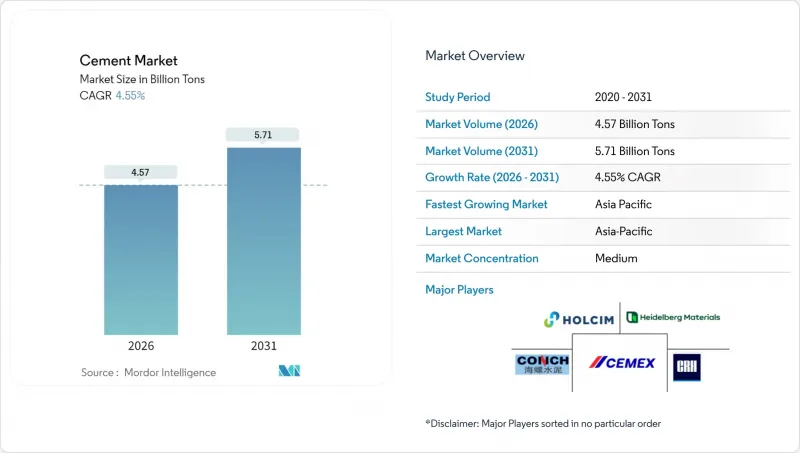
2026년 시멘트 시장 규모는 45억 7,000만 톤으로 추정되고, 2025년 43억 7,000만 톤에서 성장이 전망됩니다.
2031년 예측치는 57억 1,000만 톤으로 2026년부터 2031년까지 CAGR 4.55%로 확대될 전망입니다.
건설업의 회복, 인프라 건설의 진전, 저탄소 결합재로의 전환 가속화가 수요의 핵심을 구성합니다. 조달 부문이 환경, 사회, 거버넌스 요구 사항을 통합하면서 혼합 배합이 수용되고 있으며, 데이터센터 및 물류 시설의 건설이 점진적인 수요를 견인할 것입니다. 생산자는 에너지 가격 변동에 따른 비용 안정화를 위해 킬른 디지털화 및 연료 전환으로 대응합니다. CO2 배출 규제 강화로 인해 클링커 대체가 가속화되고 있으며, 주요 시멘트 시장 전반에 걸쳐 보충 시멘트질 재료가 전략적 투입물로 자리매김하고 있습니다.
세계 시멘트 시장 동향과 인사이트
신흥 아시아-아프리카의 도시화 연동형 인프라 붐
메가시티 계획, 지역 철도 회랑, 대규모 주택 건설 계획은 아시아태평양의 모든 주요 시멘트 시장에서 지속적인 수요를 촉진할 것입니다. 중국의 일대일로 구상은 파트너 국가에 대한 수요를 확대하고, 인도는 GDP의 약 5%에 육박하는 연간 인프라 지출을 유지하며 국내 소비를 뒷받침하고 있습니다. 주택 부족(예: 필리핀의 경우 2028년까지 1,000만 가구의 공급 부족이 예상됨)은 주택 수요를 더욱 확대시킬 것입니다. 아프리카의 도시 성장은 아시아의 선행 사이클을 반영하고 있으며, 가나에서는 가격 규제 프레임워크가 가격 대비 공급의 균형을 맞추고 있습니다. 농촌에서 도시로 이주자 1명당 교통, 주택, 공공시설, 상업시설 등 시멘트를 대량으로 소비하는 자산이 3-4배 증가합니다.
저탄소 공공 인프라에 대한 정부 부양책(포스트 코로나)
포스트 팬데믹 복구 패키지는 프로젝트 사양에 배출량 상한을 포함시켜 선진 시멘트 시장 전체에서 저탄소 대안을 우선시합니다. 미국 초당적 인프라 법은 신규 사업에 5,500억 달러를 할당하고 있으며, 포틀랜드 시멘트 협회는 이 계획으로 5년간 4,600만 톤의 생산량 증가를 예상하고 있습니다. 연방정부의 지원은 공정 혁신에도 적용되며, 에너지부는 세멕스 녹스빌 공장의 탄소회수 시범사업을 지원하고 있습니다. 투자금액 1달러당 3.5달러 이상의 승수효과로 지속적인 수주 파이프라인을 형성하여 혼합시멘트 및 대체연료 제품에 대한 안정적인 수요 창출을 보장합니다.
엄격한 CO2 배출량 제한 및 클링커 대 시멘트 비율
EU 배출권 거래제나 캘리포니아주의 넷제로 의무화와 같은 컴플라이언스 프로그램은 고비용의 가마 개보수를 의무화합니다. 석탄화력발전소 폐쇄에 따라 플라이애시 부족이 심각해지면서 생산자들은 대체 보조재 확보에 어려움을 겪고 있습니다. 내셔널 시멘트가 카본테라볼트와 협력하여 캘리포니아 주 최초의 넷 제로 시설을 건설한 사례는 규제 대응에 따른 자본 부담이 얼마나 큰지 잘 보여주고 있습니다. ISO 14001과 같은 인증 기준은 진입 요건으로 진화하여 자본이 부족한 기업의 진입장벽을 높이고 있습니다.
부문 분석
2025년 출하량에서 혼합 시멘트가 68.45%를 차지하여 부문 수준에서 시멘트 시장 규모의 가장 큰 부분을 차지했습니다. 석회석 기반 배합이 수요 확대를 주도하고 있으며, 상업적 성능과 저탄소화를 동시에 달성하고 있습니다. 일반 포틀랜드 시멘트는 초기 강도가 요구되는 도로 및 프리캐스트 패널에 필수적이지만, 클링커 함량 감소 규제로 인해 점유율이 감소하는 추세입니다. 장식용, 특히 파사드 패널용 화이트 시멘트는 틈새시장을 형성하고 있으며, 튀르키예가 북미로의 주요 수출국이 되었습니다. 섬유 시멘트 보드는 내구성과 내화성으로 인해 주거용 사이딩 시장에 널리 보급되고 있습니다.
투자 동향도 이러한 전환을 뒷받침하고 있습니다. 홀심사가 스위스 내 공장을 대상으로 실시한 2억 7,800만 달러 규모의 설비투자는 대체연료 사용률을 57%에서 85% 이상으로 끌어올리는 것을 목표로 하고 있으며, 환경 성능 강화에 필요한 투자 규모를 보여주고 있습니다. 하이델베르크 머티리얼즈는 가나에 세계 최대 규모의 소성 점토 라인을 확장하여 이 지역에 저탄소 결합재 공급을 실현하고 있습니다. 이러한 움직임은 혼합 시멘트 분야의 예상 CAGR 4.88%를 뒷받침하는 구조적 재편을 강화하여 세계 시멘트 시장에서 선도적인 위치를 확고히 할 것입니다.
시멘트 보고서는 제품 유형(혼합 시멘트, 섬유 시멘트, 일반 포틀랜드 시멘트, 백색 시멘트, 기타), 최종 용도 부문(주거, 상업, 인프라, 산업 및 공공), 지역(아시아태평양, 북미, 유럽, 남미, 중동 및 아프리카) 별로 분류되어 있습니다. 시장 예측은 톤 단위로 제공됩니다.
지역별 분석
아시아태평양은 2025년 생산량의 74.60%를 차지했으며, 이는 아시아태평양이 시멘트 시장의 핵심임을 입증합니다. 중국의 2024년 생산량은 부동산 시장 조정으로 10% 감소했지만, 국유 대기업들은 잉여분을 동남아시아와 아프리카로 수출해 국내 부진을 상쇄했습니다. 인도는 유리한 인구통계와 연방 정부의 자본 지출 계획으로 인한 수주 증가로 인해 성장의 견인차 역할을 하고 있습니다. 베트남, 인도네시아, 태국도 전자제품 제조 유입과 도시 교통 프로젝트에 힘입어 두 자릿수 공장 가동률을 기록하고 있습니다.
중동 및 아프리카는 2031년까지 CAGR 4.92%로 확대되어 세계 시멘트 시장에서 가장 빠른 지역 성장 궤도를 보이고 있습니다. 사우디의 '비전 2030'으로 대표되는 걸프 국가들의 경제 다변화 계획은 대규모 인프라 컨소시엄을 만들어내고 있지만, 주기적인 수출 할당량 축소로 인해 현지 공급이 타이트해지는 국면도 나타나고 있습니다. 아프리카에서의 확장은 시장마다 차이가 있습니다. 가나에서는 소비자 보호를 위해 가격 상한제를 도입한 반면, 케냐에서는 공공사업 자금 흐름에 연동된 주기적 변동이 발생하고 있습니다. 하이델베르크 머티리얼즈는 통합 네트워크를 활용하여 물류의 어려움을 극복하고, 서비스 소외계층의 수요처를 개척하고 있습니다. 북미와 유럽의 소비는 성숙 단계에 있으며, 자산 개보수 계획으로 인해 안정적입니다. 유럽에서는 탄소 가격 책정 및 가마 전기화 프로젝트가 설비 투자를 주도하고 있으며, 다국적 기업들은 공정 최적화를 중심으로 연구개발에 집중하고 있습니다. 호르심(Holcim)이 2025년 300억 달러 이상의 가치를 지닌 암라이즈(Amrise)를 분사하는 것은 북미에서의 수익성과 효율적인 자본 배분에 대한 집중을 강화하는 것을 의미합니다.
기타 특전:
- 엑셀 형식의 시장 예측(ME) 시트
- 애널리스트의 3개월간 지원
자주 묻는 질문
목차
제1장 소개
제2장 조사 방법
제3장 주요 요약
제4장 시장 구도
제5장 시장 규모와 성장 예측
제6장 경쟁 구도
제7장 시장 기회와 향후 전망
KSM 26.03.10Cement market size in 2026 is estimated at 4.57 Billion Tons, growing from 2025 value of 4.37 Billion Tons with 2031 projections showing 5.71 Billion Tons, growing at 4.55% CAGR over 2026-2031.
Construction recovery, infrastructure upgrades, and accelerated shifts toward low-carbon binders form the core demand engine. Blended formulations gain acceptance as procurement teams embed environmental, social, and governance requirements, while data-center and logistics construction spur incremental volumes. Producers respond with kiln digitalization and fuel switching to stabilize costs in a volatile energy landscape. Regulatory tightening on CO2 emissions accelerates clinker substitution, positioning supplementary cementitious materials as strategic inputs across every major cement market.
Global Cement Market Trends and Insights
Urbanization-Linked Infrastructure Boom in Emerging Asia and Africa
Mega-city projects, regional rail corridors, and mass-housing plans push sustained volumes into every major cement market across Asia-Pacific. China's Belt and Road Initiative extends demand into partner nations, while India sustains annual infrastructure spending near 5% of GDP, underpinning domestic consumption. Housing shortfalls, such as the Philippines' projected 10 million-unit backlog by 2028, amplify residential requirements. African urban growth mirrors earlier Asian cycles, with Ghana's price-regulation framework balancing affordability and supply. Each rural-to-urban migrant drives a three-to-four-fold increase in cement-intensive assets spanning transit, housing, utilities, and commercial space.
Government Stimulus for Low-Carbon Public Infrastructure (Post-COVID)
Post-pandemic recovery packages embed emissions ceilings into project specifications, favoring lower-carbon alternatives across developed cement markets. The U.S. Bipartisan Infrastructure Law earmarks USD 550 billion for new works, a program the Portland Cement Association links to a 46 million-ton five-year volume uplift. Federal support extends to process innovation, with the Department of Energy backing carbon-capture pilots at Cemex's Knoxville plant. Multiplier effects above USD 3.5 per dollar invested trigger sustained contractor pipelines, ensuring steady pull-through of blended cement and alternative-fuel output.
Stringent CO2-Emission Caps and Clinker-to-Cement Ratios
Compliance programs such as the EU Emissions Trading System and California's net-zero mandate obligate costly kiln upgrades. Fly-ash scarcity worsens as coal utilities retire, pressing producers to seek alternative supplementary materials. National Cement's partnership with Carbon TerraVault to construct California's first net-zero facility highlights the capital burden attached to regulatory alignment. Certification standards like ISO 14001 evolve into entry requirements, raising barriers for under-capitalized firms.
Other drivers and restraints analyzed in the detailed report include:
- Rising Demand for Blended/Green Cement to Meet Corporate ESG Targets
- Expansion of Ready-Mix Concrete Networks in Tier-2/3 Cities
- Volatile Coal and Pet-Coke Prices Inflating Production Costs
For complete list of drivers and restraints, kindly check the Table Of Contents.
Segment Analysis
Blended cement captured 68.45% of 2025 shipments, underpinning the largest portion of the cement market size at the segment level. Limestone-based formulations drive the uptick, aligning commercial performance with reduced embodied carbon. Ordinary Portland Cement remains vital for early-strength highways and precast panels, yet its share declines as regulations push for lower clinker content. White cement fills decorative niches, particularly for facade panels, with Turkey acting as the primary exporter into North America. Fiber cement boards penetrate residential siding thanks to their durability and fire resistance benefits.
Investment patterns confirm the pivot. Holcim's USD 278 million package across Swiss plants seeks to boost alternative-fuel usage from 57% to above 85%, illustrating the required spend to fortify environmental credentials. Heidelberg Materials is scaling the world's largest calcined clay line in Ghana, providing a regional supply of low-carbon binder. These moves reinforce a structural realignment that supports the blended segment's 4.88% forecast CAGR and consolidates leadership within the global cement market.
The Cement Report is Segmented by Product Type (Blended Cement, Fiber Cement, Ordinary Portland Cement, White Cement, and Other Types), End-Use Sector (Residential, Commercial, Infrastructural, and Industrial and Institutional), and Geography (Asia-Pacific, North America, Europe, South America, and Middle-East and Africa). The Market Forecasts are Provided in Terms of Volume (Tons).
Geography Analysis
Asia-Pacific accounted for 74.60% of 2025 volume, confirming the region's centrality to the cement market. China's 2024 output fell 10% amid property corrections, yet state-owned majors offset domestic softness by exporting surplus to Southeast Asia and Africa. India remains the growth engine as favorable demographics and federal capital-expenditure commitments strengthen order books. Vietnam, Indonesia, and Thailand also report double-digit factory utilization rates, supported by electronics manufacturing inflows and urban transport projects.
The Middle East and Africa advance at a 4.92% CAGR through 2031, the fastest regional trajectory in the global cement market. Gulf diversification plans, typified by Saudi Arabia's Vision 2030, generate large infrastructure consortia, albeit with periodic export quotas tightening local supply. African expansion varies by market; Ghana adopts price caps to protect consumers, while Kenya experiences cyclical volatility linked to public works funding streams. Heidelberg Materials leverages an integrated network to navigate logistic hurdles and capture underserved demand pockets. North American and European consumption is mature yet steadied by asset-refurbishment agendas. In Europe, carbon pricing and kiln electrification projects dominate capex, with multinationals clustering research and development around process optimization. Holcim's 2025 spin-off of Amrize, valued above USD 30 billion, signals a sharpened focus on North American profitability and efficient capital deployment
- Adani Group
- Anhui Conch Cement Co., Ltd.
- BBMG Corporation
- Buzzi S.p.A.
- CEMEX S.A.B. de C.V.
- Cemros
- China National Building Material Group Corporation (CNBM)
- China Resources Building Materials Technology Holdings
- Concreat
- CRH
- Dangote Cement Plc
- Heidelberg Materials
- HOLCIM
- InterCement
- JSW Cement
- OYAK Cement
- SCG
- TCC GROUP HOLDINGS
- UltraTech Cement Ltd
- Vicat
- Votorantim Cimentos
Additional Benefits:
- The market estimate (ME) sheet in Excel format
- 3 months of analyst support
TABLE OF CONTENTS
1 Introduction
- 1.1 Study Assumptions and Market Definition
- 1.2 Scope of the Study
2 Research Methodology
3 Executive Summary
4 Market Landscape
- 4.1 Market Overview
- 4.2 Market Drivers
- 4.2.1 Urbanisation-linked infrastructure boom in emerging Asia and Africa
- 4.2.2 Government stimulus for low-carbon public infrastructure (post-COVID)
- 4.2.3 Rising demand for blended/green cement to meet corporate ESG targets
- 4.2.4 Expansion of ready-mix concrete networks in Tier-2/3 cities
- 4.2.5 3-D concrete-printing creating niche demand for specialised binders
- 4.3 Market Restraints
- 4.3.1 Stringent CO2-emission caps and clinker-to-cement ratios
- 4.3.2 Volatile coal and pet-coke prices inflating production costs
- 4.3.3 Shrinking fly-ash supply as coal plants retire
- 4.4 Value Chain Analysis
- 4.5 Porter's Five Forces
- 4.5.1 Bargaining Power of Suppliers
- 4.5.2 Bargaining Power of Buyers
- 4.5.3 Threat of New Entrants
- 4.5.4 Threat of Substitutes
- 4.5.5 Competitive Rivalry
5 Market Size and Growth Forecasts (Value)
- 5.1 By Product Type
- 5.1.1 Blended Cement
- 5.1.2 Fiber Cement
- 5.1.3 Ordinary Portland Cement
- 5.1.4 White Cement
- 5.1.5 Other Types
- 5.2 By End-Use Sector
- 5.2.1 Residential
- 5.2.2 Commercial
- 5.2.3 Infrastructural
- 5.2.4 Industrial and Institutional
- 5.3 By Geography
- 5.3.1 Asia-Pacific
- 5.3.1.1 China
- 5.3.1.2 India
- 5.3.1.3 Indonesia
- 5.3.1.4 Japan
- 5.3.1.5 Malaysia
- 5.3.1.6 South Korea
- 5.3.1.7 Thailand
- 5.3.1.8 Vietnam
- 5.3.1.9 Australia
- 5.3.1.10 Rest of Asia-Pacific
- 5.3.2 North America
- 5.3.2.1 United States
- 5.3.2.2 Canada
- 5.3.2.3 Mexico
- 5.3.3 Europe
- 5.3.3.1 France
- 5.3.3.2 Germany
- 5.3.3.3 Italy
- 5.3.3.4 Russia
- 5.3.3.5 Spain
- 5.3.3.6 United Kingdom
- 5.3.3.7 Rest of Europe
- 5.3.4 South America
- 5.3.4.1 Brazil
- 5.3.4.2 Argentina
- 5.3.4.3 Rest of South America
- 5.3.5 Middle-East and Africa
- 5.3.5.1 Saudi Arabia
- 5.3.5.2 South Africa
- 5.3.5.3 Rest of Middle-East and Africa
- 5.3.1 Asia-Pacific
6 Competitive Landscape
- 6.1 Market Concentration
- 6.2 Strategic Moves
- 6.3 Market Share (%)/Ranking Analysis
- 6.4 Company Profiles (includes Global level Overview, Market level Overview, Core Segments, Financials as available, Strategic Information, Market Rank/Share for key companies, Products and Services, and Recent Developments)
- 6.4.1 Adani Group
- 6.4.2 Anhui Conch Cement Co., Ltd.
- 6.4.3 BBMG Corporation
- 6.4.4 Buzzi S.p.A.
- 6.4.5 CEMEX S.A.B. de C.V.
- 6.4.6 Cemros
- 6.4.7 China National Building Material Group Corporation (CNBM)
- 6.4.8 China Resources Building Materials Technology Holdings
- 6.4.9 Concreat
- 6.4.10 CRH
- 6.4.11 Dangote Cement Plc
- 6.4.12 Heidelberg Materials
- 6.4.13 HOLCIM
- 6.4.14 InterCement
- 6.4.15 JSW Cement
- 6.4.16 OYAK Cement
- 6.4.17 SCG
- 6.4.18 TCC GROUP HOLDINGS
- 6.4.19 UltraTech Cement Ltd
- 6.4.20 Vicat
- 6.4.21 Votorantim Cimentos
7 Market Opportunities and Future Outlook
- 7.1 White-space and Unmet-Need Assessment
- 7.2 Emerging Sustainable Cement Technologies
- 7.3 Digitalisation and Automation Opportunities


