
|
시장보고서
상품코드
1940798
동남아시아의 디지털 옥외광고(DOOH) : 시장 점유율 분석, 업계 동향과 통계, 성장 예측(2026-2031년)South East Asia Digital Out-of-Home (DooH) - Market Share Analysis, Industry Trends & Statistics, Growth Forecasts (2026 - 2031) |
||||||
 Mordor Intelligence
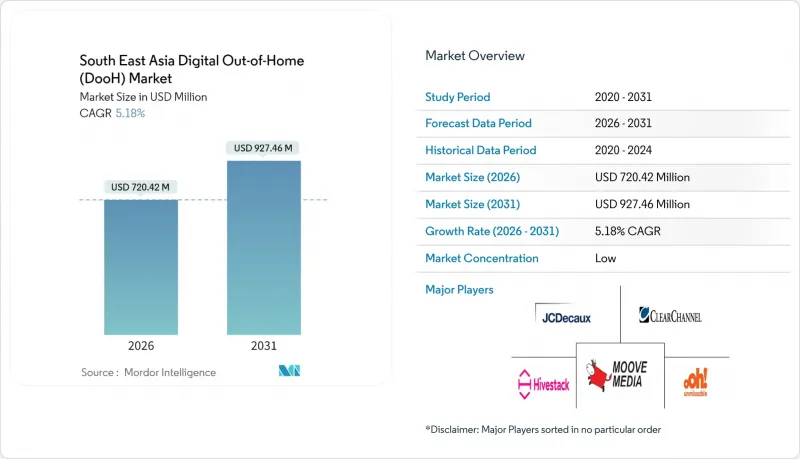
동남아시아의 디지털 옥외광고(DOOH) 시장은 2025년 6억 8,493만 달러에서 2026년에는 7억 2,042만 달러에 이르고, 2026-2031년 CAGR 5.18%로 성장을 지속하여 2031년까지 9억 2,746만 달러에 달할 것으로 예측됩니다.
이러한 성장은 급속한 도시화, 정부의 스마트시티 예산, 슈퍼앱 광고 생태계가 지역 전체에 걸쳐 통합되면서 정적 디스플레이에서 데이터 기반 프로그램 광고 인벤토리로 꾸준히 전환되고 있음을 반영합니다. 대중교통 통근자 수 증가와 함께 쇼핑몰 디지털화 프로젝트 및 소매 미디어 네트워크의 확장으로 프리미엄 스크린 설치 장소가 확대되어 패널당 평균 수익이 증가하고 있습니다. 브랜드 기업들은 이 포맷의 높은 가시성과 구매 경로와의 연관성을 높이 평가하고 있으며, 광고 대행사들은 캠페인 효과를 높이기 위해 동적 크리에이티브에 퍼스트 파티 데이터를 겹겹이 쌓아 올리는 사례가 늘고 있습니다. 경쟁의 핵심은 최고의 설치 장소에 대한 접근성, LED 공급망의 효율성, 그리고 각 사업자가 실시간 최적화 요구 사항을 충족하는 프로그래머틱 파이프를 얼마나 빨리 배포할 수 있는지에 달려 있습니다.
동남아시아의 디지털 옥외광고(DOOH) 시장 동향과 인사이트
급격한 도시화와 교통 허브의 방문객 수 급증
지방에서 대도시권으로의 지속적인 인구 이동으로 대중교통의 일일 승객 수가 증가하고 체류 시간이 길어짐에 따라 집중된 고부가가치 스크린 광고 공간이 창출되고 있습니다. 태국은 105개 도시를 대상으로 한 계획에 따라 2030년까지 1,800억 바트(51억 달러)를 투자하여 교통 터미널의 디지털화를 추진하고 있습니다. 인도네시아 누산타라 계획에서는 신수도를 위한 스마트 인프라 구축이 계획되어 있습니다. 말레이시아 페낭섬에서는 2027년까지 23억 링깃(5억 6,000만 달러)을 투자해 통합형 안내 시스템과 수익배분형 광고 네트워크를 구축합니다. 통근자들은 하루 42.9분을 대중교통 안에서 보내고 있으며, 이 구속 시간이 프리미엄 CPM을 지탱하고 있습니다. 싱가포르의 MRT와 쿠알라룸푸르의 철도 허브에서 디지털 패널의월사용료가 이미 1만 5,000달러를 넘어서고 있어 수익화 잠재력을 입증하고 있습니다.
디지털 사이니지에 대한 정부 주도의 스마트 시티 투자
국가 디지털화 계획은 교통기관, 의료시설, 지자체 시설에 광고 대응 스크린을 설치하고, 미디어 사업자에게 장기적인 양허 계약을 제공합니다. 태국의 디지털 경제 마스터플랜은 새로운 국가 시설에 디지털 사이니지 설치를 의무화하여 규모 확대와 기술 표준화를 촉진하고 있습니다. 인도네시아의 320억 달러 규모의 누산타라 예산에는 개방적이고 프로그래밍 가능한 인터페이스를 중시하는 도시 전역의 IoT 네트워크가 포함되어 있습니다. 말레이시아의 디지털 경제 청사진은 2030년까지 디지털 부문의 GDP 기여도를 25.5%까지 끌어올리기 위해 지방정부에 광고 수익형 인프라 도입을 추진하고 있습니다. 명확한 조달 규칙을 통해 판매 주기를 단축하고, 통일된 기술 사양으로 사업자와 광고주의 통합 비용을 절감할 수 있습니다.
높은 설비 투자 및 지속적인 유지 관리 비용
풀 모션 LED 간판은 많은 초기 투자와 지속적인 유지보수가 필요하며, 수입 채널에 의존하는 소규모 사업자에게는 장벽이 될 수 있습니다. 이자율이 두 자릿수를 넘는 신흥 시장에서는 대출 조건이 여전히 비싸고, 회수 기간이 5년을 초과하는 경우도 적지 않습니다. 또한, 변동하는 환율은 달러로 표시된 부품 비용을 증가시킵니다. 현지 전력 공급, 냉각 설비, 광섬유 연결은 지속적인 비용 부담이 되고, 광고 단가가 낮은 지방 도시에서는 수익률을 압박합니다. 자본 부담이 설비 확장을 제한하고 현대화 주기를 늦추기 때문에 재고 증가가 억제됩니다.
부문 분석
2025년 매출에서 광고판 광고가 차지하는 비중은 34.78%로, 싱가포르의 오차드 로드(Orchard Road), 말레이시아의 연방 고속도로와 같은 간선도로를 따라 대형 포맷을 통한 도달 범위에 대한 브랜드 측의 지속적인 선호를 뒷받침하고 있습니다. 동남아시아의 디지털 옥외광고(DOOH) 시장에서는 정부가 LED 구조물을 도시 경관에 통합함에 따라 간판 형식의 규모가 꾸준히 확대될 것으로 예측됩니다. 그러나 가장 빠른 성장은 3D 아나모픽 사이트에서 발생할 것으로 예상되며, CAGR 6.12%가 예상됩니다. 몰입형 비주얼이 소셜 미디어에서의 확산을 촉진하고, 프리미엄 CPM(노출당 단가)을 정당화하기 때문입니다.
버스쉘터와 가로등 패널을 포함한 스트리트 퍼니처는 길 안내 기능과 광고 프레임을 결합한 스마트시티 정책의 추진으로 예측 가능한 지자체 수입원으로 가치를 높이고 있습니다. 장소 기반 미디어는 여전히 가장 작은 부문이지만, 체류 시간이 긴 공항, 영화관, 의료시설에서 수요가 증가하고 있으며, 시청자 층의 질이 향상되고 있습니다. 샤이닝 등 LED 공급업체들은 버스용 방진 디스플레이와 GPS 지원 타겟팅 기술을 개발하여 노선 기반 수익화를 추진하고 있습니다.
실내 환경은 2025년 39.25%의 점유율을 차지하며 2031년까지 5.68%의 가장 높은 CAGR을 나타낼 것으로 예측됩니다. 쇼핑몰 소유주들은 방문 고객을 광고 수익으로 전환하는 동시에 쇼핑객의 탐색을 강화하기 위해 LCD 비디오월과 엘리베이터 스크린을 후방으로 설치합니다. 싱가포르 창이 공항의 VIOOH 지원 패널은 비행 데이터와 동적 크리에이티브 스케줄링을 결합하여 맥락에 맞는 관련성 높은 메시지를 전달하고 있습니다.
옥외 스크린은 정부 인프라 예산으로 지원되는 도로변 광고판과 교통수단 대기실을 통해 광범위한 도달 범위를 유지하고 있습니다. 통합된 QR 코드와 NFC 태그는 물리적 화면과 모바일 상거래를 연결하여 브랜드가 실시간으로 전환을 측정할 수 있도록 합니다. 실내의 정확성과 실외의 규모를 결합함으로써, 사업자들은 동남아시아의 디지털 옥외광고(DOOH) 시장 전체에서 풀패널 마케팅 목표를 달성할 수 있는 위치에 서게 되었습니다.
기타 특전:
- 엑셀 형식 시장 예측(ME) 시트
- 애널리스트의 3개월간 지원
자주 묻는 질문
목차
제1장 서론
제2장 조사 방법
제3장 주요 요약
제4장 시장 구도
제5장 시장 규모와 성장 예측
제6장 경쟁 구도
제7장 시장 기회와 향후 전망
LSH 26.03.10The South East Asia Digital Out-of-Home market is expected to grow from USD 684.93 million in 2025 to USD 720.42 million in 2026 and is forecast to reach USD 927.46 million by 2031 at 5.18% CAGR over 2026-2031.
This growth reflects the steady migration from static displays toward data-driven, programmatic inventory as rapid urbanization, government smart-city budgets, and super-app advertising ecosystems converge across the region. Rising commuter volumes in mass-transit corridors, coupled with shopping-mall digitization projects and retail-media network rollouts, are expanding premium screen locations and lifting average yields per panel. Brands value the format's high viewability and path-to-purchase relevance, and agencies increasingly layer first-party data onto dynamic creative to improve campaign lift. Competition hinges on access to grade-A locations, LED supply-chain efficiencies, and the speed at which each operator can deploy programmatic pipes that meet real-time optimization demands.
South East Asia Digital Out-of-Home (DooH) Market Trends and Insights
Rapid Urbanization and Transit-Hub Footfall Surge
Continued migration from rural areas to metropolitan corridors raises daily ridership on mass-transit systems, lifting dwell times and creating concentrated, high-value screen real estate. Thailand's 105-city initiative allocates THB 180 billion (USD 5.1 billion) through 2030 to digitize transport terminals, while Indonesia's Nusantara project earmarks smart infrastructure for its new capital. On Penang Island, Malaysia committed MYR 2.3 billion (USD 506 million) through 2027 for integrated way-finding and revenue-share ad networks. Commuters spend 42.9 minutes per day onboard public transport, a captive interval that supports premium CPMs. Singapore's MRT and Kuala Lumpur's rail hubs already price digital panels above USD 15,000 per month, validating the monetization upside.
Government Smart-City Investments in Digital Signage
National digitization plans embed advertising-ready screens into transport, healthcare, and municipal facilities, providing long-term concession contracts for media owners. Thailand's Digital Economy masterplan mandates digital signage in new state buildings, encouraging scale and technical standardization. Indonesia's USD 32 billion Nusantara budget includes city-wide IoT networks that favor open, programmatic interfaces. Malaysia's Digital Economy Blueprint targets a 25.5% GDP contribution from digital sectors by 2030, pushing local councils to adopt ad-funded infrastructure. Clear procurement rules shorten selling cycles, while uniform technical specs reduce integration costs for operators and advertisers.
High Capex and Ongoing Maintenance Costs
Full-motion LED billboards require substantial upfront spend and continual servicing, a hurdle for small operators that rely on syndicated import channels. Financing terms remain expensive in emerging markets where interest rates exceed double digits, stretching payback periods beyond five years. In addition, fluctuating foreign-exchange rates inflate component costs indexed in USD. On-site power, cooling, and fiber connectivity add recurring overhead, squeezing margins in secondary cities where ad rates are lower. The capital burden limits fleet expansion and slows modernization cycles, curbing inventory growth.
Other drivers and restraints analyzed in the detailed report include:
- Explosion of Programmatic DOOH Buying Platforms
- Omnichannel Retail and Consumer-Brand Ad-Spend Uptick
- Fragmented Supply Limiting Unified Measurement
For complete list of drivers and restraints, kindly check the Table Of Contents.
Segment Analysis
Billboards accounted for 34.78% of 2025 revenue, underscoring enduring brand preference for large-format reach along arterial roads such as Singapore's Orchard Road and Malaysia's Federal Highway. The South East Asia Digital Out-of-Home market size for billboard formats is forecast to expand at a steady clip as governments integrate LED structures into urban streetscapes. Yet the fastest acceleration comes from 3D anamorphic sites, projected at a 6.12% CAGR, because immersive visuals drive social-media amplification and justify premium CPMs.
Street furniture, including bus shelters and lamp-post panels, gains from smart-city mandates that bundle way-finding with ad inventory, providing predictable municipal revenue. Place-based media remains the smallest slice but sees rising demand in airports, cinemas, and healthcare facilities where dwell times boost audience quality. LED suppliers like Shining develop anti-vibration bus displays and GPS-enabled targeting to advance route-based monetization.
Indoor environments captured 39.25% share in 2025, and this slice registers the highest 5.68% CAGR through 2031. Shopping-mall owners retrofit LCD videowalls and elevator screens to convert footfall into advertising revenue while enhancing shopper navigation. At Singapore's Changi Airport, VIOOH-enabled panels marry flight data with dynamic creative scheduling, delivering contextually relevant messaging.
Outdoor screens retain broad reach via roadside billboards and transit shelters funded by government infrastructure budgets. Integrated QR codes and NFC tags bridge physical screens to mobile commerce, letting brands measure conversions in real time. The blend of indoor precision and outdoor scale positions operators to serve full-funnel marketing objectives across the South East Asia Digital Out-of-Home market.
The South East Asia Digital Out-Of-Home Market Report is Segmented by Format (Billboards, Street Furniture, Transit, and Place-Based Media), Application (Outdoor DOOH, and Indoor DOOH), End-User Industry (Retail, Automotive, Entertainment and Media, Food and Beverages, Telecom, BFSI, and More), Technology (Programmatic DOOH, and Non-Programmatic DOOH), and Geography. The Market Forecasts are Provided in Terms of Value (USD).
List of Companies Covered in this Report:
- JCDecaux Singapore Pte Ltd
- Clear Channel Singapore Pte Ltd
- oOh!media Limited
- Hivestack Inc.
- Moove Media Pte Ltd
- SPHMBO Pte Ltd (Singapore Press Holdings)
- Vistar Media Inc.
- Talon Outdoor Ltd
- Mediatech Services Pte Ltd
- Daktronics Inc.
- Neosys Documail (S) Pte Ltd
- TAC Media Sdn Bhd
- Moving Walls Pte Ltd
- Pi Interactive Sdn Bhd
- Plan B Media Public Co Ltd
- VGI Public Co Ltd
- Big Tree Outdoor Sdn Bhd
- City Vision Outdoor Advertising PT
- Redberry Media Sdn Bhd
- SEAtronics Inc.
Additional Benefits:
- The market estimate (ME) sheet in Excel format
- 3 months of analyst support
TABLE OF CONTENTS
1 INTRODUCTION
- 1.1 Study Assumptions and Market Definition
- 1.2 Scope of the Study
2 RESEARCH METHODOLOGY
3 EXECUTIVE SUMMARY
4 MARKET LANDSCAPE
- 4.1 Market Overview
- 4.2 Market Drivers
- 4.2.1 Rapid urbanisation and transit-hub footfall surge
- 4.2.2 Government smart-city investments in digital signage
- 4.2.3 Explosion of programmatic DOOH buying platforms
- 4.2.4 Omnichannel retail and consumer-brand ad spend uptick
- 4.2.5 3D anamorphic billboards driving premium inventory
- 4.2.6 Super-app retail-media integration with DOOH
- 4.3 Market Restraints
- 4.3.1 High capex and ongoing maintenance costs
- 4.3.2 Fragmented supply limiting unified measurement
- 4.3.3 Country-specific brightness and content limits
- 4.3.4 Shortage of skilled LED/IoT technicians
- 4.4 Impact of Macroeconomic Factors
- 4.5 Regulatory Landscape
- 4.6 Technological Outlook
- 4.7 Porter's Five Forces Analysis
- 4.7.1 Bargaining Power of Suppliers
- 4.7.2 Bargaining Power of Buyers
- 4.7.3 Threat of New Entrants
- 4.7.4 Threat of Substitutes
- 4.7.5 Intensity of Competitive Rivalry
- 4.8 Industry Ecosystem Analysis
5 MARKET SIZE AND GROWTH FORECASTS (VALUE)
- 5.1 By Format
- 5.1.1 Billboards
- 5.1.2 Street Furniture
- 5.1.3 Transit
- 5.1.4 Place-Based Media
- 5.2 By Application
- 5.2.1 Outdoor DOOH
- 5.2.2 Indoor DOOH
- 5.3 By End-User Industry
- 5.3.1 Retail
- 5.3.2 Automotive
- 5.3.3 Entertainment and Media
- 5.3.4 Food and Beverages
- 5.3.5 Telecom
- 5.3.6 BFSI
- 5.3.7 Other End-User Industries
- 5.4 By Technology
- 5.4.1 Programmatic DOOH
- 5.4.2 Non-programmatic DOOH
- 5.5 By Geography
- 5.5.1 Singapore
- 5.5.2 Malaysia
- 5.5.3 Thailand
- 5.5.4 Indonesia
- 5.5.5 Philippines
- 5.5.6 Vietnam
- 5.5.7 Rest of South-East Asia
6 COMPETITIVE LANDSCAPE
- 6.1 Market Concentration
- 6.2 Strategic Moves
- 6.3 Market Share Analysis
- 6.4 Company Profiles (includes Global level overview, Market level overview, Core segments, Financials as available, Strategic information, Market rank/share, Products and Services, Recent developments)
- 6.4.1 JCDecaux Singapore Pte Ltd
- 6.4.2 Clear Channel Singapore Pte Ltd
- 6.4.3 oOh!media Limited
- 6.4.4 Hivestack Inc.
- 6.4.5 Moove Media Pte Ltd
- 6.4.6 SPHMBO Pte Ltd (Singapore Press Holdings)
- 6.4.7 Vistar Media Inc.
- 6.4.8 Talon Outdoor Ltd
- 6.4.9 Mediatech Services Pte Ltd
- 6.4.10 Daktronics Inc.
- 6.4.11 Neosys Documail (S) Pte Ltd
- 6.4.12 TAC Media Sdn Bhd
- 6.4.13 Moving Walls Pte Ltd
- 6.4.14 Pi Interactive Sdn Bhd
- 6.4.15 Plan B Media Public Co Ltd
- 6.4.16 VGI Public Co Ltd
- 6.4.17 Big Tree Outdoor Sdn Bhd
- 6.4.18 City Vision Outdoor Advertising PT
- 6.4.19 Redberry Media Sdn Bhd
- 6.4.20 SEAtronics Inc.
7 MARKET OPPORTUNITIES AND FUTURE OUTLOOK
- 7.1 White-space and unmet-need assessment